
Social network usage nature fosters youth sense of identity and life satisfaction: A moderated mediation model analysis
Vol.20,No.3(2026)
Wang On Li
 Ching Man Fung
Tak Sang Jason Chow
Kai Ip Danny Leung
Yuet Wah Cheung
Ching Man Fung
Tak Sang Jason Chow
Kai Ip Danny Leung
Yuet Wah Cheung
Adolescents’ use of social networking services or sites (SNSs) exhibits complex associations with users’ identity and life satisfaction. The present study examined how the social and entertainment functions of SNS influence adolescents’ life satisfaction through identity synthesis and identity confusion, potentially moderated by self-esteem. Cross-sectional data from 1,817 adolescents were analyzed using the Social Networking Activity Intensity Scale (SNAIS), the Erikson Psychosocial Stage Inventory (EPSI), the Satisfaction with Life Scale (SWLS), and the Rosenberg Self-esteem Scale (RSES). Mediation analyses revealed a dual pathway: both the social and entertainment functions of SNS facilitated the youths’ identity synthesis, indirectly enhancing their life satisfaction. However, moderated mediation analyses showed that their self-esteem influenced the effect of social function use on identity confusion, among adolescents with low self-esteem. Alternative models were tested and supported the view that self-esteem functions as a buffer against the adverse effects of SNS use on identity, rather than directly influencing SNS use intensity. The study advances a model integrating functional and motivational dimensions to explain the divergent psychosocial outcomes of SNS use, mediated by identity development, with detrimental effects concentrated among adolescents with low self-esteem. The findings suggest that tailored interventions promoting mindful social engagement may support identity synthesis and mitigate identity confusion among vulnerable individuals. Future research should employ multidimensional and longitudinal designs to disentangle the behavioral and motivational aspects of SNS use and clarify the temporal dynamics of identity development.
social networking services usage; SNS usage; adolescents' life satisfaction; identity synthesis; identity confusion; self-esteem
Wang On Li
Department of Counselling and Psychology, Hong Kong Shue Yan University
Wang On Li is an Associate Professor of the Department of Counselling and Psychology, Hong Kong Shue Yan University. His primary interests are cognition and emotion.
Ching Man Fung
Department of Counselling and Psychology, Hong Kong Shue Yan University
Ching Man Fung is a professional counseling psychologist with her expertise in youth development.
Tak Sang Jason Chow
Department of Counselling and Psychology, Hong Kong Shue Yan University
Tak Sang Jason Chow is an Associate Professor of the Department of Counselling and Psychology, Hong Kong Shue Yan University. His primary interests are self-control, motivation, and resilience.
Kai Ip Danny Leung
Department of Journal and Communication, Hong Kong Shue Yan University
Kai Ip Danny Leung’s primary interest is how digital platforms have changed the traditional mass media and youth development.
Yuet Wah Cheung
Department of Sociology, Hong Kong Shue Yan University
Yuet-Wah Cheung is a Professor of the Department of Sociology, Hong Kong Shue Yan University. His primary interests are youth development and deviant behaviors.
Appel, M., Schreiner, C., Weber, S., Mara, M., & Gnambs, T. (2018). Intensity of Facebook use is associated with lower self-concept clarity: Cross-sectional and longitudinal evidence. Journal of Media Psychology: Theories, Methods, and Applications, 30(3), 160–172. https://doi.org/10.1027/1864-1105/a000192
Beer, J. S. (2014). Exaggerated positivity in self-evaluation: A social neuroscience approach to reconciling the role of self-esteem protection and cognitive bias. Social and Personality Psychology Compass, 8(10), 583–594. https://doi.org/10.1111/spc3.12133
Becht, A. I., Luyckx, K., Nelemans, S. A., Goosens, L., Branje, S. J. T., Vollebergh, W. A. M., & Meeus, W. H. J. (2019). Linking Identity and depressive symptoms across adolescence: A multisample longitudinal study testing within-person effect. Developmental Psychology, 55(8), 1722–1742. https://doi.org/10.1037/dev0000742
Best, P., Manktelow, R., & Taylor, B. (2014). Online communication, social media and adolescent wellbeing: A systematic narrative review. Child Youth Services Review, 41, 27–36. http://doi.org/10.1016/j.childyouth.2014.03.001
Blais, J. J., Craig, W. M., Pepler, D., & Connolly, J. (2008). Adolescents online: The importance of internet activity choices to salient relationships. Journal of Youth and Adolescence, 37(5), 522–536. https://doi.org/10.1007/s10964-007-9262-7
Blanton, H. (2001). Evaluating the self in the context of another: The three-selves model of social comparison assimilation and contrast. In G. B. Moskowitz (Ed.), Cognitive social psychology: The Princeton symposium on the legacy and future of social cognition (pp. 75–87). Psychology Press. https://doi.org/10.4324/9781410605887
Bogaerts, A., Claes, L., Buelens, T., Verschueren, M., Palmeroni, N., Bastiaens, T., & Luyckx, K. (2021). Identity synthesis and confusion in early to late adolescents: Age trends, gender differences, and associations with depressive symptoms. Journal of Adolescence, 87(1), 106–116. https://doi.org/10.1016/j.adolescence.2021.01.006
Booker, C. L., Skew, A. J., Kelly, Y. J., & Sacker, A. (2015). Media use, participation, and well-being in adolescence: Cross-sectional findings from the UK household longitudinal study. American Journal of Public Health, 105(1), 173–179. http://doi.org/10.2105/AJPH.2013.301783
Branje, S., de Moor, E. L., Spitzer, J., & Becht, A. I. (2021). Dynamics of identity development in adolescence: A decade in review. Journal of Research on Adolescence, 31(4), 908–927. https://doi.org/10.1111/jora.12678
Burrow, A., L., & Rainone, N. (2017). How many likes did I get?: Purpose moderates links between positive social media feedback and self-esteem. Journal of Experimental Social Psychology, 69, 232–236. https://doi.org/10.1016/j.jesp.2016.09.005
Campbell, J. D. (1990). Self-esteem and clarity of the self-concept. Journal of Personality and Social Psychology, 59(3), 538–549. http://doi.org/10.1037/0022-3514.59.3.538
Campbell, J. D., Trapnell, P. D., Heine, S. J., Katz, I. M., Lavallee, L. F., & Lehman, D. R. (1996). Self-concept clarity: Measurement, personality correlates, and cultural boundaries. Journal of Personality and Social Psychology, 70(1), 141–156. https://doi.org/10.1037/0022-3514.70.1.141
Cast, A. D., & Burke, P. J. (2002). A theory of self-esteem. Social Forces, 80(3), 1041–1068. https://doi.org/10.1353/sof.2002.0003
Chaabane, S., Doraiswamy, S., Chaabna, K., Mamtani, R., & Cheema, S. (2021). The impact of COVID-19 school closure on child and adolescent health: A rapid systematic review. Children, 8(5), Article 415. https://doi.org/10.3390/children8050415
Chui, W. H., & Wong, M. Y. H. (2016). Gender differences in happiness and life satisfaction among adolescents in Hong Kong: Relationships and self-concept. Social Indicators Research, 125(3), 1035–1051. https://doi.org/10.1007/s11205-015-0867-z
Collins, R. L. (1996). For better or worse: The impact of upward social comparison on self-evaluations. Psychological Bulletin, 119(1), 51–69. https://doi.org/10.1037/0033-2909.119.1.51
Coopersmith, S. (1967). The antecedents of self-esteem. Freeman and Company.
Cote, J. E. (2009). Identity formation and self-development in adolescence. In In R. M. Lerner & L. Steinberg (Eds.), Handbook of adolescent psychology (3rd ed., pp. 26–304). John Wiley & Sons. https://doi.org/10.1002/9780470479193.adlpsy001010
Cote, J. E. (2015). Identity formation, youth, and development: A simplified approach (1st ed.). Psychology Press. https://doi.org/10.4324/9780203767047
Course-Choi, J., & Hammond, L. (2021). Social media use and adolescent well-being: A narrative review of longitudinal studies. Cyberpsychology, Behavior, and Social Networking, 24(4), 223–236. https://doi.org/10.1089/cyber.2020.0020
Crocetti, E., Rubini, M., & Meeus, W. (2008). Capturing the dynamics of identity formation in various ethnic groups: Development and validation of a three-dimensional model. Journal of Adolescence, 31(2), 207–222. https://doi.org/10.1016/j.adolescence.2007.09.002
Davis, K. (2013). Young people’s digital lives: The impact of interpersonal relationships and digital media use on adolescents’ sense of identity. Computers in Human Behaviors, 29(6), 2281–2293. https://doi.org/10.1016/j.chb.2013.05.022
Deci, E. L., & Ryan, R. M. (2000). The “what” and “why” of goal pursuits: Human needs and the self-determination of behaviour. Psychological Inquiry, 11(4), 277–268. https://doi.org/10.1207/S15327965PLI1104_01
Desjarlais, M. (2022). The socially poor get richer, the rich get poorer: The effect of online self-disclosure on social connectedness and well-being is conditional on social anxiety and audience size. Cyberpsychology: Journal of Psychosocial Research on Cyberspace, 16(4), Article 4. http://doi.org/10.5817/CP2022-4-4
Diener, E., Emmons, R. A., Larsen, R. J., & Griffin, S. (1985). The Satisfaction With Life Scale. Journal of Personality Assessment, 49(1), 71–75. https://doi.org/10.1207/s15327752jpa4901_13
Dredge, R., Gleeson, J. F. M., & de la Piedad Gracia, X. (2014). Risk factors associated with impact severity of cyberbullying victimization: A qualitative study of adolescent online social networking. Cyberpsychology, Behaviour, and Social Networking, 17(5), 287–291. https://doi.org/10.1089/cyber.2013.0541
Eraslan-Capan, B. (2015). Interpersonal sensitivity and problematic Facebook use in Turkish university students. The Anthropologist, 21(3), 395–403. http://doi.org/10.1080/09720073.2015.11891829
Erikson, E. H. (1968). Identity, youth and crisis. Norton.
Granic, I., Morita, H., & Scholten, H. (2020). Beyond screen time: Identity development in the digital age, Psychological Inquiry, 31(3), 195–223. https://doi.org/10.1080/1047840X.2020.1820214
Hamilton, J. L., Nesi, J., & Choukas-Bradley, S. (2022). Reexamining social media and socioemotional well-being among adolescents through the lens of the COVID-19 pandemic: A theoretical review and directions for future research. Perspectives on Psychological Science, 17(3), 662–679. https://doi.org/10.1177/17456916211014189
Handschuh, P., Kroh, J., & Nester, M. (2024). The effect of the COVID-19 pandemic on life satisfaction: Does social belonging matter as a mechanism and are there differences by age? Journal of Happiness Studies, 25(8), Article 114. https://doi.org/10.1007/s10902-024-00823-x
Hatano, K., Hihara, S., Nakama, R., Tsuzuki, M., Mizokami, S., & Sugimura, K. (2022). Trajectories in sense of identity and relationship with life satisfaction during adolescence and young adulthood. Developmental Psychology, 58(5), 977–989. https://doi.org/10.1037/dev0001326
Hayes, A. F. (2013). Introduction to mediation, moderation, and conditional process analysis: A regression-based approach. Guilford Press.
Hong, F.-Y., Huang, D.-H., Lin, H.-Y., & Chiu, S.-L. (2014). Analysis of the psychological traits, Facebook usage, and Facebook addiction model of Taiwanese university students. Telematics and Informatics, 31(4), 597–606. https://doi.org/10.1016/j.tele.2014.01.001
Hui, B. P. H., Au, A. K. Y., Ng, J. K. N., & Song, X. (2023). From social networking site use to subjective well-being: The interpersonal and intrapersonal mediating pathways of prosocial behavior among vocational college students in China. International Journal of Environmental Research and Public Health, 20(1), Article 100. https://doi.org/10.3390/ijerph20010100
Kraut, R., Kielser, S., Boneva, B., Cummings, J. N., Helgeson, V., & Crawfords, A. M. (2002). Internet paradox revisited. Journal of Social Issues, 58(1), 49–74. https://doi.org/10.1111/1540-4560.00248
Kroger, J. (2006). Identity development: Adolescence through adulthood (2nd ed.). Sage Publications.
Kumar, N. (2025, September 17). Average time spent on social media [2025 statistics]. Demandsage. https://web.archive.org/web/20250926010544/https://www.demandsage.com/average-time-spent-on-social-media/
Leary, M. R., & Baumeister, R. F. (2000). The nature and function of self-esteem: Sociometer theory. Advances in Experimental Social Psychology, 32, 1–62. https://doi.org/10.1016/s0065-2601(00)80003-9
Li, J., Lau, J. T. F., Mo, P. K. H., Su, X., Wu, A. M. S., Tang, J., & Qin, Z. (2016). Validation of the Social Networking Activity Intensity Scale among junior middle school students in China. PLoS ONE, 11(10), Article e0165695. https://doi.org/10.1371/journal.pone.0165695
Lin, S. Liu, D., Liu, W., Hui, Q., Cortina, K. S., & You, X. (2021). Mediating effects of self-concept clarity on the relationship between social network sites use and subjective well-being. Current Psychology, 40(3), 1348–1355. http://doi.org/10.1007/s12144-018-0066-6
Liu, Q., Niu, G., Fan, C., & Zhou, Z. (2017). Passive use of social network site and its relationships with self-esteem and self-concept clarity: A moderated mediation analysis. Acta Psychologica Sinica, 49(1), 60–71. https://doi.org/10.3724/SP.J.1041.2017.00060
Longmore, M. A., & Demaris, A. (1997). Perceived inequity and depression in intimate relationships: The moderating effect of self-esteem. Social Psychology Quarterly, 60(2), 172–184. https://doi.org/10.2307/2787103
Lu, H., Yang, J., Zhao, K., Jin, Z., Wen, X., Hu, N., Yang, H., Sun, Z., Chen, H., Huang, Y., Wang, D. B., & Wu, Y. (2024). Perceived risk of COVID-19 hurts mental health: The mediating role of fear of COVID-19 and the moderating role of resilience. BMC psychiatry, 24(1), Article 58. https://doi.org/10.1186/s12888-024-05511-x
Mannerström, R., Hietajarvi, L., Moutka, J., & Salmela-Aro, K. (2018). Identity profiles and digital engagement among Finnish high school students. Cyberpsychology: Journal of Psychosocial Research on Cyberspace, 12(1), Article 2. https://doi.org/10.5817/CP2018-1-2
Marcia, J. E. (1966). Development and validation of ego-identity status. Journal of Personality and Social Psychology, 3(5), 551–558. https://doi.org/10.1037/h0023281
Marcia, J. E. (1980). Identity in adolescence. In J. Adelson (Ed.), Handbook of adolescent psychology (pp. 109–137). John Wiley & Sons.
Marcia, J. E. (2002). Identity and psychosocial development in adulthood. Identity: An International Journal of Theory and Research, 2(1), 7–28, https://doi.org/10.1207/S1532706XID0201_02
Marciano, L., Ostroumova, M., Schulz, P. J., & Camerini, A.-L. (2022). Digital media use and adolescents’ mental health during the Covid-19 pandemic: A systematic review and meta-analysis. Frontiers in Public Health, 9, Article 793868. https://doi.org/10.3389/fpubh.2021.793868
Marino, C., Gini, G., Vieno, A., & Spada, M. M. (2018). A comprehensive meta-analysis on problematic Facebook use. Computers in Human Behaviour, 83, 262–277. https://doi.org/10.1016/j.chb.2018.02.009
Matsuba, M. K. (2006). Searching for self and relationships online. Cyberpsychology, Behavior, and Social Networking , 9(3), 275–284. https://doi.org/10.1089/cpb.2006.9.275
Meier, A., & Krause, H.-V. (2023). Does passive social media use harm well-being? Journal of Media Psychology, 35(3), 169–180. https://doi.org/10.1027/1864-1105/a000358
Meier, A., & Reinecke, L. (2021). Computer-mediated communication, social media, and mental health: A conceptual and empirical meta review. Communication Research, 48(8), 1182–1209. https://doi.org/10.1177/0093650220958224
Meng, S., Kong, F., Dong, W., Zhang, Y., Yu, T., & Jin, W. (2023). Mobile social media use and life satisfaction among adolescents: A moderated mediation model. Frontiers in Public Health, 11, Article 1117745. https://doi.org/10.3389/fpubh.2023.1117745
Michikyan, M., Dennis, J., & Subrahamanyam, K. (2015). Can you guess who I am? Real, ideal, and false self-presentation on Facebook among emerging adults. Emerging Adulthood, 3(1), 55–64. https://doi.org/10.1177/2167696814532442
Michikyan, M., Subrahmanyam, K., Regan, P., Bessaha, M., Bartholomew, J., Cano, M. A., Meca, A., & Schwartz, S. J. (2024). Identity distress, confusion, synthesis, and social media use of for coping: Implications for identity development. Identity, 25(3), 392–411. http://doi.org/10.1080/15283488.2024.2379411
Nesi, J., Telzer, E. H., & Prinstein, M. J. (2020). Adolescent development in the digital media context. Psychological Inquiry, 31(3), 229–234. https://doi.org/10.1080/1047840X.2020.1820219
Nezlek, J. B., & Plesko, R. M. (2001). Day-to-day relationships among self-concept clarity, self-esteem, daily events, and mood. Personality and Social Psychology Bulletin, 27(2), 201–211. https://doi.org/10.1177/0146167201272006
Nikcevic, A. V., Marino, C., Kolubinski, D. C., Leach, D., & Spada, M. M. (2021). Modelling the contribution of the Big Five personality traits, health anxiety, and COVID-19 psychological distress to generalised anxiety and depressive symptoms during the COVID-19 pandemic. Journal of Affective Disorders, 279, 578–584. https://doi.org/10.1016/j.jad.2020.10.053
Niu, G.-F., Luo, Y.-j., Sun, X.-j., Zhou, Z.-k., Yu, F., Yang, S.-L., & Zhao, L. (2018). Qzone use and depression among Chinese adolescents: A moderated mediation model. Journal of Affective Disorders, 231, 58–62. https://doi.org/10.1016/j.jad.2018.01.013
Orben, A., Dienlin, T., & Przbylski, A. K. (2019). Social media’s enduring effect on adolescent life satisfaction. Proceedings of the National Academy of Sciences of the United States of America, 116(21), 10226–10228. https://doi.org/10.1073/pnas.1902058116
Ozimek, P., Brailovskaia, J., Bierhoff, H.-W. (2023). Active and passive behaviour in social media: Validating the social media activity questionnaire (SMAQ). Telematics and Informatics Reports, 10, Article 100048. https://doi.org/10.1016/j.teler.2023.100048
Patchin, J. W., & Hinduja, S. (2017). Digital self-harm among adolescents. Journal of Adolescent Health, 61(6), 761–766. https://doi.org/10.1016/j.jadohealth.2017.06.012
Pearline, L. I., & Schooler, C. (1978). The structure of coping. Journal of Health and Social Behaviour, 19(1), 2–21. https://doi.org/10.2307/2136319
Raiziene, S., Erentaite, R., Pakalniskiene, V., Grigutyte, N., & Crocetti, E. (2022). Identity formation patterns and online activities in adolescence. Identity, 22(2), 150–165. https://doi.org/10.1080/15283488.2021.1960839
Rosenberg, M. (1965). Society and the adolescent self-image. Princeton University Press.
Rosenberg, M. (1979). Conceiving the self. Basic Books.
Rosenberg, M., Schooler, C., Schoenbach, C., & Rosenberg, F. (1995). Global self-esteem and specific self-esteem: Different concepts, different outcomes. American Sociological Review, 60(1), 141–156. http://doi.org/10.2307/2096350
Rosenthal, D. A., Gurney, R. M., & Moore, S. (1981). From trust on intimacy: A new inventory for examining Erikson’s stages of psychosocial development. Journal of Youth and Adolescence, 10(6), 525–537. https://doi.org/10.1007/bf02087944
Rothwell, J. (2023, October 13). Teens spend average of 4.8 hours on social media per day. Gallup. https://news.gallup.com/poll/512576/teens-spend-average-hours-social-media-per-day.aspx
Saiphoo, A. N., Halevi, L. D., & Vahedi, Z. (2020). Social networking site use and self-esteem: A meta-analytic review. Personality and Individual Differences, 153, Article 109639. https://doi.org/10.1016/j.paid.2019.109639
Schlenker, B. R., Weigold, M. F., & Hallam, J. R. (1990). Self-serving attributions in social context: Effects of self-esteem and social pressure. Journal of Personality and Social Psychology, 58(5), 855–863. https://doi.org/10.1037/0022-3514.58.5.855
Schwartz, S. J. (2001). The evolution of Eriksonian and Neo-Eriksonian identity theory and research: A review and integration. Identity, 1(1), 7–58. https://doi.org/10.1207/S1532706XSCHWARTZ
Schwartz, S. J. (2007). The structure of identity consolidation: Multiple correlated constructs or one superordinate construct? Identity, 7(1), 27–49. https://doi.org/10.1080/15283480701319583
Schwartz, S. J., Zamboanga, B. L., Wang, W., & Olthuis, J. V. (2009). Measuring identity from an Eriksonian perspective: Two sides of the same coin? Journal of Personality Assessment, 91(2), 143–154. https://doi.org/10.1080/00223890802634266
Schwartz, S. J., Klimstra, T. A., Luyckx, K., Hale, W. W., Frijns, T., Oosterwegel, A., van Lier, P. A. C., Koot, H. M., & Meeus, W. H. J. (2011). Daily dynamics of personal identity and self-concept clarity. European Journal of Personality, 25(5), 373–385. https://doi.org/10.1002/per.798
Schwartz, S. J., Hardy, S. A., Zamboanga, B. L., Meca, A., Waterman, A. S., Picariello, S., Luyckx, K., Crocetti, E., Kim, S. Y., Brittian, A. S., Roberts, S. E., Whitbourne, S. K., Ritchie, R. A., Brown, E. J., & Forthun, L. F. (2015). Identity in young adulthood: Links with mental health and risky behavior. Journal of Applied Developmental Psychology, 36, 39–52. https://doi.org/10.1016/j.appdev.2014.10.001
Sebre, S. B., & Miltuze, A. (2021). Digital media as a medium for adolescent identity development. Technology, Knowledge and Learning, 26(4), 867–881. https://doi.org/10.1007/s10758-021-09499-1
Steinfield, C., Ellison, N. B., & Lampe, C. (2008). Social capital, self-esteem, and use of online social network sites: A longitudinal analysis. Journal of Applied Developmental Psychology, 29(6), 434–445. https://doi.org/10.1016/j.appdev.2008.07.002
Sugimura, K., Hihara, S., Hatano, K., Nakama, R., Saiga, S. & Tsuzuki, M. (2022). Profiles of emotional separation and parental trust from adolescence to emerging adulthood: Age differences and associations with identity and life satisfaction. Journal of Youth and Adolescence, 52(3), 475-489. https://doi.org/10.1007/s10964-022-01716-z
Sugimura, K., & Mizokami, S. (2012). Personal identity in Japan. New Directions for Child and Adolescent Development, 2012(138), 123–143. https://doi.org/10.1002/cad.20025
Teng, F., & Chen, Z., (2012). Does social support reduce distress caused by ostracism? It depends on the level of one’s self-esteem. Journal of Experimental Social Psychology, 48(5), 1192–1195. https://doi.org/10.1016/j.jesp.2012.03.014
Tesser, A. (1988). Toward a self-evaluation maintenance model of social behaviour. Advances in Experimental Social Psychology, 21, 181–227. https://doi.org/10.1016/S0065-2601(08)60227-0
Twenge, J. M., Martin, G. N., & Campbell, W. K. (2018). Decreases in psychological well-being among American adolescents after 2012 and links to screen time during the rise of smartphone technology. Emotion, 18(6), 765–780. https://doi.org/10.1037/emo0000403
Valkenburg, P. M., Beyens, I., Pouwels, J. L., van Driel, I. I., & Keijsers, L. (2021). Social media browsing and adolescent well-being: Challenging the “passive social media use hypothesis.” Journal of Computer-Mediated Communication, 27(1), Article zmab015. https://doi.org/10.1093/jcmc/zmab015
Valkenburg, P. M., Koutamanis, M., & Vossen, H. G. (2017). The concurrent and longitudinal relationships between adolescents’ use of social network sites and their social self-esteem. Computers in Human Behavior, 76, 35–41. https://doi.org/10.1016/j.chb.2017.07.008
Valkenburg, P. M., & Peter, J. (2007). Preadolescents’ and adolescents’ online communication and their closeness to friends. Developmental Psychology, 43(2), 267–277. https://doi.org/10.1037/0012-1649.43.2.267
Valkenburg, P. M., & Peter, J. (2008). Adolescents’ identity experiments on the internet: Consequences for social competence and self-concept unity. Communication Research, 35(2), 208–231. https://doi.org/10.1177/0093650207313164
Valkenburg, P. M., & Peter, J. (2011). Online communication among adolescents: An integrated model of its attraction, opportunities, and risks. Journal of Adolescent Health, 48(2), 121–127. https://doi.org/10.1016/j.jadohealth.2010.08.020
Verduyn, P., Gugushvili, N., & Kross, E. (2022). Do social networking sites influence well-being? The extended active-passive model. Current Directions in Psychological Science, 31(1), 62–68. https://doi.org/10.1177/09637214211053637
Verduyn, P., Gugushvili, N., & Massar, K., Taht, K., & Kross, E. (2020). Social comparison on social networking sites. Current Opinion in Psychology, 36, 32–37. https://doi.org/10.1016/j.copsyc.2020.04.002
Verduyn, P., Ybarra, O., Resibois, M., Jonides, J., & Kross, E. (2017). Do social network sites enhance or undermine subjective well-being? A critical review. Social Issues and Policy Review, 11(1), 274–302. https://doi.org/10.1111/sipr.12033
Viner, R., Russell, S., Saulle, R., Croker, H., Stansfeld, C., Packer, J., Nicholls, D., Goddings, A.-L., Bonell, C., Hudson, L., Hope, S., Schwalbe, N., Morgan, A., & Minozzi, S. (2021). Impacts of school closures on physical and mental health of children and young people: A systematic review. [Preprint.] medRxiv. https://doi.org/10.1101/2021.02.10.21251526
Vogel, E. A., Rose, J. P., Okdie, B. M., Eckles, K., & Franz, B. (2015). Who compares and despairs? The effect of social comparison orientation on social media use and its outcomes. Personality and Individual Differences, 86, 249–256. https://doi.org/10.1016/j.paid.2015.06.026
Vogel, E. A., Rose, J. P., Roberts, L. R., & Eckles, K. (2014). Social comparison, social media, and self-esteem. Psychology of Popular Media Culture, 3(4), 206–222. https://doi.org/10.1037/ppm0000047
Vohs, K. D., & Heatherton, T. F. (2004). Ego threat elicits different social comparison processes among high and low self-esteem people: Implications for interpersonal perceptions. Social Cognition, 22(1), 168–191. https://doi.org/10.1521/soco.22.1.168.30983
Volmer, J. (2015). Followers‘ daily reactions to social conflicts with supervisors: The moderating role of core self-evaluations and procedural justice perceptions. Leadership Quarterly, 26(5), 719–731. https://doi.org/10.1016/j.leaqua.2015.01.005
Webster, D., Dunne, L., & Hunter, R. (2021). Association between social networks and subjective well-being in adolescents: A systematic review. Youth & Society, 53(2). 175–210. https://doi.org/10.1177/0044118X20919589
Wu, W., Huang, L., & Yang, F. (2024). Social anxiety and problematic social media use: A systematic review and meta-analysis. Addictive Behaviors, 153, Article 107995. https://doi.org/10.1016/j.addbeh.2024.107995
Wu, Y., Yin, G., & Zhang, Y. (2022). Experience and perceptions of Chinese university students regarding the COVID-19 pandemic: A qualitative analysis. Frontiers in Public Health, 10, Article 872847. https://doi.org/10.3389/fpubh.2022.872847
Yang, Q., van den Bos, K., Zhang, X., Adams, S., & Ybarra, O. (2022). Identity lost and found: Self-concept clarity in social network site contexts. Self and Identity, 21(4), 406–429. https://doi.org/10.1080/15298868.2021.1940270
Zeigler-Hill, V., Madson, M. B., & Ricedorf, A. (2012). Does self-esteem moderate the associations between protective behavoural strategies and negative outcomes associated with alcohol consumption? Journal of Drug Education: Substance Use Research and Prevention, 42(2), 211–227. https://doi.org/10.2190/DE.42.2.f
Authors' Contribution
Wang On Li: conceptualization, data curation, formal analysis, funding acquisition, methodology, supervision, validation, writing—original draft, writing—review & editing. Ching Man Fung: conceptualization, data curation, formal analysis, visualization, writing—original draft, writing—review & editing. Tak Sang Jason Chow: conceptualization, formal analysis, methodology, writing—review & editing. Kai Ip Danny Leung: conceptualization, methodology, writing—review & editing. Yuet-Wah Cheung: conceptualization, funding acquisition, methodology, project administration, resources, supervision, validation, writing—review & editing.
Editorial Record
First submission received:
April 3, 2024
Revisions received:
May 23, 2025
November 24, 2025
April 19, 2026
Accepted for publication:
May 27, 2026
Editor in charge:
Alexander P. Schouten
Introduction
Background Information and Literature Review
The impact of Social Networking Services (SNSs) on young people’s life satisfaction and psychological well-being has been debated since the services’ introduction. Early research raised concerns that SNS might displace in-person activities—such as sports and social gatherings—that are known to bolster one’s well-being and warned that online interactions with strangers or excessive entertainment use could pose additional risks (Blais et al., 2008; Booker et al., 2015; Twenge et al., 2018). Nonetheless, the COVID-19 pandemic marked a dramatic and enduring transformation in SNS engagement, particularly among youths, and the increase of SNS usage during the pandemic has proven to be long-lasting. The increased reliance on digital technology allowed for continuous social connection, which facilitated identity exploration and synthesis, contributing to enhanced life satisfaction in some cases (Handschuh et al., 2024; Wu et al., 2022). Yet the reduced physical social interactions and increased screen time also lead to heightened anxiety and reduced life satisfaction (Lu et al., 2024, Wu et al., 2024; Nikcevic et al., 2021). As the world transitions into the post-pandemic era, these digital interactions have left a lasting imprint on adolescent identity development. Gallup reports that U.S. teenagers spent an average of 4.8 hours daily solely on social media platforms in 2023, compared with 3.9 hours on all activities on smartphones and tablets in 2014, when similar data on social media were unavailable (Rothwell, 2023). Despite the gradual resumption of in-person activities post-pandemic, usage rates have not reverted to pre-pandemic levels, thus suggesting that these behavioral changes are likely to be persistent features of youths’ social life (Kumar, 2025). The pandemic thus intensified and cemented SNS as a primary locus for young people’s connection, self-expression, and entertainment, with long-term implications for their well-being and identity development. Subsequent meta-analyses have revealed that while overall associations between SNS use and mental health remain modest when measured broadly (Course-Choi & Hammon, 2021; Meier & Reinecke, 2021; Webster et al., 2021), pandemic-era studies such as the work of Marciano et al. (2022) found that elevated usage correlated with increased ill-being, except when SNSs were used to maintain friends’ connections, or for constructive entertainment.
There is a growing consensus that a single unified measurement of SNS usage does not provide a coherent conclusion of its effects on well-being. Several studies have divided usage into active and passive categories (see Meier & Krause, 2023; Verduyn et al., 2017, 2022). Active usage involves activities such as content creation, direct communication (e.g., posting, commenting), and intentional self-presentation, whereas passive usage involves viewing content on SNS without engaging in communication with others. When people use SNS passively, they merely browse the content on what others have posted (Ozimek et al., 2023; Verduyn et al., 2022). It has been suggested that while passive use may increase the chance of upward social comparisons, and because information on SNS generally is biased, using online information for social comparisons may negatively affect one’s well-being (Verduyn et al., 2020; Vogel et al., 2015). There is, however, growing evidence that this division of active and passive usage is not sufficient to explain the mixed results that have been produced in the field (Verdurn et al., 2022). For instance, Valkenburg et al. (2021) argued that "passive" consumption (e.g., browsing) actually involves active cognitive processes, such as information selection, processing, and interpretation. These arguments prompt a reconsideration of the decomposition of types of usage and the inclusion of users’ characteristics.
Whereas the active versus passive dichotomy captures engagement patterns in SNS usage, the social-entertainment function framework offers an alternative perspective for studying the rise of SNS for personal amusement (Hui et al., 2023). That framework originated from Li et al. (2016), who developed the Social Networking Activity Intensity Scale (SNAIS) for Chinese school students. The SNAIS identifies two distinct functions: Social Function Use Intensity (SFUI), which measures the use of SNS features to build and maintain interpersonal relationships, and Entertainment Function Use Intensity (EFUI), which measures SNS use for personal amusement, such as watching videos, gaming, buying or giving virtual goods, and browsing content (Li et al., 2016).
Crucially, the SNAIS framework provides an alternative framework to the active-passive model. For instance, the SFUI comprises both active behaviors (e.g., posting photos) and passive behaviors (e.g., browsing relatives’ profiles), because both serve social functions and facilitate social connections. Furthermore, the SNAIS includes common activities, such as gaming and instant messaging, which are not captured by the active-passive dichotomy.
The distinction between social and entertainment functions may have important implications for adolescent well-being, and social SNS use may confer psychological benefits. Best et al. (2014) found that adolescents’ engagement with peers online, particularly their sharing of personal problems with friends, was associated with better mental well-being. SNS can create a safe space for self-disclosures (Valkenburg & Peter, 2011), allowing adolescents with high social anxiety to enhance their social connectedness and develop positive subjective well-being (Desjarlas, 2022). Webster et al. (2021) highlighted receiving social support from SNSs as a significant positive factor. Hui et al. (2023) argued that using SNSs for social functions offers ways for users to achieve interpersonal satisfaction, whereas entertainment function helps to fulfil intrapersonal needs, although its effects on identity and satisfaction remain underexplored. Given the growing consensus that differential SNS use affects well-being in distinct ways, this study utilised the SNAIS to assess adolescents' SNS usage across these two functional types.
Identity Development as the Mediator
A probable pathway is that SNS plays an essential role in youth identity development. Identity is widely recognized as a central developmental concern during adolescence, there is considerable debate regarding how to define identity as a construct (see Cote, 2009; Schwartz, 2001, 2007). The current study adopts an Eriksonian perspective, which emphasizes coherence and continuity in identity formation. This developmental stage involves the formation of an inner sense of identity, in which adolescents experience a progressive continuity between who they have become in childhood and who they expect to be in the future (Erikson, 1968). According to Erikson, successful navigation of this stage results in identity synthesis, or the capacity to cohesively integrate diverse aspects of the self into a coherent sense of wholeness, a state positively associated with life satisfaction (Hatano et al., 2022). Conversely, identity confusion, which arises when individuals struggle to unify these aspects, is negatively associated with life satisfaction (Hatano et al., 2022). Building on Erikson’s framework, Marcia’s (1966, 2002) identity status model focuses specially on the processes through which individuals form or maintain a synthesized identity. Within this model, identity development entails exploration of and commitment to roles, values, and goals. Commitment is theorized to foster identity synthesis, whereas maladaptive patterns of exploration or commitment may lead to identity confusion (Becht et al., 2019). Traditionally, the development grounded in relationships with family, peers, and school (Kroger, 2006), identity exploration now occurs increasingly on social networking platforms. Adolescents use SNS for self-expression, presentation, and disclosure (Nesi et al., 2020; Patchin & Hinduja, 2017)—a trend amplified by the COVID-19 pandemic and still prevalent today (Kumar, 2025).
Instead of Erickson’s theory of psychosocial development, a related framework was more commonly used to study the effects of SNS use. Self-concept clarity refers specifically to the extent to which individuals' self-beliefs are clearly and confidently defined, internally consistent, and temporally stable (Campbell et al., 1996). Two competing hypotheses have sought to explain the relationship between SNS use and self-concept clarity. The self-concept unity hypothesis posits that online communication fosters self-concept clarity by providing SNS users with an expanded social sounding board, helping affirm and consolidate users' sense of self. Conversely, the self-concept fragmentation hypothesis contends that online interaction impedes the development of a coherent self-concept, arguing that exposure to varied audiences and competing identity cues leads adolescents to develop inconsistent and unstable self-views, resulting in a fragmented sense of self (Valkenburg & Peter, 2008, 2011). While self-concept clarity shares conceptual ground with Erikson's (1968) notion of identity synthesis—both address self-certainty and internal consistency—they are not equivalent constructs. Self-concept clarity is a context-free structural property of self-knowledge (Branje et al., 2021; Campbell et al., 1996). Eriksonian identity synthesis focuses on psychosocial achievement, encompassing active exploration of values, roles, and commitments, and the construction of a coherent self-narrative across time (Erikson, 1968, Schwartz et al., 2011). Critically, low self-concept clarity and identity confusion, while empirically correlated, are also distinguishable (Branje et al., 2021; Schwartz et al., 2011). Identity confusion involves the existential sense of being "mixed up" about one's life direction, whereas low self-concept clarity reflects structural instability in self-beliefs, which may or may not involve such directional uncertainty. In contrast, self-concept clarity, which reflects greater self-knowledge, may reciprocally influence identity synthesis (Branje et al., 2021; Schwartz et al., 2011).
Empirical studies testing the unity and fragmentation hypotheses about SNS usage have yielded mixed results, thereby underscoring the nuanced nature of SNS's impact on identity development. Several studies have corroborated the fragmentation hypothesis, showing that greater intensity of Facebook use (both concurrently and longitudinally), general internet use (e.g., time spent online), and passive use of SNS (e.g., browsing others' profiles) are correlated with lower self-concept clarity (Appel et al., 2018; Lin et al., 2021; Liu et al., 2017; Matsuba, 2006). Conversely, other research has supported the self-concept unity hypothesis. Davis (2013) demonstrated that while online identity exploration (e.g., expressing oneself in different ways) negatively impacted self-concept clarity by harming friendship quality, using SNS to communicate with existing friends improved friendship quality and thereby enhanced self-concept clarity. These inconsistent findings reflect, at least in part, a limitation of self-concept clarity as a framework for studying SNS and identity. Self-concept clarity captures only the structural organization of self-beliefs. It does not capture whether SNS use facilitates the kind of exploration and commitment processes that Erikson (1968) theorized as central to healthy identity development. These conceptual gaps propel us to adopt Rosenthal et al.'s (1981) constructs of identity synthesis and identity confusion to investigate how SNS usage influences adolescent identity development. These two dimensions directly capture the psychosocial quality of adolescents' sense of self—synthesis reflecting a coherent, committed self-definition, and confusion reflecting felt uncertainty about one's direction and values (Bogaerts et al., 2021). This two-dimensional approach has proven instrumental in explaining the relationship between youth identity and well-being (Hatano et al., 2022; Schwartz et al., 2015), and the present study proposes that it can capture the distinct effects of different forms of SNS usage on both synthesis and confusion, potentially revealing a clearer mediating pathway to life satisfaction. This approach is further motivated by the established proposition that SNS usage should not be measured as a unified variable (Granic et al., 2020; Verduyn et al., 2017, 2022); what matters is the nature of usage—social versus entertainment—rather than usage quantity alone (Hamilton et al., 2022). This hypothesized framework allows us to examine multiple potential mediation pathways.
Distinguishing between the social and entertainment uses of social networking services provides a framework for studying youth identity development that is a viable alternative to the commonly used active–passive distinction. Because identity development is inherently social, the SNS features that facilitate peer communication and support are directly linked to relational bonding and self-exploration (Valkenburg & Peter, 2007; Webster et al., 2021). In this way, they fulfill the basic psychological need to relate to others, as outlined in self-determination theory (SDT; Deci & Ryan, 2000). Indeed, lower engagement in these friendship-driven activities has been found to correlate with a more diffused identity status (Mannerström et al., 2018; Raiziene et al., 2022), leading us to hypothesize that social use of SNS – rather than entertainment use – is more conducive to identity synthesis and, in turn, positively influences life satisfaction.
In contrast, the entertainment function, using SNS for enjoyment and diversion (Hui et al., 2023), presents a more complex picture. Some research has suggested that it may serve as an escape from identity issues. For instance, gaming has been associated with an avoidance of identity challenges and with weaker identity commitments (Crocetti et al., 2008; Sebre & Miltuze, 2021). However, other studies, including Mannerström et al. (2018) and Raiziene et al. (2022), found no significant link between passive entertainment activities (e.g., gaming, listening to music, and watching videos) and identity development. These mixed findings, coupled with the rapid integration of short-form video features (e.g., TikTok Reels, YouTube Shorts), highlight a pressing need to reinvestigate how entertainment-oriented SNS use affects identity synthesis and confusion.
The present study first investigated a mediation model to elucidate how two different SNS functions—social functions and entertainment functions—influence adolescent life satisfaction through distinct identity development pathways. First, we hypothesized that greater use of social functions will promote identity synthesis, even as it may increase identity confusion (H1a), a consequence of interacting socially with others online. This hypothesis parallels earlier work based on the framework of self-concept unity and fragmentation hypotheses (Davis, 2013) but extends it by distinguishing between specific SNS functions rather than relying on global usage intensity. Conversely, we predicted that heavier use of entertainment functions would both hinder identity synthesis and exacerbate identity confusion by facilitating avoidance of core identity challenges (H1b) since online entertainment activities promote escapism which may dampen identity development. Building on these foundational effects, we further proposed that identity synthesis would function as a positive mediator between SNS use and life satisfaction (H2a), while identity confusion would act as a negative mediator (H2b). Together, these hypotheses frame the SNS-well-being link as an indirect but function-specific relationship, operating primarily through the mechanism of identity development.
H1a: The intensity of using the social functions of SNS predicts identity synthesis positively and also identity confusion positively.
H1b: The intensity of using the entertainment functions of SNS predicts identity synthesis negatively and identity confusion positively.
H2a: Identity synthesis positively mediates the intensity of SNS functional usage on life satisfaction.
H2b: Identity confusion negatively mediates the intensity of SNS functional usage on life satisfaction.
Self-Esteem as a Moderating Factor
Self-esteem, defined as a general evaluation of oneself (Rosenberg et al., 1995), functions as an adaptive sociometer that gauges an individuals’ level of social acceptance and belonging (Leary & Baumeister, 2000). Self-esteem is considered as one of the important protective factors for self-evaluation and psychological adaption, which could buffer adolescents from risk factors (Teng & Chen, 2012; Volmer, 2015; Zeigler-Hill et al., 2012). A substantial body of research has indicated that a strong positive relationship exists between self-esteem and self-concept clarity (Campbell, 1990; Campbell et al., 1996; Nezlek & Plesko, 2001). Self-esteem can be conceptualised in three distinct ways, each of which provides unique insight into its relationship with SNS use (Cast & Burke, 2002).
First, conceptualized as an outcome, self-esteem can be strengthened or weakened by social cognitive processes conducted on SNSs (Coopersmith, 1967; Rosenberg, 1979). For instance, receiving “likes” on one’s content can bolster self-esteem (Burrow & Rainone, 2017), while upward social comparisons with others can diminish it (Vogel et al., 2014, 2015). Secondly, self-esteem can act as a motivator for SNS use (Tesser, 1988). The social compensation hypothesis suggests that individuals with low self-esteem may find it easier to socialize online, using SNSs to gain social capital (Kraut et al., 2002; Steinfield et al., 2008).
Finally, self-esteem can function as a buffer or a protective factor. Individuals with high self-esteem are more likely to engage in self-enhancement and exhibit a “self-serving bias,” whereby judgements, attributions, and explanations are skewed in ways that favor the self (Beer, 2014; Schlenker et al., 1990). Consequently, self-esteem operates as a cognitive filter that shapes how individuals interpret social comparative information and engage in social comparison processes. Specifically, individuals with high self-esteem tend to perceive upward social comparisons as challenging rather than threatening (Collins, 1996; Vohs & Heatherton, 2004). In contrast, those with low self-esteem are more prone to feeling inferior when encountering upward social information (Blanton, 2001; Vohs & Heatherton, 2004). Indeed, self-esteem has been found to moderate the relationship between SNS use and negative social comparison (Niu et al., 2018). High self-esteem can also mitigate the psychological impact of negative online experiences such as cyberbullying (Dredge et al., 2014; Longmore & Demaris, 1997; Pearline & Schooler, 1978). By shielding adolescents from these identity-threatening experiences—such as harmful social comparisons or peer victimization—self-esteem preserves the psychological safety needed for them to engage in the exploratory processes crucial for forming a coherent sense of self.
A meta-analysis by Saiphoo et al. (2020) concluded that a small but significant negative relationship exists between SNS use and self-esteem. This conclusion suggests that individuals with lower self-esteem may cultivate more online relationships because they have a heightened sensitivity to face-to-face communication (Kraut et al., 2002; Stenfield et al., 2008) and a greater dependence on others for approval (Hong et al., 2014). However, the benefits of SNS use for this group are likely limited. Given the small effect size, Saiphoo et al. (2020) also considered the alternative that SNS use can be positively associated with self-esteem. This alternative aligns with the “rich get richer” hypothesis (Kraut et al., 2002; Valkenburg & Peter, 2011), which suggests that adolescents with higher self-esteem may use SNSs in ways that will further bolster their self-esteem, such as by socializing, sharing positive events, and receiving positive feedback. Valkenburg et al. (2017) provided further support to that thinking by demonstrating that earlier occurrences of social self-esteem predicted later SNS use, but not the reverse.
Taken together, the existing findings on SNS use – considering both its social and entertainment functions – and identity development and self-esteem, suggest a complex, cyclical overall relationship. Individuals with high self-esteem are better positioned to capitalize on the benefits of SNSs while shielding themselves from their negative effects. This shielding effect is critical, as it allows high-self-esteem-individuals to navigate SNS without the identity disruption (e.g., confusion, anxiety; Bogaerts et al., 2021) that often derails the exploration process for their lower-self-esteem counterparts, thereby facilitating more positive identity development. Conversely, individuals with lower self-esteem are more vulnerable to the negative impacts of SNSs and are more susceptible to their problematic use. Based on this theoretical foundation, we proposed the following additional hypothesis:
H3: Self-esteem moderates the relationship between the intensity of SNS functional usage and identity development.
The Present Study
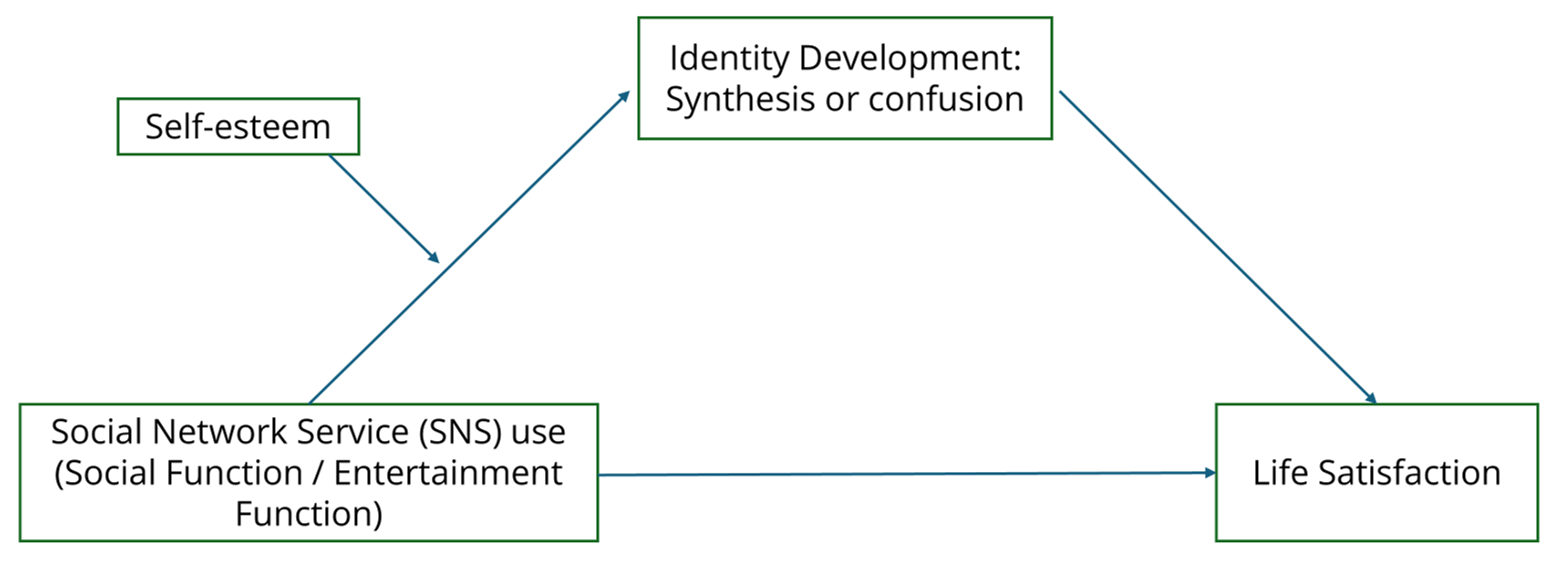
A common consensus in the literature holds that the relationship between SNS usage and adolescent life satisfaction is not linear – increased use does not uniformly lead to positive or negative outcomes. To resolve this ambiguity, the present study investigated the distinct roles of two of SNS’s functional uses – social engagement and entertainment. We proposed that the intensity of these different functions impacts adolescent life satisfaction through the mediating mechanism of identity development, a pathway that is further moderated by self-esteem. To test this dynamic, we constructed a moderated mediation model (see Figure 1) to examine: (a) whether identity development mediates the link between functional SNS use and life satisfaction, and (b) whether self-esteem moderates that mediating effect.
Figure 1. Conceptual Model.
Methods
The collected data were part of a large-scale project studying identity development among Hong Kong youth and were collected from November 2020 to September 2021. Two major sources of the data were secondary school students and university/tertiary students. Fifteen secondary schools joined the study, with 1,172 students participating. There were 948 valid responses from secondary school students after we screened for incomplete and abnormal responses (e.g., same responses to all questions). University students were recruited individually by convenience sampling through social networks and invitations in person on campus. A total of 1,161 students from 24 universities/tertiary institutions filled out the questionnaire, and 869 of the responses were valid. The secondary and post-secondary students received a coupon of HK$50 and HK$100, respectively, as an incentive.
Measures
Identity Development
The 12-item identity subscale of the Erikson Psychosocial Stage Inventory (EPSI; Rosenthal et al., 1981; Schwartz et al., 2009) was used to measure the participants’ sense of identity. The subscale consists of six items measuring identity synthesis (e.g., I know what kind of person I am) and six items measuring identity confusion (e.g., I change my opinion of myself a lot); they are rated on a five-point Likert-type scale ranging from 1 (strongly disagree) to 5 (strongly agree). These two constructs are independent but negatively correlated, and they can coexist within the same person (Marcia, 2002). Healthy identity development is associated with a preponderance of synthesis over confusion (Erikson, 1968). Previous studies have supported subscale’s two-factor structure and have demonstrated it to be valid and reliable in the population of early to late adolescents (Bogaerts et al., 2021; Schwartz et al., 2009). The scale has also been found by Sugimura et al. (2022) to be reliable with Asian late adolescents for identify synthesis (α = .73) and for identity confusion (α = .74). Cronbach’s alpha for the overall identity scale in the current study was .736.
Life Satisfaction
The Satisfaction with Life Scale (SWLS; Diener et al., 1985) was used to measure the participants’ level of satisfaction with their life. The measure consists of five items (e.g., In most ways, my life is close to my ideal) that are rated on a seven-point-Likert-type scale, ranging from 1 (strongly disagree) to 7 (strongly agree). Previous reliability with a Hong Kong adolescents’ sample was high (α = .88; Chui & Wong, 2016), and the internal consistency in the current study was also high (α = .88).
Social Networking Activity Intensity Scale
The Social Networking Activity Intensity Scale (SNAIS; Li et al., 2016) was used to measure the intensity of the participants’ social network use. The scale consists of 14 items, 10 of which measure the social function use intensity (SFUI; e.g., sent message to friends on a message board and commented on friends’ status, logs, and photos) and four of which measure entertainment function use intensity (EFUI; e.g., played games/applications and watched video/listened to music). Items are rated on a five-point scale, ranging from 1 (never) to 5 (always). The test-retest intra-class correlation coefficients were .87 (SFUI), .67 (EFUI), and .85 (overall SNAIS) in the original validation study, with Chinese junior middle school students (Li et al., 2016). In the present study, Cronbach’s α for the overall SNAIS scale was .864, and for SFUI and EFUI it was .884 and .548, respectively.
Self-Esteem
The Rosenberg Self-esteem Scale (RSES; Rosenberg, 1965) was used to measure the adolescents’ global evaluation of the self. The scale is a widely used measure of self-esteem, composed of 10 items (e.g., I feel that I am a person of worth), five of which are reversed items (e.g., I feel I do not have much to be proud of). The items are rated on a four-point scale from 1 (strongly agree) to 4 (strongly disagree). The scale has been shown to be reliable with Hong Kong adolescents (α = .82; Chui & Wong, 2016), and its internal consistency in the current study was high (Cronbach’s α = .84).
Results
The study had 1,817 valid responses from both secondary school and university students. Table 1 shows the demographic information of the participants and their level of education. Table 2 shows the means and SDs of the target variables and their bivariate Pearson correlations. Identity synthesis and identify confusion were significantly and negatively correlated, thus indicating their opposite nature (r = −.32, p < .001). The two types of SNS usage were moderately related and were positively associated with identity synthesis but did not significantly correlate with identity confusion, thus partially supporting H1 concerning SNS usage being related to identity development. Self-esteem did not significantly correlate with the two types of SNS usage (SFUI: r = .02, p = .385; EFUI: r = −.02, p = .364), whereas it did significantly correlate positively with identity synthesis (r = .47, p < .001) and negatively with identity confusion (r = −.57, p < .001). Life satisfaction correlated significantly but weakly with SFUI (r = .06, p = .018), while its correlation with EFUI was not significant (r = −.003, p = .909). Aligning with previous studies (for example, Orben et al., 2019), the relationship in this study between SNS usage and life satisfaction was not a simple, direct relationship.
Using Hayes’ (2013) PROCESS Macro (Model 4), we first tested a basic mediation model in which identity development (operationalized as identity synthesis and identity confusion) linked a specific SNS use (SFUI and EFUI) to life satisfaction (Hypotheses 2a and 2b). The two mediation models reported in Figure 2 & 3 depicted the effects of the two usages (SFUI and EFUI) and identity development on the adolescents’ life satisfaction. The results indicated that identity synthesis, but not identity confusion, mediated the relationship between SNS use and life satisfaction. While the direct effects of both SFUI and EFUI on life satisfaction were non-significant, both did significantly predict identity synthesis, but not identity confusion, after controlling for gender and age, and that result partly supported Hypothesis 1a – which proposed that the intensity of using the social functions of SNS predicts identity synthesis positively. The effect of EFUI was the opposite of our proposal in Hypothesis 1b—that EFUI positively associates with identity synthesis. Bootstrap analyses (bias-corrected, 95% CI) confirmed a significant indirect effect of SFUI on life satisfaction through identity synthesis (effect = .06, 95% CI [.04, .09] and of EFUI on life satisfaction through identity synthesis (effect = .04, 95% CI [.03, .06]). In contrast, an indirect effect through identity confusion was non-significant for both SFUI (effect = −.007, CI [−.02, .01]) and EFUI (effect = −.008, CI [−.03, .009]). As a result, Hypothesis 2a was supported—identity synthesis positively mediated the intensity of SNS functional usage on life satisfaction—while 2b was not supported.
Table 1. Demographic Information About the Participants (N = 1,817, Mean Age = 17.99, SD = 3.2).
|
Demographic |
|
N |
Percentage |
|
Gender |
Male |
727 |
40% |
|
Female |
1,090 |
60% |
|
|
Educational Level |
Secondary |
948 |
52% |
|
University level |
869 |
48% |
Table 2. Bivariate Pearson Correlations Among All Study Variables (N = 1,817).
|
Variable |
M |
SD |
1 |
2 |
3 |
4 |
5 |
6 |
|
1. Age |
17.99 |
3.2 |
— |
|
|
|
|
|
|
2. SNS usage (SFUI) |
2.84 |
0.80 |
< −.01 |
— |
|
|
|
|
|
3. SNS usage (EFUI) |
3.38 |
0.72 |
−.15** |
.40** |
— |
|
|
|
|
4. Identity Synthesis |
3.49 |
0.55 |
.04 |
.18** |
.11** |
— |
|
|
|
5. Identity Confusion |
3.16 |
0.62 |
−.03 |
.02 |
.03 |
−.32** |
— |
|
|
6. Self-esteem |
2.57 |
0.46 |
.05* |
.02 |
−.02 |
.47** |
–.57** |
|
|
7. Life Satisfaction |
4.25 |
1.20 |
−.08** |
.06* |
< −.01 |
.29** |
–.30** |
.45** |
|
Note. *p < .05, **p < .001. |
||||||||
Figure 2. Mediation Effect of Identity Development on the Relationship Between
Social Function Use Intensity and Life Satisfaction (N = 1,817).
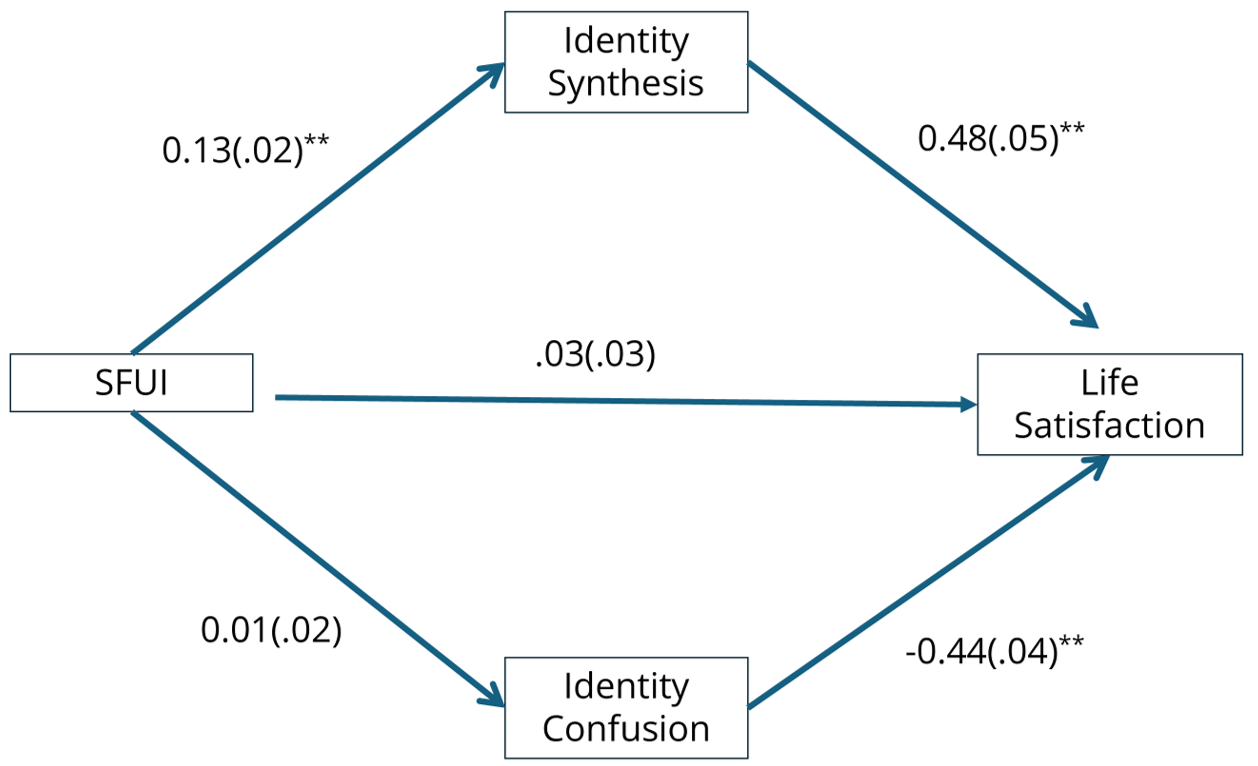
Note. Path coefficients are unstandardized (Standard errors in parenthesis). *p < .05, **p < .001. Bootstrap sample size = 5,000.
Figure 3. Mediation Effect of Identity Development on the Relationship Between
Entertainment Function Use Intensity and Life Satisfaction (N = 1,817).
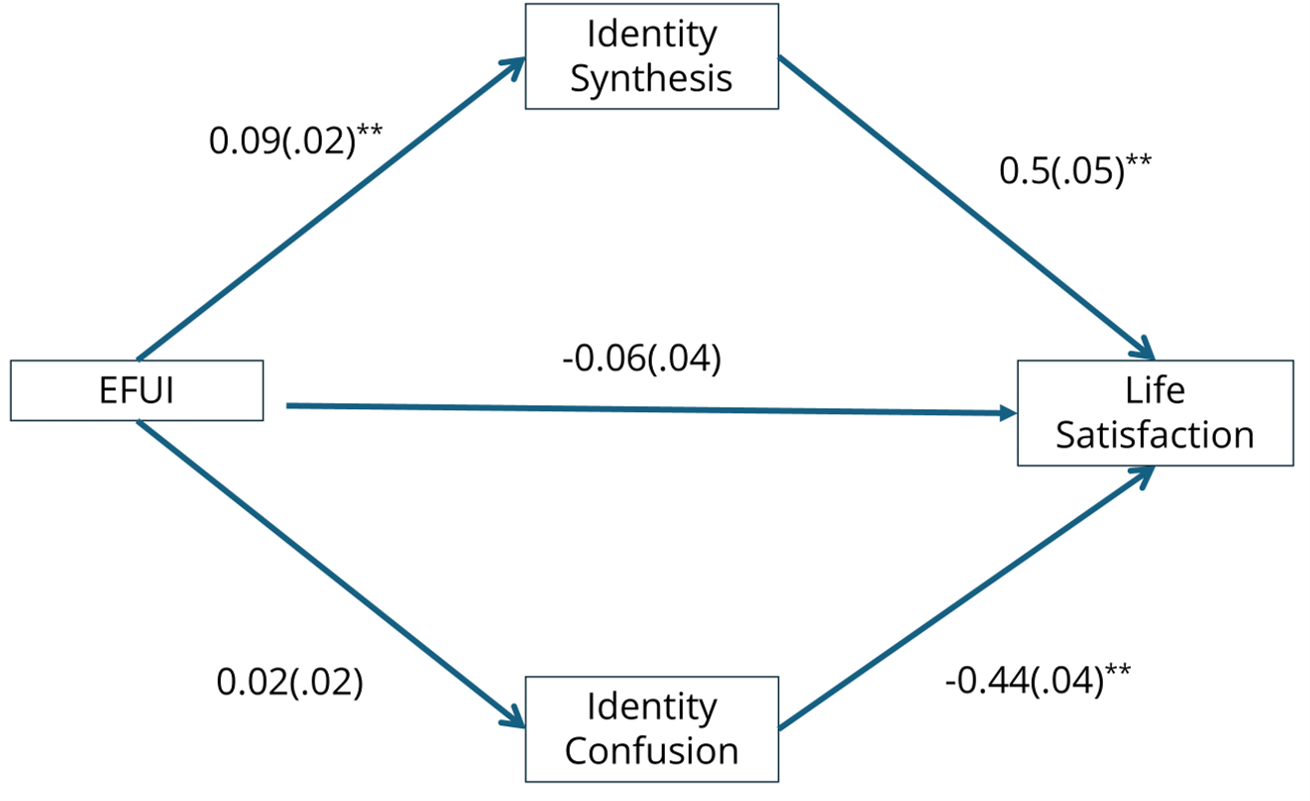
Note. Path coefficients are unstandardized (Standard errors in parenthesis). *p < .05, **p < .001. Bootstrap sample size = 5,000.
Hypothesis 3 proposed that self-esteem moderates the relationship between the intensity of SNS functional usage on identity development (operationalized as identity synthesis and identity confusion). Analysis using PROCESS Marco (Model 7) indicated a significant interaction between social function usage (SFUI) and self-esteem on identity confusion (B = −.09, SE = .03, p = .002; Table 3) while no significant interaction between entertainment usage (EFUI) and self-esteem on identity development was demonstrated (Table 5). Interestingly, an examination of the conditional effects (Table 4) showed that the positive association between SFUI and identity confusion was significant only for individuals with low self-esteem (−1 SD), while for those with average or high self-esteem (the mean, and +1 SD), the effect was non-significant. To examine this interaction, values of the moderator were categorised into three group (i.e., a group at mean, groups plus and minus one standard deviation from the mean). As shown in Figure 4, the positive effect of social function use of intensity (SFUI) on identity confusion was significant only for those with low self-esteem (Mean −1 SD; B (SE) = .07(.02), t = 3.33,
p = < .001. The effect was not significant among those who have high self-esteem (Mean +1 SD; B (SE) = −.02 (.02), t = −0.84, p = .402) and moderate (Mean; B (SE) = .03(.01), t = 1.7, p = .090). This pattern of moderation further explains the indirect effect on life satisfaction: the negative indirect effect of SFUI on life satisfaction (via increased identity confusion) was significant only for users with low self-esteem.
In addition, because age was a significant covariate in the moderated mediation model, we conducted an exploratory follow-up analysis by splitting the sample into two cohorts: participants in secondary school, and those who were post-secondary. The results revealed the same moderated mediation model results among the post-secondary group that only the self-esteem moderated SFUI → Identity Confusion → Life Satisfaction pathway was significant = .04 (Boot SE = .02; 95% CI [< .01, .09]), which was not significant among the secondary school participants = .04 (Boot SE = .02; 95% CI = [< −.01, .09]). The results are presented in the Appendix.
Table 3. Regression Results From the Moderated Mediation Model (PROCESS Model 7) of Social Function Use Intensity as
Predictor of Identity Development and Life Satisfaction, by Social Function Frequency of Use (N = 1,817).
|
Variable |
Identity Synthesis |
Life Satisfaction |
||||
|
B (SE) |
β |
p |
B (SE) |
β |
p |
|
|
Conceptual variables |
|
|
|
|
|
|
|
SFUI |
0.26 (.07)** |
.37 |
< .001 |
0.03 (.03) |
.02 |
.352 |
|
Self-esteem |
0.7 (.08)** |
.58 |
< .001 |
|
|
|
|
SFUI x Self-esteem |
−0.05 (.03) |
−.03 |
.066 |
|
|
|
|
Identity Synthesis |
|
|
|
0.48 (.05)** |
.02 |
< .001 |
|
Constant |
1.38 (.22)** |
|
< .001 |
|
|
|
|
R2 |
.26** |
< .001 |
|
|
|
|
|
|
Identity Confusion |
Life Satisfaction |
||||
|
|
B (SE) |
β |
p |
B (SE) |
β |
p |
|
Conceptual variables |
|
|
|
|
|
|
|
SFUI |
0.27 (.08)** |
.34 |
< .001 |
|
|
|
|
Self-esteem |
−0.51 (.09)** |
−.38 |
< .001 |
|
|
|
|
SFUI x Self-esteem |
−0.09 (.03)* |
−.05 |
< .001 |
|
|
|
|
Identity Confusion |
|
|
|
−0.44 (.04)** |
−.02 |
< .001 |
|
Constant |
4.44(.24)** |
|
< .001 |
4.58 (.31)** |
|
< .001 |
|
R2 |
.33** |
< .001 |
.14** |
< .001 |
||
|
Note. *p < .05, **p < .001. Analyses control for age and gender. B = unstandardized regression coefficients. SE = standard error. The moderated mediation model was supported when identity confusion was the mediator. The indexes of moderated mediation of the two paths were as follows: SFUI → Identity Synthesis → Life Satisfaction = −.02 (Boot SE = .02; 95% CI [−.06, .01]). SFUI → Identity Confusion → Life Satisfaction = .041 (Boot SE = .02; 95% CI [.01, .07]). |
||||||
Table 4. Conditional Indirect Effect Analysis of Life Satisfaction on the Moderating Values With
Social Function Intensity of Use as Antecedent (N = 1,817).
|
|
Self-esteem |
Indirect effect (Boot SE) |
Boot LLCI |
Boot ULCI |
|
Identity Synthesis |
Low |
.07(.02) |
.04 |
.1 |
|
Medium |
.06(.01) |
.04 |
.08 |
|
|
High |
.05(.01) |
.03 |
.07 |
|
|
Identity Confusion |
Low |
−.03(.01) |
−.05 |
−.01 |
|
Medium |
−.01(.01) |
−.03 |
< .01 |
|
|
High |
.01(.01) |
−.01 |
.03 |
|
|
Note. Bootstrap sample size = 5,000. For Self-esteem, the low, medium, and high categorizations refer to one standard deviation below the mean, the mean, and one standard deviation above the mean, respectively. Boot LLCI = bootstrap lower limit confidence interval. Boot ULCI = bootstrap upper limit confidence interval. |
||||
Figure 4. Self Esteem as a Moderator of the Relationship Between
Social Function Use Intensity and Identity Confusion.
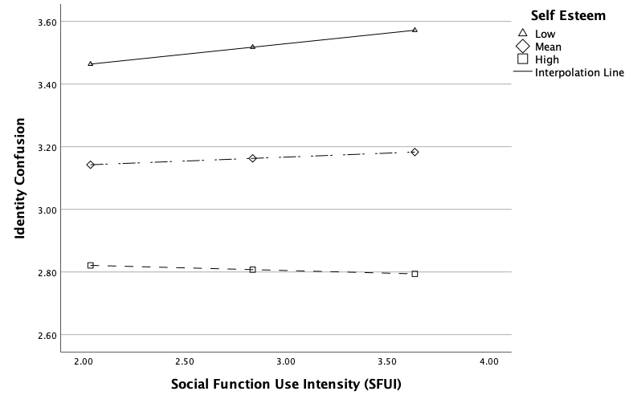
Table 5. Regression Results from the Moderated Mediation Model (PROCESS Model 7) of
Entertainment Function Use Intensity as a Predictor of Identity Development and Life Satisfaction (N = 1,817).
|
Variable |
Identity Synthesis |
Life Satisfaction |
||||
|
|
B (SE) |
β |
p |
B (SE) |
β |
p |
|
Conceptual variables |
|
|
|
|
|
|
|
EFUI |
0.14 (.09) |
.19 |
.095 |
−0.06 (.04) |
−.04 |
.099 |
|
Self-esteem |
0.63 (.12)** |
.53 |
< .001 |
|
|
|
|
EFUI x Self-esteem |
−0.02 (.03) |
−.01 |
.552 |
|
|
|
|
Identity Synthesis |
|
|
|
0.5 (.05)** |
.23 |
< .001 |
|
Constant |
1.5(.31)** |
|
< .001 |
|
|
|
|
R2 |
.24** |
< .001 |
|
|
|
|
|
|
Identity Confusion |
Life Satisfaction |
||||
|
|
B (SE) |
β |
p |
B (SE) |
β |
p |
|
Conceptual variables |
|
|
|
|
|
|
|
EFUI |
0.09 (.09) |
.01 |
.354 |
|
|
|
|
Self-esteem |
−0.67 (.12)** |
−.5 |
< .001 |
|
|
|
|
EFUI x Self-esteem |
−0.03 (.04) |
−.02 |
.419 |
|
|
|
|
Identity Confusion |
|
|
|
−0.44 (.04)** |
−.23 |
< .001 |
|
Constant |
4.87 (.33)** |
|
< .001 |
4.8 (.33)** |
|
< .001 |
|
R2 |
.33** |
< .001 |
.14** |
< .001 |
||
|
Note. *p < .05, **p < .001. Analyses control for age and gender. B = unstandardized regression coefficients. SE = standard error. The overall moderated mediation model was not supported. The indexes of moderated mediation of the two paths were: EFUI → Identity Synthesis → Life Satisfaction = −.01(Boot SE = .02; 95% CI [−.05;.04]). EFUI → Identity Confusion → Life Satisfaction = .01(Boot SE = .02; 95% CI [−.02; .05]). |
||||||
Table 6. Conditional Indirect Effect Analysis of Life Satisfaction on Moderating Values
With Entertainment Function Use Intensity as an Antecedent (N = 1,817).
|
|
Self Esteem |
Indirect effect (Boot SE) |
Boot LLCI |
Boot ULCI |
|
Identity Synthesis |
Low |
.05(.02) |
.02 |
.08 |
|
Medium |
.05(.01) |
.03 |
.07 |
|
|
High |
.04(.01) |
.02 |
.07 |
|
|
Identity Confusion |
Low |
−.01(.01) |
−.03 |
.01 |
|
Medium |
−.01(.01) |
−.02 |
.01 |
|
|
High |
< .01(.01) |
−.02 |
.02 |
|
|
Note. Bootstrap sample size = 5,000. For Self-esteem, the low, medium, and high categorizations refer to one standard deviation below the mean, the mean, and one standard deviation above the mean, respectively. Boot LLCI = bootstrap lower limit confidence interval. Boot ULCI = bootstrap upper limit confidence interval. |
||||
Discussion
Prior literature has consistently indicated that SNS use influences adolescents' life satisfaction. However, these effects are complex and may occur indirectly. To clarify this complex association, the present study examined whether identity development (operationalized as identity synthesis and identity confusion) mediates this relationship. After controlling for age and gender, the results provided partial support for the hypothesized models. Also, we used a functional approach to categorize SNS usage, which found that both social and entertainment SNS use promoted the adolescents’ life satisfaction by facilitating identity synthesis. The mediating roles of identity synthesis were significant for both social and entertainment SNS use. The indirect effect was more profound for social SNS usage, and its direct positive effect on life satisfaction became non-significant when the identity synthesis mediator was included. Further, self-esteem moderated the pathway for social SNS use mediated by identity confusion. Young people with lower self-esteem demonstrated a significant link between their social SNS use and identity confusion, which in turn predicted lower life satisfaction.
Identity Development Mediates the Effects of Social and Entertainment Function Use Intensities on Life Satisfaction
The results align with Marcia's (1980) identity status model, which emphasizes the role of social processes in promoting role experimentation and strengthening community affiliation (Michikyan et al., 2015; Raiziene et al., 2022). This framework is particularly relevant given that identity exploration increasingly unfolds within social networking platforms offering opportunities to communicate with existing friends (Davis, 2013), thereby increasing life satisfaction. Supporting this, Hatano et al. (2022) demonstrated longitudinally that changes in identity synthesis were positively associated with the changes in life satisfaction, whereas changes in identity confusion were negatively related. Contrary to our hypothesis, entertainment SNS usage also positively influenced identity synthesis, supporting the argument that it fulfills intrapersonal needs in identity exploration (Hui et al., 2023). In addition, no significant evidence was found for a negative effect of entertainment use on life satisfaction via identity confusion. That unexpected finding may be explained by the broad scope of entertainment activities captured by the EFUI scale (e.g., news browsing and video streaming), which extends beyond the gaming activities often linked to identity diffusion in previous research (Crocetti et al., 2008; Sebre & Mituze, 2021). Indeed, Raiziene et al. (2022) found that adolescents in the achievement status, a state closely associated with identity synthesis (Becht et al., 2019; Schwartz et al., 2009), tend to use social media for seeking school and news-related information and engaging in discussions about social issues. These activities are closely linked to establishing meaning in life, which was found to mediate the relationship between mobile media use and life satisfaction among adolescents (Meng et al., 2023). Our findings suggest that engaging in a diverse range of online activities contributes positively to identity synthesis. Ultimately, while both the social and entertainment functions of social network services play a role, their relatively weak direct relationships with identity synthesis imply that complementary offline experiences remain essential.
The functional approach of social networking usage offers further insights to the understanding of SNS influence on adolescents’ life satisfaction that the pathways of SFUI and EFUI are mediated by identity development differently. The division also offers a viable alternative to the conventional active-passive dichotomy for understanding the influence of social network usage on adolescents’ development. Most notably, in the present study, both SFUI and EFUI demonstrated positive associations with identity synthesis as a mediator of their influences on life satisfaction. This categorization contrasts with findings from the active-passive literature, in which passive use typically exhibits negative effects on well-being through mechanisms such as upward social comparison and feelings of envy (Verduyn et al., 2017, 2022). The divergence of our findings from the active-passive literature can be attributed to the functional framework's capacity to transcend behavioral engagement patterns and instead capture the underlying purposes of usage. For instance, whereas the active-passive model categorizes browsing friends' profiles as passive consumption – often linked to detrimental social comparison – the SNAIS framework recognizes such behaviors as serving a social function when aimed at maintaining interpersonal connections, thereby potentially facilitating identity synthesis rather than identity confusion. Furthermore, the SNAIS incorporates contemporary activities that are increasingly central to adolescent online experiences, such as gaming and entertainment, which the traditional active-passive dichotomy does not capture (Hui et al., 2023). By distinguishing between social functions and entertainment functions rather than engagement type, the SNAIS therefore provides a valid alternative assessment of modern social networking behavior, highlighting that the intent and function of usage – rather than a unified measure – are critical determinants of psychosocial outcomes.
A Moderated Mediation Model With Self-Esteem
The findings in this study revealed a significant, albeit weak, moderating role played by self-esteem in the complex relationship between the use of social networking services and identity development. The mediating pathways through identity synthesis remain unaffected by self-esteem, while using SNS for social functions diminishes adolescents’ life satisfaction through the mediating mechanism of identity confusion among both secondary and post-secondary students. Additional analyses were conducted to test alternative models in which self-esteem is the antecedent to SFUI and EFUI and, via these, predicts identity and life satisfaction (Process Model 6). None of the direct paths between self-esteem and the intensity of SNS functional uses is statistically significant in the mediation analyses (p > .36). In other words, self-esteem does not directly affect how much adolescents use SNS. Such results provide additional support to the existing literature suggesting that individuals with low-esteem are more susceptible to the adverse effect of SNS use (Eraslan-Capan, 2015; Marino et al., 2018), while it may not directly predict SNS usage.
This reasoning supports the established theory that self-esteem acts as a psychological buffer, protecting individuals from the adverse effects of negative online experiences (Dredge et al., 2014; Longmore & Demaris, 1997; Pearline & Schooler, 1978). High self‑esteem serves as a buffer, allowing youth to engage with SNS content with less threat to identity. In contrast, low self‑esteem heightens sensitivity to cues of inferiority and identity-relevant threats (Blanton, 2001; Vohs & Heatherton, 2004). In other words, self-esteem operates as a cognitive filter shaping how adolescents interpret and internalize SNS experience. Irrespective of usage frequency, the literature indicates that low-self-esteem individuals remain more susceptible to the associated risks of online engagement. Their heightened vulnerability to problematic SNS use (Eraslan-Capan, 2015; Saiphoo et al., 2020; Yang et al., 2022) is further exacerbated by the psychological dangers of engaging in upward social comparison (Niu et al., 2018). This also clarifies why self-esteem can moderate SFUI and identity confusion despite its weak zero-order correlation with SFUI. The very feature that defines social SNS – exposure to a vast and diverse social network – can paradoxically heighten the risk of identity crises for this group. This thinking explains why social use of SNS, but not entertainment-related SNS use, was linked to identity confusion; the social function directly facilitates the comparative judgements that trigger self-doubt. This distinction can be explained by the inherently social nature of self-esteem itself – according to the Sociometer Theory (Leary & Baumeister, 2000), a primary function of self-esteem is to monitor for threats of social exclusion and to motivate individuals to repair their social standing when their perceived relational value is low. The social networking services’ entertainment function, as measured by the EFUI subscale (SNAIS; Li et al., 2016), largely comprises intrapersonal activities (e.g., browsing news, watching videos) that involve less-direct social interactions. Consequently, these activities are less likely to trigger the social-evaluative concerns that self-esteem is theorized to regulate, thereby explaining the absence of a moderating effect in the entertainment use context. The present study’s inclusion of personal characteristics, specifically self-esteem, serves as an important moderator in understanding the effects of SNS – thus supporting the importance of including self-characteristics in related studies.
The differential results of social and entertainment functionalities of SNS in the tested models offer a critical insight. As mentioned, there are debates regarding further decomposing the active and passive usage of SNS, which is posited to be crucial for examining its impact on well-being (Verduyn et al., 2022). The current findings propose an alternative approach by decomposing SNS usage according to its functions, thereby indicating that the social function exhibits a stronger impact than the entertainment function does, particularly when controlling for self-esteem. Although this alternative approach does not necessarily imply a better classification, it urges reconsiderations of the multiple functions of SNS activities and behaviors in further study. The moderated mediation model further denotes the significance of the differential function use of SNS in identity development and life satisfaction, after controlling for self-esteem. However, only a weak linkage has been observed. For instance, the new categorization of SNS usage based on functions might have incorporated detrimental factors within the social function, thereby diminishing its positive impact, such as the passive consumption of friends' profiles previously indicated by the active and passive classification. In the future, a multidimensional categorization composed of both functional and engagement may prove beneficial. For instance, the social function use of SNS may be further divided into self-expressive and interactive usage, which may potentially induce contrasting results.
The data collection of the present study coincided with the COVID-19 pandemic period, and the pandemic profoundly disrupted adolescent identity development – a crucial developmental task – by depriving youths of essential peer interactions that are fundamental for psychological well-being (Orben et al., 2019). This deprivation likely heightened the participants’ existing vulnerabilities, leading to increased anxiety, loneliness, and depression (Chaabane et al., 2021; Viner et al., 2021). To mitigate this isolation, many adolescents turned to SNS. Our findings indicate that SNS usage helped to mitigate the isolation in promoting identity synthesis through social connection and entertainment. This synthesis, in turn, supported greater life satisfaction. Understandably, however, other measurements may also have been affected by the pandemic. The pandemic itself also induced identity distress among adolescents, further influencing these results (Michikyan et al., 2024). Public surveys and recent studies have shown an irreversible increase in SNS usage after the pandemic. Further studies should seek to confirm whether the mechanism still holds in the post-pandemic era.
Age was a significant covariate in all of this study’s analyses. An exploratory cohort analysis revealed a significant difference in the moderated mediation model between secondary school and post-secondary students. Previous studies have demonstrated that youths tend to have higher identity confusion (Bogaerts et al., 2021; Hatano et al., 2022). Both the youths undergoing school-to-school transitions and those transitioning to work have been found to experience pressures that promote identity development (Hatano et al., 2022). The adolescents in the present sample similarly faced comparable developmental challenges, including standardized examinations and career planning decisions, underscoring age's significance as a factor in identity formation. The secondary school participants were approaching their Hong Kong Diploma of Secondary Education Examination (HKDSE), while the post-secondary students were navigating early career considerations. Arguably, the secondary school participants in the present study had their support circles better established, with most having spent at least 3 years with their friends at school. In contrast, the post-secondary group faced a steeper challenge in building a new support network after starting university. Notably, the protective buffer provided by self-esteem was more critical to their identity development.
Limitations
A limitation of this study is that data collection coincided with the COVID-19 pandemic, which has been discussed above. During that time, online learning and schooling became prevalent among participants, potentially creating an alleviating effect on SNS usage intensity that reduced its bivariate associations with other measurements. Social networks evolved from one of many social tools into an indispensable medium for social interaction, entertainment, work, and study, while other activities were restricted. Consequently, SNS contributed more significantly to identity development during this period than it did in prior studies, in which SNS was one of many factors. In addition, youth identity development is typically bounded by societal and cultural factors, meaning that this study’s findings regarding functional usage of SNS, and its effects on identity synthesis and confusion, may not fully generalize to other populations (Hatano et al., 2022). The SNAIS provides an alternative but still dichotomous classification of social network usage. Gaming and short-video browsing, for instance, have in recent years evolved beyond entertainment functions and now also facilitate social connections, thus highlighting the need for measurements that capture these multidimensional characteristics. Finally, the cross-sectional design limits causal interpretation. The relationships between the factors, especially SNS usage and identity development, are likely to be reciprocal, which necessitates longitudinal investigations in the future.
Conclusions
The present study explains the dual pathways of social and entertainment social networking services functions in shaping adolescents’ life satisfaction––mediated by identity synthesis and confusion. While both functional usages foster identity synthesis in enhancing life satisfaction, social functions paradoxically undermine well-being when they are linked to identity confusion, with its risk magnified among low self-esteem adolescents. By integrating functional usage patterns with identity development models, this work advances a framework for understanding the psychosocial impacts of social network services in adolescent identity development and well-being, thus urging future research to adopt multidimensional, longitudinal designs that capture evolving social network platform dynamics.
Conflict of Interest
The authors have no conflicts of interest to declare.
Use of AI Services
The authors declare they have used AI services, specifically Perplexity Pro and Grammarly, for grammar correction and minor style refinements. They carefully reviewed all suggestions from these services to ensure the original meaning and factual accuracy were preserved.
Data Availability Statement
The dataset generated during the current study is not yet in the public domain but may be available from the corresponding author on reasonable request.
Acknowledgement
The work described in this paper was fully supported by a grant from the Research Grants Council of the Hong Kong Special Administrative Region, China (Ref#: UGC/IDS(C)15/H01/19).
Appendix
Table A1. Regression Results from the Moderated Mediation Model (PROCESS Model 7) for
Predicting Identity Development and Life Satisfaction by Social Function Frequency Use (N = 869 Post-Secondary Group).
|
|
Identity Synthesis |
Life Satisfaction |
||||
|
|
B (SE) |
β |
p |
B (SE) |
β |
p |
|
SNS usage (SFUI) |
0.23 (.12)* |
.3 |
.046 |
.14 (.06)* |
.08 |
.014 |
|
Self-esteem |
0.7 (.13)** |
.59 |
< .001 |
|
|
|
|
SNS usage (SFUI) x Self-esteem |
−0.04 (.04) |
−.03 |
.353 |
|
|
|
|
Identity Synthesis |
|
|
|
.55 (.07)** |
.25 |
< .001 |
|
Constant |
1 (.37)* |
|
.006 |
|
|
|
|
R2 |
.27** |
< .001 |
|
|
|
|
|
|
Identity Confusion |
Life Satisfaction |
||||
|
|
B (SE) |
β |
p |
B (SE) |
β |
p |
|
Conceptual variables |
|
|
|
|
|
|
|
SNS usage (SFUI) |
0.31 (.12)* |
.35 |
.012 |
|
|
|
|
Self-esteem |
−0.48 (.13)** |
−.36 |
< .001 |
|
|
|
|
SNS usage (SFUI) x Self-esteem |
−0.11 (.05)* |
−.06 |
.017 |
|
|
|
|
Identity Confusion |
|
|
|
−0.4 (.07)** |
−.02 |
< .001 |
|
Constant |
4.58 (.39)** |
|
< .001 |
4.17 (.53)** |
|
< .001 |
|
R2 |
.36** |
< .001 |
.16** |
< .001 |
||
|
Note. *p < .05, **p < .001. Analyses control for age and gender. B = unstandardized regression coefficients. SE = standard error. The moderated mediation model was supported when identity confusion is the mediator. The indexes of moderated mediation of the two paths are as followed: SFUI → Identity Synthesis → Life Satisfaction = −.02 (Boot SE = .03; 95% CI [−.09, .04]). SFUI → Identity Confusion → Life Satisfaction = .04 (Boot SE = .02; 95% CI [< .01, .09]). |
||||||
Table A2. Conditional Indirect Effect Analysis of Life Satisfaction on Moderating Values With
Social Function Use as Antecedent (N = 869 Post-Secondary Group).
|
|
Self Esteem |
Indirect effect (Boot SE) |
BootLLCI |
BootULCI |
|
Identity Synthesis |
Low |
.08(.03) |
.03 |
.13 |
|
Medium |
.07(.02) |
.04 |
.11 |
|
|
High |
.06(.02) |
.03 |
.1 |
|
|
Identity Confusion |
Low |
−.03(.01) |
−.06 |
< −.01 |
|
Medium |
−.01(.01) |
−.03 |
.01 |
|
|
High |
.01(.01) |
−.02 |
.03 |
|
|
Note. Bootstrap sample size = 5,000. For Self-esteem, low, medium, and high categorizations refer to one standard deviation below the mean, the mean, and one standard deviation above the mean respectively. BootLLCI = bootstrap lower limit. Confidence interval. BootULCI = bootstrap upper limit confidence interval. |
||||
Table A3. Regression Results from the Moderated Mediation Model (PROCESS Model 7) for
Predicting Identity Development and Life Satisfaction by Social Function Frequency Use (N = 948 Secondary Group).
|
|
Identity Synthesis |
Life Satisfaction |
||||
|
|
B (SE) |
β |
p |
B (SE) |
β |
p |
|
Conceptual variables |
|
|
|
|
|
|
|
SNS usage (SFUI) |
0.29(.09)** |
.46 |
< .001 |
−0.03(.04) |
−.02 |
.536 |
|
Self-esteem |
0.69(.11)** |
.57 |
< .001 |
|
|
|
|
SNS usage (SFUI) x Self-esteem |
−0.06(.04) |
−.04 |
.099 |
|
|
|
|
Identity Synthesis |
|
|
|
0.42(.07)** |
.19 |
< .001 |
|
Constant |
1.36(.35)** |
|
< .001 |
|
|
|
|
R2 |
.25 |
< .001 |
|
|
|
|
|
|
Identity Confusion |
Life Satisfaction |
||||
|
|
B (SE) |
β |
p |
B (SE) |
β |
p |
|
Conceptual variables |
|
|
|
|
|
|
|
SNS usage (SFUI) |
0.24 (.1) |
.33 |
.022 |
|
|
|
|
Self-esteem |
−0.53 (.12)** |
−.39 |
< .001 |
|
|
|
|
SNS usage (SFUI) x Self-esteem |
−0.08 (.04)* |
−.11 |
.040 |
|
|
|
|
Identity Confusion |
|
|
|
−.48 (.06)** |
−.25 |
< .001 |
|
Constant |
4.19(.38) |
|
< .001 |
6.14(.61) |
|
< .001 |
|
R2 |
.31 |
< .001 |
.14 |
< .001 |
||
|
Note. *p < .05, **p < .001. Analyses control for age and gender. B = unstandardized regression coefficients. SE = standard error. The moderated mediation model was supported when identity confusion is the mediator. The indexes of moderated mediation of the two paths are as followed: SFUI → Identity Synthesis → Life Satisfaction = −.03 (Boot SE = .02; 95% CI [−.07, .02]). SFUI → Identity Confusion → Life Satisfaction = .04 (Boot SE = .02; 95% CI [<−.01, .09]). |
||||||
Table A4. Conditional Indirect Effect Analysis of Life Satisfaction on Moderating Values With
Social Function use as Antecedent (N = 948 Secondary Group).
|
|
Self Esteem |
Indirect effect (Boot SE) |
BootLLCI |
BootULCI |
|
Identity Synthesis |
Low |
.07(.02) |
.03 |
.11 |
|
Medium |
.06(.01) |
.03 |
.09 |
|
|
High |
.05(.02) |
.02 |
.08 |
|
|
Identity Confusion |
Low |
−.03(.02) |
−.06 |
−.01 |
|
Medium |
−.01(.01) |
−.03 |
.01 |
|
|
High |
< .01(.01) |
−.03 |
.03 |
|
|
Note. Bootstrap sample size = 5,000. For Self-esteem, low, medium, and high categorizations refer to one standard deviation below the mean, the mean, and one standard deviation above the mean respectively. BootLLCI = bootstrap lower limit. Confidence interval. BootULCI = bootstrap upper limit confidence interval. |
||||


This work is licensed under a Creative Commons Attribution-ShareAlike 4.0 International License.
Copyright © 2026 Wang On Li, Ching Man Fung, Tak Sang Jason Chow, Kai Ip Danny Leung, Yuet Wah Cheung