
“What can I do as somebody who only knows her through the internet?”: An interview study on the role bystanders play when people make suicidal disclosures on social media
Vol.20,No.3(2026)
Bethany Cliffe
 Lisa Marzano
Maria Woloshynowych
Jay-Marie Mackenzie
Lisa Marzano
Maria Woloshynowych
Jay-Marie Mackenzie
Evidence suggests that lay persons can play an important role in suicide prevention. Whilst recent research has focused on the role bystanders play when people are at risk of suicide in physical environments, few studies have considered what happens when someone makes a suicidal disclosure on social media. The current study explored how bystanders respond when exposed to suicidal ideation online and what motivates this response. Thirteen UK adults aged 19 to 40 (M = 24.62, SD = 7.33) who had been a bystander at least once when someone had made a suicidal disclosure online were interviewed. Twelve identified as women, one as a man. Using reflexive thematic analysis, we generated five themes: 1) Questioning authenticity of online disclosures, 2) Distance and diffusion of responsibility, 3) Limitations of bystander support, 4) Acting with urgency and on instinct and 5) The Emotional Toll of Witnessing Suicidal Disclosures. Findings highlight the need to challenge doubt over authenticity around online disclosures, and the importance of guidelines to ensure the safety of all involved.
suicide; suicide prevention; social media; bystander intervention; qualitative research
Rhianna Brien
University College London, Division of Psychology and Language Sciences, London, United Kingdom
Rhianna Brien is a Clinical Psychologist who trained at University College London, after completing her Masters degree at University of Westminster.
Bethany Cliffe
University of Westminster, Department of Psychology, London, United Kingdom
Bethany Cliffe is a research fellow at University of Westminster.
Lisa Marzano
Middlesex University, Department of Psychology, London, United Kingdom
Lisa Marzano is a Professor of Psychology and Co-Director of the Centre for Abuse, Trauma and Suicide Studies (CATS) at Middlesex University.
Maria Woloshynowych
University of Westminster, Department of Psychology, London, United Kingdom
Maria Woloshynowych is a Chartered Psychologist and a Senior Lecturer at the University of Westminster.
Jay-Marie Mackenzie
University of Westminster, Department of Psychology, London, United Kingdom
Jay-Marie Mackenzie is a Reader in Suicide Prevention in the Department of Psychology at University of Westminster.
Arendt, F., Scherr, S., & Romer, D. (2019). Effects of exposure to self-harm on social media: Evidence from a two-wave panel study among young adults. New Media & Society, 21(11–12), 2422–2442. https://doi.org/10.1177/1461444819850106
Banyard, V., Mitchell, K. J., & Ybarra, M. L. (2021). Exposure to self-directed violence: Understanding intention to help and helping behaviors among adolescents and emerging adults. International Journal of Environmental Research and Public Health, 18(16), Article 16. https://doi.org/10.3390/ijerph18168606
Braun, V., & Clarke, V. (2006). Using thematic analysis in psychology. Qualitative Research in Psychology, 3(2), 77–101. https://doi.org/10.1191/1478088706qp063oa
Braun, V., & Clarke, V. (2019). Reflecting on reflexive thematic analysis. Qualitative Research in Sport, Exercise and Health, 11(4), 589–597. https://doi.org/10.1080/2159676X.2019.1628806
Calear, A. L., McCallum, S., Morse, A. R., Banfield, M., Gulliver, A., Cherbuin, N., Farrer, L. M., Murray, K., Rodney Harris, R. M., & Batterham, P. J. (2022). Psychosocial impacts of home-schooling on parents and caregivers during the COVID-19 pandemic. BMC Public Health, 22(1), Article 119. https://doi.org/10.1186/s12889-022-12532-2
Cliffe, B., Katsampa, D., Mackenzie, J.-M., Marsh, I., & Marzano, L. (2026). Experiences of receiving a bystander intervention during a suicide attempt on the railways. BJPsych Open, 12(2), Article 79. https://doi.org/10.1192/bjo.2026.10991
Corbitt-Hall, D. J., Gauthier, J. M., & Troop-Gordon, W. (2019). Suicidality disclosed online: Using a simulated Facebook task to identify predictors of support giving to friends at risk of self-harm. Suicide and Life-Threatening Behavior, 49(2), 598–613. https://doi.org/10.1111/sltb.12461
Davidovic, A., Talbot, C., Hamilton-Giachritsis, C., & Joinson, A. (2023). To intervene or not to intervene: Young adults’ views on when and how to intervene in online harassment. Journal of Computer-Mediated Communication, 28(5), Article zmad027. https://doi.org/10.1093/jcmc/zmad027
Department for Science, Innovation & Technology. (2023). Online safety act: Explainer. GOV.UK. https://www.gov.uk/government/publications/online-safety-act-explainer/online-safety-act-explainer
Department of Health and Social Care. (2023). Suicide prevention in England: 5-year cross-sector strategy. https://www.gov.uk/government/publications/suicide-prevention-strategy-for-england-2023-to-2028/suicide-prevention-in-england-5-year-cross-sector-strategy
Fischer, P., Krueger, J. I., Greitemeyer, T., Vogrincic, C., Kastenmüller, A., Frey, D., Heene, M., Wicher, M., & Kainbacher, M. (2011). The bystander-effect: A meta-analytic review on bystander intervention in dangerous and non-dangerous emergencies. Psychological Bulletin, 137(4), 517–537. https://doi.org/10.1037/a0023304
Frost, M., & Casey, L. (2016). Who seeks help online for self-injury? Archives of Suicide Research, 20(1), 69–79. https://doi.org/10.1080/13811118.2015.1004470
Fu, K., Cheng, Q., Wong, P. W. C., & Yip, P. S. F. (2013). Responses to a self-presented suicide attempt in social media. Crisis, 34(6), 406–412. https://doi.org/10.1027/0227-5910/a000221
Hallford, D. J., Rusanov, D., Winestone, B., Kaplan, R., Fuller-Tyszkiewicz, M., & Melvin, G. (2023). Disclosure of suicidal ideation and behaviours: A systematic review and meta-analysis of prevalence. Clinical Psychology Review, 101, Article 102272. https://doi.org/10.1016/j.cpr.2023.102272
Hofstra, E., van Nieuwenhuizen, C., Bakker, M., Özgül, D., Elfeddali, I., de Jong, S. J., & van der Feltz-Cornelis, C. M. (2020). Effectiveness of suicide prevention interventions: A systematic review and meta-analysis. General Hospital Psychiatry, 63, 127–140. https://doi.org/10.1016/j.genhosppsych.2019.04.011
Janota, M., Kovess-Masfety, V., Gobin-Bourdet, C., & Husky, M. M. (2022). Use of mental health services and perceived barriers to access services among college students with suicidal ideation. Journal of Behavioral and Cognitive Therapy, 32(3), 183–196. https://doi.org/10.1016/j.jbct.2022.02.003
Jones, L. J., Iqbal, Z., Airey, N. D., Brown, S. R., & Burbidge, F. (2019). Barriers to help-seeking in suicidal men: A systematic literature review. International Journal of Psychiatry, 4(2), 1–5. https://doi.org/10.33140/ijp.04.02.06
Katsampa, D., Mackenzie, J.-M., Crivatu, I., & Marzano, L. (2022). Intervening to prevent suicide at railway locations: Findings from a qualitative study with front-line staff and rail commuters. BJPsych Open, 8(2), Article 62. https://doi.org/10.1192/bjo.2022.27
Kirk-Wade, E. (2025). Suicide statistics. UK Parliament. https://researchbriefings.files.parliament.uk/documents/CBP-7749/CBP-7749.pdf
La Sala, L., Teh, Z., Lamblin, M., Rajaram, G., Rice, S., Hill, N. T. M., Thorn, P., Krysinska, K., & Robinson, J. (2021). Can a social media intervention improve online communication about suicide? A feasibility study examining the acceptability and potential impact of the #chatsafe campaign. PLOS ONE, 16(6), Article 0253278. https://doi.org/10.1371/journal.pone.0253278
Latané, B., & Darley, J. M. (1970). The unresponsive bystander: Why doesn’t he help? Prentice-Hall. https://cir.nii.ac.jp/crid/1970023484932626338/holdings
Lawani, A. (2020). Critical realism: What you should know and how to apply it. Qualitative Research Journal, 21(3), 320–333. https://doi.org/10.1108/qrj-08-2020-0101
Mackenzie, J.-M., Marsh, I., Fields, B., Kruger, I., Katsampa, D., Crivatu, I., & Marzano, L. (2025). Preventing suicides on the railways: Learning from lived and living experiences. BMC Public Health, 25(1), Article 1625. https://doi.org/10.1186/s12889-025-22744-x
Malterud, K., Siersma, V. D., & Guassora, A. D. (2016). Sample size in qualitative interview studies: Guided by information power. Qualitative Health Research, 26(13), 1753–1760. https://doi.org/10.1177/1049732315617444
Mann, J. J., Michel, C. A., & Auerbach, R. P. (2021). Improving suicide prevention through evidence-based strategies: A systematic review. American Journal of Psychiatry, 178(7), 611–624. https://doi.org/10.1176/appi.ajp.2020.20060864
Mitchell, K. J., Banyard, V., & Ybarra, M. L. (2022). Are the bystanders okay? Exploring the impact of bystander behavior for self-directed violence. Journal of Adolescent Health, 70(2), 298–304. https://doi.org/10.1016/j.jadohealth.2021.08.003
Moskos, M. A., Olson, L., Halbern, S. R., & Gray, D. (2007). Utah youth suicide study: Barriers to mental health treatment for adolescents. Suicide and Life-Threatening Behavior, 37(2), 179–186. https://doi.org/10.1521/suli.2007.37.2.179
Niederkrotenthaler, T., Tran, U. S., Baginski, H., Sinyor, M., Strauss, M. J., Sumner, S. A., Voracek, M., Till, B., Murphy, S., Gonzalez, F., Gould, M., Garcia, D., Draper, J., & Metzler, H. (2023). Association of 7 million+ tweets featuring suicide-related content with daily calls to the Suicide Prevention Lifeline and with suicides, United States, 2016–2018. Australian & New Zealand Journal of Psychiatry, 57(7), 994–1003. https://doi.org/10.1177/00048674221126649
Owens, C., Derges, J., & Abraham, C. (2019). Intervening to prevent a suicide in a public place: A qualitative study of effective interventions by lay people. BMJ Open, 9(11), Article e032319. https://doi.org/10.1136/bmjopen-2019-032319
Robinson, J., Cox, G., Bailey, E., Hetrick, S., Rodrigues, M., Fisher, S., & Herrman, H. (2016). Social media and suicide prevention: A systematic review. Early Intervention in Psychiatry, 10(2), 103–121. https://doi.org/10.1111/eip.12229
Rudnicki, K., Vandebosch, H., Voué, P., & Poels, K. (2023). Systematic review of determinants and consequences of bystander interventions in online hate and cyberbullying among adults. Behaviour & Information Technology, 42(5), 527–544. https://doi.org/10.1080/0144929X.2022.2027013
Samaritans. (2020). Supporting someone online who might be struggling. Samaritans. https://www.samaritans.org/about-samaritans/research-policy/internet-suicide/online-safety-resources/supporting-someone-online-who-might-be-risk-self-harm-or-suicide/
Sheehan, L. (2026). Social media disclosure of suicidal thoughts and behaviors: A qualitative study of lived experience perspectives. Crisis. https://doi.org/10.1027/0227-5910/a001047
Sinyor, M., Williams, M., Zaheer, R., Loureiro, R., Pirkis, J., Heisel, M. J., Schaffer, A., Cheung, A. H., Redelmeier, D. A., & Niederkrotenthaler, T. (2021). The relationship between suicide-related twitter events and suicides in Ontario from 2015 to 2016. Crisis, 42(1), 40–47. https://doi.org/10.1027/0227-5910/a000684
Samaritans. (2017). Small Talk Saves Lives. Samaritans. https://www.samaritans.org/support-us/campaign/small-talk-saves-lives/
Sobol, M., Przepiórka, A., & Błachnio, A. (2025). Factors contributing to the defending behavior of adolescent cyberbystanders: A systematic review and meta-analysis. Computers in Human Behavior, 162, Article 108463. https://doi.org/10.1016/j.chb.2024.108463
Song, J., Song, T. M., Seo, D.-C., & Jin, J. H. (2016). Data mining of web-based documents on social networking sites that included suicide-related words among Korean adolescents. Journal of Adolescent Health, 59(6), 668–673. https://doi.org/10.1016/j.jadohealth.2016.07.025
Tang, S., Reily, N. M., Arena, A. F., Batterham, P. J., Calear, A. L., Carter, G. L., Mackinnon, A. J., & Christensen, H. (2022). People who die by suicide without receiving mental health services: A systematic review. Frontiers in Public Health, 9, Article 736948. https://doi.org/10.3389/fpubh.2021.736948
World Medical Association (2013). World Medical Association Declaration of Helsinki: ethical principles for medical research involving human subjects. JAMA, 310(20), 2191–2194. https://doi.org/10.1001/jama.2013.281053
Zalsman, G., Hawton, K., Wasserman, D., van Heeringen, K., Arensman, E., Sarchiapone, M., Carli, V., Höschl, C., Barzilay, R., Balazs, J., Purebl, G., Kahn, J. P., Sáiz, P. A., Lipsicas, C. B., Bobes, J., Cozman, D., Hegerl, U., & Zohar, J. (2016). Suicide prevention strategies revisited: 10-year systematic review. The Lancet Psychiatry, 3(7), 646–659. https://doi.org/10.1016/S2215-0366(16)30030-X
Authors' Contribution
Rhianna Brien: conceptualization, recruitment, formal analysis, writing—original draft, writing—review. Bethany Cliffe: writing—original draft, writing—review & editing. Lisa Marzano: conceptualization, writing—original draft, writing—review. Maria Woloshynowych: writing—original draft, writing—review. Jay-Marie Mackenzie: conceptualization, formal analysis, writing—original draft, writing—review.
Editorial Record
First submission received:
May 6, 2025
Revisions received:
September 22, 2025
March 30, 2026
Accepted for publication:
April 4, 2026
Editor in charge:
Lenka Dedkova
Introduction
Most individuals who die by suicide do not have contact with mental health services prior to their death (Tang et al., 2022), meaning suicide prevention also occurs in non-clinical spaces such as in the community or online. Consequently, members of the public, or ‘bystanders’, are often in positions where they may be able to intervene when someone is exhibiting or disclosing suicidality.
Research has explored the experiences and impacts of bystander interventions taking place in person, highlighting the benefits of key strategies such as making small talk and taking a compassionate approach. However, little is known about interventions that take place in online spaces. The current study fills this gap by exploring the experiences and motivations of those who have intervened when witnessing disclosures of suicidality online. This provides insight into how social media platforms can promote safety online to protect both those experiencing suicidality and those who may ‘witness’ such disclosures.
Suicide Prevention
In 2023, rates of death by suicide were the highest they have been since 1999 and suicide was the leading cause of death for people in the UK aged 20-34 (Kirk-Wade, 2025). These statistics underscore a clear and urgent need to understand more about effective suicide prevention in order to reduce deaths by suicide. There is some literature to support the efficacy of pharmacological or clinical interventions for suicide prevention in psychiatric populations (e.g., Hofstra et al., 2020; Mann et al., 2021; Zalsman et al., 2016). However, evidence shows that two out of three people who died by suicide in 2023 did not have any contact with mental health services prior to their death. Reasons for not seeking professional help commonly include concerns around stigma associated with suicidal thoughts and distress, mistrust of mental health services, fears of hospitalisation, not knowing where or how to access support, and not believing anything will help (Janota et al., 2022; Jones et al., 2019; Moskos et al., 2007). Moreover, research shows that people experiencing suicidal thoughts may be more likely to disclose them to a friend or family member instead of a professional (Calear et al., 2022; Hallford et al., 2023). This means that effective suicide prevention efforts often take place in community settings, in addition to formal, professional services (Department of Health and Social Care, 2023). However, those witnessing suicidal behaviour in public places do not always intervene and research has explored why this may be. Feeling unskilled, the individual being a stranger, personal risk and perceived danger are examples of factors that may prevent someone intervening in an emergency (Fischer et al., 2011).
The Bystander Intervention Model (BIM) outlines five steps that determine whether someone may intervene in an emergency, which can be applied to suicide interventions in community settings (Latané & Darley, 1970). The model states that the individual must first notice the situation and interpret it as an emergency, assume responsibility, decide what actions need to be taken and then carry those actions out. This model provides a useful framework for understanding intervention behaviours, particularly why individuals may choose not to intervene upon witnessing suicidal behaviour in community spaces.
Effective Suicide Prevention in the Community
Community suicide prevention interventions are broad and include campaigns to increase awareness of the role that the general public can play in preventing deaths by suicide. Examples include the government’s ‘suicide prevention is everyone’s business’ slogan (Department of Health and Social Care, 2023), and the Samaritans’ ‘Small Talk Saves Lives’ campaign (Samaritans, 2017). The latter depicts a member of the public intervening by approaching an individual appearing visibly distressed at a train station and beginning to make small talk. Owens et al. (2019) interviewed individuals who had intervened to prevent a stranger from taking their life in-person, as well as people who had been prevented from dying by suicide by a stranger. Owens et al. (2019) identified that the key parts of an intervention relate much more to how the distressed individual feels rather than what the intervener said, and this included the distressed individual feeling validated, connected and safe. Similar research has highlighted the importance of listening, making small talk and how simply being present can be enough of a distraction or deterrent (Katsampa et al., 2022). Further, people with lived experience of being suicidal in a public space also highlight the importance of human intervention but emphasise the need for a compassionate approach (Cliffe et al., 2026; Mackenzie et al., 2025). These studies show the capacity that people who do not necessarily have any specialist training have to save lives.
Suicide Prevention in Online Spaces
With society being increasingly ‘online’, conversations about mental health are taking place in online platforms such as social media. One study found that, on average, there are 16,639 posts per day about suicide on X (formerly Twitter) in the USA alone (Niederkrotenthaler et al., 2023). Similarly, a study from South Korea found that around 22% of adolescents’ online posts across a variety of social media platforms indicated risk of suicide (Song et al., 2016). Investigations into why people discuss suicide on social media found that these platforms are perceived as supportive atmospheres where people receive empathy and care, and that people feel able to share their feelings with others who understand and do not judge (Robinson et al., 2016). They also offer anonymity and easy connections to support (Sheehan, 2026). However, not all online expressions of suicidality are met with support and messages of hope. They may instead be ignored or responded to in ways that are unhelpful and may exacerbate suicide risk (Fu et al., 2013). In one study participants were asked to interact with a simulated Facebook news feed that included suicidal content, yet only 20-30% responded positively to posts indicative of suicide risk, with the majority not interacting with those posts at all (Corbitt-Hall et al., 2019). In the context of the BIM, it may be that bystanders are not interpreting these situations as emergencies, not ‘assuming responsibility’, or not being able to decide what actions need to be taken in these scenarios (Latané & Darley, 1970). Research is needed to understand what motivates whether someone responds to suicidal content online, and if so, how they respond.
Online Interventions in Other Domains
Given the scarcity of research into online suicide interventions, insight can be gained from looking to online interventions in other domains. Focus groups with young adults explored reasons for and against intervening in online harassment, finding a general reluctance to intervene due to fears around exacerbating the situation from being ill-equipped (Davidovic et al., 2023). There was also an assumption or expectation that others would intervene, absolving them of the responsibility. Online spaces were described as being more detached, making it easier to ‘scroll past’ without engaging, i.e., not ‘assuming responsibility’. Feeling skilled and equipped to intervene appropriately and effectively seems a common finding, with other research into cyberbullying describing self-efficacy as a factor that determines ones ability to intervene without anxiety about making it worse (Sobol et al., 2025). Additionally, empathy with the victim appears to motivate interventions, whereby individuals who have similar experiences are more likely to engage (Davidovic et al., 2023; Rudnicki et al., 2023).
Impact on Those Intervening
A further consideration is the potential impact of witnessing distressing situations online such as cyberbullying, harassment or suicidal disclosure. There is some evidence documenting the impact on the wellbeing of those viewing suicide related content on social media, but the research is inconclusive. Some findings suggest that viewing online content relating to self-harm or suicide can increase the viewer’s own suicide risk, known as a contagion effect (Arendt et al., 2019). On the other hand, research investigating possible contagion from viewing X posts around suicide found no evidence of effect (Sinyor et al., 2021). However, impacts on wellbeing are not limited to contagion. Research into in-person interventions has identified that, after the incident, interveners were left feeling excluded and afraid due to not knowing what happened next for the individual, as well as feeling disturbed by the experience (Owens et al., 2019). Other research has found that many who intervene feel negatively about the intervention after, being concerned about not having helped or made a difference for the individual (Mitchell et al., 2022). It is not yet clear whether these effects are mirrored in online spaces, nevertheless, the possible risks from viewing harmful content online are a priority noted by the UK government in the 2023 Online Safety Act, which highlights the importance of protecting people from self-harm and suicide content (Department for Science, Innovation & Technology, 2023). In line with this, a better understanding of how witnessing and possibly responding to an online suicidal disclosure effects bystanders is essential to inform ways of keeping people safe online.
The Current Study
Research into bystander interventions occurring in-person highlights effective strategies that can be used to save lives and, whilst social media provides similar opportunities to intervene when witnessing content indicative of suicide risk, less is known about the process and experiences of intervening online. The aim of the current study was to explore what role bystanders play when someone uses social media to disclose suicidal intent. In particular we wanted to know,
RQ1: What are the thoughts, feelings and actions of bystanders when making or considering making an intervention?
RQ2: What are the different ways that bystanders respond when exposed to suicidal ideation online?
RQ3: What motivates bystanders’ responses upon seeing suicidal ideation disclosed online?
Methods
Participants and Procedures
Semi-structured interviews were conducted by telephone or Microsoft Teams video call between May 2020 and July 2021. Thirteen participants were recruited through social media (Facebook and X) and a snowball approach where participants were asked to share the study information among their own networks. The sample size was informed by the information power approach; as the sample were highly knowledgeable about the topic following their personal experiences and the research aims were specific to their experiences, 13 participants were deemed adequate to address the research question (Malterud et al., 2016).
To be included, participants had to have witnessed a suicidal disclosure on social media, whether this be direct or indirect, someone they knew personally or not, and whether they intervened or not. For ethical purposes, anyone formally diagnosed as currently suffering from a mental health problem at the time of the study was excluded. This meant that one person was excluded.
Interviews lasted approximately one hour and focused on participants’ experiences of being a bystander, the context of the incident, how it made them feel and their response. The interview guide was devised based on previous literature and research expertise in the area and structured according to the aims of the study. Interviews were digitally recorded and were manually transcribed verbatim.
Participants were aged 19 to 40 (M = 24.62, SD = 7.33) and 12/13 identified as women, one identified as a man. Their professional backgrounds ranged from being students, teachers, paralegal, a clinical psychologist and a freelance consultant for suicide prevention. All were UK residents and had, on at least one occasion, been a bystander when someone else had made a suicidal disclosure online.
Participants’ demographic characteristics are summarised in Table 1 below.
Table 1. Participants Demographics.
|
Participant number |
Gender |
Age |
Relation to discloser |
|
P1 |
Woman |
22 |
Close friend (1); Sister (2) |
|
P2 |
Woman |
26 |
Daughter |
|
P3 |
Woman |
21 |
Ex-partner (1); Sports teammate (2); Acquaintance from college (3) |
|
P4 |
Woman |
38 |
Close friend |
|
P5 |
Man |
40 |
Acquaintance from school (not seen for 17 years at time of disclosure) |
|
P6 |
Woman |
21 |
Close friend |
|
P7 |
Woman |
32 |
Ex colleague and friend |
|
P8 |
Woman |
20 |
Strangers on Twitter |
|
P9 |
Woman |
21 |
Strangers on Reddit |
|
P10 |
Woman |
23 |
Online friend – met through shared interest group |
|
P11 |
Woman |
19 |
School friend |
|
P12 |
Woman |
19 |
Strangers on TikTok |
|
P13 |
Woman |
19 |
Online friends |
|
Note. The numbers in parentheses are used when the participant had witnessed more than one to disclosure, in order to differentiate between the relationships. |
|||
Epistemology and Reflexivity
This research was conducted from a critical realist position, acknowledging that people’s perspectives are formed from their own experiences and are shaped by underlying structures (Lawani, 2020). The research team was comprised of people who identify as white women, who were at varying stages in their career and all working within the field of mental health research. The researcher who collected the data (RB) is an early career researcher who was conducting research for her master’s degree at the time. She was familiar with two of the 13 participants due to the snowballing technique used for recruitment. BC is an early career researcher in a post-doctoral role, and was involved in analysing the data but does not know any of the participants. JMM also advised on data analysis and is in a more senior position as a Reader who was supervising RB’s master’s project. Being at different career stages, it is likely that the project was shaped by our various expertise which built upon each other to produce this work. Some members of the research team have their own lived experience relating to suicide, which will have informed our interpretations of the findings during analysis. A formal reflexive diary was not kept, but personal notes were made throughout the research process to document any key reflections.
Analysis
Reflexive thematic analysis was performed following the six key stages outlined by Braun and Clarke (Braun & Clarke, 2006, 2019). The interviews were first transcribed and read to ensure familiarity with the data. The transcripts were then coded by RB inductively using NVivo, generating both latent and semantic codes. JMM also independently coded one transcript and checked some of RB’s initial codes to explore any additional insights. RB then coded the remaining data independently whilst discussing regularly with JMM. Themes were subsequently created from the codes in an iterative process where the data and codes were returned to regularly to adapt and build the themes. Themes were developed in discussions with the research team, which took place at least monthly throughout the research process, and happened more frequently during analysis. During initial theme development, JMM and RB discussed how the ideas fit together, whether there was any overlap, etc. The themes were then revised and finalised in discussion with BC.
Ethical Considerations
The authors assert that all procedures contributing to this work comply with the ethical standards of the relevant national and institutional committees on human experimentation and with the Helsinki Declaration of 1975, as revised in 2013 (World Medical Association, 2013). All procedures involving human subjects/patients were approved by the University of Westminster Research Ethics Committee, ethical approval reference: ETH1920-0925. Written informed consent was obtained from each participant prior to the interview, and they were reminded that they were free to withdraw from the study at any time. After each interview was transcribed, the audio recording was destroyed. To protect participants’ confidentiality and anonymity, each participant was given a pseudonym and corresponding number. Due to the sensitive nature of the interviews, safeguarding and distress protocols were followed but, fortunately, no participants became distressed during the interviews.
There were particular ethical considerations around online recruitment and data collection. Recruitment was carried out in publicly accessible online spaces where posting was permitted. Care was taken to respect platform and community guidelines, ensuring that participants were not contacted directly or in ways that compromised privacy. Those interested were asked to contact the researcher via email rather than responding on the platform to help protect their anonymity. This approach reflected a commitment to minimising harm and promoting informed consent in a digital context, where communication can often feel less personal or clear. With interviews taking place remotely, the lack of a shared physical space possibly shifted the balance of safety and control, requiring extra effort to build trust. Rapport was built through clear, empathetic communication and active listening, which helped participants feel safe despite the physical distance.
Results
Participants reported witnessing suicidal disclosures made on several different platforms including Facebook, X, Snapchat, Instagram, Reddit, and WhatsApp. Some were made publicly (most commonly in the form of a status update or post and accessible to anyone in the disclosers’ online network) and others privately (directly to the participant over private message).
Eight of the 13 participants knew the discloser personally, ranging from immediate family members through to colleagues and acquaintances. When the participant only knew the discloser in an online context, there was normally a common interest which brought them together (e.g., a TV programme or shared life experience). Eleven participants had experience of intervening, but some also had experiences of being a bystander when they had not intervened.
Most disclosures in this dataset were explicit – including goodbyes, apologies, references to suicide methods, or other clear statements of intent: “It was very clear cut; it was like I’m just going to kill myself now” [P3]. Only one of the 13 participants described an ambiguous disclosure: “She just said she was going away and that it was going to help her and that she felt like it was the best thing to do” [P7]. In this instance, the participant was not aware it was a statement of suicidal intent until after the discloser had taken her own life.
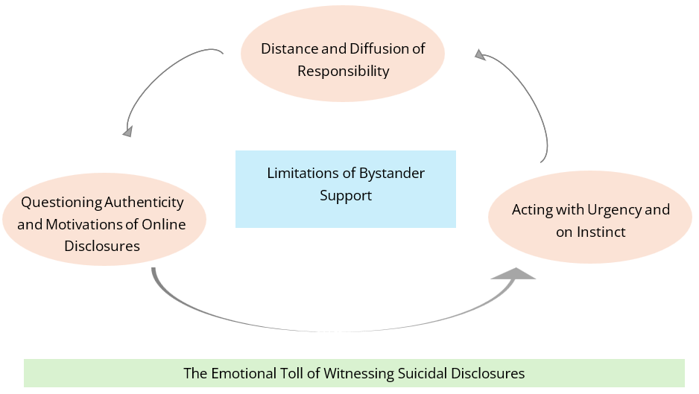
We analysed data and developed five themes which aim to provide a holistic understanding of the bystander’s experience – from their decision whether or not to make an intervention through to reflections in the aftermath. Participants reported:
1. Questioning authenticity and motivations of online disclosures
2. Distance and diffusion of responsibility
3. Limitations of bystander support
4. Acting with urgency and on instinct
5. The emotional toll of witnessing suicidal disclosures
Please see figure 1 for thematic map.
Figure 1. Thematic Map.
Questioning Authenticity of Online Disclosures
Disclosures happening online present unique challenges due to the distance and separation between the individual disclosing and bystanders. This creates issues around trust, with some participants raising concerns around the authenticity of disclosures taking place online: “That’s the hard part of social media which is why I do sometimes go, ‘Do they really feel like that?’” [P3]. This distrust and uncertainty were somewhat alleviated in instances where there was physical ‘evidence’ to substantiate the disclosure “I mean earlier on she was self-harming so you know, there was physical evidence that she was doing something at least” [P2]. On the other hand, if the person had made similar disclosures on other occasions, participants reported greater distrust as they believed it was a ploy rather than being a genuine disclosure. This meant participants were less likely to intervene with any urgency: “When it got to like the seventh time, we then spoke about it more so we didn’t act straight away because we felt – well I say we – they felt it was more of a ploy” [P3].
Some participants felt that it was inappropriate to be frequently sharing such personal things on social media, hinting at an underlying judgement associated with these public disclosures:
“She has like suicidal thoughts quite often and that’s like all over social media. All over. She just publicly announces it to the world. She’s terrible for it […] She needs to stop announcing it to the world and talk to someone, probably face-to-face, which would be better” [P1].
Disclosures that were deemed to not be genuine were met with anger from bystanders: “I did start getting annoyed to be honest with you. I really did because it was kind of apparent from her actions that she wasn’t genuine” [P11]. In these instances, participants believed that there was an element of attention-seeking and/or manipulation involved. This was particularly the case if the disclosure had been made publicly (i.e. in the form of a status update or public post): “I think like because it’s a wide audience so everyone in the world can know how she’s feeling and why. Yeh, I think she craves somebody’s attention” [P1].
Distance and Diffusion of Responsibility
The extent to which participants felt a sense of responsibility to act was an important consideration in deciding whether to intervene or not. The lack of relationship with the discloser led to diffusion of responsibility if it was an acquaintance, stranger, or someone the participant was less close to: “It’s bad but I left it because I don’t know them much” [P3].
In instances where there was no relationship between the bystander and the discloser and the bystander did intervene, it seemed as though this distance between them led participants to make a quicker, less-considered intervention or have less concern for what the consequences of their actions might be: “Because it was a complete stranger, I felt like there was almost no consequences to it, like I could stop talking to them and ghost them” [P8].
Equally, they felt less pressure to intervene if other bystanders were already involved or they believed others would get involved: “He posted some stuff but he already had loads of people commenting so I left it” [P3]; “I guess I was also in the mindset that probably they will tweet about this again and someone else will reach out to them. It’s not just on me to do it” [P8].
On the other hand, some participants felt a responsibility to act if there was less distance between themselves and the individual disclosing, possibly through a personal relationship: “No, because he was a really good friend my gut was just straight to get involved and find out what on earth was going on and make sure he was ok” [P4]. Equally, some felt closer to the situation if they had professional expertise, which meant they felt a responsibility to intervene: “I think working in the suicide prevention space, working at Samaritans, you do sort of feel a certain sense of responsibility” [P5].
Similarly, personal lived experience of mental health difficulties seemed to impact how close bystanders felt to the discloser and therefore whether they intervened or not. One participant implied that their own experiences with mental health difficulties made them more confident about what course of action would be best as they were able to place themself in the discloser’s shoes, allowing them to make a more helpful intervention. This made them feel closer to the individual and thus filled them with a greater sense of responsibility: “For me, it’s very much a personal thing. It’s almost like I’m responding to myself if I was in that situation” [P9].
Limitations of Bystander Support
When it came to offering support to the individual, participants described feeling helpless, terrified and panicked from not being able to physically intervene in that moment: “It’s that feeling of panic, not knowing who to turn to, now knowing how to get to them quickly” [P2].
Several participants felt they could not handle the situation independently and wanted to involve a professional “Sometimes things are out of my reach. I can try as much as I can but sometimes my efforts are not as much as professional help that they need or that they require” [P6].
Without being there with the individual, one of the only strategies participants could rely on was ‘listening’ to the individual, offering reassurance and supportive comments: “I was thinking if I can’t do anything else, I can at least be there to listen” [P10].
Whilst some participants did feel that opening up a dialogue or providing emotional support was a helpful intervention, others reflected that it could be perceived as “superficial” or “generic”:
“There were specific kind of quotes or things you would lean on or say all the time like “you can talk to me whenever, I won’t judge you, things will get better” and it was always quite superficial, it was never really that meaningful” [P8].
Overall, it was clear that participants who made a talking intervention wanted to say something helpful, however, most felt confused or fearful about what how best to support the individual from a distance without exacerbating the situation:
“That’s another reason why every time I come across this friend’s tweet, I am really worried like how do I engage? I don’t want to say something that might make her, whatever, I don’t know what stage she is in when she’s tweeting that as well” [P10].
Acting With Urgency and on Instinct
The majority of participants described going into a type of ‘crisis mode’ and acting almost immediately after witnessing an overt disclosure for the first time. This involved using instinct, with no time to question themselves, consider other courses of action or discuss with anyone else: “It’s all instinct because I’m thinking if it takes too long to make this decision, it could make things really bad” [P3].
Several participants’ descriptions of their intervention implied a “fight-or-flight” response: “I think it’s like an adrenaline rush going through it so I don’t really remember as much but I remember me just being calm” [P6].
Even one of the participants with professional experience acknowledged they found it difficult to draw on her skillset in the moment of crisis: “but in that moment I sort of went slightly blank I guess and just went on my gut” [P4]. In this respect, there was a strong consensus that the disclosure signalled an urgent crisis and that it could be catastrophic if time was wasted: “It felt like an immediate crisis, an urgent crisis from reading it so I think instant action would have been required” [P5].
Even participants who had concerns around the authenticity of a disclosure reported intervening ‘just in case’ something did happen: “I did it anyway because I was just thinking, oh god, that would be on my conscience for the rest of my life” [P3].
Despite experiencing these feelings, participants suggested an ability to overcome panic and there was a general agreement among participants that regardless of what action was taken, one of the most important things as part of an intervention was to remain calm: “I wouldn’t know where to respond but I would act really calm in that situation because you need that sense of calmness” [P6].
The Emotional Toll of Witnessing Suicidal Disclosures
Participants discussed the impact of witnessing suicidal disclosures on their own mental health. This was something participants reflected on in terms of the triggering effect that witnessing a disclosure had had for them, whilst also acknowledging the distress the individual was experiencing: “I’m coming on this platform to kind of like bring my mood up but then I see something negative and it does bring me back to that sad, life is so bad, kind of state” [P12].
One participant said that witnessing the disclosure caused her to mirror the behaviour in her own life at a later point: “For some reason, I find it quite absurd now, I started doing the same thing she did” [P11].
Amongst those who intervened, some felt positive about having saved someone’s life, but others did express regret over how they had handled it. This included wishing they had acted differently or had been better at spotting the signs: “In retrospect, I should have called the police and I would do I think in that situation again” [P4].
Due to the difficult feelings that it triggered for participants, some described a feeling of relief or even victory once the disclosure(s) had stopped:
“The fact that she was not talking about negative things anymore, and I was able to distract her in a way, that felt like a huge victory to me at the time so I was like ok, perfect, this is good” [P10].
Overall, there was a consensus that being a bystander was not easy and all participants referenced being emotionally affected on some level afterwards.
Discussion
This study sought to understand the experiences of bystanders who have witnessed a disclosure of suicidal intent on social media. The findings highlight the complexity of the experience, including concerns around whether the disclosures are genuine or not, the degree of responsibility felt relative to how close/distant the individual felt from the discloser/situation, challenges around not being present physically and the consequent limitations around what support can be offered, the instinctual nature in which people responded, and the reflections and learning people took from these experiences.
Questions around authenticity of suicide disclosures hint at the underlying stigma that exists in society towards people who have suicidal thoughts/ ideation. In this case, some suicidal disclosures were interpreted as being a ploy or manipulative, which resulted in negative feelings towards the individual disclosing. In the context of the BIM, this finding supports the idea that doubting the authenticity of a disclosure and consequently not interpreting the situation as an emergency can prevent intervention (Latané & Darley, 1970). It is known that people often turn to online spaces to disclose suicidal intent as they perceive the platforms to be supportive and they expect empathetic, compassionate responses free of judgement (Robinson et al., 2016; Sheehan, 2026). Yet, as previous research has shown, that is not always the case (Fu et al., 2013). The current study also highlights this, with participants expressing judgement, doubting authenticity and wondering if disclosures had manipulative intent. This issue may be heightened in online disclosures where bystanders must rely on the individual’s testimony rather than being able to make judgements based on observable behaviour. It is therefore crucial to address judgement surrounding online, public disclosures; if individuals experiencing suicidal ideation learn they might be judged for making an online disclosure, they may be deterred from doing so. This judgement could invertedly heighten their risk of suicide as evidence shows that making an online disclosure can be the first step towards getting help offline and can help to decrease suicidal intent (Frost & Casey, 2016).
This study found evidence for a ‘bystander effect’ which diffused participants’ sense of responsibility to intervene in online disclosures. The bystander effect has been found in in-person contexts and in research into online interventions in cyberbullying, whereby individuals are less likely to intervene if there are others present (Banyard et al., 2021; Sobol et al., 2025). The BIM outlines that not ‘assuming responsibility’ for the situation can prevent intervention, and the bystander effect poses that the presence of others can inhibit the responsibility an individual feels for the situation (Latané & Darley, 1970). Participants in the current study reported not intervening as others already were or they believed others were likely to, suggesting the bystander effect is also present in online spaces. Similarly, it is possible that the separation and anonymity in online spaces may further diffuse their sense of responsibility, as has also been highlighted in research around cyberbullying (Sobol et al., 2025). Previous research has found that the majority of people do not interact with social media posts indicative of suicide risk (Corbitt-Hall et al., 2019). Participants in the current study reported feeling as though there were less consequences to the interaction with it being online, enabling them to act differently, such as ‘ghosting’ them. This suggests that the bystander effect may be amplified in online spaces, and further research should explore in greater depth the differences in bystander effects online versus offline, as well as exploring strategies for mitigating against this effect.
Participants discussed the limitations to what support they could offer from a distance, meaning they mostly relied on listening and offering reassurance. Research into in-person contexts has identified caring touch and thoughtful body language to be helpful deterrents, which are not possible in online spaces (Owens et al., 2019). However, similar research has also found that listening, small talk and any form of distraction are also beneficial (Cliffe et al., 2026; Katsampa et al., 2022; Mackenzie et al., 2025). The findings from the current study suggest it is possible to translate these tactics to online spaces, as some participants reported simply listening and offered reassurance which they found effective.
Some participants felt ill-equipped to intervene in online disclosures. They felt panicked, hopeless, and fearful of saying the wrong thing. This has also been evident in bystanders who are physically present (Mitchell et al., 2022; Owens et al., 2019), as well as those witnessing online harassment (Davidovic et al., 2023), indicating the challenges of being a bystander in any context. Participants in the current study identified things they had learnt from the experience and would do differently should it happen again, and said there were parts of the intervention that they regretted. This suggests a need for greater public education around effective bystander interventions to help equip the general public with the skills, knowledge and confidence to intervene. According to the BIM, a key step in intervention is knowing what actions need to be taken and being able to carry them out (Latané & Darley, 1970). This suggests that equipping bystanders with knowledge around what tactics can be effective may facilitate intervention. In online spaces, there are guidelines such as #chatsafe which aim to ensure young people are willing and able to discuss suicide online with someone who is suicidal. Evidence suggests these guidelines improve young people’s self-efficacy, confidence and safety when communicating with a suicidal person (La Sala et al., 2021). Similarly, Samaritans have a bank of resources that provide guidance on staying safe online when exposed to content around suicide and self-harm (Samaritans, 2020). This also includes guidance on how to support someone online who may be at risk of suicide. Based on findings from the current study, it seems as though these resources are greatly needed, and increasing awareness and use of these may ensure that bystanders feel more equipped and confident to intervene during a suicidal disclosure.
Similarly, the current study also found that being a bystander took its toll on their wellbeing. Participants acknowledged that it was emotionally difficult for the discloser as well as themselves, and they discussed the potential harms of witnessing such posts. One participant even noted that they began to mirror the behaviour they had witnessed, disclosing their own suicidal intent online. The concept of ‘contagion’ is very complex, and imitative behaviours are not an inevitable consequence of witnessing such posts, but this finding nevertheless highlights the detrimental personal impact that witnessing disclosures may have for some (Arendt et al., 2019). Previous research has discussed the importance of having resources for coping and support available for those involved (Banyard et al., 2021). The #chatsafe and Samaritans guidelines described above include self-care components designed to equip individuals with ways of keeping themselves safe in online spaces where suicide is discussed (La Sala et al., 2021; Samaritans, 2020). Resources such as these may facilitate more interventions that are safer and more effective for all involved.
Limitations
Firstly, it must be acknowledged that participants may have been more likely to come forward if they had had a positive experience. In the current study, none of the intervention attempts were known to be unsuccessful. This means we are unable to draw conclusions about ineffective interventions. Also, two participants were known to the researcher conducting the interviews. This may have influenced their decision to take part and what they felt comfortable saying during the interview.
For many participants, there was a considerable time gap between the bystander intervention and the interview taking place. This may have led to inaccuracies in their reports which could have been enhanced by the fact many participants recalled being in ‘flight-fight’ mode which can impact the processing and storage of memory.
Finally, this was a small qualitative study – not intended to produce generalisable insights, but to offer novel insight in relation to this important and under-researched area, and as was apparent during the recruitment phase, this is a difficult population to recruit.
Implications
The current findings identified that the authenticity of suicidal disclosures can be questioned and seen as manipulative or a ploy due to the public nature of online spaces. This may act as a barrier to intervention and lead to negative feelings towards the individual disclosing. Public awareness campaigns which aim to challenge these negative beliefs whilst also educating online users about how to identify and support someone who may be at risk would therefore be helpful. Nevertheless, some participants still intervened ‘just in case’ and offered support and reassurance to the individual. This was a challenge though due to participants’ perceived lack of confidence, knowledge or skills to intervene. Guidance exists for how to stay safe and communicate effectively about suicide online (La Sala et al., 2021; Samaritans, 2020), and the current research endorses the need for this for both the individual disclosing and the bystanders.
Finally, bystanders expressed a clear need for external support but interestingly none of them reported using the support mechanisms available via the social media platform. Based on the knowledge that bystanders feel a need to act quickly and on instinct, social media platforms need to play more of a role in providing more obvious and accessible support and/or advice mechanisms that bystanders can use in a real-time when a disclosure is made.
Conflict of Interest
The authors do not have any conflicts of interest to report.
Use of AI Services
The authors declare they have not used any AI services to generate or edit any part of the manuscript or data.
Data Availability Statement
The participants of this study did not give written consent for their data to be shared publicly, so due to the sensitive nature of the research supporting data is not available.
Acknowledgement
The authors would like to thank the participants who took their time to share their stories with us, and who provided the insights into this under researched topic.


This work is licensed under a Creative Commons Attribution-ShareAlike 4.0 International License.
Copyright © 2026 Rhianna Brien, Bethany Cliffe, Lisa Marzano, Maria Woloshynowych, Jay-Marie Mackenzie