
Algorithm-mediated social learning and social appearance anxiety in China: Predictors, mediating mechanism, and contextual factors
Vol.20,No.3(2026)
Guanxiong Huang
 Mengru Sun
Yuanyi Mao
Mengru Sun
Yuanyi Mao
range = 18–65), we found that (1) passive social media use, including general use intensity and viewing appearance-related content, was positively associated with social appearance anxiety, while active social media use was not; (2) internalization mediated the relationship between users’ passive social media use and their appearance anxiety; (3) appearance talk was linked to appearance anxiety via internalization; and (4) some of the above relationships were moderated by the social context where the participants resided. These findings offer insights into users’ interactions with algorithm-mediated image-based platforms and users’ cognition and behavior regarding psychological well-being.
passive vs. active social media use; negative well-being; internalization; mediatization; appearance anxiety
Guanxiong Huang
Department of Media and Communication, City University of Hong Kong
Guanxiong Huang is an associate professor at the Department of Media and Communication of City University of Hong Kong. Her research interests include health and risk communication, persuasive technology, and media psychology.
Mengru Sun
College of Media and International Culture, Zhejiang University, Hangzhou
Mengru Sun is an Assistant Professor at the College of Media and International Culture, Zhejiang University. Her research interests lie in new media and interpersonal communication.
Yuanyi Mao
Department of Media and Communication, City University of Hong Kong
Yuanyi Mao is a postdoctoral fellow in the Department of Media and Communication at City University of Hong Kong. His research interests lie at the intersection of computer-mediated communication, media psychology, and human–machine communication.
Adams, K., Tyler, J. M., Calogero, R., & Lee, J. (2017). Exploring the relationship between appearance-contingent self-worth and self-esteem: The roles of self-objectification and appearance anxiety. Body Image, 23, 176–182. https://doi.org/10.1016/j.bodyim.2017.10.004
Ames, D. R., Rose, P., & Anderson, C. P. (2006). The NPI-16 as a short measure of narcissism. Journal of Research in Personality, 40(4), 440–450. https://doi.org/10.1016/j.jrp.2005.03.002
Arroyo, A., & Harwood, J. (2012). Exploring the causes and consequences of engaging in fat talk. Journal of Applied Communication Research, 40(2), 167–187. https://doi.org/10.1080/00909882.2012.654500
Bandura, A. (1977). Social learning theory. Prentice-Hall.
Bjelland, I., Krokstad, S., Mykletun, A., Dahl, A. A., Tell, G. S., & Tambs, K. (2008). Does a higher educational level protect against anxiety and depression? The HUNT study. Social Science & Medicine, 66(6), 1334–1345. https://doi.org/10.1016/j.socscimed.2007.12.019
Boursier, V., & Gioia, F. (2020). Women’s pathological narcissism and its relationship with social appearance anxiety: The mediating role of body shame. Clinical Neuropsychiatry, 17(3), 164–174. https://doi.org/10.36131/cnfioritieditore20200304
Brady, W. J., Jackson, J. C., Lindström, B., & Crockett, M. J. (2023). Algorithm-mediated social learning in online social networks. Trends in Cognitive Sciences, 27(10), 947–960. https://doi.org/10.1016/j.tics.2023.06.008
Caner, N., Efe, Y. S., & Başdaş, Ö. (2022). The contribution of social media addiction to adolescent LIFE: Social appearance anxiety. Current Psychology, 41(12), 8424–8433. https://doi.org/10.1007/s12144-022-03280-y
Ch, D. (2025, January 20). RedNote statistics—users, revenue, growth (2025). https://sendshort.ai/statistics/rednote/
Chen, H., & Jackson, T. (2012). Gender and age group differences in mass media and interpersonal influences on body dissatisfaction among Chinese adolescents. Sex Roles, 66(1), 3–20. https://doi.org/10.1007/s11199-011-0056-8
Chow, C. M., & Tan, C. C. (2016). Weight status, negative body talk, and body dissatisfaction: A dyadic analysis of male friends. Journal of Health Psychology, 21(8), 1597–1606. https://doi.org/10.1177/1359105314559621
Course-Choi, J., & Hammond, L. (2021). Social media use and adolescent well-being: A narrative review of longitudinal studies. Cyberpsychology, Behavior, and Social Networking, 24(4), 223–236. https://doi.org/10.1089/cyber.2020.0020
Ellison, N. B., Steinfield, C., & Lampe, C. (2007). The benefits of Facebook “friends:” Social capital and college students’ use of online social network sites. Journal of Computer‐Mediated Communication, 12(4), 1143–1168. https://doi.org/10.1111/j.1083-6101.2007.00367.x
Engeln, R., Loach, R., Imundo, M. N., & Zola, A. (2020). Compared to Facebook, Instagram use causes more appearance comparison and lower body satisfaction in college women. Body Image, 34, 38–45. https://doi.org/10.1016/j.bodyim.2020.04.007
Escobar-Viera, C. G., Shensa, A., Bowman, N. D., Sidani, J. E., Knight, J., James, A. E., & Primack, B. A. (2018). Passive and active social media use and depressive symptoms among United States adults. Cyberpsychology, Behavior, and Social Networking, 21(7), 437–443. http://doi.org/10.1089/cyber.2017.0668
Fardouly, J., & Vartanian, L. R. (2016). Social media and body image concerns: Current research and future directions. Current Opinion in Psychology, 9, 1–5. http://dx.doi.org/10.1016/j.copsyc.2015.09.005
Fardouly, J., Willburger, B. K., & Vartanian, L. R. (2018). Instagram use and young women’s body image concerns and self-objectification: Testing mediational pathways. New Media & Society, 20(4), 1380–1395. https://doi.org/10.1177/1461444817694499
Feltman, C. E., & Szymanski, D. M. (2018). Instagram use and self-objectification: The roles of internalization, comparison, appearance commentary, and feminism. Sex Roles, 78(4), 311–324. https://doi.org/10.1007/s11199-017-0796-1
Fioravanti, G., Benucci, S. B., Ceragioli, G., & Casale, S. (2022). How the exposure to beauty ideals on social networking sites influences body image: A systematic review of experimental studies. Adolescent Research Review, 7(7), 419–458. https://doi.org/10.1007/s40894-022-00179-4
Frison, E., & Eggermont, S. (2017). Browsing, posting, and liking on Instagram: The reciprocal relationships between different types of Instagram use and adolescents’ depressed mood. Cyberpsychology, Behavior, and Social Networking, 20(10), 603–609. https://doi.org/10.1089/cyber.2017.0156
Gao, C. (2024, August 27). XiaoHongShu (RED): China’s rising social platform – Impact, user demographics and marketing solutions. The Egg. https://www.theegg.com/social/china/xiaohongshu-red-chinas-rising-social-platform-impact-user-demographics-and-marketing-solutions/
GMA. (2024, February 2). Xiaohongshu user base overview 2022. https://fashionchinaagency.com/xiaohongshu-user-base-overview-2022/
Hair, J. F., Black, W. C., Babin, B. J., & Anderson, R. E. (2018). Multivariate data analysis (8th ed.). Cengage Learning EMEA.
Hancock, J. T., Liu, S. X., French, M., Luo, M., & Mieczkowski, H. (2019, May). Social media use and psychological well-being: A meta-analysis [Conference presentation]. 69th Annual Conference of the International Communication Association, Washington, DC, United States.
Hardy, B. W., & Castonguay, J. (2018). The moderating role of age in the relationship between social media use and mental well-being: An analysis of the 2016 General Social Survey. Computers in Human Behavior, 85, 282–290. https://doi.org/10.1016/j.chb.2018.04.005
Hart, T. A., Flora, D. B., Palyo, S. A., Fresco, D. M., Holle, C., & Heimberg, R. G. (2008). Development and examination of the Social Appearance Anxiety Scale. Assessment, 15(1), 48–59. https://doi.org/10.1177/1073191107306673
Hau, J. (2025, January 15). XiaoHongShu vs Instagram – A detailed breakdown. PRIZM Group. https://prizmdigital.co.nz/xiaohongshu-vs-instagram/
Hayes, A. F. (2022). Introduction to mediation, moderation, and conditional process analysis: A regression-based approach (3rd ed). The Guilford Press.
Heinrichs, N., Rapee, R. M., Alden, L. A., Bögels, S., Hofmann, S. G., Oh, K. J., & Sakano, Y. (2006). Cultural differences in perceived social norms and social anxiety. Behaviour Research and Therapy, 44(8), 1187–1197. https://doi.org/10.1016/j.brat.2005.09.006
Hjarvard, S. (2008). The mediatization of society: A theory of the media as agents of social and cultural change. Nordicom Review,29(2), 105–134. https://doi.org/10.1515/nor-2017-0181
Jarman, H. K., Marques, M. D., McLean, S. A., Slater, A., & Paxton, S. J. (2021). Social media, body satisfaction and well-being among adolescents: A mediation model of appearance-ideal internalization and comparison. Body Image, 36, 139–148. https://doi.org/10.1016/j.bodyim.2020.11.005
Jones, D. C., Vigfusdottir, T. H., & Lee, Y. (2004). Body image and the appearance culture among adolescent girls and boys: An examination of friend conversations, peer criticism, appearance magazines, and the internalization of appearance ideals. Journal of Adolescent Research, 19(3), 323–339. https://doi.org/10.1177/0743558403258847
Kwon, J.-W. (2012). Does China have more than one culture? Exploring differences of work values in China. Asia Pacific Journal of Management, 29(1), 79–102. https://doi.org/10.1007/s10490-010-9191-y
Lee, H.-R., Lee, H. E., Choi, J., Kim, J. H., & Han, H. L. (2014). Social media user, body image, and psychological well-being: A cross-cultural comparison of Korea and the United States. Journal of Health Communication, 19(2), 1343–1358. https://doi.org/10.1080/10810730.2014.904022
Levinson, C. A., Rodebaugh, T. L., White, E. K., Menatti, A. R., Weeks, J. W., Iacovino, J. M., & Warren, C. S. (2013). Social appearance anxiety, perfectionism, and fear of negative evaluation. Distinct or shared risk factors for social anxiety and eating disorders? Appetite, 67, 125–133. https://doi.org/10.1016/j.appet.2013.04.002
Lin, Y., Fu, S., & Zhou, X. (2023). Unmasking the bright-dark duality of social media use on psychological well-being: A large-scale longitudinal study. Internet Research, 33(6), 2308–2355. https://doi.org/10.1108/INTR-05-2022-0320
Liu, G., Liu, W., Zheng, X., & Li, J. (2023). The higher the household income, the low the possibility of depression and anxiety disorder: Evidence from a bidirectional Mendelian randomization study. Frontiers in Psychiatry, 14, 1264174. https://doi.org/10.3389/fpsyt.2023.1264174
Maftei, A., Merlici, I.-A., & Dănilă, O. (2023). Social media use as a coping mechanism during the COVID-19 pandemic: A multidimensional perspective on adolescents’ well-being. Frontiers in Public Health, 10, Article 1062688. https://doi.org/10.3389/fpubh.2022.1062688
Marengo, D., Quilghini, F., Ricci, G., & Settanni, M. (2024). Instagram stories unveiled: Exploring links with psychological distress, personality, and gender. Cyberpsychology, Behavior, and Social Networking, 27(4), 275–281. https://doi.org/10.1089/cyber.2023.0316
McCain, J. L., & Campbell, W. K. (2018). Narcissism and social media use: A meta-analytic review. Psychology of Popular Media Culture, 7(3), 308–327. https://doi.org/10.1037/ppm0000137
Menard, S. (1995). Applied logistic regression analysis. Sage.
Mills, J., & Fuller-Tyszkiewicz, M. (2017). Fat talk and body image disturbance: A systematic review and meta-analysis. Psychology of Women Quarterly, 41(1), 114–129. https://doi.org/10.1177/0361684316675317
Muth, J. L., & Cash, T. F. (1997). Body-image attitudes: What difference does gender make? Journal of Applied Social Psychology, 27(16), 1438–1452. https://doi.org/10.1111/j.1559-1816.1997.tb01607.x
National Bureau of Statistics. (2020). China population census yearbooks 2020. https://www.stats.gov.cn/sj/pcsj/rkpc/7rp/zk/indexch.htm
Özgüven, N., & Mucan, B. (2013). The relationship between personality traits and social media use. Social Behavior and Personality: An Intentional Journal, 41(3), 517–528. https://doi.org/10.2224/sbp.2013.41.3.517
Papapanou, T. K., Darviri, C., Kanaka-Gantenbein, C., Tigani, X., Michou, M., Vlachakis, D., Chrousos, G. P., & Bacopoulou, F. (2023). Strong correlations between social appearance anxiety, use of social media, and feelings of loneliness in adolescents and young adults. International Journal of Environmental Research and Public Health, 20(5), Article 4296. https://doi.org/10.3390/ijerph20054296
Paterna, A., Alcaraz-Ibáñez, M., Fuller-Tyszkiewicz, M., & Sicilia, Á. (2021). Internalization of body shape ideals and body dissatisfaction: A systematic review and meta-analysis. International Journal of Eating Disorder, 54(9), 1575–1600. https://doi.org/10.1002/eat.23568
Roberts, S. R., Maheux, A. J., Hunt, R. A., Ladd, B. A., & Choukas-Bradley, S. (2022). Incorporating social media and muscular ideal internalization into the tripartite influence model of body image: Towards a modern understanding of adolescent girls’ body dissatisfaction. Body Image, 41, 239–247. https://doi.org/10.1016/j.bodyim.2022.03.002
Rodgers, R. F., McLean, S. A., & Paxton, S. J. (2015). Longitudinal relationships among internalization of the media ideal, peer social comparison, and body dissatisfaction: Implications for the tripartite influence model. Developmental Psychology, 51(5), 706–713. https://doi.org/10.1037/dev0000013
Saiphoo, A. N., & Vahedi, Z. (2019). A meta-analytic review of the relationship between social media use and body image disturbance. Computers in Human Behavior, 101, 259–275. https://doi.org/10.1016/j.chb.2019.07.028
Schaffer, D. R., & Debb, S. M. (2020). Assessing Instagram use across cultures: A confirmatory factory analysis. Cyberpsychology, Behavior, and Social Networking, 23(2), 100–106. https://doi.org/10.1089/cyber.2019.0247
Sheldon, P., Rauschnabel, P. A., Antony, M. G., & Car, S. (2017). A cross-cultural comparison of Croatian and American social network sites: Exploring cultural differences in motives for Instagram use. Computers in Human Behavior, 75, 643–651. https://doi.org/10.1016/j.chb.2017.06.009
Sun, S., Chen, J., Johannesson, M., Kind, P., Xu, L., Zhang, Y., & Burström, K. (2011). Regional differences in health status in China: Population health-related quality of life results from the National Health Services Survey 2008. Health & Place, 17(2), 671–680. https://doi.org/10.1016/j.healthplace.2011.01.007
Thelwall, M., & Vis, F. (2017). Gender and image sharing on Facebook, Twitter, Instagram, Snapchat and WhatsApp in the UK: Hobbying alone or filtering for friends? Aslib Journal of Information Management, 69(6), 702–720. https://doi.org/10.1108/AJIM-04-2017-0098
Thompson, J. K., Heinberg, L. J., Altabe, M., & Tantleff-Dunn, S. (1999). Exacting beauty: Theory, assessment, and treatment of body image disturbance. American Psychological Association.
Thompson, J. K., Van Den Berg, P., Roehrig, M., Guarda, A. S., & Heinberg, L. J. (2004). The Sociocultural Attitudes Towards Appearance Scale‐3 (SATAQ‐3): Development and validation. International Journal of Eating Disorders, 35(3), 293–304. https://doi.org/10.1002/eat.10257
Valkenburg, P. M. (2022). Social media use and well-being: What we know and what we need to know. Current Opinion in Psychology, 45(5), Article 101294. https://doi.org/10.1016/j.copsyc.2021.12.006
Wang, Y., Geng, J., Di, K., Chu, X., & Lei, L. (2022). Body talk on social network sites and body dissatisfaction among college students: The mediating roles of appearance ideals internalization and appearance comparison. Cyberpsychology: Journal of Psychosocial Research on Cyberspace, 16(3), Article 2. https://doi.org/10.5817/CP2022-3-2
Yang, C.-C., Holden, S. M., & Ariati, J. (2021). Social media and psychological well-being among youth: The multidimensional model of social media use. Clinical Child and Family Psychology Review, 24(1), 631–650. https://doi.org/10.1007/s10567-021-00359-z
Yang, X., Geng, L., & Zhou, K. (2020). Environmental pollution, income growth, and subjective well-being: Regional and individual evidence from China. Environmental Science and Pollution Research, 27(2), 34211–34222. https://doi.org/10.1007/s11356-020-09678-0
Yin, X.-Q., de Vries, D. A., Gentile, D. A., & Wang, J.-L. (2019). Cultural background and measurement of usage moderate the association between social networking sites (SNSs) usage and mental health: A meta-analysis. Social Science Computer Review, 37(5), 631–648. https://doi.org/10.1177/0894439318784908
Zhang, X., Zhu, W., Sun, S., & Chen, J. (2021). Does influencers popularity actually matter? An experimental investigation of the effect of influencers on body satisfaction and mood among young Chinese females: The case of RED (Xiaohongshu). Frontiers in Psychology, 12, Article 756010. https://doi.org/10.3389/fpsyg.2021.756010
Authors’ Contribution
Guanxiong Huang: conceptualization, formal analysis, funding acquisition, methodology, software, resources, supervision, writing—original draft, writing—review & editing. Mengru Sun: data curation, investigation, funding acquisition, methodology, project administration, writing—review & editing. Yuanyi Mao: validation, visualization, writing—original draft, writing—review & editing.
Editorial Record
First submission received:
August 27, 2024
Revisions received:
August 13, 2025
April 11, 2026
Accepted for publication:
April 13, 2026
Editor in charge:
Lenka Dedkova
Introduction
Social appearance anxiety refers to the “fear of being negatively evaluated for one’s appearance” (Hart et al., 2008, p. 49). This type of social anxiety can be linked to various negative physical and psychological outcomes, such as higher levels of loneliness (Papapanou et al., 2023), lower self-esteem (Adams et al., 2017), and eating disorders (Levinson et al., 2013). Therefore, mitigating social appearance anxiety is an urgent public health issue, especially in today’s digital environments where people are exposed to massive numbers of filtered or manipulated pictures that perpetuate unrealistic beauty ideals.
Social media is a major source of information and provides venues for social networking. It has been found that social media use has a notable association with users’ psychological well-being, and the findings point to both positive and negative associations (Valkenburg, 2022). Scholars have recently noted the association between the use of image-based social media such as Instagram and increases in users’ appearance concerns and body dissatisfaction (e.g., Engeln et al., 2020; Fardouly et al., 2018). Building on this line of research, the present study examines the role of the use of algorithm-mediated imaged-based social media in predicting users’ social appearance anxiety, the relevant underlying mechanism, and the role played by social context.
This study is situated in the case of a Chinese social media platform—RedNote, also known as Xiaohongshu. RedNote is China’s largest lifestyle social media platform with over 200 million monthly active users. Users share their experiences regarding lifestyle-related topics such as beauty, fashion, fitness, food, travel, entertainment, and parenting through photos, videos, text, and livestreaming. RedNote is often referred to as the “Chinese Instagram,” as Instagram is not accessible in China and RedNote shares similar functions as Instagram. Despite that, RedNote and Instagram have different content curation algorithms which play a crucial role in shaping user experience on these platforms. According to some industry sources, “Instagram’s algorithm prioritizes high-quality content based on relevance, timeliness, and user engagement.” “In contrast, XiaoHongShu’s algorithm focuses on content quality, authenticity and relevance to individual user interests” (Hau, 2025). As such, a RedNote user’s main feed is filled with user-generated posts aligned with the user’s personal interests and past behaviors, while Instagram’s algorithm gives greater weighting to the users’ social networks and the recency of the posts. The dynamics of user interactions and subsequent responses are different across the two platforms. Moreover, RedNote and Instagram are situated in different cultural contexts. Instagram, based in the US, boasts a global, primarily Western, audience, while RedNote’s audience is predominantly Chinese. Many studies have investigated body image concerns and social media use focusing on Instagram (e.g., Engeln et al., 2020; Fardouly et al., 2018; Saiphoo & Vahedi, 2019). Given the abovementioned differences between Instagram and RedNote, it remains unclear whether the findings from Instagram studies can be generalized to RedNote. Furthermore, significant cross-cultural variations have been found regarding social media use and body image concerns, particularly between the Eastern and the Western cultures and between individualistic and collectivistic cultures (Lee et al., 2014; Schaffer & Debb, 2020; Sheldon et al., 2017). Hence, this investigation into the role of RedNote use in predicting social appearance anxiety in the Chinese context is warranted.
Our theoretical perspective of this study integrates social learning theory (Bandura, 1977) and the Tripartite Influence Model (Thompson et al., 1999). Social learning theory addresses how human behaviors are shaped through interactions with the external environment, within which media use and interpersonal conversations are important processes. The Tripartite Influence Model also highlights the crucial role of media and social circles in influencing the formation of socially acceptable appearance standards. Thus, we take this approach to examine how algorithm-mediated social media use and appearance talk predict female users’ appearance anxiety. Furthermore, RedNote is home to numerous celebrities and fashion influencers whom female users admire. Following these celebrities and influencers and viewing and engaging with their posts are part of female users’ RedNote use activities (Zhang et al., 2021). Celebrities and influencers are found to have a considerable influence on their followers’ body dissatisfaction, as they set high standards for “beauty,” which their followers may then internalize as an ideal (Feltman & Szymanski, 2018; Roberts et al., 2022). Meanwhile, “appearance conversations direct attention to appearance-related issues, reinforce the value and importance of appearance to close friends, and promote the construction of appearance ideals” (Jones et al., 2004, p. 324). Thus, we also investigate the role of internalizing the appearance ideal in the algorithm-mediated learning process. This extends the applications of social learning theory and the Tripartite Influence Model to the algorithm-mediated information context.
This study specifically targeted female adult users of RedNote. Notable gender differences have been found in terms of appearance related perceptions and attitudes, psychological well-beings, and social media use patterns. For example, female American college students reported more negative self-evaluations of their appearances and lower levels of emotional well-beings than their male counterparts (Muth & Cash, 1997). Moreover, women spend more time, share photos more frequently and engage more with others’ photos by liking and commenting on image-based social media platforms than men (Marengo et al., 2024; Thelwall & Vis, 2017). Therefore, it is possible that the relationship between RedNote use and social appearance anxiety would differ between genders. Given that the majority (approximately 70%) of RedNote users are women (Ch, 2025; Gao, 2024; GMA, 2024), we included only female users in this study to obtain a clear picture of the role of RedNote use in predicting social appearance anxiety for them, which may provide insights into designing targeted interventions to mitigate social appearance anxiety for this gender group.
A Multidimensional Approach to Social Media Use
Many studies have documented that the use of social media, particularly if it is image-based (e.g., Instagram), is associated with appearance concerns and body dissatisfaction (Engeln et al., 2020; Fardouly et al., 2018). However, these studies have measured social media using different methods, which may affect the findings. For example, in their meta-analysis, Saiphoo and Vahedi (2019) differentiated general social media use, i.e., the intensity of use or the time spent on social media, from appearance-focused use, which refers to the use frequency or time spent specifically on appearance-related content. Their meta-analysis found that appearance-focused use had a stronger effect on body image concerns than general use. Other studies have taken a multi-dimensional approach to social media use, examining its role in relation to mental well-being or assessing various forms of content-specific use, such as connecting with others, posting content, or viewing and commenting on others’ posts (Maftei et al., 2023; C.-C. Yang et al., 2021).
We contextualize social media use as a multidimensional construct in the context of RedNote to gain a comprehensive understanding of its role in users’ appearance anxiety. We examine general use (i.e., use intensity) and appearance-focused use (i.e., viewing, posting, commenting on appearance-related posts, and following celebrities and influencers). This enables us to identify the extent to which specific social media activities can predict users’ appearance anxiety, thus informing the design of corresponding approaches to effectively reduce appearance anxiety. In the following section, we discuss the mechanism of RedNote use through the lens of social learning.
Algorithm-Mediated Social Learning via Social Media
Social learning theory suggests that human behaviors are shaped by observing and imitating those of others (i.e., modeling) and are then reinforced by reward and punishment mechanisms (Bandura, 1977). Bandura noted that social learning can take place through direct (e.g., face-to-face social interactions) or indirect (e.g., observing images of individuals via mass media) experiences. The scope of social learning can thus be expanded to social media platforms to account for current digital information environments.
One distinctive feature of social learning on social media platforms is the pivotal role of algorithms, “much of what we learn and how we learn is influenced by content algorithms designed by corporations” (Brady et al., 2023, p. 947). In the case of RedNote, users who have viewed or engaged with appearance-related content may be exposed to more and more appearance-related content as a result of the human–algorithm interactions, which amplifies the impact of platform use on their cognitive and emotional responses. Both general use and exposure to appearance-related content on Instagram have been found to be positively associated with appearance concerns (Engeln et al., 2020; Fardouly et al., 2018; Saiphoo & Vahedi, 2019). We thus expect these associations to hold and may even be stronger in the algorithm-mediated context of RedNote because of the amplification effect of the algorithms. Accordingly, we propose the following hypotheses.
H1: General RedNote use is positively associated with social appearance anxiety.
H2: Viewing appearance-related content on RedNote is positively associated with social appearance anxiety.
Social media users also post their own content and comment on others’ posts as forms of active social media use (Frison & Eggermont, 2017). For example, on Reddit, both posting and commenting were negatively associated with levels of depression (Escobar-Viera et al., 2018). Besides, following celebrities and influencers on image-based social media is another common type of active social media use activities, and it is positively related to social appearance anxiety among Turkish adolescents (Caner et al., 2022). Moreover, a scoping review on this topic revealed that the relationship between active social media use and psychological well-being varied across studies and may be subject to the platform affordance and content as well as the characteristics of content generators and receivers (Valkenburg, 2022). RedNote is an emergent platform that has attracted relatively limited academic attention despite its huge user base. In light of previous studies on Instagram and other platforms, we propose the following hypotheses regarding the roles of posting, commenting, and following in this context.
H3: Appearance-related active use of RedNote, including a) posting, and b) commenting on appearance-related content and c) following celebrities and influencers, is positively associated with social appearance anxiety.
Appearance Talk and Social Appearance Anxiety
In addition to various types of social media use, we investigate whether and how appearance conversations are associated with female social media users’ social appearance anxiety. Sociocultural theories such as the Tripartite Influence Model (Thompson et al., 1999) emphasize that media and interpersonal factors such as family and peers can influence the formation of appearance-related social standards and can result in negative psychological outcomes. Conversations about body size and shape have been referred to as “body talk” (Chow & Tan, 2016; Wang et al., 2022) and “fat talk” (Arroyo & Harwood, 2012), which generally have negative connotations. In this study, the term “appearance talk” refers to interpersonal discussions about appearance-related issues.
Correlational and experimental studies have provided evidence for a positive relationship between body talk and body image concerns (Mills & Fuller-Tyszkiewicz, 2017). Chinese adolescent girls and young women often engage in conversations about physical appearance with their peers, and the more they engage in such talk, the more dissatisfied they become with their body shapes (Chen & Jackson, 2012; Wang et al., 2022). In this view, offline interpersonal conversations about physical appearance are likely to induce social appearance anxiety as hypothesized below.
H4: Appearance talk is positively associated with social appearance anxiety.
The Mediating Role of Appearance-Ideal Internalization
We further investigate the mediating mechanism linking various social media use activities and appearance talk to social appearance anxiety. The internalization of appearance ideals is defined as “the extent to which an individual personally adopts socially defined appearance ideals” (Jarman et al., 2021, p. 140). The Tripartite Influence Model (Thompson et al., 1999) indicates that the media, family, and peers are the three main socio–cultural actors that exert social influence in terms of presenting beauty ideals and constructing social standards regarding physical appearance. Through the media and interactions with family and peers, individuals typically accept socially dominant appearance ideals and internalize the associated appearance standards (Rodgers et al., 2015). This internalization of ideals can then influence the development of body dissatisfaction and result in a decrease in psychological well-being (Paterna et al., 2021).
Numerous photos showing physically attractive faces and bodies are displayed on image-based social media, and the celebrities and fashion influencers who share their photos play a major role in setting beauty standards by offering the ideal appearance. The literature has documented that both general use intensity and appearance-focused use of social media negatively relate to body satisfaction through the internalization of thin body ideals (Jarman et al., 2021). In addition to social media, Roberts et al. (2022) found that traditional media, family, and peers were also sources of appearance pressure for adolescent girls and can lead to greater body dissatisfaction via the further internalization of the thin ideal. However, most studies have focused on body image concerns and body dissatisfaction rather than social appearance anxiety. Such anxiety has increasingly become a societal problem in the age of social media, as the algorithm-mediated content curation mechanisms of image-based platforms can magnify the effects of social media exposure and engagement on social learning. Given the affordance of RedNote’s content curation algorithm, a user’s main feed is filled with user-generated posts aligned with the user’s personal interests and past behaviors, and the amount or percentage of appearance-related content they are exposed to may increase because of their continuous engagement with such content. This amplifies the impact of RedNote use on user responses, including internalizing the appearance ideals they have continuously been exposed to and the associated appearance standards. In this sense, the social learning curve in relation to the use of algorithm-driven platforms may differ from that of non-algorithm-driven platforms as algorithm mediation uniquely amplifies internalization of the social norms and standards related to certain interest areas on the respective algorithmic platform. In addition, interpersonal discussions on appearance-related topics within one’s social circle, such as family members and peers (i.e., appearance talk), can promote the internalization of appearance ideals, resulting in negative psychological well-being (Mills & Fuller-Tyszkiewicz, 2017; Wang et al., 2022). Based on the Tripartite Influence Model and relevant studies of body dissatisfaction, we propose the following hypotheses regarding social appearance anxiety.
H5: The relationship between general social media use and social appearance anxiety is mediated by the internalization of the appearance ideals projected by celebrities and influencers.
H6: The relationship between appearance-focused content use on social media, including a) viewing, b) posting, and c) commenting on appearance-related content and d) following celebrities and influencers, and social appearance anxiety is mediated by the internalization of the appearance ideal projected by celebrities and influencers.
H7: The relationship between appearance talk and social appearance anxiety is mediated by the internalization of the appearance ideals projected by celebrities and influencers.
Figure 1. The Conceptual Model of the Study.
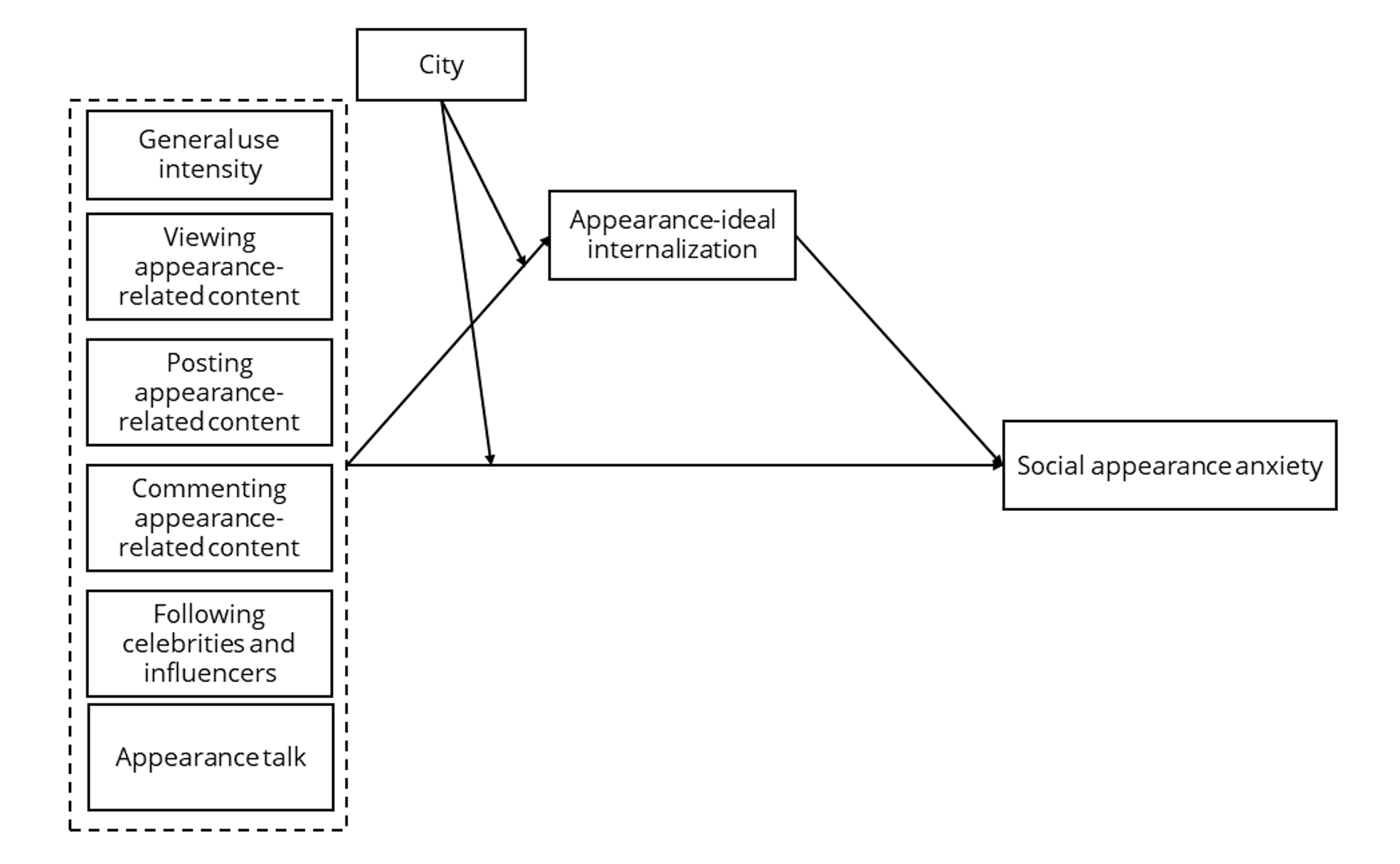
Notably, although there is substantial evidence in the literature for the impact of social media use and body talk on body image concerns (Course-Choi & Hammond, 2021; Fardouly & Vartanian, 2016; Fioravanti et al., 2022), it is possible that the direction of the relationship can be inverse (i.e., body image concerns may affect social media use and body talk; Frison & Eggermont, 2017; Rogers et al., 2015). We argue, however, that the relationships presented in the conceptual model (see Figure 1) are more plausible than the opposite direction based on the following theoretical and empirical grounds. Theoretically, the two classic social scientific theories that this study draws from both hold the assumption that media is a social actor that influences individuals’ perceptions and behaviors (Bandura, 1977; Thompson et al., 1999). Aligned with this theoretical assumption, this study emphasizes on media effect and hypothesizes that social media use and interpersonal communication may influence female RedNote users’ social appearance anxiety. Empirically, longitudinal and experimental studies that are generally considered more robust for bolstering causal claims than cross-sectional studies have supported that social media use has a significant impact on psychological well-being (Course-Choi & Hammond, 2021; Fardouly & Vartanian, 2016; Fioravanti et al., 2022; Lin et al., 2023).
Furthermore, this study examines whether the above relationships as presented in the conceptual model varied by geographic location where users resided. Geographic location represents the macro social cultural context which plays a crucial role in shaping users’ formation of social norms and internalization of social standards. An eight-nation study involving both Eastern and Western cultures finds significant cross-cultural differences in social anxiety and a significant correlation between social anxiety and social norms (Heinrichs et al., 2006). Additionally, the relationship between social media use and body dissatisfaction has also been found be contingent on the cultural context (Lee et al., 2014; Schaffer & Debb, 2020; Sheldon et al., 2017). However, prior studies have focused on differences across nations, rather than regional differences within a nation. Given China’s vast territory and cross-region heterogeneity, variations across regions have been observed in many aspects such as health status (Sun et al., 2011), well-being (X. Yang et al., 2020), and work values (Kwon, 2012). Hence, investigation into regional differences in terms of social media use and social appearance anxiety can provide insights into the nuances in relation to the broader social cultural factors associated with geographic location.
Covariates
To provide a more accurate estimation of the roles of the variables included in the conceptual model, we included users’ demographics, including age, education, and income, and the personality trait of narcissism as covariates. There is empirical evidence that age moderates the relationship between social media use and psychological well-being. More specifically, for younger adults under 30, social media use is negatively associated with anxiety; however, for adults aged 30 and above, the association is positive (Hardy & Castonguay, 2018). Education and income have also been found to be significantly linked to social media use (Özgüven & Mucan, 2013) and anxiety (Bjelland et al., 2008; Liu et al., 2023). Previous studies have also noted that narcissism is associated with social media use and social appearance anxiety (Boursier & Gioia, 2020; McCain & Campbell, 2018). Therefore, these variables should be taken into consideration to isolate the effects of social media use and interpersonal conversations on social appearance anxiety.
Methods
Participants and Procedures
We tested the hypotheses using an online survey of female RedNote users in China. This study was approved by the Human Subjects Ethics Committee of the corresponding author’s institution (Approval No. H003088). To increase the representativeness of the sample, we applied a stratified sampling method, in which we first selected three Chinese cities and then obtained our samples from these cities. Chinese cities are classified into three tiers based on criteria such as GDP, population size, and political administration. We then selected a representative city from each of the three tiers and from different geographic regions: Shanghai (Tier 1, in Eastern China), Chengdu (Tier 2, in Western China), and Harbin (Tier 3, in Northeastern China). We chose Shanghai, an international metropolis, as the exemplar city for Tier 1, as it is a global hub for business, finance, trade, and politics. In 2023, Shanghai had one of the largest populations of all Chinese cities, with approximately 24.75 million inhabitants, as well as the highest GDP, about 4.72 trillion yuan. Chengdu, the capital of Sichuan Province, is a Tier 2 city, and it is a major commerce, technology, and finance center in Western China. Chengdu’s overall urban development does not match the scale of Tier 1 cities, although it has experienced substantial economic growth, with a GDP of approximately 2.21 trillion yuan and a population of 20 million in 2023. Finally, Harbin, located in Northeastern China, is the capital of Heilongjiang Province, with a much smaller urban population (9.82 million) and economy (a GDP of approximately 500 billion yuan in 2023). Thus, Harbin is classified as a Tier 3 city.
Only female RedNote users in Shanghai, Chengdu, and Harbin were eligible to participate in the survey. The online survey was administered in August 2022 via Wenjuanxing, an online market research company in China whose sample pool covers over 2.6 million registered respondents with diverse demographic and geographic backgrounds. The survey platform distributed the questionnaire to eligible residents in these cities and provided financial compensations to those who submitted valid responses. The survey company employed rigorous quality control measures to ensure data reliability. These measures included removing cases with duplicate IP addresses, failed attention checks, and responses completed in an unreasonably short time.
After excluding two participants with missing data, we obtained 1,234 valid responses (NShanghai = 417, NChengdu = 404, NHarbin = 413). The average age of the participants was 29.14 years (range = 18–65, SD = 7.60). In terms of education, 77.2% held a bachelor’s degree, while 12.3% had postgraduate education and 10.5% had finished high school or below. In terms of income, over half of the participants (58.5%) earned less than 8,000 yuan per month, nearly one-third (34.1%) earned between 8,000 and 20,000 yuan, and 7.4% earned above 20,000 yuan. According to China’s latest national population census data (National Bureau of Statistics, 2020), our sample is younger and more highly educated than the general female population. However, based on user profile data from RedNote (Ch, 2025; Gao, 2024; GMA, 2024), approximately 70% of its users are women, 75% are young people aged 18 to 34, 71% hold a bachelor’s degree or higher, and 50% reside in first- or second-tier cities. These figures suggest that our sample closely matches the typical demographic characteristics of RedNote users.
Measures
General Use Intensity of RedNote
General use intensity was measured with five items adapted from the Facebook Intensity Scale (Ellison et al., 2007), which we modified to fit the context of RedNote. The participants were asked to rate the items (e.g., “Using RedNote is part of my everyday activity”) on a 5-point scale (1 = strongly disagree, 5 = strongly agree). The five items were averaged, with higher scores indicating a greater intensity of use (Cronbach’s α = .85, M = 3.58, SD = 0.81).
Viewing Appearance-Related Content on RedNote
Viewing appearance-related content on RedNote was measured with two items. The first was, “How often do you view appearance-related content on RedNote (e.g., fashion, cosmetics, skincare, weight loss, plastic surgery, medical aesthetics)?” The response options ranged from 1 = never to 5 = always. The second item required participants to rate the percentage of appearance-related content that they had browsed on RedNote. The response options ranged from 0 to 100 percent. We recoded the answers as follows:
1 = ‘0–20%’, 2 = ‘21–40%’, 3 = ‘41–60%’, 4 = ‘61–80%’, and 5 = ‘81–100%’. The two items were averaged, with a higher score indicating a higher frequency of viewing appearance-related content on RedNote (M = 3.47, SD = 0.94, Spearman’s correlation = .52, p < .001).
Posting Appearance-Related Content on RedNote
We asked the respondents to indicate the frequency of their posting of appearance-related content on RedNote on a 5-point scale (1 = never, 5 = always; M = 2.63, SD = 1.11).
Commenting on Appearance-Related Content on RedNote
The participants were asked to report how frequently they commented on others’ appearance-related posts on RedNote. This item was rated on a 5-point scale ranging from
1= never to 5 = always (M = 2.24, SD = 1.09).
Following Celebrities and Influencers on RedNote
Following celebrities and influencers on RedNote was assessed by asking the participants to report the number of influencers and celebrities on RedNote that they followed. As the distribution of this response was skewed, we log-transformed the answers (log (x+1)) to achieve normality (M = 1.04, SD = 0.61).
Appearance Talk
We assessed appearance talk using three items adapted from Jones et al. (2004; e.g., “My friends and I talk about how important it is to always look attractive”) on a 5-point scale (1 = never, 5 = always). The three items were averaged, with higher scores indicating more frequent appearance talk with friends (Cronbach’s α = .73, M = 3.61,
SD = 0.81).
Appearance-Ideal Internalization
Three items from the Sociocultural Attitudes Toward Appearance Questionnaire-3 (Thompson et al., 2004) were used to measure the internalization of appearance ideals. We slightly reworded the items to emphasize that appearance ideals were reflected in the participants’ references to influencers on RedNote. The participants were asked to rate the items (e.g., “I wish I looked like the influencers on RedNote”) on a 5-point scale (1 = strongly disagree, 5 = strongly agree). The three items were averaged, with higher scores indicating greater internalization of the appearance ideal (Cronbach’s α = .80, M = 2.79, SD = 1.00).
Social Appearance Anxiety
Social appearance anxiety was measured with the Social Appearance Anxiety Scale (Hart et al., 2008). The participants were asked to rate their level of agreement or disagreement (1 = strongly disagree, 5 = strongly agree) with seven items that assessed the anxiety of being negatively evaluated by others due to their overall appearance. A sample item is “I am concerned that people may not like me because of the way I look.” After conducting a confirmatory factor analysis as reported below, we removed one item because its standardized factor loading was below the acceptable threshold. The average of all six items was calculated, with higher scores indicating higher social appearance anxiety (Cronbach’s α = .87, M = 2.94, SD = 0.89).
Control Variables
Participants’ demographics, including age, education, and income, and the personality trait of narcissism were included as covariates. Narcissism was measured with the Narcissistic Personality Inventory (Ames et al., 2006). The participants were asked to indicate their levels of agreement (1 = strongly disagree, 5 = strongly agree) with nine items. A sample item is “I like to be the center of attention.” The responses on the nine items were averaged, with higher scores demonstrating higher levels of narcissism (Cronbach’s α = .77, M = 3.21, SD = 0.58).
These original measures were in English, and two bilingual speakers translated them into Chinese and back translated them to ensure accuracy.1
We conducted a confirmatory factor analysis (CFA) using maximum likelihood estimation to evaluate the measurement model for constructs assessed with multiple items. The model specified four latent constructs: general RedNote use intensity (5 items), appearance talk (3 items), appearance-ideal internalization (3 items), and social appearance anxiety (initially 7 items). All latent constructs were allowed to correlate. The remaining measures (i.e., viewing, posting, commenting, and following) were excluded from the CFA because they were treated as observed variables (i.e., single-item measures or composite indices) and therefore did not provide multiple indicators for specifying latent constructs.
The initial CFA results indicated that the measurement model had an adequate fit to the data, χ² = 750.16, df = 129, p < .001, CFI = .93, TLI = .92, RMSEA = .06,
90% CI [.058, .067], SRMR = .07. However, one item from the social appearance anxiety scale had a standardized factor loading of .30, which was below the commonly accepted threshold of .50 (Hair et al., 2018). Therefore, we removed this item and re-ran the CFA. The new measurement model had a good fit, χ² = 554.85, df = 113, p < .001, CFI = .95, TLI = .94, RMSEA = .06, 90% CI [.052, .061], SRMR = .04, and all standardized factor loadings exceeded the .50 cutoff, suggesting that the measures used in our study demonstrate adequate validity. We also calculated the variance inflation factor (VIF) to test for any multicollinearity. The VIF values were all between 1 and 2, below the threshold value of 5 (Menard, 1995). Thus, multicollinearity did not appear to be an issue in this study. Table 1 presents the correlation matrix of the variables.
Table 1. Zero-Order Correlation of Variables.
|
M |
SD |
1 |
2 |
3 |
4 |
5 |
6 |
7 |
8 |
9 |
10 |
11 |
12 |
||
|
1. Age |
29.14 |
7.60 |
— |
||||||||||||
|
2. Education |
— |
— |
.01 |
— |
|||||||||||
|
3. Income |
— |
— |
.35*** |
.37*** |
— |
||||||||||
|
4. Narcissism |
3.21 |
0.58 |
.01 |
.10*** |
.20*** |
— |
|||||||||
|
5. General use intensity |
3.58 |
0.81 |
.004 |
.09*** |
.24*** |
.33*** |
— |
||||||||
|
6. Viewing |
3.47 |
0.94 |
−.15*** |
.05 |
.14*** |
.23*** |
.39*** |
— |
|||||||
|
7. Following |
1.04 |
0.61 |
−.14*** |
.09** |
.16*** |
.17*** |
.39*** |
.40*** |
— |
||||||
|
8. Posting |
2.63 |
1.11 |
.05 |
.07* |
.22*** |
.31*** |
.37*** |
.37*** |
.27*** |
— |
|||||
|
9. Commenting |
2.24 |
1.09 |
.05 |
.04 |
.19*** |
.30*** |
.30*** |
.29*** |
.22*** |
.50*** |
— |
||||
|
10. Appearance talk |
3.61 |
0.81 |
.04 |
.04 |
.17*** |
.33*** |
.44*** |
.39*** |
.29*** |
.44*** |
.35*** |
— |
|||
|
11. Internalization |
2.79 |
1.00 |
−.01 |
.01 |
.08** |
.32*** |
.34*** |
.30*** |
.20*** |
.35*** |
.36*** |
.49*** |
— |
||
|
12. Social appearance anxiety |
2.94 |
0.89 |
−.23*** |
−.08** |
−.17*** |
−.01 |
.08** |
.17*** |
.09** |
.08** |
.08** |
.18*** |
.37*** |
— |
|
|
Note. *p < .05, **p < .01, ***p < .001.
|
|||||||||||||||
Data Analysis
H1 through H4 examined the role of general social media use, use of appearance-related content on social media, and appearance talk in predicting participants’ levels of social appearance anxiety. Hierarchical regressions were performed to test these proposed predictors in a stepwise fashion. To examine the mediation hypotheses presented in H5 to H7, we applied the PROCESS macro in SPSS (Model 4) with 5000 bias-corrected bootstrap samples and 95% confidence intervals (Hayes, 2022). A confidence interval that does not include zero indicates a statistically significant indirect effect at the α = .05 level. We also performed additional analyses to investigate whether a participant’s geographic location (i.e., Shanghai, Chengdu, or Harbin) played a moderating role in the above relationships via PROCESS (Model 8). This aimed at revealing whether the results could be universally generalized to other geographic locations within China or were determined by the social or economic development level of their location despite their similar cultural settings. Age, education, income, and narcissism were included as covariates in all the analyses, and additional covariates were added to some of the above analyses as specified in the Results below.
Results
After controlling for age, education, income, and narcissism, we found that the intensity of general RedNote use was significantly associated with appearance anxiety, b = 0.14, SE = 0.03, t = 4.15, p < .001. Thus, H1 was supported (Model 1). We then added the four types of appearance-related content use to the model as an additional block (Model 2). Viewing appearance-related content was a significant predictor of appearance anxiety, b = 0.12, SE = 0.03, t = 3.76, p < .001, but the number of celebrities and influencers that a user follows, the frequency of posting appearance-related content, and the frequency of commenting on appearance-related posts were not. These results supported H2 but not H3. We then added appearance talk as a new block (Model 3), which was positively associated with appearance anxiety, b = 0.19, SE = 0.04, t = 5.27, p < .001. Therefore, H4 was supported.
It should be noted that general use intensity was not significantly associated with appearance anxiety in Models 2 and 3. Table 2 summarizes the results of the hierarchical regression analyses.
Table 2. Hierarchical Regression Analysis on Social Appearance Anxiety.
|
|
Model 0 |
Model 1 |
Model 2 |
Model 3 |
||||||||
|
b |
SE |
β |
b |
SE |
β |
b |
SE |
β |
b |
SE |
β |
|
|
Block 1: Control variables |
||||||||||||
|
Constant |
3.97*** |
0.22 |
|
3.67*** |
0.23 |
|
3.41*** |
0.24 |
|
3.21*** |
0.24 |
|
|
Age |
−0.02*** |
0.003 |
−.20 |
−0.02*** |
0.003 |
−.20 |
−0.02*** |
0.004 |
−.17 |
−0.02*** |
0.004 |
−.18 |
|
Education |
−0.09 |
0.05 |
−.05 |
−0.08 |
0.05 |
−.05 |
−0.07 |
0.05 |
−.04 |
−0.07 |
0.05 |
−.04 |
|
Income |
−0.04** |
0.01 |
−.09 |
−0.05*** |
0.01 |
−.11 |
−0.06*** |
0.01 |
−.14 |
−0.06*** |
0.01 |
−.14 |
|
Narcissism |
0.03 |
0.04 |
.02 |
−0.03 |
0.05 |
−.02 |
−0.08 |
0.05 |
−.05 |
−0.11* |
0.05 |
−.07 |
|
Block 2: General use |
||||||||||||
|
General use intensity |
|
|
|
0.14*** |
0.03 |
.12 |
0.06 |
0.04 |
.06 |
0.02 |
0.04 |
.02 |
|
Block 3: Appearance−related content use |
||||||||||||
|
Viewing |
|
|
|
|
|
|
0.12*** |
0.03 |
.12 |
0.09** |
0.03 |
.09 |
|
Following |
|
|
|
|
|
|
0.01 |
0.05 |
.01 |
-0.004 |
0.05 |
−.003 |
|
Posting |
|
|
|
|
|
|
0.04 |
0.03 |
.05 |
0.01 |
0.03 |
.01 |
|
Commenting |
|
|
|
|
|
|
0.04 |
0.03 |
.05 |
0.03 |
0.03 |
.04 |
|
Block 4: Appearance talk |
||||||||||||
|
Appearance talk |
|
|
|
|
|
|
|
|
|
0.19*** |
0.04 |
.17 |
|
R2 |
.067 |
.080 |
.102 |
.122 |
||||||||
|
Adjusted R2 |
.064 |
.076 |
.095 |
.115 |
||||||||
|
Adjusted R2Change |
— |
.012 |
.019 |
.020 |
||||||||
|
F |
21.95 |
21.23 |
15.43 |
16.96 |
||||||||
|
Note. *p < .05, **p < .01, ***p < .001. |
||||||||||||
Based on the above results, we conducted mediation analyses of the three significant predictors—general use, viewing appearance-related content, and appearance talk—to test H5, H6, and H7 (see Table 3). We found that after controlling for age, education, income, and narcissism, general use intensity had a nonsignificant direct effect on appearance anxiety (b = 0.01, SE = 0.03, t = 0.39, p = .696), but a significant indirect effect through internalization (b = 0.12, SE = 0.02, 95% CI [0.09, 0.15]). Therefore, H5 was supported, and the effect of general use intensity on appearance anxiety was almost fully mediated by internalization. Viewing appearance-related content on RedNote had a significant direct effect on appearance anxiety (b = 0.07, SE = 0.03, t = 2.56, p = .011, 95% CI [0.02, 0.12]) and an indirect effect through internalization, which was also significant (b = 0.07, SE = 0.01, 95% CI [0.04, 0.09]). This result was observed after controlling for age, education, income, narcissism, and general RedNote use. H6(a) was thus supported, and the indirect effect via internalization accounted for approximately half of the total effect.
With age, education, income, narcissism, general use intensity, and viewing appearance-related content on RedNote included as covariates, the results showed that the direct effect of appearance talk on appearance anxiety was not significant, b = 0.05, SE = 0.04, t = 1.42, p = .155, 95% CI [−0.02, 0.12]. In contrast, appearance talk had a significant indirect effect on appearance anxiety through internalization, b = 0.15, SE = 0.02, 95% CI [0.12, 0.19]. H7 was supported, and the indirect path via internalization accounted for about 75% of the total effect of viewing appearance-related content on appearance anxiety.
Table 3. Direct and Indirect Effects of General Use Intensity, Viewing Appearance-Related Content,
and Appearance Talk on Social Appearance Anxiety.
|
Path |
Effect |
SE |
95% CI |
|
General use intensity -> social appearance anxiety |
0.01 |
0.03 |
[−0.05, 0.07] |
|
General use intensity -> internalization -> social appearance anxiety |
0.12 |
0.02 |
[0.09, 0.15] |
|
Viewing appearance-related content -> social appearance anxiety |
0.07 |
0.03 |
[0.02, 0.12] |
|
Viewing appearance-related content -> internalization -> social appearance anxiety |
0.07 |
0.01 |
[0.04, 0.09] |
|
Appearance talk -> social appearance anxiety |
0.05 |
0.04 |
[−0.02, 0.12] |
|
Appearance talk -> internalization -> social appearance anxiety |
0.15 |
0.02 |
[0.12, 0.19] |
|
Note. Bold fonts indicate statistical significance (p < .05). |
|||
Table 4. The Moderation of City in the Direct and Indirect Effects of General Use Intensity, Viewing Appearance-Related
Content, and Appearance Talk on Social Appearance Anxiety.
|
City |
Paths |
Effect |
SE |
95% CI |
|
Shanghai |
General use intensity -> social appearance anxiety |
−0.09 |
0.05 |
[−0.19, 0.01] |
|
General use intensity -> internalization -> social appearance anxiety |
0.14 |
0.02 |
[0.09, 0.19] |
|
|
Viewing appearance-related content -> social appearance anxiety |
0.09 |
0.04 |
[0.003, 0.17] |
|
|
Viewing appearance-related content -> internalization -> social appearance anxiety |
0.10 |
0.02 |
[0.07, 0.14] |
|
|
Appearance talk -> social appearance anxiety |
−0.01 |
0.05 |
[−0.11, 0.09] |
|
|
Appearance talk -> internalization -> social appearance anxiety |
0.16 |
0.02 |
[0.12, 0.20] |
|
|
Chengdu |
General use intensity -> social appearance anxiety |
−0.01 |
0.03 |
[−0.07, 0.06] |
|
General use intensity -> internalization -> social appearance anxiety |
0.13 |
0.02 |
[0.10, 0.16] |
|
|
Viewing appearance-related content -> social appearance anxiety |
0.07 |
0.03 |
[0.02, 0.13] |
|
|
Viewing appearance-related content -> internalization -> social appearance anxiety |
0.07 |
0.01 |
[0.05, 0.10] |
|
|
Appearance talk -> social appearance anxiety |
0.05 |
0.04 |
[−0.02, 0.12] |
|
|
Appearance talk -> internalization -> social appearance anxiety |
0.15 |
0.02 |
[0.12, 0.19] |
|
|
Harbin |
General use intensity -> social appearance anxiety |
0.08 |
0.04 |
[0.001, 0.16] |
|
General use intensity -> internalization -> social appearance anxiety |
0.11 |
0.02 |
[0.08, 0.15] |
|
|
Viewing appearance-related content -> social appearance anxiety |
0.05 |
0.04 |
[−0.02, 0.13] |
|
|
Viewing appearance-related content -> internalization -> social appearance anxiety |
0.04 |
0.02 |
[0.01, 0.08] |
|
|
Appearance talk -> social appearance anxiety |
0.11 |
0.05 |
[0.01, 0.20] |
|
|
Appearance talk -> internalization -> social appearance anxiety |
0.15 |
0.02 |
[0.11, 0.19] |
|
|
Note. Bold fonts indicate statistical significance (p < .05). |
||||
We also explored whether the above relationships were conditioned by city using PROCESS Model 8. City (1 = Shanghai, 2 = Chengdu, and 3 = Harbin) was added to the model as a moderator of the direct and indirect effects of the exogenous variable on appearance anxiety (see Table 4). The results showed that city was not a significant moderator of the indirect effect of general social media use on appearance anxiety through internalization (the index of moderated mediation = −0.01, SE = 0.02,
95% CI [−0.04, 0.02]). However, the direct effect was conditioned by city (b = 0.09, SE = 0.03, t = 2.63, p = .009): only Harbin participants reported a significant positive direct association between general use and appearance anxiety (b = 0.08, SE = 0.04, t = 1.99, p = .047, 95% CI [0.001, 0.16]), while this association was not significant among Shanghai and Chengdu participants (Shanghai: b = −0.09, SE = 0.05,t = −1.86, p = .063; Chengdu: b = −0.01, SE = 0.03, t = −0.17, p = 0.862).
Interestingly, we found that this pattern was reversed for viewing appearance-related content, as city significantly moderated the indirect effect of viewing appearance-related content on appearance anxiety through internalization (the index of moderated mediation = −0.03, SE = 0.01, 95% CI [−0.05, −0.01]). More specifically, the indirect effect was stronger among female RedNote users in Shanghai (b = 0.10, SE = 0.02, 95% CI [0.07, 0.14]) than for those in Chengdu and Harbin (Chengdu: b = 0.07, SE = 0.01,
95% CI [0.05, 0.10]; Harbin: b = 0.04, SE = 0.02, 95% CI [0.01, 0.08]). However, the specific city did not influence the direct effect (b= −0.02, SE = 0.03, t = −.56, p = .572).
With regard to appearance talk, city was not a significant moderator of the direct effect of appearance talk on appearance anxiety (b= 0.06, SE = 0.03, t = 1.76, p = .078), nor was it a significant moderator of the indirect effect of appearance talk (the index of moderated mediation = −0.004, SE = 0.01, 95% CI [−0.03, 0.02]).
Discussion
Social appearance anxiety has become an increasingly severe problem, particularly among women, because of the huge number of beautified photos flooding social media that feature unrealistic appearance ideals. Drawing on algorithm-mediated social learning and the Tripartite Influence Model, in this study, we revealed the roles of algorithm-mediated image-based social media use and appearance talk in predicting users’ social appearance anxiety, and we explored the underlying mechanism and contextual factors. Through a survey conducted among female RedNote users in three Chinese cities representing different Tiers, we found that the level of general use of the platform was indirectly associated with users’ appearance anxiety via internalization, while viewing appearance-related content was directly and indirectly linked to appearance anxiety. These relationships were moderated by the participants’ specific geographic locations. The direct association between general use intensity and appearance anxiety was significant only among Harbin participants (Tier 3 city), while the indirect effect of viewing appearance-related content on appearance anxiety through internalization was strongest for Shanghai participants (Tier 1 city). Additionally, appearance talk was indirectly associated with social appearance anxiety via internalization. These findings offer unique insights into users’ interactions with this algorithm-mediated platform and their corresponding cognition and behavior regarding social appearance anxiety. We discussed the theoretical and practical implications of our findings as follows.
Algorithm-Driven Social Media Use
The results support that passive social media use (i.e., general use intensity and viewing appearance-related content) was positively associated with social appearance anxiety rather than active social media use (i.e., posting and commenting on appearance-related content and following celebrities and influencers). The previous research findings on the ability of passive versus active social media use to predict well-being are mixed (Valkenburg, 2022). For example, in their meta-analysis, Yin et al. (2019) found that the effects of passive and active social media use on aggregate psychological outcomes were nonsignificant. However, another meta-analytic study on specific well-being reported a weak but positive association between active social media use and anxiety (r = .06) and a stronger association for passive social media use (r = .21; Hancock et al., 2019). Our findings align with these results rather than those of Yin et al. (2019). These mixed findings indicate that psychological well-being is a complex concept that encompasses various distinct types of well-being such as depression, anxiety, and self-esteem, all of which may have differential associations with social media use. Our results further confirm that passive social media use (i.e., general use intensity and viewing appearance-related content) plays a more important role in predicting social appearance anxiety than active social media use (i.e., posting and commenting on appearance-related content and following celebrities and influencers). One possible explanation for this is that the aggravation of social appearance anxiety through social learning demands the acceptance of the predominant social norms regarding beauty standards and the internalization of these standards to guide an individual’s behavior. Passive social media use better fits the purpose of this process as it mainly involves viewing content and taking in information, manifesting a classic media effect induced by content exposure. In contrast, active social media use such as posting and commenting requires users to invest more physical and intellectual resources, which indicates a higher likelihood of exercising critical thinking and thus potentially higher resistance to the content, particularly if it can have negative impacts. This echoes the findings of other well-being studies, suggesting that active social media use alleviates depression while passive social media use increases depressive symptoms (Escobar-Viera et al., 2018). Therefore, we can tentatively conclude that when criticizing the dark side of social media use on negative well-being outcome, we probably should blame passive social media use. However, active social media use may help people resist the potentially negative influence of unhealthy content. In addition, passive social media use on algorithm-based platforms may be a more accurate predictor of users’ cognition and behavior, as their activities on the platform can be considered as input into the content curation algorithm, which can then be fine-tuned to better predict users’ interests and thus provide them with more appropriate personalized content. From this viewpoint, active social media use is part of the human–algorithm interaction on the platform, whereas passive social media use indicates the level of exposure to the content pushed to the user by the algorithm. This highlights the power of the algorithms applied to image-based social media in disciplining user behavior. More research is needed to further disentangle the roles of different types of passive and active social media use in reducing the potential influence of algorithm-mediated learning, particularly when the content elicits negative psychological outcomes. However, it should be noted that the effect size of general social media use and viewing appearance-related content found in this study was small as reflected in the adjusted R2 change. Compared to social media use, demographics and personality traits were stronger predictors on social appearance anxiety. In this view, we should not blame algorithmic social media solely for negative psychological well-being and relevant adverse outcomes. Social appearance anxiety is a complex social problem, and resolving this problem demands joint efforts from individuals, social media platforms, educational institutions, and governments.
Internalization as the Underlying Mechanism
We also found that the mechanisms through which general use and content-specific use were associated with social appearance anxiety differed. Internalization almost fully mediated the positive relationship between general use and appearance anxiety, while viewing appearance-related content was both directly and indirectly associated with increased levels of appearance anxiety. This is consistent with findings regarding Western platforms such as Instagram, as research has indicated that both general use and content-specific use have indirect effects on body dissatisfaction via internalization (Jarman et al., 2021). In our study, the direct association between viewing appearance-related content and appearance anxiety can be understood through the lens of the classic media effect model of content exposure. Whereas the mediating role of internalization in the effect of general use and viewing appearance-related content on appearance anxiety lends support to the notion of the algorithm-mediated social learning that takes place on RedNote. The more time users spend on RedNote, the more likely they will be to internalize the norms and standards promoted by the platform’s content, which may be due to continuous exposure to the highly similar content curated by the algorithm. Thus, the roles of general versus content-specific use should be further examined in the contexts of different algorithmic social media.
In addition to social media use, interpersonal discussions related to physical appearance (i.e., appearance talk) were found to play a complementary role in promoting appearance anxiety via internalization. This aligns with the prediction of the Tripartite Influence Model, which indicates that even in the age of algorithmic social media when human communication is increasingly mediated by various media technologies, direct interpersonal communication remains important for internalizing the social norms promoted through social media content to be part of users’ own world views and values that guide their cognition and behavior. Future studies can investigate the factors of interpersonal communication that may affect the processes and outcomes of algorithm-mediated social learning, such as the frequency and intensity of interpersonal discussions as well as the partner of interpersonal communication.
It is important to note that this mediating mechanism was supported with the cross-sectional data of this study which cannot establish temporality. Nevertheless, the Tripartite Influence Model posits that internalization is one key mechanism that the media and social circles shape the formation of socially accepted standards (Thompson et al., 1999). Additionally, the mediating role of internalization identified by this study is also consistent with previous studies (Paterna et al., 2021; Wang et al., 2022). Therefore, we believe this finding is more plausible than the other direction, and more longitudinal and experimental evidence is expected to substantiate the causal relationship.
The Moderating Role of Geographic Location
The identified relationships are also conditioned by the geographic contexts. The three cities of Shanghai, Chengdu, and Harbin differ in geographic location, population size, and the level of economic development. The Shanghai (Tier 1 city) participants reported the strongest indirect association between viewing appearance-related content and appearance anxiety through internalization. In contrast, only Harbin (Tier 3 city) participants reported a significant positive direct association between general use and appearance anxiety. This should be interpreted through a holistic lens of the geographic, economic, social and cultural factors of the respective location. Shanghai is an economically developed and highly modernized region where the level of penetration and development of media systems is advanced. Its population is more than 2 times the population of Harbin and its GDP is more than 9 times that of Harbin, indicating considerable differences in terms of economic development and associated lifestyles of residents between Shanghai and Harbin. Furthermore, these differences are also consistent with the level of mediatization in the two cities. Mediatization is the extent of the media’s role in societal development and cultural change as a social institution, in other words, to what extent the society is mediated by the media (Hjarvard, 2008). For instance, Shanghai has two of China’s largest media conglomerates—Shanghai United Media Group and Shanghai Media Group, covering newspapers, magazines, websites, radio, cable television, satellite television, and other media formats. Whereas Harbin’s media industry has a much smaller size and a lower level of development. Moreover, RedNote has a higher penetration rate in Tier 1 cities than in Tier 3 cities (Ch, 2025; Gao, 2024; GMA, 2024). Taken together, it is suggested that the level of mediatization of Shanghai is higher than that of Harbin.
In this view, the direct association between general use and appearance anxiety in Harbin can be explained through the classic angle of media effects, that is, more media exposure, stronger media effects, indicating the effects stem from the use of the medium rather than the media content in contexts featuring a relatively lower level of economic development and mediatization. However, the indirect association between appearance-related content exposure and appearance anxiety through internalization among Shanghai participants tells a different story: in contexts featuring a high level of economic development and mediatization, the media plays a prominent role in shaping people’s views and values through the process of internalization, which is a self-persuasion process featuring individuals integrating opinions and norms into their inner value systems. Norms internalized through the influence of social media may be more resistant to potential attacks and thereby have a more enduring effect on attitudes and behavior. Future studies are recommended to test the long-term effects of RedNote use in terms of how resistant the perceptions, attitudes, and behaviors formed through media use is to counterarguments in different regions within and outside China with longitudinal research design.
Theoretical Implications
This study contributes to the existing body of studies on social media use and psychological well-being in the following aspects. First, this study approaches this topic from an innovative perspective that integrates algorithm-mediated social learning and the Tripartite Influence Model. Social learning theory and the Tripartite Influence Model were originally developed in the context of traditional media. This study expands the scope of these classic theories to the algorithm-mediated information context, particularly the image-based algorithmic platforms, and provides empirical evidence for the underlying mechanism of internalization. Moreover, the interest-based content curation affordance of RedNote algorithm may uniquely amplify internalization of the social norms and standards related to certain interest areas because of user-algorithm interactions, which is a new insight regarding the algorithm-mediated information context. Second, this study explicates the differential roles of passive social media use and active social media use as well as the unique roles of general use and content-specific use in the process of algorithm-mediated learning, contributing to deepening our understanding of this new theoretical notion. Third, previous studies have noted that the association between social media use and body dissatisfaction in Western and Asian countries differs (Lee et al., 2014). This study extends this line of research into the Chinese context and the platform RedNote which has unique algorithmic affordances. Furthermore, few studies have assessed the cross-regional differences within a country in this regard, let alone in the Chinese context. Our study fills this research gap and contributes to the literature by revealing how the level of mediatization in a society and the nuances of local cultures within a nation can help determine the role of social media in predicting users’ psychological well-being.
Practical Implications
Based on our findings, we offer the following suggestions for mitigating social appearance anxiety in China. First, the platform may design some relevant features to mitigate the potential harm of extensive algorithmic media use. For example, they may send reminders or prompts to heavy users whose total time spent on the platform exceeds a maximum. It is also important for platforms that employ algorithms to curate personalized content for their users to disclose the factors that they rely on for content curation decisions to their users for transparency purposes. Relatedly, the platforms may refine their algorithms to implement content controls for avoiding excessive presentation of content on a certain topic in a short time span to a particular user. Second, a community-based peer-assisted approach can reduce the social appearance anxiety induced by social media use, as interpersonal communication can influence its development. Third, local social and cultural factors should be considered when taking such approaches, and small-scale pilot tests can be conducted with local residents before any remedy is implemented on a larger scale.
Limitations and Conclusion
Our study has some limitations that should be considered when interpreting the results and planning future research. First, causal relationships cannot be established from cross-sectional studies, so other methods such as longitudinal designs or experimental methods can be used to gather more substantial evidence of causality. Second, although we attempted to ensure that our sample was representative by applying a stratified sampling method, we only collected data from three cities, which represented different tiers, due to limited resources. Moreover, our study only included female adult users of RedNote in the three cities. Caution should be exercised when generalizing the results to other contexts, other age groups, other genders, and rural users. Third, we only focused on the psychological well-being outcome of social appearance anxiety; whether it also applies to other outcomes such as depression and self-esteem requires further investigation. Fourth, some measures can be improved. Measures of general use and appearance-related use of RedNote were not associated with a specific time frame, so participants might have various interpretations of the items. Future research can specify a timeframe in these measures (e.g., in the past week) to enhance the measurement validity. For measures such as the number of celebrities and influencers a participant follows on RedNote and the frequency of social media use behaviors (e.g., viewing content), due to their self-reported nature, the accuracy of the results may be difficult to assess. Future studies are recommended to obtain relevant data from other sources such as digital user record.
Furthermore, although appearance-related social media use and appearance talk were statistically significant predictors of social appearance anxiety, their incremental contribution to the explained variance was relatively small. Therefore, the practical impact of these behaviors should be interpreted with caution. Future research should incorporate a broader range of psychological or environmental factors to better account for the remaining variance.
To conclude, in this research, we reveal the predictors, mediating mechanism, and contextual factors of social appearance anxiety in the Chinese context. The findings enrich our understanding of the interplay between various types of social media use, interpersonal discussions, and psychological well-being in algorithm-mediated social media environments. We also extend the classic Tripartite Influence Model to algorithmic media. Our study also offers practical insights into how effective remedies can be designed to mitigate the negative influences of social media use.
Footnotes
[1] Before we started the data collection, we invited a few female RedNote users (university students) to complete the draft questionnaire. Based on their feedback, we slightly changed the wording of some items to enhance readability. Then we hired a professional survey company in China to collect data for this survey. The survey company first conducted a pilot test and collected around 50 responses. We conducted a preliminary analysis with the 50 responses and did not spot any irregularity. Then the survey company continued to collect more data.
Conflict of Interest
The authors have no conflicts of interest to declare.
Use of AI Services
The authors declare that they used AI services, specifically ChatGPT-4o, in the Method section for grammar correction and minor stylistic refinements. They carefully reviewed all suggestions from these services to ensure the original meaning and factual accuracy were preserved.
Data Availability Statement
The data underlying this article are available from the corresponding author upon reasonable request.
Acknowledgement
This study was supported by the Strategic Research Grant from City University of Hong Kong (Project No. 7005700) and the Social Science Foundation of Zhejiang Province (Project No. 25CCG09).
Appendices
Appendix A
Table A1. Items Used for All Variables.
|
General Use Intensity of RedNote (Ellison et al., 2007; 1 = strongly disagree, 5 = strongly agree) |
|
RedNote is part of my everyday activity. |
|
RedNote has become part of my daily routine. |
|
I feel out of touch when I haven’t logged onto RedNote for a while. |
|
I feel I am part of the RedNote community. |
|
I would be sorry if RedNote shut down. |
|
Viewing Appearance-related Content on RedNote |
|
How often are you exposed to appearance-related content (e.g., fashion, cosmetics/skin care, hair, fitness/exercise, weight loss/dieting, cosmetic surgery) on RedNote? |
|
What percentage of the content you are exposed to on RedNote is related to appearance? (0-100%) |
|
Posting Appearance-related Content on RedNote |
|
How often do you post appearance-related content (e.g., fashion, cosmetics/skin care, hair, fitness/exercise, weight loss/dieting, cosmetic surgery) on RedNote? (1 = never, 2 = occasionally, 3 = sometimes, 4 = often, 5 = always) |
|
Commenting on Appearance-related Content on RedNote |
|
How often do you comment on others’ appearance-related posts (e.g., fashion, cosmetics/skin care, hair, fitness/exercise, weight loss/dieting, cosmetic surgery) on RedNote? (1 = never, 2 = occasionally, 3 = sometimes, 4 = often, 5 = always) |
|
Following Celebrities and Influencers on RedNote |
|
How many accounts you follow on RedNote are celebrities and influencers? |
|
Appearance Talk (Jones et al., 2004; 1 = strongly disagree, 5 = strongly agree) |
|
My friends and I talk about what we would like our bodies to look like. |
|
My friends and I talk about how important it is to always look attractive. |
|
My friends and I talk about what we can do to always look our best. |
|
Appearance-ideal Internalization (Thompson et al., 2004) (1 = strongly disagree, 5 = strongly agree) |
|
I compare my appearance to the appearance of celebrities and influencers on RedNote. |
|
I wish I looked like the influencers on RedNote. |
|
I think the appearance of influencers on RedNote is exactly what the society now accepts as the standards of beauty. |
|
Social Appearance Anxiety (Hart et al., 2008; 1 = strongly disagree, 5 = strongly agree) |
|
I get tense when it is obvious people are looking at me. |
|
I am concerned people would not like me because of the way I look. |
|
I worry that my appearance will make life more difficult for me. |
|
I am concerned that I have missed out on opportunities because of my appearance. |
|
I get nervous when talking to people because of the way I look. |
|
I worry people will judge the way I look negatively. |
|
I feel comfortable with the way I appear to others. (excluded due to low factor loading) |
Appendix B
Table B1. Full Results of Hierarchical Regression Analysis on Social Appearance Anxiety.
|
Model 0 |
Model 1 |
Model 2 |
Model 3 |
|||||||||||||||||
|
b |
SE |
β |
t |
p |
b |
SE |
β |
t |
p |
b |
SE |
β |
t |
p |
b |
SE |
β |
t |
p |
|
|
Block 1: Control variables |
|
|
|
|
|
|
|
|
||||||||||||
|
Constant |
3.97 |
0.22 |
17.87 |
<.001 |
3.67 |
0.23 |
15.78 |
<.001 |
3.41 |
0.24 |
14.22 |
<.001 |
3.21 |
0.24 |
13.32 |
<.001 |
||||
|
Age |
−0.02 |
0.003 |
−.20 |
−6.86 |
<.001 |
−0.02 |
0.003 |
−.20 |
−6.58 |
<.001 |
−0.02 |
0.004 |
−.17 |
−5.67 |
<.001 |
−0.02 |
0.004 |
−.18 |
−6.04 |
<.001 |
|
Education |
−0.09 |
0.05 |
−.05 |
−1.67 |
.096 |
−0.08 |
0.05 |
−.05 |
−1.62 |
.105 |
−0.07 |
0.05 |
−.04 |
−1.38 |
.167 |
−0.07 |
0.05 |
−.04 |
−1.28 |
.201 |
|
Income |
−0.04 |
0.01 |
−.09 |
−2.69 |
.007 |
−0.05 |
0.01 |
−.11 |
−3.47 |
<.001 |
−0.06 |
0.01 |
−.14 |
−4.26 |
<.001 |
−0.06 |
0.01 |
−.14 |
−4.23 |
<.001 |
|
Narcissism |
0.03 |
0.04 |
.02 |
0.59 |
.554 |
−0.03 |
0.05 |
−.02 |
−0.63 |
.528 |
−0.08 |
0.05 |
−.05 |
−1.71 |
.088 |
−0.11 |
0.05 |
−.07 |
−2.48 |
.013 |
|
Block 2: General use |
|
|
|
|
|
|
|
|||||||||||||
|
General use intensity |
0.14 |
0.03 |
.12 |
4.15 |
<.001 |
0.06 |
0.04 |
.06 |
1.76 |
.079 |
0.02 |
0.04 |
.02 |
0.57 |
.568 |
|||||
|
Block 3: Appearance-related content use |
|
|
|
|
|
|
||||||||||||||
|
Viewing |
|
|
|
|
0.12 |
0.03 |
.12 |
3.76 |
<.001 |
0.09 |
0.03 |
.09 |
2.87 |
.004 |
||||||
|
Following |
|
|
|
|
0.01 |
0.05 |
.01 |
0.20 |
.846 |
−0.004 |
0.05 |
−.003 |
−0.09 |
.931 |
||||||
|
Posting |
|
|
|
|
0.04 |
0.03 |
.05 |
1.43 |
.152 |
0.01 |
0.03 |
.01 |
0.34 |
.737 |
||||||
|
Commenting |
|
|
|
|
0.04 |
0.03 |
.05 |
1.59 |
.113 |
0.03 |
0.03 |
.04 |
1.19 |
.234 |
||||||
|
Block 4: Appearance talk |
|
|
|
|
|
|
|
|
||||||||||||
|
Appearance talk |
|
|
|
|
|
|
0.19 |
0.04 |
.17 |
5.27 |
<.001 |
|||||||||
|
R2 |
.067 |
.080 |
.102 |
.122 |
||||||||||||||||
|
Adjusted R2 |
.064 |
.076 |
.095 |
.115 |
||||||||||||||||
|
F |
21.95 |
21.23 |
15.43 |
16.96 |
||||||||||||||||


This work is licensed under a Creative Commons Attribution-ShareAlike 4.0 International License.
Copyright © 2026 Guanxiong Huang, Mengru Sun, Yuanyi Mao