
Basic psychological need satisfaction and problematic gaming, mobile phone use, and social networking in adolescents: Disentangling between- and within-person associations
Vol.20,No.5(2026)
Xuan Xu
 Haide Chen
Lingfeng Gao
Basic psychological need satisfaction is often treated as a dynamic antecedent and consequence of adolescents’ problematic use of digital technologies. However, longitudinal associations may reflect stable differences between adolescents rather than changes occurring within the same adolescent. Using three-wave data from 1,024 Chinese adolescents assessed at six-month intervals, this study estimated multiple-indicator latent random-intercept cross-lagged panel models examining psychological need satisfaction in relation to Internet gaming disorder (IGD), problematic mobile phone use (PMPU), and social networking site addiction (SNSA) scores. At the between-person level, lower need satisfaction was associated with higher IGD, r = −.442, 95% CI [−.783, −.102], and PMPU, r = −.614, 95% CI [−.952, −.277]. The association with SNSA was negative but not statistically significant, r = −.431, 95% CI [−.926, .064]. None of the six-month cross-lagged paths was statistically significant. In dimension-specific models, FDR-adjusted between-person associations remained for competence and relatedness with IGD and PMPU, whereas none of the dimension-specific cross-lagged paths was statistically significant. Composite-score and classroom-cluster-robust analyses yielded the same general pattern. These findings refine the theoretical interpretation of the need and technology use association: At a six-month timescale, the clearest detected pattern was stable covariation between adolescents, whereas reciprocal cross-lagged within-person associations were not detected. Distinguishing these levels provides a more precise basis for separating enduring need-related vulnerability from shorter-term compensatory processes.
basic psychological need satisfaction; Internet gaming disorder; problematic mobile phone use; social networking site addiction; adolescents; RI-CLPM
Xuan Xu
Key Laboratory of Adolescent Cyberpsychology and Behavior (CCNU), Ministry of Education, Wuhan, Hubei, China
Xuan Xu is a PhD candidate at the School of Psychology, Central China Normal University, China. His research focuses on adolescent mental health and psychological processes in digital environments, with particular interests in behavioral addictions, human–AI interaction, and misinformation. He is also interested in interdisciplinary research. His work uses longitudinal modeling, network analysis, and experimental methods.
Haide Chen
Intelligent Laboratory of Child and Adolescent Mental Health and Crisis Intervention of Zhejiang Province, School of Psychology, Zhejiang Normal University, Jinhua, Zhejiang, China
Haide Chen, PhD, is an Associate Professor at Zhejiang Normal University, China. His research focuses on health psychology and the development of health behaviors among children and adolescents, including diet, physical activity, and sleep. His work primarily uses ecological momentary assessment and behavioral experiments.
Wan Zhao
Intelligent Laboratory of Child and Adolescent Mental Health and Crisis Intervention of Zhejiang Province, School of Psychology, Zhejiang Normal University, Jinhua, Zhejiang, China
Wan Zhao received a master’s degree in applied psychology from the School of Psychology, Zhejiang Normal University, China, in 2024. Research interests include behavioral addictions, particularly problematic mobile phone use and gaming disorder, with a specific interest in craving and desire thinking. Research methods include mediation and moderation analyses, network analysis, and event-related potentials (ERPs).
Lingfeng Gao
Intelligent Laboratory of Child and Adolescent Mental Health and Crisis Intervention of Zhejiang Province, School of Psychology, Zhejiang Normal University, Jinhua, Zhejiang, China
Lingfeng Gao, PhD, is an Associate Professor at the School of Psychology, Zhejiang Normal University, China. His research focuses on child and adolescent mental health, particularly psychological crises and internet addiction. He has published extensively in Chinese and international journals and serves on professional committees of the Chinese Psychological Society and on the editorial board of Humanities and Social Sciences Communications.
Andreassen, C. S., Billieux, J., Griffiths, M. D., Kuss, D. J., Demetrovics, Z., Mazzoni, E., & Pallesen, S. (2016). The relationship between addictive use of social media and video games and symptoms of psychiatric disorders: A large-scale cross-sectional study. Psychology of Addictive Behaviors, 30(2), 252–262. https://doi.org/10.1037/adb0000160
Bender, P. K., & Gentile, D. A. (2020). Internet gaming disorder: Relations between needs satisfaction in-game and in life in general. Psychology of Popular Media, 9(2), 266–278. https://doi.org/10.1037/ppm0000227
Brand, M., Wegmann, E., Stark, R., Müller, A., Wölfling, K., Robbins, T. W., & Potenza, M. N. (2019). The interaction of person-affect-cognition-execution (I-PACE) model for addictive behaviors: Update, generalization to addictive behaviors beyond internet-use disorders, and specification of the process character of addictive behaviors. Neuroscience & Biobehavioral Reviews, 104, 1–10. https://doi.org/10.1016/j.neubiorev.2019.06.032
Chen, A. (2019). From attachment to addiction: The mediating role of need satisfaction on social networking sites. Computers in Human Behavior, 98, 80–92. https://doi.org/10.1016/j.chb.2019.03.034
Chen, B., Vansteenkiste, M., Beyers, W., Soenens, B., & Van Petegem, S. (2013). Autonomy in family decision making for Chinese adolescents: Disentangling the dual meaning of autonomy. Journal of Cross-Cultural Psychology, 44(7), 1184–1209. https://doi.org/10.1177/0022022113480038
Chen, F. F. (2007). Sensitivity of goodness of fit indexes to lack of measurement invariance. Structural Equation Modeling: A Multidisciplinary Journal, 14(3), 464–504. https://doi.org/10.1080/10705510701301834
Chen, I.-H., Ahorsu, D. K., Pakpour, A. H., Griffiths, M. D., Lin, C.-Y., & Chen, C.-Y. (2020). Psychometric properties of three simplified Chinese online-related addictive behavior instruments among mainland Chinese primary school students. Frontiers in Psychiatry, 11, Article 875. https://doi.org/10.3389/fpsyt.2020.00875
Chen, L., & Xia, M. (2025). Adolescent psychological adaptation: The impact of daily levels and instability in psychological need satisfaction and frustration. Journal of Adolescence, 97(5), 1272–1283. https://doi.org/10.1002/jad.12495
Chen, Y., Li, R., & Liu, X. (2023). Relatedness frustration and compensatory behaviors in social networking sites among Chinese college students: Role of self-control failure. Current Psychology, 42(1), 307–316. https://doi.org/10.1007/s12144-021-01440-0
Christakis, D. A. (2019). The challenges of defining and studying “digital addiction” in children. JAMA, 321(23), 2277–2278. https://doi.org/10.1001/jama.2019.4690
Csibi, S., Griffiths, M. D., Demetrovics, Z., & Szabo, A. (2021). Analysis of problematic smartphone use across different age groups within the ‘components model of addiction’. International Journal of Mental Health and Addiction, 19(3), 616–631. https://doi.org/10.1007/s11469-019-00095-0
Deci, E. L., & Ryan, R. M. (2012). Self-determination theory. In P. A. M. Van Lange, A. W. Kruglanski, & E. T. Higgins (Eds.), Handbook of theories of social psychology (pp. 416–437). SAGE Publications. https://doi.org/10.4135/9781446249215.n21
Du, J., Kato, K., & Kobayashi, M. (2020). Reliability and validity of the Chinese version of the Basic Psychological Need Satisfaction Scale among college students. Chinese Journal of Health Psychology, 28(2), 218–221. https://doi.org/10.13342/j.cnki.cjhp.2020.02.015
Gao, Q., Zheng, H., Sun, R., & Lu, S. (2022). Parent-adolescent relationships, peer relationships, and adolescent mobile phone addiction: The mediating role of psychological needs satisfaction. Addictive Behaviors, 129, Article 107260. https://doi.org/10.1016/j.addbeh.2022.107260
Geng, J., Bao, L., Wang, H., Wang, J., Gao, T., & Lei, L. (2022). Does childhood maltreatment increase the subsequent risk of problematic smartphone use among adolescents? A two-wave longitudinal study. Addictive Behaviors, 129, Article 107250. https://doi.org/10.1016/j.addbeh.2022.107250
Groenestein, E., Willemsen, L., van Koningsbruggen, G. M., & Kerkhof, P. (2025). Fear of missing out and social media use: A three-wave longitudinal study on the interplay with psychological need satisfaction and psychological well-being. New Media & Society,27(7), 4205–4227. https://doi.org/10.1177/14614448241235935
Gu, J., Wang, H., Xu, Y., Zhan, P., & Wang, J. (2023). Childhood maltreatment, basic psychological needs satisfaction, internet addiction and internalizing problems. Journal of Applied Developmental Psychology, 86, Article 101533. https://doi.org/10.1016/j.appdev.2023.101533
Gugliandolo, M. C., Costa, S., Kuss, D. J., Cuzzocrea, F., & Verrastro, V. (2020). Technological addiction in adolescents: The interplay between parenting and psychological basic needs. International Journal of Mental Health and Addiction, 18(5), 1389–1402. https://doi.org/10.1007/s11469-019-00156-4
Hamaker, E. L., Kuiper, R. M., & Grasman, R. P. P. P. (2015). A critique of the cross-lagged panel model. Psychological Methods, 20(1), 102–116. https://doi.org/10.1037/a0038889
Han, Y., Qiu, J., Shi, C., Huang, S., Huang, H., Wang, X., Zhu, S., Lu, D. L., Lu, P., & Zeng, F. (2025). Factors associated with digital addiction: Umbrella review. JMIR Mental Health, 12, Article e66950. https://doi.org/10.2196/66950
Holding, A. C., Verner-Filion, J., Lalande, D., Schellenberg, B. J. I., & Vallerand, R. J. (2021). The roles of need satisfaction and passion in symptoms of behavioral addiction: The case of video gaming and gambling. Motivation Science, 7(3), 345–355. https://doi.org/10.1037/mot0000241
Hu, L.-t., & Bentler, P. M. (1999). Cutoff criteria for fit indexes in covariance structure analysis: Conventional criteria versus new alternatives. Structural Equation Modeling: A Multidisciplinary Journal, 6(1), 1–55. https://doi.org/10.1080/10705519909540118
Karahanna, E., Xu, S. X., Xu, Y., & Zhang, N. A. (2018). The needs–affordances–features perspective for the use of social media. MIS Quarterly, 42(3), 737–756. https://doi.org/10.25300/MISQ/2018/11492
Kardefelt-Winther, D. (2014). A conceptual and methodological critique of internet addiction research: Towards a model of compensatory internet use. Computers in Human Behavior, 31, 351–354. https://doi.org/10.1016/j.chb.2013.10.059
Kaya, A., Türk, N., Batmaz, H., & Griffiths, M. D. (2024). Online gaming addiction and basic psychological needs among adolescents: The mediating roles of meaning in life and responsibility. International Journal of Mental Health and Addiction, 22(4), 2413–2437. https://doi.org/10.1007/s11469-022-00994-9
Kurker, F., & Surucu, A. (2024). Social media addiction mediates the relationship between basic psychological needs satisfaction and academic procrastination. Psychology in the Schools, 61(7), 2701–2721. https://doi.org/10.1002/pits.23190
Leung, H., Pakpour, A. H., Strong, C., Lin, Y.-C., Tsai, M.-C., Griffiths, M. D., Lin, C.-Y., & Chen, I.-H. (2020). Measurement invariance across young adults from Hong Kong and Taiwan among three internet-related addiction scales: Bergen Social Media Addiction Scale (BSMAS), Smartphone Application-Based Addiction Scale (SABAS), and Internet Gaming Disorder Scale–Short Form (IGDS-SF9) (Study Part A). Addictive Behaviors, 101, Article 105969. https://doi.org/10.1016/j.addbeh.2019.04.027
Li, D., Zhang, W., Li, X., Zhou, Y., Zhao, L., & Wang, Y. (2016). Stressful life events and adolescent Internet addiction: The mediating role of psychological needs satisfaction and the moderating role of coping style. Computers in Human Behavior, 63, 408–415. https://doi.org/10.1016/j.chb.2016.05.070
Lin, S., Mastrokoukou, S., & Longobardi, C. (2023). Social relationships and social media addiction among adolescents: Variable-centered and person-centered approaches. Computers in Human Behavior, 147, Article 107840. https://doi.org/10.1016/j.chb.2023.107840
Littlefield, A. K., King, K. M., Acuff, S. F., Foster, K. T., Murphy, J. G., & Witkiewitz, K. (2022). Limitations of cross-lagged panel models in addiction research and alternative models: An empirical example using project MATCH. Psychology of Addictive Behaviors, 36(3), 271–283. https://doi.org/10.1037/adb0000750
Marino, C., Canale, N., Melodia, F., Spada, M. M., & Vieno, A. (2021). The overlap between problematic smartphone use and problematic social media use: A systematic review. Current Addiction Reports, 8, 469–480. https://doi.org/10.1007/s40429-021-00398-0
Mills, D. J., Milyavskaya, M., Mettler, J., & Heath, N. L. (2018). Exploring the pull and push underlying problem video game use: A self-determination theory approach. Personality and Individual Differences, 135, 176–181. https://doi.org/10.1016/j.paid.2018.07.007
Mulder, J. D., & Hamaker, E. L. (2021). Three extensions of the random intercept cross-lagged panel model. Structural Equation Modeling: A Multidisciplinary Journal, 28(4), 638–648. https://doi.org/10.1080/10705511.2020.1784738
Nikdel, F., & Parvinian Nasab, M. (2022). Family communication patterns and internet addiction among Iranian female high school students: The mediating role of psychological needs satisfaction. Cyberpsychology: Journal of Psychosocial Research on Cyberspace, 16(5), Article 9. https://doi.org/10.5817/CP2022-5-9
Orben, A., Meier, A., Dalgleish, T., & Blakemore, S.-J. (2024). Mechanisms linking social media use to adolescent mental health vulnerability. Nature Reviews Psychology, 3(6), 407–423. https://doi.org/10.1038/s44159-024-00307-y
Parent, N. (2023). Basic need satisfaction through social media engagement: A developmental framework for understanding adolescent social media use. Human Development, 67(1), 1–17. https://doi.org/10.1159/000529449
Pontes, H. M., & Griffiths, M. D. (2015). Measuring DSM-5 internet gaming disorder: Development and validation of a short psychometric scale. Computers in Human Behavior, 45, 137–143. https://doi.org/10.1016/j.chb.2014.12.006
Pouwels, J. L., Valkenburg, P. M., Beyens, I., van Driel, I. I., & Keijsers, L. (2021). Some socially poor but also some socially rich adolescents feel closer to their friends after using social media. Scientific Reports, 11, Article 21176. https://doi.org/10.1038/s41598-021-99034-0
Quandt, T. (2017). Stepping back to advance: Why IGD needs an intensified debate instead of a consensus. Journal of Behavioral Addictions, 6(2), 121–123. https://doi.org/10.1556/2006.6.2017.014
Reeve, J., & Lee, W. (2019). A neuroscientific perspective on basic psychological needs. Journal of Personality, 87(1), 102–114. https://doi.org/10.1111/jopy.12390
Sharifi Fard, S. A., Griffiths, M. D., Mohseni, F., Nabi Zadeh, S., & Ali Babaei, G. (2024). Basic psychological needs and psychological well-being: The mediating role of Instagram addiction. Journal of Technology in Behavioral Science, 9(2), 171–179. https://doi.org/10.1007/s41347-023-00313-6
Sheldon, K. M., & Niemiec, C. P. (2006). It's not just the amount that counts: Balanced need satisfaction also affects well-being. Journal of Personality and Social Psychology, 91(2), 331–341. https://doi.org/10.1037/0022-3514.91.2.331
Sheldon, K. M., & Titova, L. (2023). Social media use and well-being: Testing an integrated self-determination theory model. Media Psychology, 26(6), 637–659. https://doi.org/10.1080/15213269.2023.2185259
Shiferaw, B. D., Tang, J., Wang, Y., Wang, Y., Wang, Y., Mackay, L. E., Luo, Y., Yan, N., Shen, X., Zhou, T., Zhu, Y., Cai, J., Wang, Q., Yan, W., Gao, X., Pan, H., & Wang, W. (2025). Impact of digital addiction on youth health: A systematic review and meta-analysis. Journal of Behavioral Addictions, 14(3), 1129–1158. https://doi.org/10.1556/2006.2025.00081
Takahashi, M., Adachi, M., Hirota, T., Nishimura, T., Shinkawa, H., Mori, H., & Nakamura, K. (2022). Longitudinal association between addictive internet use and depression in early adolescents over a 2-year period: A study using a random intercept cross-lagged model. Computers in Human Behavior, 132, Article 107251. https://doi.org/10.1016/j.chb.2022.107251
Unanue, W., Martela, F., Vignoles, V. L., & Dittmar, H. (2024). Clarifying the link between psychological need satisfaction and positive affect: Longitudinal within-person tests for bi-directional influence in two cultures. European Journal of Personality, 38(2), 241–254. https://doi.org/10.1177/08902070231157149
Vansteenkiste, M., Ryan, R. M., & Soenens, B. (2020). Basic psychological need theory: Advancements, critical themes, and future directions. Motivation and Emotion, 44(1), 1–31. https://doi.org/10.1007/s11031-019-09818-1
Wang, M., Qu, X., Chen, X., Wu, X., & Wang, J. (2024). Harsh fathering longitudinally predicts adolescents’ internet gaming addiction via unfulfilled psychological need. Youth & Society, 56(2), 372–386. https://doi.org/10.1177/0044118X231168666
Wei, H., Tang, J., Xu, H., Shi, J., Wu, Q., & Song, Y. (2025). The longitudinal associations between filial piety belief and mobile phone addiction: From the perspective of self-determination theory. Frontiers in Psychology, 16, Article 1635463. https://doi.org/10.3389/fpsyg.2025.1635463
Weinstein, N., Przybylski, A. K., & Murayama, K. (2017). A prospective study of the motivational and health dynamics of internet gaming disorder. PeerJ, 5, Article e3838. https://doi.org/10.7717/peerj.3838
Wong, T. Y., Yuen, K. S., & Li, W. O. (2014). A basic need theory approach to problematic internet use and the mediating effect of psychological distress. Frontiers in Psychology, 5, Article 1562. https://doi.org/10.3389/fpsyg.2014.01562
Xu, X., Gao, L. F., Lian, S. L., Chen, Q., & Zhou, Z. K. (2023). How the Dark Triad associated with internet gaming disorder? The serial mediation of basic psychological needs satisfaction and negative coping styles. Current Psychology, 42(34), 30138–30146.https://doi.org/10.1007/s12144-022-03996-x
Yang, Q., Wang, H., Wu, H., Li, W., Zhang, Y., Yao, Y., Yuan, X., Chen, C., Wang, Y., Zhong, Y., Wang, W., Zhang, M., Yang, Y., Liu, H., & Zhang, K. (2023). Effect of online game policy on smartphone game play time, addiction, and emotion in rural adolescents of China. BMC Psychiatry, 23, Article 814. https://doi.org/10.1186/s12888-023-05325-3
Zhu, Y., Chen, Y., Tang, Y., Zhang, X., Shen, Q., Li, F., Wang, H., & Zheng, X. (2025). The association between perceived social support and self-management behaviors in adolescents and young adults with inflammatory bowel disease: The chain mediating role of basic psychological needs and anxiety/depression. Frontiers in Psychology, 16, Article 1483021. https://doi.org/10.3389/fpsyg.2025.1483021
Authors' Contribution
Xuan Xu: conceptualization, data curation, formal analysis, methodology, writing—original draft, writing—review & editing. Haide Chen: conceptualization, formal analysis, validation, writing—review & editing. Wan Zhao: validation, writing—review & editing. Lingfeng Gao: conceptualization, formal analysis, methodology, project administration, funding acquisition, writing—review & editing.
Editorial Record
First submission received:
March 3, 2026
Revisions received:
August 7, 2026
September 28, 2026
Accepted for publication:
September 29, 2026
Editor in charge:
Maèva Flayelle
Introduction
Adolescence is a developmental period in which autonomy, competence, and relatedness are especially salient, and digital technologies are deeply embedded in the everyday contexts through which these needs are pursued and experienced (Orben et al., 2024; Parent, 2023). Although engagement with digital technologies is a normative part of adolescent life, some adolescents experience persistent difficulties regulating particular forms of use (Christakis, 2019). Problematic use of digital technologies refers broadly to poorly controlled engagement with digital activities that is accompanied by negative consequences or interference with daily functioning. Prominent forms include Internet gaming disorder (IGD; impaired control over persistent gaming despite adverse consequences; Pontes & Griffiths, 2015), problematic mobile phone use (PMPU; poorly regulated mobile-phone use that interferes with daily life; Csibi et al., 2021), and social networking site addiction (SNSA; compulsive and poorly controlled use of social networking sites; Andreassen et al., 2016). These constructs share features of dysregulated use but differ in their behavioral object: IGD and SNSA refer to specific activities, whereas PMPU refers to a multifunctional device that enables multiple activities (Brand et al., 2019; Marino et al., 2021). Higher levels of these forms of problematic use are associated with poorer physical health, externalizing problems, and internalizing symptoms, which together constitute a major public health burden (Shiferaw et al., 2025). One psychosocial factor that may help explain individual differences in these forms of problematic use is basic psychological need satisfaction (Han et al., 2025).
According to self-determination theory, autonomy, competence, and relatedness are fundamental psychological needs that support adaptive functioning and well-being (Deci & Ryan, 2012). Digital activities may provide need-relevant experiences in distinct ways. Specifically, customization and choice over online activities (e.g., avatar design) may support autonomy; progress indicators (e.g., leveling up) and immediate feedback foster competence; and online communication, group belonging, and social recognition (e.g., receiving likes or comments) offer opportunities for relatedness (Bender & Gentile, 2020; Parent, 2023). Persistent need frustration may elicit compensatory strategies, including rigid patterns of engagement that provide short-lived relief or substitute forms of need fulfillment (Vansteenkiste et al., 2020). Because digital activities make need-related experiences readily accessible, they may become attractive compensatory outlets (Brand et al., 2019; Mills et al., 2018). Repeated reliance on such activities may develop into problematic use when it contributes to loss of control, conflict, or interference with daily functioning (Kardefelt-Winther, 2014). Conversely, persistent problematic use may generate consequences that further undermine need satisfaction, making reciprocal associations theoretically plausible (Brand et al., 2019; Holding et al., 2021).
Conceptually and empirically, psychological need satisfaction shows meaningful stability over time while remaining responsive to changing social contexts (L. Chen & Xia, 2025; Reeve & Lee, 2019; Unanue et al., 2024). Problematic use of digital technologies also reflects both enduring individual differences and change over time. Stable characteristics, including personality and sustained environmental exposure, may contribute to persistent differences in IGD, PMPU, and SNSA between adolescents, although each form of problematic use may also fluctuate within individuals (Littlefield et al., 2022; Takahashi et al., 2022). Thus, both psychological need satisfaction and problematic use contain stable between-person and time-varying within-person components.
Existing research has examined associations between psychological need satisfaction and problematic use across adolescent, university-student, and young-adult samples. Studies have linked psychological need satisfaction to IGD (Bender & Gentile, 2020; Wang et al., 2024; Weinstein et al., 2017; Xu et al., 2023), PMPU (Gao et al., 2022; Wei et al., 2025), and SNSA (A. Chen, 2019; Kurker & Surucu, 2024; Nikdel & Parvinian Nasab, 2022; Sharifi Fard et al., 2024; Wong et al., 2014). Related work on broader problematic internet use has reported similar associations (Li et al., 2016). However, much of this evidence is cross-sectional, and longitudinal research focusing specifically on adolescents remains comparatively limited. Several longitudinal studies using conventional cross-lagged models have suggested that lower need satisfaction predicts later increases in problematic use, with some reporting reciprocal associations (Bender & Gentile, 2020; Gu et al., 2023; Wang et al., 2024; Wei et al., 2025; Weinstein et al., 2017). Other studies have found no direct prospective effects (Geng et al., 2022; Gugliandolo et al., 2020), and Wang et al. (2024) reported lagged associations that were not consistent across intervals.
However, two gaps remain. First, most longitudinal studies have relied on conventional cross-lagged models that do not separate stable between-person differences from within-person change, leaving unclear whether lower need satisfaction characterizes adolescents with generally higher problematic use or prospectively precedes changes within the same adolescent (Hamaker et al., 2015; Littlefield et al., 2022). Recent random-intercept cross-lagged panel models (RI-CLPM) research illustrates the importance of this distinction: after stable differences were separated from within-person fluctuations, psychological need satisfaction did not consistently predict subsequent within-person changes in social media use, whereas associations were more evident at the between-person level (Groenestein et al., 2025).
Second, few studies have examined IGD, PMPU, and SNSA separately within the same adolescent sample and analytic framework, and it remains unclear whether their associations vary across need dimensions. This issue is theoretically relevant because gaming, mobile-phone use, and social networking provide different combinations of the need-related experiences described above (Karahanna et al., 2018; Kardefelt-Winther, 2014). For IGD, the high-intensity feedback of gaming may be especially attractive to adolescents with lower competence satisfaction (Quandt, 2017; Xu et al., 2023). However, some studies have found little differentiation among autonomy, competence, and relatedness in predicting IGD (Kaya et al., 2024; Weinstein et al., 2017). For PMPU, autonomy and competence have often been emphasized because mobile phones support independent activities and rapid skill-related or social feedback (Gao et al., 2022). For SNSA, lower relatedness satisfaction has often been highlighted, although competence-related feedback on social platforms may also be relevant (Y. Chen et al., 2023; Sharifi Fard et al., 2024; Sheldon & Titova, 2023). It therefore remains unclear whether need-related association patterns are consistent across the three forms of problematic use and whether they reflect stable between-person differences, within-person processes, or both.
The present study used three waves of data collected at six-month intervals to examine the associations of basic psychological need satisfaction with IGD, PMPU, and SNSA in adolescents. RI-CLPMs separate stable between-person differences from wave-specific within-person deviations and are therefore aligned with the study’s central aim (Hamaker et al., 2015). We further used multiple-indicator latent RI-CLPMs as the primary models. By embedding longitudinal measurement models within the between-person and within-person decomposition, this approach reduces the extent to which measurement error is absorbed into the within-person component (Mulder & Hamaker, 2021). IGD, PMPU, and SNSA were examined separately within a common analytic framework, followed by dimension-specific models of autonomy, competence, and relatedness. This design allowed us to clarify both the level at which the associations were observed and the patterns that emerged across need dimensions and digital contexts. We addressed the following research questions:
RQ1: What stable between-person associations and six-month cross-lagged within-person associations are observed between global psychological need satisfaction and IGD, PMPU, and SNSA?
RQ2: What patterns of between-person and six-month cross-lagged within-person associations emerge when autonomy, competence, and relatedness are examined separately in relation to IGD, PMPU, and SNSA?
Methods
Participants and Procedure
Participants were recruited from two middle schools and two high schools located in urban and suburban areas of Zhejiang Province, China. Using classroom-based cluster sampling, intact classes were randomly selected within each participating school, yielding 25 classrooms: 15 middle-school classrooms with 615 students and 10 high-school classrooms with 409 students. Of the 1,072 initially recruited students, 48 were excluded because focal construct data were available at fewer than two of the three assessments, resulting in an analytic sample of 1,024 participants. Participation was nonmonotonic (Supplementary Tables S1-S2): 788 participants contributed focal data at all three waves and 236 at exactly two waves. The wave-specific sample sizes were 981 at W1, 995 at W2, and 860 at W3. Included and excluded participants did not differ significantly in age, gender, school stage, IGD, PMPU, or SNSA. The nine excluded participants with available W1 focal scores reported lower psychological need satisfaction than the included participants. Given the very small comparison group, this result should be interpreted cautiously.
For the sample, the mean age at baseline was 14.35 years (SD = 2.00). Gender composition was 480 males (46.88%), 541 females (52.83%), and 3 participants who did not report gender. At W1, 75.6% of participants reported owning their own mobile phone. Wave-specific counts and percentages for mobile-phone ownership and weekly mobile-phone, gaming, and social-media use are reported in Supplementary Table S3.
Data were collected in September 2022, March 2023, and September 2023, with approximately six months between adjacent assessments. At each wave, participants completed paper-and-pencil questionnaires in their classrooms. A teacher trained in psychological assessment administered the survey but was not permitted to view participants’ responses. Each assessment took approximately 30 minutes. Written assent was obtained from the students, written informed consent from their parents or guardians, and permission from the participating schools and homeroom teachers. Participants were informed that participation was voluntary and that they could withdraw at any time without penalty. After completing the questionnaire, each participant received a small nonmonetary gift, such as a bookmark or notebook. The study was approved by the Ethics in Human Research Committee of Zhejiang Normal University (IRB No. ZSRT2023159).
Measures
Psychological Needs Satisfaction
Basic psychological need satisfaction was assessed using the Chinese version of the nine-item Basic Psychological Need Satisfaction Scale (Du et al., 2020; Sheldon & Niemiec, 2006). The Chinese version has shown high internal consistency in a Chinese sample of adolescents (Zhu et al., 2025). The scale assesses autonomy, competence, and relatedness with three items per dimension. All items are rated on a 7-point scale, ranging from 1 (strongly disagree) to 7 (strongly agree). The mean score of the 9 items is the basic need satisfaction score, with higher scores indicating greater fulfillment of psychological needs. Dimension scores were calculated as the mean of the three corresponding items. Internal consistency was acceptable across waves for the overall score (α = .91–.94; ω = .94–.96), autonomy (α = .85–.90; ω = .85–.90), competence
(α = .89–.91; ω = .90–.91), and relatedness (α = .85–.91; ω = .86–.91). Wave-specific reliability estimates are reported in Supplementary Table S6.
Internet Gaming Disorder
Internet gaming disorder was measured using the short form of the Internet Gaming Disorder Scale (Pontes & Griffiths, 2015). The scale comprises nine items rated from 1 (never) to 5 (very often), with higher mean scores indicating more severe IGD risk. Internal consistency was acceptable across waves (α = .90–.93; ω = .90–.93; Supplementary Table S6).
Problematic Mobile Phone Use
Problematic mobile phone use was measured with the Smartphone Application-Based Addiction Scale developed by Csibi et al. (2021). The scale includes 6 items corresponding to key addiction components (e.g., salience, conflict, and tolerance). All items arerated on a 6-point scale, ranging from 1 (strongly disagree) to 6 (strongly agree), with higher scores indicating greater levels of problematic mobile phone use. Internal consistency was acceptable across waves (α = .89–.90; ω = .89–.90; Supplementary Table S6).
Social Networking Site Addiction
Social networking site addiction was measured with the Bergen Social Media Addiction Scale (Andreassen et al., 2016). The scale contains six items that capture core addiction components and uses a 5-point scale (1 = very rarely, 5 = very often). Internal consistency was acceptable across waves (α = .90–.93; ω = .90–.93; Supplementary Table S6).
The simplified Chinese versions of the IGD, PMPU, and SNSA measures used in this study have demonstrated satisfactory psychometric properties in Chinese schoolchildren and young adults (I.-H. Chen et al., 2020; Leung et al., 2020).
Data Analysis
All analyses were conducted in Mplus 8.3. Longitudinal models were estimated using robust maximum likelihood (MLR), and missing data were handled using full-information maximum likelihood (FIML). Preliminary analyses included descriptive statistics, zero-order correlations, reliability estimates, intraclass correlation coefficients, and within-person standard deviations.
Longitudinal measurement invariance was tested sequentially at the configural, metric, and scalar levels. Because the same indicators were repeatedly assessed, residuals of corresponding indicators were allowed to correlate across waves. These correlated-uniqueness paths accounted for stable indicator-specific variance not captured by the latent constructs and were specified consistently rather than selected using modification indices (Mulder & Hamaker, 2021). Invariance was supported when ΔCFI ≤ .010 and ΔRMSEA ≤ .015 (F. F. Chen, 2007).
The primary analyses comprised three multiple-indicator latent random-intercept cross-lagged panel models (RI-CLPMs), pairing global psychological need satisfaction separately with IGD, PMPU, and SNSA (Hamaker et al., 2015; Mulder & Hamaker, 2021). At each wave, psychological need satisfaction was indicated by autonomy, competence, and relatedness scores. IGD was indicated by nine items, whereas PMPU and SNSA were each indicated by six items. Random intercepts represented stable between-person differences, and wave-specific latent factors represented within-person deviations. Autoregressive and cross-lagged paths were freely estimated across the two intervals. Metric- and scalar-invariant models were estimated, with the more constrained scalar specification retained when model fit remained acceptable and focal estimates were stable relative to the metric specification. Model fit was evaluated using the CFI, TLI, RMSEA, and SRMR. Following Hu and Bentler (1999), values close to .95 for the CFI and TLI, .06 for the RMSEA, and .08 for the SRMR were considered approximate benchmarks of relatively good fit.
To address RQ2, nine separate composite-score RI-CLPMs examined autonomy, competence, and relatedness in relation to each outcome. The three need dimensions were not entered simultaneously. For each pair, unconstrained, autoregressive-stationary, cross-lagged-stationary, and fully stationary models were compared. Benjamini–Hochberg adjustment was applied separately to the nine between-person correlations and the 36 cross-lagged paths. Sensitivity analyses included adjustment of both random intercepts for gender, baseline age, and baseline subjective family socioeconomic status, global composite-score RI-CLPMs, classroom-cluster-robust standard errors, and severity-restricted subsamples.
Results
Descriptive Statistics and Correlations
Table 1 presents the means, standard deviations, and correlations among the main variables. Within-construct correlations were generally moderate across waves, and psychological need satisfaction was generally negatively correlated with IGD, PMPU, and SNSA. Correlations among IGD, PMPU, and SNSA were generally positive within and across waves.
Baseline demographic comparisons are reported in Supplementary Tables S4-S5. Girls reported lower IGD scores than boys but higher SNSA scores. Baseline age was positively associated with PMPU and SNSA, whereas its associations with psychological need satisfaction and IGD were small and not statistically significant.
Longitudinal Measurement Invariance and Within-Person Variability
The joint PN–outcome longitudinal measurement models supported scalar invariance. From the metric to the scalar models, absolute ΔCFI values were .005 for PN–IGD, .002 for PN–PMPU, and .004 for PN–SNSA; the corresponding absolute ΔRMSEA values were .001, < .001, and .001, respectively (Supplementary Table S8).
Construct-level variance decompositions indicated that both stable between-person differences and within-person fluctuations contributed to the observed scores. ICCs were .30 for psychological need satisfaction, .37 for IGD, .44 for PMPU, and .34 for SNSA. The corresponding within-person SDs were 0.99, 0.60, 0.89, and 0.70, respectively (Supplementary Table S7).
Table 1. Descriptive Statistics and Correlations for Main Variables.
|
|
1 |
2 |
3 |
4 |
5 |
6 |
7 |
8 |
9 |
10 |
11 |
12 |
|
1 PN W1 |
— |
|
|
|
|
|
|
|
|
|
|
|
|
2 PN W2 |
.357*** |
— |
|
|
|
|
|
|
|
|
|
|
|
3 PN W3 |
.215*** |
.321*** |
— |
|
|
|
|
|
|
|
|
|
|
4 IGD W1 |
−.194*** |
−.117*** |
−.045 |
— |
|
|
|
|
|
|
|
|
|
5 IGD W2 |
−.153*** |
−.103*** |
−.092** |
.413*** |
— |
|
|
|
|
|
|
|
|
6 IGD W3 |
−.167*** |
−.073* |
−.173*** |
.319*** |
.370*** |
— |
|
|
|
|
|
|
|
7 PMPU W1 |
−.221*** |
−.182*** |
−.076* |
.568*** |
.339*** |
.225*** |
— |
|
|
|
|
|
|
8 PMPU W2 |
−.232*** |
−.142*** |
−.104** |
.346*** |
.523*** |
.257*** |
.508*** |
— |
|
|
|
|
|
9 PMPU W3 |
−.208*** |
−.133*** |
−.093** |
.252*** |
.332*** |
.523*** |
.382*** |
.433*** |
— |
|
|
|
|
10 SNSA W1 |
−.149*** |
−.099** |
.003 |
.481*** |
.216*** |
.098** |
.604*** |
.372*** |
.238*** |
— |
|
|
|
11 SNSA W2 |
−.148*** |
−.122*** |
−.020 |
.254*** |
.494*** |
.128** |
.383*** |
.605*** |
.260*** |
.446*** |
— |
|
|
12 SNSA W3 |
−.139*** |
−.083* |
−.093** |
.178*** |
.246*** |
.524*** |
.247*** |
.310*** |
.607*** |
.231*** |
.308*** |
— |
|
M |
4.767 |
4.590 |
4.649 |
1.665 |
1.721 |
1.755 |
2.811 |
2.860 |
2.941 |
1.874 |
1.900 |
1.993 |
|
SD |
1.150 |
1.201 |
1.174 |
0.724 |
0.768 |
0.789 |
1.222 |
1.181 |
1.114 |
0.859 |
0.863 |
0.865 |
|
Skewness |
−0.145 |
−0.141 |
−0.037 |
1.375 |
1.144 |
1.216 |
0.374 |
0.117 |
0.065 |
1.010 |
0.770 |
0.870 |
|
Kurtosis |
0.572 |
0.890 |
0.778 |
2.137 |
1.331 |
1.736 |
−0.547 |
−0.636 |
−0.480 |
0.752 |
0.049 |
0.756 |
|
Note. PN = psychological need satisfaction; IGD = Internet gaming disorder; PMPU = problematic mobile phone use; SNSA = social networking site addiction; |
||||||||||||
Primary Multiple-Indicator Latent RI-CLPMs
All three scalar-invariant multiple-indicator latent RI-CLPMs with correlated indicator residuals converged normally. Fit indices were as follows: IGD, CFI = .939, TLI = .934, RMSEA = .037, SRMR = .040; PMPU, CFI = .968, TLI = .964, RMSEA = .033, SRMR = .032; and SNSA, CFI = .954, TLI = .948, RMSEA = .041, SRMR = .034 (Supplementary Tables S9-S13). The corresponding metric-invariant models produced the same substantive pattern, with corresponding cross-lagged estimates differing from the scalar-invariant estimates by no more than .002.
At the between-person level, psychological need satisfaction was negatively correlated with IGD, r = −.442, SE = .174, p = .011, 95% CI [−.783, −.102], and PMPU, r = −.614, SE = .172, p < .001, 95% CI [−.952, −.277]. The association with SNSA was negative but not statistically significant, r = −.431, SE = .253, p = .088, 95% CI [−.926, .064].
At the within-person level, none of the 12 cross-lagged paths was statistically significant. Standardized estimates ranged from β = −.059 to .082, and all 95% confidence intervals included zero. Thus, the models did not detect prospective cross-lagged within-person associations across the six-month intervals (see Figure 1 and Figure 2). Complete structural estimates are reported in Supplementary Tables S9-S13.
Figure 1. Standardized Estimates for the Multiple-Indicator Latent RI-CLPMs.
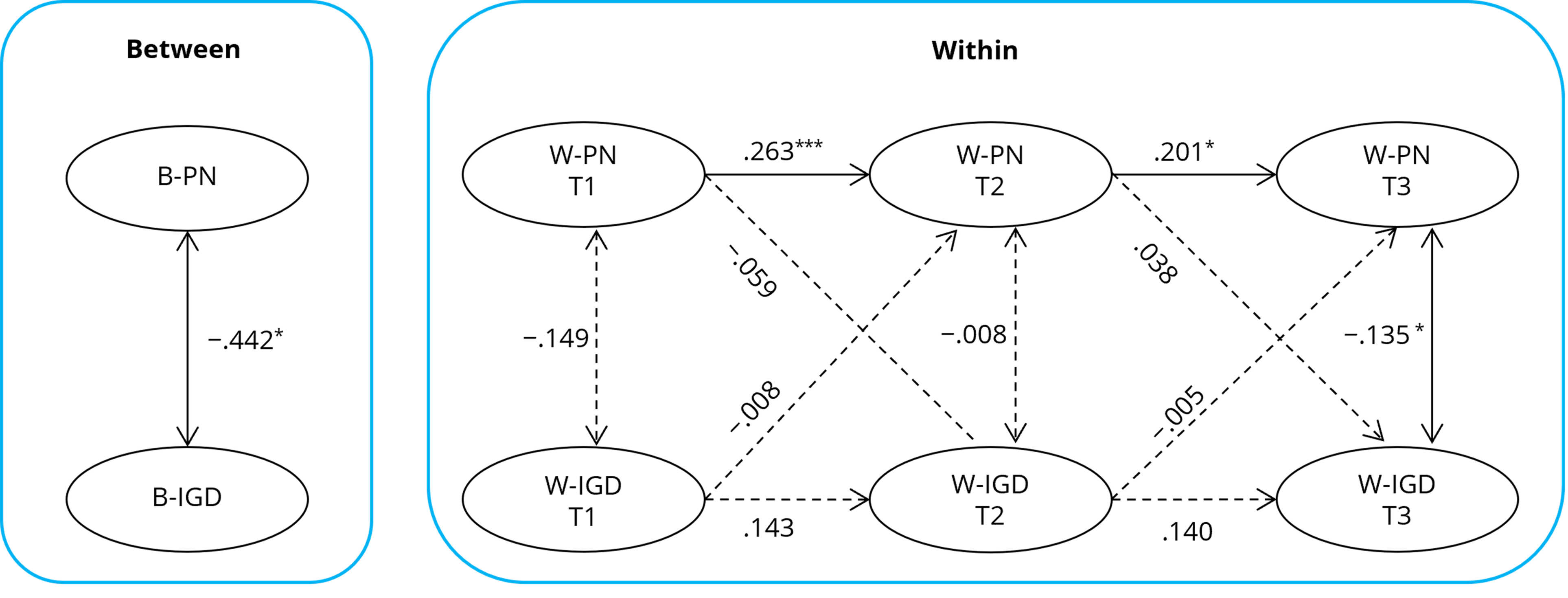
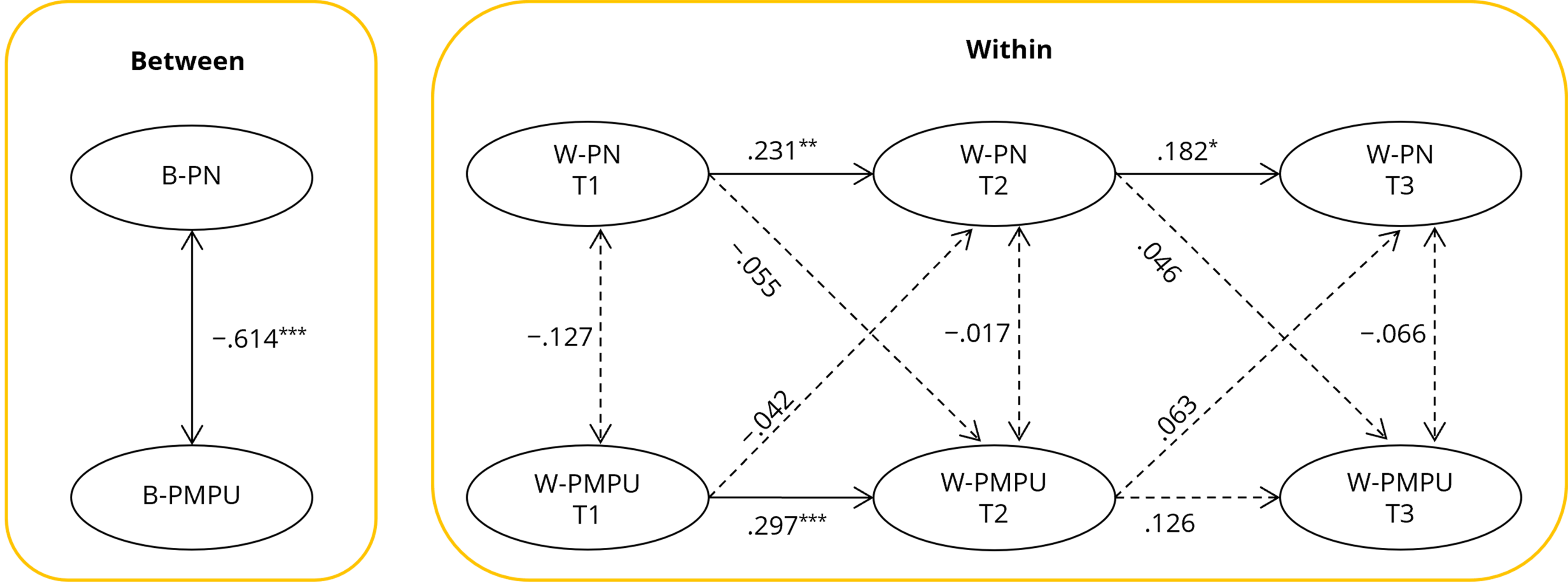
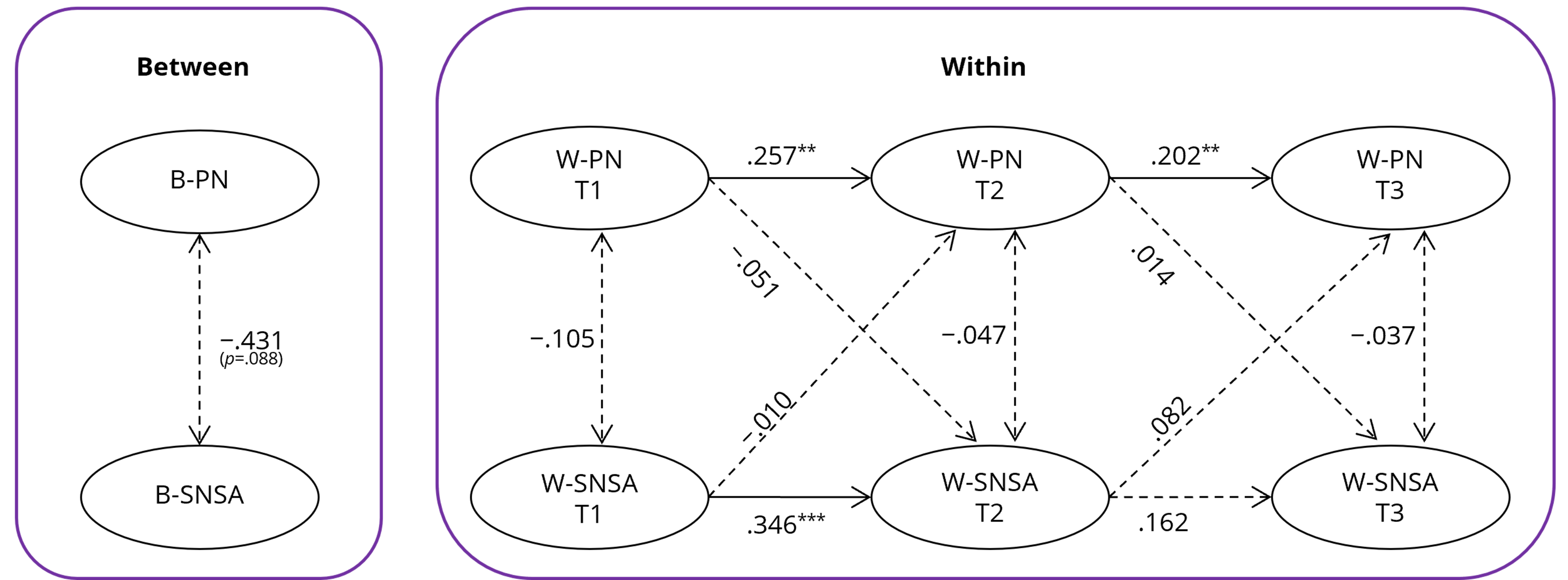
Note. B-PN and B-IGD/B-PMPU/B-SNSA represent between-person random intercepts; W-PN and W-IGD/W-PMPU/W-SNSA represent within-person deviations. Horizontal arrows indicate autoregressive paths, diagonal arrows indicate cross-lagged paths, and vertical double-headed arrows indicate within-wave correlations. Values are standardized estimates. Measurement indicators and correlated residuals are omitted for clarity. Solid lines indicate p < .05; dashed lines indicate p ≥ .05. IGD = Internet gaming disorder; PMPU = problematic mobile phone use; SNSA = social networking site addiction; *p < .05, **p < .01, ***p < .001.
Dimension-Specific RI-CLPMs
Nine separate composite-score RI-CLPMs paired autonomy, competence, and relatedness with each problematic digital-use outcome. After Benjamini–Hochberg adjustment across the nine between-person correlations, four negative associations remained statistically significant. Competence was negatively correlated with IGD, r = −.527, 95% CI [−.917, −.136], adjusted p = .018, and PMPU, r = −.636, 95% CI [−.972, −.300], adjusted p < .001. Relatedness was negatively correlated with IGD, r = −.403,
95% CI [−.649, −.157], adjusted p = .004, and PMPU, r = −.415, 95% CI [−.676, −.154], adjusted p = .006. The nominal associations of autonomy with PMPU and competence with SNSA did not remain statistically significant after adjustment.
None of the 36 dimension-specific cross-lagged paths was statistically significant before or after Benjamini–Hochberg adjustment, and all corresponding 95% confidence intervals included zero (see Table 2 and Supplementary Tables S14-S15).
Figure 2. Standardized Between-Person and Cross-Lagged Estimates for the Multiple-Indicator Latent RI-CLPMs.

Note. Panel A displays standardized correlations (r) between the random intercepts of psychological need satisfaction (PN) and each problematic-use outcome. Panel B displays standardized cross-lagged coefficients (β) between within-person deviations across adjacent six-month intervals. Points represent estimates and horizontal lines represent 95% confidence intervals. IGD = Internet gaming disorder; PMPU = problematic mobile phone use; SNSA = social networking site addiction; W1–W3 = Waves 1–3.
Robustness and Sensitivity Analyses
Observed composite-score RI-CLPMs yielded a similar pattern. Psychological need satisfaction showed negative between-person correlations with IGD and PMPU, whereas the between-person association with SNSA was not statistically significant. No six-month cross-lagged path was statistically significant (Supplementary Tables S16-S18).
Adjustment for gender, baseline age, and subjective family socioeconomic status did not alter the inferential pattern of the between-person associations (adjusted residual
r = −.489, −.725, and −.575 for IGD, PMPU, and SNSA, respectively). All 12 adjusted cross-lagged paths remained statistically nonsignificant, and the largest absolute change from the primary estimates was .016 (Supplementary Table S19).
Classroom-cluster-robust analyses using the same selected model structures did not alter the results (Supplementary Table S20). Severity-restricted analyses did not yield stable, interpretable models (Supplementary Table S21).
Table 2. Dimension-Specific Between-Person Correlations and Within-Person Cross-Lagged Associations.
|
Outcome |
Need Dimension |
Between-person r |
Need W1 → Outcome W2 |
Outcome W1 → Need W2 |
Need W2 → Outcome W3 |
Outcome W2 → Need W3 |
|
IGD |
Autonomy |
−.181 [−.460, .098] |
−.025 [−.117, .066] |
−.063 [−.147, .022] |
−.024 [−.111, .063] |
−.070 [−.164, .024] |
|
IGD |
Competence |
−.527* [−.917, −.136] |
.012 [−.084, .108] |
−.007 [−.084, .069] |
.011 [−.079, .101] |
−.008 [−.091, .075] |
|
IGD |
Relatedness |
−.403** [−.649, −.157] |
.001 [−.088, .089] |
.033 [−.048, .113] |
.001 [−.087, .088] |
.037 [−.054, .127] |
|
PMPU |
Autonomy |
−.317 [−.609, −.025] |
−.046 [−.133, .042] |
−.064 [−.160, .033] |
−.046 [−.133, .042] |
−.062 [−.155, .032] |
|
PMPU |
Competence |
−.636*** [−.972, −.300] |
−.034 [−.132, .065] |
−.037 [−.145, .072] |
.081 [−.046, .208] |
.056 [−.062, .174] |
|
PMPU |
Relatedness |
−.415** [−.676, −.154] |
−.051 [−.136, .034] |
−.006 [−.099, .086] |
−.056 [−.148, .036] |
−.006 [−.098, .085] |
|
SNSA |
Autonomy |
−.101 [−.496, .294] |
−.033 [−.120, .054] |
−.039 [−.133, .055] |
−.032 [−.118, .053] |
−.039 [−.134, .055] |
|
SNSA |
Competence |
−.519 [−1.035, −.003] |
−.002 [−.092, .088] |
.021 [−.070, .113] |
−.002 [−.090, .086] |
.022 [−.072, .116] |
|
SNSA |
Relatedness |
−.236 [−.602, .129] |
−.053 [−.136, .030] |
.036 [−.057, .130] |
−.055 [−.139, .030] |
.038 [−.061, .138] |
|
Note. Values are standardized estimates with 95% confidence intervals. Asterisks in the between-person column indicate Benjamini–Hochberg FDR-adjusted results across the nine random-intercept correlations, *p < .05, **p < .01, ***p < .001. None of the 36 cross-lagged paths survived FDR correction. |
||||||
Discussion
Using three waves of data from Chinese adolescents, the present study applied multiple-indicator latent RI-CLPMs to distinguish stable between-person associations from six-month cross-lagged within-person associations. Lower psychological need satisfaction was associated at the between-person level with higher IGD and PMPU, whereas the corresponding association with SNSA was negative but not statistically significant. None of the global or dimension-specific six-month cross-lagged paths was statistically significant. At the need-dimension level, the clearest FDR-adjusted associations involved competence and relatedness with IGD and PMPU. Together, these findings address the two research questions by showing that the need–problematic-use association was most clearly expressed as relatively persistent differences between adolescents and that its pattern varied across need dimensions and digital-use domains. At this timescale, psychological need satisfaction appeared less as a proximal driver of change than as a relatively enduring developmental resource associated with lower levels of problematic use.
The negative between-person associations of psychological need satisfaction with IGD and PMPU are consistent with previous research linking lower need satisfaction to problematic gaming (Bender & Gentile, 2020; Wang et al., 2024; Weinstein et al., 2017; Xu et al., 2023) and problematic mobile phone use (Gao et al., 2022; Wei et al., 2025). The present study extends this literature by locating these associations more specifically at the between-person level after stable differences were separated from within-person deviations. Several complementary processes may contribute to this pattern. First, shared vulnerability characteristics, such as personality dispositions, difficulties in self-regulation, or broader psychological vulnerability, may be associated with both lower need satisfaction and greater problematic use (Brand et al., 2019; Xu et al., 2023). Second, relatively enduring environmental conditions may shape both constructs. Persistent stress and unsupportive family, school, or peer contexts may undermine psychological need satisfaction while increasing reliance on digital activities for escape or compensation (Li et al., 2016; Lin et al., 2023). Third, from the perspective of basic psychological need theory, sustained need frustration may also foster rigid compensatory responses that provide temporary relief or substitute need fulfillment (Vansteenkiste et al., 2020). Repeated reliance on digital activities may therefore become consolidated into a stable coping pattern, rather than appearing as an immediate response to each temporary fluctuation in need satisfaction.
At the within-person level, none of the 12 six-month cross-lagged paths was statistically significant, and the same substantive pattern emerged across alternative measurement-constraint specifications, composite-score models, covariate-adjusted models, and classroom-cluster-robust analyses. The findings therefore did not support a six-month reciprocal process in which lower-than-usual need satisfaction predicted subsequent increases in IGD, PMPU, or SNSA, or vice versa. Two considerations may help explain this pattern. First, compensatory processes may operate at different timescales: proximal responses may unfold over days or weeks, whereas rigid coping patterns may consolidate more gradually. Second, active need frustration may be a more immediate trigger of problematic use than low need satisfaction, which reflects limited positive need experiences but not necessarily pressure, failure, or rejection (Vansteenkiste et al., 2020). In addition, the relatively low level of digital use in this sample may also have reduced observable within-person variation. Data were collected after China introduced stricter restrictions on minors’ online gaming and strengthened mobile-phone management in primary and secondary schools in 2021 (Yang et al., 2023). Approximately half of the adolescents reported no more than one hour of gaming per week. However, PMPU showed a broader distribution and greater within-person variability but yielded the same cross-lagged pattern, suggesting that restricted gaming exposure alone does not account for the overall findings.
The dimension-specific models further suggested that the between-person pattern varied across psychological needs and digital-use domains. First, lower competence and relatedness satisfaction were associated with higher IGD. One possible explanation is that gaming is particularly well suited to compensate for deficits in these needs, because it combines clear challenges, progression, and performance feedback with cooperation and group belonging (Bender & Gentile, 2020; Weinstein et al., 2017). Second, lower competence and relatedness satisfaction were also associated with higher PMPU. Because mobile phones provide access to gaming, social interaction, entertainment, and information, we speculate that PMPU may reflect several need-related functions rather than a single, narrowly defined need profile (Gao et al., 2022; Marino et al., 2021). Third, the need-related pattern for SNSA was less definite, particularly for relatedness, which differs from studies emphasizing relatedness in social-media engagement and problematic use (A. Chen, 2019; Sharifi Fard et al., 2024; Sheldon & Titova, 2023). Several processes may contribute to this discrepancy. Social-enhancement and social-compensation processes may operate differently across adolescents, such that person-specific associations partly offset one another at the sample level (Pouwels et al., 2021). General relatedness satisfaction may also be connected to SNSA through more proximal processes such as fear of missing out, rather than through a simple direct association (Groenestein et al., 2025). In addition, social networking platforms afford entertainment, content consumption, and game-like feedback as well as interpersonal communication, potentially weakening a specifically relatedness-based association (Karahanna et al., 2018). The absence of a statistically significant sample-level association may therefore reflect heterogeneity in how adolescents use social networking sites rather than demonstrate that relatedness is irrelevant to SNSA. Finally, autonomy showed a less consistent pattern across the three outcomes. We speculate that this may partly reflect the contextual meaning of autonomy among Chinese adolescents: volitional endorsement can coexist with accepting parental or school expectations, while external regulation may simultaneously restrict choice and reduce opportunities for digital use (B. Chen et al., 2013). These countervailing processes may make the association between general autonomy satisfaction and problematic use less direct.
These findings have two broader implications. First, they help distinguish relatively enduring need-related vulnerability from proximal compensatory processes. Psychological need satisfaction may function as a developmental resource accumulated across family, school, and peer contexts, whereas repeated reliance on digital activities for substitute need fulfillment may gradually consolidate into a relatively stable coping pattern. A lack of six-month cross-lagged associations therefore does not undermine compensatory accounts but indicates that stable vulnerability and short-term compensation should not be treated as the same process. Second, the findings highlight the context specificity of need-related associations. IGD, PMPU, and SNSA involve partly different activities and affordances, and their associations with autonomy, competence, and relatedness should not be subsumed under a single undifferentiated category of problematic digital technology use. From an applied perspective, competence and relatedness may be useful dimensions for identifying adolescents and social contexts that warrant closer assessment, particularly in relation to IGD and PMPU. However, whether sustained need-supportive environments reduce problematic use requires direct testing in experimental or quasi-experimental research.
Several methodological features strengthen the present study, including the three-wave adolescent design, longitudinal measurement invariance, multiple-indicator latent modeling, and convergent sensitivity analyses. Nevertheless, several limitations should be considered. First, three waves separated by six months were suited to examining relatively sustained developmental patterns but could not capture more proximal compensatory processes. Intensive longitudinal studies should assess need satisfaction and need frustration alongside momentary affect and specific digital activities. Second, all focal constructs were assessed using self-report. Device- or application-based logs could provide more precise information about exposure and temporal patterns, but they should be combined with assessments of loss of control, conflict, and functional impairment because use duration alone does not indicate problematic use. Third, the relatively low IGD and SNSA levels and the regulatory context may limit generalizability to adolescents with more severe problematic use. The severity-restricted models were inadmissible or poorly fitting, leaving the corresponding patterns in higher-risk groups unresolved. Fourth, although most baseline characteristics were comparable between included and excluded participants, only nine excluded participants had available baseline focal scores, and they reported lower need satisfaction. Selective retention of adolescents with relatively higher need satisfaction therefore remains possible, although the small comparison group precludes a firm conclusion. Finally, adjustment for gender, baseline age, and subjective family socioeconomic status and correction for classroom clustering did not alter the substantive pattern, but the RI-CLPM estimates remain observational. Unmeasured stable characteristics and time-varying confounders may still influence the associations. Experimental, quasi-experimental, and intensive longitudinal designs are needed to identify the causal and time-specific processes linking psychological needs to problematic use of digital technologies.
Conclusion
The central contribution of this study is to clarify the level at which psychological need satisfaction is associated with adolescents’ problematic use of digital technologies. Using measurement-error-adjusted RI-CLPMs, we found that lower need satisfaction covaried stably with higher IGD and PMPU, whereas six-month reciprocal cross-lagged within-person associations were not detected. Competence and relatedness emerged as the clearest stable correlates of IGD and PMPU, while the pattern for SNSA was less definite. These findings underscore that stable between-person covariation and six-month cross-lagged within-person associations represent distinct levels of longitudinal association. Future theory and research should therefore distinguish enduring individual and contextual conditions from proximal compensatory processes and match the measurement timescale to the mechanism under investigation.
Conflict of Interest
The authors have no conflicts of interest to declare.
Use of AI Services
The authors declare they have used AI services, specifically ChatGPT (OpenAI), for grammar correction and minor style refinements. They carefully reviewed all suggestions to ensure the original meaning and factual accuracy were preserved.
Data Availability Statement
De-identified item-level analytic data, derived scale and subscale scores, a data dictionary, Mplus syntax for the primary and supplementary analyses, and supporting documentation are publicly available on the Open Science Framework at https://osf.io/92dtc/.
Acknowledgement
This work was supported by the National Natural Science Foundation of China (32400907). The funders had no role in study design, data collection and analysis, decision to publish, or preparation of the manuscript.
The study was approved by the Ethics in Human Research Committee of Zhejiang Normal University (IRB No. ZSRT2023159).


This work is licensed under a Creative Commons Attribution-ShareAlike 4.0 International License.
Copyright © 2026 Xuan Xu, Haide Chen, Wan Zhao, Lingfeng Gao