
Rumination, excessive reassurance seeking, depression, and problematic social media use
Vol.20,No.5(2026)
Jon Elhai
 Tali Gazit
Christian Montag
Depression and problematic social media use (PSMU) symptoms are robustly correlated. However, few studies have investigated cognitive or affective psychological mechanisms explaining why depressed individuals may develop PSMU. We analyzed cross-sectional web survey data collected from 388 American university students in 2025. We administered standardized measures of depression, rumination, excessive reassurance seeking (ERS; a maladaptive interpersonal strategy often used by depressed individuals to test social relationship strength), and problematic social media use. Using confirmatory factor analysis, we discovered good-fitting measurement models for these measures. Using structural equation modeling, we found that rumination’s brooding dimension was significantly related to both ERS and PSMU symptoms. ERS was also associated with PSMU severity. Analyses revealed that brooding indirectly accounted for relations between depression and PSMU severity. Furthermore, ERS accounted for relations between brooding and PSMU severity. Finally, we discovered that the path from brooding to ERS indirectly accounted for relations between depression and PSMU. Results provide support for cognitive/affective and coping mechanisms such as rumination and ERS that may explain relationships between depression and PSMU. We also place findings in context of a widely-studied theoretical model of problematic Internet use.
depression; rumination; excessive reassurance seeking; problematic social media use
Jon Elhai
Department of Psychology, Department of Neurosciences and Psychiatry, University of Toledo, Toledo, Ohio, USA
Jon D. Elhai is Distinguished University Professor of Psychology, Neurosciences and Psychiatry at the University of Toledo. His primary area of research is in cyberpsychology and internet addictions, examining problematic internet, social media, and smartphone use.
Tali Gazit
Department of Information Science and Applied AI, Bar-Ilan University, Ramat-Gan, Israel
Tali Gazit is a Senior Lecturer in the Department of Information Science and Applied AI at Bar-Ilan University, Israel. She earned her PhD in Internet Psychology from the same institution. Her primary research focuses on Internet Psychology, with particular emphasis on engagement with and use of social media and generative artificial intelligence, and their associations with well-being, personality traits, and related psychological factors. Her work is regularly published in leading academic journals and presented at international conferences.
Christian Montag
Institute of Artificial Intelligence and Brain Sciences, Department of Computer Science, Department of Psychology, University of Macau, Macau SAR, China
Christian Montag is Distinguished Professor of Cognitive and Brain Sciences at the University of Macau. He works at the intersection of psychology, computer science, neuroscience and behavioral economics.
Ahmed, O., Dawel, A., Walsh, E. I., & Cherbuin, N. (2025). Longitudinal associations between problematic social media use and mental health: Mediating role of sleep. Addictive Behaviors, 170, Article 108446. https://doi.org/10.1016/j.addbeh.2025.108446
Alavinikoo, A., Elhai, J. D., Hutcheson, E. F., & Montag, C. (2025). Underlying dimensions of depression and negative affect are equally related to problematic smartphone and social media use severity. Psychiatry Research, 353, Article 116769. https://doi.org/10.1016/j.psychres.2025.116769
American Psychiatric Association. (2022). Diagnostic and statistical manual of mental disorders (5th ed., text rev.). https://doi.org/10.1176/appi.books.9780890425787
Andreassen, C. S., Billieux, J., Griffiths, M. D., Kuss, D. J., Demetrovics, Z., Mazzoni, E., & Pallesen, S. (2016). The relationship between addictive use of social media and video games and symptoms of psychiatric disorders: A large-scale cross-sectional study. Psychology of Addictive Behaviors, 30(2), 252–262. https://doi.org/10.1037/adb0000160
Billieux, J., Philippot, P., Schmid, C., Maurage, P., De Mol, J., & Van der Linden, M. (2015). Is dysfunctional use of the mobile phone a behavioural addiction? Confronting symptom-based versus process-based approaches. Clinical Psychology & Psychotherapy, 22(5), 460–468. https://doi.org/10.1002/cpp.1910
Bird, T., Tarsia, M., & Schwannauer, M. (2018). Interpersonal styles in major and chronic depression: A systematic review and meta-analysis. Journal of Affective Disorders, 239, 93–101. https://doi.org/10.1016/j.jad.2018.05.057
Bottaro, R., Griffiths, M. D., & Faraci, P. (2026). Meta-analysis of reliability and validity of the Bergen Social Media Addiction Scale (BSMAS). International Journal of Mental Health and Addiction, 24(2), 1438–1465. https://doi.org/10.1007/s11469-025-01461-x
Brand, M., Muller, A., Wegmann, E., Antons, S., Brandtner, A., Muller, S. M., Stark, R., Steins-Loeber, S., & Potenza, M. N. (2025). Current interpretations of the I-PACE model of behavioral addictions. Journal of Behavioral Addictions, 14(1), 1–17. https://doi.org/10.1556/2006.2025.00020
Brand, M., Wegmann, E., Stark, R., Muller, A., Wolfling, K., Robbins, T. W., & Potenza, M. N. (2019). The interaction of person-affect-cognition-execution (I-PACE) model for addictive behaviors: Update, generalization to addictive behaviors beyond internet-use disorders, and specification of the process character of addictive behaviors. Neuroscience & Biobehavioral Reviews, 104, 1–10. https://doi.org/10.1016/j.neubiorev.2019.06.032
Brand, M., Young, K. S., Laier, C., Wolfling, K., & Potenza, M. N. (2016). Integrating psychological and neurobiological considerations regarding the development and maintenance of specific Internet-use disorders: An interaction of person-affect-cognition-execution (I-PACE) model. Neuroscience & Biobehavioral Reviews, 71, 252–266. https://doi.org/10.1016/j.neubiorev.2016.08.033
Caplan, S. E. (2003). Preference for online social interaction. Communication Research, 30(6), 625–648. https://doi.org/10.1177/0093650203257842
Casale, S. (2020). Problematic social media use: Conceptualization, assessment and trends in scientific literature. Addictive Behaviors Reports, 12, Article 100281. https://doi.org/10.1016/j.abrep.2020.100281
Castro-Calvo, J., Beltrán-Martínez, P., Flayelle, M., & Billieux, J. (2022). Rumination across Internet use disorders (IUDs): A systematic review. Current Addiction Reports, 9(4), 540–570. https://doi.org/10.1007/s40429-022-00442-7
Cataldo, I., Billieux, J., Esposito, G., & Corazza, O. (2022). Assessing problematic use of social media: Where do we stand and what can be improved? Current Opinion in Behavioral Sciences, 45, Article 101145. https://doi.org/10.1016/j.cobeha.2022.101145
Chen, Y., Liu, X., Chiu, D. T., Li, Y., Mi, B., Zhang, Y., Ma, L., & Yan, H. (2022). Problematic social media use and depressive outcomes among college students in China: Observational and experimental findings. International Journal of Environmental Research and Public Health, 19(9), Article 4937. https://doi.org/10.3390/ijerph19094937
Cheng, C., Lau, Y. C., Chan, L., & Luk, J. W. (2021). Prevalence of social media addiction across 32 nations: Meta-analysis with subgroup analysis of classification schemes and cultural values. Addictive Behaviors, 117, Article 106845. https://doi.org/10.1016/j.addbeh.2021.106845
Cheung, G. W., & Lau, R. S. (2011). A direct comparison approach for testing measurement invariance. Organizational Research Methods, 15(2), 167–198. https://doi.org/10.1177/1094428111421987
Clark, G. I., Rock, A. J., Clark, L. H., & Murray‐lyon, K. (2021). Adult attachment, worry and reassurance seeking: Investigating the role of intolerance of uncertainty. Clinical Psychologist, 24(3), 294–305. https://doi.org/10.1111/cp.12218
Cougle, J. R., Fitch, K. E., Fincham, F. D., Riccardi, C. J., Keough, M. E., & Timpano, K. R. (2012). Excessive reassurance seeking and anxiety pathology: Tests of incremental associations and directionality. Journal of Anxiety Disorders, 26(1), 117–125. https://doi.org/10.1016/j.janxdis.2011.10.001
Cuijpers, P., Cristea, I. A., Karyotaki, E., Reijnders, M., & Huibers, M. J. (2016). How effective are cognitive behavior therapies for major depression and anxiety disorders? A meta-analytic update of the evidence. World Psychiatry, 15(3), 245–258. https://doi.org/10.1002/wps.20346
Demetrovics, Z., Czakó, A., Potenza, M. N., Griffiths, M. D., Fineberg, N. A., Stein, D. J., Ekhtiari, H., Brand, M., Montag, C., Lin, C., Li, L., Elhai, J. D., & Király, O. (2026). Are you on the internet or using screen-based devices? Revisiting the concepts of ‘internet addiction’ and ‘smartphone addiction’. Journal of Behavioral Addictions. https://doi.org/10.1556/2006.2025.00105
Eitan, T., & Gazit, T. (2024). The “here and now” effect: JoMO, FoMO and the well-being of social media users. Online Information Review, 48(5), 1002–1024. https://doi.org/10.1108/OIR-03-2023-0111
Elhai, J. D., Casale, S., & Bond, R. (2025). FOMO’s apprehension of missing out and constant connection desire dimensions differentially correlate with problematic smartphone and social media use, but not with depression or generalized anxiety. Journal of Anxiety Disorders, 114, Article 103037. https://doi.org/10.1016/j.janxdis.2025.103037
Elhai, J. D., Casale, S., & Montag, C. (2025). Worry and fear of missing out are associated with problematic smartphone and social media use severity. Journal of Affective Disorders, 379, 258–265. https://doi.org/10.1016/j.jad.2025.03.062
Elhai, J. D., Demetrovics, Z., Casale, S., & Montag, C. (2026). Social media use is associated with, but is not a major cause of mental disorder among adolescents. Current Addiction Reports, 13(1), Article 62. https://doi.org/10.1007/s40429-026-00769-5
Elhai, J. D., Rozgonjuk, D., Alghraibeh, A. M., Levine, J. C., Alafnan, A. A., Aldraiweesh, A. A., Aljooma, S. S., & Hall, B. J. (2020). Excessive reassurance seeking mediates relations between rumination and problematic smartphone use. Bulletin of the Menninger Clinic, 84(2), 137–155. https://doi.org/10.1521/bumc_2020_84_07
Evraire, L. E., & Dozois, D. J. (2011). An integrative model of excessive reassurance seeking and negative feedback seeking in the development and maintenance of depression. Clinical Psychology Review, 31(8), 1291–1303. https://doi.org/10.1016/j.cpr.2011.07.014
Ezawa, I. D., & Hollon, S. D. (2023). Cognitive restructuring and psychotherapy outcome: A meta-analytic review. Psychotherapy, 60(3), 396–406. https://doi.org/10.1037/pst0000474
Forchuk, C. A., Plouffe, R. A., & Saklofske, D. H. (2021). Do you “like” me? The roles of Facebook reassurance seeking and attachment style on depression. Psychology of Popular Media, 10(2), 223–229. https://doi.org/10.1037/ppm0000312
Gao, F., & Du, X. (2025). A meta-analysis of rumination and digital addiction. Personality and Individual Differences, 238, Article 113074. https://doi.org/10.1016/j.paid.2025.113074
Gao, L., Yang, C., Yang, X., Chu, X., Liu, Q., & Zhou, Z. (2021). Negative emotion and problematic mobile phone use: The mediating role of rumination and the moderating role of social support. Asian Journal of Social Psychology, 25(1), 138–151. https://doi.org/10.1111/ajsp.12471
Giancola, M., Piccardi, L., Nori, R., D'Amico, S., & Palmiero, M. (2026). The vulnerable side of technology addiction: Pathways linking the Vulnerable Dark Triad to problematic smartphone and social media use. Personality and Individual Differences, 251, Article 113560. https://doi.org/10.1016/j.paid.2025.113560
Grant, D. M., Judah, M. R., Mills, A. C., Lechner, W. V., Davidson, C. L., & Wingate, L. R. (2013). Rumination and excessive reassurance seeking: Mediators of the relationship between social anxiety and depression? Journal of Psychopathology and Behavioral Assessment, 36(3), 465–474. https://doi.org/10.1007/s10862-013-9399-5
Harmon, J., Boland, J., & Venta, A. (2022). Further validation of the Motivations for Electronic Interaction Scale. Current Psychology, 41(11), 7588–7594. https://doi.org/10.1007/s12144-020-01300-3
Hasegawa, A., Koda, M., Hattori, Y., Kondo, T., & Kawaguchi, J. (2014). Depressive rumination and past depression in Japanese university students: Comparison of brooding and reflection. Psychological Reports, 114(3), 653–674. https://doi.org/10.2466/15.03.PR0.114k26w6
Hutcheson, E. F., Montag, C., & Elhai, J. D. (2025). Intolerance of uncertainty and emotion dysregulation mediate relations between fear of negative evaluation and problematic social media use severity. Cyberpsychology: Journal of Psychosocial Research on Cyberspace, 19(5), Article 7. https://doi.org/10.5817/CP2025-5-7
Jing, Z., Yang, W., Lei, Z., Junmei, W., Hui, L., & Tianmin, Z. (2025). Correlations between social media addiction and anxiety, depression, FoMO, loneliness and self-esteem among students: A systematic review and meta-analysis. PloS One, 20(9), Article e0329466. https://doi.org/10.1371/journal.pone.0329466
Joiner, T. E., Jr., Metalsky, G. I., Katz, J., & Beach, S. R. H. (1999). Depression and excessive reassurance-seeking. Psychological Inquiry, 10(3), 269–278. https://doi.org/10.1207/S15327965PLI1004_1
Kardefelt-Winther, D. (2014). A conceptual and methodological critique of internet addiction research: Towards a model of compensatory internet use. Computers in Human Behavior, 31, 351–354. https://doi.org/10.1016/j.chb.2013.10.059
Kelber, M. S., Shank, L. M., Boyd, C., Bellanti, D. M., Morgan, M. A., Libretto, S., Edwards-Stewart, A., Parisi, K., & Evatt, D. P. (2024). A systematic review of problematic social media use and occupational functioning. Current Psychology, 43(44), 34297–34305. https://doi.org/10.1007/s12144-024-06826-4
Li, X., & Li, H. (2024). Exploring the relationship between problematic social networking sites use and depression: A longitudinal study. PloS One, 19(11), Article e0313362. https://doi.org/10.1371/journal.pone.0313362
Lin, C. Y., Namdar, P., Griffiths, M. D., & Pakpour, A. H. (2021). Mediated roles of generalized trust and perceived social support in the effects of problematic social media use on mental health: A cross-sectional study. Health Expectations, 24(1), 165–173. https://doi.org/10.1111/hex.13169
Lovibond, P. F., & Lovibond, S. H. (1995). The structure of negative emotional states: Comparison of the Depression Anxiety Stress Scales (DASS) with the Beck Depression and Anxiety Inventories. Behaviour Research and Therapy, 33(3), 335–343. https://doi.org/10.1016/0005-7967(94)00075-U
MacKinnon, D. P., Fairchild, A. J., & Fritz, M. S. (2007). Mediation analysis. Annual Review of Psychology, 58, 593–614. https://doi.org/10.1146/annurev.psych.58.110405.085542
Marino, C., Canale, N., Melodia, F., Spada, M. M., & Vieno, A. (2021). The overlap between problematic smartphone use and problematic social media use: A systematic review. Current Addiction Reports, 8(4), 469–480. https://doi.org/10.1007/s40429-021-00398-0
Marttila, E., Koivula, A., & Räsänen, P. (2021). Does excessive social media use decrease subjective well-being? A longitudinal analysis of the relationship between problematic use, loneliness and life satisfaction. Telematics and Informatics, 59, Article 101556. https://doi.org/10.1016/j.tele.2020.101556
Meynadier, J., Malouff, J. M., Schutte, N. S., & Loi, N. M. (2024). Meta-analysis of associations between five-factor personality traits and problematic social media use. Current Psychology, 43(27), 23016–23035. https://doi.org/10.1007/s12144-024-06052-y
Meynadier, J., Malouff, J. M., Schutte, N. S., Loi, N. M., & Griffiths, M. D. (2026). Relationships between social media addiction, social media use metacognitions, depression, anxiety, fear of missing out, loneliness, and mindfulness. International Journal of Mental Health and Addiction, 24(3), 2399–2421. https://doi.org/10.1007/s11469-024-01440-8
Mitchell, L., & Hussain, Z. (2018). Predictors of problematic smartphone use: An examination of the integrative pathways model and the role of age, gender, impulsiveness, excessive reassurance seeking, extraversion, and depression. Behavioral Sciences, 8(8), Article 74. https://doi.org/10.3390/bs8080074
Mitra, R., & Rangaswamy, M. (2019). Excessive social media use and its association with depression and rumination in an Indian young adult population: A mediation model. Journal of Psychosocial Research, 14(1), 223–231. https://doi.org/10.32381/JPR.2019.14.01.24
Montag, C., Demetrovics, Z., Elhai, J. D., Grant, D., Koning, I., Rumpf, H. J., Spada, M., Throuvala, M., & van den Eijnden, R. (2025). Social media use in childhood and adolescence: Minimizing its adverse effects through corporate social responsibility and European Union regulations. In D. A. Christakis (Ed.), Handbook of children, and screens: Digital media, development, and well-being from birth through adolescence (pp. 477–484). Springer. https://doi.org/10.1007/978-3-031-69362-5_65
Montag, C., Wegmann, E., Sariyska, R., Demetrovics, Z., & Brand, M. (2021). How to overcome taxonomical problems in the study of internet use disorders and what to do with “smartphone addiction”? Journal of Behavioral Addictions, 9(4), 908–914. https://doi.org/10.1556/2006.8.2019.59
Moretta, T., & Wegmann, E. (2025). Toward the classification of social media use disorder: Clinical characterization and proposed diagnostic criteria. Addictive Behaviors Reports, 21, Article 100603. https://doi.org/10.1016/j.abrep.2025.100603
Nolen-Hoeksema, S., Stice, E., Wade, E., & Bohon, C. (2007). Reciprocal relations between rumination and bulimic, substance abuse, and depressive symptoms in female adolescents. Journal of Abnormal Psychology, 116(1), 198–207. https://doi.org/10.1037/0021-843X.116.1.198
Olatunji, B. O., Naragon-Gainey, K., & Wolitzky-Taylor, K. B. (2013). Specificity of rumination in anxiety and depression: A multimodal meta-analysis. Clinical Psychology: Science and Practice, 20(3), 225–257. https://doi.org/10.1111/cpsp.12037
Orfi, K., & Ellithorpe, M. (2026). Distinct pathways of problematic social media use: Behavioral indicators and psychological correlates. Telematics and Informatics, 107, Article 102421. https://doi.org/10.1016/j.tele.2026.102421
Parry, D. A., Davidson, B. I., Sewall, C. J. R., Fisher, J. T., Mieczkowski, H., & Quintana, D. S. (2021). A systematic review and meta-analysis of discrepancies between logged and self-reported digital media use. Nature Human Behavior, 5(11), 1535–1547. https://doi.org/10.1038/s41562-021-01117-5
Rickerby, N., Krug, I., Fuller-Tyszkiewicz, M., Forte, E., Davenport, R., Chayadi, E., & Kiropoulos, L. (2024). Rumination across depression, anxiety, and eating disorders in adults: A meta-analytic review. Clinical Psychology: Science and Practice, 31(2), 251–268. https://doi.org/10.1037/cps0000110
Rozgonjuk, D., Sindermann, C., Elhai, J. D., Christensen, A. P., & Montag, C. (2020). Associations between symptoms of problematic smartphone, Facebook, WhatsApp, and Instagram use: An item-level exploratory graph analysis perspective. Journal of Behavioral Addictions, 9(3), 686–697. https://doi.org/10.1556/2006.2020.00036
Rozgonjuk, D., Sindermann, C., Elhai, J. D., & Montag, C. (2021). Comparing smartphone, WhatsApp, Facebook, Instagram, and Snapchat: Which platform elicits the greatest use disorder symptoms? Cyberpsychology, Behavior, and Social Networking, 24(2), 129–134. https://doi.org/10.1089/cyber.2020.0156
Salari, N., Zarei, H., Rasoulpoor, S., Ghasemi, H., Hosseinian-Far, A., & Mohammadi, M. (2025). The impact of social networking addiction on the academic achievement of university students globally: A meta-analysis. Public Health Practice, 9, Article 100584. https://doi.org/10.1016/j.puhip.2025.100584
Samra, A., Warburton, W. A., & Collins, A. M. (2022). Social comparisons: A potential mechanism linking problematic social media use with depression. Journal of Behavioral Addictions, 11(2), 607–614. https://doi.org/10.1556/2006.2022.00023
Sapci, O., Elhai, J. D., Amialchuk, A., & Montag, C. (2021). The relationship between smartphone use and students’ academic performance. Learning and Individual Differences, 89, Article 102035. https://doi.org/10.1016/j.lindif.2021.102035
Shanthi, V. G., Williams, J. R., & Elhai, J. D. (2025). Depression and anxiety in association with problematic social media use severity: The mediating role of distress tolerance. Discover Psychology, 5(1), Article 185. https://doi.org/10.1007/s44202-025-00505-6
Shi, D., Maydeu-Olivares, A., & Rosseel, Y. (2020). Assessing fit in ordinal factor analysis models: SRMR vs. RMSEA. Structural Equation Modeling: A Multidisciplinary Journal, 27(1), 1–15. https://doi.org/10.1080/10705511.2019.1611434
Shoshani, A., Kor, A., & Bar, S. (2024). The impact of social media use on psychiatric symptoms and well-being of children and adolescents in the Post-COVID-19 era: A four-year longitudinal study. European Child & Adolescent Psychiatry, 33(11), 4013–4027. https://doi.org/10.1007/s00787-024-02454-2
Thorisdottir, I. E., Sigurvinsdottir, R., Kristjansson, A. L., Allegrante, J. P., Lilly, C. L., & Sigfusdottir, I. D. (2020). Longitudinal association between social media use and psychological distress among adolescents. Preventive Medicine, 141, Article 106270. https://doi.org/10.1016/j.ypmed.2020.106270
Treynor, W., Gonzalez, R., & Nolen-Hoeksema, S. (2003). Rumination reconsidered: A psychometric analysis. Cognitive Therapy and Research, 27(3), 247–259. https://doi.org/10.1023/A:1023910315561
Tunney, C., & Rooney, B. (2023). Using theoretical models of problematic internet use to inform psychological formulation: A systematic scoping review. Clinical Child Psychology and Psychiatry, 28(2), 810–830. https://doi.org/10.1177/13591045221104569
Valencia, P. D., & Paredes-Angeles, R. (2022). Revisiting the factor structure of the Ruminative Response Scale: A bifactor approach. Trends in Psychology, 32(4), 1408–1425. https://doi.org/10.1007/s43076-022-00214-2
Verhulst, B., & Neale, M. C. (2021). Best practices for binary and ordinal data analyses. Behavior Genetics, 51(3), 204–214. https://doi.org/10.1007/s10519-020-10031-x
Wang, P., Wang, X., Wu, Y., Xie, X., Wang, X., Zhao, F., Ouyang, M., & Lei, L. (2018). Social networking sites addiction and adolescent depression: A moderated mediation model of rumination and self-esteem. Personality and Individual Differences, 127, 162–167. https://doi.org/10.1016/j.paid.2018.02.008
Wegmann, E., & Brand, M. (2021). Affective and cognitive processes involved in behavioral addictions. Addictive Behaviors, 118, Article 106885. https://doi.org/10.1016/j.addbeh.2021.106885
Weinstock, L. M., & Whisman, M. A. (2006). Rumination and excessive reassurance-seeking in depression: A cognitive–interpersonal integration. Cognitive Therapy and Research, 31(3), 333–342. https://doi.org/10.1007/s10608-006-9004-2
World Health Organization. (2019). International statistical classification of diseases and related health problems (11th rev.). https://icd.who.int/en/
Xia, Y., & Yang, Y. (2019). RMSEA, CFI, and TLI in structural equation modeling with ordered categorical data: The story they tell depends on the estimation methods. Behavior Research Methods, 51(1), 409–428. https://doi.org/10.3758/s13428-018-1055-2
Xiao, W., Peng, J., & Liao, S. (2022). Exploring the associations between social media addiction and depression: Attentional bias as a mediator and socio-emotional competence as a moderator. International Journal of Environmental Research and Public Health, 19(20), Article 13496. https://doi.org/10.3390/ijerph192013496
Yao, N., Chen, J., Huang, S., Montag, C., & Elhai, J. D. (2023). Depression and social anxiety in relation to problematic TikTok use severity: The mediating role of boredom proneness and distress intolerance. Computers in Human Behavior, 145, Article 107751. https://doi.org/10.1016/j.chb.2023.107751
Zanon, C., Brenner, R. E., Baptista, M. N., Vogel, D. L., Rubin, M., Al-Darmaki, F. R., Gonçalves, M., Heath, P. J., Liao, H. Y., Mackenzie, C. S., & Topkaya, N. (2021). Examining the dimensionality, reliability, and invariance of the Depression, Anxiety, and Stress Scale–21 (DASS-21) across eight countries. Assessment, 28(6), 1531–1544. https://doi.org/10.1177/1073191119887449
Authors’ Contribution
Jon D. Elhai: conceptualization, methodology, project administration, writing—original draft, final approval. Tali Gazit: conceptualization, methodology, writing—review & editing, final approval. Christian Montag: writing—review & editing, final approval.
Editorial Record
First submission received:
February 16, 2026
Revisions received:
July 10, 2026
September 25, 2026
Accepted for publication:
September 30, 2026
Editor in charge:
Maèva Flayelle
Introduction
Problematic Social Media Use, Its Consequences, and Associations With Psychopathology and Cognitive/Affective Variables
Problematic social media use (PSMU) involves prolonged, uncontrolled social media use, and requires adverse consequences to daily functioning (Cataldo et al., 2022; Moretta & Wegmann, 2025). PSMU is a specific type of more general problematic Internet use (PIU), focusing on social media overuse (Montag et al., 2021). We provide the caveat that PSMU is not a diagnosable mental disorder in the Diagnostic and Statistical Manual of Mental Disorders-5-TR (DSM-5-TR; American Psychiatric Association, 2022) or International Classification of Diseases-11 (ICD-11); World Health Organization, 2019). Furthermore, researchers often prefer using the term PSMU over addiction-related terminology such as “social media addiction” (Casale, 2020; Demetrovics et al., in press; Montag et al., 2025). We should emphasize that PSMU may involve diverse symptom presentations, and diverse sets of risk factors underlying its development (Orfi & Ellithorpe, 2026).
Despite not being a diagnosable disorder, PSMU’s (potential) adverse consequences are substantial. For example, PSMU can result in impairments in academic functioning among students (Salari et al., 2025). PSMU also results in impaired occupational performance (Kelber et al., 2024).
Several psychopathology-related variables are robustly correlated with PSMU symptoms. Specifically, negative affectivity (i.e., negative, unpleasant emotion), such as depression, anxiety, and low self-esteem, have robust relationships with PSMU symptoms across studies, with pooled (Pearson’s r) effect sizes of .31, .31, and −.24, respectively (Jing et al., 2025). We should emphasize that negative affectivity can influence PSMU, but PSMU can also subsequently exacerbate negative affectivity. However, current evidence suggests that mental disorders are more likely to precede rather than result from PSMU (Elhai et al., 2026). Most theoretical frameworks in fact assume and conceptualize that poor mental health influences PIU, but with reciprocal effects possible (Brand et al., 2019; Caplan, 2003; Kardefelt-Winther, 2014). For example, the Interaction of Person-Affect-Cognition-Execution (I-PACE) model conceptualizes diverse dispositional variables such as psychopathology and negative affectivity, along with more proximal risk and resilience factors, for developing and maintaining PIU (Brand et al., 2016); we discuss this framework in more detail in the Theory section, below. Recent work with Chinese college students is consistent with depression preceding PSMU (but effects are complex; Li & Li, 2024). However, some work has nonetheless discovered PSMU driving subsequent negative affectivity, in adult Bangladeshi social media users (Ahmed et al., 2025) and in a nationally representative sample of Finish social media users (Marttila et al., 2021).
Numerous studies have investigated cognitive and affective risk factors for PSMU (Wegmann & Brand, 2021). Cognitive and affective risk factors for PIU in general also fit within the I-PACE model, and can include such diverse constructs as emotion dysregulation, coping styles, Internet-related cognitive biases, executive dysfunction, craving, and numerous others. Furthermore, cognitive/affective mechanisms account for relations between depression and PSMU severity, including distress intolerance examined in U.S. college students (Shanthi et al., 2025) and Chinese adults recruited online (Yao et al., 2023), meta-cognitions about social media use investigated in Australian adults recruited online (Meynadier et al., 2026), online social comparison studied in Australian college students (Samra et al., 2022), loneliness studied in Chinese college students (Chen et al., 2022) and Iranian healthcare patients (Lin et al., 2021), decreased perceived social support in Chinese college students (Chen et al., 2022), and attentional bias in Chinese secondary school students (Xiao et al., 2022).
Rumination
Another cognitive/affective variable associated with PSMU symptoms is rumination (reviewed in Castro-Calvo et al., 2022; F. Gao & Du, 2025). Rumination also accounted for associations between depression and PSMU symptoms in Indian college students (Mitra & Rangaswamy, 2019) and Chinese adolescents (Wang et al., 2018). Rumination involves repetitive negative thinking, focusing primarily on past events, as a maladaptive emotion regulation strategy (Rickerby et al., 2024). Rumination is a risk factor for depressive/anxiety disorders (Olatunji et al., 2013), with some evidence for depression/anxiety driving rumination, as well as reciprocal relationships (Hasegawa et al., 2014; Nolen-Hoeksema et al., 2007). Two rumination dimensions specifically have been widely studied: a) brooding, involving gloomy/moody pondering, considered a more maladaptive type of rumination, and b) reflection, defined as analytical introspection about emotion, considered less maladaptive (Rickerby et al., 2024). Highly ruminative individuals may engage in PSMU a) to distract themselves from ruminative thoughts (Castro-Calvo et al., 2022), and b) to over-engage in online reassurance behaviors (e.g., messaging, and social media use) to alleviate their rumination (Billieux et al., 2015).
Excessive Reassurance Seeking
In fact, excessive reassurance seeking (ERS) is another potential contributing factor to PSMU. Depression often co-occurs with significant interpersonal difficulties (reviewed in Bird et al., 2018). Consequently, depressed individuals often excessively seek reassurance from friends/family to test relationship strength (Evraire & Dozois, 2011). However, such relationship testing can inadvertently worsen relationships, thus maintaining one’s depression and isolation (Joiner et al., 1999).
Modern-day ERS is often digitally-based, such as messaging to elicit a response (Billieux et al., 2015), or seeking social media likes, comments, and follows from close associates or others (Forchuk et al., 2021). Thus, excessive reassurance seekers may consequently engage in PSMU as a means or behavioral manifestation of ERS. However, ERS can nonetheless still involve offline reassurance behaviors. Furthermore, research demonstrates that rumination about interpersonal relationships can influence ERS for relationship testing (Grant et al., 2013; Weinstock & Whisman, 2006). Although not specifically examining PSMU, Mitchell and Hussain (2018) recruited adult social media users and revealed a moderate relationship between general ERS (not online-specific ERS) and problematic smartphone use (PSU) severity. Additionally, Elhai et al. (2020) discovered in American college students that general ERS was associated with PSU severity, and ERS accounted for relations between rumination and PSU. Furthermore, Elhai et al. (2020) discovered a serial indirect effect: depression influenced rumination, which in turn predicted ERS, in turn influencing PSU symptoms. Thus, the association between rumination and ERS may account for relations between depression and PIU (e.g., PSU or PSMU).
Despite existing research studies examining PSMU’s relations with such cognitive and affective variables as rumination and ERS, prior work has not examined a comprehensive model exploring relations among these variables. We therefore aimed to fill this gap by examining how rumination and ERS correlate with PSMU, while also incorporating depression as a covariate.
Theory
Numerous theories have been conceived to explain the development and maintenance of PIU (Tunney & Rooney, 2023). A notable theory is the I-PACE model, mentioned above. To elaborate on this model, I-PACE is a prominent, comprehensive theoretical framework for understanding development of PIU (e.g., PSMU) (Brand et al., 2016; Brand et al., 2019; Brand et al., 2025). I-PACE proposes dispositional, predisposing risk factors for PIU, such as biological (e.g., genetics), personality and temperament (e.g., neuroticism, impulsivity), attachment, deep seated cognitions, and psychopathology (e.g., depression and anxiety) variables. Such dispositional (including psychological) variables are associated with PIU (e.g., Giancola et al., 2026; Meynadier et al., 2024). I-PACE also conceptualizes various other, more proximal (less dispositional) risk factors for PIU that may be influenced by predisposing variables, including affective/cognitive responses (e.g., emotion dysregulation, attention bias), coping styles (e.g., avoidant coping), craving, desire thinking regarding Internet use, punishment sensitivity regarding avoiding emotional distress, executive dysfunction and disinhibition impairment, and Internet-related cognitive biases. These affective/cognitive variables are conceptualized in I-PACE as mechanisms through which dispositional variables may ultimately lead to PIU. Furthermore, the predisposing and more proximal variables can intersect or interact with each other to influence development of PIU. I-PACE also distinguishes between how these risk and resilience factors may lead to PIU (in a maladaptive way) in contrast to more healthy forms of Internet use. Furthermore, I-PACE distinguishes between risk factors influencing the initial development of PIU, as well as risk factors that maintain PIU over time (Brand et al., 2019). Thus I-PACE is a dynamic and comprehensive theoretical framework that conceptualizes a diverse set of risk and resilience variables to explain how people develop healthy or maladaptive Internet use patterns in the short- and long-term.
In I-PACE, depression would represent a predisposing, psychopathology-related risk factor of PSMU, in which the motivation behind social media use (and PSMU) is to alleviate negative affect (although often can exacerbate negative affect). Rumination would represent a more proximal risk factor of PSMU, as an affective/cognitive mechanism. ERS would also serve as a more proximal risk factor for PSMU, as a coping style.
Aims and Hypotheses
Our aim was to examine relations between depression, ERS, rumination and PSMU symptoms, testing a theoretically-driven research model linking these variables. We should emphasize that our measurement of ERS was not specific to online-based reassurance seeking behaviors; rather, we queried ERS more generally.
We posed several hypotheses.
H1: ERS should be positively associated with PSMU severity.
Individuals engaging in ERS may use and overuse social media to seek reassurance, which can result in PSMU. Prior work discovered ERS significantly related to PSU severity (Elhai et al., 2020; Mitchell & Hussain, 2018). This hypothesis has not been examined regarding PSMU. However, PSU and PSMU are robustly related (Rozgonjuk et al., 2020; Rozgonjuk et al., 2021), because most social media use occurs on the smartphone (Marino et al., 2021). Thus, we expected that findings from this work with PSU could potentially extend to PSMU, in light of the inherently interpersonal and feedback-oriented nature of social media platforms.
H2: Rumination - specifically the brooding dimension - should be positively associated with PSMU severity.
Rumination is consistently related to PSMU severity (Castro-Calvo et al., 2022; F. Gao & Du, 2025). Because the brooding dimension is considered the most maladaptive form of rumination (Rickerby et al., 2024) and is characterized by a passive focus on negative affect, it may be particularly relevant to maladaptive coping behaviors such as PSMU (L. Gao et al., 2021). Therefore, brooding should be especially strongly associated with PSMU severity.
H3: ERS should account for relations between rumination’s brooding dimension and PSMU severity.
Rumination about interpersonal relationships can co-occur with ERS aimed at relationship testing (Elhai et al., 2020; Grant et al., 2013; Weinstock & Whisman, 2006). And ERS can consequently function as a mechanism linking rumination to greater PSMU severity (see H1). In fact, Elhai et al. (2020) discovered that ERS accounted for relations between rumination and PSU severity; we expect that this finding could extend to PSMU.
H4: A serial indirect effect should be apparent, such that depression is associated with rumination’s brooding dimension, in turn associated with ERS, and consequently related to PSMU severity.
Evidence for a serial indirect effect begins with support for depression and rumination being highly correlated (Olatunji et al., 2013), with some longitudinal evidence pointing to depression symptoms preceding increases in later rumination (Hasegawa et al., 2014; Nolen-Hoeksema et al., 2007). Next, rumination may be associated with ERS for relationship testing (Elhai et al., 2020; Grant et al., 2013; Weinstock & Whisman, 2006). And as indicated in H1, ERS is associated with PSU (Elhai et al., 2020; Mitchell & Hussain, 2018), and could be associated with the similar PSMU variable. Furthermore, Elhai et al. (2020) discovered a serial indirect effect from depression to rumination to ERS to PSU symptom severity, suggesting broader emotion regulation and interpersonal mechanisms that may be particularly salient in social media contexts and warrant examination with PSMU.
Research Model
Figure 1. Hypothesized Research Model Diagram (Model A).
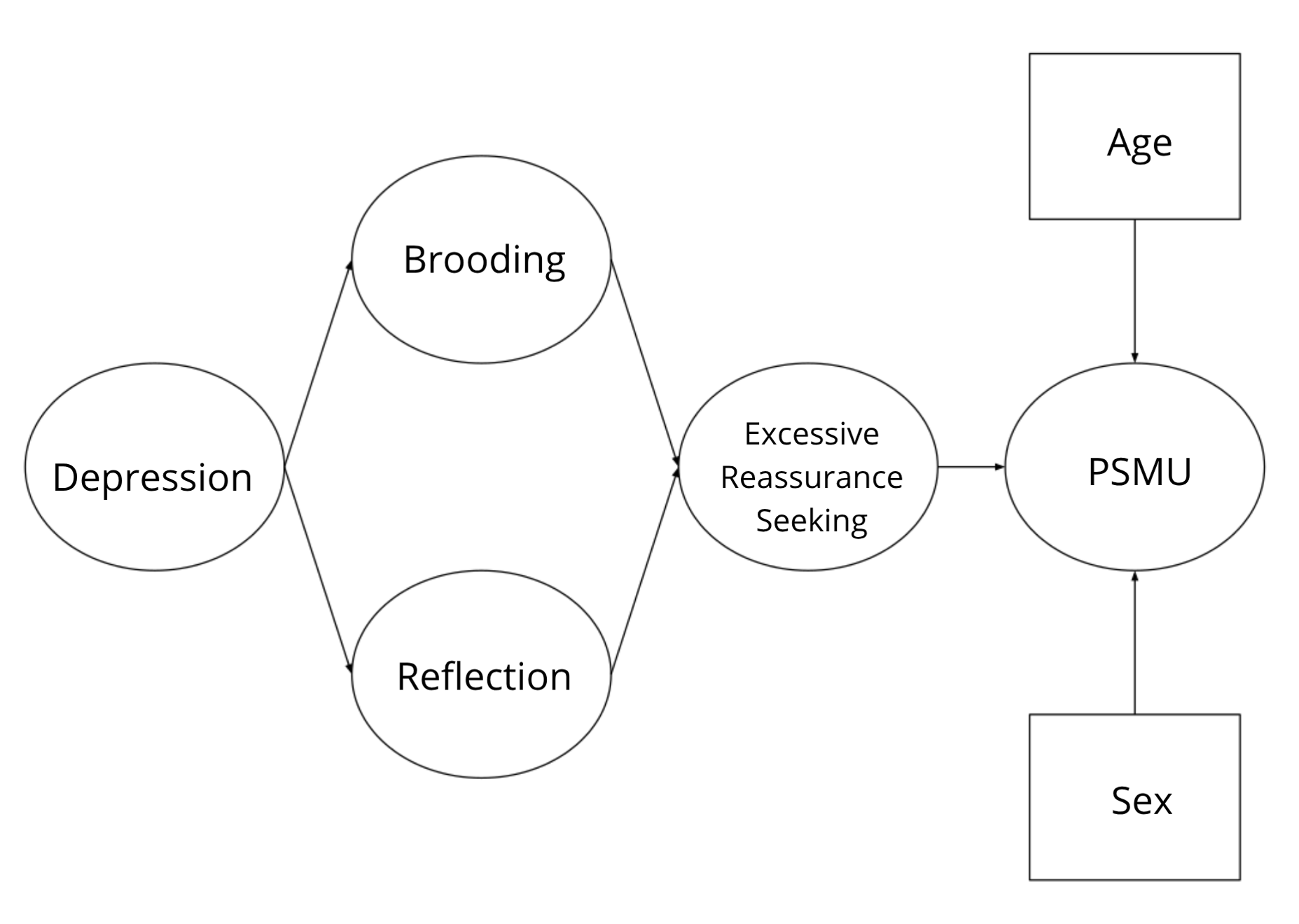
Note. PSMU = Problematic social media use. Oval-shaped variables are latent variables, while rectangle-shaped variables are observed variables. Factor loadings paths for the latent variables are not displayed, to reduce visual clutter.
Figure 1 displays our initial research model (Model A). Depression is specified to predict rumination’s brooding and reflection dimensions. Brooding and reflection are specified to predict ERS. And ERS is specified to predict PSMU severity. This model fits with I-PACE’s conceptualization of predisposing psychopathology variables (e.g., depression) influencing cognitive/affective response variables and coping style (e.g., rumination and ERS), in turn representing risk factors for PSMU (Brand et al., 2019; Brand et al., 2016). We modeled age and sex at birth as covariates of PSMU, because of consistent relationships for PSMU severity with both younger age and female sex (Cheng et al., 2021). We also tested additional model variations discussed below.
Methods
We collected data from January to December 2025, during spring and fall classes at a medium-sized university in the Midwestern USA. We recruited participants enrolled in Introductory Psychology courses using the Department of Psychology’s Sona Systems research pool. Participants were required to be a minimum age of 18, and course research points were awarded for participation. Participation required agreeing to terms in an online informed consent form; if consenting, participants were routed to a web survey on psychdata.com. The university’s Institutional Review Board first approved the study. The research project was not preregistered.
Initially, 422 participants appeared to have participated, providing survey responses. We subsequently removed data for the following reasons: 14 participants for answering few or no questions after initial demographic query, six duplicate participants (judged by reconciling duplicate names provided on a separate web form with timestamps), four improbably fast completers (in the fastest 1% rank for time duration, or <215 seconds, for the larger survey of which we present relevant measures below), six underage participants, one participant consecutively answering 23 questions with the same response, and three participants denying current social media use. Our final sample included 388 participants.
Average age was 20.06 years (SD = 4.18); age ranged from 18–61, however the vast majority were <26 years old (n = 373, 96.1%). A majority reported their biological sex as female (n = 255; 65.7%). A minority identified gender as non-binary or transgender (n = 8, 2.1%). Although more than two-thirds of participants reported Caucasian race
(n = 271; 69.8%), we also had Black (n = 61; 15.7%), Asian (n = 57; 14.7%), and Hispanic/Latino (n = 36; 9.4%) minority representation (percentages add to >100% because multiple responses could be selected). A slight majority were first-year university students (n = 228; 58.8%). Most participants were working part-time (n = 205; 52.8%), or not working (n = 138; 35.6%).
Measures
We administered a web survey using cross-sectional methodology as part of a larger research project. In addition to demographic inquiry, the following measures relevant to this particular paper’s study were administered (in English).
Social Media Use
We asked participants “Do you currently use at least one social networking/social media site? (e.g. Facebook, Instagram, Twitter, Snapchat, Discord, Tiktok, WhatsApp, Pinterest, Reddit, etc.).” Participants responded with a yes or no answer; only those selecting yes were included in analyses (also mentioned above).
Depression Anxiety Stress Scale-21 (DASS-21)
We administered the DASS-21 (Lovibond & Lovibond, 1995), including 21 items measuring depression, anxiety and stress. The DASS-21 response scale ranges from 0 (did not apply to me at all/never) to 3 (applied to me very much, or most of the time/almost always). We used a past-month rating time-frame. Zanon et al. (2021) presented comprehensive analyses demonstrating the DASS-21’s psychometric properties. We only analyzed the seven depression items, summed for a depression score. Our sample’s coefficient alpha for depression was .90; Omega was .92. We present item numbers for the DASS-21’s depression items in Supplemental Table S3.
Ruminative Responses Scale-10 (RRS-10)
The RRS-10 (Treynor et al., 2003) measures rumination, using ten items, with a response scale of 1 (almost never) to 4 (almost always). No time-frame is provided. We separately evaluated the five brooding and five reflection items, summing them for subscale scores. Psychometrics are detailed in Valencia and Paredes-Angeles (2022). Our coefficient alpha was .82 (Omega = .86) for brooding items, .79 (Omega = .84) for reflection, and .87 (Omega = .90) for the whole measure. Item numbers for the subscales are displayed in Supplemental Table S2.
Threat-Related Reassurance Seeking Scale (TRRS)
The original TRRS (Cougle et al., 2012) measures ERS, and has eight items, with a response scale from 1 (no, not at all) to 7 (yes, very much). No rating time-frame is provided. We modeled the four “general threat” items and summed them for a total score, revealing associations with negative affectivity measures (Clark et al., 2021). Our coefficient alpha was .85 (Omega = .88). Item numbers for these four items (within the 8-item TRSS) are displayed in Supplemental Table S4.
Bergen Social Media Addiction Scale (BSMAS)
The BSMAS (Andreassen et al., 2016) measures PSMU, including six items, with a response scale from 1 (very rarely) to 5 (very often). We used a past-month time-frame for inquiry. This measure was only administered to participants indicating current social media use, as mentioned above. We summed items for a total score. Recent work has detailed adequate psychometric properties (Bottaro et al., 2026). Our coefficient alpha was .85 (Omega = .90).
Analysis
We used R software V.4.2.5 (through RStudio) for data cleaning and preliminary analyses. After data exclusions discussed above, we had trivial amounts of missing data: 0.40% of item-level data were missing. Using R’s mice package, we imputed missing item-level data within a scale (one scale at a time) for participants with at least 50% of their item responses present. Using this procedure, 1-3 missing items were imputed for 2-37 participants per scale, contingent on the scale (see Supplemental Table 6 for details). Subsequently, we summed scale/subscale scores, and had a complete dataset without missing scale scores. We used several additional R packages, for careless response detection (careless), missing data screening (naniar), internal consistency (GPArotation), descriptive statistics (pastecs), correlations (apaTables), and ANOVA (sjstats, car).
Next, we used R software to analyze means and standard deviations for continuous data (age and scale scores), and frequencies for categorical demographic variables. We computed Pearson correlations among age and scale scores. We used analysis of variance (ANOVA) with type III sum of squares to assess relations between sex and scale scores. The only skewed continuous variable was age (skewness = 6.36, kurtosis = 51.01), because of our truncated age range: more than 90% of participants were between age 18-23 (as expected for university students).
We used Mplus V.9 software to compute confirmatory factor analyses (CFA) for each measure separately. We modeled single-factor CFA models for depression, ERS, and PSMU; we modeled a two-factor (brooding and reflection) CFA model for rumination. Other than the TRSS, the remaining measures each use < 6 response options. Furthermore, all measures (including the TRRS) use descriptive, behavioral anchors for response options. Thus, the ratings scales more closely appear ordinal than continuous. Consequently, we treated items as ordinal in CFA, implementing weighted least squares estimation with a mean- and variance-adjusted (WLSMV) chi-square, using a polychoric covariance matrix, and probit- rather than linear-based factor loadings (Verhulst & Neale, 2021). We did not implement any residual error covariances, and the first unstandardized factor loading per scale was fixed to 1. We judged good model fit using established benchmarks, including values > .95 for the Tucker-Lewis index (TLI) and comparative fit index (CFI), < .06 for the root mean square error of approximation (RMSEA), and < .08 for the standardized root mean squared residual (SRMR), with mild worsening of goodness-of-fit suggestive of adequate rather than good fit (Xia & Yang, 2019). However, because we treated items as ordinal, we highlight that RMSEA is not sensitive to detecting good model fit with ordinal data (Shi et al., 2020).
Next, we used Mplus software to test our initial research model from Figure 1 (Model A) using structural equation modeling (SEM) with WLSMV estimation. All variables were modeled as latent factors using CFA, except for age and sex observed covariates. We used the same estimation procedures as in CFA above. We also tested an alternative model (Figure 2) by adding paths from the rumination factors directly to PSMU. We used chi-square difference testing with a correction factor using Mplus’ DIFFTEST command to statistically compare model fit between these models; we also compared CFI values to determine the magnitude of fit difference between models (Cheung & Lau, 2011).
Figure 2. Model B Diagram.
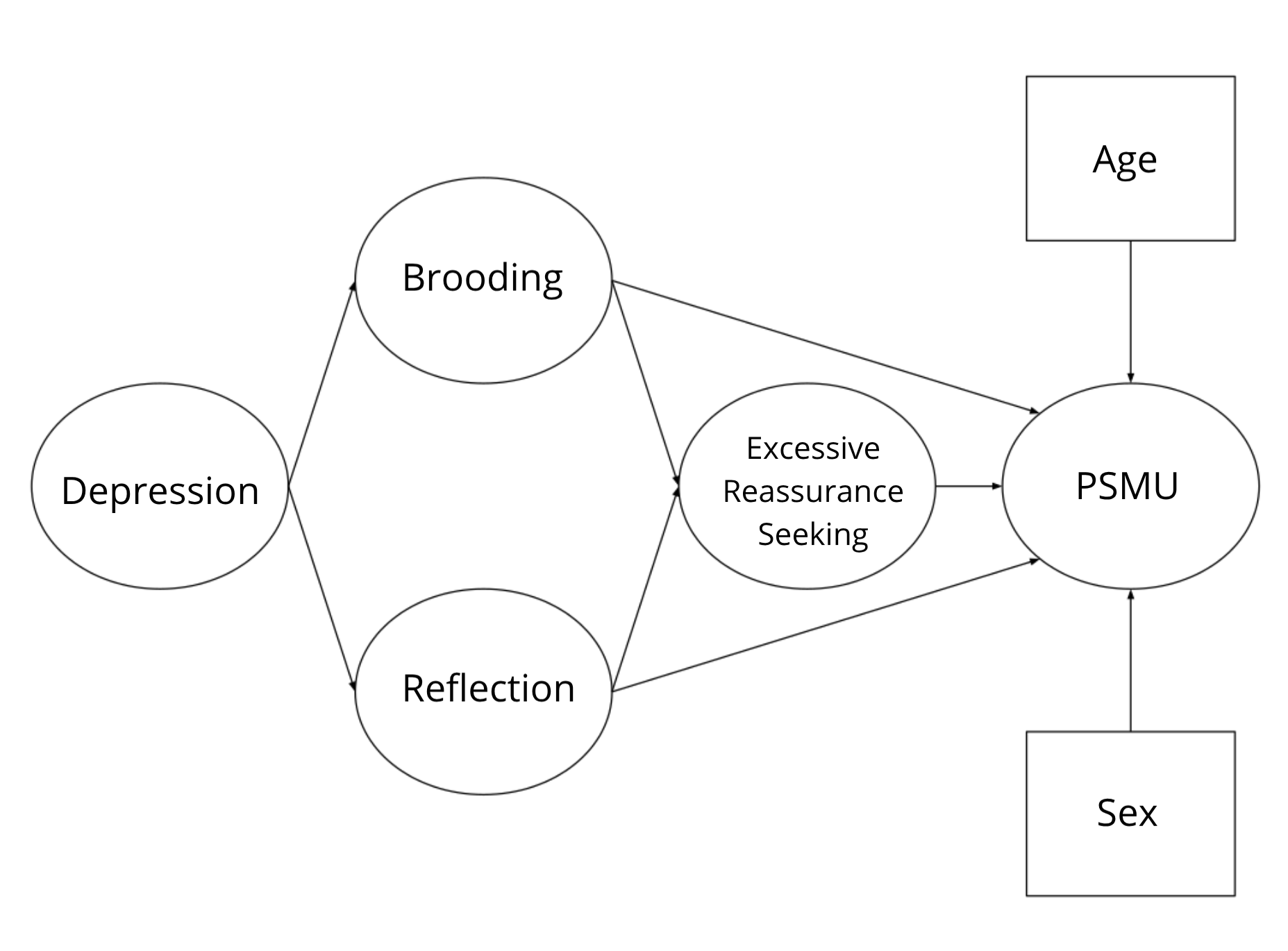
Note. PSMU = Problematic social media use. Oval-shaped variables are latent variables, while rectangle-shaped variables are observed variables. Factor loadings paths for the latent variables are not displayed, to reduce visual clutter.
Finally, we tested indirect effects by computing cross-products of our direct path coefficients, and using the Delta method to determine standard errors of these indirect effects. We used non-parametric bootstrapping with 1,000 replications (using Mplus’ bootstrap command) to facilitate more accurate indirect effect standard errors (MacKinnon et al., 2007), dividing them by the direct path coefficients to compute z-tests and p values. We used WLSMV estimation for these analyses.
We present our anonymized data for the CFA and SEM analyses, along with our survey protocol, in a data repository. The data can be accessed using the following link: https://data.mendeley.com/datasets/7z5tzwxj8f/1
Results
Table 1 displays descriptive statistics, and intercorrelations, for age and scale scores. The scales all had moderate-to-large intercorrelations. Age did not significantly correlate with most scales. Table 2 displays scale score descriptive statistics separated by sex, and tests of sex differences; several sex differences were found, but based on effect sizes, only ERS had greater than a small sex difference in magnitude, with women scoring significantly higher than men.
Table 1. Means, Standard Deviations, and Pearson Correlations for Age and the Observed Scale and Subscale Scores.
|
Variable |
M |
SD |
1 |
2 |
3 |
4 |
5 |
|
Age |
20.06 |
4.18 |
|
|
|
|
|
|
PSMU |
15.14 |
5.37 |
−.12* |
|
|
|
|
|
Depression |
4.98 |
4.36 |
−.02 |
.31*** |
|
|
|
|
ERS |
15.80 |
6.09 |
−.04 |
.39*** |
.35*** |
|
|
|
Brooding |
11.51 |
3.69 |
−.05 |
.35*** |
.53*** |
.44*** |
|
|
Reflection |
10.88 |
3.55 |
−.03 |
.27*** |
.45*** |
.29*** |
.61*** |
|
Note. M and SD are used to represent mean and standard deviation, respectively. ERS = Excessive reassurance seeking; PSMU = Problematic social media use. * indicates p < .05. ** indicates p < .01. *** indicates p < .001. |
|||||||
Table 2. Sex Differences for Scale/Subscale Scores Using Analyses of Variance (ANOVA).
|
Variable |
Men (M) |
Men (SD) |
Women (M) |
Women (SD) |
F(1,386) |
p |
η2 |
|
PSMU |
13.684 |
5.186 |
15.902 |
5.310 |
15.490 |
< .001 |
.040 |
|
Depression |
5.143 |
4.484 |
4.902 |
4.296 |
0.267 |
.606 |
< .001 |
|
ERS |
13.594 |
6.062 |
16.953 |
5.784 |
28.520 |
< .001 |
.070 |
|
Brooding |
10.774 |
3.357 |
11.890 |
3.801 |
8.146 |
.005 |
.020 |
|
Reflection |
10.729 |
3.387 |
10.957 |
3.641 |
0.358 |
.550 |
< .001 |
|
Note. M = Mean; SD = Standard deviation; F = ANOVA F test; p = p value or significance level; η2 = eta-squared (effect size) value; PSMU = Problematic social media use; ERS = Excessive reassurance seeking. |
|||||||
Table 3 displays CFA results for constructs analyzed as part of Model A. Except for RMSEA (discussed above), CFA models mostly demonstrated evidence for good fit. Supplementary Tables S1-S4 display factor loadings for each CFA model. All standardized factor loadings were computed using Mplus’ STDYX standardization method.
Table 3. Confirmatory Factor Analysis (CFA) Results for Model A.
|
CFA Model |
χ2(df), p |
CFI |
TLI |
RMSEA (90% CI) |
SRMR |
|
Depression |
54.652(14), p < .001 |
.992 |
.988 |
.087 (.063, .111) |
.023 |
|
Rumination |
175.366(34), p < .001 |
.959 |
.946 |
.104 (.089, .119) |
.046 |
|
ERS |
41.513(2), p < .001 |
.986 |
.958 |
.226 (.169, .288) |
.020 |
|
PSMU |
90.610(9), p < .001 |
.962 |
.937 |
.153 (.125, .182) |
.038 |
|
Note. ERS = Excessive reassurance seeking; PSMU = Problematic social media use. χ2 = chi-square value; df = degrees of freedom; p = p value/level of statistical significance; CFI = comparative fit index; TLI = Tucker-Lewis Index; RMSEA = root mean squared error of approximation; SRMR = standardized root mean square residual; CI = confidence interval. All models used weighted least squares estimation with a mean- and variance- adjusted chi-square. |
|||||
In conducting SEM, Model A (Figure 1) fit adequately, WLSMV χ2(371) = 1106.269, p < .001, CFI = .930, TLI = .924, RMSEA = .071 [90% CI: .067, .076], SRMR = .085. Model B (Figure 2), adding paths directly from rumination’s brooding and reflection factors to PSMU, also resulted in adequate fit, WLSMV χ2(369) = 1016.021, p < .001,
CFI = .939, TLI = .933, RMSEA = .067 [90% CI: .062, .072], SRMR = .081. Model B fit significantly better than Model A, DIFFTEST χ2diff(2) = 36.723, p < .001; Model B’s CFI increase of .009 points closely approached the .010 difference level typically considered substantial or meaningful in model testing (Cheung & Lau, 2011).
Because Model B fit better than Model A, we display the full output for Model B’s direct path coefficients – see Table 4 (top portion). Depression was significantly associated with both brooding and reflection. Brooding (but not reflection) was significantly associated with ERS. Brooding (but not reflection) was significantly related to PSMU (after adjusting for ERS, age and sex), supporting H2. And ERS was significantly related to PSMU (after adjusting for brooding, reflection, age and sex), supporting H1.
Table 4. Direct and Indirect Effect Standardized Results For Model B.
|
Std. Beta |
SE |
Z-test |
p |
Std. Beta 95% CI |
|
|
Direct Effects |
|
|
|
|
|
|
ERS→PSMU |
.261 |
0.059 |
4.411 |
< .001 |
|
|
Brooding→PSMU |
.225 |
0.061 |
3.690 |
< .001 |
|
|
Reflection→PSMU |
.094 |
0.053 |
1.769 |
.077 |
|
|
Brooding→ERS |
.475 |
0.052 |
9.121 |
< .001 |
|
|
Reflection→ERS |
.096 |
0.056 |
1.729 |
.084 |
|
|
Depression→Brooding |
.802 |
0.029 |
27.639 |
< .001 |
|
|
Depression→Reflection |
.725 |
0.033 |
22.167 |
< .001 |
|
|
Age→PSMU |
−.082 |
0.052 |
−1.574 |
.116 |
|
|
Sex→PSMU |
.417 |
0.111 |
3.748 |
< .001 |
|
|
Indirect Effects |
|||||
|
Depression→Reflection→PSMU |
.068 |
0.044 |
1.532 |
.125 |
[−.005, .141] |
|
Depression→Brooding→PSMU |
.180 |
0.057 |
3.177 |
.001 |
[.087, .274] |
|
Depression→ERS→PSMU |
.000 |
0.000 |
N/A |
N/A |
N/A |
|
Brooding→ERS→PSMU |
.124 |
0.034 |
3.634 |
< .001 |
[.068, .180] |
|
Reflection→ERS→PSMU |
.025 |
0.019 |
1.353 |
.176 |
[−.005, .056] |
|
Depression→Reflection→ERS→PSMU |
.018 |
0.014 |
1.329 |
.184 |
[−.004, .041] |
|
Depression→Brooding→ERS→PSMU |
.099 |
0.029 |
3.456 |
.001 |
[−.052, .147] |
|
Note. ERS = Excessive reassurance seeking; PSMU = Problematic social media use; Std. Beta = Standardized beta/regression coefficient; SE = Standard error; Z-test = Computation of Std. Beta/SE; p = p value or significance level; CI = Confidence interval (provided for indirect effects); N/A = Not applicable (because dividing the Std. Beta by an SE of zero cannot be computed). Indirect effects’ standard errors were bootstrapped. All standardized beta coefficients were computed using Mplus’ STDYX method, except for the path from sex→PSMU which used the STDY method because sex is a categorical predictor variable. Sex was coded 1 = male, |
|||||
Table 4 (bottom portion) displays indirect effects from Model B. Brooding significantly accounted for relations between depression and PSMU severity. Furthermore, ERS indirectly accounted for associations between brooding and PSMU severity, supporting H3. Finally, a serial indirect association from depression to brooding to ERS to PSMU severity was significant, supporting H4.
Despite our conceptualization of depression influencing rumination (discussed above), many studies alternatively demonstrate that rumination may influence depression (Olatunji et al., 2013). Therefore, we also tested an additional model—Model C. In Model C, rather than specifying depression to predict rumination’s brooding and reflection factors, we instead specified brooding and rumination predicting depression (Model C, displayed in Supplemental Figure S1). Aside from this modification, Model C is similar to Model B. However, this model sequence does not fit well conceptually with I-PACE ordering of variables suggesting depression as the predictor/predisposing variable. We present results of Model C in Supplemental Results Description 1 (SRD1) and Supplemental Table 5 (S5).
Discussion
We examined research models testing relations among depression, rumination’s brooding and reflection dimensions, excessive reassurance seeking, and problematic social media use. Our primary finding was that rumination’s brooding dimension and ERS serially accounted for relations between depression and PSMU severity. These findings provide support for brooding and ERS as mechanisms that can explain the robust relationships often found between depression and PSMU (reviewed in Jing et al., 2025).
Supporting H1, we discovered that excessive reassurance seeking was significantly associated with problematic social media use severity (within Model B, and within Model C which included a reversed sequence of brooding to depression). Prior work has revealed ERS related to PSU (Elhai et al., 2020; Mitchell & Hussain, 2018). The present paper extends this finding to PSMU. Individuals engaging in ERS may naturally gravitate to using their smartphone and social media to message close associates in hope of a response, and to seek follows, likes, shares, and comments (Billieux et al., 2015; Forchuk et al., 2021). In this way, excessive reassurance seeking may be considered a coping strategy (albeit maladaptive) in the I-PACE model (Brand et al., 2019) that can increase likelihood of developing problematic online behavior such as PSMU.
Our findings are consistent with H2, in that rumination’s brooding dimension was significantly associated with problematic social media use severity (in Models B and C). Rumination’s reflection dimension was associated with PSMU severity only in bivariate correlational analyses, but not in our structural models which adjusted for other variables. Rumination can be considered a cognitive/affective response variable in I-PACE, and may result in PSMU as a means of distracting oneself from rumination (Billieux et al., 2015), and/or through online reassurance behaviors to alleviate ruminative thoughts (Castro-Calvo et al., 2022). Rumination in general is widely associated with various forms of problematic Internet use, including PSMU (Castro-Calvo et al., 2022; F. Gao & Du, 2025). However, little work has more granularly examined types of rumination (i.e., brooding and reflection) to explore differential relationships with PIU (L. Gao et al., 2021). Our findings support the distinction between brooding and reflection, with brooding being more maladaptive (Rickerby et al., 2024). Thus, brooding fits within I-PACE as a cognitive/affective risk factor that may influence PSMU.
Results also demonstrate support for H3, in that excessive reassurance seeking accounted for relations between rumination’s brooding dimension and problematic social media use severity (in Model B, but not Model C). Previously, this research question was only tested with PSU (but not PSMU) as the dependent variable, finding that ERS accounted for relations between overall rumination and PSU severity (Elhai et al., 2020). Rumination seems to influence PSMU (Castro-Calvo et al., 2022; F. Gao & Du, 2025), but ERS could be an important mechanism explaining why some people scoring high in rumination consequently engage in PSMU. Excessive reassurance seeking may be conceptualized as a maladaptive behavioral coping mechanism or response to the cognitive (non-behavioral) process of rumination. In social media contexts, social comparison has been linked to greater social media engagement (Eitan & Gazit, 2024), which may heighten interpersonal uncertainty, thereby increasing ERS that, in turn, are associated with greater PSMU severity. Thus, this finding provides further support for I-PACE’s focus on cognitive/affective factors, such as ERS and rumination, intersecting with each other to influence excessive Internet use.
We also found support for H4, in that the serial indirect effect from depression to brooding to ERS to PSMU severity in Model B was significant. This similar serial indirect effect in Model C’s reversed sequence - from brooding to depression to ERS to PSMU - was also significant. In fact, portions of the serial indirect effects involving depression were also significant, including depression to brooding to PSMU (Model B), and depression to ERS to PSMU (Model C). These findings attest further to brooding and ERS as mechanisms explaining the depression-PSMU relationship. Although testing PSU instead of PSMU, Elhai et al. (2020) discovered a similar serial indirect effect. This serial indirect effect fits well within I-PACE, because coping and cognitive/affective responses (e.g., ERS and rumination) are conceptualized as mechanisms explaining why predisposing psychopathology (e.g., depression) may intersect with more proximal factors (e.g., rumination and ERS) to influence PIU (such as PSMU). Thus, the significant serial indirect effect also provides further support for I-PACE.
Our most important findings were that a) excessive reassurance seeking accounted for relations between brooding and PSMU severity, and b) the ERS-brooding relationship accounted for relations between depression and PSMU severity. Models such as I-PACE attempt to understand risk factors for PIU, and importantly why some individuals with predisposing psychopathology such as major depressive disorder consequently engage in PSMU while other depressed individuals do not engage in PSMU. This issue is also relevant to findings that depression’s relationship with PSMU severity is only moderate in size rather than larger (Jing et al., 2025), and whether other important mechanisms may be responsible for this relationship. Our findings suggest that brooding and ERS may be important cognitive and affective mechanisms explaining why some depressed individuals engage in PSMU. Depression may influence PSMU especially among those individuals who score high in brooding and whose brooding triggers ERS behaviors to test their interpersonal relationships. These findings support cognitive and affective variables intersecting with and accounting for relations between predisposing psychopathology and PIU in the I-PACE model.
Theoretical and Practical Implications
Results fit with theoretical frameworks such as the I-PACE model, extending the model’s focus on cognitive/affective risk factors for PIU to also include such cognitive/affective variables as ERS and rumination. Importantly, results add support for cognitive/affective variables intersecting with predisposing variables (i.e., depression) in accounting for relations with PIU, such as PSMU. Practical implications in intervening among individuals with PSMU include not only directly targeting problematic online behaviors, but also targeting predisposing variables such as depression and depressive disorders, which may be some of the root causes of PSMU (Elhai et al., 2026), using empirically-validated psychological treatments for depression (Cuijpers et al., 2016). Also important is the use of empirically-validated treatments targeting maladaptive cognitions involving the need for reassurance, using cognitive restructuring (Ezawa & Hollon, 2023).
Limitations
We acknowledge several limitations with the present study. First, our design was cross-sectional, and thus we cannot confidently infer cause and effect. We added reverse-specified analyses especially because of mixed findings on whether rumination influences depression or vice-versa (Hasegawa et al., 2014; Nolen-Hoeksema et al., 2007; Olatunji et al., 2013). And while most theoretical frameworks suggest poor mental health influences PIU (Brand et al., 2019; Caplan, 2003; Kardefelt-Winther, 2014), reciprocal effects may still be apparent (Shoshani et al., 2024; Thorisdottir et al., 2020). Thus, it is alternatively possible that PSMU may amplify rumination or ERS, for example, through such processes as online social comparison or habitual smartphone/social media checking behavior; PSMU may also reinforce and exacerbate ERS through online interpersonal relationship testing. Experimental or longitudinal designs can help better address causality and the temporal order of these variables. Additionally, should emphasize not all of our SEM models fit well. Also, our sample was limited in comprising only Midwestern American students (primarily young adults) from one university. We also only used self-report methods for assessing psychopathology; using structured diagnostic interviews to assess depressive disorders, for example, would be a more rigorous assessment method. Furthermore, our measure of ERS was a general measure of reassurance seeking behaviors, rather than being specific to online ERS. Additionally, we did not objectively measure social media or smartphone use (Sapci et al., 2021), which is important when querying time spent using the Internet (Parry et al., 2021).
Conclusions
Despite the limitations, our results provide further support for coping and cognitive/affective psychological mechanisms (i.e., excessive reassurance seeking and rumination) that can explain why many depressed individuals engage in problematic social media use. Our data screening procedures also represent strengths, such as excluding respondents completing the survey too quickly. Future research should explore additional mechanisms underlying relations between psychopathology and PSMU, such as the fear of missing out (FOMO) (Elhai, Casale, & Montag, 2025), emotion dysregulation (Hutcheson et al., 2025), and attentional bias (Xiao et al., 2022). More granular examination of psychopathology symptoms and psychological processes most related to PIU is also warranted (Alavinikoo et al., 2025; Elhai, Casale, & Bond, 2025). Furthermore, including an online-specific assessment of ERS (e.g., Harmon et al., 2022) in future research would be helpful in understanding the relationship between ERS and PSMU. Finally, replicating findings in a clinical sample in future research would enhance clinical relevance.
Conflict of Interest
The authors report no conflicts of interest with this paper’s study. However, outside the scope of the present paper, the authors report the following…
JDE notes that he receives royalties for several books published on posttraumatic stress disorder (PTSD); occasionally serves as a paid, expert witness on PTSD legal cases.
CM has generated books or book chapters for publishers of mental health texts. For some of these activities he received royalties. Dr. Montag mentions that he was part of a discussion circle (Digitalität und Verantwortung: https://about.fb.com/de/news/h/gespraechskreis-digitalitaet-und-verantwortung/) debating ethical questions linked to social media, digitalization and society/democracy at Facebook. In this context, he received no salary for his activities.
Use of AI Services
The authors did not rely on any large language models or AI in this research project or article write-up.
Data Availability Statement
The anonymized data and survey protocol from this project are available in a Mendeley repository: https://data.mendeley.com/datasets/7z5tzwxj8f/1


This work is licensed under a Creative Commons Attribution-ShareAlike 4.0 International License.
Copyright © 2026 Jon Elhai, Tali Gazit, Christian Montag