
When fast becomes too fast: Working memory constraints in accelerated video playback
Vol.20,No.4(2026)
Hyenyeong Chung
 Yunju Nam
Upyong Hong
Yunju Nam
Upyong Hong
This study investigated whether accelerated video playback affects cognitive load and comprehension, focusing on the moderating role of working memory capacity. With speed control widely available on digital platforms, it is crucial to understand how individuals cognitively process video content presented at varying speeds. To examine this, eye movements were recorded while 38 participants (16 males, 22 females; age range = 19–26 years, M = 22.5, SD = 1.9) watched information-oriented videos at varying speeds, followed immediately by a recall test. Results indicated that as playback speed increased, perceptual load increased for all participants. However, cognitive load and comprehension patterns differed by working memory capacity. Individuals with lower working memory capacity showed shallow processing, as indicated by the absence of elevated cognitive load, and exhibited significantly reduced accuracy in recall tasks. This suggests that they were unable to sufficiently process and retain key information due to the limitations in their cognitive resources. In contrast, individuals with higher capacity showed increased cognitive load under high-speed conditions yet maintained stable recall performance. This implies that their greater capacity to process information enabled deep processing and successful transfer to long-term memory. These findings highlight the importance of considering individual cognitive differences when evaluating the effectiveness of speed-watching strategies. Working memory capacity critically determines how well viewers can cope with the rapid presentation of multimodal content. Ultimately, our findings suggest that speed adjustment may not be an efficient strategy for all users, highlighting the need for cognitively responsive designs that foster user-centered ICT environments.
video playback speed; working memory capacity; cognitive load; eye-tracking; content comprehension
Hyenyeong Chung
Department of Media and Communication, Konkuk University, Seoul
Hyenyeong Chung is a lecturer in the Department of Media and Communication at Konkuk University, South Korea. Her research interests include cognitive science, communication psychology and psycholinguistics. Her research focuses on cognitive processing and human-digital media interaction in contemporary communication environments, utilizing behavioral experiments and physiological measures (e.g., eye-tracking, GSR) to examine attention, cognitive load, and language comprehension.
Yunju Nam
Department of German Language and Literature, Hanyang University, Seoul; KU Institute for Communication Studies, Konkuk University, Seoul
Yunju Nam is an Associate Professor in the Department of German Language and Literature at Hanyang University, South Korea, with a joint appointment in the Department of Data Science (Psychology and Brain Science). Her research focuses on experimental psycholinguistics and neurolinguistics, employing cognitive neuroscience methodologies including eye-tracking, ERP, and behavioral measures to investigate language processing mechanisms. In cyberpsychology, she investigates cybersickness patterns in virtual reality environments and user attention in digital media contexts.
Upyong Hong
Department of Media and Communication, Konkuk University, Seoul
Upyong Hong is a Professor in the Department of Media and Communication at Konkuk University, South Korea. His research focuses on empirical approaches to language communication, drawing on theories and experimental methods from Cognitive Science in general and Psycholinguistics in particular. He also conducts experimental research on user experience (UX) in computer-mediated communication.
Ahn, J., Shin, M., & Kwon, D. (2002). 정상 성인 및 아동의 구어속도에 관한 연구 [The study of speech rate in normal-speaking adults and children]. Speech Sciences, 9(4), 93–103.
Allard, E. S., Wadlinger, H. A., & Isaacowitz, D. M. (2010). Positive gaze preferences in older adults: Assessing the role of cognitive effort with pupil dilation. Aging, Neuropsychology, and Cognition, 17(3), 296–311. https://doi.org/10.1080/13825580903265681
Apraiz-Iriarte, A., Lasa-Erle, G., & Mazmela-Etxabe, M. (2021). Evaluating user experience with physiological monitoring: A systematic literature review. DYNA New Technologies, 8(1). https://doi.org/10.6036/NT10072
Atkinson, R. C., & Shiffrin, R. M. (1968). Human memory: A proposed system and its control processes. In K. W. Spence & J. T. Spence (Eds.), Psychology of learning and motivation (Vol. 2, pp. 89–195). Academic Press. https://doi.org/10.1016/S0079-7421(08)60422-3
Aubry, A., Gonthier, C., & Bourdin, B. (2021). Explaining the high working memory capacity of gifted children: Contributions of processing skills and executive control. Acta Psychologica, 218, Article 103358. https://doi.org/10.1016/j.actpsy.2021.103358
Baayen, R. H. (2008). Analyzing linguistic data: A practical introduction to statistics using R. Cambridge University Press.
Baddeley, A. (1992). Working memory. Science, 255(5044), 556–559. https://doi.org/10.1126/science.1736359
Baddeley, A. (2000). The episodic buffer: A new component of working memory? Trends in Cognitive Sciences, 4(11), 417–423. https://doi.org/10.1016/S1364-6613(00)01538-2
Baddeley, A. D., & Hitch, G. (1974). Working memory. In G. A. Bower (Ed.), Psychology of learning and motivation (Vol. 8, pp. 47–89. https://doi.org/10.1016/S0079-7421(08)60452-1
Barrett, L. F., Tugade, M. M., & Engle, R. W. (2004). Individual differences in working memory capacity and dual-process theories of the mind. Psychological Bulletin, 130(4), 553–573. https://doi.org/10.1037/0033-2909.130.4.553
Bartoń, K. (2026). MuMIn: Multi-model inference (R package version 1.48.19). https://CRAN.R-project.org/package=MuMIn
Bates, D., Machler, M., Bolker, B., & Walker, S. (2015). Fitting linear mixed-effects models using lme4. Journal of Statistical Software, 67(1), 1–48. https://doi.org/10.18637/jss.v067.i01
Bauer, R., Jost, L., Günther, B., & Jansen, P. (2022). Pupillometry as a measure of cognitive load in mental rotation tasks with abstract and embodied figures. Psychological Research, 86(5), 1382–1396. https://doi.org/10.1007/s00426-021-01568-5
Boehm-Davis, D. A., Gray, W. D., & Schoelles, M. J. (2000). The eye blink as a physiological indicator of cognitive workload. Proceedings of the Human Factors and Ergonomics Society Annual Meeting, 44(33), 6–116. https://doi.org/10.1177/154193120004403309
Bolker, B. M., Brooks, M. E., Clark, C. J., Geange, S. W., Poulsen, J. R., Stevens, M. H. H., & White, J. S. S. (2009). Generalized linear mixed models: A practical guide for ecology and evolution. Trends in Ecology & Evolution, 24(3), 127–135. https://doi.org/10.1016/j.tree.2008.10.008
Broadway, J. M., & Engle, R. W. (2011). Individual differences in working memory capacity and temporal discrimination. PloS ONE, 6(10), Article e25422. https://doi.org/10.1371/journal.pone.0025422
Brockmole, J. R., & Logie, R. H. (2013). Age-related change in visual working memory: A study of 55,753 participants aged 8–75. Frontiers in Psychology, 4, Article 12. https://doi.org/10.3389/fpsyg.2013.00012
Cain, B. (2007). A review of the mental workload literature (DRDC Toronto TR 2007-121). Defence Research and Development Canada. https://apps.dtic.mil/sti/tr/pdf/ADA474193.pdf
Carr, N. G. (2011). The shallows: What the Internet is doing to our brains. W. W. Norton & Company.
Chung, Y. J., Hsu, C. W., Chan, M. H., & Cherng, F. Y. (2024). Enhancing ESL learners' experience and performance through gradual adjustment of video speed during extensive viewing. In Proceedings of the 2024 CHI Conference on Human Factors in Computing Systems (Article 669). Association for Computing Machinery. https://doi.org/10.1145/3613904.3642366
Conway, A. R., Cowan, N., Bunting, M. F., Therriault, D. J., & Minkoff, S. R. (2002). A latent variable analysis of working memory capacity, short-term memory capacity, processing speed, and general fluid intelligence. Intelligence, 30(2), 163–183. https://doi.org/10.1016/S0160-2896(01)00096-4
Conway, A. R., Kane, M. J., Bunting, M. F., Hambrick, D. Z., Wilhelm, O., & Engle, R. W. (2005). Working memory span tasks: A methodological review and user’s guide. Psychonomic Bulletin & Review, 12(5), 769–786. https://doi.org/10.3758/BF03196772
Cornelissen, T. H., & Võ, M. L. H. (2017). Stuck on semantics: Processing of irrelevant object-scene inconsistencies modulates ongoing gaze behavior. Attention, Perception, & Psychophysics, 79(1), 154–168. https://doi.org/10.3758/s13414-016-1203-7
Corsi, P. M. (1972). Human memory and the medial temporal region of the brain. [Unpublished doctoral dissertation, McGill University]. https://hdl.handle.net/20.500.14905/132848
Daneman, M., & Carpenter, P. A. (1980). Individual differences in working memory and reading. Journal of Verbal Learning and Verbal Behavior, 19(4), 450–466. https://doi.org/10.1016/S0022-5371(80)90312-6
Dobbs, A. R., & Rule, B. G. (1989). Adult age differences in working memory. Psychology and Aging, 4(4), 500–503. https://doi.org/10.1037/0882-7974.4.4.500
Dziemian, S., Appenzeller, S., Von Bastian, C. C., Jäncke, L., & Langer, N. (2021). Working memory training effects on white matter integrity in young and older adults. Frontiers in Human Neuroscience, 15, Article 605213. https://doi.org/10.3389/fnhum.2021.605213
Faure, V., Lobjois, R., & Benguigui, N. (2016). The effects of driving environment complexity and dual tasking on drivers’ mental workload and eye blink behavior. Transportation Research Part F: Traffic Psychology and Behaviour, 40, 78–90. https://doi.org/10.1016/j.trf.2016.04.007
Firth, J., Torous, J., Stubbs, B., Firth, J. A., Steiner, G. Z., Smith, L., Alvarez-Jimenez, M., Gleeson, J., Vancampfort. D., & Sarris, J. (2019). The “online brain”: How the Internet may be changing our cognition. World Psychiatry, 18(2), 119–129. https://doi.org/10.1002/wps.20617
Hancock, P. A., Wulf, G., Thom, D., & Fassnacht, P. (1990). Driver workload during differing driving maneuvers. Accident Analysis & Prevention, 22(3), 281–290. https://doi.org/10.1016/0001-4575(90)90019-H
He, Q., Han, A. T., Churaman, T. A., & Brown, T. I. (2021). The role of working memory capacity in spatial learning depends on spatial information integration difficulty in the environment. Journal of Experimental Psychology: General, 150(4), 666–685. https://doi.org/10.1037/xge0000972
Hess, E. H., & Polt, J. M. (1964). Pupil size in relation to mental activity during simple problem-solving. Science, 143(3611), 1190–1192. https://doi.org/10.1126/science.143.3611.1190
Hester, R. L., Kinsella, G. J., & Ong, B. E. N. (2004). Effect of age on forward and backward span tasks. Journal of the International Neuropsychological Society, 10(4), 475–481. https://doi.org/10.1017/S1355617704104037
Hooge, I. T., Niehorster, D. C., Nyström, M., Andersson, R., & Hessels, R. S. (2022). Fixation classification: How to merge and select fixation candidates. Behavior Research Methods, 54(6), 2765–2776. https://doi.org/10.3758/s13428-021-01723-1
Hsieh, J. K., Huang, H. Y., & Liao, C. H. (2025). How video-viewing behaviours influence learning effectiveness in online video-based platform: A flow theory perspective. Behaviour & Information Technology, 45(11),
2646–2659. https://doi.org/10.1080/0144929X.2025.2590085
Huitt, W. (2003). The information processing approach to cognition. Educational Psychology Interactive. Valdosta State University. https://www.edpsycinteractive.org/topics/cogsys/infoproc.html
Iqbal, S. T., Zheng, X. S., & Bailey, B. P. (2004). Task-evoked pupillary response to mental workload in human-computer interaction.In CHI '04 Extended Abstracts on Human Factors in Computing Systems (pp. 1477–1480). Association for Computing Machinery. https://doi.org/10.1145/985921.986094
Jarrold, C., & Towse, J. N. (2006). Individual differences in working memory. Neuroscience, 139(1), 39–50. 10.1016/j.neuroscience.2005.07.002
Kao, C. T., Liu, Y. T., & Hsu, A. (2014, October). Speeda: Adaptive speed-up for lecture videos. In Adjunct Proceedings of the 27thAnnual ACM Symposium on User Interface Software and Technology (pp. 97–98). Association for Computing Machinery. https://doi.org/10.1145/2658779.2658794
Keehr, J., & Reardon, R. (2025). Is speed-watching a good idea? Potential metacognitive complications of watching instructional videos at faster speeds. Computers in Human Behavior, 165, Article 108556. https://doi.org/10.1016/j.chb.2025.108556
Kim, E., Oh, S., & Park, S. (2025). An empirical study of user playback interactions and engagement in mobile video viewing. IEEE Access, 13, 78272–78289. https://doi.org/10.1109/ACCESS.2025.3566402
Kıyak, Y. S., Budakoğlu, I. İ., Masters, K., & Coşkun, Ö. (2023). The effect of watching lecture videos at 2× speed on memory retention performance of medical students: An experimental study. Medical Teacher, 45(8), 913–917. https://doi.org/10.1080/0142159X.2023.2189537
Klingner, J. (2010). Measuring cognitive load during visual tasks by combining pupillometry and eye tracking [Doctoral dissertation, Stanford University]. Stanford Digital Repository. https://graphics.stanford.edu/papers/klingner-dissertation/klingner-dissertation.pdf
Kramer, A. F. (2020). Physiological metrics of mental workload: A review of recent progress. In D. Damos (Ed.), Multiple task performance (pp.279–328). Routledge. https://doi.org/10.1201/9781003069447-14
Kuznetsova, A., Brockhoff, P. B., & Christensen, R. H. (2017). lmerTest package: Tests in linear mixed effects models. Journal of Statistical Software, 82(13), 1–26. https://doi.org/10.18637/jss.v082.i13
Liu, J. C., Li, K. A., Yeh, S. L., & Chien, S. Y. (2022). Assessing perceptual load and cognitive load by fixation-related information of eye movements. Sensors, 22(3), Article 1187. https://doi.org/10.3390/s22031187
Luck, S. J., & Vogel, E. K. (2013). Visual working memory capacity: From psychophysics and neurobiology to individual differences. Trends in Cognitive Sciences, 17(8), 391–400. https://doi.org/10.1016/j.tics.2013.06.006
Lyko, T., Elkhatib, Y., Ramdhany, R., & Race, N. (2026). Beyond bitrate: Understanding the QoE impact of playback rate and seeking in adaptive video streaming. ACM Transactions on Multimedia Computing, Communications and Applications, 22(4), Article 98. https://doi.org/10.1145/3796724
Mahanama, B., Jayawardana, Y., Rengarajan, S., Jayawardena, G., Chukoskie, L., Snider, J., & Jayarathna, S. (2022). Eye movement and pupil measures: A review. Frontiers in Computer Science, 3, Article 733531. https://doi.org/10.3389/fcomp.2021.733531
Mallick, R., Slayback, D., Touryan, J., Ries, A. J., & Lance, B. J. (2016, October). The use of eye metrics to index cognitive workload in video games. In 2016 IEEE second workshop on eye tracking and visualization (ETVIS) (pp. 60–64). IEEE. https://doi.org/10.1109/ETVIS.2016.7851168
Mathôt, S., Fabius, J., Van Heusden, E., & Van der Stigchel, S. (2018). Safe and sensible preprocessing and baseline correction of pupil-size data. Behavior Research Methods, 50(1), 94–106. https://doi.org/10.3758/s13428-017-1007-2
Mathôt, S., & Vilotijević, A. (2023). Methods in cognitive pupillometry: Design, preprocessing, and statistical analysis. Behavior Research Methods, 55(6), 3055–3077. https://doi.org/10.3758/s13428-022-01957-7
Mayer, R. E. (2009). Multimedia learning (2nd ed.). Cambridge University Press.
Mayer, R. E., & Moreno, R. (2003). Nine ways to reduce cognitive load in multimedia learning. Educational Psychologist, 38(1), 43–52. https://doi.org/10.1207/S15326985EP3801_6
Merhavy, Z. I., Bassett, L., Melchiorre, M., & Hall, M. P. (2023). The impact of lecture playback speeds on concentration and memory. BMC Medical Education, 23(1), Article 515. https://doi.org/10.1186/s12909-023-04491-y
Mo, C. Y., Wang, C., Dai, J., & Jin, P. (2022). Video playback speed influence on learning effect from the perspective of personalized adaptive learning: A study based on cognitive load theory. Frontiers in Psychology, 13, Article 839982. https://doi.org/10.3389/fpsyg.2022.839982
Mueller, S. T. (2011). The PEBL Corsi Block Test [Computer software]. http://pebl.sf.net
Mueller, S. T., & Piper, B. J. (2014). The psychology experiment building language (PEBL) and PEBL test battery. Journal of Neuroscience Methods, 222, 250–259. https://doi.org/10.1016/j.jneumeth.2013.10.024
Murphy, D. H., Hoover, K. M., Agadzhanyan, K., Kuehn, J. C., & Castel, A. D. (2022). Learning in double time: The effect of lecture video speed on immediate and delayed comprehension. Applied Cognitive Psychology, 36(1), 69–82. https://doi.org/10.1002/acp.3899
Murphy, D. H., Hoover, K. M., & Castel, A. D. (2023). The effect of video playback speed on learning and mind-wandering in younger and older adults. Memory, 31(6), 802–817. https://doi.org/10.1080/09658211.2023.2198326
Nagahama, T., & Morita, Y. (2017). Effect analysis of playback speed for lecture video including instructor images. International Journal for Educational Media and Technology, 11(1), 50–58. https://ijemt.org/index.php/journal/article/view/217
Nakagawa, S., Johnson, P. C., & Schielzeth, H. (2017). The coefficient of determination R2 and intra-class correlation coefficient from generalized linear mixed-effects models revisited and expanded. Journal of the Royal Society Interface, 14(134), Article 20170213. https://doi.org/10.1098/rsif.2017.0213
Neath, I., & Surprenant, A. M. (2003). Human memory: An introduction to research, data, and theory (2nd ed.). Wadsworth.
Ness, I., Opdal, K., & Sandnes, F. E. (2021). On the convenience of speeding up lecture recordings: Increased playback speed reduces learning. In Y.-M. Huang, C.-F. Lai, & T. Rocha (Eds.), Innovative technologies and learning: ICITL 2021, Lecture notes in computer science (Vol. 13117, pp. 461–469). Springer International Publishing. https://doi.org/10.1007/978-3-030-91540-7_47
Noël, M. P., Désert, M., Aubrun, A., & Seron, X. (2001). Involvement of short-term memory in complex mental calculation. Memory & Cognition, 29(1), 34–42. https://doi.org/10.3758/BF03195738
Ominato, T., & Gu, X. (2023). Age matters: Influence of the video instructional materials' playback speed on learning effects. In 2023 IEEE International Conference on Industrial Engineering and Engineering Management (IEEM) (pp. 1109–1112). IEEE. https://doi.org/10.1109/IEEM58616.2023.10406218
Pang, L., Fan, Y., Deng, Y., Wang, X., & Wang, T. (2020). Mental workload classification by eye movements in visual search tasks. In 2020 13th International Congress on Image and Signal Processing, Biomedical Engineering and Informatics (CISP-BMEI) (pp. 29–33). IEEE. https://doi.org/10.1109/CISP-BMEI51763.2020.9263668
Park, D. C., Lautenschlager, G., Hedden, T., Davidson, N. S., Smith, A. D., & Smith, P. K. (2002). Models of visuospatial and verbal memory across the adult life span. Psychology and Aging, 17(2), 299–320. https://doi.org/10.1037/0882-7974.17.2.299
Pedrotti, M., Mirzaei, M. A., Tedesco, A., Chardonnet, J. R., Mérienne, F., Benedetto, S., & Baccino, T. (2014). Automatic stress classification with pupil diameter analysis. International Journal of Human-Computer Interaction, 30(3), 220–236. https://doi.org/10.1080/10447318.2013.848320
Pérez, P., García, N., & Villegas, Á. (2019, June). Subjective assessment of adaptive media playout for video streaming. In 2019 Eleventh International Conference on Quality of Multimedia Experience (QoMEX) (pp. 1–6). IEEE. https://doi.org/10.1109/QoMEX.2019.8743320
Rayner, K. (1998). Eye movements in reading and information processing: 20 years of research. Psychological Bulletin, 124(3), 372–422. https://doi.org/10.1037/0033-2909.124.3.372
R Core Team (2024). R: A language and environment for statistical computing [Computer software]. R Foundation for Statistical Computing. http://www.R-project.org
Ritzhaupt, A. D., Pastore, R., & Davis, R. (2015). Effects of captions and time-compressed video on learner performance and satisfaction. Computers in Human Behavior, 45, 222–227. https://doi.org/10.1016/j.chb.2014.12.020
Schaefer Jr., T., Ferguson, J. B., Klein, J. A., & Rawson, E. B. (1968). Pupillary responses during mental activities. Psychonomic Science, 12(4), 137–138. https://doi.org/10.3758/bf03331236
Skulmowski, A., & Xu, K. M. (2022). Understanding cognitive load in digital and online learning: A new perspective on extraneous cognitive load. Educational Psychology Review, 34(1), 171–196. https://doi.org/10.1007/s10648-021-09624-7
Song, K., Chakraborty, A., Dawson, M., Dugan, A., Adkins, B., & Doty, C. (2018). Does the podcast video playback speed affect comprehension for novel curriculum delivery? A randomized trial. Western Journal of Emergency Medicine, 19(1), 101–105. https://doi.org/10.5811/westjem.2017.10.36027
Sperber, D., & Wilson, D. (1995). Relevance: Communication and cognition (2nd ed.). Blackwell.
Stoffel, M. A., Nakagawa, S., & Schielzeth, H. (2021). PartR2: Partitioning R2 in generalized linear mixed models. PeerJ, 9, Article e11414. https://doi.org/10.7717/peerj.11414
Süß, H. M., Oberauer, K., Wittmann, W. W., Wilhelm, O., & Schulze, R. (2002). Working-memory capacity explains reasoning ability—and a little bit more. Intelligence, 30(3), 261–288. https://doi.org/10.1016/S0160-2896(01)00100-3
Sweller, J. (1988). Cognitive load during problem solving: Effects on learning. Cognitive Science, 12(2), 257–285. https://doi.org/10.1016/0364-0213(88)90023-7
Tran, S., Bianchi, L. J., & Risko, E. F. (2026). Examining increasing playback speed in recorded lectures on memory, attention, and experience. The Journal of Experimental Education, 94(1), 1–19. https://doi.org/10.1080/00220973.2024.2306399
Van Orden, K. F., Limbert, W., Makeig, S., & Jung, T. P. (2001). Eye activity correlates of workload during a visuospatial memory task. Human Factors: The Journal of the Human Factors and Ergonomics Society, 43(1), 111–121. https://doi.org/10.1518/001872001775992570
Watson, R. (2022, August 22). Need for Speed: How YouTubers watch video using playback speeds. YouTube Official Blog. https://blog.youtube/inside-youtube/youtube-watch-video-playback-speeds-trends
Xie, W., Campbell, S., & Zhang, W. (2020). Working memory capacity predicts individual differences in social-distancing compliance during the COVID-19 pandemic in the United States. Proceedings of the National Academy of Sciences, 117(30), 17667–17674. https://doi.org/10.1073/pnas.2008868117
Ye, J. M., & Zhou, J. (2022). Exploring the relationship between learning sentiments and cognitive processing in online collaborative learning: A network analytic approach. The Internet and Higher Education, 55, Article 100875. https://doi.org/10.1016/j.iheduc.2022.100875
Zaki, T., & Islam, M. N. (2021). Neurological and physiological measures to evaluate the usability and user-experience (UX) of information systems: A systematic literature review. Computer Science Review, 40, Article 100375. https://doi.org/10.1016/j.cosrev.2021.100375
Authors’ Contribution
Hyenyeong Chung: conceptualization, investigation, formal analysis, writing—original draft. Yunju Nam: methodology, writing—review & editing. Upyong Hong: resources, supervision, writing—review & editing, project administration.
Editorial Record
First submission received:
December 5, 2025
Revision received:
May 20, 2026
Accepted for publication:
May 30, 2026
Editor in charge:
Lenka Dedkova
Introduction
As users consume increasing amounts of video content in digital environments, new forms of interaction distinct from offline communication emerge, mediated by diverse media technologies. One prominent example that many users frequently adopt today is the ‘playback speed control’, which allows viewers to adjust the speed of information delivery according to their preferences or needs. According to a report by YouTube (Watson, 2022), most viewers who adjust playback speed tend to accelerate the speed rather than slow it down. This type of speed-watching was originally used as a strategy to view lecture content more efficiently in online learning environments (Murphy et al., 2022) but has become common even in daily video-viewing contexts (Kim et al., 2025).
This context raises the question of how users cognitively process video content under speed-watching conditions. Accelerated viewing has the advantage of reducing viewing time, allowing users to consume more content within a given time. However, since the faster playback speed simultaneously increases the rate at which information is delivered, viewers are required to process information at a faster pace. From this perspective, speed-watching should not only be examined in terms of its technical function but also from the perspective of cognitive psychology, focusing on how users regulate cognitive effort and the temporal flow of information.
Understanding how accelerated playback affects users’ cognitive effort requires examining video viewing as a cognitive process. Humans actively transform sensory input into mental representations (Huitt, 2003; Sperber & Wilson, 1995), which makes content comprehension inherently cognitively demanding. When the rate of incoming information rises due to increased playback speed, a higher cognitive load is imposed on working memory. Therefore, investigating how accelerated speed influences cognitive load is crucial for uncovering the mechanisms underlying speed-watching and for evaluating its effects. Addressing this gap is also important from a Human-Computer Interaction (HCI) perspective, as dynamic playback-speed manipulation poses notable challenges for designing cognitively friendly user experiences.
Cognitive load refers to the total amount of mental effort required for information processing and plays a critical role in learning performance (Sweller, 1988). According to Cognitive Load Theory (Sweller, 1988), materials and instructional methods should be structured in ways that help manage cognitive load at an appropriate level. Based on this framework, speed-watching is likely to raise cognitive load since it increases the amount of information that must be processed within a given time. In such cases, cognitive load may be elevated and potentially lead to cognitive overload, impairing comprehension. This concern extends to digital environments, where various design factors have been shown to induce extraneous cognitive load (Skulmowski & Xu, 2022). Given that digital content has become a primary medium through which people engage with information in contemporary life, such increases in cognitive load can ultimately affect the efficiency with which users acquire and process information.
Whether cognitive load becomes ‘excessive’ depends on an individual’s working memory capacity. Working memory capacity refers to the amount of information that can be temporarily retained and manipulated at once (Baddeley & Hitch, 1974; Daneman & Carpenter, 1980). Cognitive overload occurs when task demands surpass this capacity. One of the prominent features of working memory capacity is its individual variability, which serves as an essential determinant in explaining performance differences across various cognitive tasks (e.g., Barrett et al., 2004; Conway et al., 2005; Daneman & Carpenter, 1980; Jarrold & Towse, 2006; Luck & Vogel, 2013; Noël et al., 2001; Süß et al., 2002). Given this variability, working memory capacity can serve as a key factor that determines the effectiveness of high-speed watching since viewers with low working memory capacity are likely to be more susceptible to cognitive overload.
To this end, the present study employed eye-tracking measures to quantitatively assess cognitive load imposed on viewers. Although self-report questionnaires have been widely used to evaluate cognitive load, they rely on retrospective judgments and therefore have limitations in validity and reproducibility (Cain, 2007). To overcome this limitation, recent research has increasingly adopted real-time physiological measures. Among them, eye-tracking is a well-established method that provides continuous indicators of ongoing cognitive processing.
Accordingly, this study aims to examine whether speed-watching induces cognitive load in viewers, and whether this effect varies depending on their working memory capacity. As digital media consumption becomes deeply embedded in everyday life, investigating whether digital technologies such as accelerated playback truly offer cognitive benefits can shed light on the dynamics of human-computer interaction. In this regard, the present study contributes empirical evidence on whether speed-watching functions as a universally beneficial strategy across users and serves as an interdisciplinary example of research grounded in cognitive psychology methodology.
Research Questions
Although many studies have been conducted, there is still no clear consensus on how playback speed in multimodal content influences comprehension. Moreover, the relationship between playback speed and cognitive load has not been firmly established. Drawing on the limited-capacity information processing framework, this study examines how playback speed affects cognitive load and comprehension as a function of individual differences in working memory capacity.
Understanding multimodal information involves organizing and integrating inputs into long-term memory. According to Cognitive Load Theory (Sweller, 1988), intrinsic load reflects inherent task complexity determined by task difficulty and prior knowledge, whereas extraneous load arises from suboptimal instructional design or presentation methods. Because speed-watching modifies only the presentation rate while holding content constant, it primarily amplifies extraneous load by increasing temporal density and reducing processing time for encoding and integration across visual and auditory channels (Mayer & Moreno, 2003).
When extraneous load exceeds capacity limits, cognitive overload occurs, impairing comprehension. We hypothesize that working memory capacity shapes this effect: individuals with lower capacity are more likely to experience overload due to limited resources. By contrast, those with higher capacity can better maintain effective encoding and integration despite increased playback speed.
Alternatively, habitual use of accelerated playback has fostered cognitive adaptation, such as selective attention to gist-level information or predictive processing of discourse structure. If so, playback speed may have little effect on cognitive load even for low-capacity viewers, as both groups may employ compensatory strategies that mitigate overload.
RQ1: How does working memory capacity shape the effect of playback speed on cognitive load, as indexed by eye-tracking measures?
RQ2: How does working memory capacity shape the effect of playback speed on comprehension, as measured by recall accuracy?
Literature Review
Previous Research on Speed-Watching Video Content
Prior studies on accelerated video playback have been approached from various perspectives. In engineering and HCI research, playback speed has been examined primarily through subjective user evaluation of optimal viewing experience (Lyko et al., 2026; Pérez et al., 2019), as well as through the development and evaluation of systems that adjust playback speed using behavioral or content-based indicators (Chung et al., 2024; Kao et al., 2014). From a cognitive processing perspective, more directly relevant to the present study, educational researchers have investigated the adaptive threshold of playback speed for learning by measuring learning outcomes such as comprehension and memory retention across discrete speed conditions. These studies have typically assigned participants to fixed discrete speed conditions and examined the resulting effects on learning. However, the findings remain inconclusive, with results varying across studies.
Prior findings on the effects of accelerated playback in learning contexts can be broadly categorized into three patterns. First, some studies report that accelerated playback can hinder learning. For example, Song et al. (2018) found that medical students showed lower test performance after viewing lecture videos at 1.5x speed than after viewing them at normal speed. In a similar vein, Ness et al. (2021) reported lower test scores when learners listened to a podcast at 2.0x speed compared to normal speed.
Second, several studies have suggested that even though the videos are played at an accelerated speed, viewers’ comprehension is not compromised. Murphy et al. (2022) manipulated the playback speed of the same learning video across four conditions (1x, 1.5x, 2x, and 2.5x) and assigned 231 participants to one of the conditions randomly. Results of the comprehension test showed that scores were lower only in the 2.5x condition in both the immediate and delayed tests. Similarly, Ritzhaupt et al. (2015) reported no significant differences in comprehension across 1x, 1.25x, and 1.5x speeds. Adding further evidence, Keehr and Reardon (2025) showed that viewing an instructional video at 1.5x did not impair content understanding, even when interruptions were introduced. Collectively, several studies have demonstrated that accelerated playback up to 2x does not significantly impair memory retention (Kıyak et al., 2023; Merhavy et al., 2023; Tran et al., 2026). These studies suggest that unless the playback speed goes beyond a tolerable limit for processing, speed-watching can serve as an efficient and cognitively sustainable learning strategy.
Third, other studies indicate that the effects of accelerated playback are speed-dependent, with optimal performance observed at intermediate speeds. For instance, Nagahama and Morita (2017) found that comprehension scores were higher at 1.5x speed compared to normal speed, while performance was maintained at 2x speed. Likewise, Ominato and Gu (2023) showed that learning outcomes at 1.5x speed were better than at normal or 2x speed for younger adults.
These mixed findings may partly reflect the fact that individual differences in cognitive processing capacity were not systematically controlled across studies. Indeed, the effectiveness of accelerated playback is likely to depend on learners’ capacity to handle the increased processing demands, yet relatively few studies have directly examined this relationship. Prior research has shown that learners with higher learning ability are better able to manage cognitive processing, suggesting a link to greater working memory capacity (Mo et al., 2022). In line with this, accelerated playback impaired learning outcomes in older adults, whereas younger adults showed no decline across faster playback speeds (Murphy et al., 2023; Ominato & Gu, 2023). Given that working memory capacity declines with age (Brockmole & Logie, 2013; Dobbs & Rule, 1989; Park et al., 2002), these studies underscore its potential role as a central mechanism that determines the effectiveness of speed-watching.
While these findings point to working memory as a key individual difference variable, the cognitive mechanisms through which playback speed affects processing load remain poorly understood. Mo et al. (2022) took a step toward addressing this by investigating both learning outcomes and cognitive load, finding that increased playback speed elevated cognitive load across all learners, while high-ability learners consistently experienced lower load than low-ability learners. Although this study provides important insight into cognitive processing during accelerated playback, its reliance on self-report measures limits the ability to capture real-time cognitive dynamics.
Taken together, these findings reveal critical gaps in existing literature. The mixed results across studies underscore the need for new empirical evidence that more directly examines the cognitive mechanisms underlying accelerated playback. Moreover, individual differences in working memory capacity, a likely determinant of how effectively learners process time-compressed information, have not been systematically examined as a moderating factor. Furthermore, methodological approaches that can capture the real-time dynamics of cognitive processing are required. In this regard, eye-tracking provides a particularly suitable tool, as it enables continuous and objective measurement of processing load during naturalistic video-viewing contexts.
Eye-Tracking as a Multi-Dimensional Indicator of Processing Load
Eye-tracking captures moment-to-moment changes that reflect the perceptual and cognitive effort induced by the task, unlike self-report measures. This method also provides an index of processing load by distinguishing early perceptual processing from later comprehension processes that rely on working memory.
Fixation behavior, brief pauses during which the eyes remain relatively still to extract visual information, reflects how visual information is sampled and integrated during the early stages of processing. Two fixation-based metrics provide evidence of the perceptual load. Under high perceptual load, fixation count tends to increase and the mean fixation duration becomes shorter since viewers must scan wider regions to extract essential visual information more rapidly (Liu et al., 2022).
While fixation patterns primarily reflect perceptual-level demands, blink behavior offers a sensitive index of the level of cognitive load. When viewers have to retain or integrate information actively in their working memory, blinking is often suppressed because each blink interrupts visual intake. As cognitive demands increase, it is known that blink rate typically decreases and blink duration becomes shorter (Boehm-Davis et al., 2000; Faure et al., 2016; Hancock et al., 1990; Kramer, 2020; Mallick et al., 2016; Pang et al., 2020; Van Orden et al., 2001). In addition to blinking-related indices, pupil diameter reflects the level of cognitive load (Mahanama et al., 2022), since pupils reliably dilate when the task requires employing more cognitive resources. Prior research has consistently shown that more difficult tasks induce greater pupil dilation (Allard et al., 2010; Bauer et al., 2022; Hess & Polt, 1964; Iqbal et al., 2004; Mallick et al., 2016; Pang et al., 2020; Schaefer et al., 1968).
These eye movement measures allow us to distinguish perceptual load from cognitive load. Shorter and more frequent fixations reflect higher perceptual load, while suppressed blink behavior and pupil dilation indicate elevated cognitive load. Together, these eye-tracking measures enable a multi-dimensional assessment of how accelerated playback affects the dynamics of cognitive processing and reveal the differential demands it places on perceptual and cognitive systems.
Methods
Experimental Materials
Six informational videos were selected from YouTube1 based on the following criteria: length of approximately six minutes, a single primary speaker, and subtitles. To account for variations arising from personal interests or prior viewing experiences, one video was selected for each of six different topics: travel, finance, health, product reviews, movie reviews, and education.
To control the speaking rate within each video, all spoken content by the primary interlocutor was transcribed, and the total speaking time was calculated. Based on the number of spoken syllables in Korean (Ahn et al., 2002), the syllables per minute (SPM) for each video were computed by dividing the total number of syllables by the total speaking time. The list of experimental materials along with their SPM values is presented in Table 1. All materials were presented using a Latin square design to minimize content effects. Therefore, all videos were combined at six different playback speeds (0.75x, 1x, 1.25x, 1.5x, 1.75x, 2x).
Table 1. Overview and Speech Rate of Experimental Stimuli.
|
Topic |
Main theme |
Length of video |
Number of spoken syllables |
Total |
Syllables |
|
Travel |
Major travel destinations in Taean |
6m 15s |
1,775 |
278s |
383.09 |
|
Finance |
Information about PayPal and stock trends |
6m 56s |
2,591 |
406s |
382.91 |
|
Health |
Recommendations on supplement intake by time of day |
6m 13s |
2,289 |
358s |
383.63 |
|
Product reviews |
Review of Xiaomi photo printer |
6m 12s |
2,373 |
372s |
382.74 |
|
Movie reviews |
Analysis of the film My Neighbor Totoro |
6m 39s |
2,350 |
354s |
398.31 |
|
Education |
Life and works of Henri Matisse |
6m 43s |
2,184 |
356s |
368.09 |
Procedures
This study was approved by the Institutional Review Board (IRB) and the experiment was conducted accordingly. Data collection took place between May and June 2024, with working memory tasks administered prior to the video-viewing session.
Working Memory Tasks
According to Baddeley and Hitch (1974), working memory consists of three components: the phonological loop for retaining auditory information, the visuospatial sketchpad for storing visual information, and the central executive, which is responsible for manipulating and regulating information. Given that video content combines both auditory and visual modalities, this study employed three tasks to assess each working memory subsystem.
The capacity of the phonological loop was measured by the forward digit span task (Baddeley, 2000). In the task, digits from 1 to 9 were presented at one-second intervals, with sequence length increasing from three to nine digits over seven levels. Each level was administered twice. If the participant correctly repeated at least one sequence at a given level, the sequence length increased by one digit. The task was terminated if the participant failed to recall both sequences at a given level.
The capacity of the central executive was assessed using the backward digit span task (Hester et al., 2004). In this task, participants listened to a series of digit sequences and were instructed to recall the digits in reverse order. This task requires both storage and manipulation of information, thereby reflecting central executive functioning. The task structure and procedure were identical to the forward digit span task, with sequence lengths ranging from 2 to 8 digits across seven levels, each administered twice.
Visuospatial working memory was measured using the Corsi block tapping test (Corsi, 1972) implemented in PEBL 2.1 (Mueller, 2011; Mueller & Piper, 2014). At the start of each trial, nine blue squares were presented on the screen. In each sequence, a subset of the squares turned yellow one at a time for one second each. Participants were instructed to click the squares in the same order to reproduce the sequence. The number of squares to be recalled started at two and increased to nine, with two trials per level. If the participant correctly performed at least one trial at a given level, the sequence length increased by one. If the participant failed both trials at a given level, the task was terminated.
Eye-Movement Recordings and Recall Task
During the eye-movement recording phase, participants were instructed to freely watch each video. All experimental materials were displayed on a 22-inch monitor using SMI Experiment Center 3.7. While participants viewed the video content, eye movements were recorded at a sampling rate of 250 Hz using the SMI RED500, a screen-based eye-tracker. During stimulus presentation, the distance between the participant and the monitor was maintained between 60 and 70 cm. Prior to the presentation of each stimulus, calibration was conducted, and the experiment proceeded only if the vertical and horizontal accuracy errors were both less than 1.0 degree. In addition, considering the sensitivity of pupil diameter to changes in luminance, a two-second gray screen was presented before each video. The brightness of the gray screen for each video was matched to the average luminance across all frames of the upcoming video. After watching each video, participants completed a recall task corresponding to its content.
The recall task consisted of fill-in-the-blank questions based on key information extracted from a summary of each video’s transcript2. Each video was followed by 11 to 12 questions. To minimize the potential influence of the previously viewed video's playback speed on perceived speed in subsequent trials, a minimum inter-trial interval of 2 minutes was maintained following each video, including the time taken to complete the recall task; if completed early, participants rested freely but were instructed to refrain from using mobile phones or engaging in any information-processing activities.
The order of video presentation was pseudo-randomized, with the constraint that videos were not presented in monotonically ascending or descending order of playback speed to avoid systematic speed adaptation effects. The entire video viewing and recall task session lasted approximately one hour. To mitigate potential fatigue effects, participants were permitted to take additional breaks upon request between trials.
Participants
Forty-three Korean native speakers in their twenties participated in the experiment. Five participants who reported no prior experience with speed-watching were excluded to control for familiarity with accelerated playback. As a result, data from 38 participants (16 males, 22 females; age range = 19–26 years, M = 22.5, SD = 1.9) were included in the analysis. All participants were undergraduate students recruited through public announcements posted at the authors' affiliated university. They were confirmed to have normal color vision as well as no cases of color blindness and color weakness. They also reported using the YouTube platform at least once per week. On average, they used the platform almost daily (M = 6.58 days, SD = 0.91), with a mean daily usage time of 100 minutes (SD = 68.17). Upon completion of the experiment, participants received monetary compensation.
Data Analysis
To assess working memory capacity, the number of correctly recalled items was calculated for each participant across three tasks (Conway et al., 2002). Since the maximum number of items differed across tasks, the raw scores for each participant were standardized as z-scores. A composite working memory score was then calculated by averaging the z-scores from the three tasks (Aubry et al., 2021; Dziemian et al., 2021). Participants were subsequently divided into the low working memory group and the high working memory group, based on the median value (0.06) of the composite working memory score3. The distribution of participants in each group is presented in Table 2.
Table 2. Working Memory Capacity Distribution Across Participant Groups.
|
Group |
n |
Forward digit task |
Backward digit task |
Corsi block test |
Composite WM score |
|
LWM |
19 |
58.79 (15.26) |
37.79 (9.21) |
45.84 (12.79) |
−0.56 (0.37) |
|
HWM |
19 |
72.32 (9.00) |
54.26 (13.02) |
67.74 (13.46) |
0.56 (0.39) |
|
Note. Means are shown with standard deviations in parentheses. Scores for the Forward digit task (max = 84), Backward digit task (max = 70), and Corsi block test indicate the number of correctly recalled items (max = 88). Composite WM score represents the average of standardized |
|||||
In the analysis, any trials containing data-logging errors or anomalies were excluded prior to preprocessing. All metrics calculated by SMI BeGaze 3.7 were extracted and used for analysis. As for mean fixation duration and number of fixations, any fixations shorter than 100 ms or longer than 2,000 ms were excluded from the analysis (Cornelissen & Võ, 2017; Hooge et al., 2022; Rayner, 1998). The number of fixations was normalized by dividing the raw count by corresponding playback duration since the length of each video stimulus varied. For blink rate, the values were normalized in the same manner as fixation count. In the case of pupil diameter, only values recorded during fixation periods were included, and missing values were replaced using linear interpolation (Mathôt & Vilotijević, 2023; Pedrotti et al., 2014). Following Mathôt et al. (2018), baseline correction was applied by subtracting the average pupil diameter recorded during a two-second gray screen period from the pupil diameter recorded while participants viewed each target stimulus. For analysis, the mean baseline-corrected pupil diameter per trial was used for each participant. Each item in the recall task was coded as 1 for correct responses and 0 for incorrect responses for the purpose of analysis.
Prior to statistical analysis, all eye-movement data were screened for outliers, and any values exceeding ±2.5 standard deviations from the mean were removed. All subsequent statistical analyses were conducted using R version 4.4.2 (R Core Team, 2024). The cleaned data were analyzed using linear mixed-effects regression models. Linear mixed-effects regression analyses were performed using the lme4 package (Bates et al., 2015), and the accuracy of recall task responses was analyzed using generalized linear mixed-effects regression (GLMER). In each model, video playback speed was included as a categorical fixed effect (coded as categorical variables: 1 = 1x, 2 = 0.75x, 3 = 1.25x, 4 = 1.5x, 5 = 1.75x, 6 = 2x), with normal speed (1x) serving as the baseline for comparison. Both participants and stimulus items were included as random effects. Model construction followed a maximal model approach, where the full model was specified initially. When convergence issues or excessively high correlations among random effects were observed, the corresponding random-effect components were removed, and the bobyqa optimizer was used with increased iterations (maxfun = 1e5) to achieve convergence (Bates et al., 2015). In linear mixed-effects models, fixed effects were considered significant if the absolute value of the t-statistic or z-statistic exceeded 1.96 (Baayen, 2008; Bolker et al., 2009), with significant effects indicated by asterisks in the results tables (*p < .05, **p < .01, ***p < .001) as estimated using the lmerTest package (Kuznetsova et al., 2017). Group-wise linear mixed-effects analyses were conducted to examine differences according to working memory capacity. To assess the effect size of playback speed as a fixed effect in each group-wise model, marginal R² (R²m) was calculated using MuMIn package (Bartoń, 2026), representing the proportion of variance explained by playback speed alone.
Results
Results are organized by eye-tracking indices corresponding to perceptual and cognitive load. Fixation measures reflect perceptual load, whereas blink- and pupil-based measures reflect cognitive load. In each table presenting the descriptive statistics, means and standard deviations are reported in parentheses. Additionally, LWM refers to participants with lower composite working memory scores, whereas HWM refers to those with higher scores.
Fixation-Related Indices
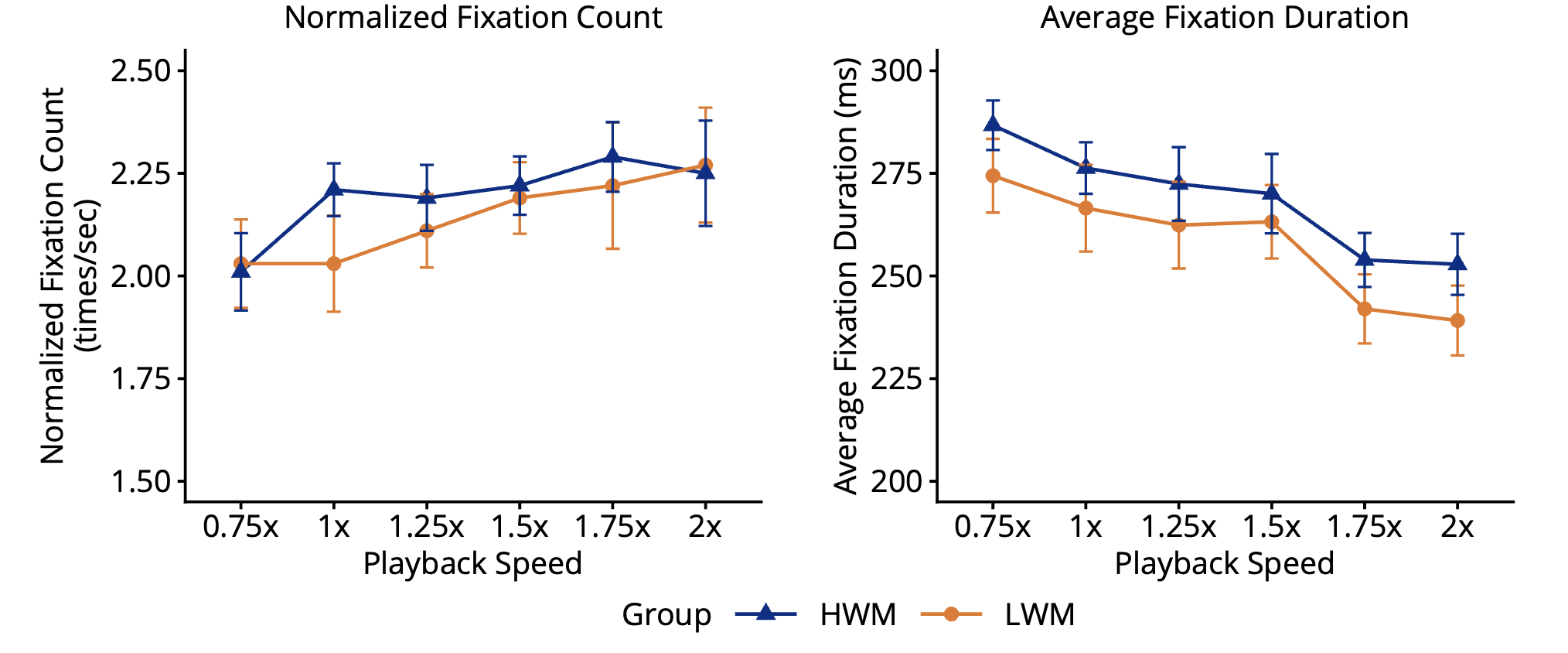
Tables 3 and 4 present the descriptive statistics and results of the statistical analyses for normalized fixation count. As shown in Table 4, playback speed had a significant effect on fixation count in both groups; however, the pattern differed by group. The LWM group showed significantly more fixations under the 2x playback condition (β = 0.24, SE = 0.10, t = 2.48), indicating increased fixation count at higher speeds. In contrast, the HWM group did not show a significant increase at higher speeds; instead, they exhibited significantly fewer fixations under the 0.75x playback condition (β = −0.19, SE = 0.08, t = −2.35). The variance in normalized fixation count attributable to playback speed was 3% for LWM and 5% for HWM.
Table 3. Descriptive Statistics of Normalized Fixation Count.
|
Group |
0.75x |
1x |
1.25x |
1.5x |
1.75x |
2x |
|
LWM |
2.03 (0.47) |
2.03 (0.51) |
2.11 (0.39) |
2.19 (0.38) |
2.22 (0.67) |
2.27 (0.61) |
|
HWM |
2.01 (0.41) |
2.21 (0.28) |
2.19 (0.35) |
2.22 (0.31) |
2.29 (0.37) |
2.25 (0.56) |
Table 4. Linear Mixed-Effects Model Results for Normalized Fixation Count.
|
Group |
Condition |
Estimate |
SE |
t |
R²m |
|
LWM |
(Intercept) |
2.03 |
0.12 |
16.44 |
.03 |
|
0.75x |
0.00 |
0.10 |
0.03 |
||
|
1.25x |
0.08 |
0.10 |
0.79 |
||
|
1.5x |
0.12 |
0.10 |
1.21 |
||
|
1.75x |
0.19 |
0.10 |
1.94 |
||
|
2x |
0.24 |
0.10 |
2.48* |
||
|
HWM |
(Intercept) |
2.21 |
0.10 |
22.66 |
.05 |
|
0.75x |
−0.19 |
0.08 |
−2.35* |
||
|
1.25x |
−0.02 |
0.08 |
−0.22 |
||
|
1.5x |
0.03 |
0.08 |
0.31 |
||
|
1.75x |
0.09 |
0.08 |
1.10 |
||
|
2x |
0.04 |
0.08 |
0.50 |
Tables 5 and 6 report the descriptive statistics and LMER results for average fixation duration. According to the LMER results in Table 6, both the LWM and HWM groups showed statistically significant differences depending on the playback speed. Specifically, for both groups, average fixation duration was shorter under the 1.75x and 2x playback conditions compared to the normal speed condition (LWM: 1.75x – β = −29.85, SE = 6.09, t = −4.90; 2x – β = −34.40, SE = 6.10, t = −5.64; HWM: 1.75x – β = −26.73, SE = 6.22, t = −4.30; 2x – β = −26.24, SE = 6.21, t = −4.22). The R²m values indicated that playback speed explained 11% and 13% of the variance in fixation duration for the LWM and HWM groups, respectively.
Table 5. Descriptive Statistics of Average Fixation Duration.
|
Group |
0.75x |
1x |
1.25x |
1.5x |
1.75x |
2x |
|
LWM |
274.41 (39.12) |
266.53 (46.12) |
262.38 (46.02) |
263.19 (38.98) |
241.98 (36.73) |
239.14 (37.03) |
|
HWM |
286.71 (26.22) |
276.29 (27.40) |
272.40 (39.07) |
270.03 (42.18) |
253.90 (28.69) |
252.83 (32.39) |
Table 6. Linear Mixed-Effects Model Results for Average Fixation Duration.
|
Group |
Condition |
Estimate |
SE |
t |
R²m |
|
LWM |
(Intercept) |
272.02 |
11.03 |
24.67 |
.11 |
|
0.75x |
4.76 |
6.19 |
0.77 |
||
|
1.25x |
−9.33 |
6.09 |
−1.53 |
||
|
1.5x |
−8.10 |
6.09 |
−1.33 |
||
|
1.75x |
−29.85 |
6.09 |
−4.90*** |
||
|
2x |
−34.40 |
6.10 |
−5.64*** |
||
|
HWM |
(Intercept) |
279.05 |
10.08 |
27.69 |
.13 |
|
0.75x |
8.16 |
6.20 |
1.32 |
||
|
1.25x |
−5.96 |
6.20 |
−0.96 |
||
|
1.5x |
−11.39 |
6.21 |
−1.83 |
||
|
1.75x |
−26.73 |
6.22 |
−4.30*** |
||
|
2x |
−26.24 |
6.21 |
−4.22*** |
Figure 1. Fixation-Related Indices Across Playback Speeds by Working Memory Group.
 Note. Error bars represent standard errors of the mean.
As illustrated in Figure 1, both groups showed an overall increase in fixation count and decrease in fixation duration as playback speed increased, with the LWM group exhibiting a more pronounced decline in fixation duration at higher speeds. Results from the normalized fixation counts and average fixation durations indicate that faster playback speeds induce higher perceptual load during the early stages of cognitive processing. As Liu et al. (2022) reported, average fixation duration decreased under higher playback speeds (1.75x and 2x) compared to the normal-speed condition. Similarly, both groups exhibited an overall increase in the number of fixations at higher speeds; however, this trend did not reach statistical significance for the HWM group, although descriptive statistics suggested a slight upward trend. Meanwhile, for the HWM group, a reduction in fixation count under the 0.75x condition suggests that slower playback speeds impose lower perceptual load, likely due to the reduced temporal density of incoming information.
These findings demonstrate that high playback speed inherently increases perceptual load by compressing more sensory information into a given time frame. This requires the perceptual system to process a denser stream of input within a compressed temporal window. Importantly, this increased perceptual load occurred regardless of individual differences in working memory capacity, consistent with models in which perceptual processing precedes working memory operations.
Blink-Related Indices
As cognitive load increases, both the frequency and duration of blinks generally decrease. Given this, the following analyses examined both blink rate and duration measures.
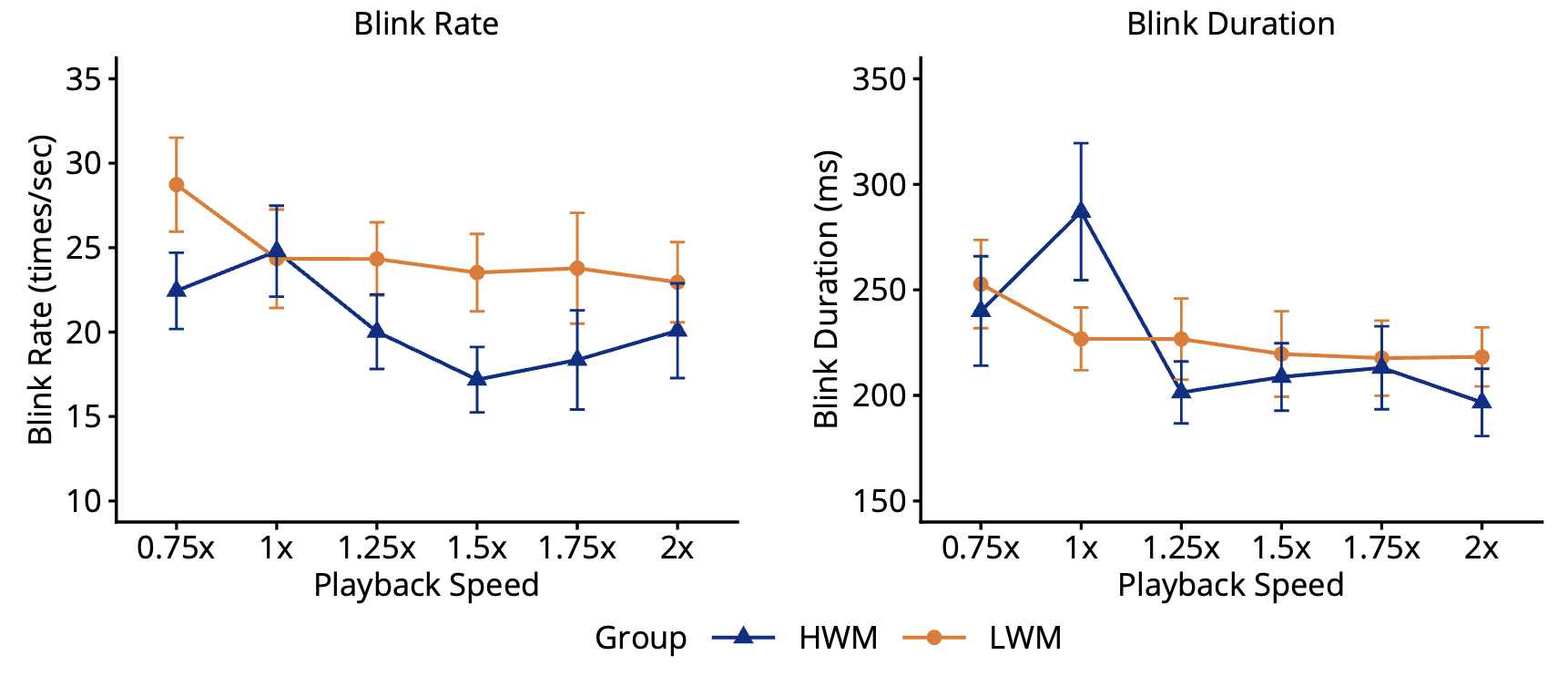
Tables 7 and 8 report the descriptive statistics and LMER results for blink rate, respectively. The LMER results (Table 8) revealed a divergent pattern between groups: no significant main effect of playback speed was found for the LWM group, whereas the HWM group exhibited a significant main effect. Specifically, blink rate was significantly lower under the 1.5x (β = −5.51, SE = 2.05, t = −2.68) and 1.75x (β = −5.70, SE = 1.95, t = −2.93) conditions. Notably, although the descriptive statistics (Table 7) suggest reductions in blink rate at 1.25x (M = 20.02) and 2x (M = 20.08) for the HWM group, these differences did not reach statistical significance (1.25x: β = −2.51, SE = 2.05,
t = −1.23; 2x: β = −3.26, SE = 1.97, t = −1.65). Playback speed accounted for 3% of the variance in blink rate for both groups.
Table 7. Descriptive Statistics of Blink Rate.
|
Group |
0.75x |
1x |
1.25x |
1.5x |
1.75x |
2x |
|
LWM |
28.73 (12.13) |
24.34 (12.70) |
24.33 (9.45) |
23.52 (10.00) |
23.78 (14.31) |
22.95 (10.35) |
|
HWM |
22.44 (9.85) |
24.79 (11.75) |
20.02 (9.62) |
17.18 (8.44) |
18.35 (12.81) |
20.08 (12.23) |
Table 8. Linear Mixed-Effects Model Results for Blink Rate.
|
Group |
Condition |
Estimate |
SE |
t |
R²m |
|
LWM |
(Intercept) |
26.57 |
2.94 |
9.05 |
.03 |
|
0.75x |
2.00 |
2.02 |
0.98 |
||
|
1.25x |
−0.94 |
2.08 |
−0.45 |
||
|
1.5x |
−2.48 |
2.07 |
−1.20 |
||
|
1.75x |
−2.76 |
2.02 |
−1.37 |
||
|
2x |
−3.60 |
2.02 |
−1.79 |
||
|
HWM |
(Intercept) |
24.07 |
2.62 |
9.18 |
.03 |
|
0.75x |
−1.68 |
1.94 |
−0.87 |
||
|
1.25x |
−2.51 |
2.05 |
−1.23 |
||
|
1.5x |
−5.51 |
2.05 |
−2.68** |
||
|
1.75x |
−5.70 |
1.95 |
−2.93** |
||
|
2x |
−3.26 |
1.97 |
−1.65 |
Table 9 presents the descriptive statistics and Table 10 presents the LMER results for blink duration. As indicated by the LMER results (Table 10), the effects of playback speed differed between groups. While the LWM group showed no significant main effect of playback speed, the HWM group demonstrated a significant main effect, indicating greater sensitivity to speed variations. Specifically, the HWM group showed significantly shorter blink duration under the 2x playback condition compared to the normal speed condition (β = −47.39, SE = 19.96, t = −2.37). Additionally, they showed longer blink duration under the 0.75x speed condition (β = 44.24, SE = 19.92, t = 2.22). Playback speed explained 3% and 8% of the variance in blink duration for the LWM and HWM groups, respectively.
Table 9. Descriptive Statistics of Blink Duration.
|
Group |
0.75x |
1x |
1.25x |
1.5x |
1.75x |
2x |
|
LWM |
252.73 (91.27) |
226.79 (64.80) |
226.69 (83.64) |
219.60 (88.27) |
217.65 (77.60) |
218.22 (60.88) |
|
HWM |
239.99 (113.03) |
287.05 (141.45) |
201.38 (63.93) |
208.73 (69.59) |
213.08 (85.79) |
196.66 (69.43) |
Table 10. Linear Mixed-Effects Model Results for Blink Duration.
|
Group |
Condition |
Estimate |
SE |
t |
R²m |
|
LWM |
(Intercept) |
230.74 |
18.33 |
12.59 |
.03 |
|
0.75x |
21.85 |
12.32 |
1.77 |
||
|
1.25x |
−3.92 |
12.32 |
−0.32 |
||
|
1.5x |
−11.22 |
12.32 |
−0.91 |
||
|
1.75x |
−12.99 |
12.32 |
−1.06 |
||
|
2x |
−17.00 |
12.52 |
−1.36 |
||
|
HWM |
(Intercept) |
240.72 |
22.74 |
10.59 |
.08 |
|
0.75x |
44.24 |
19.92 |
2.22* |
||
|
1.25x |
−28.85 |
19.92 |
−1.45 |
||
|
1.5x |
−24.02 |
19.98 |
−1.20 |
||
|
1.75x |
−20.42 |
20.38 |
−1.00 |
||
|
2x |
−47.39 |
19.96 |
−2.37* |
Figure 2. Blink-Related Indices Across Playback Speeds by Working Memory Group.
 Note. Error bars represent standard errors of the mean.
As presented in Figure 2, blink-related indices varied across playback speeds in the HWM group, whereas the LWM group showed relatively stable patterns. These results suggest that individuals with lower working memory capacity exhibited little variation in cognitive load across different playback speeds. However, individuals with higher working memory capacity exhibited shorter blink durations under high-speed playback (2x), indicating increased cognitive demand, whereas their blink durations lengthened under the slow-speed condition (0.75x), reflecting reduced cognitive load.
These results indicate that cognitive load at the working memory level varies with playback speed depending on the viewer’s working memory capacity. Results on blink-related measures demonstrated a clear divergence: viewers with high capacity showed greater sensitivity to accelerated playback. Specifically, those viewers exhibited greater cognitive load under high-speed playback (2x), whereas they experienced reduced cognitive load under the slow-speed playback (0.75x). This pattern suggests that high-capacity viewers allocate greater cognitive resources and engage in deeper processing, making them more responsive to variations in temporal density. In contrast, low-capacity viewers showed non-significant variations in cognitive load across playback speed, indicating less adaptive modulation of processing depth.
Pupil Diameter
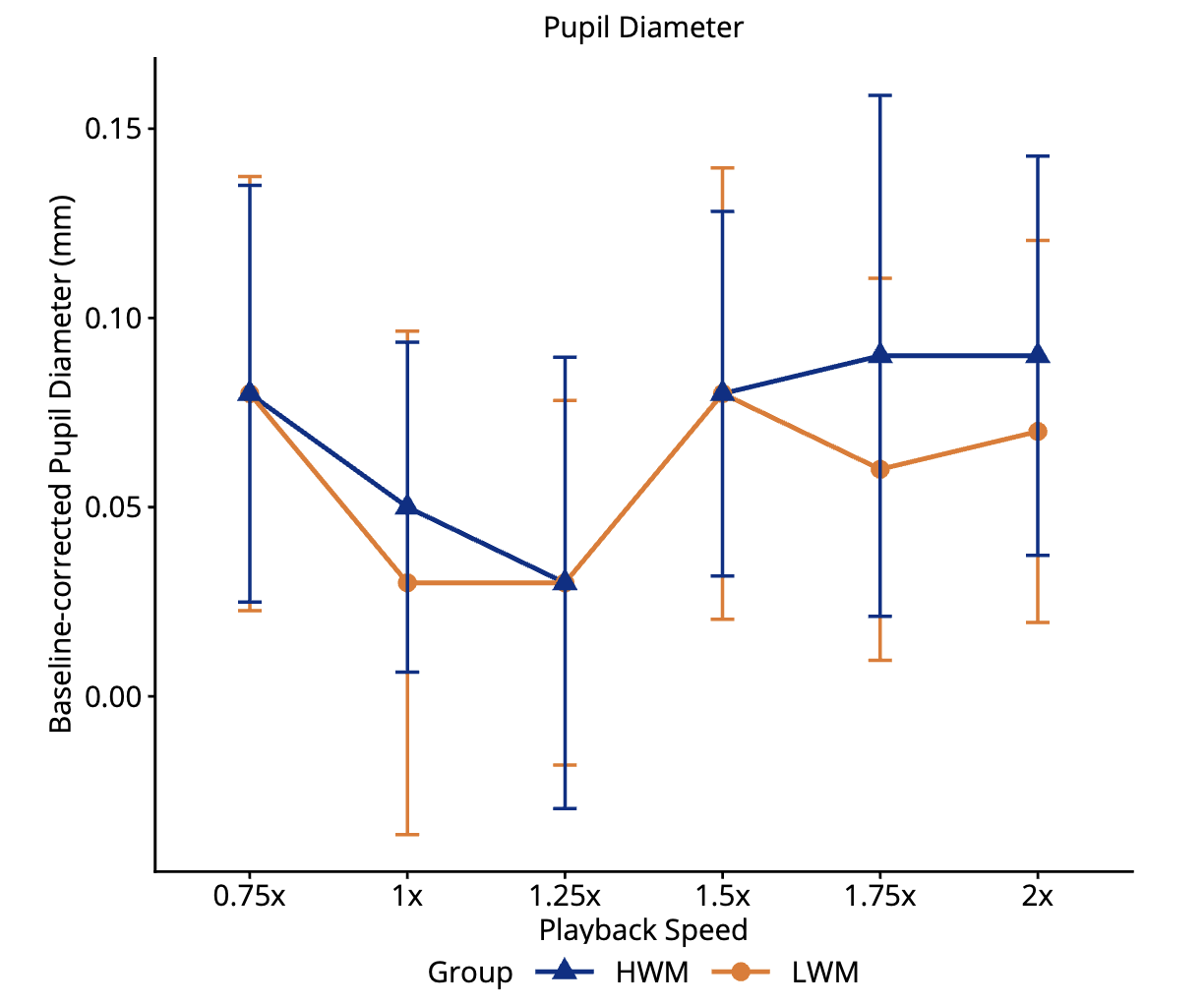
Table 11 presents the descriptive statistics and Table 12 presents the LMER results for pupil diameter. The LMER results (Table 12) indicated that neither group showed statistically significant differences in pupil diameter across playback speed conditions (Tables 11 and 12). The R²m values were .01 for both groups.
Pupil diameter is generally considered a sensitive physiological indicator of cognitive load. However, under the conditions of this experiment, it did not appear to capture differences according to playback speed for either group (Figure 3). One possible explanation is that pupil diameter reliably reflects cognitive load under static conditions or clearly defined tasks but may be less effective in dynamic visual environments (Klingner, 2010), such as video content with continuously changing visual input.
Recall Task
Table 13 presents the generalized linear mixed-effects model results, where the Intercept represents the estimated log-odds of correct recall at the baseline speed (1x), and the remaining estimates indicate the change in log-odds relative to this baseline. Z-value indicates statistical significance. Participants with lower working memory capacity showed a general tendency toward decreased probability of correct responses as the playback speed increased, compared to the normal-speed condition. In contrast, those with higher working memory capacity showed no significant difference across playback speed conditions. The R²m values were .01 for both groups4.
These results suggest that comprehension in high-speed viewing environments was impaired among individuals with lower working memory capacity. This demonstrates that essential information may be omitted during processing, ultimately causing an impaired transfer of key messages to long-term memory. In contrast, the absence of declines in the recall task across all conditions among individuals with higher working memory capacity indicates that they were able to process information effectively even when the video playback speed was increased.
Table 11. Descriptive Statistics of Pupil Diameter.
|
Group |
0.75x |
1x |
1.25x |
1.5x |
1.75x |
2x |
|
LWM |
0.08 (0.25) |
0.03 (0.29) |
0.03 (0.21) |
0.08 (0.26) |
0.06 (0.22) |
0.07 (0.22) |
|
HWM |
0.08 (0.24) |
0.05 (0.19) |
0.03 (0.26) |
0.08 (0.21) |
0.09 (0.30) |
0.09 (0.23) |
Table 12. Linear Mixed-Effects Model Results for Pupil Diameter.
|
Group |
Condition |
Estimate |
SE |
t |
R²m |
|
LWM |
(Intercept) |
0.02 |
0.07 |
0.34 |
.01 |
|
0.75x |
0.03 |
0.05 |
0.64 |
||
|
1.25x |
−0.01 |
0.05 |
−0.15 |
||
|
1.5x |
0.05 |
0.05 |
1.00 |
||
|
1.75x |
0.02 |
0.05 |
0.43 |
||
|
2x |
0.03 |
0.05 |
0.68 |
||
|
HWM |
(Intercept) |
0.04 |
0.06 |
0.70 |
.01 |
|
0.75x |
0.02 |
0.08 |
0.30 |
||
|
1.25x |
−0.01 |
0.08 |
−0.14 |
||
|
1.5x |
0.06 |
0.08 |
0.84 |
||
|
1.75x |
0.05 |
0.10 |
0.45 |
||
|
2x |
0.04 |
0.08 |
0.54 |
Figure 3. Pupil Diameter Across Playback Speeds by Working Memory Group.
Note. Error bars represent standard errors of the mean.
Table 13. Generalized Linear Mixed-Effects Model Results for Recall Task.
|
Group |
Condition |
Estimate |
SE |
z |
R²m |
|
LWM |
(Intercept) |
1.27 |
0.33 |
3.84 |
.01 |
|
0.75x |
−0.20 |
0.23 |
−0.88 |
||
|
1.25x |
−0.48 |
0.22 |
−2.15* |
||
|
1.5x |
−0.53 |
0.22 |
−2.41* |
||
|
1.75x |
−0.71 |
0.22 |
−3.29** |
||
|
2x |
−0.75 |
0.22 |
−3.37*** |
||
|
HWM |
(Intercept) |
1.05 |
0.34 |
3.08 |
.01 |
|
0.75x |
0.04 |
0.34 |
0.12 |
||
|
1.25x |
−0.33 |
0.25 |
−1.34 |
||
|
1.5x |
−0.50 |
0.27 |
−1.84 |
||
|
1.75x |
−0.34 |
0.28 |
−1.22 |
||
|
2x |
−0.29 |
0.25 |
−1.18 |
||
|
Note. For the recall task (GLMER), the delta method was used to compute R²m (Nakagawa et al., 2017). |
|||||
Discussion
Overview and Interpretation
This study investigated whether working memory capacity influences cognitive load (RQ1) and comprehension (RQ2) in accelerated playback environments. The main finding of our study is that all viewers experienced increased perceptual load at higher playback speeds, while the level of cognitive load differed depending on the working memory capacity. Viewers with higher capacity showed elevated levels of cognitive load, but they maintained stable recall performance. In contrast, individuals with lower capacity did not exhibit elevated cognitive load but did show significantly impaired comprehension. These results collectively address both research questions: working memory shapes the relationship between playback speed and viewers’ cognitive processing in terms of both cognitive load and comprehension outcomes.
Together, these findings demonstrate that working memory capacity is a key determinant of how effectively individuals can process information under high-speed viewing conditions. Individuals with lower working memory capacity can retain only a smaller amount of information at a time. Consequently, they can hold only fragments of rapidly presented input, increasing the likelihood that essential content is only partially processed. As a result, they may not exhibit high levels of cognitive load, which in turn limits the transfer of information into long-term memory. This loss directly impairs performance on recall tasks.
In contrast, individuals with higher working memory capacity possess greater cognitive resources. Even under high-speed viewing conditions, they can process a larger portion of the rapidly presented input with minimal loss. Although accelerated playback speeds elevate cognitive load due to the increased amount of information, their greater cognitive resources consequently facilitate more active and sophisticated processing. Therefore, essential information can be efficiently transferred to long-term memory, ultimately resulting in consistent comprehension performance across different playback speeds.
Theoretical Implications
This study addresses a key gap in previous research by providing direct empirical evidence on the cognitive processing mechanisms underlying accelerated video playback. Particularly, by incorporating working memory capacity as an individual difference variable, the findings provide empirical support for its moderating role in cognitive processing under accelerated playback conditions, a relationship that had previously been inferred but not directly tested. Furthermore, while prior research has largely focused on educational settings, the current findings extend this line of inquiry to general video viewing contexts, offering insights that are broadly applicable to everyday digital media consumption.
From a theoretical standpoint, our findings offer a nuanced extension of Cognitive Load Theory (CLT; Sweller, 1988). Within the traditional CLT framework, accelerated playback has been conceptualized as increasing extraneous cognitive load by shortening the interval available for comprehension (Mayer & Moreno, 2003). However, the present results suggest that this effect is not uniform across viewers. Instead, the extent to which faster playback elevates cognitive load is contingent upon individuals’ working memory capacity. This indicates that the extraneous load imposed by accelerated playback does not automatically lead to cognitive overload, but rather depends on the availability of cognitive resources. In this sense, the findings refine the application of Cognitive Load Theory to digital media environments by highlighting the moderating role of individual differences.
These findings further underscore the importance of distinguishing perceptual load from cognitive load in high-speed video playback. According to cognitive processing models, incoming sensory input is first processed at the perceptual level before being selected and transferred to working memory for further processing (Atkinson & Shiffrin, 1968; Baddeley, 1992). As playback speed increases, perceptual demands inevitably rise for all viewers, as more information must be sampled within a compressed time frame. However, whether this perceptual input is successfully encoded into working memory depends on the available cognitive resources. This dissociation suggests that higher perceptual load does not necessarily induce greater cognitive load. Rather, cognitive overload occurs only when the encoded information exceeds working memory resources available to maintain and integrate it. This distinction demonstrates that cognitive load is not simply a function of input density, but of how effectively that input is processed within the constraints of working memory.
From an HCI perspective, the present findings contribute to the growing body of research employing psychophysiological measures in UX evaluation (Apraiz-Iriarte et al., 2021; Zaki & Islam, 2021). This study demonstrates that eye-tracking indices are sensitive to variations in playback speed and capture differential cognitive processing across users with varying working memory capacity. Importantly, the cognitive consequences of accelerated playback vary as a function of working memory capacity, indicating that similar subjective evaluations may mask substantial differences in cognitive load among users. These findings highlight the importance of incorporating objective physiological measures for a more comprehensive and ecologically valid assessment of user experience in digital media environments.
Practical Implications
Our findings emphasize the importance of inclusive content design that recognizes cognitive diversity in digital environments. As the Internet increasingly shapes how people process information, cognitive processing is becoming more dynamic and adapted to technological contexts (Carr, 2011; Firth et al., 2019). These findings therefore highlight the need for media platforms and instructional systems to adopt designs that are responsive to individual cognitive characteristics, ensuring equitable and effective information access for all users.
From a content platform perspective, current one-size-fits-all playback designs remain insufficient, as cognitively adaptive systems that account for individual differences are largely undeveloped. In response, platforms could move toward more cognitively informed designs by leveraging existing engagement data (e.g., rewind frequency, pause patterns, and content completion rates) to identify users who may struggle with accelerated playback and provide personalized speed recommendations. Additionally, platforms could offer optional cognitive screening tools, such as brief working memory assessments, to help users identify their optimal viewing speed.
For online instructors and educational content designers, these results have direct implications for how instructional videos are structured and delivered. Building on prior research emphasizing cognitive support in instructional design (Hsieh et al., 2025; Ye & Zhou, 2022), our study highlights that CLT-based principles such as segmenting, signaling, and pre-training can effectively reduce cognitive load and support deeper learning (Mayer, 2009; Mayer & Moreno, 2003). Applying these to accelerated playback contexts, instructors should anticipate that a substantial portion of viewers may watch content at accelerated speeds, causing critical information to pass too quickly for lower-capacity learners to encode. To counteract this, providing brief pre-training materials that introduce key concepts before the main lecture can reduce initial processing demands and support efficient encoding under accelerated playback. During viewing, key concepts should be presented with extended on-screen exposure, supplemented by visual cues such as highlights or text overlays that remain visible independent of narration speed. Segmenting lectures into shorter, topically coherent units is also recommended, as chunking information into manageable portions has been shown to reduce cognitive load (Mayer, 2009;
Neath & Surprenant, 2003). This allows learners to pause and re-engage at their own pace, improving accessibility for those with limited working memory resources. Finally, providing interactive navigation features such as chapter markers and timestamped summaries enables learners to self-regulate their viewing experience, offering a practical safeguard against comprehension loss in speed-watching contexts.
Beyond platform and instructional design, these results also carry implications for media literacy education. Because of individual differences in cognitive capacity, fostering awareness of one’s own processing limitations is increasingly important. Media literacy programs can encourage strategic playback speed selection based on content complexity and individual cognitive capacity. More broadly, these considerations point to the need for cognitive accessibility standards in educational media platforms, ensuring that diverse learners are adequately supported in digital learning environments.
Limitations and Further Directions
The present study has several limitations that should be acknowledged. First, the use of a median split to classify participants into high- and low-working-memory-capacity groups, while commonly used in prior research, involves some loss of statistical information by treating a continuous variable as categorical. Moreover, the binary classification into two groups may not fully capture the heterogeneity within working memory capacity. Although the repeated-measures design used in the present study provided increased statistical efficiency relative to between-subjects approaches, future research would benefit from larger sample sizes that allow for more fine-grained classifications, such as three to five capacity levels, or from analyzing working memory capacity as a continuous moderator variable to provide more granular insights.
Second, the present study assessed only immediate recall performance following each video. While Murphy et al. (2022) examined both immediate and delayed recall under accelerated playback conditions, the present study was limited to immediate recall, and whether the observed effects persist over time remains an open question. Future studies should incorporate delayed recall measures to examine the long-term retention of information processed under accelerated playback conditions and to determine whether the differential effects observed between LWM and HWM groups are maintained or attenuated over time.
Third, although video length and speech rate were controlled across stimuli, the present study did not systematically manipulate content difficulty or information density. All videos were drawn from general informational content, and it therefore remains unclear whether the present findings generalize to materials with varying levels of conceptual complexity or domain-specific knowledge. Future research should examine how content difficulty interacts with playback speed and working memory capacity, as the cognitive demands imposed by accelerated playback may differ substantially depending on the conceptual complexity and informational demands of the material.
Conclusion
Ultimately, the findings of this study highlight that emerging content consumption behaviors, such as speed-watching, should not be evaluated solely in terms of technical or economic efficiency. The consequences of accelerated media consumption fundamentally depend on viewers’ internal cognitive processing, demonstrating that technological efficiency does not always guarantee cognitive efficiency. As digital communication environments continue to evolve, understanding how users process information under such accelerated conditions is central to designing media systems that align with human cognitive capabilities.
Accordingly, the development of digital technologies should shift from a technology-centered toward a human-centered perspective in ICT development. In contemporary society, where digital media consumption has become a daily routine, it is humans who ultimately interpret and integrate the information they encounter. Therefore, a human-centered ICT approach enables the creation of cognitively responsive technologies that enhance both the usability and quality of digital experiences.
Footnotes
1 Links to the experimental video stimuli are available as Supplementary Material 1 via the Open Science Framework (OSF): https://osf.io/3zpd6/
2 Recall task questions for each video are available as Supplementary Material 2 via the Open Science Framework (OSF): https://osf.io/3zpd6
3 Participants were divided at the median of the composite working memory score because there is no universally established cutoff for classifying individuals into high and low working memory capacity groups. Median split has been used in prior working memory research to distinguish high- and low-capacity groups (e.g., Broadway & Engle, 2011; He et al., 2021; Xie et al., 2020). In the present study, this approach also resulted in balanced group sizes (n = 19 per group), which is advantageous for maintaining statistical stability in group-wise analyses.
4 Although R²m value appears small (R²m = .014 for LWM; .005 for HWM), it is partly attributable to the nature of binomial GLMMs, in which distribution-specific variance contributes to the residual component and yields more conservative R²m estimates (Nakagawa et al., 2017; Stoffel et al., 2021).
Conflict of Interest
The authors have no conflicts of interest to declare.
Use of AI Services
The authors declare that AI services were not used to generate any part of the manuscript or data.
Data Availability Statement
The datasets generated and/or analyzed during the current study are not publicly available due to ethical and privacy restrictions approved by the Institutional Review Board (IRB) but are available from the corresponding author upon reasonable request.
Acknowledgement
We sincerely thank all participants for their participation and cooperation. This paper was supported by Konkuk University in 2021. Also, this article is based on the first author’s doctoral dissertation completed at Konkuk University in 2025, under the supervision of the corresponding author.


This work is licensed under a Creative Commons Attribution-ShareAlike 4.0 International License.
Copyright © 2026 Hyenyeong Chung, Yunju Nam, Upyong Hong