
Comparative role of self-factors: A gender-based network analysis of problematic social media use and physical health
Vol.20,No.4(2026)
Jakub Helvich
 Lukas Novak
Bibiana Jozefiakova
Eva Milkova
Peter Tavel
Lukas Novak
Bibiana Jozefiakova
Eva Milkova
Peter Tavel
The growing prevalence of problematic social media use (PSMU) and its negative association with health has become a significant public health concern. Despite increasing attention to its psychological correlates, there remains a critical need to investigate factors that might be associated with the co-occurrence of physical health and PSMU on a fine-grained level. This study aims to examine the symptom-level relationships between PSMU, physical health, self-esteem, and self-compassion and investigate potential gender differences in these relationships. A sample of 2912 Czech adults (Age: M = 27.6, SD = 12.3, Females: 61.02%) was used to examine the relationships. A stratified network analysis based on undirected mixed graphical models and network comparison tests were conducted to inspect the gender differences. Distinct gender-specific patterns were found. In women, the use of social media to escape negative emotions emerged as a bridge symptom linking PSMU with physical health. In men, fewer and weaker connections were observed between specific PSMU and physical health symptoms. Self-esteem bridged a new cluster of physical health symptoms through escape-use in both genders. Self-compassion bridged escape-use with physical health symptoms in women, whereas no direct associations were observed in men. However, the inclusion of self-compassion in the men’s network was associated with changes in existing connections, making all links between PSMU and physical health absent. These findings highlight the gender-specific nature of PSMU and underscore the need for nuanced approaches when fostering potentially protective factors that may be relevant to physical health.
problematic social media use; physical health; self-esteem; self-compassion; network analysis
Jakub Helvich
Olomouc University Social Health Institute, Palacky University Olomouc, Olomouc
Lukas Novak
Olomouc University Social Health Institute, Palacky University Olomouc, Olomouc
Lukáš Novák is an assistant professor at the Olomouc University Social Health Institute (OUSHI), Palacký University Olomouc, with an additional affiliation at the Department of Community and Occupational Medicine, University Medical Center Groningen, University of Groningen. His work centres on psychometrics, depression, digital health, with strong expertise in quantitative data analysis and R programming. He has published widely on network analysis and psychometric scale development and validation in Czech and Slovak populations.
Bibiana Jozefiakova
Olomouc University Social Health Institute, Palacky University Olomouc, Olomouc; Institute of Psychology, Faculty of Arts, University of Presov, Presov
Bibiána Jozefiaková is a researcher at the Olomouc University Social Health Institute (OUSHI), Palacký University Olomouc. Her work lies in psychology and clinical psychology, with research interests spanning psychometrics, trauma and posttraumatic growth, and perceived stress. She has contributed to longitudinal studies on mental health indicators such as depression, anxiety, PTSD, and insomnia, and has been involved in large-scale collaborative and replication science across international consortia.
Eva Milkova
Department of Technics and Informatics, Faculty of Education, University of Hradec Králové, Hradec Králové
Eva Milková is a full professor at the Department of Technics and Informatics, Faculty of Education, University of Hradec Králové, where she has held a professorship since 2010. She earned her doctorate at the Faculty of Mathematics and Physics, Charles University in Prague. Her scientific interests include graph theory, combinatorial optimization, and ICT in education, alongside algorithms and educational technology, and she has also published on internet addiction.
Peter Tavel
Olomouc University Social Health Institute, Palacky University Olomouc, Olomouc
Peter Tavel is a full professor at the Olomouc University Social Health Institute (OUSHI) and at the Sts Cyril and Methodius Faculty of Theology at Palacký University Olomouc. A clinical psychologist by training, he graduated in clinical psychology and theology at Palacký University Olomouc and defended his professorship in clinical psychology at the Faculty of Arts in 2013, with specialisations in family and couples’ therapy, and supervision in palliative care. His research addresses health in its physical, mental, social, and spiritual dimensions, and the interconnections of health and spirituality.
Alanzi, T. M., Almumen, M., Almogrin, M., Asiri, A., Alhalal, R., Almuslem, Z., Alharbi, M., Alshammari, M., Altammar, J., Almarhoun, A., Aldarsi, L. A., Abuseer, H., Almuwallad, M., Isa, F., & Altuwaylie, B. (2024). Examining the relationship between anxiety, depression, and gastrointestinal symptoms among university students: A campus-wide survey analysis. Cureus, 16(9), Article e69270. https://doi.org/10.7759/cureus.69270
Alateeq, D., Doumi, R., Alharthi, A., Alsayari, N., Alotaibi, R., Alharthi, R., Althomali, W., Alsaif, B., Alshammari, A., Aladwani, S., Aldossary, N., Alhindawi, Z., & Fayed, A. (2025). Social media addiction: Prevalence, determinants, and correlation with self-esteem and loneliness among young adults in Saudi Arabia. Journal of Nature and Science of Medicine, 8(3), 233–241. https://doi.org/10.4103/jnsm.jnsm_207_24
Andreassen, C. S., Pallesen, S., & Griffiths, M. D. (2017). The relationship between addictive use of social media, narcissism, and self-esteem: Findings from a large national survey. Addictive Behaviors, 64, 287–293. https://doi.org/10.1016/j.addbeh.2016.03.006
Anjana, R. M., Ranjani, H., Cerin, E., Akram, M., Salmon, J., Conway, T. L., Cain, K. L., Pradeepa, R., Barnett, A., Sit, C. H. P., Van Dyck, D., Hino, A. A., Pizarro, A., Oyeyemi, A. L., Muda, W. A. M. W., Moran, M. R., Troelsen, J., Mitáš, J., Islam, M. Z., … Sallis, J. F. (2024). Associations of perceived neighbourhood and home environments with sedentary behaviour among adolescents in 14 countries: The IPEN adolescent cross sectional observational study. International Journal of Behavioral Nutrition and Physical Activity, 21(1), Article 136. https://doi.org/10.1186/s12966-024-01678-4
Baumeister, R. F., Campbell, J. D., Krueger, J. I., & Vohs, K. D. (2003). Does high self-esteem cause better performance, interpersonal success, happiness, or healthier lifestyles? Psychological Science in the Public Interest, 4(1), 1–44. https://doi.org/10.1111/1529-1006.01431
Benda, J., & Reichova, A. (2016). Psychometrické charakteristiky české verze Self-Compassion Scale (SCS-CZ) [Psychometric characteristics of the Czech version of the Self-Compassion Scale (SCS-CZ)]. Ceskoslovenska Psychologie, 60(2), 120–136. https://www.jan-benda.com/downloads/benda_reichova2016.pdf
Bergen-Cico, D., & Cheon, S. (2014). The mediating effects of mindfulness and self-compassion on trait anxiety. Mindfulness, 5(5), 505–519. https://doi.org/10.1007/s12671-013-0205-y
Beyens, I., Pouwels, J. L., van Driel, I. I., Keijsers, L., & Valkenburg, P. M. (2020). The effect of social media on well-being differs from adolescent to adolescent. Scientific Reports, 10, Article 10763. https://doi.org/10.1038/s41598-020-67727-7
Blatny, M., Urbánek, T., & Osecka, L. (2006). Structure of Rosenberg’s Self-Esteem Scale: Three-factor solution. Studia Psychologica, 48(4), 371–378. https://www.studiapsychologica.com/uploads/BLATNY_04_vol.48_2006_pp.371-378.pdf
Bluth, K., Campo, R. A., Futch, W. S., & Gaylord, S. A. (2017). Age and gender differences in the associations of self-compassion and emotional well-being in a large adolescent sample. Journal of Youth and Adolescence, 46(4), 840–853. https://doi.org/10.1007/s10964-016-0567-2
Bluth, K., Roberson, P. N. E., Gaylord, S. A., Faurot, K. R., Grewen, K. M., Arzon, S., & Girdler, S. S. (2016). Does self-compassion protect adolescents from stress? Journal of Child and Family Studies, 25(4), 1098–1109. https://doi.org/10.1007/s10826-015-0307-3
Borsboom, D., Deserno, M. K., Rhemtulla, M., Epskamp, S., Fried, E. I., McNally, R. J., Robinaugh, D. J., Perugini, M., Dalege, J., Costantini, G., Isvoranu, A.-M., Wysocki, A. C., van Borkulo, C. D., van Bork, R., & Waldorp, L. J. (2021). Network analysis of multivariate data in psychological science. Nature Reviews Methods Primers, 1, Article 58. https://doi.org/10.1038/s43586-021-00055-w
Boschloo, L., van Borkulo, C. D., Rhemtulla, M., Keyes, K. M., Borsboom, D., & Schoevers, R. A. (2015). The network structure of symptoms of the diagnostic and statistical manual of mental disorders. PloS One, 10(9), Article e0137621. https://doi.org/10.1371/journal.pone.0137621
Brailovskaia, J., & Margraf, J. (2020). Relationship between depression symptoms, physical activity, and addictive social media use. Cyberpsychology, Behavior, and Social Networking, 23(12), 818–822. https://doi.org/10.1089/cyber.2020.0255
Brand, M., Wegmann, E., Stark, R., Müller, A., Wölfling, K., Robbins, T. W., & Potenza, M. N. (2019). The interaction of person-affect-cognition-execution (I-PACE) model for addictive behaviors: Update, generalization to addictive behaviors beyond internet-use disorders, and specification of the process character of addictive behaviors. Neuroscience & Biobehavioral Reviews, 104, 1–10. https://doi.org/10.1016/j.neubiorev.2019.06.032
Brand, M., Young, K. S., Laier, C., Wölfling, K., & Potenza, M. N. (2016). Integrating psychological and neurobiological considerations regarding the development and maintenance of specific Internet-use disorders: An interaction of person-affect-cognition-execution (I-PACE) model. Neuroscience & Biobehavioral Reviews, 71, 252–266. https://doi.org/10.1016/j.neubiorev.2016.08.033
Burnette, C. B., Kwitowski, M. A., & Mazzeo, S. E. (2017). “I don’t need people to tell me I’m pretty on social media:” A qualitative study of social media and body image in early adolescent girls. Body Image, 23, 114–125. https://doi.org/10.1016/j.bodyim.2017.09.001
Cabezas-Klinger, H., Fernandez-Daza, F. F., & Mina-Paz, Y. (2025). Associations between social media use and mental disorders in adolescents and young adults: A systematic review and meta-analysis of recent evidence. Behavioral Sciences, 15(11), Article 1450. https://doi.org/10.3390/bs15111450
Cha, J. E., Boggiss, A. L., Serlachius, A. S., Cavadino, A., Kirby, J. N., & Consedine, N. S. (2022). A systematic review on mediation studies of self-compassion and physical health outcomes in non-clinical adult populations. Mindfulness, 13(8), 1876–1900. https://doi.org/10.1007/s12671-022-01935-2
Cheng, Q., Zhou, Y., Zhu, H., Wang, Q., & Peng, W. (2024). Relationships between daily emotional experiences and smartphone addiction among college students: Moderated mediating role of gender and mental health problems. Frontiers in Psychology, 15, Article 1490338. https://doi.org/10.3389/fpsyg.2024.1490338
Chomynova, P., Dvořáková, Z., Černíková, T., Orlikova, B., Grohmannová, K., & Franková, E. (2023). Zpráva o digitálních závislostech v České republice 2023 [Report on digital addictions in the Czech Republic 2023]. https://www.drogy-info.cz/data/obj_files/33889/1220/Zprava_o_digitalnich_zavislostech_v_CR_2023.pdf
Cohen, G., Medina, E., Handysides, D., Shah, H., Arechiga, A., & Shih, W. (2024). The impact of social media usage on lifestyle behaviors and health. Lifestyle Medicine, 5(1), Article e94. https://doi.org/10.1002/lim2.94
Costantini, G., Epskamp, S., Borsboom, D., Perugini, M., Mõttus, R., Waldorp, L. J., & Cramer, A. O. J. (2015). State of the aRt personality research: A tutorial on network analysis of personality data in R. Journal of Research in Personality, 54(R Special Issue), 13–29. https://doi.org/10.1016/j.jrp.2014.07.003
Coyne, S. M., Rogers, A. A., Zurcher, J. D., Stockdale, L., & Booth, M. (2020). Does time spent using social media impact mental health?: An eight year longitudinal study. Computers in Human Behavior, 104, Article 106160. https://doi.org/10.1016/j.chb.2019.106160
Creswell, C., & Chalder, T. (2002). Underlying self-esteem in chronic fatigue syndrome. Journal of Psychosomatic Research, 53(3), 755–761. https://doi.org/10.1016/S0022-3999(02)00329-X
CZSO. (2018, November 19). Více než polovina Čechů používá sociální sítě [More than half of Czechs use social media]. Produkty. https://csu.gov.cz/produkty/vice-nez-polovina-cechu-pouziva-socialni-site
CZSO. (2026). Informační a komunikační technologie v mezikrajském srovnání v roce 2024 [Interregional comparison of information and communication technologies in 2024]. Jihočeský kraj. https://csu.gov.cz/jhc/informacni-a-komunikacni-technologie-v-mezikrajskem-srovnani-v-roce-2024
Demirdöğen, E. Y., Akinci, M. A., Bozkurt, A., Bayraktutan, B., Turan, B., Aydoğdu, S., Ucuz, İ., Abanoz, E., Tonkaz, G. Y., Çakir, A., & Ferahkaya, H. (2024). Social media addiction, escapism and coping strategies are associated with the problematic internet use of adolescents in Türkiye: A multi-center study. Frontiers in Psychiatry, 15, Article 1355759. https://doi.org/10.3389/fpsyt.2024.1355759
Dibb, B. (2019). Social media use and perceptions of physical health. Heliyon, 5(1), Article e00989. https://doi.org/10.1016/j.heliyon.2018.e00989
Ding, Y., Fu, X., Liu, R., Hwang, J., Hong, W., & Wang, J. (2021). The impact of different coping styles on psychological distress during the COVID-19: The mediating role of perceived stress. International Journal of Environmental Research and Public Health, 18(20), Article 10947. https://doi.org/10.3390/ijerph182010947
Dunne, S., Sheffield, D., & Chilcot, J. (2018). Brief report: Self-compassion, physical health and the mediating role of health-promoting behaviours. Journal of Health Psychology, 23(7), 993–999. https://doi.org/10.1177/1359105316643377
Epskamp, S., & Fried, E. I. (2018). A tutorial on regularized partial correlation networks. Psychological Methods, 23(4), 617–634. https://doi.org/10.1037/met0000167
Epskamp, S., Waldorp, L. J., Mõttus, R., & Borsboom, D. (2018). The Gaussian graphical model in cross-sectional and time-series data. Multivariate Behavioral Research, 53(4), 453–480. https://doi.org/10.1080/00273171.2018.1454823
Fang, T., Zhuo, F., Xie, X., Yang, Y., & Kong, L. (2025). Unraveling the complexity of associations between problematic internet use, anxiety, and somatic symptoms in Chinese youth: A network perspective. Addictive Behaviors, 170, Article 108438. https://doi.org/10.1016/j.addbeh.2025.108438
Folkman, S. (2013). Stress: Appraisal and coping. In M.D. Gellman & J. R. Turner (Eds.), Encyclopedia of behavioral medicine (pp. 1913–1915). Springer. https://doi.org/10.1007/978-1-4419-1005-9_215
Foroughi, B., Griffiths, M. D., Iranmanesh, M., & Salamzadeh, Y. (2022). Associations between Instagram addiction, academic performance, social anxiety, depression, and life satisfaction among university students. International Journal of Mental Health and Addiction, 20(4), 2221–2242. https://doi.org/10.1007/s11469-021-00510-5
Friedman, J., Hastie, T., & Tibshirani, R. (2010). Regularization paths for generalized linear models via coordinate descent. Journal of Statistical Software, 33(1), 1–22. https://doi.org/10.18637/jss.v033.i01
Fruchterman, T. M. J., & Reingold, E. M. (1991). Graph drawing by force-directed placement. Software: Practice and Experience, 21(11), 1129–1164. https://doi.org/10.1002/spe.4380211102
Grasshoff, J., Safieddine, B., Sperlich, S., & Beller, J. (2025). Gender differences in psychosomatic complaints across occupations and time from 2006 to 2018 in Germany: A repeated cross-sectional study. BMC Public Health, 25(1), Article 409. https://doi.org/10.1186/s12889-025-21462-8
Haghjoo, P., Siri, G., Soleimani, E., Farhangi, M. A., & Alesaeidi, S. (2022). Screen time increases overweight and obesity risk among adolescents: A systematic review and dose-response meta-analysis. BMC Primary Care, 23(1), Article 161. https://doi.org/10.1186/s12875-022-01761-4
Hanımoğlu, E. (2025). Life satisfaction in emerging adulthood: A longitudinal study of social support, resilience, and gender differences. Frontiers in Psychology, 16, Article 1602140. https://doi.org/10.3389/fpsyg.2025.1602140
Haslbeck, J. M. B. (2023). mgm: Estimating time-varying k-order mixed graphical models (Version 1.2-14) [Computer software].https://cran.r-project.org/web/packages/mgm/index.html
Haslbeck, J. M. B. (2022). Estimating group differences in network models using moderation analysis. Behavior Research Methods, 54(1), 522–540. https://doi.org/10.3758/s13428-021-01637-y
Haslbeck, J. M. B., & Waldorp, L. (2020). mgm: Estimating time-varying mixed graphical models in high-dimensional data. Journal of Statistical Software, 93. https://doi.org/10.18637/jss.v093.i08
Henriksen, I. O., Ranøyen, I., Indredavik, M. S., & Stenseng, F. (2017). The role of self-esteem in the development of psychiatric problems: A three-year prospective study in a clinical sample of adolescents. Child and Adolescent Psychiatry and Mental Health, 11, Article 68. https://doi.org/10.1186/s13034-017-0207-y
Hirota, T., Adachi, M., Monden, R., Mori, H., Takahashi, M., & Nakamura, K. (2025). Examining the comorbidity network of Internet addiction and depression: the role of effortful control on their bridge symptoms in adolescents. Frontiers in Psychiatry, 16, Article 1493888. https://doi.org/10.3389/fpsyt.2025.1493888
Hobfoll, S. E. (1989). Conservation of resources: A new attempt at conceptualizing stress. American Psychologist, 44(3), 513–524. https://doi.org/10.1037/0003-066X.44.3.513
Homan, K. J., & Sirois, F. M. (2017). Self-compassion and physical health: Exploring the roles of perceived stress and health-promoting behaviors. Health Psychology Open, 4(2), Article 2055102917729542. https://doi.org/10.1177/2055102917729542
Isvoranu, A.-M., & Epskamp, S. (2023). Which estimation method to choose in network psychometrics? Deriving guidelines for applied researchers. Psychological Methods, 28(4), 925–946. https://doi.org/10.1037/met0000439
Kågesten, A., Gibbs, S., Blum, R. W., Moreau, C., Chandra-Mouli, V., Herbert, A., & Amin, A. (2016). Understanding factors that shape gender attitudes in early adolescence globally: A mixed-methods systematic review. PloS One, 11(6), Article e0157805. https://doi.org/10.1371/journal.pone.0157805
Karakasidou, E., Raftopoulou, G., & Stalikas, A. (2020). Investigating differences in self-compassion levels: Effects of gender and age in a Greek adult sample. Psychology: The Journal of the Hellenic Psychological Society, 25(1), 164–177. https://doi.org/10.12681/psy_hps.25344
Keles, B., McCrae, N., & Grealish, A. (2020). A systematic review: The influence of social media on depression, anxiety and psychological distress in adolescents. International Journal of Adolescence and Youth, 25(1), 79–93. https://doi.org/10.1080/02673843.2019.1590851
Kelly, M. M., Tyrka, A. R., Price, L. H., & Carpenter, L. L. (2007). Sex differences in the use of coping strategies: Predictors of anxiety and depressive symptoms. Depression and Anxiety, 25(10), 839–846. https://doi.org/10.1002/da.20341
Kemp, S. (2025, March 3). Digital 2025: Czechia. DataReportal – Global Digital Insights. https://datareportal.com/reports/digital-2025-czechia
Krieger, T., Berger, T., & Holtforth, M. G. (2016). The relationship of self-compassion and depression: Cross-lagged panel analyses in depressed patients after outpatient therapy. Journal of Affective Disorders, 202, 39–45. https://doi.org/10.1016/j.jad.2016.05.032
Kroenke, K., Spitzer, R. L., & Williams, J. B. W. (2002). The PHQ-15: Validity of a new measure for evaluating the severity of somatic symptoms. Psychosomatic Medicine, 64(2), 258–266. https://doi.org/10.1097/00006842-200203000-00008
Lee, D. S., & Way, B. M. (2021). Social media use and systemic inflammation: The moderating role of self-esteem. Brain, Behavior, & Immunity – Health, 16, Article 100300. https://doi.org/10.1016/j.bbih.2021.100300
Lee, D. S., Jiang, T., Crocker, J., & Way, B. M. (2022). Social media use and its link to physical health indicators. Cyberpsychology, Behavior, and Social Networking, 25(2), 87–93. https://doi.org/10.1089/cyber.2021.0188
Li, H. C. W., Chan, S. L. P., Chung, O. K. J., & Chui, M. L. M. (2010). Relationships among mental health, self-esteem and physical health in Chinese adolescents: An exploratory study. Journal of Health Psychology, 15(1), 96–106. https://doi.org/10.1177/1359105309342601
Li, P., & Zhuo, Q. (2023). Emotional straying: Flux and management of women’s emotions in social media. PloS One, 19(12), Article e0295835. https://doi.org/10.1371/journal.pone.0295835
Lu, H., Li, X., Wang, Y., Song, Y., & Liu, J. (2018). The hippocampus underlies the association between self-esteem and physical health. Scientific Reports, 8, Article 1. https://doi.org/10.1038/s41598-018-34793-x
Lv, S., Chang, T., Na, S., Lu, L., & Zhao, E. (2023). Association between negative life events and somatic symptoms: A mediation model through self-esteem and depression. Behavioral Sciences, 13(3), Article 243. https://doi.org/10.3390/bs13030243
Mahon, C., & Hevey, D. (2021). Processing body image on social media: Gender differences in adolescent boys’ and girls’ agency and active coping. Frontiers in Psychology, 12, Article 626763. https://doi.org/10.3389/fpsyg.2021.626763
Manjanatha, D., Pippard, N., & Bloss, C. S. (2025). Self-compassion as a protective factor against adverse consequences of social media use: A scoping review. PloS One, 20(5), Article e0322227. https://doi.org/10.1371/journal.pone.0322227
Matud, M. P., Ibáñez, I., Hernández-Lorenzo, D. E., & Bethencourt, J. M. (2023). Gender, life events, and mental well-being in emerging adulthood. International Journal of Social Psychiatry, 69(6), 1432–1443. https://doi.org/10.1177/00207640231164012
Messer, M., Lee, S., & Linardon, J. (2023). Longitudinal association between self‐compassion and intuitive eating: Testing emotion regulation and body image flexibility as mediating variables. Journal of Clinical Psychology, 79(11), 2625–2634. https://doi.org/10.1002/jclp.23569
Mitropoulou, E. (2024). Exploration of the association between social media addiction, self-esteem, self-compassion and loneliness. Journal of Social Media Research, 1(1), 25–37. https://doi.org/10.29329/jsomer.2
Mitropoulou, E. M., Karagianni, M., & Thomadakis, C. (2022). Social media addiction, self-compassion, and psychological well-being: A structural equation model. Alpha Psychiatry, 23(6), 298–304. https://doi.org/10.5152/alphapsychiatry.2022.22957
Moretta, T., & Wegmann, E. (2025). Toward the classification of social media use disorder: Clinical characterization and proposed diagnostic criteria. Addictive Behaviors Reports, 21, Article 100603. https://doi.org/10.1016/j.abrep.2025.100603
Naslund, J. A., Bondre, A., Torous, J., & Aschbrenner, K. A. (2020). Social media and mental health: Benefits, risks, and opportunities for research and practice. Journal of Technology in Behavioral Science, 5(3), 245–257. https://doi.org/10.1007/s41347-020-00134-x
Neff, K. D. (2003). The development and validation of a scale to measure self-compassion. Self and Identity, 2(3), 223–250. https://doi.org/10.1080/15298860309027
Nilsen, S. A., Stormark, K. M., Heradstveit, O., & Breivik, K. (2023). Trends in physical health complaints among adolescents from 2014–2019: Considering screen time, social media use, and physical activity. SSM – Population Health, 22, Article 101394. https://doi.org/10.1016/j.ssmph.2023.101394
Orben, A., Dienlin, T., & Przybylski, A. K. (2019). Social media’s enduring effect on adolescent life satisfaction. Proceedings of the National Academy of Sciences, 116(21), 10226–10228. https://doi.org/10.1073/pnas.1902058116
Orth, U., & Robins, R. W. (2022). Is high self-esteem beneficial? Revisiting a classic question. The American Psychologist, 77(1), 5–17. https://doi.org/10.1037/amp0000922
Pearlin, L. I., & Schooler, C. (1978). The structure of coping. Journal of Health and Social Behavior, 19(1), 2–21. https://doi.org/10.2307/2136319
Phillips, W. J., & Hine, D. W. (2021). Self-compassion, physical health, and health behaviour: A meta-analysis. Health Psychology Review, 15(1), 113–139. https://doi.org/10.1080/17437199.2019.1705872
Phillips, W. J., & Wisniewski, A. T. (2021). Self-compassion moderates the predictive effects of social media use profiles on depression and anxiety. Computers in Human Behavior Reports, 4, Article 100128. https://doi.org/10.1016/j.chbr.2021.100128
Piko, B. F., Varga, S., & Mellor, D. (2016). Are adolescents with high self-esteem protected from psychosomatic symptomatology? European Journal of Pediatrics, 175(6), 785–792. https://doi.org/10.1007/s00431-016-2709-7
Pop, L. M., Iorga, M., & Iurcov, R. (2022). Body-esteem, self-esteem and loneliness among social media young users. International Journal of Environmental Research and Public Health, 19(9), Article 5064. https://doi.org/10.3390/ijerph19095064
Qiu, Y., Gong, S., Yang, Y., Wang, J., & Tan, L. (2025). Self-compassion and smartphone addiction tendency among college students: The chain-mediating effect of self-concept clarity and experiential avoidance. Behavioral Sciences, 15(4), Article 512. https://doi.org/10.3390/bs15040512
Revathy, V. R., Aram, I. A., & Sharmila, V. S. (2018). Social media as a means to overcome stress and depression among women. Journal of Media and Communication Studies, 10(6), 46–64. https://doi.org/10.5897/JMCS2018.0605
Rosenberg, M. (1965). Society and the adolescent self-image. Princeton University Press. https://www.jstor.org/stable/j.ctt183pjjh
Šablatúrová, N., Rečka, K., & Blinka, L. (2022). Validation of the Social Media Disorder Scale using network analysis in a large representative sample of Czech adolescents. Frontiers in Public Health, 10, Article 907522. https://doi.org/10.3389/fpubh.2022.907522
Schlarb, A. A., Claßen, M., Hellmann, S. M., Vögele, C., & Gulewitsch, M. D. (2017). Sleep and somatic complaints in university students. Journal of Pain Research, 10, 1189–1199. https://doi.org/10.2147/JPR.S125421
Servidio, R., Soraci, P., Griffiths, M. D., Boca, S., & Demetrovics, Z. (2024). Fear of missing out and problematic social media use: A serial mediation model of social comparison and self-esteem. Addictive Behaviors Reports, 19, Article 100536. https://doi.org/10.1016/j.abrep.2024.100536
Shannon, H., Bush, K., Villeneuve, P. J., Hellemans, K. G., & Guimond, S. (2022). Problematic social media use in adolescents and young adults: A systematic review and meta-analysis. JMIR Mental Health, 9(4), Article e33450. https://doi.org/10.2196/33450
Shannon, H., Montgomery, M., Funk, A., Kamyabi, A., Hunt, M., Pope, C., Hellemans, K., & Guimond, S. (2025). Beyond problematic social media use and the brain: A public health and policy perspective. Annals of the New York Academy of Sciences, 1550(1), 14–22. https://doi.org/10.1111/nyas.15409
Shensa, A., Escobar-Viera, C. G., Sidani, J. E., Bowman, N. D., Marshal, M. P., & Primack, B. A. (2017). Problematic social media use and depressive symptoms among U.S. young adults: A nationally-representative study. Social Science & Medicine, 182, 150–157. https://doi.org/10.1016/j.socscimed.2017.03.061
Shi, Y., Koval, P., Kostakos, V., Goncalves, J., & Wadley, G. (2023). “Instant happiness”: Smartphones as tools for everyday emotion regulation. International Journal of Human-Computer Studies, 170, Article 102958. https://doi.org/10.1016/j.ijhcs.2022.102958
Sirois, F. M. (2020). The association between self-compassion and self-rated health in 26 samples. BMC Public Health, 20(1), Article 74. https://doi.org/10.1186/s12889-020-8183-1
Sirois, F. M., Kitner, R., & Hirsch, J. K. (2015). Self-compassion, affect, and health-promoting behaviors. Health Psychology, 34(6), 661–669. https://doi.org/10.1037/hea0000158
Statista. (2019). Social network penetration in Czechia 2011-2018. Statista. https://www.statista.com/statistics/384334/social-network-penetration-in-the-czech-republic/
Stiglic, N., & Viner, R. M. (2019). Effects of screentime on the health and well-being of children and adolescents: A systematic review of reviews. BMJ Open, 9(1), Article e023191. https://doi.org/10.1136/bmjopen-2018-023191
Sun, X., Chan, D. W., & Chan, L. (2016). Self-compassion and psychological well-being among adolescents in Hong Kong: Exploring gender differences. Personality and Individual Differences, 101, 288–292. https://doi.org/10.1016/j.paid.2016.06.011
Svensson, R., Johnson, B., & Olsson, A. (2022). Does gender matter? The association between different digital media activities and adolescent well-being. BMC Public Health, 22(1), Article 273. https://doi.org/10.1186/s12889-022-12670-7
Terry, M. L., & Leary, M. R. (2011). Self-compassion, self-regulation, and health. Self and Identity, 10(3), 352–362. https://doi.org/10.1080/15298868.2011.558404
Theodoratou, M., Farmakopoulou, I., Kougioumtzis, G., Kaltsouda, A., Siouti, Z., Sofologi, M., Gkintoni, E., & Tsitsas, G. (2023). Emotion-focused coping, social support and active coping among university students: Gender differences. Journal of Psychology & Clinical Psychiatry, 14(1), 5–9. https://doi.org/10.15406/jpcpy.2023.14.00720
Uram, P., & Skalski, S. (2022). Still logged in? The link between Facebook addiction, FoMO, self-esteem, life satisfaction and loneliness in social media users. Psychological Reports, 125(1), 218–231. https://doi.org/10.1177/0033294120980970
van Borkulo, C., van Bork, R., Boschloo, L., Kossakowski, J. J., Tio, P., Schoevers, R. A., Borsboom, D., & Waldorp, L. J. (2023). Comparing network structures on three aspects: A permutation test. Psychological Methods, 28(6), 1273–1285. https://doi.org/10.1037/met0000476
van den Eijnden, R. J. J. M., Lemmens, J. S., & Valkenburg, P. M. (2016). The Social Media Disorder Scale. Computers in Human Behavior, 61, 478–487. https://doi.org/10.1016/j.chb.2016.03.038
von Soest, T., Wagner, J., Hansen, T., & Gerstorf, D. (2018). Self-esteem across the second half of life: The role of socioeconomic status, physical health, social relationships, and personality factors. Journal of Personality and Social Psychology, 114(6), 945–958. https://doi.org/10.1037/pspp0000123
Wang, W., Wang, J., Liu, Y., & Deng, L. (2025). Exploring the relationship between physical activity and social media addiction among adolescents through a moderated mediation model. Scientific Reports, 15(1), Article 22209. https://doi.org/10.1038/s41598-025-05173-z
Wei, P. (2024). The effect of self-compassion on social media addiction among college students – The mediating role of gratitude: An observational study. Medicine, 103(21), Article e37775. https://doi.org/10.1097/MD.0000000000037775
Woods, H. C., & Scott, H. (2016). #Sleepyteens: Social media use in adolescence is associated with poor sleep quality, anxiety, depression and low self-esteem. Journal of Adolescence, 51(1), 41–49. https://doi.org/10.1016/j.adolescence.2016.05.008
Yang, Z., Algesheimer, R., & Tessone, C. J. (2016). A comparative analysis of community detection algorithms on artificial networks. Scientific Reports, 6(1), Article 30750. https://doi.org/10.1038/srep30750
Yarnell, L. M., Neff, K. D., Davidson, O. A., & Mullarkey, M. (2019). Gender differences in self-compassion: Examining the role of gender role orientation. Mindfulness, 10(6), 1136–1152. https://doi.org/10.1007/s12671-018-1066-1
Yarnell, L. M., Stafford, R. E., Neff, K. D., Reilly, E. D., Knox, M. C., & Mullarkey, M. (2015). Meta-analysis of gender differences in self-compassion. Self and Identity, 14(5), 499–520. https://doi.org/10.1080/15298868.2015.1029966
Yue, Z., Lee, D. S., Xiao, J., & Zhang, R. (2023). Social media use, psychological well-being and physical health during lockdown. Information, Communication & Society, 26(7), 1452–1469. https://doi.org/10.1080/1369118X.2021.2013917
Zhuang, X. (2023). The impact of social media on self-image control in adolescents and relevant factors. Journal of Education, Humanities and Social Sciences, 22, 41–46. https://doi.org/10.54097/ehss.v22i.12283
Zillmann, D. (1988). Mood management through communication choices. American Behavioral Scientist, 31(3), 327–340. https://doi.org/10.1177/000276488031003005
Zuckerman, M., Li, C., & Hall, J. A. (2016). When men and women differ in self-esteem and when they don’t: A meta-analysis. Journal of Research in Personality, 64, 34–51. https://doi.org/10.1016/j.jrp.2016.07.007
Authors’ Contribution
Jakub Helvich: conceptualisation, methodology, formal analysis, data curation, writing—original draft, writing—review & editing. Lukas Novak: conceptualisation, methodology, validation, formal analysis, data curation, writing—original draft, supervision, writing—review & editing. Bibiana Jozefiakova: formal analysis, writing—original draft, writing—review & editing. Eva Milkova: writing—review & editing. Peter Tavel: resources, supervision, funding acquisition.
Editorial Record
First submission received:
November 5, 2025
Revisions received:
April 24, 2026
June 9, 2026
Accepted for publication:
June 11, 2026
Editor in charge:
Joris Van Ouytsel
Introduction
Over the past decades, social media have successfully permeated the mainstream of today’s modern society and this is no less true in the Czech context. According to the Czech Statistical Office, 60% of individuals over 16 actively used social media in 2024, up from 30% in 2012 and 50% in 2018 (CZSO, 2018, 2026; Statista, 2019). Broader estimates suggest that about 82% of Czech adults have at least one social media account (Kemp, 2025). Consequently, this surge of social media among Czech adults may also lead to an increase in problematic social media use (PSMU).
PSMU can be defined as a pattern of maladaptive engagement with social media leading to impairments in daily functioning (Shannon et al., 2022, 2025). Unlike normative use, PSMU is characterised by addiction-like psychobehavioural symptoms, including a loss of control over online behaviour, reliance on online engagement as a strategy for mood regulation, and persistent negative consequences in daily life (Moretta & Wegmann, 2025). A nationally representative survey estimated that approximately 5–6% of the Czech population aged 15 and over is at risk of PSMU (Chomynova et al., 2023), with higher rates observed among young adults (Chomynova et al., 2023). However, it has become clear that there is also a large comorbidity with other adverse mental as well as physical health outcomes.
PSMU has been associated with a range of distress symptoms, including stress (Cabezas-Klinger et al., 2025; Shannon et al., 2022), anxiety (Keles et al., 2020; Shannon et al., 2022), and depression (Shannon et al., 2022; Shensa et al., 2017). Research has also revealed a negative relationship between PSMU and physical health. Meta-analytic evidence shows that PSMU is consistently linked to cardiovascular risks (Stiglic & Viner, 2019), obesity (Haghjoo et al., 2022), and somatic complaints (Nilsen et al., 2023). Prolonged social media use can displace sleep and physical activity (Cohen et al., 2024; Wang et al., 2025) and increase sedentary screen time (Anjana et al., 2024), which may contribute to poor physical health (Stiglic & Viner, 2019). However, directionality remains difficult to establish (Coyne et al., 2020; Orben et al., 2019), with population-level averages often masking individual variation (Beyens et al., 2020). Nonetheless, even younger adults show notable variance in subclinical somatic correlates of PSMU (Lee et al., 2022; Schlarb et al., 2017). However, despite these implications, the identification of protective factors remains largely unexplored.
Self-compassion is conceptualised as a self-regulatory stance in which individuals respond to their own suffering, failures, and shortcomings with the same extension of kindness, understanding, and care that one would extend to others (Neff, 2003). Beyond its well-documented links to lower psychological distress (Bergen-Cico & Cheon, 2014; Bluth et al., 2016; Krieger et al., 2016), past evidence suggests that self-compassion is associated with better physical health (Dunne et al., 2018; Messer et al., 2023; Phillips & Hine, 2021). Additionally, more self-compassionate individuals report less problematic and less frequent social media use (Manjanatha et al., 2025; Phillips & Wisniewski, 2021; Wei, 2024). Critically, studies suggest that self-compassion may also function as a conditional buffer. Following the self-regulation models (Sirois et al., 2015; Terry & Leary, 2011), self-compassion can support health-promoting behaviours and decrease maladaptive coping, reducing the need for digital engagement and physical inactivity (Foroughi et al., 2022; Qiu et al., 2025; Shi et al., 2023). However, this protective role may likely be gendered. The differential gender-specific socialisation and media challenges both suggest that dispositional resources, such as self-compassion, may operate differently across genders (Bluth et al., 2017; Karakasidou et al., 2020), with women consistently scoring lower on self-compassion than men (Yarnell et al., 2015). Women are more often encouraged to prioritise others' needs and to engage in self-criticism, which may undermine the self-kindness central to self-compassion, whereas men are more commonly socialised toward self-reliance and emotional restraint (Kågesten et al., 2016; Sun et al., 2016). Self-compassion may therefore be particularly relevant for women, for whom it could buffer the self-critical responses these pressures elicit.
Self-esteem can be broadly defined as an evaluative construct of self-knowledge and subjective value individuals assign to themselves, regardless of whether their self-perceptions align with objective reality (Baumeister et al., 2003). Low self-esteem was found to be a significant correlate of physical well-being (H. C. W. Li et al., 2010; Lu et al., 2018; von Soest et al., 2018). Past studies have also revealed that individuals who show signs of PSMU tend to also score low in self-esteem (Andreassen et al., 2017; Pop et al., 2022; Woods & Scott, 2016). Coping-resource models describe self-esteem as a personal resource that facilitates adaptive appraisal (Folkman, 2013; Hobfoll, 1989; Pearlin & Schooler, 1978), which may shape the association between PSMU and physical health. Accordingly, evidence shows that among those with lower self-esteem, PSMU was associated with worse somatic health (Lee & Way, 2021; Wang et al., 2025). However, the role of this factor may also be gendered, as women are more susceptible to the social-evaluative pressures, especially online (Mahon & Hevey, 2021; Zhuang, 2023) and generally also report lower self-esteem than men (Zuckerman et al., 2016). Women tend to face greater appearance-related and social-evaluative pressure on social media, engaging more in self-presentation and being more sensitive to social feedback and comparison, whereas men more often respond to body-related content through active, agentic coping (Burnette et al., 2017; Mahon & Hevey, 2021; Zhuang, 2023). However, research has yet to examine how self-compassion and self-esteem co-occur with PSMU and physical health on a more fine-grained level.
Prior studies have primarily analysed associations using aggregate scores (Dibb, 2019; Nilsen et al., 2023; Yue et al., 2023). However, such methods mask heterogeneity and assume uniform relationships across PSMU and physical health symptoms, and obscure the degree to which other co-occurring variables, such as self-compassion or self-esteem, structure associations between individual physical health and PSMU symptoms (Boschloo et al., 2015). In response, more advanced analytical methods, such as network analysis, are needed, as they allow for modelling symptom-level conditional dependencies and identifying key bridging variables that may function as potential intervention targets and inform novel research directions (Borsboom et al., 2021). This makes it possible to examine not only how PSMU and physical health are associated on the level of individual symptoms, but also whether self-esteem and self-compassion reshape these symptom-level associations and whether their role differs between men and women.
Therefore, this study aims to examine the symptom-level relationships between PSMU, physical health, self-esteem, and self-compassion using network analysis and subsequently investigate potential gender differences in these relationships.
Methods
Participants
Data were collected in the Czech Republic via an online survey conducted by the Olomouc University Social Health Institute (OUSHI) between March and December 2022. Participants were recruited using convenience and snowball sampling methods. Participation was voluntary, and respondents could withdraw at any stage. All participants provided informed consent before starting the questionnaire. The study was approved by the Research Ethics Committee of the Faculty of Education, University of Hradec Králové (No. 1/2022) as a part of an institutional research project and its procedure complied with the research ethics framework of the Ministry of Education, Youth and Sports.
Several quality assurance procedures were used to guarantee data integrity and quality. Initially, the dataset consisted of n = 4,542 completed surveys. Respondents younger than 18 years (n = 737) were excluded first. Afterwards, participants completing the questionnaire in less than the minimum established time of 10 minutes, as determined by pilot testing, were also excluded (n = 792). Subsequently, respondents who indicated a nationality other than Czech were removed to maintain cultural homogeneity within the sample (n = 70). Additionally, participants whose responses to demographic control items, specifically weight, height, and age, exceeded predefined tolerance limits (±2 kg for weight, ±2 cm for height, ±1 year for age) were removed (n = 31). These verification questions were placed at both the start and end of the survey to identify inconsistent or careless responses. These limits were established based on researcher consensus and deliberately set to be conservative, accounting for minor recall errors rather than intentional misrepresentation. Furthermore, the strict tolerance limit for age was necessary to ensure full compliance with our ethical clearance, which was strictly limited to adult participants. In total, the final dataset consisted of 2,912 participants (Age: M = 27.6, SD= 12.3, range: 66; Females: 61.02%).
Measures
The Social Media Disorder Scale (SMDS) is a short self-report instrument developed by van den Eijnden et al. (2016) to evaluate PSMU among adolescents and adults. The scale comprises 9 items corresponding to diagnostic criteria frequently associated with behavioural addiction, specifically preoccupation, tolerance, withdrawal, persistence, displacement, problem recognition, deception, escape, and conflict. Respondents report their experience of each criterion within the past year through dichotomous responses 0 (yes) and 1 (no). The total scores range from 0 to 9, with higher scores indicating greater severity of PSMU. In our study we used the Czech validation of the SMDS (Šablatúrová et al., 2022). The internal consistency was good: Cronbach’s α = .72, 95% CI [.70–.74] and McDonald's ω = .78, 95% CI [.78–.79].
The Rosenberg Self-Esteem Scale (RSES) is a widely used self-report measure designed to assess an individual's overall sense of self-worth (Rosenberg, 1965). The RSES comprises 10 items reflecting both positive and negative feelings about oneself. Participants rate their agreement with each statement on a four-point Likert scale ranging from 1 (strongly disagree) to 4 (strongly agree). Five items are positively worded (e.g., "I feel that I have a number of good qualities"), while five are negatively worded (e.g., "At times I think I am no good at all"). Negative items were reverse-scored. Total scores range from 10 to 40, with higher scores indicating higher self-esteem. In our study, we used the Czech validation of the RSES by Blatny et al. (2006). The internal consistency of the RSES was good: Cronbach’s α = .86, 95% CI [.85–.86] and McDonald's ω = .89, 95% CI [.89–.90].
The Self-Compassion Scale (SCS) is a self-report measure, developed by Neff (2003), designed to evaluate individuals' attitudes toward themselves during difficult times, specifically assessing individual differences in self-compassion. The scale consists of 26 items grouped into six subscales representing three dimensions of self-compassion, self-kindness versus self-judgment, common humanity versus isolation, and mindfulness versus over-identification. In our study we used the Czech version SCS-CZ (Benda & Reichova, 2016), consisting of 20 items. Respondents rate each item using a five-point Likert scale ranging from 1 (almost never) to 5 (almost always). The internal consistency of the SCS in our study was good: Cronbach’s α = .76, 95% CI [.74–.77] and McDonald's ω = .90, 95% CI [.90–.91].
The Patient Health Questionnaire-15 (PHQ-15) is a self-report instrument, derived from the full PHQ, developed by Kroenke et al. (2002), designed to measure the severity of somatic symptoms and their associated distress. The questionnaire comprises 15 items, assessing the severity of common physical complaints reported in the outpatient setting, such as headaches, stomach pain, dizziness, and fatigue. Additionally, it also consists of a question asking about menstrual issues, which was administered only to women. Respondents rate how frequently they have experienced each symptom over the past four weeks using a three-point scale: 0 (not bothered at all), 1 (bothered a little), and 2 (bothered a lot). Two additional physical symptoms, feeling tired or having little energy, and trouble sleeping, are coded as 0 (not at all), 1 (several days), or 2 (more than half the days or nearly every day). Total scores range from 0 to 30, with higher scores reflecting greater symptom severity. The internal consistency of the PHQ-15 was good: Cronbach’s α = .82, 95% CI [.81–0.83] and McDonald's ω = .85, 95% CI [.85–.86].
Data Analysis
We assessed the extent and pattern of missing data across all variables. The proportion of missingness was < 25% across all studied variables. Missing data patterns were subsequently examined via Little’s MCAR test, which showed no systematic pattern of missingness (p = .272). Therefore, any cases with missing data on any variable included in a given network were removed through listwise deletion.
Conditional associations were modelled using Mixed Graphical Models (MGMs) within the Markov Random Fields (MRFs; Epskamp et al., 2018). In this approach, each variable is represented as a node and each pairwise association, computed after partialling out all other variables in the system, is represented as an edge. MRFs were preferred over standard multivariate techniques for three reasons. First, the simultaneous estimation of all edges while adjusting for every remaining variable permits the inclusion of covariates directly within the network model (Epskamp & Fried, 2018). Second, the resulting model provides a transparent depiction of the network of interdependencies among variables, making it possible to identify reciprocal and higher-order relational patterns that composite-score analyses would conceal (Costantini et al., 2015). Third, and most relevant here, MRFs can operate at the item level, providing a significant advantage over traditional aggregate scores. While sum scores assume that all symptoms are interchangeable and equally contribute to a single underlying construct, they often mask critical heterogeneity. By analyzing data at the item level, specific and unique associations between individual symptoms can be detected, preventing the loss of granular information. Furthermore, this approach ensures that changes in the edge structure and specific bridging pathways can be observed when another construct is added (Borsboom et al., 2021).
All networks were estimated with the mgm package (Haslbeck, 2023), with age, economic status, and education included as nodes in the network. Because each edge in an MGM represents an association conditional on all remaining nodes, the associations among the PSMU, physical health, and self-factor variables are thereby estimated net of these sociodemographic variables, rather than through any separate adjustment procedure. The MGM employs node-wise generalised regression, fitting a separate penalised regression for each node and retaining an edge only when both corresponding regressions identify it—a conjunction (“AND”) rule that favours conservative edge selection (Haslbeck, 2022; Haslbeck & Waldorp, 2020). Sparsity was enforced through Least Absolute Shrinkage and Selection Operator regularisation (LASSO), which applies an L1 penalty to progressively reduce trivial or unreliable edges toward zero, yielding a parsimonious network whose surviving edges are more likely to represent substantive conditional associations (Friedman et al., 2010; van Borkulo et al., 2023). The degree of penalisation was governed by the Extended Bayesian Information Criterion (EBIC) with a tuning parameter (γ) of 0.25 (Yang et al., 2016), this ensures a balance between suppressing false positives and retaining edges of theoretical interest (Isvoranu & Epskamp, 2023). The resulting networks were visualised using the Fruchterman–Reingold spring-embedding algorithm (Fruchterman & Reingold, 1991).
Network accuracy and stability were assessed through complementary resampling procedures. 2,000 non-parametric bootstrap iterations were performed to obtain 95% confidence intervals for every estimated edge weight (Epskamp et al., 2018). Then case-dropping bootstrap analyses with 2,000 iterations were conducted. Accordingly, the networks were re-estimated after removing random proportions of cases, and the resulting centrality indices were correlated with those from the full sample.
Gender-based network comparisons were carried out with the NetworkComparisonTest package (van Borkulo et al., 2023). Two omnibus permutation tests (2,000 resamples) were applied: one evaluating whether the overall pattern of edge weights differed between men's and women's networks (network structure invariance), and another evaluating whether the total absolute connectivity differed between the two networks (global strength invariance).
Results
Descriptive Statistics
For complete descriptive statistics of the self-compassion, self-esteem, and PHQ-15 measures, including total scores as well as item-level means and standard deviations, see Supplementary Materials 1–3.
Table 1. Sociodemographic Characteristics of the Sample (n = 2,912).
|
Variable |
n (%) |
|
Gender |
|
|
Women |
1,777 (61.02) |
|
Men |
1,135 (38.98) |
|
Economic status |
|
|
Student |
1,530 (52.54) |
|
Employed |
1,017 (34.92) |
|
Self-Employed |
154 (5.29) |
|
Unemployed |
90 (3.09) |
|
Retired |
64 (2.20) |
|
On maternity/parental leave |
57 (1.96) |
|
Education |
|
|
Elementary |
226 (7.76) |
|
Vocational school |
231 (7.93) |
|
Secondary school |
1,865 (64.04) |
|
Higher vocational school |
88 (3.02) |
|
Bachelor's degree (B.A.) |
250 (8.59) |
|
Master's degree (M.A. or PhD) |
252 (8.65) |
|
Family status |
|
|
Not in a relationship |
1,185 (40.69) |
|
Married |
484 (16.62) |
|
Divorced |
99 (3.40) |
|
Widower/Widow |
23 (0.79) |
|
In a relationship/partnership |
1,121 (38.50) |
Network Analysis
In the initial stage of the analysis, a full-sample network was estimated. Socio-demographic variables (age, economic status, and education) were directly modelled as nodes and integrated into the estimated network structure, so that all remaining associations are estimated conditional on them. The resulting full-sample network (Figure 1) revealed several associations (non-zero edges) between PSMU symptoms and somatic health complaints.
In particular, SMDS_8 (“Have you often used social media to escape from negative feelings?”) was identified as a central bridging node, displaying strong positive edges with PHQ_15_4 (“menstrual problems”), PHQ_15_14 (“feeling tired”), and PHQ_15_9 (“heart race”). Moreover, several more, yet weaker, connections were observed between PHQ_15_11 (“pain during intercourse”) and SMDS_1 (“Have you regularly found that you can't think of anything else but the moment that you will be able to use social media again?”) as well as SMDS_6 (“Have you regularly had arguments with others because of your social media use?”), and between PHQ_15_6 (“chest pain”) and SMDS_7 (“Have you regularly lied to your parents or friends about the amount of time you spend on social media?”) as well as SMDS_5 (“Have you regularly had no interest in hobbies or other activities because you would rather use social media?”). For detailed results on expected influence and strength centrality metrics, see Supplementary Material 4.
Figure 1. Full Sample Network Adjusted for Age, Economic Status, and Education.
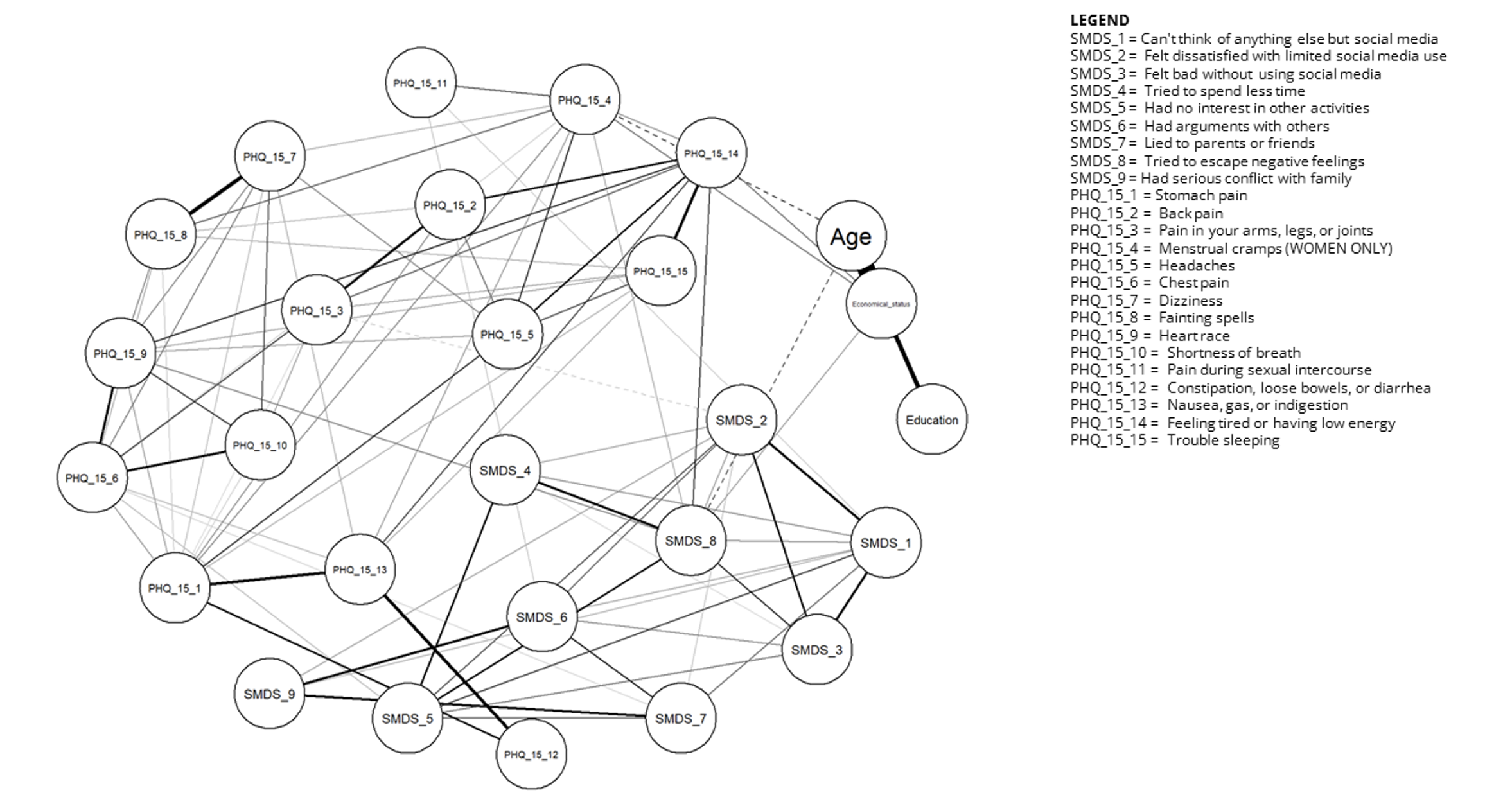 Note. Thicker edges represent stronger associations, while thin edges reflect weak associations. Solid line edges reflect positive associations, while dashed line edges represent negative associations. PHQ_15_1–15 = The Patient Health Questionnaire-15 items, SMDS_1–9 = The Social Media Disorder Scale items.
In the next stage, networks were estimated and visually inspected to identify potential structural differences before the network comparison testing procedure was conducted. The comparison revealed one prominent divergence in how PSMU symptoms were connected to physical health symptoms across subsamples.
In the women’s network (Figure 2), SMDS_8 (“Have you often used social media to escape from negative feelings?”) emerged as the central bridging symptom (a node that connects previously directly unrelated symptom communities or node clusters), being directly associated with multiple somatic complaints, including PHQ_15_4 (“menstrual problems”), PHQ_15_14 (“feeling tired”), and PHQ_15_9 (“heart race”).
In contrast, the men’s network (Figure 3) a total of three edges between SMDS_6 (“Have you regularly had arguments with others because of your social media use?”) and PHQ_15_8 (“fainting spells”) as well as PHQ_15_11 (“pain during intercourse”) and between SMDS_5 (“Have you regularly had no interest in hobbies or other activities because you would rather use social media?”) and PHQ_15_6 (“chest pain”) were found. For detailed results on expected influence and strength centrality metrics in each subgroup, see Supplementary Materials 5–6.
Figure 2. Women’s Network Adjusted for Age and Economic Status, and Education. 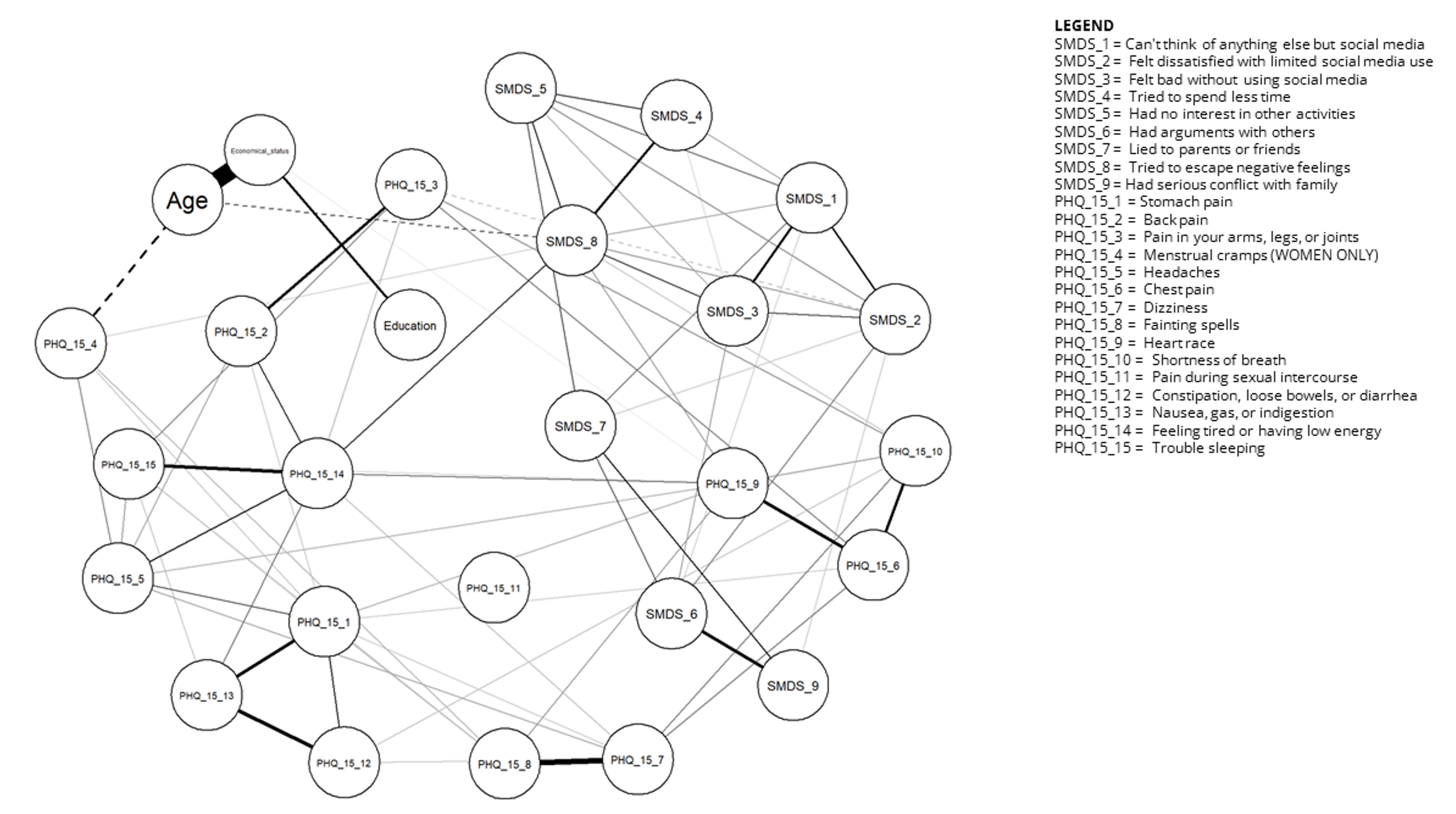 Note. Thicker edges represent stronger associations, while thin edges reflect weak associations. Solid line edges reflect positive associations, while dashed line edges represent negative associations. PHQ_15_1–15 = The Patient Health Questionnaire-15 items, SMDS_1–9 = The Social Media Disorder Scale items.
Figure 3. Men’s Network Adjusted for Age and Economic Status, and Education.
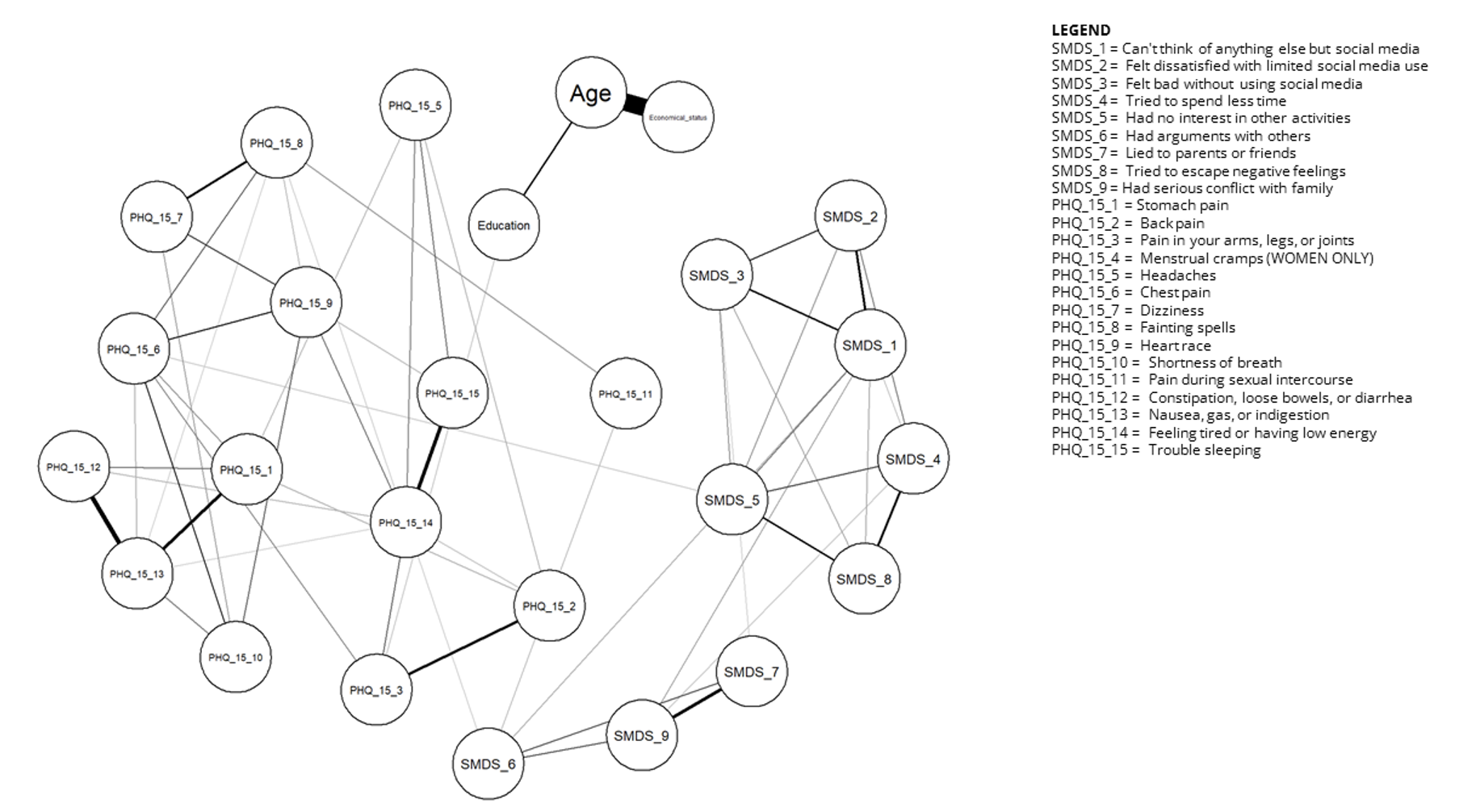 Note. Thicker edges represent stronger associations, while thin edges reflect weak associations. Solid line edges reflect positive associations, while dashed line edges represent negative associations. PHQ_15_1–15 = The Patient Health Questionnaire-15 items, SMDS_1–9 = The Social Media Disorder Scale items.
Comparative Effect of Self-Esteem on the Network Structure
When the RSES (i.e., self-esteem) was introduced into the networks, no significant changes in edge weights, either positive or negative, between PSMU symptoms and physical health items were observed in the women’s (Figure 4) or men’s (Figure 5) networks. On the other hand, a significant finding was made in how self-esteem bridges and relates to PSMU and physical health differently in women’s and men’s networks.
In the women’s network, self-esteem showed several strong negative associations with physical health symptoms (PHQ_15_15 (“trouble sleeping”), PHQ_15_8 (“fainting spells”), PHQ_15_9 (“heart race”), PHQ_15_1 (“stomach pain”), PHQ_15_14 (“feeling tired”)), but only two negative associations with PSMU (SMDS_8 and SMDS_7). Yet crucially, SMDS_8 had previously been identified as a key bridging symptom linking PSMU with physical health in women. With self-esteem in the network, its connection with SMDS_8 created additional negative pathways that bridged PSMU to a broader set of physical health symptoms via self-esteem.
The inclusion of self-esteem in the men’s network showed a very similar role in the overall network structure, functioning as a bridging symptom between SMDS_8 and a range of physical health symptoms [PHQ_15_6 (“chest pain”), PHQ_15_9 (“heart race”), PHQ_15_14 (“feeling tired”), PHQ_15_15 (“trouble sleeping”)]. For detailed results on expected influence and strength centrality metrics within each subgroup, see Supplementary Materials 7–8.
Figure 4. Women’s Network With Self-Esteem Adjusted for Age and Economic Status, and Education. 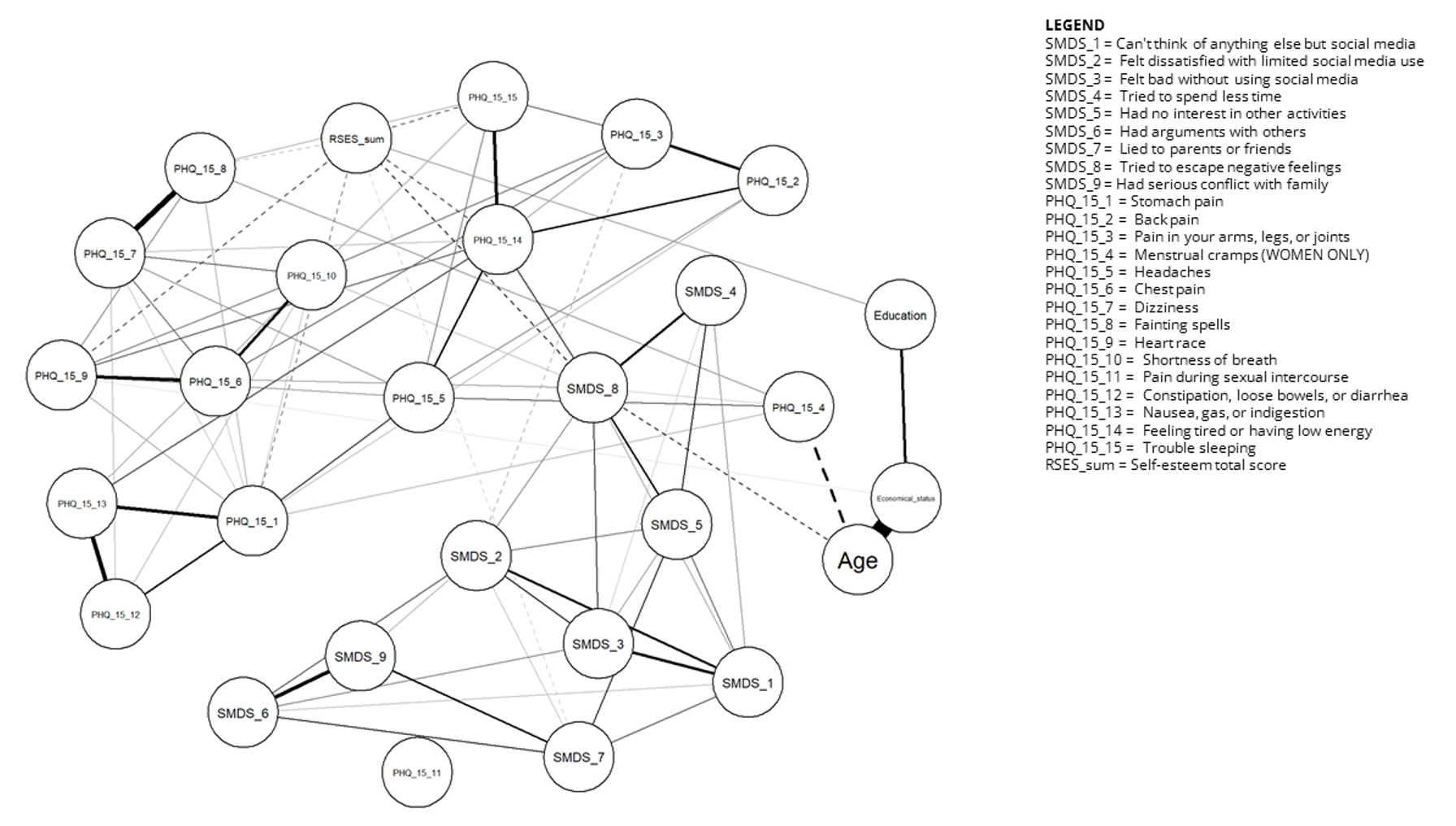 Note. Thicker edges represent stronger associations, while thin edges reflect weak associations. Solid line edges reflect positive associations, while dashed line edges represent negative associations. PHQ_15_1–15 = The Patient Health Questionnaire-15 items, SMDS_1–9 = The Social Media Disorder Scale items, RSES = The Rosenberg Self-Esteem Scale score.
Figure 5. Men’s Network With Self-Esteem Adjusted for Age and Economic Status, and Education.
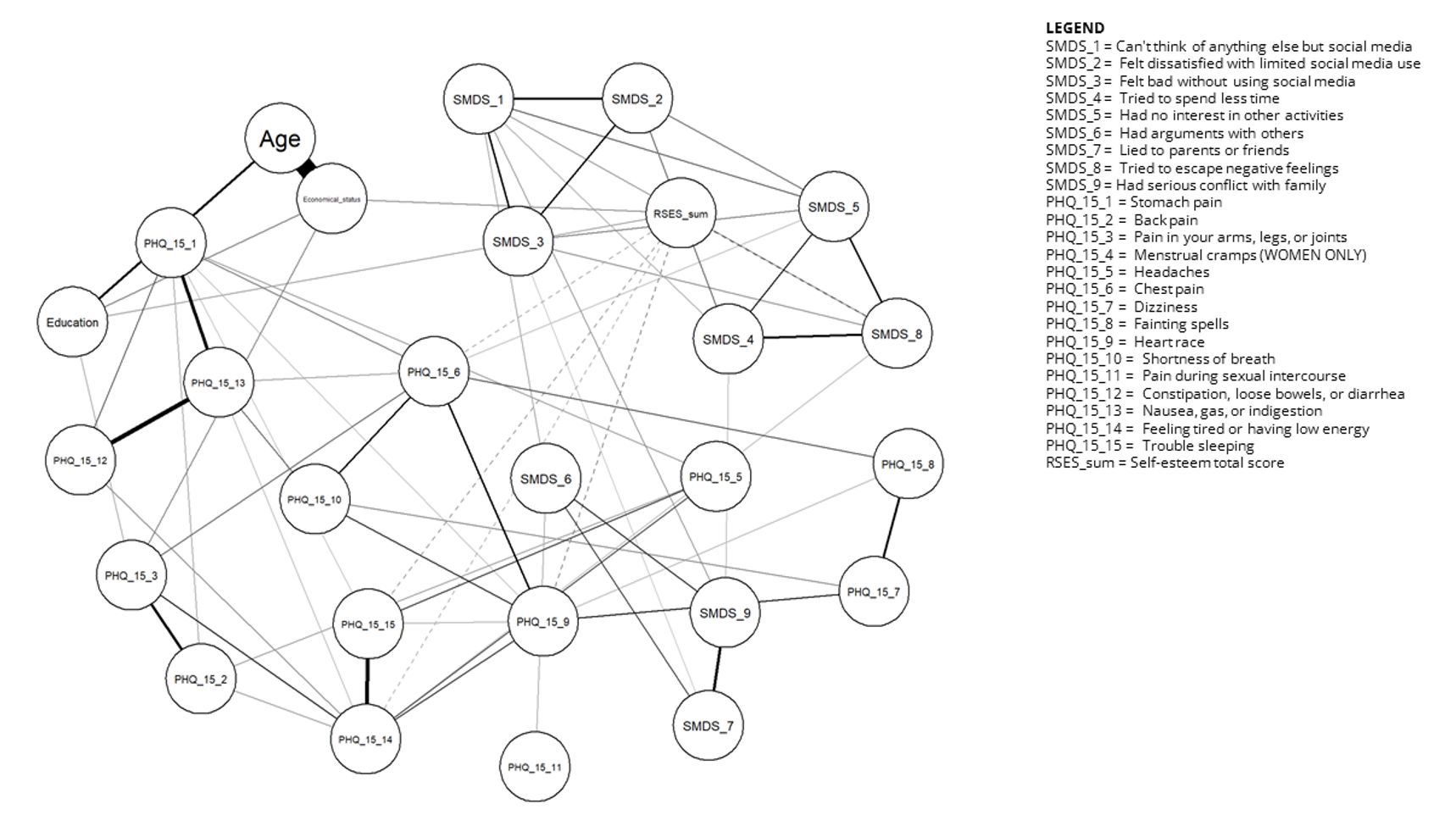 Note. Thicker edges represent stronger associations, while thin edges reflect weak associations. Solid line edges reflect positive associations, while dashed line edges represent negative associations. PHQ_15_1–15 = The Patient Health Questionnaire-15 items, SMDS_1–9 = The Social Media Disorder Scale items, RSES = The Rosenberg Self-Esteem Scale score.
Comparative Effect of Self-Compassion on the Network Structure
In contrast, the inclusion of the SCS (i.e., self-compassion) yielded more pronounced changes in network structure in the women’s (Figure 6) and men's (Figure 7) networks. Specifically, several edges linking PSMU and physical health symptoms either decreased in strength or disappeared completely. This finding was particularly strong in the men’s network where all edges that linked PSMU and physical health symptoms became absent. Additionally, self-compassion weakened the associations among PSMU symptoms across both genders, with this change being more pronounced in the men’s network.
Figure 6. Women’s Network With Self-Compassion Adjusted for Age and Economic Status, and Education.
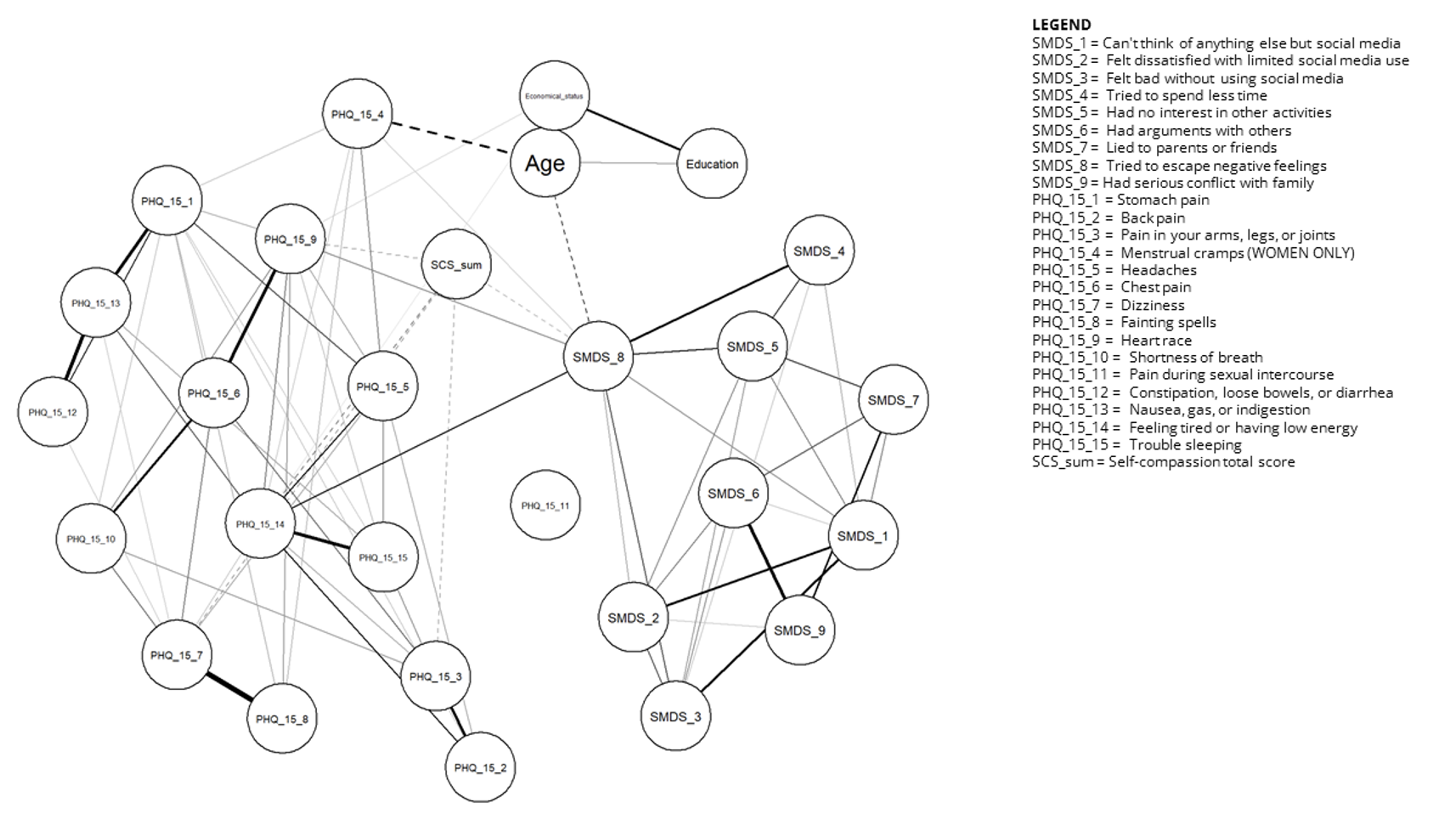 Note. Thicker edges represent stronger associations, while thin edges reflect weak associations. solid line edges reflect positive associations, while dashed line edges represent negative associations. PHQ_15_1–15 = The Patient Health Questionnaire-15 items, SMDS_1–9 = The Social Media Disorder Scale items, SCS = The Self-Compassion Scale score.
Figure 7. Men’s Network With Self-Compassion Adjusted for Age and Economic Status, and Education.
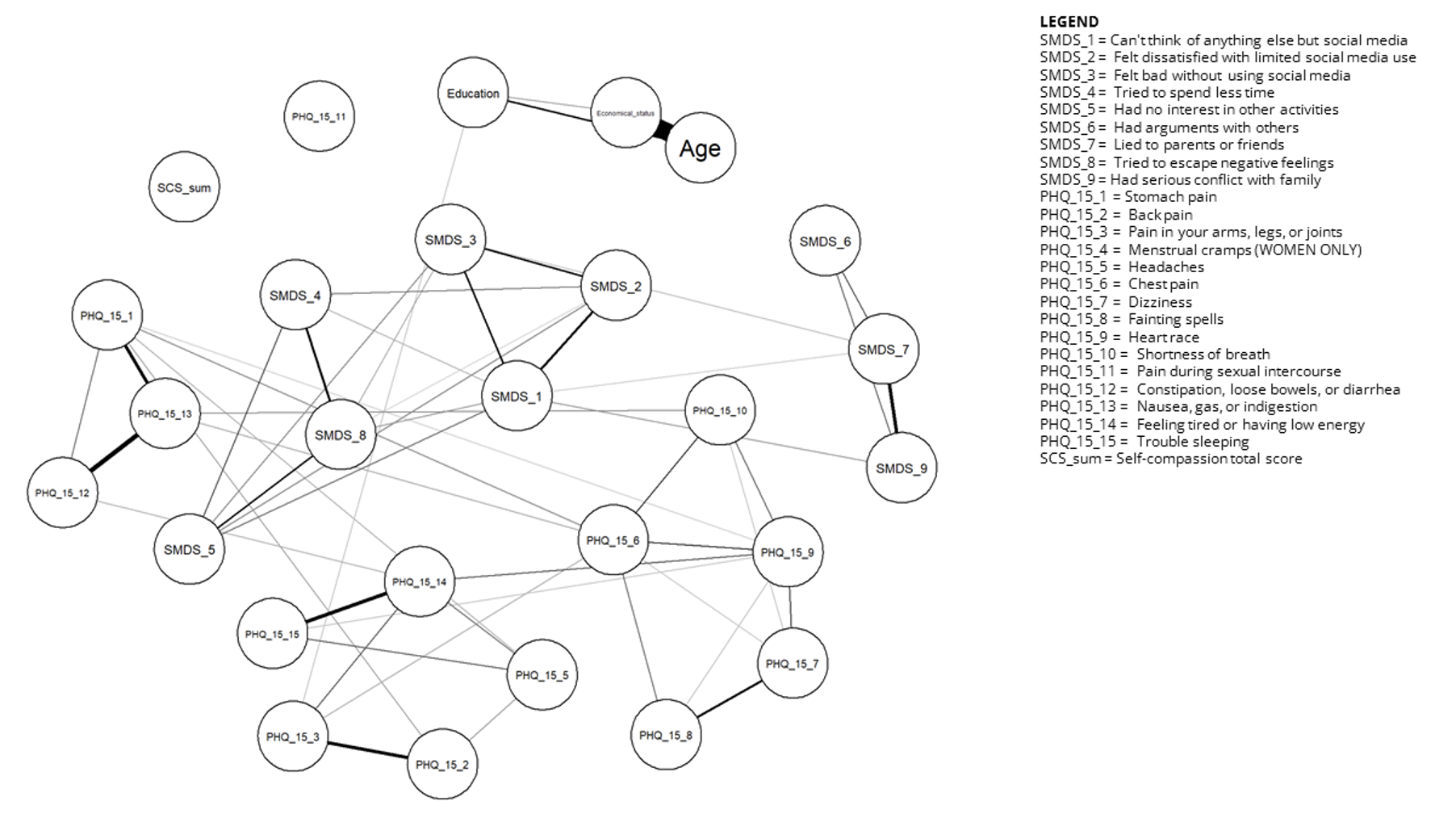 Note. Thicker edges represent stronger associations, while thin edges reflect weak associations. solid line edges reflect positive associations, while dashed line edges represent negative associations. PHQ_15_1–15 = The Patient Health Questionnaire-15 items, SMDS_1–9 = The Social Media Disorder Scale items, SCS = The Self-Compassion Scale score.
Moreover, a significant finding was made in how self-compassion bridges and relates to PSMU and physical health differently in women’s and men’s networks. In the men’s network, no relation was found between self-compassion and PSMU or physical health. On the other hand, comparable to self-esteem, several strong negative associations were observed between self-compassion and physical health in the women’s network [PHQ_15_3 (“body pains”), PHQ_15_7 (“dizziness”), PHQ_15_9 (“heart race”), PHQ_15_14 (“feeling tired”)]. Most importantly, the observed negative link between self-compassion and SMDS_8 created additional negative pathways that connected PSMU to a broader range of physical health symptoms. For detailed results on expected influence and strength centrality metrics within each subgroup, see Supplementary Materials 9–10.
Network Comparison Testing
A network comparison test was conducted to examine differences in the structure and overall connectivity between the women’s and the men’s estimated networks. For network comparison testing between groups, we re-estimated both networks, excluding PHQ_15_4, to ensure structural equivalence required by the network comparison test. The structure invariance test indicated no significant difference in the configuration of edges between the two networks (M = 0.2, p = .765). Additionally, the global strength invariance test showed no difference in overall connectivity (sum of absolute edge weights), with global strength values of 8.37 for one group and 6.92 for the other (S = 1.45,
p = .302). Edge-wise probes highlighted a small set of candidate differences, especially among physical health symptoms. Centrality (node strength) comparisons indicated the highest differences for SMDS_8, PHQ_15_7 and PHQ_15_14, while other nodes showed no significant between-group differences. Overall, while men and women do not differ in how strongly PSMU and physical health symptoms are connected overall, specific symptom-to-symptom edges (and the prominence of a few nodes) operate differently. For more detailed results comparing procedures, see supplementary materials 11–12.
Discussion
This study examined the item-level associations between PSMU, physical health, self-esteem, and self-compassion, revealing distinct gender-specific patterns. Some symptom-level differences emerged between women and men despite broadly similar network structures. In women, the tendency to use social media to escape negative emotions was identified as a bridge symptom, connecting the PSMU node cluster with the physical health node cluster. In men, fewer and weaker direct connections were observed between specific PSMU and physical health symptoms, even though the overall magnitude of network connectivity did not significantly differ between genders. When self-esteem was incorporated in both men’s and women’s networks, it created another bridge symptom that connected a new physical health node cluster to PSMU via the tendency to use social media to escape from negative emotions. Similarly, when self-compassion was introduced, its role in the network structure differed by gender. In the women’s network, it created another bridge symptom, connecting the physical health node cluster with PSMU via the escapism symptom. On the other hand, in the men’s network, no associations were observed between self-compassion and either physical health or PSMU. However, once self-compassion was included, all associations between PSMU and physical health became absent.
In women, the tendency to use social media to escape negative emotions emerged as a strong bridge symptom connecting PSMU with physical health complaints, whereas in men fewer and weaker direct connections were found between specific PSMU and physical health symptoms. PSMU has been repeatedly associated with physical health, but often indirectly (Cohen et al., 2024; Lee et al., 2022; Wang et al., 2025). For instance, PSMU has been associated with poorer sleep quality, lower physical activity, and poor health-related behaviors, which are often linked to lower physical well-being (Cohen et al., 2024; Wang et al., 2025). It was also revealed that these associations often vary by gender, with stronger links between PSMU and somatic symptoms (such as headaches, fatigue, and other psychosomatic complaints) typically observed among women (Grasshoff et al., 2025; Svensson et al., 2022). This suggests that PSMU is usually more strongly connected to bodily manifestations of psychological distress in women than in men. The identification of using social media to escape negative emotions as a bridge symptom is of particular significance. Mood management theory holds that individuals select and engage with media to regulate their affective states, including alleviating negative mood (Zillmann, 1988). The Interaction of Person-Affect-Cognition-Execution (I-PACE) model extends this to problematic use, proposing that when social media is repeatedly used to escape or down-regulate negative affect, the short-term relief it provides reinforces the behaviour, gradually strengthening habitual and ultimately addiction-like patterns of use (Brand et al., 2016, 2019). Accordingly, distressed individuals who go online to manage negative affect may experience temporary emotional relief, but this same process may entrench maladaptive use over time (Brailovskaia & Margraf, 2020; Naslund et al., 2020). In this sense, women are generally more likely than men to report using emotion-focused coping strategies when distressed, including seeking emotional relief or distraction, whereas men may favor problem-focused or distraction-based coping (Kelly et al., 2007; Theodoratou et al., 2023). This tendency may partly explain why emotional escape through social media forms a stronger association with physical symptoms in women in the present sample. Previous network analyses have also revealed gender-specific bridge connections between digital behaviors and health complaints (Fang et al., 2025; Hirota et al., 2025). For instance, among women, strong bridges have been detected between emotionally driven online engagement and somatic symptoms, such as indigestion or exhaustion, whereas in men, these associations tend to be found through more behavioral mechanisms (Fang et al., 2025). Taken together with the omnibus comparison, these observations suggest that, although the overall network structures did not differ significantly between genders, specific bridging symptoms connecting PSMU and physical health may operate differently in women and men.
The results revealed that self-esteem functioned as a key bridge symptom linking a cluster of physical health symptoms to PSMU through the tendency to use social media as a means of escaping negative emotions. This finding suggests that self-esteem may serve as a crucial construct through which negative emotions and related coping behaviours are associated with physical well-being in both men and women. This bridging role of self-esteem is consistent with previous evidence showing a strong negative association between self-esteem and various somatic health problems across gender groups (Henriksen et al., 2017; Orth & Robins, 2022; Piko et al., 2016). Individuals with higher self-esteem also typically report fewer psychosomatic complaints and tend to demonstrate greater resilience to stress, while those with lower self-esteem experience higher negative affectivity and anxiety (Henriksen et al., 2017; Piko et al., 2016). Increased psychological stress among individuals with low self-esteem has also been found to co-occur with physical complaints such as headaches, gastrointestinal discomfort, or fatigue (Alanzi et al., 2024; Creswell & Chalder, 2002; Lv et al., 2023). Supporting self-esteem has therefore been proposed as a potentially beneficial approach to lower stress-related somatic symptoms (Lv et al., 2023). The identified bridge also corresponds with extensive research associating self-esteem with PSMU (Alateeq et al., 2025; Servidio et al., 2024; Uram & Skalski, 2022). Individuals low in self-esteem tend to adopt avoidant coping styles focused on emotion rather than problem-solving (Henriksen et al., 2017). One common avoidant coping strategy is using online platforms to “escape” or distract from negative feelings (Demirdöğen et al., 2024). Research has suggested that individuals with low self-esteem often use passive, emotion-focused coping (i.e., escapism) which may reduce effective stress resolution (Ding et al., 2021). This suggests that people with higher self-esteem may have healthier coping styles and may be less prone to rely on digital escapism and are less likely to report stress-related somatic issues.
The results showed that incorporating self‑compassion into a women’s network created a novel bridge symptom linking physical health symptoms to PSMU via the tendency to use social media to escape negative emotions. However this bridge symptom was not found in men. Extensive evidence has linked self-compassion to various aspects of physical health (Homan & Sirois, 2017; Phillips & Hine, 2021; Sirois, 2020). Cross-sectional research has consistently shown that individuals with higher levels of self-compassion report fewer physical health complaints and tend to engage more frequently in health-promoting behaviours (Dunne et al., 2018; Homan & Sirois, 2017). Higher self-compassion has been associated with increased participation in physical exercise, intuitive eating, and smoking cessation (Dunne et al., 2018; Messer et al., 2023; Phillips & Hine, 2021). Furthermore, serial mediation analyses have demonstrated that self-compassion relates to lower perceived stress, which may subsequently be linked to healthier behaviours and may contribute to better physical health outcomes (Cha et al., 2022; Homan & Sirois, 2017). Recent evidence also revealed a strong negative association between self-compassion and PSMU (Manjanatha et al., 2025; Phillips & Wisniewski, 2021; Wei, 2024). Studies have also shown that negative self-compassion is often characterised by harsh self-criticism and self-judgment (Mitropoulou, 2024; Wei, 2024). These findings converge on the idea that individuals who are more self-compassionate are better able to acknowledge and regulate their emotions without resorting to maladaptive coping strategies such as compulsive online engagement (Foroughi et al., 2022; Qiu et al., 2025; Shi et al., 2023). Such individuals may then be less inclined to use social media for immediate emotional gratification or stress-related escapism (Mitropoulou et al., 2022; Phillips & Wisniewski, 2021). Evidence further indicates that self-compassion may function differently across genders. Women may use social media as a means of emotional regulation—to relax, escape from daily stressors, or soothe negative emotions, particularly before sleep (P. Li & Zhuo, 2023; Revathy et al., 2018). Women also tend to experience stronger emotional reinforcement from positive online interactions, which may be linked to more habitual patterns of use (Cheng et al., 2024). When women possess higher self‑compassion, they may recognise their negative emotions without resorting to online escapism, which may relate to lower physical discomfort and PSMU. Conversely, women with lower self‑compassion may struggle with intense emotional reactions to physical symptoms and may seek relief through social media.
In the men’s network, self‑compassion was not directly connected to either PSMU or physical health. However, after self‑compassion was included in the network, all previously observed associations between PSMU and physical health became absent. Although the absence of a direct association may reflect limited variability in self-compassion among men, the disappearance of these associations underscores its indirect but notable role within the men’s network. Meta‑analytic evidence indicates that men report slightly higher self‑compassion than women (Yarnell et al., 2015). Higher baseline self‑compassion may mean that men already benefit from the stress‑reducing and health‑promoting effects of self‑compassion (Bluth et al., 2017; Karakasidou et al., 2020), leaving less variability to create a bridge between PSMU and physical health. Moreover, self-compassion appears to be more related to gender role orientation than to biological sex. Yarnell et al. (2019) found that individuals who integrate both highly feminine (e.g., communal, nurturing) and highly masculine (e.g., agentic, self-assured) traits display the highest levels of self-compassion. However, socialisation processes tend to channel men and women toward different, and often incomplete, trait configurations (Kågesten et al., 2016). Women are frequently encouraged to prioritise others' needs and engage in self-criticism, which may cultivate communal warmth but undermine the agentic self-assurance component of self-compassion (Sun et al., 2016; Yarnell et al., 2015). Men, by contrast, are more often socialised toward self-reliance and emotional restraint, which may increase agency (Hanımoğlu, 2025; Matud et al., 2023). This imbalance may help to explain why self-compassion emerged as a bridge symptom in women's networks, where communal tendencies may be linked to emotional engagement with social media while lacking agentic self-regulation, but not in men's, where agentic coping may already shape the link between PSMU and physical health regardless of self-compassion levels. Gender differences are also evident in how social media content is used and interpreted. Research has shown that men tend to exhibit greater agency and more active coping strategies when encountering body-related content, whereas women engage more in self‑presentation and are more sensitive to social feedback (Burnette et al., 2017; Mahon & Hevey, 2021; Zhuang, 2023). Self-compassion may counteract such maladaptive processes by promoting acceptance, which may reduce rumination and encourage balanced emotional responses (Homan & Sirois, 2017). This may explain why self-compassion functions as a bridge between PSMU and physical health in women but not in men in the present study. If men’s social media use is associated with less emotional distress, self-compassion may play only a limited role in linking PSMU to physical health. Nevertheless, men who engage in PSMU may remain at risk for stress-related physical symptoms.
Implications
Implications for Research
The gender-specific patterns identified in this study highlight several directions for future research. First, because the symptom-level and centrality differences observed here emerged even though the omnibus network comparison test detected no significant difference in overall structure or global strength, future studies should test whether these specific differences are robust and replicable, ideally in larger and more balanced samples. Second, because these results are based on cross-sectional, correlational data, longitudinal and experimental designs are essential to establish causality and directionality. For example, future longitudinal work could determine whether escapist social media use in women predicts later health complaints, or whether individuals with pre-existing health symptoms are more likely to engage in escapist use. Third, research should explore potential mechanisms linking PSMU to health, such as stress, sleep disturbance, or other behavioral pathways. The role of self-esteem and self-compassion suggests that both constructs may act as moderators or mediators in these relationships. Prior longitudinal research has focused primarily on self-esteem, (Manjanatha et al., 2025), incorporating self-compassion may yield novel insights, particularly given its potential protective function in women. Fourth, cross-cultural and age-diverse samples are needed to examine the generalizability of these gender differences beyond the current population.
Implications for Practice
Although causal inferences cannot be made from this study, the findings highlight practical considerations for those working in psychological, public, and digital health. For mental health professionals, it may be beneficial to assess clients’ social media habits and motives, especially for women who might be using social media as a maladaptive escape from negative emotions. Therapists can help individuals develop healthier coping strategies (e.g., mindfulness or reaching out to friends) instead of “doom-scrolling” when distressed. Fostering self-compassion (in women) and self-esteem (in both women and men) is another promising intervention target. Practices like self-compassion training (e.g., via meditation) or reflective exercises could potentially counter the impact of PSMU on health. For public health practitioners, these results underscore the importance of digital health education. Campaigns might raise awareness that PSMU is associated with physical symptoms, encouraging balanced use (such as screen-time limits and tech-free periods) and promoting self-care behaviors to mitigate stress. Integrating self-compassion, self-esteem, and digital literacy into school curricula or community programs could foster resilience against social media’s negative outcomes.
Limitations
Nevertheless, several limitations should be considered. First, the cross-sectional design prevents us from drawing causal conclusions; longitudinal designs are needed in future research to clarify the directionality of the observed symptom-level associations. Second, the sample was recruited online through convenience and snowball sampling and was relatively young, predominantly composed of students, and skewed toward women, which restricts the generalizability of the findings to the broader Czech adult population, and particularly to older and non-student groups. The concentration of younger, student participants may be associated with higher baseline social media engagement and a more restricted range of somatic complaints than would be expected in a more age-diverse sample, which could attenuate some of the item-level associations recovered by the network. Additionally, younger, predominantly student participants, tend to report somatic symptoms infrequently. Such floor effects reduce both the variance of these items and their covariance with other symptoms, which has direct consequences for an item-level network. Consistent with this, the somatic symptoms involved in the weakest and least stable edges in our networks were also among the least frequently endorsed. Future studies should aim to replicate these patterns in probability-based, demographically representative samples with more balanced and adequately powered gender groups and a wider age range, in order to establish the robustness and generalizability of the gender-specific structures identified here. Third, the present research did not focus specifically on any potentially vulnerable subpopulations, such as individuals from immigrant backgrounds or those identifying as LGBTQ+. Given the increased risks often reported in these groups, their inclusion in future research would improve both the inclusiveness and interpretative value of subsequent findings. Fourth, it is important to acknowledge that even though our data were collected in 2022, following the acute phase of the COVID-19 pandemic, the long-term effects of the pandemic might have influenced our findings. The pandemic caused a sustained shift in digital habits, significantly increasing participants' baseline level of engagement with social media platforms and altering their physical health and lifestyle behaviors. This residual impact potentially introduced confounding factors that need to be considered when interpreting the results.
Conclusion
This study explored the symptom-level associations between PSMU, physical health, self-esteem, and self-compassion, highlighting clear gender-specific differences. A number of symptom-level differences emerged between women and men despite broadly similar network structures. In women, the tendency to use social media as a means of escaping negative emotions emerged as a central bridge symptom, linking the PSMU item cluster with the cluster of physical health symptoms. By contrast, in men, fewer and weaker direct connections were observed between specific PSMU and physical health symptoms, even though the overall magnitude of network connectivity did not significantly differ between genders. When self-esteem was incorporated into the networks of both genders, it formed an additional bridge symptom, connecting a newly emerged physical health cluster to PSMU through the escapism symptom. The inclusion of self-compassion, however, revealed divergent patterns by gender. In women, self-compassion introduced another bridge symptom that linked physical health to PSMU via escapism. In men, no direct associations were observed between self-compassion and either PSMU or physical health. However, once self-compassion was included in the men’s network, all previously observed associations between PSMU and physical health became absent.
Conflict of Interest
The authors have no conflicts of interest to declare.
Use of AI Services
The authors declare they have used AI services, specifically Claude Opus versions 4.7 and 4.8, for grammar correction and minor style refinements. They carefully reviewed all suggestions from these services to ensure the original meaning and factual accuracy were preserved.
Data Availability Statement
Data, study code, and additional resources linked to this research can be accessed through the Open Science Framework (OSF) website via the following link: https://osf.io/2fs7q/.
Acknowledgement
We would like to thank the students of the University of Hradec Králové and Palacký University Olomouc for their voluntary participation in disseminating the survey and collecting data for this study.
Funding
The work was supported by the ERDF/ESF project DigiWELL [No. CZ.02.01.01/00/22_008/0004583] co-financed by the EU.
This study was supported by the Sts Cyril and Methodius Faculty of Theology of Palacký University Olomouc, through the internal project Health in an era of global uncertainty: research into social, psychological, and spiritual determinants [grant number: IGA_CMTF_2026_007].
Human Ethics and Consent to Participate
The study was approved by the Research Ethics Committee of the Faculty of Education, University of Hradec Králové (No. 1/2022) and its procedure complied with the research ethics framework of the Ministry of Education, Youth and Sports. Participation was voluntary, and respondents could withdraw at any stage. All participants provided informed consent before starting the questionnaire.


This work is licensed under a Creative Commons Attribution-ShareAlike 4.0 International License.
Copyright © 2026 Jakub Helvich, Lukas Novak, Bibiana Jozefiakova, Eva Milkova, Peter Tavel