
Problematic Mobile Media Use as a Family Issue: A Latent Profile Analysis in Parent-Child Dyads
Vol.20,No.2(2026)
Nele Janssens
 Kathleen Beullens
Current research primarily addresses children’s problematic mobile media use (PMMU) and its negative outcomes, leaving a gap in our understanding of how parents’ PMMU might contribute to a problematic media culture within the home. The study aimed to (a) identify family profiles based on PMMU by the child and parent simultaneously through latent profile analysis and examine their associations with (b) sociodemographic factors and (c) key indicators of family well-being, specifically child self-esteem, parental self-efficacy and parent-child conflict. Using a sample of 410 parent-child dyads, primarily mother-daughter pairs (42.4%), with preadolescent children (8-14 years; Mage = 11.5), we identified four profiles based on cross-sectional dyadic survey data; Families with high child PMMU (46.6%), families with low child PMMU (16.1%), media-balanced families (33.2%) and media-immersed families (4.2%). Results showed notable sociodemographic variations, including a higher prevalence of only-child families in the media-immersed group, and revealed that families with high child PMMU and media-immersed family profiles were linked to lower personal and relational well-being within the family. These findings emphasize the importance of family-centered approaches to PMMU prevention and intervention.
latent profile analysis; problematic mobile media use; parent-child dyads; self-esteem; parental self-efficacy; parent-child conflict
Nele Janssens
Media Psychology Lab, Department of Communication Science, KU Leuven, Leuven, Belgium; Research Foundation–Flanders (FWO-Vlaanderen), Brussels, Belgium
Nele Janssens, is a PhD candidate at the Media Psychology Lab at KU Leuven (Belgium). Her research focuses on the role of digital media use in family interactions and relationships.
Sarah Coyne
School of Family Life, Brigham Young University, Provo, Utah, USA
Sarah Coyne, PhD, is a professor of child development in the School of Family Life at Brigham Young University. Her research interests include media, body image, gender, mental health, and child development. She regularly speaks to families about using media in positive ways.
Kathleen Beullens
Media Psychology Lab, Department of Communication Science, KU Leuven, Leuven, Belgium
Kathleen Beullens, PhD, is professor at the Media Psychology Lab and vice dean for research of the Faculty of Social Sciences at KU Leuven (Belgium). Her research focuses on the (longitudinal) effects of different media uses on children's and adolescents' psychosocial well-being.
Ainsworth, M. D. S. (1978). The Bowlby-Ainsworth attachment theory. Behavioral and Brain Sciences, 1(3), 436–438. https://doi.org/10.1017/S0140525X00075828
Albanese, A. M., Russo, G. R., & Geller, A. P. (2019). The role of parental self‐efficacy in parent and child well‐being: A systematic review of associated outcomes. Child: Care, Health and Development, 45(3), 333–363. https://doi.org/10.1111/cch.12661
Bandura, A. (1978). Social learning theory of aggression. Journal of Communication, 28(3), 12–29. https://doi.org/10.1111/j.1460-2466.1978.tb01621.x
Benedetto, L., & Ingrassia, M. (2018). Parental self-efficacy in promoting children care and parenting quality. InTech. https://doi.org/10.5772/intechopen.68933
Beyens, I., & Beullens, K. (2017). Parent–child conflict about children’s tablet use: The role of parental mediation. New Media & Society, 19(12), 2075–2093. https://doi.org/10.1177/1461444816655099
Boer, M., van den Eijnden, R. J. J. M., Boniel-Nissim, M., Wong, S.-L., Inchley, J. C., Badura, P., Craig, W. M., Gobina, I., Kleszczewska, D., Klanšček, H. J., & Stevens, G. W. J. M. (2020). Adolescents’ intense and problematic social media use and their well-being in 29 countries. Journal of Adolescent Health, 66(6), S89–S99. https://doi.org/10.1016/j.jadohealth.2020.02.014
Broderick, C. (1993). Understanding family process: Basics of family systems theory. Sage Publications, Inc.
Burgoon, J. K. (1978). A communication model of personal space violations: Explication and an initial test. Human Communication Research, 4(2), 129–142. https://doi.org/10.1111/j.1468-2958.1978.tb00603.x
Canale, N., Pivetta, E., Costa, S., Galeotti, T., & Billieux, J. (2023). Maternal technology distraction and its associations with stress and parenting during the COVID-19 pandemic. Psychology of Popular Media, 13(2), 262–268. https://doi.org/10.1037/ppm0000463
Coyne, S. M., Hirschi, T., Gale, M., Jones, B. L., Van Alfen, M., Almeida, L. M., Siddoway, C., Christensen-Duerden, C., Shawcroft, J., Holmgren, H. G., Porter, C. L., Jones, B., Fraser, A., Reschke, P. J., Booth, M. A., Swit, C., Kerr, M., Barr, R., Kirkorian, H., Radesky, J., & Densley, R. L. (2025). “I’ve let screens take over”: Parental guilt about media and children's problematic media use [Manuscript submitted for publication].
Coyne, S. M., Rogers, A., Holmgren, H. G., Booth, M. A., Van Alfen, M., Harris, H., Barr, R., Padilla-Walker, L. M., Sheppard, J. A., Shawcroft, J., & Ober, M. (2023). Masters of media: A longitudinal study of parental media efficacy, media monitoring, and child problematic media use across early childhood in the United States. Journal of Children and Media, 17(3), 318–335. https://doi.org/10.1080/17482798.2023.2200958
Davies, J. J., & Gentile, D. A. (2012). Responses to children’s media use in families with and without siblings: A family development perspective. Family Relations, 61(3), 410–425. https://doi.org/10.1111/j.1741-3729.2012.00703.x
Domoff, S. E., Borgen, A. L., & Radesky, J. S. (2020). Interactional theory of childhood problematic media use. Human Behavior and Emerging Technologies, 2(4), 343–353. https://doi.org/10.1002/hbe2.217
Domoff, S. E., Harrison, K., Gearhardt, A. N., Gentile, D. A., Lumeng, J. C., & Miller, A. L. (2019). Development and validation of the problematic media use measure: A parent report measure of screen media “addiction” in children. Psychology of Popular Media Culture, 8(1), 2–11. https://doi.org/10.1037/ppm0000163
Driscoll, K., & Pianta, R. C. (2011). Mothers’ and fathers’ perceptions of conflict and closeness in parent-child relationships during early childhood. Journal of Early Childhood and Infant Psychology, 7, 1–24.
Dziak, J. J., Lanza, S. T., & Tan, X. (2014). Effect size, statistical power and sample size requirements for the bootstrap likelihood ratio test in latent class analysis. Structural Equation Modeling: A Multidisciplinary Journal, 21(4), 534–552. https://doi.org/10.1080/10705511.2014.919819
Easey, K. E., Mars, B., Pearson, R., Heron, J., & Gunnell, D. (2019). Association of birth order with adolescent mental health and suicide attempts: A population-based longitudinal study. European Child & Adolescent Psychiatry, 28(8), 1079–1086. http://doi.org/10.1007/s00787-018-1266-1
Ferguson, C. J., & Olson, C. K. (2013). Friends, fun, frustration and fantasy: Child motivations for video game play. Motivation and Emotion, 37(1), 154–164. https://doi.org/10.1007/s11031-012-9284-7
Findley, E., LaBrenz, C. A., Childress, S., Vásquez-Schut, G., & Bowman, K. (2022). ‘I’m not perfect’: Navigating screen time among parents of young children during COVID-19. Child: Care, Health and Development, 48(6), 1094–1102. https://doi.org/10.1111/cch.13038
Geurts, S. M., Vossen, H. G. M., Van den Eijnden, R. J. J. M., & Koning, I. M. (2023). Adolescents’ problematic social media use: Agreement and discrepancies between self- versus mother- and father-reports. Technology, Mind, and Behavior, 4(2), 171–182. https://doi.org/10.1037/tmb0000110
Groskurth, K., Bluemke, M., & Lechner, C. M. (2024). Why we need to abandon fixed cutoffs for goodness-of-fit indices: An extensive simulation and possible solutions. Behavior Research Methods, 56(4), 3891–3914. https://doi.org/10.3758/s13428-023-02193-3
Hardy, L. L., Baur, L. A., Garnett, S. P., Crawford, D., Campbell, K. J., Shrewsbury, V. A., Cowell, C. T., & Salmon, J. (2006). Family and home correlates of television viewing in 12 – 13 year old adolescents. International Journal of Behavioral Nutrition and Physical Activity, 3, Article 24. https://doi.org/10.1186/1479-5868-3-24
Holmgren, H. G., Stockdale, L., Gale, M., & Coyne, S. M. (2022). Parent and child problematic media use: The role of maternal postpartum depression and dysfunctional parent-child interactions in young children. Computers in Human Behavior, 133, Article 107293. https://doi.org/10.1016/j.chb.2022.107293
Hou, Y., Benner, A. D., Kim, S. Y., Chen, S., Spitz, S., Shi, Y., & Beretvas, T. (2020). Discordance in parents' and adolescents' reports of parenting: A meta-analysis and qualitative review. The American Psychologist, 75(3), 329–348. https://doi.org/10.1037/amp0000463
Huang, C. (2022). A meta-analysis of the problematic social media use and mental health. International Journal of Social Psychiatry, 68(1), 12–33. https://doi.org/10.1177/0020764020978434
Huang, K.-Y., Teti, D. M., O’Brien Caughy, M., & Feldstein, S. (2007). Mother-child conflict interaction in the toddler years: Behavior patterns and correlates. Journal of Child and Family Studies, 16(2), 219–241. https://doi.org/10.1007/s10826-006-9081-6
Janssens, N., Meeus, A., & Beullens, K. (2025). (Dis)connecting families: Parents’ versus children’s perspectives on the role of mobile devices within family interactions. Mobile Media & Communication, 13(1), 192–213. https://doi.org/10.1177/20501579241278757
Kenny, M. E., & Rice, K. G. (1995). Attachment to parents and adjustment in late adolescent college students: Current status, applications, and future considerations. The Counseling Psychologist, 23(3), 433–456. https://doi.org/10.1177/0011000095233003
Kim, D., Lee, Y., Lee, J., Nam, J. K., & Chung, Y. (2014). Development of Korean Smartphone Addiction Proneness Scale for youth. PLoS One, 9(5), Article e97920. https://doi.org/10.1371/journal.pone.0097920
Kim, K., Birditt, K. S., Zarit, S., & Fingerman, K. (2020). Typology of parent-child ties within families: Associations with psychological well-being. Journal of Family Psychology, 34(4), 448–458. https://doi.org/10.1037/fam0000595
Konrad, C., Domoff, S., E., & Schneider, S. (2026). Validation of the German version of the Problematic Media Use Measure (PMUM-short form) and its relation to child and parental mental health. Computers in Human Behavior Reports, 21, Article 100911. https://doi.org/10.1016/j.chbr.2025.100911
Kroger, J. (2007). Identity development: Adolescence through adulthood (2nd ed.). Sage Publications, Inc.
Lauricella, A. R., Wartella, E., & Rideout, V. J. (2015). Young children’s screen time: The complex role of parent and child factors. Journal of Applied Developmental Psychology, 36, 11–17. https://doi.org/10.1016/j.appdev.2014.12.001
Linder, L., McDaniel, B., & Jaffe, H. (2022). Moment-to-moment observation of parental media use and parent-child interaction: Quality and media multitasking. Human Behavior and Emerging Technologies, 2022(1), Article 4896637. https://doi.org/10.1155/2022/4896637
Liu, M., Zhuang, A., Norvilitis, J. M., & Xiao, T. (2024). Usage patterns of short videos and social media among adolescents and psychological health: A latent profile analysis. Computers in Human Behavior, 151, Article 108007. https://doi.org/10.1016/j.chb.2023.108007
Lozano-Blasco, R., Robres, A. Q., & Sánchez, A. S. (2022). Internet addiction in young adults: A meta-analysis and systematic review. Computers in Human Behavior, 130, Article 107201. https://doi.org/10.1016/j.chb.2022.107201
McCutcheon, A. C. (1987). Latent class analysis. Sage Publications, Inc.
McDaniel, B. T., Pater, J., Cornet, V., Mughal, S., Reining, L., Schaller, A., Radesky, J., & Drouin, M. (2023). Parents’ desire to change phone use: Associations with objective smartphone use and feelings about problematic use and distraction. Computers in Human Behavior, 148, Article 107907. https://doi.org/10.1016/j.chb.2023.107907
Meeus, A., Beullens, K., & Eggermont, S. (2019). Like me (please?): Connecting online self-presentation to pre- and early adolescents’ self-esteem. New Media & Society, 21(11–12), 2386–2403. https://doi.org/10.1177/1461444819847447
Mun, I. B., & Lee, S. (2025). A longitudinal study of the relationship between parents’ self-esteem and children’s digital media addiction: Testing the mediating roles of children’s self-esteem and aggression. The Social Science Journal, 62(3), 802–815. https://doi.org/10.1080/03623319.2023.2194472
Muris, P., & Otgaar, H. (2023). Self-esteem and self-compassion: A narrative review and meta-analysis on their links to psychological problems and well-being. Psychology Research and Behavior Management, 16, 2961–2975. https://doi.org/10.2147/PRBM.S402455
Nikken, P., & Opree, S. J. (2018). Guiding young children's digital media use: SES-differences in mediation concerns and competence. Journal of Child and Family Studies, 27(6), 1844–1857. https://doi.org/10.1007/s10826-018-1018-3
Pesch, A., Todaro, R., Piper, D., Evans, N. S., Pasek, J., Golinkoff, R. M., & Hirsh-Pasek, K. (2024). A bird’s-eye view of phubbing: How adult observations of phone use impact judgments, epistemic trust, and interpersonal trust. Mobile Media & Communication, 12(3), 536–563. https://doi.org/10.1177/20501579241246726
Philippi, J., Simon-Kutscher, K., Austermann, M. I., Thomasius, R., & Paschke, K. (2024). Investigating parental factors for adolescent problematic gaming and social media use – A cross-sectional and longitudinal approach. Journal of Adolescent Health, 75(4), 626–634. https://doi.org/10.1016/j.jadohealth.2024.06.012
Podsakoff, P. M., MacKenzie, S. B., Lee, J.-Y., & Podsakoff, N. P. (2003). Common method biases in behavioral research: A critical review of the literature and recommended remedies. Journal of Applied Psychology, 88(5), 879–903. https://doi.org/10.1037/0021-9010.88.5.879
Radesky, J., Miller, A. L., Rosenblum, K. L., Appugliese, D., Kaciroti, N., & Lumeng, J. C. (2015). Maternal mobile device use during a structured parent–child interaction task. Academic Pediatrics, 15(2), 238–244. https://doi.org/10.1016/j.acap.2014.10.001
Ramírez-Uclés, I., González-Calderón, M. J., del Barrio-Gándara, V., & Carrasco, M. Á. (2018). Perceived parental acceptance-rejection and children’s psychological adjustment: The moderating effects of sex and age. Journal of Child and Family Studies, 27(4), 1336–1348. https://doi.org/10.1007/s10826-017-0975-2
Rega, V., Gioia, F., & Boursier, V. (2023). Problematic media use among children up to the age of 10: A systematic literature review. International Journal of Environmental Research and Public Health, 20(10), Article 5854. https://doi.org/10.3390/ijerph20105854
Rosen, L. D., Whaling, K., Carrier, L. M., Cheever, N. A., & Rokkum, J. (2013). The media and technology usage and attitudes scale: An empirical investigation. Computers in Human Behavior, 29(6), 2501–2511. http://dx.doi.org/10.1016/j.chb.2013.06.006
Rosenberg, J. M, Beymer, P. N., Anderson, D. J., van Lissa, C. J., & Schmidt, J. A. (2018). tidyLPA: An R package to easily carry out latent profile analysis (LPA) using open-source or commercial software. Journal of Open Source Software, 3(30), Article 978. https://doi.org/10.21105/joss.00978
Rosenberg, M. (1965). Society and the adolescent self-image. Princeton University Press. https://doi.org/10.1515/9781400876136
Rosenberg, M. (1979). Conceiving the self. Basic Books.
Schmuck, D., Stevic, A., Matthes, J., & Karsay, K. (2021). Out of control? How parents’ perceived lack of control over children’s smartphone use affects children’s self-esteem over time. New Media & Society, 25(1), 199–219. https://doi.org/10.1177/14614448211011452
Schneider, L. A., King, D. L., & Delfabbro, P. H. (2017). Family factors in adolescent problematic internet gaming: A systematic review. Journal of Behavioral Addictions, 6(3), 321–333. https://doi.org/10.1556/2006.6.2017.035
Schrock, A. (2015). Communicative affordances of mobile media: Portability, availability, locatability, and multimediality. International Journal of Communication, 9, 1229–1246. http://ijoc.org/index.php/ijoc/article/view/3288
Schwarzer, C., Grafe, N., Hiemisch, A., Kiess, W., & Poulain, T. (2022). Associations of media use and early childhood development: Cross-sectional findings from the LIFE Child study. Pediatric Research, 91, 247–253. https://doi.org/10.1038/s41390-021-01433-6
Silva, K., Ford, C. A., & Miller, V. A. (2020). Daily parent–teen conflict and parent and adolescent well-being: The moderating role of daily and person-level warmth. Journal of Youth and Adolescence, 49(8), 1601–1616. https://doi.org/10.1007/s10964-020-01251-9
Sowislo, J. F., & Orth, U. (2013). Does low self-esteem predict depression and anxiety? A meta-analysis of longitudinal studies. Psychological Bulletin, 139(1), 213–240. https://doi.org/10.1037/a0028931
Stockdale, L., & Coyne, S. M. (2020). Parenting paused: Pathological video game use and parenting outcomes. Addictive Behaviors Reports, 11, Article 100244. https://doi.org/10.1016/j.abrep.2019.100244
Størup, J. O., & Lieberoth, A. (2023). What’s the problem with “screen time”? A content analysis of dominant voices and worries in three years of national print media. Convergence: The International Journal of Research into New Media Technologies, 29(1), 201–224. https://doi.org/10.1177/13548565211065299
Swit, C. S., Coyne, S. M., Shawcroft, J., Gath, M., Barr, R., Holmgren, H. G., & Stockdale, L. (2023). Problematic media use in early childhood: The role of parent-child relationships and parental wellbeing in families in New Zealand and the United States. Journal of Children and Media, 17(4), 443–466. https://doi.org/10.1080/17482798.2023.2230321
van den Eijnden, R., Koning, I., Doornwaard, S., van Gurp, F., & ter Bogt, T. (2018). The impact of heavy and disordered use of games and social media on adolescents’ psychological, social, and school functioning. Journal of Behavioral Addictions, 7(3), 697–706. https://doi.org/10.1556/2006.7.2018.65
van Dijk, R., van der Valk, I. E., Vossen, H. G. M., Branje, S., & Deković, M. (2021). Problematic internet use in adolescents from divorced families: The role of family factors and adolescents’ self-esteem. International Journal of Environmental Research and Public Health, 18(7) Article 3385. https://doi.org/10.3390/ijerph18073385
Vanoppen, J., Linten, K., Boudry, E., Vanwynsberghe, H., Janssens, N., Traoré, A., De Cock, E., & Denecker, F. (2025). MediaNest Cijfers 2025: Onderzoek in Vlaanderen naar het mediagebruik van 0- tot 18-jarigen en mediaopvoeding in gezinnen [MediaNest Report 2025: Research in Flanders on media use by 0- to 18-year-olds and digital parenting in families]. https://assets.mediawijs.be/2025-05/Rapport%20MediaNest%20Cijfers%202025_0.pdf
Wang, M., Qiaowen, D., Bi, X., & Ye, H. (2017). Performance of the entropy as an index of classification accuracy in latent profile analysis: A Monte Carlo simulation study. Acta Psychologica Sinica, 49(11), 1473–1482. https://doi.org/10.3724/SP.J.1041.2017.01473
Wolfers, L. N., Nabi, R. L., & Walter, N. (2025). Too much screen time or too much guilt? How child screen time and parental screen guilt affect parental stress and relationship satisfaction. Media Psychology, 28(1), 102–133. https://doi.org/10.1080/15213269.2024.2310839
Woolgar, M., Beckett, C., Falconer, S., Humayun, S., Marsden, A., Scott, S., & Dadds, M. (2013). A new, brief measure of parental efficacy for parenting practitioners. Department of Child and Adolescent Psychiatry/National Academy of Parenting Research: Kings College London.
Woolgar, M., Humayun, S., Scott, S., & Dadds, M. R. (2025). I know what to do; I can do it; it will work: The Brief Parental Self Efficacy Scale (BPSES) for parenting interventions. Child psychiatry and human development, 56(3), 619–628. https://doi.org/10.1007/s10578-023-01583-0
Zhao, F., & Yu, G. (2017). Sibling relationship and its relation with children and adolescents’ social development. Advances in Psychological Science, 25(5), 825–836. https://doi.org/10.3724/SP.J.1042.2017.00825
Authors´ Contribution
Nele Janssens: conceptualization, formal analysis, funding acquisition, investigation, methodology, writing—original draft, review & editing. Sarah Coyne: conceptualization, writing—original draft, review & editing. Kathleen Beullens: conceptualization, funding acquisition, supervision, writing—original draft, review & editing.
Editorial record
First submission received:
September 19, 2025
Revisions received:
February 6, 2026
March 9, 2026
Accepted for publication:
March 12, 2026
Editor in charge:
Maèva Flayelle
Introduction
In the rapidly evolving landscape of digital media, mobile devices offer families new opportunities for communication and entertainment due to their interactive nature, constant connectivity and portability (Schrock, 2015). However, these same features raise concerns about the ability to use these devices “anytime, anywhere”, allowing them to easily intrude into various aspects of daily life. When mobile media use begins to interfere with an individual’s everyday functioning, it is considered problematic (Domoff et al., 2019). Current literature primarily focuses on examining children’s and adolescents’ problematic mobile media use (PMMU) and its negative effects (e.g., Rega et al., 2023), showing negative links with social, behavioral, and academic development, as well as contributions to maladaptive media habits later in life (Coyne et al., 2023; Domoff et al., 2020; Schwarzer et al., 2022; Swit et al., 2023). However, despite the stereotypes of media use being an adolescent or young adult issue (Holmgren et al., 2022), PMMU is not confined to children and adolescents; yet, almost no research has examined parents’ PMMU (Holmgren et al., 2022; Stockdale & Coyne, 2020).
Researchers have begun to recognize the value of looking at problematic media use as a family-wide issue rather than an isolated behavior, both in terms of its development and its effects. Therefore, this study will explore the interaction between parent and child PMMU as a way of investigating the broader problematic family media culture by employing a latent profile analysis utilizing cross-sectional data from 410 parent-child dyads. Furthermore, this research aims to examine how these patterns of PMMU among parents and children relate to psychological and relational outcomes, including the child's self-esteem, the parent's self-efficacy and the parent-child relationship. By focusing on the parent-child dyad as a unit of analysis, this study will contribute to a deeper understanding of how problematic media habits within the family context can be linked to key indicators of family members’ well-being and family dynamics.
Problematic Mobile Media Use in the Family Context
The Development of Problematic Mobile Media Use in the Family Context
Existing studies frequently focus on either parents or children PMMU, yet, according to several theoretical frameworks (Ainsworth, 1978; Bandura, 1978) and empirical findings (Konrad et al., 2026; Schneider et al., 2017; Schwarzer et al., 2022), there is reasoning to believe that family members’ media use is strongly interrelated with each other. Firstly, Bandura’s Social Learning Theory posits that children primarily learn behaviors through observation (Bandura, 1978). In other words, if parents engage with media in a problematic manner, children are likely to observe and adopt these behaviors, making parental media habits a significant factor in children’s own media use (Holmgren et al., 2022; Konrad et al., 2026). Secondly, in line with the attachment theory (Ainsworth, 1978), parents’ PMMU can disrupt or prevent opportunities for meaningful parent-child interactions, and consequently children may turn to media devices for comfort or companionship, potentially increasing their reliance on media in a maladaptive way (Konrad et al., 2026; Radesky et al., 2015).
Both theoretical argumentations are in agreement with the more recent Interactional Theory of Childhood Problematic Media Use (IT-CPU; Domoff, et al., 2020). According to this theory, there are three types of factors that might impact PMMU across childhood: distal, proximal, and maintaining factors. Distal factors refer to factors of the child’s larger developmental environment that might increase the likelihood of development PMMU, such as general parenting styles, parental feelings of self-efficacy, socioeconomic status, or the general parent-child relationship. These factors are not directly related to media, but may impact PMMU for example, if that child turns to media continually to escape a difficult relationship with their parent. These tend to exert influence on proximal factors, which are the specific antecedents to PMMU development. For example, a parent might have a problem with their own media use. Not only would this model to the child directly how to use media, but parental PMMU might also interfere with the ability to manage or monitor the child’s own media use. Both factors then may influence the development of PMMU via maintaining factors, which are consistent interactions that increase the likelihood that PMMU would continue over time.
Overall, the development of PMMU likely represents a larger family system issue, where the family climate, both media-specific, and non-media related, impacts the development of problematic media use in childhood (Domoff et al., 2020). Together, this suggest that parents’ media habits, by way of both modeling and emotional availability, may significantly shape children's media behaviors. Furthermore, this could even suggest that PMMU is a shared experience rather than an individual one, reinforcing the pressing need to conduct research from a family systems perspective (Broderick, 1993). In order to examine the PMMU from a family system perspective, the current study will use latent profile analysis (LPA), a person-centered statistical technique used to identify groups within a population based on similar response patterns across several variables (McCutcheon, 1987). This approach allows for a more holistic understanding of how specific constellations of behaviors or experiences – such as PMMU – co-occur on the family level, enabling us to capture the manifestation of the interplay between parents’ and children’s PMMU across families. Based on the theoretical and empirical research, as stated above, we expect to find family profiles in which both parents and children exhibit similarly high or low levels of PMMU.
Problematic Mobile Media Use in the Family Context and Personal and Family Functioning
Parental Self-Efficacy. Parental self-efficacy, indicating a caregiver's perception of their ability in meeting their children’s needs and fostering desired behaviors
(Benedetto & Ingrassia, 2018), is essential for responsive parenting and effective behavioral regulation (Coyne et al., 2023). However, given mobile devices’ negative reputation (Størup & Lieberoth, 2023) as the narrative is largely centered around its detrimental effects, permitting children to use media devices for extended periods of time might be negative for parents’ feelings of self-efficacy as it is incongruent with good parenting practices (Wolfers et al., 2025). Moreover, when children exhibit PMMU, parents may feel less capable of managing these behaviors, which further diminishes their self-efficacy (Philippi et al., 2024). In addition, parents who feel reliant on their mobile devices could feel guilty about the compromised attention given to their children (Coyne et al., 2025; Linder et al., 2022). Given that being a good parent is likely a key identity goal, this sense of guilt and concern fueled by PMMU within the household has the potential to evoke feelings of reduced parental self-efficacy (Findley et al., 2022). It is plausible that parents in where both parent and child exhibit PMMU may experience the lowest levels of self-efficacy due to a lack of control and negative interaction cycles.
Parent-Child Conflict. Parent–child conflict is a normative aspect of childhood development (K.-Y. Huang et al., 2007), however, a relationship characterized by frequent and intense negativity can have adverse effects on both parents and children (Janssens et al., 2025; Silva et al., 2020). Emerging evidence suggests that the introduction and problematic use of mobile devices within family settings may serve as a catalyst for such negative interactions (e.g., Beyens & Beullens, 2017; Holmgren et al., 2022;
Rega et al., 2023), particularly when expectations around mobile media use differ among family members. In other words, what one family or even one family member might see as a violation of expectations – like prioritizing mobile activities over time with relatives (Radesky et al., 2015) – another family or family member might not (Burgoon, 1978). For instance, when both parents and children engage in PMMU, they may become more lenient in their perceptions of each other’s habits, leading to fewer direct confrontations (Pesch et al., 2024). However, this leniency may also allow PMMU to persist, letting anti-social behavior carry on and undermining the quality of interactions and emotional connection. In addition, the IT-CPU refers to conflictual parent-child interactions as maintaining factor of problematic media use (Domoff et al., 2020), indicating the reinforcing character of problematic media use and dyadic relationship may have on each other.
Children’s Self-Esteem. Though we focus primary on parenting behaviors, both in general and involving media, according to the IT-CPU (Domoff, et al., 2020), child characteristics, such as self-esteem, may also act as distal, proximal, and maintaining factors. Self-esteem, a fundamental aspect of a child's individual psychological functioning and healthy development, reflects one’s overall sense of self-worth and confidence (M. Rosenberg, 1979). The significance of self-esteem for an individual's general well-being and mental health has already been demonstrated by numerous empirical studies (Sowislo & Orth, 2013). Notably, research indicates a strong link between children’s PMMU and multiple adverse developmental outcomes (Boer et al., 2020; van den Eijnden et al., 2018), particularly lower self-esteem (C. Huang, 2022). Although self-esteem has most often been investigated as a predictor of problematic media use (e.g., Mun & Lee, 2025), problematic media use can also lead to lower levels of self-esteem. Using media in a problematic way could lead to a greater exposure to negative online experiences or foster dependency on digital validation, making self-esteem a maintaining factor according to the IT-CPU theory (Domoff, et al., 2020; Liu et al., 2024; Meeus et al., 2019). This is especially concerning for preadolescents and adolescents, who are highly sensitive to these influences due to their developmental stage (Kroger, 2007).
PMMU by parents, not just by children, may also be associated with lower levels of child self-esteem. When parents are frequently occupied with their devices, it may detract from meaningful interactions and reduce their responsiveness and emotional availability (Canale et al., 2023), which are essential for supporting children's self-esteem
(Radesky et al., 2015; Silva et al., 2020). Children who experience lack of parental support and perceived rejection can have their self-defining process damaged, fostering feelings of insecurity and a lower self-esteem (Kenny & Rice, 1995; Ramírez-Uclés et al., 2018). Thus, while prior research shows that PMMU by either parent or child can be detrimental to the child’s self-esteem, it is likely that a family context in which both engage in PMMU creates an even more adverse environment.
Present Study
Utilizing data from 410 parent-child dyads, we aim to (1) identify distinct profiles of families' PMMU through latent profiles analysis, (2) examine demographic factors associated with membership in these profiles, and (3) determine how profile membership relates to key indicators of healthy family functioning, specifically parental self-efficacy
(Albanese et al., 2019), parent-child conflict (K. Kim et al., 2020) and child self-esteem (Muris & Otgaar, 2023).
This study extends prior research in several important ways. First, unlike traditional variable-centered approaches, we implement a person-centered design (latent profile analysis) to explore patterns of co-occurrence of parents’ and preadolescents’ PMMU across families. Second, whereas the first aim builds on foundational theories in this research domain, such as Social Learning Theory (Bandura, 1978), the second and third aims test the more recent IT-CPU framework, which is specific to the development of PMMU (Domoff, et al., 2020). This framework emphasizes that PMMU development occurs within family systems, which are shaped by both the characteristics of individual family members and the relationships between them. In the context of this study, we focus on (1) key sociodemographic characteristics of family composition (individual level: parents’ and children’s age and gender; family level: the presence of siblings) that allow us to identify whether distinct family PMMU profiles are associated with developmental stage, gendered media practices, or differences in family composition; and (2) core indicators of family functioning (individual level: child self-esteem and parental self-efficacy; family level: parent–child conflict). Third, we focus on self-reported perceptions of PMMU by both parents and children by using a dyadic approach, as these socially constructed perceptions likely shape media's effects on individual and relational outcomes (McDaniel et al., 2023). Lastly, we concentrate on families with preadolescent children (8–14 years old), a crucial developmental stage during which children experience significant psychological changes (Kroger, 2007) and increasingly incorporate mobile devices into their everyday lives (Vanoppen et al., 2025). Despite the growing prevalence of mobile device use among preadolescents, research on PMMU in this age group is still scarce (Domoff et al., 2020), with the majority of studies focusing on adolescents or young adults (Rega et al., 2023). Altogether, preadolescence is a critical time for the implementation of effective interventions among families since this is a period of change experienced by the family system as a whole, not just the child.
Methods
Procedure and Participants
The present study makes use of the FAMTECH dataset, collected through online survey via Qualtrics among Flemish parents and their children aged 8 to 14 (dataset is available on the Open Science Framework (OSF); https://osf.io/pf9vg/). Data collection took place between March and May 2023 with the help of students as part of a methodological undergraduate course, with the survey link shared via social media and schools. Parents were first provided with information about the study and asked to give informed consent for both their own and their child’s participation. After consenting, parents completed their survey, and a separate survey link was sent to their child. If parents had more than one eligible child, they were instructed to participate with the child whose birthday was closest, to avoid potential bias in child selection. Both parents and children were asked to fill out the surveys on their own, and they were constantly reminded to keep the family member also participating in mind during relational questions. The study adhered to APA ethical guidelines and received approval from the social ethics committee of the authors' university KU Leuven (G-2022-6142-R2).
After listwise deletion of cases in which either parent or child data were missing (n = 22), this final sample included 410 dyads, predominantly mother-daughter (n = 174, 42.4%) and mother-son pairs (n = 134, 32.7%), with fewer father-daughter (n = 55, 13.4%) and father-son pairs (n = 47, 11.5%). The parents had an average age of 42.8 years
(SD = 6.06), with most working full-time (n = 269, 65.6%) and holding a higher education degree (n = 330, 80.5%). The preadolescents were on average 11.5 years old
(SD = 1.86), with the largest group being in their last year of elementary school (n = 82, 20%) and owning their own smartphone (n = 298, 72.7%) or tablet device (n = 228, 55.6%). At the time of data collection, 14.1% of the children (n = 58) had no siblings.
Measures
All details on the measurement items and variable construction can be found in Supplementary Materials A on OSF (https://osf.io/pf9vg/) and the descriptive statistics of the measures can be found in Table 1.
Problematic Mobile Media Use
Preadolescents and parents each reported on their own problematic mobile media use (PMMU), utilizing different scales to ensure age-appropriate measurements for each group. In this way, we capture conceptually related, yet developmentally distinct, manifestations of problematic mobile media use.
For preadolescents, the Smartphone Addiction Proneness Scale (SAPS) for youth (D. Kim et al., 2014), was adapted to focus on both smartphones and tablets. This instrument conceptualizes PMMU as a multidimensional behavioral pattern reflecting difficulties in self-regulation and psychosocial functioning related to mobile media use, which are particularly salient during the developmental period of preadolescence. The scale consists of fifteen items rated on a four-point scale, from (1) totally disagree to (4) totally agree, and assesses four subdomains of media use: (1) disturbance of adaptive functions (five items; e.g., my school grades dropped due to excessive smartphone or tablet use), (2) virtual life orientation (two items; e.g., when I cannot use a smartphone or tablet, I feel like I have lost the entire world), (3) withdrawal (four items; e.g., I get restless and nervous when I am without smartphone or tablet), and (4) tolerance (four items; e.g., I find it difficult to stop using a smartphone or tablet).
The measurement of parents’ PMMU focuses on their dependency on and withdrawal due to mobile devices by making use of the anxiety and dependence subscale of the Media and Technology Usage and Attitudes Scale (Rosen et al., 2013). This subscale captures problematic mobile media use primarily in terms of emotional dependence and withdrawal-related anxiety associated with mobile device access, reflecting the expectations of availability as part of their daily functioning as a parent. It consists of three items (e.g., I get anxious when I don't have my phone at hand), rated on a scale from (1) totally disagree to (5) totally agree. An average score was calculated, with a higher score indicating a higher level of parental dependency on mobile media devices.
Parental Self-Efficacy
Parental self-efficacy was assessed using the five items of the Brief Parental Self Efficacy Scale (BPSES; Woolgar et al., 2025), with each item scored on a scale from (1) totally disagree to (5) totally agree (e.g., I can make an important difference to my child). Confirmatory factor analysis revealed sufficient factor loadings (λ > .50) and a good model fit. The sum of all item scores was calculated, with a higher total score representing a higher level of parental self-efficacy.
Parent-Child Conflict
Parents completed the short form of the Child-Parent Relationship Scale (CPRS; Driscoll & Pianta, 2011), which measures conflict through eight items (e.g., My child easily becomes angry at me). They rated the current state of their relationship with their child on a scale from (1) certainly not applicable to (5) definitely applicable.
Child Self-Esteem
Child self-esteem was assessed using the Rosenberg Self-Esteem Scale (M. Rosenberg, 1965), which comprises ten statements: five positive (e.g., I feel that I have a number of good qualities) and five negative (e.g., I feel that I do not have much to be proud of). Children responded to each item on a five-point Likert scale, ranging from (1) strongly disagree to (5) strongly agree. Negative statements were reverse-coded, and a confirmatory factor analysis was performed. All items were summed, with higher scores indicating higher self-esteem of the child.
Socio-Demographics
Parents and preadolescents provided information about their age, gender (1 = female, 2 = male), and the number of children/siblings (0 = only child, 1 = multiple children/siblings) as part of the online survey. With regard to gender, children could choose from three options: boy, girl, or X, while parents had five options: man, woman, non-binary, prefer not to say, or other (with a space for specification). Responses outside the male-female binary were excluded due to potential identifiability issues, as very few participants selected these options.
Data Analysis
First, descriptive statistics (see Table 1) and zero-order correlations were calculated based on the observed means (see Appendix B). Before conducting the latent profile analysis (LPA), all PMMU constructs were checked for skewness – log transformations were applied if necessary – and were standardized. LPA was performed in R v4.2.2 using the tidyLPA package (J. M. Rosenberg et al., 2018) to identify distinct profiles among families. Five models were estimated, starting with two profiles and increasing incrementally. To evaluate a model with a better fit, the following characteristics were checked: the Bayesian Information Criteria (BIC), entropy values (≥.80 for good classification precision; Wang et al., 2017), and a significant value for the bootstrap likelihood ratio test (BLRT) which compares the absolute fit between k-profile and k-1 profiles models (Dziak et al., 2014). The conceptual interpretability of the profiles also guided model selection.
Next, multinomial logistic regression analyses were conducted to examine profile membership based on socio-demographic covariates (gender, age and only child), comparing the likelihood of membership in each profile to that of a designated reference profile. Finally, multiple linear regression analyses were performed to examine the relationship between profile membership, socio-demographic variables, and the outcome variables: (1) parental self-efficacy, (2) parent-child conflict and (3) child self-esteem. For more insights in the methodology and results, as well as the sensitivity analyses concerning the robustness check of the factor analyses (Appendix D), all supplementary materials can be found on OSF (https://osf.io/pf9vg/).
Table 1. Descriptive Statistics.
|
|
α |
M (SD) |
Theoretical range |
|
Child PMMU |
|
|
|
|
Disturbance of adaptive functions |
.71 |
2.29 (0.60) |
1 – 4 |
|
Virtual life orientation |
.45 |
1.83 (0.59) |
1 – 4 |
|
Withdrawal |
.81 |
2.03 (0.60) |
1 – 4 |
|
Tolerance |
.71 |
2.47 (0.59) |
1 – 4 |
|
Parent PMMU |
.75 |
2.45 (0.92) |
1 – 5 |
|
Parental self-efficacy |
.74 |
20.74 (2.35) |
5 – 25 |
|
Parent-child conflict |
.80 |
14.40 (5.04) |
8 – 40 |
|
Child self-esteem |
.89 |
39.31 (6.48) |
1 – 50 |
|
Note. PMMU = problematic mobile media use. |
|||
Results
Latent Profile Analysis
Based on entropy, BIC and p-value of the BLRT, the four-profile solution was selected as the optimal model (see Table 2 for all model fit results). Profiles with the highest member probability, ranging from .77 to .92 across the four groups, were allocated to the subjects.
Table 2. Model Fit Indices for Latent Profile Analysis.
|
Profiles |
AIC |
BIC |
Entropy |
Prob (min) |
Prob (max) |
p-value BLRT |
% smallest profile |
|
1 |
5832.64 |
5872.80 |
1.00 |
1.00 |
1.00 |
|
1.00 |
|
2 |
5407.39 |
5471.65 |
.81 |
.93 |
.96 |
.01 |
.45 |
|
3 |
5339.10 |
5427.45 |
.76 |
.84 |
.95 |
.01 |
.17 |
|
4 |
5285.31 |
5397.76 |
.80 |
.77 |
.92 |
.01 |
.04 |
|
5 |
5283.44 |
5419.99 |
.74 |
.68 |
.93 |
.05 |
.04 |
|
6 |
5262.37 |
5423.02 |
.75 |
.62 |
.91 |
.01 |
.04 |
|
Note. Latent Profile Analysis is conducted with the assumption of equal variances and class-varying covariances. AIC = Akaike Information Criterion; BIC = Bayesian Information Criterion; BLRT = Bootstrap Likelihood Ratio Test. |
|||||||
Profile 1, labeled “High child PMMU families”, was the largest, comprising 46.59% of the parent-child dyads (n = 191). In this profile, children exhibited high levels of problematic mobile media use (PMMU) across all subdomains, while parents showed the lowest levels of PMMU compared to the other profiles. Profile 2, referred to as “Low child PMMU families”, included 16.10% of the dyads (n = 66). In this group, children had very low levels of PMMU, whereas parents displayed moderate PMMU. Profile 3, called “Media-balanced families”, represented 33.17% of the sample (n = 136). Both children and parents in this profile showed moderate PMMU levels, though children scored lower on virtual life orientation and withdrawal. Lastly, Profile 4, the smallest profile, made up only 4.15% of the sample (n = 17) and was called “Media-immersed families”. In this profile, parents exhibited the highest dependency on mobile devices, and children scored very high across all PMMU subdomains. Descriptive statistics for each profile are provided in Table 3 (see Appendix C for more information on the other profile solutions), and Figure 1 offers a visual representation of the four-profile solution.
Table 3. Descriptive Statistics of Latent Profiles.
|
|
Profile 1 (n = 191) |
Profile 2 (n = 66) |
Profile 3 (n = 136) |
Profile 4 (n = 17) |
ANOVA |
|
|
M (SD) |
M (SD) |
M (SD) |
M (SD) |
F |
p |
|
|
Child PMMU |
|
|
|
|
|
|
|
DAF |
0.53 (.78) |
−1.22 (.53) |
−0.20 (.87) |
0.41 (.92) |
35.91 |
< .001 |
|
VLO |
0.57 (.67) |
−0.91 (.63) |
−0.60 (.67) |
1.88 (.89) |
45.52 |
< .001 |
|
Withdrawal |
0.69 (.57) |
−0.96 (.54) |
−0.74 (.53) |
1.89 (.59) |
85.81 |
< .001 |
|
Tolerance |
0.46 (.70) |
−1.64 (.58) |
−0.00 (.55) |
1.16 (.91) |
6.32 |
.012 |
|
Parent PMMU |
−0.14 (.95) |
0.20 (1.08) |
−0.06 (.92) |
1.30 (.90) |
10.41 |
.001 |
|
Note. Descriptive statistics are based on the standardized variables. PMMU = problematic mobile media use. DFA = Disturbance of adaptive functions; VLO = Virtual life orientation. |
||||||
Figure 1. Graphical Representation of Four-Profile Solution.
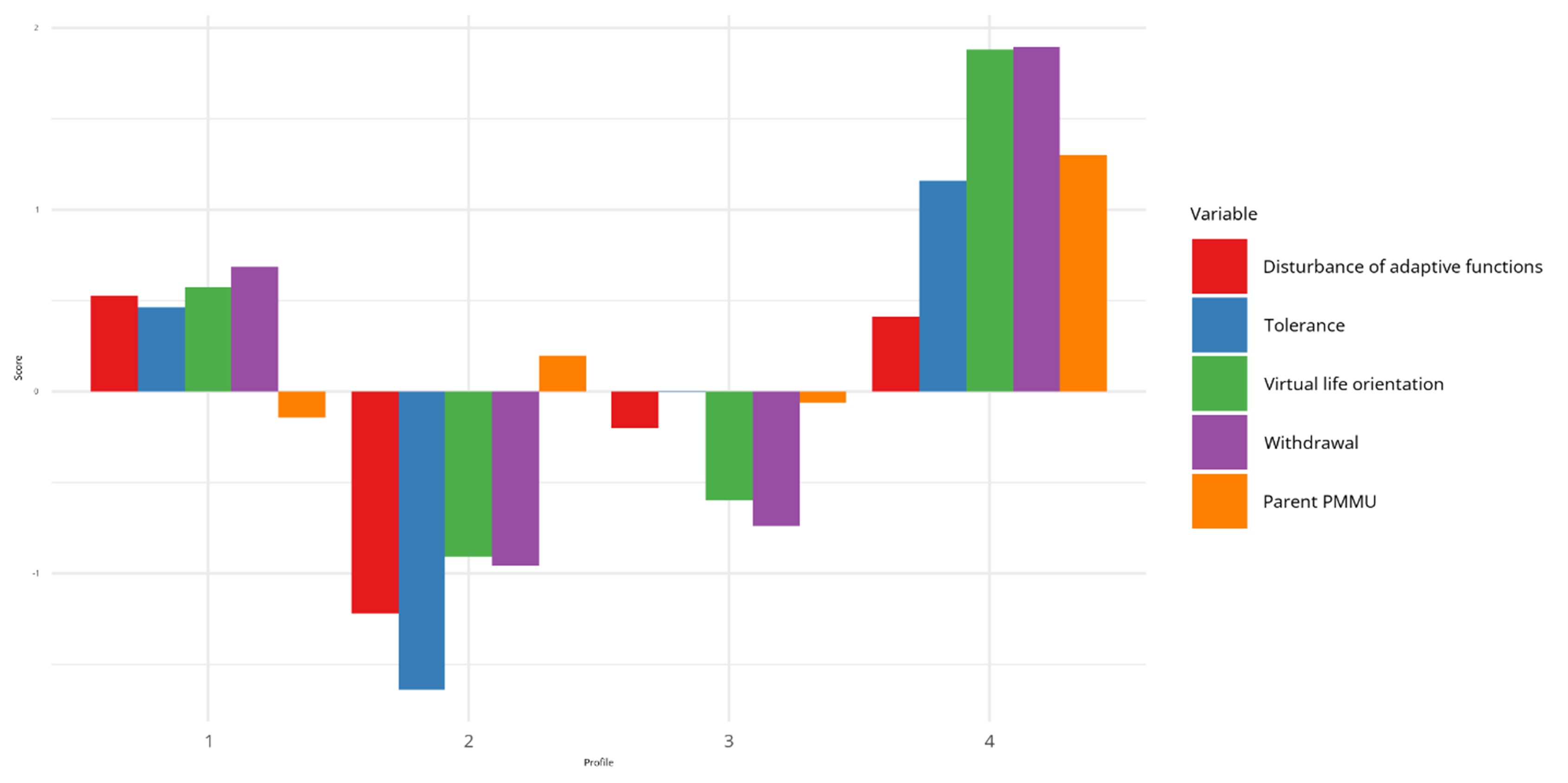
Note. PMMU = problematic mobile media use.
Sociodemographic Characteristics and Latent Profile Membership
A multinomial logistic regression was conducted to examine the association between the families’ profile membership and the following sociodemographic characteristics: Age and gender of both parent and child and whether the child is an only child. The model had a residual deviance of 905.23 and an AIC of 941.23, suggesting a reasonable fit to the data. The results (see Table 4) reveal several significant associations between characteristics and membership in the profiles. The estimates are presented as odds ratios with 95% confidence intervals (CI).
The results illustrate that the odds of being in Profile 2 (OR = 0.74, 95% CI = [0.63 – 0.87], p < .001) or Profile 3 (OR = 0.82, 95% CI = [0.72 – 0.93], p = .003) rather than Profile 1 tend to be lower as the child’s age increases. This means that parent-child dyads with older children were more likely to be part of the “High child PMMU families” family profile, than the “Low child PMMU families” or “Media-balanced families” profiles. The odds of being in Profile 2 rather than Profile 1 were also lower for fathers than mothers (OR = 0.42, 95% CI = [0.19 – 0.92], p = .031). Interestingly, being an only child was associated with higher odds of being in the ”Media-immersed families” compared to being in Profile 1 (OR = 0.21, 95% CI = [0.07 – 0.60], p = .004), Profile 2 (OR = 0.26, 95% CI = [0.08 – 0.85], p = .026) or Profile 3 (OR = 0.20, 95% CI = [0.07 – 0.61], p = .005). These results suggest that both child (child’s age), parent (parent’s gender) and family characteristics (having siblings present) significantly influence the likelihood of belonging to different family PMMU profiles.
Latent Profile Membership and Personal and Family Functioning
Separate multiple regression analyses were conducted for child self-esteem, parental self-efficacy, and parent-child conflict, with covariates and the different family PMMU profiles as independent variables, using Profile 3 as the reference category. The results of these three models are presented in Table 5.
Table 4. Results of Multinomial Logistic Regression.
|
|
Profile 1 vs. 2 |
Profile 1 vs. 3 |
Profile 1 vs. 4 |
Profile 2 vs. 3 |
Profile 2 vs. 4 |
Profile 3 vs. 4 |
||||||
|
B |
OR |
B |
OR |
B |
OR |
B |
OR [CI] |
B |
OR |
B |
OR |
|
|
Intercept |
4.40** (1.36) |
81.56 |
1.42 (1.10) |
4.13 [0.47; 35.96] |
−0.36 (2.49) |
0.70 [0.01; 93.52] |
−2.98* (1.40) |
0.05 [0.00; 0.80] |
−4.76 (2.64) |
0.01 [0.00; 1.53] |
−1.77 (2.52) |
0.17 [0.00; 23.94] |
|
Child age |
−0.31*** (0.08) |
0.74 [0.63; |
−0.20** (0.07) |
0.82 [0.72; 0.93] |
−0.15 (0.15) |
0.86 [0.64; 1.16] |
0.11 (0.09) |
1.11 [0.94; 1.31] |
0.15 (0.16) |
1.16 [0.85; 1.60] |
0.05 (0.15) |
1.05 [0.78; 1.42] |
|
Parent age |
−0.00 (0.02) |
1.00 [0.95; |
0.02 (0.02) |
1.03 [0.98; 1.07] |
0.03 (0.05) |
1.03 [0.93; 1.14] |
0.03 (0.03) |
1.03 [0.97; 1.08] |
0.03 (0.05) |
1.03 [0.92; 1.15] |
0.00 (0.05) |
1.00 [0.90; 1.11] |
|
Child gender |
−0.45 (0.30) |
0.64 [0.35; |
−0.18 (0.23) |
0.84 [0.53; 1.32] |
−0.41 (0.53) |
0.66 [0.23; 1.87] |
0.27 (0.31) |
1.31 [0.71; 2.42] |
0.03 (0.57) |
1.03 [0.34; 3.17] |
−0.24 (0.54) |
0.79 [0.27; 2.27] |
|
Parent gender |
−0.87* (0.40) |
0.42 [0.19;0.92] |
−0.20 (0.26) |
0.82 [0.49; 1.38] |
0.29 (0.55) |
1.34 [0.45; 3.99] |
0.68 (0.42) |
1.97 [0.87; 4.47] |
1.17 (0.64) |
3.22 [0.91; 11.33] |
0.49 (0.57) |
1.63 [0.54; 4.96] |
|
Only child |
−0.22 (0.42) |
0.80 [0.35; |
0.01 (0.34) |
1.01 [0.51; 1.97] |
−1.58** (0.54) |
0.21 [0.07; 0.60] |
0.23 (0.44) |
1.26 [0.53; 2.96] |
−1.36* (0.61) |
0.26 [0.08; 0.85] |
−1.59** (0.56) |
0.20 [0.07; 0.61] |
|
Note. Profile 1 = “High child PMMU families”; Profile 2 = “Low child PMMU families”; Profile 3 = “Media-balanced families”; Profile 4 = “Media-immersed families”. |
||||||||||||
Table 5. Results of Multiple Regression Models.
|
|
Child self-esteem |
Parental self-efficacy |
Parent-child conflict |
||||||
|
B (SE) |
CI |
t |
B (SE) |
CI |
t |
B (SE) |
CI |
t |
|
|
Intercept |
47.11*** (2.82) |
41.57; 52.64 |
16.73 |
21.35*** (1.08) |
19.22; 23.49 |
19.69 |
16.86*** (2.28) |
12.37; 21.35 |
7.38 |
|
Profile 1 |
−3.42*** (0.67) |
−4.75; −2.10 |
−5.08 |
−0.81** (0.26) |
−1.32; −0.30 |
−3.10 |
2.44*** (0.55) |
1.36; 3.51 |
4.45 |
|
Profile 2 |
0.95 (0.90) |
−0.82; 2.72 |
1.06 |
0.69* (0.35) |
0.01; 1.37 |
1.99 |
−0.57 (0.73) |
−2.00; 0.87 |
−0.78 |
|
Profile 4 |
−4.57** (1.55) |
−7.61; −1.52 |
−2.95 |
−0.46 (0.60) |
−1.63; 0.72 |
−0.77 |
3.47** (1.26) |
0.99; 5.94 |
2.76 |
|
Child age |
−0.52** (0.17) |
−0.86; −0.18 |
−3.02 |
−0.06 (0.07) |
−0.19; 0.08 |
−0.83 |
−0.09 (0.14) |
−0.36; 0.18 |
−0.64 |
|
Child gender |
2.31*** (0.60) |
1.14; 3.49 |
3.87 |
−0.24 (0.23) |
0.69; 0.22 |
−1.03 |
−1.37** (0.49) |
−2.32; −0.41 |
−2.82 |
|
Parent age |
−0.05 (0.05) |
−0.16; 0.05 |
−1.04 |
0.01 (0.02) |
−0.03; 0.05 |
0.46 |
−0.00 (0.04) |
−0.09; 0.08 |
−0.06 |
|
Parent gender |
−0.08 (0.69) |
−1.45; 1.28 |
−0.12 |
−0.06 (0.27) |
−0.59; 0.46 |
−0.23 |
−1.36* (0.56) |
−2.46; −0.25 |
−2.41 |
|
Only child |
−1.30 (0.85) |
−2.98; 0.37 |
−1.53 |
0.39 (0.33) |
−0.25; 1.04 |
1.20 |
1.38* (0.69) |
0.01; 2.74 |
1.99 |
|
R2 / R2 adjusted |
.18/.16 |
.07/.05 |
.11/.09 |
||||||
|
Note. Profile 3 is the reference group. *p < .05 ; **p < .01 ; ***p < .001. |
|||||||||
The regression model with child self-esteem as dependent variable revealed that compared to Profile 3, children in Profile 1 (“High child PMMU families”) reported significantly lower self-esteem (B = −3.42, SE = 0.67, p < .001), as did those in Profile 4 (“Media-immersed families”; B = −4.57, SE = 1.55, p = .003). Additionally, child gender and child age were significantly related to child self-esteem while controlling for the other variables, with boys (B = 2.31, SE = 0.60, p < .001) and younger children (B = −0.52, SE = 0.17,
p = .003) showing higher self-esteem.
Concerning parental self-efficacy, the model explains only 5% of the variance in parental self-efficacy. Parents in Profile 1 reported significantly lower self-efficacy compared to Profile 3 (B = −0.81, SE = 0.26, p = .002), while parents in Profile 2 (“Low child PMMU families”) had significantly higher self-efficacy (B = 0.69, SE = 0.35, p = .047).
Finally, with regards to the regression model with parent-child conflict as dependent variable, parents in Profile 1 reported significantly higher parent-child conflict (B = 2.44,
SE = 0.55, p < .001), as did those in Profile 4 (B = 3.47, SE = 1.26, p = .006). The coefficients of parent and child gender were also significant, with males reporting lower conflict than females (B = −1.36, SE = 0.56, p = .016; B = −1.37, SE = 0.49, p = .005, respectively). A family with only one child was also significantly related to higher parent-child conflict (B = 1.38, SE = 0.69, p = .048).
Discussion
Main Results
Using latent profile analysis, four unique family PMMU profiles emerged, each with varying levels of parent and child PMMU, highlighting the complexity and diversity of family media dynamics. While we expected to find profiles with congruent PMMU levels between parents and children in accordance with prior theoretical and empirical research, only Profiles 3 and 4 exhibited clear parent-child alignment in PMMU. Particularly Profile 4, “Media-immersed families”, the smallest profile, highlights families where both parents and children engage intensely with media. It is plausible that highly distracted parents may be less available and responsive, potentially modeling maladaptive media behaviors to their children and contributing to a family media environment in which PMMU is normalized. Another possibility is that parents with high PMMU may place less priority on monitoring or limiting their children’s media use (Lauricella et al., 2015), thereby amplifying children’s risk for very high PMMU.
Importantly, comparing Profiles 1 and 4 suggests that parental PMMU may function less as a sole determinant and more as an additional risk factor that differentiates elevated from very elevated child PMMU. Both profiles are characterized by high child PMMU; however, children in Profile 4 exhibit the highest levels in the context of high parental PMMU, whereas Profile 1 (“High child PMMU families”) includes children with high PMMU while their parents showed the lowest levels of PMMU compared to the other profiles. This pattern indicates that low levels of parental PMMU do not uniformly translate into low PMMU in children: high parental PMMU may exacerbate or intensify children’s problematic media use when other child-level or contextual vulnerabilities are already present, rather than being strictly necessary for high child PMMU to emerge. In other words, high parental PMMU appears to amplify children's vulnerability, creating a compounding effect within the family system.
Conversely, Profile 2 (“Low child PMMU families”) demonstrates this dynamic working in the opposite direction. Here, despite parents exhibiting moderate levels of PMMU, children show the lowest PMMU levels across all profiles. This pattern underscores that parental media behavior, while influential, represents only one proximal factor within the broader family system as conceptualized by IT-CPU (Domoff et al., 2020). Even when parental PMMU is present as a potential risk factor, its effects are not deterministic. Other protective mechanisms (e.g., effective parental mediation strategies, open parent-child communication, supportive parent–child relationships, structured routines, or individual child resilience) may buffer against the development of child PMMU despite some degree of parental PMMU. This finding highlights the complex, non-deterministic nature of family media dynamics, where protective factors can counterbalance risk factors.
Drawing on the family systems perspective (Broderick, 1993) and IT-CPU (Domoff et al., 2020), these patterns emphasize that parental media behavior constitutes only one subsystem within a proximal factor embedded within a broader, dynamic family system. The broader complex interplay of relationships, emotional climate, parenting practices beyond media use, and individual child characteristics may collectively shape children's media habits (Domoff et al., 2020). Another explanation for the discrepancy between our findings and prior research showing stronger parent-child congruence may be methodological; we gathered self-reports from both parents and children, while many earlier studies rely solely on parent reports, potentially creating common-method variance that inflates perceived congruency.
Sociodemographic Characteristics and Latent Profile Membership
In line with the IT-CPU framework (Domoff, et al., 2020), we also explored how distal sociodemographic factors at the child, parent, and family levels are associated with membership in specific family PMMU profiles. The findings showed that older children are more likely to belong to the “High child PMMU families” profile (Profile 1) compared to profiles with lower levels of child PMMU (Profile 2 “Low child PMMU families” or Profile 3 “Media-balanced families”). This implies that as children grow older, there is a greater likelihood of engaging more problematically with mobile media. Preadolescence is marked by an increased importance of peer relationships, signaling a shift toward establishing social connections outside the family (Kroger, 2007) and, in today’s digital world, much of this socialization occurs on digital platforms (Vanoppen et al., 2025). At the same time, preadolescence is marked by growing autonomy from parents, which can make it more challenging for parents to set rules or mediate their child’s media use. Also, children typically experience higher levels of stress from their social and school lives as they get older, and mobile media apps like social media or streaming services might help them decompress or escape from these demands (Ferguson & Olson, 2013). However, it is important to acknowledge that our sample encompasses a relatively broad age range
(8–14 years), spanning developmentally diverse stages from middle childhood through preadolescence. These developmental periods differ substantially in cognitive maturity, autonomy-seeking, peer influence, and parental monitoring, all of which may influence PMMU patterns. It is possible that as children and parents become older, some families may shift between PMMU profiles while others remain stable. Future longitudinal research is needed to explore how family PMMU profiles evolve over time as children progress through these developmental stages, which factors may drive shifts toward increasing levels of children’s PMMU, and whether certain developmental transitions (e.g., the transition to secondary school or early adolescence) represent critical periods for changes in family PMMU profiles.
Additionally, the results indicated that fathers are less likely than mothers to be in Profile 2 (“Low child PMMU families”) rather than Profile 1 (“High child PMMU families”). This highlights gender differences in parenting media practices within families. Indeed, prior research indicates that mothers and fathers exhibit different media parenting practices. Mothers are generally more likely to monitor and limit screen time, which could reduce child PMMU, whereas fathers' practices tend to be more context-dependent and less consistent (Vanoppen et al., 2025).
Interestingly, our findings revealed that being an only child significantly increases the likelihood of belonging to the “Media-immersed families” profile (Profile 4) compared to other profiles, suggesting that the absence of siblings may foster an environment where both parents and children engage more intensely with mobile media. Siblings can provide social interaction and activities, reducing reliance on media as an engagement source and encouraging more balanced media habits (Davies & Gentile, 2012). Although the presence of siblings may increase co-viewing television time (Hardy et al., 2006), children without siblings may be more likely to engage in solitary media use and turn to media for comfort when parental interaction is limited (Zhao & Yu, 2017). By exploring whether only-child families are more likely in certain family PMMU profiles, the current study sheds light on how the presence of siblings relates to the family media environment.
Latent Profile Membership and Personal and Family Functioning
We examined the relations between family PMMU profiles and markers of family members’ psychological well-being (child self-esteem and parental self-efficacy) and family functioning (parent-child conflict) with the use of multiple regression models.
- Parental Self-Efficacy. The multiple regression results for parental self-efficacy showed that parents belonging to Profile 1 (“High child PMMU families”) reported significantly lower self-efficacy compared to those in Profile 3 (“Media-balanced families”). This suggests that when parents may feel less successful in monitoring or regulating their child’s media behavior, and not necessarily their own, their self-efficacy is reduced (Schmuck et al., 2021). On the other hand, parents in Profile 2 (“Low child PMMU families”) reported significantly higher self-efficacy, suggesting that lower child media use may be linked to parents feeling more effective in managing their child's behavior. These results highlight how problematic or more balanced use of the child only potentially influences parents’ sense of control and competence. However, given that the model explained only 5% of the variance in parental self-efficacy, further research could investigate mechanisms beyond parental self-efficacy, including the role of parental well-being factors (e.g., stress, burnout, and social connection), individual child characteristics (e.g., temperament, self-regulation) or specific types of PMMU (e.g., disordered use of social media or games) to better understand how both individual and family factors may influence the relationship between family PMMU and parental self-efficacy.
- Parent-Child Conflict. Emerging evidence suggests that the introduction and problematic use of mobile devices within family settings may serve as a catalyst for overall negativity within the parent-child relationship (e.g., Beyens & Beullens, 2017; Holmgren et al., 2022; Rega et al., 2023). The regression analysis examining parent-child conflict as the dependent variable revealed that both families in Profile 1 (“High child PMMU families”) and Profile 4 (“Media-immersed families”) reported significantly higher parent-child conflict compared to those in Profile 3 (“Media-balanced families”). These findings agree with current theoretical (IT-CPU; Domoff et al., 2020) and empirical research suggesting that families with more PMMU of the child (Beyens & Beullens, 2017; Rega et al., 2023) or of both parent and child (Holmgren et al., 2022) experience more tension and disagreements. In children, PMMU is often accompanied by behaviors like difficulty disengaging from screens, sneaking media use, or lying to parents about media consumption (Swit et al., 2023), which can increase family tension (Domoff et al., 2020). Yet, the effect size of Profile 4, wherein parents also exhibit high levels of PMMU, on parent-child conflict is larger than Profile 1, suggesting that the PMMU across multiple family members could amplify the disruption in family dynamics and reduce opportunities for quality interactions. However, given the cross-sectional nature of the data, causality cannot be established. It is possible that parent–child conflict contributes to increased media use, which in turn may reinforce conflict, creating a potential vicious cycle of rising PMMU and relational tension, which is in line with the framing of a conflictual parent-child relationship as maintaining factor in the IT-CPU (Domoff et al., 2020).
- Children’s Self-Esteem. The multiple regression analysis highlighted significant differences in self-esteem across family PMMU profiles: children in profiles with high levels of child PMMU (Profile 1 “High child PMMU families” and Profile 4 “Media-immersed families”) reported significantly lower levels of self-esteem, aligning with prior research (Boer et al., 2020; C. Huang, 2022; van den Eijnden et al., 2018) and theoretical frameworks (Domoff et al., 2020). An interesting nuance in the findings is the larger effect size observed for Profile 4 (“Media-immersed families”) on child self-esteem, as compared to Profile 1 (“High child PMMU families”), suggesting that the negative association is stronger in families where both parents and children exhibit high levels of PMMU. Research shows that positive parent-child interactions and parental emotional availability are crucial for adolescent self-esteem (e.g., Silva et al., 2020). In media-immersed families, however, parents’ own PMMU may detract from these supportive interactions and involvement in managing children’s media use, diminishing children’s self-esteem (Canale et al., 2023; Radesky et al., 2015).
In contrast, “Media-balanced families”, where media use of both parent and child is more regulated, appear to foster a family environment that supports better self-esteem outcomes for children. These findings align with family systems theory (Broderick, 1993), which posits that a structured and supportive family environment can positively influence individual development. This could imply that balanced and intentional management of media use within families may act as a protective factor for children’s self-esteem and underscores the importance of parental roles in managing not only their children’s media use but also their own. As self-esteem is a core aspect of children’s psychological health (M. Rosenberg, 1979) and has far-reaching implications for well-being and mental health (Sowislo & Orth, 2013), the need for balanced media use within families becomes even more critical.
Limitations
This study’s findings should be interpreted with several limitations in mind. First, the cross-sectional data prevent us from establishing causality or determining the directionality of relationships between PMMU profiles, parental self-efficacy, parent-child conflict, and child self-esteem. The causal pathways remain debated; for instance, children with low self-esteem may turn to media for social support, leading to problematic use (Mun & Lee, 2025). Moreover, Coyne et al. (2023) found that parental self-efficacy influenced children’s media use rather than the reverse. However, as their study relied solely on parent reports, the results may be affected by common-method variance, meaning that when the same person reports on both their own and the other’s behavior, it can inflate the associations between them (Podsakoff et al., 2003).
The processes examined in this study may also be bidirectional. For example, parent-child conflict might lead family members to engage more with mobile media in a problematic way as a form of “escape,” which could, in turn, further heighten tensions within the relationship. Future longitudinal research is needed to clarify the directionality of these relationships and to explore any transactional or bidirectional effects.
A second limitation is the reliance on self-reported data, which introduces the potential for recall bias and social desirability effects. Future research could benefit from incorporating objective indicators of use patterns, such as the distinction between fragmented versus sustained engagement, which may capture qualitatively different forms of problematic mobile media use not fully reflected in self-report measures. Also, this study depended on parent reports for assessing parent-child conflict to minimize the burden on child participants by limiting questionnaire length. While a meta-analysis on parenting practices has demonstrated significant correlations between parent and adolescent reports (Hou et al., 2020), parents and children may still hold divergent perceptions of family interactions (e.g., Geurts et al., 2023; Janssens et al., 2025). These perceptual differences can be particularly pronounced during developmental periods characterized by increasing autonomy. Consequently, informant source may influence how parent-child conflict relates to other constructs, which should be considered when interpreting our results. Future research would benefit from incorporating child-reported or multi-informant assessments to capture these potentially divergent perspectives more comprehensively. Third, the PMMU measurements of preadolescents and parents reflected distinct conceptualizations, based on their developmental period. Consequently, when interpreting the results, it should be kept in mind that these constructs capture different expressions of problematic media use within the family system. Related to this, the analyses included only one indicator for parental PMMU, which may not fully capture the nuances of adult PMMU and minimalized the role of parental PMMU in profile identification, and the child PMMU measurement concerning the subdomain ‘virtual life orientation’ demonstrated very low internal consistency. Future research should further investigate these family profiles using more comprehensive measures of these behaviors. Additionally, studies could explore whether distinct family profiles emerge based on different types of PMMU (e.g., gaming, social media) and examine whether developmental outcomes vary according to the type of media use involved.
Furthermore, family composition was simplified to only-child status, without considering birth order, sibling quantity, or non-traditional family structures, which may influence child outcomes (Easey et al., 2019; van Dijk et al., 2021). Fourth, the data collection method resulted in a convenience sample of families from [country blinded for peer review] with a small sample size with only two persons per family system, an underrepresentation of fathers and an overrepresentation of higher educated parents, restricting generalizability. The small size of Profile 4, characterized by high parental PMMU, should be interpreted in light of this sample composition, as prior research indicates that higher-educated parents tend to exhibit greater media literacy and, on average, lower levels of problematic media use (e.g., Nikken & Opree, 2018). Parameter estimates for this profile may be less stable and should be interpreted with caution, and replication in larger and more socioeconomically diverse samples is needed to assess the robustness and generalizability of this profile. Future research should also consider cross-cultural differences, as countries with higher PMMU prevalence, particularly in Asia and the Middle East, may experience different normalization patterns (e.g., Lozano-Blasco et al., 2022).
Implications
Given the above-mentioned limitations, the current study still adds important information regarding PMMU within family contexts, highlighting the need for family-centered prevention and intervention strategies. By examining both parent and child PMMU during preadolescence, a time of psychological changes for the child and family as a whole (Janssens et al., 2025), we offer a more nuanced picture of a problematic media culture at home. The identification of profiles with high child PMMU suggests that these behaviors may begin to develop early (Coyne et al., 2023), pointing to the importance of intervening from early on in childhood. Moreover, our finding that the highest levels of children’s PMMU are within families where the parents also display more PMMU, indicates the need for family-centered interventions, focusing not only on the child but also on concrete parental media practices, including the establishment of consistent media-related rules, the modeling of balanced mobile media use, and the promotion of alternative parent–child interactions that do not involve screens. In addition, interventions may be tailored to family structure, for example by addressing solitary media use and compensatory media engagement in single-child families. Future research should investigate the factors that influence PMMU development in both parents and children, determining whether these factors are similar, unique, or even opposing. Additionally, studies should examine the media environment of single-child families, as these dynamics may differ significantly from those in families with multiple children based on the current study’s findings.
Conflict of Interest
The authors have no conflicts of interest to declare.
Use of AI Services
During the preparation of this work, the corresponding author used Microsoft Copilot to resolve errors in the R script and to improve the grammar of the manuscript. After using this tool, the author reviewed and edited the content as needed and takes full responsibility for the content of the publication.
Acknowledgement
The authors express their gratitude to the undergrad students for their help in the data collection.
Ethical Approval
The social ethics committee of the authors’ university KU Leuven gave its approval for the study procedure (approval code: G-2022-6142-R2).
Funding
The authors disclosed receipt of the following financial support for the research, authorship, and/or publication of this article: This work was supported by the Research Foundation–Flanders (FWO-Vlaanderen) under grant 11Q2L24N. Financial support was granted for conducting the research but the funder played no role in preparing the article or designing the study.
Data Availability Statement
All data and syntaxes related to this study can be found on OSF (https://osf.io/pf9vg/)
Appendices
Appendix A. Results of the Confirmatory Factor Analyses
Table A1. Problematic Mobile Media Use of the Preadolescent.
|
Item |
Standardized factor loadings |
|
1. My school grades dropped due to excessive smartphone or tablet use. Dis |
.590 |
|
2. Using a smartphone or tablet is more enjoyable than spending time with family or friends. V |
.408 |
|
3. It would be painful if I am not allowed to use a smartphone or tablet. W D |
.252 |
|
4. I try cutting my smartphone or tablet usage time, but I fail. T |
.506 |
|
5. I have a hard time doing what I have planned (study, do homework) due to using smartphone or tablet. Dis |
.779 |
|
6. When I cannot use a smartphone or tablet, I feel like I have lost the entire world. V |
.730 |
|
7. I get restless and nervous when I am without smartphone or tablet. W |
.897 |
|
8. I find it difficult to stop using a smartphone or tablet. T |
.629 |
|
9. People frequently comment on my excessive smartphone use. Dis D |
.454 |
|
10. I feel comfortable even when I don't have a smartphone or tablet with me.* W |
.663 |
|
11. Even when I think I should stop, I continue to use my smartphone or tablet too much. T |
.726 |
|
12. Family or friends complain that I use my smartphone or tablet too much. Dis |
.569 |
|
13. My smartphone or tablet does not distract me from my studies.* Dis |
.556 |
|
14. I panic when I cannot use my smartphone or tablet. W |
.729 |
|
15. Spending a lot of time on my smartphone or tablet has become a habit. T |
.631 |
|
Model fit statistics (after deletion) |
Results |
|
Log Likelihood H0 |
−5229.713 |
|
AIC |
10523.426 |
|
BIC |
10651.232 |
|
Chi-Square Test |
130.375 |
|
RMSEA |
.055 |
|
CFI |
.957 |
|
TLI |
.943 |
|
SRMR |
.048 |
|
Note. ‘D’ means that the item was deleted from further statistical analyses. * reverse-coded items. AIC = Akaike information criterion; BIC = Bayesian information criterion; RMSEA = Root Mean Square Error of Approximation; CFI = comparative fit index; TLI = Tucker-Lewis index; SRMR = Standardized Root Mean Square Residual. Item belongs to subdomain: Dis = Disturbance of Adaptive functions; V = Virtual Life Orientation; W = Withdrawal; T = Tolerance; Two items were removed – one from the withdrawal and one from the disturbance of adaptive functions subdomain – based on low loadings (λ < .50) and theoretical considerations (e.g., one item dealt more with external perceptions of the child’s media use). The remaining items loaded sufficiently on their respective subdomains (λ > .50), except for one item in the virtual life orientation subdomain. Since this subdomain contained only two items, both were retained, and the overall model demonstrated good fit based on global fit statistics. |
|
Table A2. Problematic Mobile Media Use of the Parent.
|
Item |
Standardized factor loadings |
|
1. I get anxious when I don't have my phone at hand. |
.760 |
|
2. I get anxious when I don't have internet access. |
.907 |
|
3. I depend on mobile media devices. D |
.507 |
|
Model fit statistics (after deletion) |
Results |
|
Log Likelihood H0 |
−1022.290 |
|
AIC |
2052.580 |
|
BIC |
2068.635 |
|
Chi-Square Test |
NA |
|
RMSEA |
0.00 |
|
CFI |
NA |
|
TLI |
NA |
|
SRMR |
0.00 |
|
Note. ‘D’ means that the item was deleted from further statistical analyses. AIC = Akaike information criterion; BIC = Bayesian information criterion; RMSEA = Root Mean Square Error of Approximation; CFI = comparative fit index; TLI = Tucker-Lewis index; SRMR = Standardized Root Mean Square Residual. Initially, parents' PMMU was intended to also be measured using a 4-item scale adapted from Holmgren et al. (2022) symptoms of gaming and internet addiction, modified for smartphone and tablet use. However, the items did not load onto a single factor, and the model demonstrated poor fit. Although all items showed sufficient loadings on the latent factor (λ > .50), the third item was excluded from the analysis (i.e., “I depend on mobile media devices”). This decision was based on the observation that Cronbach’s alpha increased by more than .05 when the item was removed, and because the item was considered too broadly worded. In today’s digital society, parental dependence on mobile devices often reflects practical or functional use (e.g., for parenting tasks) rather than problematic behavior, making the item less conceptually aligned with the construct. |
|
Table A3. Parental Self-Efficacy.
|
Item |
Standardized factor loadings |
|
1. Even though I may not always manage it, I know what I need to do with my child. |
.616 |
|
2. I am able to do the things that will improve my child’s behavior. |
.660 |
|
3. I can make an important difference to my child. |
.596 |
|
4. In most situations I know what I should do to ensure my child behaves. |
.665 |
|
5. The things I do make a difference to my child’s behavior. |
.503 |
|
Model fit statistics |
Results |
|
Log Likelihood H0 |
−1643.513 |
|
AIC |
3307.027 |
|
BIC |
3347.140 |
|
Chi-Square Test |
19.709 |
|
RMSEA |
.085 |
|
CFI |
.963 |
|
TLI |
.927 |
|
SRMR |
.037 |
|
Note. AIC = Akaike information criterion; BIC = Bayesian information criterion; RMSEA = Root Mean Square Error of Approximation; CFI = comparative fit index; TLI = Tucker-Lewis index; SRMR = Standardized Root Mean Square Residual. |
|
Table A4. Parent-Child Conflict (Parent-Reported).
|
Item |
Standardized factor loadings |
|
1. My child and I always seem to be struggling with each other. |
.581 |
|
2. My child is uncomfortable with physical affection or touch from me. D |
.267 |
|
3. My child easily becomes angry at me. |
.691 |
|
4. My child remains angry or is resistant after being disciplined. |
.605 |
|
5. Dealing with my child drains my energy. |
.548 |
|
6. When my child is in a bad mood, I know we're in for a long and difficult day. |
.647 |
|
7. My child's feelings toward me can be unpredictable or can change suddenly. |
.719 |
|
8. My child is sneaky or manipulative with me. D |
.496 |
|
Model fit statistics (6-item factor) |
Results |
|
Log Likelihood H0 |
−3567.127 |
|
AIC |
7158.254 |
|
BIC |
7206.360 |
|
Chi-Square Test |
36.196 |
|
RMSEA |
.086 |
|
CFI |
.957 |
|
TLI |
.928 |
|
SRMR |
.037 |
|
Note. ‘D’ means that the item was deleted from further statistical analyses. AIC = Akaike information criterion; BIC = Bayesian information criterion; RMSEA = Root Mean Square Error of Approximation; CFI = comparative fit index; TLI = Tucker-Lewis index; SRMR = Standardized Root Mean Square Residual. Based on the confirmatory factor analysis, parent-child conflict was measured using the average of only six items (λ > .50), as two items had low factor loadings and were conceptually distinct, addressing negative aspects of the parent-child relationship beyond mere conflict. |
|
Table A5. Child Self-Esteem.
|
Item |
Standardized factor loadings |
|
1. In general, I am satisfied with myself. |
.767 |
|
2. At times, I think that I am no good at all. * |
.758 |
|
3. I feel that I have a number of good qualities. |
.559 |
|
4. I am able to do things as well as most other people. |
.400 |
|
5. I feel that I do not have much to be proud of. * |
.758 |
|
6. I certainly feel useless at times. * |
.780 |
|
7. I feel that I am a person of worth, at least on an equal plane with others. |
.643 |
|
8. I wish I could have more respect for myself. * |
.632 |
|
9. All in all, I am inclined to feel that I am a failure. * |
.723 |
|
10. I take a positive attitude toward myself. |
.725 |
|
Model fit statistics |
Results |
|
Log Likelihood H0 |
−4375.417 |
|
AIC |
8790.835 |
|
BIC |
8870.714 |
|
Chi-Square Test |
128.985 |
|
RMSEA |
.082 |
|
CFI |
.947 |
|
TLI |
.932 |
|
SRMR |
.043 |
|
Note. * reverse-coded items. AIC = Akaike information criterion; BIC = Bayesian information criterion; RMSEA = Root Mean Square Error of Approximation; CFI = comparative fit index; TLI = Tucker-Lewis index; SRMR = Standardized Root Mean Square Residual. Although the analysis identified one item with a low factor loading (“I am able to do things as well as most other people”; λ = .40), there was no strong theoretical justification to exclude it from the final analysis (Groskurth et al., 2024). |
|
Appendix B
Table B1. Correlation Matrix.
|
|
1. |
2. |
3. |
4. |
5. |
6. |
7. |
8. |
9. |
10. |
11. |
12. |
13. |
|
1. Age child |
1.00 |
|
|
|
|
|
|
|
|
|
|
|
|
|
2. Age parent |
.32*** |
1.00 |
|
|
|
|
|
|
|
|
|
|
|
|
3. Gender child |
−.10 |
.07 |
1.00 |
|
|
|
|
|
|
|
|
|
|
|
4. Gender parent |
−.01 |
.14** |
.09 |
1.00 |
|
|
|
|
|
|
|
|
|
|
5. Only child |
.02 |
.01 |
−.02 |
−.01 |
1.00 |
|
|
|
|
|
|
|
|
|
6. Disturbance of adaptive functions (Child PMMU) |
.31*** |
.12* |
.05 |
.06 |
−.01 |
1.00 |
|
|
|
|
|
|
|
|
7. Virtual life orientation (Child PMMU) |
.17*** |
.08 |
.06 |
.12* |
−.12* |
.42*** |
1.00 |
|
|
|
|
|
|
|
8. Withdrawal (Child PMMU) |
.20*** |
.04 |
−.02 |
.08 |
−.07 |
.38*** |
.61*** |
1.00 |
|
|
|
|
|
|
9. Tolerance (Child PMMU) |
.08 |
.08 |
.04 |
.07 |
−.03 |
.56*** |
.49*** |
.46*** |
1.00 |
|
|
|
|
|
10. Parent PMMU |
−.01 |
−.10* |
.01 |
−.10* |
−.10 |
−.06 |
.06 |
.05 |
.01 |
1.00 |
|
|
|
|
11. Child self-esteem |
−.24*** |
−.10* |
.18*** |
−.03 |
−.07 |
−.27*** |
−.27*** |
−.29*** |
−.21*** |
.01 |
1.00 |
|
|
|
12. Parent self-efficacy |
−.06 |
−.01 |
−.09 |
−.06 |
.01 |
−.18*** |
−.19*** |
−.19*** |
−.17*** |
−.03 |
.19*** |
1.00 |
|
|
13. Parent-child conflict |
.03 |
−.02 |
−.13** |
−.10* |
.09 |
.18*** |
.20*** |
.22*** |
.13** |
.08 |
−.21*** |
−.25*** |
1.00 |
|
Note. PMMU = problematic mobile media use. *p < .05; **p < .01; ***p < .001. |
|||||||||||||
Appendix C
Table C1. Descriptive Statistics and Graphical Representations of Other Solutions of Latent Profile Analysis.
|
2 Profile Solution |
|
|
|
|
|
|
|
||
|
|
Profile 1 (n = 224) |
Profile 2 (n = 186) |
|
|
|
|
ANOVA |
||
|
M (SD) |
M (SD) |
|
|
|
|
F |
p |
||
|
Child PMMU |
|
|
|
|
|
|
|
|
|
|
DAF |
0.51 (0.79) |
−0.62 (0.88) |
|
|
|
|
188.1 |
< .001 |
|
|
VLO |
0.65 (0.77) |
−0.78 (0.63) |
|
|
|
|
410.7 |
< .001 |
|
|
Withdrawal |
0.69 (0.73) |
−0.83 (0.55) |
|
|
|
|
549.6 |
< .001 |
|
|
Tolerance |
0.51 (0.73) |
−0.62 (0.93) |
|
|
|
|
191.6 |
< .001 |
|
|
Parent PMMU |
−0.05 (1.02) |
0.06 (0.98) |
|
|
|
|
1.15 |
.29 |
|
|
3 Profile Solution |
|
|
|
|
|
|
|
||
|
|
Profile 1 (n = 197) |
Profile 2 (n = 70) |
Profile 3 (n = 143) |
|
|
|
ANOVA |
||
|
M (SD) |
M (SD) |
M (SD) |
|
|
|
F |
p |
||
|
Child PMMU |
|
|
|
|
|
|
|
|
|
|
DAF |
0.56 (0.78) |
−1.25 (0.53) |
−0.16 (0.83) |
|
|
|
60.37 |
< .001 |
|
|
VLO |
0.72 (0.76) |
−0.94 (0.62) |
−0.54 (0.67) |
|
|
|
223.9 |
< .001 |
|
|
Withdrawal |
0.82 (0.65) |
−0.97 (0.52) |
−0.65 (0.59) |
|
|
|
366.6 |
< .001 |
|
|
Tolerance |
0.55 (0.74) |
−1.55 (0.65) |
0.00 (0.56) |
|
|
|
38.02 |
< .001 |
|
|
Parent PMMU |
−0.02 (1.03) |
0.16 (1.09) |
−0.05 (0.90) |
|
|
|
0.06 |
.81 |
|
|
5 Profile Solution |
|
|
|
|
|
|
|
||
|
|
Profile 1 (n = 190) |
Profile 2 (n = 52) |
Profile 3 (n = 64) |
Profile 4 (n = 18) |
Profile 5 (n = 86) |
|
ANOVA |
||
|
M (SD) |
M (SD) |
M (SD) |
M (SD) |
M (SD) |
|
F |
p |
||
|
Child PMMU |
|
|
|
|
|
|
|
|
|
|
DAF |
0.50 (0.77) |
−1.26 (0.53) |
0.55 (0.62) |
0.41 (0.89) |
−0.84 (0.59) |
|
79.68 |
< .001 |
|
|
VLO |
0.57 (0.66) |
−0.99 (0.59) |
−0.50 (0.61) |
1.89 (0.87) |
−0.69 (0.68) |
|
71.23 |
< .001 |
|
|
Withdrawal |
0.70 (0.55) |
−0.97 (0.55) |
−0.73 (0.44) |
1.85 (0.61) |
−0.79 (0.56) |
|
127.2 |
< .001 |
|
|
Tolerance |
0.44 (0.69) |
−1.82 (0.49) |
0.20 (0.66) |
1.10 (0.92) |
−0.24 (0.56) |
|
8.65 |
.003 |
|
|
Parent PMMU |
−0.15 (0.93) |
−0.05 (0.95) |
−0.36 (0.90) |
1.32 (0.90) |
0.35 (0.99) |
|
21.28 |
< .001 |
|
|
6 Profile Solution |
|
|
|
|
|
|
|
|
|
|
|
Profile 1 (n = 175) |
Profile 2 (n = 56) |
Profile 3 (n = 80) |
Profile 4 (n = 20) |
Profile 5 (n = 64) |
Profile 6 (n = 15) |
ANOVA |
|
|
|
M (SD) |
M (SD) |
M (SD) |
M (SD) |
M (SD) |
M (SD) |
F |
p |
|
|
|
Child PMMU |
|
|
|
|
|
|
|
|
|
|
DAF |
0.41 (0.71) |
−1.23 (0.55) |
0.34 (0.59) |
0.47 (0.87) |
−1.03 (0.52) |
−1.72 (0.60) |
14.14 |
< .001 |
|
|
VLO |
0.57 (0.65) |
−0.94 (0.65) |
−0.50 (0.66) |
1.85 (0.84) |
−0.76 (0.62) |
0.29 (0.72) |
39.22 |
< .001 |
|
|
Withdrawal |
0.72 (0.55) |
−0.96 (0.55) |
−0.75 (0.46) |
1.75 (0.66) |
−0.76 (0.59) |
0.12 (0.69) |
72.37 |
< .001 |
|
|
Tolerance |
0.32 (0.59) |
−1.78 (0.50) |
0.05 (0.54) |
1.27 (0.76) |
−0.21 (0.54) |
1.79 (0.52) |
4.27 |
.04 |
|
|
Parent PMMU |
−0.14 (0.95) |
−0.01 (0.96) |
−0.29 (0.83) |
1.09 (0.93) |
0.42 (1.02) |
−0.02 (1.20) |
15.24 |
< .001 |
|
|
Note. Descriptive statistics are based on the standardized variables. PMMU = problematic mobile media use. DAF = Disturbance of adaptive functions; VLO = Virtual life orientation. |
|||||||||
Figure C1. 2 Profile Solution.
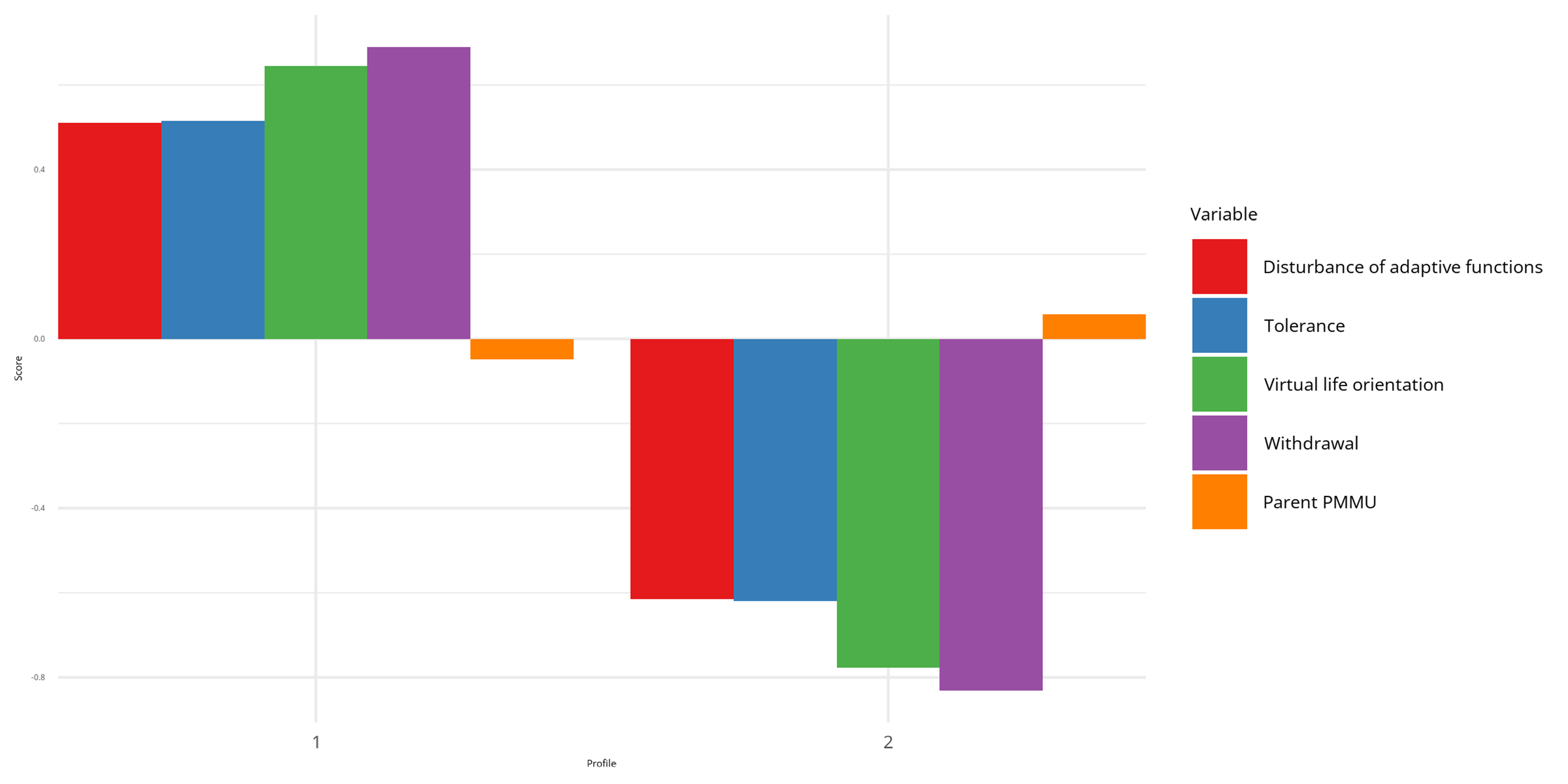 Note. PMMU = problematic mobile media use.
Figure C2. 3 Profile Solution.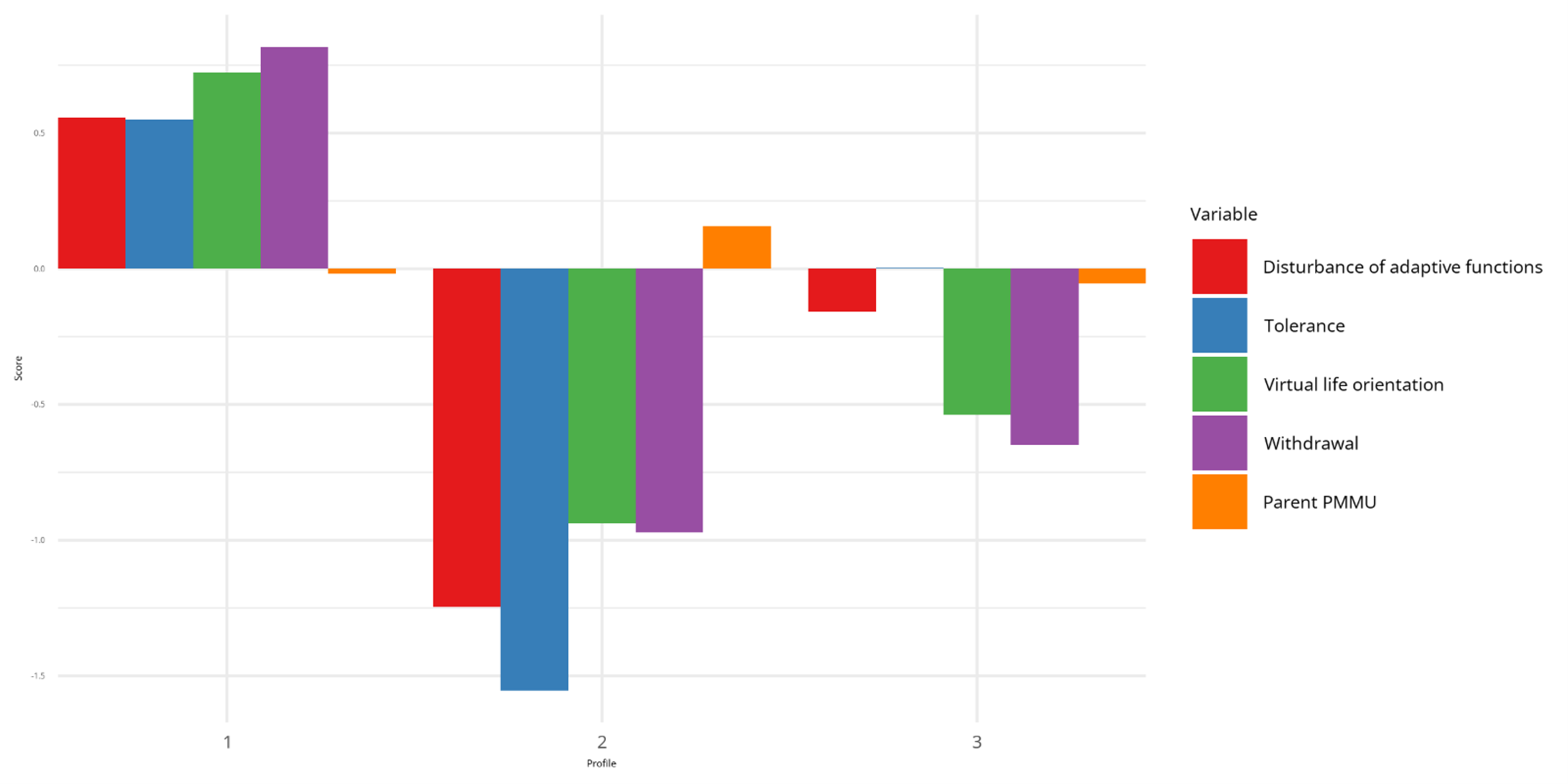
Note. PMMU = problematic mobile media use.
Figure C3. 5 Profile Solution.
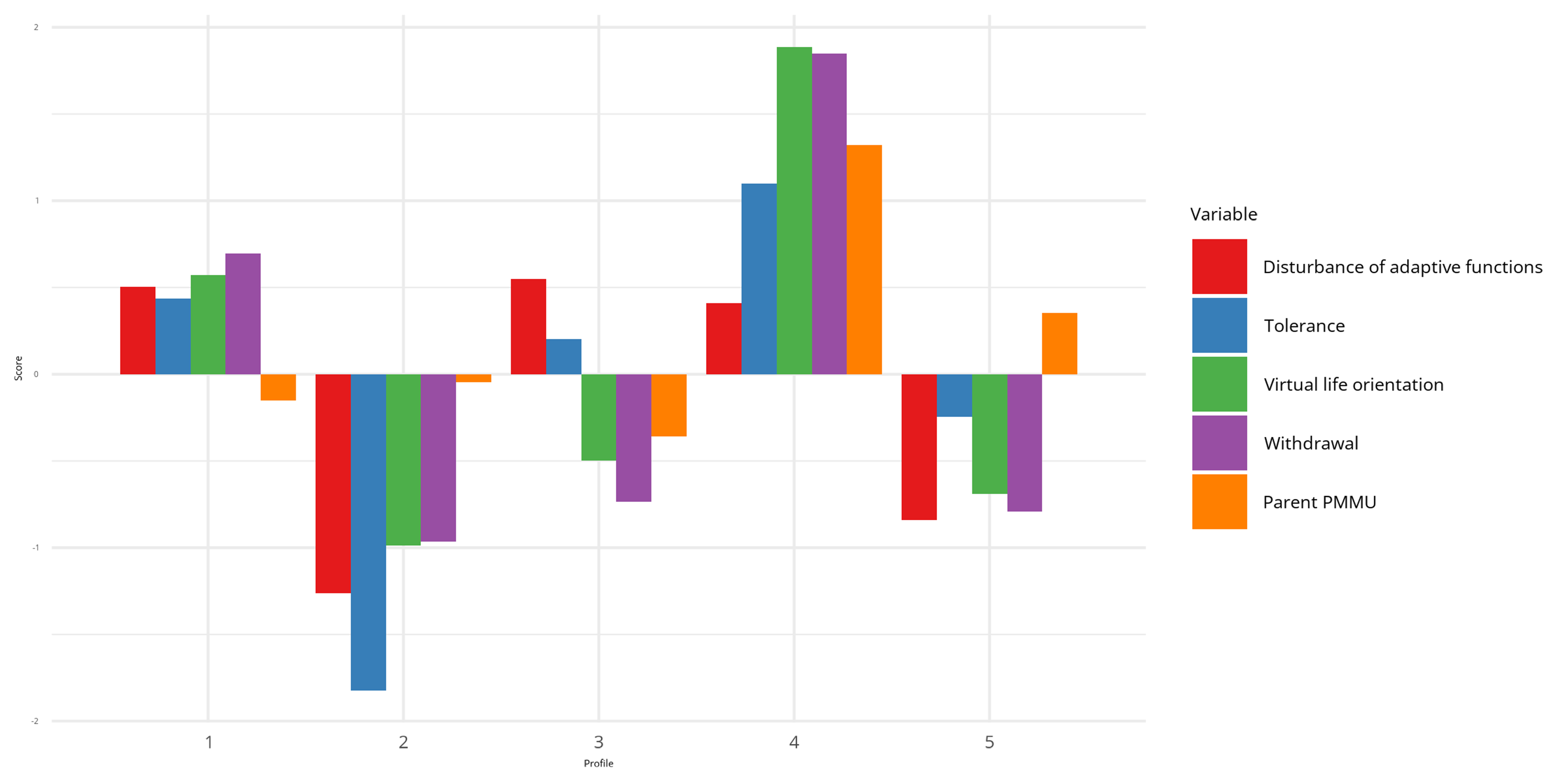
Note. PMMU = problematic mobile media use.
Figure C4. 6 Profile Solution.
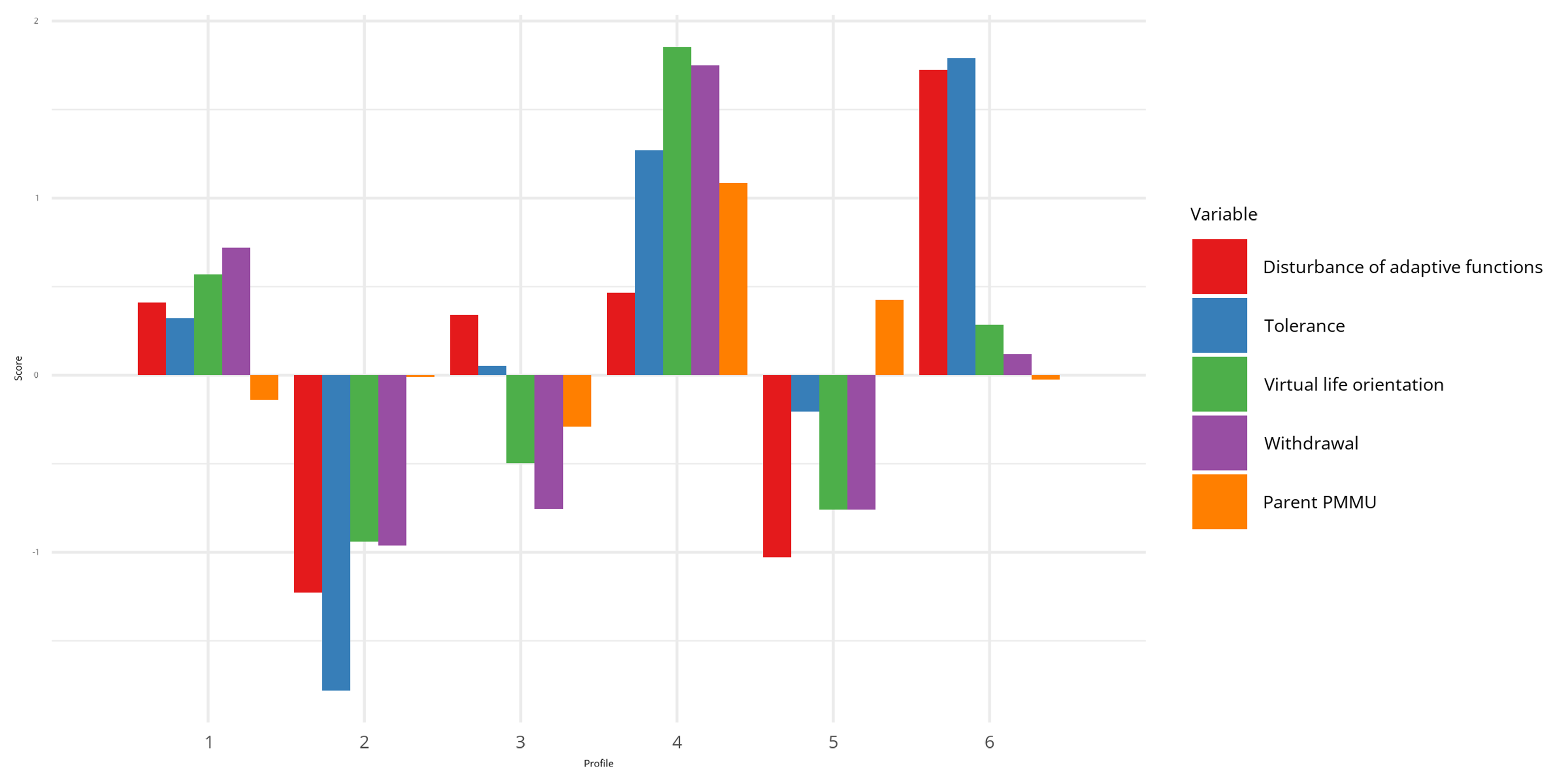
Note. PMMU = problematic mobile media use.
Appendix D
Table D1. Results of the Multiple Regression Model as Sensitivity Analyses Concerning the Robustness Check of
the Factor Analysis of Parent-Child Conflict.
|
|
B (SE) |
CI |
t |
p-value |
|
Intercept |
18.89 (2.69) |
13.60 – 24.17 |
7.03 |
< .001 |
|
Profile 1 |
3.06 (0.64) |
1.80 – 4.33 |
4.76 |
< .001 |
|
Profile 2 |
−0.65 (0.86) |
−2.34 – 1.04 |
−0.76 |
.451 |
|
Profile 4 |
5.04 (1.48) |
2.13 – 7.95 |
3.40 |
.001 |
|
Child age |
0.03 (0.16) |
−0.29 – 0.35 |
0.19 |
.851 |
|
Child gender |
−1.72 (0.57) |
−2.84 – −0.59 |
−3.00 |
.003 |
|
Parent age |
−0.00 (0.05) |
−0.10 – 0.10 |
−0.01 |
.991 |
|
Parent gender |
−1.25 (0.66) |
−2.55 – 0.05 |
−1.89 |
.060 |
|
Only child |
1.36 (0.82) |
−0.24 – 2.96 |
1.67 |
.096 |
|
R2 / R2 adjusted |
.12 / .10 |
|
|
|
|
Note. Profile 3 as reference group. *p < .05 ; **p < .01 ; ***p < .001. |
||||


This work is licensed under a Creative Commons Attribution-ShareAlike 4.0 International License.
Copyright © 2026 Nele Janssens, Sarah Coyne, Kathleen Beullens