
Media-multitasking and attentional control: A theory-driven research agenda
Vol.20,No.4(2026)
Elger Abrahamse
 Douglas Parry
Daniel le Roux
Susanne Baumgartner
Douglas Parry
Daniel le Roux
Susanne Baumgartner
Mobile digital technologies provide ample incentives and opportunities for media-multitasking, and media consumption has become almost synonymous with media-multitasking as a result. Concerns have been raised about the potential sustained impact of media-multitasking on attentional control, and ample empirical studies have been devoted to this topic. However, recent reviews and meta-analyses demonstrate that cross-sectional outcomes on the relationship between media-multitasking and attentional control remain inconsistent and inconclusive. This obstructs theoretical advancement regarding sustained impact and, consequently, hinders clear insight into the question about whether, when, and for whom remedial interventions should be considered. In the current paper, we argue that extant research has suffered from a collective failure to consider relevant intra-individual variation in attentional control. We investigate the theoretical and methodological implications of this neglect for the study of sustained media-multitasking effects on attentional control, outlining the tenets of a theory-driven research agenda to guide a new generation of cross-sectional studies. These will be much needed in providing the evidence base to justify and inform more resource-intensive causal research in this field.
attentional control; intra-individual variation; media-multitasking; cognitive functioning; cognitive control
Elger Abrahamse
Tilburg University, Tilburg, Netherlands, Universidad del Atlántico Medio, Las Palmas de Gran Canaria, Spain
Elger Abrahamse (PhD) is working as an Assistant Professor at the Department of Communication and Cognition from Tilburg University. His research concerns human cognition and its interplay with new media.
Douglas Parry
Vrije Universiteit Amsterdam, Amsterdam, Netherlands, Stellenbosch University, Stellenbosch, South Africa
Douglas A. Parry (PhD) is working as an Assistant Professor in the Department of Communication Science at the Vrije Universiteit Amsterdam. As part of the Media Psychology Group, his research concerns 1) the ways in which adolescents and young adults use digital media; 2) the potential effects that this behaviour can have on their cognition, mental health, and well-being; and 3) the knowledge and skills that enable them to thrive in a digital society.
Daniel le Roux
Stellenbosch University, Stellenbosch, South Africa
Daniel B. le Roux (PhD) is an Associate Professor at Stellenbosch University in South Africa. Heading the Cognition and Technology Research Group, his research concerns socio-technical systems, human-computer interaction, media multitasking, and human cognition.
Susanne Baumgartner
University of Amsterdam, Amsterdam, Netherlands
Susanne Baumgartner (PhD) is an Associate Professor at the Amsterdam School of Communication Research (ASCoR), at the University of Amsterdam. She is a member of the Youth and Media Entertainment program group, the Center for Research on Children, Adolescents, and the Media, and the Digital Communication Methods Lab. Her research focuses on the role of digital media in adolescent development.
Abrahamse, E., Braem, S., Notebaert, W., & Verguts, T. (2016). Grounding cognitive control in associative learning. Psychological Bulletin, 142(7), 693–728. https://doi.org/10.1037/bul0000047
Ahmed, O., Dawel, A., Walsh, E., & Cherbuin, N. (2025). Longitudinal associations between problematic social media use and mental health: Mediating role of sleep. Addictive Behaviors, 170, Article 108446. https://doi.org/10.1016/j.addbeh.2025.108446
Âkerstedt, T. (2006). Psychosocial stress and impaired sleep. Scandinavian Journal of Work, Environment & Health, 32(6), 493–501. https://doi.org/10.5271/sjweh.1054
Alzahabi, R., & Becker, M. W. (2013). The association between media multitasking, task-switching, and dual-task performance. Journal of Experimental Psychology: Human Perception & Performance, 39(5), 1485–1495. https://doi.org/10.1037/a0031208
Awh, E., Belopolsky, A. V., & Theeuwes, J. (2012). Top-down versus bottom-up attentional control: A failed theoretical dichotomy. Trends in Cognitive Sciences, 16(8), 437–443. https://doi.org/10.1016/j.tics.2012.06.010
Baumgartner, S. E. (2022). The effects of digital media and media multitasking on attention problems and sleep. In J. Nesi, E. H. Telzer, & M. J. Prinstein (Eds.), Handbook of adolescent digital media use and mental health (pp. 317–337). Cambridge University Press. https://doi.org/10.1017/9781108976237.017
Baumgartner, S. E., Parry, D. A., Beyens, I., Wiradhany, W., Uncapher, M., Wagner, A. D., & Bavelier, D. (2024). The short-and long-term effects of digital media use on attention. In D. A. Christakis & L. Hale (Eds.), Handbook of children and screens: Digital media, development, and well-being from birth through adolescence (pp. 31–37). Springer, Cham. https://doi.org/10.1007/978-3-031-69362-5_5
Baumgartner, S. E., Van Der Schuur, W. A., Lemmens, J. S., & Poel, F. T. (2017). The relationship between media multitasking and attention problems in adolescents: Results of two longitudinal studies. Human Communication Research, 44(1), 3–30. https://doi.org/10.1093/hcre.12111
Becker, M. W., Alzahabi, R., & Hopwood, C. J. (2013). Media Multitasking Is Associated with Symptoms of Depression and Social Anxiety. Cyberpsychology, Behavior, and Social Networking, 16(2), 132-135. https://doi.org/10.1089/cyber.2012.0291
Braem, S., Bugg, J. M., Schmidt, J. R., Crump, M. J., Weissman, D. H., Notebaert, W., & Egner, T. (2019). Measuring adaptive control in conflict tasks. Trends in Cognitive Sciences, 23(9), 769–783. https://doi.org/10.1016/j.tics.2019.07.002
Bustos, B., Colvett, J. S., Bugg, J. M., & Kool, W. (2024). Humans do not avoid reactively implementing cognitive control. Journal of Experimental Psychology: Human Perception & Performance, 50(6), 587–604. https://doi.org/10.1037/xhp0001207
Calderwood, C., Ackerman, P. L., & Conklin, E. M. (2014). What else do college students “do” while studying? An investigation of multitasking. Computers & Education, 75, 19–29. https://doi.org/10.1016/j.compedu.2014.02.004
Capraro, V., Globig, L., Rausch, Z., Rathje, S., Wormley, A. S., Olson, J., … Van Bavel, J. J. (2025). A consensus statement on potential negative impacts of smartphone and social media use on adolescent mental health. PsyArXiv. https://doi.org/10.31234/osf.io/b94dy_v1
Carr, N. (2010). The shallows: How the Internet is changing the way we think, read and remember. Atlantic Books Ltd.
Cecutti, L., Chemero, A., & Lee, S. W. (2021). Technology may change cognition without necessarily harming it. Nature Human Behaviour, 5(8), 973–975. https://doi.org/10.1038/s41562-021-01162-0
Chen, H., Peng, L., Peng, J., Liu, C., Yin, L., Zhang, Y., Cheng, Y., & Shi, Z. (2025). The relationship between media multitasking and attention: A three-level meta-analysis. Current Psychology, 44(7), 6326–6347. https://doi.org/10.1007/s12144-025-07624-2
Corbetta, M., & Shulman, G. L. (2002). Control of goal-directed and stimulus-driven attention in the brain. Nature Reviews. Neuroscience, 3(3), 201–215. https://doi.org/10.1038/nrn755
Crump, M. J. C., Gong, Z., & Milliken, B. (2006). The context-specific proportion congruent Stroop effect: Location as a contextual cue. Psychonomic Bulletin & Review, 13(2), 316–321. https://doi.org/10.3758/bf03193850
Egner, T. (2023). Principles of cognitive control over task focus and task switching. Nature Reviews Psychology, 2(11), 702–714. https://doi.org/10.1038/s44159-023-00234-4
Esterman, M., Noonan, S. K., Rosenberg, M., & DeGutis, J. (2013). In the zone or zoning out? Tracking behavioral and neural fluctuations during sustained attention. Cerebral Cortex, 23(11), 2712–2723. https://doi.org/10.1093/cercor/bhs261
Esterman, M., Reagan, A., Liu, G., Turner, C., & DeGutis, J. (2014). Reward reveals dissociable aspects of sustained attention. Journal of Experimental Psychology: General, 143(6), 2287–2295. https://doi.org/10.1037/xge0000019
Freytag, A., Knop-Huelss, K., Meier, A., Reinecke, L., Hefner, D., Klimmt, C., & Vorderer, P. (2021). Permanently online—always stressed out? The effects of permanent connectedness on stress experiences. Human Communication Research, 47(2), 132–165. https://doi.org/10.1093/hcr/hqaa014
Frömer, R., Lin, H., Dean Wolf, C. K., Inzlicht, M., & Shenhav, A. (2021). Expectations of reward and efficacy guide cognitive control allocation. Nature Communications, 12(1), Article 1030. https://doi.org/10.1038/s41467-021-21315-z
Geddert, R., Madlon-Kay, S., O’Neill, K., Pearson, J., & Egner, T. (2025). Modeling of control over task switching and cross-task interference supports a two-dimensional model of cognitive stability and flexibility. Psychonomic Bulletin & Review, 32(6), 2433–2453. https://doi.org/10.3758/s13423-025-02712-7
Goschke, T. (2013). Volition in action: Intentions, control dilemmas, and the dynamic regulation of cognitive control. In W. Prinz, M. Beisert, & A. Herwig (Eds.), Action science: Foundations of an emerging discipline (pp. 409–434). MIT Press. https://doi.org/10.7551/mitpress/9780262018555.003.0024
Grahek, I., Shenhav, A., Musslick, S., Krebs, R. M., & Koster, E. H. (2019). Motivation and cognitive control in depression. Neuroscience & Biobehavioral Reviews, 102, 371–381. https://doi.org/10.1016/j.neubiorev.2019.04.011
Hale, L., Hartstein, L. E., Robbins, R., Grandner, M. A., LeBourgeois, M. K., Garrison, M. M., & Czeisler, C. A. (2024). What do we know about the link between screens and sleep health? In D. A. Christakis & L. Hale (Eds.), Handbook of children and screens: Digital media, development, and well-being from birth through adolescence (pp. 101–107). Springer, Cham, https://doi.org/10.1007/978-3-031-69362-5_14
Ham, H., Grahek, I., Bustamante, L. A., Daw, N., Caplin, A., & Musslick, S. (2022). Leveraging psychometrics of rational inattention to estimate individual differences in the capacity for cognitive control. PsyArXiv. https://doi.org/10.31234/osf.io/wubv4
Hayes, S., MacLeod, C., & Hammond, G. (2009). Anxiety-linked task performance: Dissociating the influence of restricted working memory capacity and increased investment of effort. Cognition & Emotion, 23(4), 753–781. https://doi.org/10.1080/02699930802131078
Hefner, D., & Vorderer, P. (2016). Digital stress: Permanent connectedness and multitasking. In L. Reinecke & M. B. Oliver (Eds.), The Routledge handbook of media use and well-being: International perspectives on theory and research on positive media effects (pp. 237–249). Routledge. https://doi.org/10.4324/9781315714752
Hommel, B. (2015). Between persistence and flexibility: The Yin and Yang of action control. In A. J. Elliot (Eds.), Advances in motivation science (Vol. 2, pp. 33–67). Elsevier. https://doi.org/10.1016/bs.adms.2015.04.003
Hommel, B. (2022). GOALIATH: A theory of goal-directed behavior. Psychological Research, 86(4), 1054–1077. https://doi.org/10.1007/s00426-021-01563-w
Hommel, B., & Colzato, L. S. (2017). The social transmission of metacontrol policies: Mechanisms underlying the interpersonal transfer of persistence and flexibility. Neuroscience & Biobehavioral Reviews, 81(Part A), 43–58. https://doi.org/10.1016/j.neubiorev.2017.01.009
Holroyd, C. B. (2025). The controllosphere: The neural origin of cognitive effort. Psychological Review, 132(3), 603–631. https://doi.org/10.1037/rev0000467
Husain, M., & Roiser, J. P. (2018). Neuroscience of apathy and anhedonia: A transdiagnostic approach. Nature Reviews. Neuroscience, 19(8), 470–484. https://doi.org/10.1038/s41583-018-0029-9
Ileri-Tayar, M., Bugg, J., & Kool, W. (2025). Switching between cognitive control states? No, Thank You. OSF Preprints. https://doi.org/10.31219/osf.io/z7wqu_v3
Ishii, A., Tanaka, M., & Watanabe, Y. (2014). Neural mechanisms of mental fatigue. Reviews in the Neurosciences, 25(4), 469–479. https://doi.org/10.1515/revneuro-2014-0028
Jiang, J., Heller, K., & Egner, T. (2014). Bayesian modeling of flexible cognitive control. Neuroscience & Biobehavioral Reviews, 46(Part 1), 30–43. https://doi.org/10.1016/j.neubiorev.2014.06.001
Kahneman, D. (1973). Attention and effort. Prentice-Hall.
Kayser, K. C., Puig, V. A., & Estepp, J. R. (2022). Predicting and mitigating fatigue effects due to sleep deprivation: A review. Frontiers in Neuroscience, 16, Article 930280. https://doi.org/10.3389/fnins.2022.930280
Kocalevent, R. D., Hinz, A., Brähler, E., & Klapp, B. F. (2011). Determinants of fatigue and stress. BMC Research Notes, 4(1), Article 238. https://doi.org/10.1186/1756-0500-4-238
Kool, W., McGuire, J. T., Rosen, Z. B., & Botvinick, M. M. (2010). Decision making and the avoidance of cognitive demand. Journal of Experimental Psychology: General, 139(4), 665–682. https://doi.org/10.1037/a0020198
Kool, W., Shenhav, A., & Botvinick, M. M. (2017). Cognitive control as cost‐benefit decision making. In T. Egner (Ed.), The Wiley handbook of cognitive control (pp. 167–189). https://doi.org/10.1002/9781118920497.ch10
Kunasegaran, K., Ismail, A. M. H., Ramasamy, S., Gnanou, J. V., Caszo, B. A., & Chen, P. L. (2023). Understanding mental fatigue and its detection: A comparative analysis of assessments and tools. PeerJ, 11, Article e15744. https://doi.org/10.7717/peerj.15744
Kurzban, R., Duckworth, A., Kable, J. W., & Myers, J. (2013). An opportunity cost model of subjective effort and task performance. Behavioral & Brain Sciences, 36(6), 661–679. https://doi.org/10.1017/s0140525x12003196
Lamontagne, S. J., Wash, S. I. J., Irwin, S. H., Zucconi, K. E., & Olmstead, M. C. (2022). Effects of dopamine modulation on chronic stress-induced deficits in reward learning. Cognitive Affective & Behavioral Neuroscience, 22(4), 736–753. https://doi.org/10.3758/s13415-022-01001-3
le Roux, D. B., & Parry, D. A. (2022). Investigating predictors of online vigilance among university students. Information Technology & People, 35(1), 27–45. https://doi.org/10.1108/itp-04-2020-0226
Lieder, F., Shenhav, A., Musslick, S., & Griffiths, T. L. (2018). Rational metareasoning and the plasticity of cognitive control. PLoS Computational Biology, 14(4), Article e1006043. https://doi.org/10.1371/journal.pcbi.1006043
Liston, C., McEwen, B. S., & Casey, B. J. (2009). Psychosocial stress reversibly disrupts prefrontal processing and attentional control. Proceedings of the National Academy of Sciences, 106(3), 912–917. https://doi.org/10.1073/pnas.0807041106
Madden, G. J., Begotka, A. M., Raiff, B. R., & Kastern, L. L. (2003). Delay discounting of real and hypothetical rewards. Experimental & Clinical Psychopharmacology, 11(2), 139–145. https://doi.org/10.1037/1064-1297.11.2.139
Matthews, J., Pisauro, M. A., Jurgelis, M., Müller, T., Vassena, E., Chong, T. T. J., & Apps, M. A. (2023). Computational mechanisms underlying the dynamics of physical and cognitive fatigue. Cognition, 240, Article 105603. https://doi.org/10.1016/j.cognition.2023.105603
May, K. E., & Elder, A. D. (2018). Efficient, helpful, or distracting? A literature review of media multitasking in relation to academic performance. International Journal of Educational Technology in Higher Education, 15, Article 13. https://doi.org/10.1186/s41239-018-0096-z
Melby-Lervåg, M., & Hulme, C. (2013). Is working memory training effective? A meta-analytic review. Developmental Psychology, 49(2), 270–291. https://doi.org/10.1037/a0028228
Müller, T., Klein-Flügge, M. C., Manohar, S. G., Husain, M., & Apps, M. A. (2021). Neural and computational mechanisms of momentary fatigue and persistence in effort-based choice. Nature Communications, 12(1), Article 4593. https://doi.org/10.1038/s41467-021-24927-7
Murphy, K., Shin, M., & Stainer, M. (2024). Media multitasking scores and media use hours: A comparison across the standard stroop task and an emotional stroop task. Media Psychology, 28(2), 189–209. https://doi.org/10.1080/15213269.2024.2338115
Musslick, S., & Cohen, J. D. (2021). Rationalizing constraints on the capacity for cognitive control. Trends in Cognitive Sciences, 25(9), 757–775. https://doi.org/10.1016/j.tics.2021.06.001
Myerson, J., & Green, L. (1995). Discounting of delayed rewards: Models of individual choice. Journal of the Experimental Analysis of Behavior, 64(3), 263–276. https://doi.org/10.1901/jeab.1995.64-263
Oberauer, K. (2024). The meaning of attention control. Psychological Review, 131(6), 1509–1526. https://doi.org/10.1037/rev0000514
Ophir, E., Nass, C., & Wagner, A. D. (2009). Cognitive control in media multitaskers. Proceedings of the National Academy of Sciences, 106(37), 15583–15587. https://doi.org/10.1073/pnas.0903620106
Otto, A. R., & Vassena, E. (2021). It’s all relative: Reward-induced cognitive control modulation depends on context. Journal of Experimental Psychology: General, 150(2), 306–313. https://doi.org/10.1037/xge0000842
Oviedo, V., Tornquist, M., Cameron, T., & Chiappe, D. (2015). Effects of media multi-tasking with Facebook on the enjoyment and encoding of TV episodes. Computers in Human Behavior, 51(Part A), 407–417. https://doi.org/10.1016/j.chb.2015.05.022
Padmala, S., & Pessoa, L. (2011). Reward reduces conflict by enhancing attentional control and biasing visual cortical processing. Journal of Cognitive Neuroscience, 23(11), 3419–3432. https://doi.org/10.1162/jocn_a_00011
Parshina, O., Obeid, R., Che, E. S., Ricker, T. J., & Brooks, P. J. (2018). SRT and ASRT: Similar tasks tapping distinct learning mechanisms? Proceedings of the Annual Meeting of the Cognitive Science Society, 40, 2205–2210. https://escholarship.org/uc/item/5ks2h562
Parry, D. A., & Fisher, J. T. (2025). Is it time to abandon the media multitasking index? Journal of Media Psychology Theories Methods and Applications. https://doi.org/10.1027/1864-1105/a000470
Parry, D. A., & le Roux, D. B. (2021). “Cognitive control in media multitaskers” ten years on: A meta-analysis. Cyberpsychology: Journal of Psychosocial Research on Cyberspace, 15(2), Article 7. https://doi.org/10.5817/CP2021-2-7
Parry, D. A., le Roux, D. B., & Bantjes, J. R. (2020). Testing the feasibility of a media multitasking self-regulation intervention for students: Behaviour change, attention, and self-perception. Computers in Human Behavior, 104, Article 106182. https://doi.org/10.1016/j.chb.2019.106182
Pessiglione, M., Blain, B., Wiehler, A., & Naik, S. (2025). Origins and consequences of cognitive fatigue. Trends in Cognitive Sciences, 29(8), 730–749. https://doi.org/10.1016/j.tics.2025.02.005
Petkovski, M., Rosen, C., Lehmann, N., Baune, L., Steinrücke, J., & Dominguez-Rodriguez, A. (2025). The relationships between online vigilance, mental health, stress, and fear of missing out: A cross-sectional study. Acta Psychologica, 260, Article 105577. https://doi.org/10.1016/j.actpsy.2025.105577
Pizzagalli, D. A. (2014). Depression, stress, and anhedonia: Toward a synthesis and integrated model. Annual Review of Clinical Psychology, 10(1), 393–423. https://doi.org/10.1146/annurev-clinpsy-050212-185606
Ralph, B. C. W., & Smilek, D. (2016). Individual differences in media multitasking and performance on the n-back. Attention Perception & Psychophysics, 79(2), 582–592. https://doi.org/10.3758/s13414-016-1260-y
Ralph, B. C. W., Thomson, D. R., Cheyne, J. A., & Smilek, D. (2013). Media multitasking and failures of attention in everyday life. Psychological Research, 78(5), 661–669. https://doi.org/10.1007/s00426-013-0523-7
Ralph, B. C. W., Seli, P., Wilson, K. E., & Smilek, D. (2018). Volitional media multitasking: Awareness of performance costs and modulation of media multitasking as a function of task demand. Psychological Research, 84(2), 404–423. https://doi.org/10.1007/s00426-018-1056-x
Reinecke, L., Aufenanger, S., Beutel, M. E., Dreier, M., Quiring, O., Stark, B., Wölfling, K., & Müller, K. W. (2016). Digital stress over the life span: The effects of communication load and Internet multitasking on perceived stress and psychological health impairments in a German probability sample. Media Psychology, 20(1), 90–115. https://doi.org/10.1080/15213269.2015.1121832
Reinecke, L., Klimmt, C., Meier, A., Reich, S., Hefner, D., Knop-Huelss, K., Rieger, D., & Vorderer, P. (2018). Permanently online and permanently connected: Development and validation of the Online Vigilance Scale. PLoS ONE, 13(10), e0205384. https://doi.org/10.1371/journal.pone.0205384
Rizvi, S. J., Pizzagalli, D. A., Sproule, B. A., & Kennedy, S. H. (2016). Assessing anhedonia in depression: Potentials and pitfalls. Neuroscience & Biobehavioral Reviews, 65, 21–35. https://doi.org/10.1016/j.neubiorev.2016.03.004
Robertson, I. H., Manly, T., Andrade, J., Baddeley, B. T., & Yiend, J. (1997). ’Oops!’: Performance correlates of everyday attentional failures in traumatic brain injured and normal subjects. Neuropsychologia, 35(6), 747–758. https://doi.org/10.1016/s0028-3932(97)00015-8
Sali, A. W., Bejjani, C., & Egner, T. (2024). Learning cognitive flexibility: Neural substrates of adapting switch-readiness to time-varying demands. Journal of Cognitive Neuroscience, 36(2), 377–393. https://doi.org/10.1162/jocn_a_02091
Schutten, D., Stokes, K. A., & Arnell, K. M. (2017). I want to media multitask and I want to do it now: Individual differences in media multitasking predict delay of gratification and system-1 thinking. Cognitive Research Principles & Implications, 2(1), Article 8. https://doi.org/10.1186/s41235-016-0048-x
Shenhav, A., Botvinick, M. M., & Cohen, J. D. (2013). The expected value of control: An integrative theory of anterior cingulate cortex function. Neuron, 79(2), 217–240. https://doi.org/10.1016/j.neuron.2013.07.007
Shenhav, A., Musslick, S., Lieder, F., Kool, W., Griffiths, T. L., Cohen, J. D., & Botvinick, M. M. (2017). Toward a rational and mechanistic account of mental effort. Annual Review of Neuroscience, 40(1), 99–124. https://doi.org/10.1146/annurev-neuro-072116-031526
Shin, M., & Murphy, K. (2025). Frequent media use, media multitasking, and perceived cost of cognitive effort. Cyberpsychology, Behavior, & Social Networking, 28(5), 354–358. https://doi.org/10.1089/cyber.2024.0492
Shin, M., Taseski, D., & Murphy, K. (2024). Media multitasking is linked to attentional errors, mind wandering and automatised response to stimuli without full conscious processing. Behaviour & Information Technology, 43(3), 445–457. https://doi.org/10.1080/0144929x.2023.2167669
Shipstead, Z., Redick, T. S., & Engle, R. W. (2012). Is working memory training effective? Psychological Bulletin, 138(4), 628–654. https://doi.org/10.1037/a0027473
Silvestrini, N., & Gendolla, G. H. (2019). Affect and cognitive control: Insights from research on effort mobilization. International Journal of Psychophysiology, 143, 116–125. https://doi.org/10.1016/j.ijpsycho.2019.07.003
Silvetti, M., Vassena, E., Abrahamse, E., & Verguts, T. (2018). Dorsal anterior cingulate-brainstem ensemble as a reinforcement meta-learner. PLoS Computational Biology, 14(8), Article e1006370. https://doi.org/10.1371/journal.pcbi.1006370
Simoens, J., Braem, S., Verbeke, P., Chen, H., Mattioni, S., Chai, M., Schuck, N. W., & Verguts, T. (2025). Two time scales of adaptation in human learning rates. eLife, 14, Article RP108223. https://doi.org/10.7554/elife.108223.1
Spinelli, G., Perry, J. R., & Lupker, S. J. (2019). Adaptation to conflict frequency without contingency and temporal learning: Evidence from the picture–word interference task. Journal of Experimental Psychology: Human Perception & Performance, 45(8), 995–1014. https://doi.org/10.1037/xhp0000656
Statista (2025, 28 July). Number of internet and social media users worldwide as of February 2025. https://web.archive.org/web/20250729115502/https://www.statista.com/statistics/617136/digital-population-worldwide/
Struk, A. A., Scholer, A. A., Danckert, J., & Seli, P. (2020). Rich environments, dull experiences: how environment can exacerbate the effect of constraint on the experience of boredom. Cognition & Emotion, 34(7), 1517–1523. https://doi.org/10.1080/02699931.2020.1763919
Szumowska, E., & Kruglanski, A. W. (2022). The psychology of getting busy: Multitasking as a consequence of goal activation. Journal of Experimental Psychology: General, 151(1), 137–160. https://doi.org/10.1037/xge0001077
Tam, K. Y., & Inzlicht, M. (2024). People are increasingly bored in our digital age. Communications Psychology, 2(1), Article 106. https://doi.org/10.1038/s44271-024-00155-9
Theeuwes, J. (2010). Top–down and bottom–up control of visual selection. Acta Psychologica, 135(2), 77–99. https://doi.org/10.1016/j.actpsy.2010.02.006
Thomson, D. R., Besner, D., & Smilek, D. (2015). A resource-control account of sustained attention: Evidence from mind-wandering and vigilance paradigms. Perspectives on Psychological Science, 10(1), 82–96. https://doi.org/10.1177/1745691614556681
Toth, R., Parry, D., & Emmer, M. (2025). From screen time to daily rhythms: A mixed methods study of smartphone use among German adults. Journal of Quantitative Description: Digital Media, 5. https://doi.org/10.51685/jqd.2025.019
Uncapher, M. R., & Wagner, A. D. (2018). Minds and brains of media multitaskers: Current findings and future directions. Proceedings of the National Academy of Sciences of the United States of America, 115(40), 9889–9896. https://doi.org/10.1073/pnas.1611612115
Van der Schuur, W. A., Baumgartner, S. E., Sumter, S. R., & Valkenburg, P. M. (2015). The consequences of media multitasking for youth: A review. Computers in Human Behavior, 53, 204–215. https://doi.org/10.1016/j.chb.2015.06.035
Wang, Z., & Tchernev, J. M. (2012). The “myth” of media multitasking: Reciprocal dynamics of media multitasking, personal needs, and gratifications. Journal of Communication, 62(3), 493–513. https://doi.org/10.1111/j.1460-2466.2012.01641.x
Watson, R., McCabe, C., Harvey, K., & Reynolds, S. (2021). Development and validation of a new adolescent self-report scale to measure loss of interest and pleasure: The Anhedonia Scale for Adolescents. Psychological Assessment, 33(3), 201–217, Article 201. https://doi.org/10.1037/pas0000977
Wiradhany, W., Baumgartner, S., & de Bruin, A. (2021). Exploitation–exploration model of media multitasking. Journal of Media Psychology, 33(4), 169–180. https://doi.org/10.1027/1864-1105/a000303
Wiradhany, W., & Nieuwenstein, M. R. (2017). Cognitive control in media multitaskers: Two replication studies and a meta-analysis. Attention Perception & Psychophysics, 79(8), 2620–2641. https://doi.org/10.3758/s13414-017-1408-4
Xu, S., & David, P. (2018). Distortions in time perceptions during task switching. Computers in Human Behavior, 80, 362–369. https://doi.org/10.1016/j.chb.2017.11.032
Xu, S., Wang, Z., & David, P. (2022). Social media multitasking (SMM) and well-being: Existing evidence and future directions. Current Opinion in Psychology, 47, Article 101345. https://doi.org/10.1016/j.copsyc.2022.101345
Authors’ Contribution
Elger Abrahamse: conceptualization, visualization, writing—original draft, writing—review & editing. Douglas Parry: conceptualization, writing—review & editing. Daniel le Roux: conceptualization, writing—review & editing. Susanne Baumgartner: conceptualization, writing—review & editing.
Editorial Record
First submission received:
August 26, 2025
Revisions received:
March 3, 2026
June 5, 2026
Accepted for publication:
June 10, 2026
Editor in charge:
Lenka Dedkova
Introduction
With more than half of the global population actively engaging with digital technologies (Statista, 2025), concerns about their influence on our attention have gained increasing prominence in both scientific and popular discourse (Capraro et al., 2025; Carr, 2010). At the heart of these concerns is media-multitasking—the simultaneous use of media streams, sources, or content alongside another (media or non-media) task (Parry & le Roux, 2021). The ubiquitous availability of mobile devices like smartphones and laptops provides users with near constant access to the internet and its instantly gratifying affordances, fostering both opportunities and incentives for media-multitasking. There is now broad consensus that media-multitasking imposes immediate costs in primary task control and performance (e.g., Baumgartner et al., 2024; May & Elder, 2018). This has raised the central concern that—through its systematic disruption of goal-directed activities—media-multitasking may lead to sustained changes in the ability to effectively allocate limited attentional resources in line with current goals (Carr, 2010; Ophir et al., 2009). Hence, over the last two decades, a wealth of empirical work has investigated if and how high-levels of media-multitasking affect attentional control beyond the moments of actual engagement with multitasking (for reviews see Parry & le Roux, 2021; Uncapher & Wagner, 2018; Wiradhany & Nieuwenstein, 2017).
Despite these efforts, we still lack a robust answer as to the nature and extent of sustained effects of media-multitasking on attentional control (Baumgartner et al., 2024; Uncapher & Wagner, 2018). The reason for this may be twofold. First, with a few notable exceptions (Baumgartner et al., 2018; Parry et al., 2020; Ralph et al., 2020), most studies in this area have relied on cross-sectional designs, leaving the issue of causality unresolved (Chen et al., 2025; Uncapher & Wagner, 2018). Observed correlations between media-multitasking and attentional control may indicate a causal effect of the former on the latter, but they may also stem either from reversed causality whereby individuals with pre-existing cognitive profiles are more likely to engage in media-multitasking (Ralph et al., 2014), or from unmeasured ‘third variables’ that independently affect both media-multitasking and attentional control (Murphy et al., 2024). Testing for causal impact requires longitudinal randomized trials and/or intervention studies in which media-multitasking is manipulated.
Second, the existing body of cross-sectional evidence is marked by inconsistent findings (Parry & le Roux, 2021; Uncapher & Wagner, 2018; Wiradhany & Nieuwenstein, 2017). For example, correlations between media-multitasking and task-switching costs have been found to be positive, absent, or negative across studies (Parry & le Roux, 2021). Such inconsistency is particularly problematic because cross-sectional studies are typically expected to serve as foundational ‘scouts’ that inform the development of more resource-intensive causal research. Given the high resource demands of longitudinal randomized trials and intervention studies, robust and replicable correlational findings are essential for justifying these efforts and for increasing the likelihood that they target meaningful effects.
Thus, the field needs an answer to a critical question: Why has the current body of research failed to produce robust results? One potential explanation lies in the measurement of media-multitasking, which is typically assessed via self-report instruments known to suffer from both theoretical and practical limitations (Parry & Fisher, 2025). We will briefly return to this important issue later. Critically, however, we here argue that another important reason concerns the theoretical grounding of attentional control and (by extension) its assessment. Specifically, we propose that the field has suffered from a systematic neglect of intra-individual variation in attentional control. In the current paper, we develop this argument and outline its relevance for theory-driven studies on the relationship between media-multitasking and attentional control. To facilitate the reader, Table 1 provides a glossary of relevant concepts (printed in bold for first mention in main text).
Current State-Of-The-Art on Media-Multitasking Effects
Since the seminal paper by Ophir et al. (2009), media-multitasking effects on attentional control are – implicitly or explicitly—framed within the selective attention model that understands attentional selection from the interaction between bottom-up and top-down processes (Theeuwes, 2010). Top-down attention, here referred to as attentional control, refers to selective attention being guided in a goal-directed mechanism based on the observer’s intentions, expectations, and knowledge. Conversely, bottom-up attention refers to stimulus-driven processes operating independently of the observer’s goals, in which attention is captured by salient input (e.g., loud noise; Corbetta & Shulman, 2002). The association between media-multitasking and attentional control, then, has mostly been framed as heavy media-multitaskers displaying relatively low top-down control and more potent bottom-up capturing of attention. This systematically hinders their ability to filter out distractions – leading to breadth-biased attention (e.g., Ophir et al., 2009; Uncapher & Wagner, 2018).
Different mechanisms have been proposed to underlie this breadth-biased attention hypothesis (alternatively coined the scattered-attention hypothesis; Van der Schuur et al., 2015). Some proposals do not assign a causal role to media-multitasking, such as the self-selection hypothesis (Ralph et al., 2014) or the strategic hypothesis (Ralph & Smilek, 2018). Yet, most previous studies center on the concern that media-multitasking can have sustained effects on attentional control, proposing a causal link whereby media-multitasking behavior serves as a training ground that shapes attentional control (i.e., training logic). On the one hand, this includes cases in which media-multitasking leads to diminished (top-down) attentional control (i.e., deficit-producing hypothesis; Ralph et al., 2014). For example, it suggests that repeatedly attending to external distractions (outsourcing top-down to bottom-up control) weakens the individual’s top-down control of attention. On the other hand, training via media-multitasking may enhance the workings of attention control (i.e., gain-producing hypothesis) such as reported by Alzahabi and Becker (2013) for goal-directed switching between tasks. In either case, the logic is that systematic changes in information processing demands due to frequent media-multitasking may gradually strengthen (train) or weaken (untrain) our capacity to focus or switch attention.
Table 1. Glossary of Concepts.
|
Concept |
Definition |
|
Attentional control |
Cognitive mechanisms that steer the prioritization of relevant over less relevant information (cf. top-down attention) |
|
Breadth-biased attention |
Mental state in which attention is distributed broadly, rather than being narrowly focused on currently relevant stimuli |
|
Control identity |
Here used interchangeably with ‘control function’, distinguishing task-focus from switch-readiness. |
|
Control intensity |
The level of control being invested at any specific moment |
|
Control-learning |
The notion that patterns of attentional control are shaped through (recent or repeated) experience |
|
Deficit-producing hypothesis |
The view that frequent media-multitasking causes long-term impairments in cognitive functioning |
|
Delay discounting |
The subjective value of reward decays in function of time to reward receipt |
|
Gain-producing hypothesis |
The view that frequent media-multitasking enhances cognitive functioning in certain domains |
|
Intrinsic manifold |
The “default” energy-efficient region of an agent’s neural state space, corresponding to minimum control investment |
|
Motivated-control |
Decisions on control intensity (and duration) made via cost-benefit analyses |
|
Opportunity cost |
The presence of alternative tasks that could be reaped for reward in the time now spent on the current task |
|
Selective attention |
Moment-to-moment cognitive process of selectively prioritizing one piece of information over others |
|
Self-selection hypothesis |
The view that pre-existing levels of top-down control result in different levels of media-multitasking, as people with poorer attentional control may self-select into media-multitasking behaviors. |
|
Strategic hypothesis |
The view that individual differences in media-multitasking reflect the strategic, intentional adoption of reduced top-down control in heavy media-multitaskers |
|
Training logic |
The notion that media-multitasking poses specific cognitive demands to the user, such that frequent and systematic engagement to it can leave sustained traces in cognitive functioning over time. |
|
Tripartite model |
Framework proposing that attention is shaped by three interacting forces—top-down goals (attentional control), bottom-up salience (stimulus-driven capture), and selection history (capture by past experience/habits) |
The cross-sectional research strategy for testing the training logic has generally followed a standard protocol in line with the seminal work by Ophir et al. (2009): Self-reported media-multitasking scores are correlated with (self-report or performance-based) measures of attentional control. It is this strategy that has produced a large set of inconsistent findings (Parry & le Roux, 2021; Uncapher & Wagner, 2018; Wiradhany & Nieuwenstein, 2017). We believe that this may be a result of the use of classical control tasks (e.g., Stroop task, task-switching task) to index attentional control and individual differences therein. Specifically, these tasks provide ‘snapshot’ measures of control – which are valid indices of attentional control only under the assumption that attentional control is a relatively fixed, static capacity for each individual. Such snapshot measures fail to consider established intra-individual fluctuations in attentional control. For example, during an experimental control task, some participants may be highly motivated and invest heavily in control, while others are not motivated at all (Cecutti et al., 2021). Below we outline in detail why and how the field should move beyond the notion of attentional control as a static capacity, and thus beyond the mere use of snapshot measures.
Attentional Control
The current paper aims to provide an updated research agenda for future studies by specifying several distinct mechanisms through which media-multitasking may exert sustained effects on attentional control. In preparation of that aim, however, here we first review core features of attentional control theory (summarized in Figure 1).
Control Functions: Task-Focus and Switch-Readiness
At the functional level, top-down attentional control can be broadly divided into processes related to task-focus and switch-readiness (see Figure 1; Egner, 2023), a distinction central to the field of media-multitasking effects (Uncapher & Wagner, 2018). Task-focus concerns the capacity to select the most relevant information and filter out distractors to achieve stable, goal-directed task performance. This focus may come in transient bursts to manage critical moments of task performance (e.g., enhancing focus on the traffic while driving a car after receiving a notification on your smartphone), or in a more sustained fashion during prolonged efforts (sustained attention; e.g., maintaining focus on the lecture content during a two-hour class). In the lab, task focus is often indexed using interference paradigms like the Stroop task. Participants are instructed to name the ink color of color-words as quickly and accurately as possible, while ignoring the word itself. Incongruent trials (e.g., the word BLUE in red ink) typically produce slower and less accurate responses than congruent trials (e.g., RED in red ink). This performance difference is the Stroop congruency effect – a measure for how well a participant focused on the relevant information (color) while filtering out the irrelevant word information.
Next to task focus, effective attentional control requires the capacity to shift attention rapidly and efficiently between tasks (e.g., engaging in a WhatsApp conversation while cooking dinner). This is known as cognitive flexibility or switch-readiness (Egner, 2023) and is typically indexed via switch costs observed in task-switching tasks. For example, a task-switching protocol may involve showing participants on each trial a single-digit number (1–9, excluding 5) and providing a cue on each trial about which of two key-press tasks (e.g., magnitude versus parity decisions) to perform on the digit. A well-documented outcome is that responses are typically slower and more error-prone when participants must switch tasks between trials, as compared to trials where the task repeats. This switch cost serves as an index for the level of readiness to switch.
Figure 1. Summary of the Relationships Between Core Aspects of Attentional Control Theory.
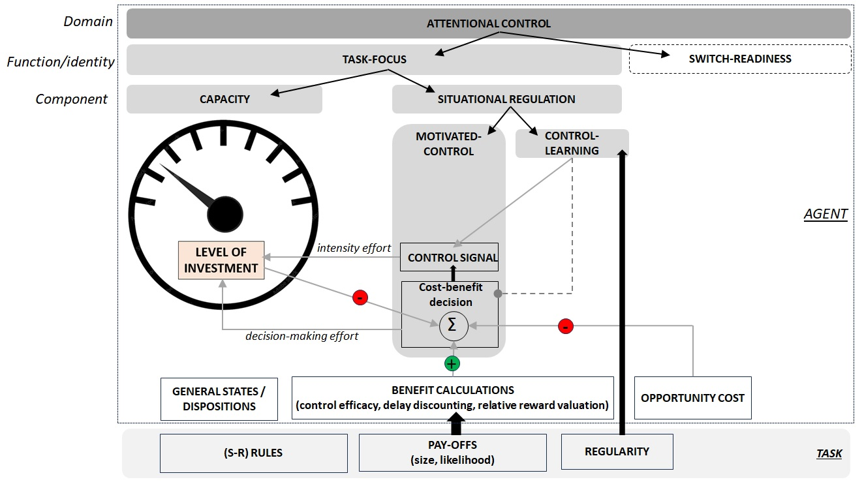
Note. The figure content is explained in detail across the section “Attentional Control” of the main text. The top part of the figure displays a breakdown of attentional control in two major functions (task-focus and switch-readiness). For each, the aim is to signal the optimal level of control investment (intensity) given the current situation (situational regulation), always within the individual bandwidth of control capacity (dial-icon). Here, this is elaborated on only for task-focus (but similar ideas hold for switch-readiness). Motivated-control concerns an effortful cost-benefit decision-making process in which cost (effort and opportunity cost; indicated by minus -sign) and benefit (subjective valuation of task pay-offs; indicated by plus-sign) information is collected and discounted to decide on the intensity of a control signal (the role of investment duration is discussed in main text, but not depicted here). This decision-making process itself requires effort (decision-making effort), and can be circumvented via control-learning (dashed-line: The association between media-multitasking and attentional control, then, has mostly been framed as heavy media-multitaskers displaying relatively low top-down control and more potent bottom-up capturing of attention. damping of effortful decision-making): Regularity in terms of control demands allow the ultimate control signal to be directly probed. Finally, the agent comes with relevant states and dispositions (e.g., stress, restfulness, apathy).
Traditionally, task-focus (cf. stability) and switch-readiness (cf. flexibility) have been considered as opposite ends of a single control spectrum, trading off against each other (stability-flexibility dilemma; Goschke, 2013; Hommel, 2015; Hommel & Colzato, 2017). More recently, however, there has been growing support for the notion that task-focus and switch-readiness are independent control functions (Egner, 2023; Geddert et al., 2025)—such that the intensities of task-focus and switch-readiness are not inversely yoked in an intrinsic manner. Here we (implicitly) adhere to such independence (cf. Figure 1) by discussing task-focus and switch-readiness in relative separation from each other (i.e., as distinct control identities; Shenhav et al., 2013)—but always from the implicit assumption that our claims and proposed mechanisms for one (e.g., task-focus) are also applicable to the other (e.g., switch-readiness). Hence, the core message of what follows is not conditional on the outcome of this ‘opposite ends’ versus ‘distinct functions’ debate.
Control Capacity
An individual’s capacity for task-focus or switch-readiness is typically framed as a limited resource that can be mobilized to carry out instrumental behavior (Holroyd, 2025; Kahneman, 1973; Silvestrini & Gendolla, 2019). If we consider the lower bound of control capacity to serve as a baseline at which task engagement is at its lowest (yet, without disengaging), thus defaulting to the brain’s intrinsic manifold (Holroyd, 2025), more enhanced states of engagement are constrained by the upper bound of control capacity that indicates an individual’s maximal level of investment (cf. dial-icon in Figure 1). Indeed, some people can manage their attention more effectively than others due to genetic, cultural, developmental, or neurological factors (e.g., Hommel & Colzato, 2017), rendering inter-individual differences in this upper bound.
The precise nature of the resource and its constraints is still a matter of debate (e.g., Holroyd, 2025; Kurzban et al., 2013; Musslick & Cohen, 2021; Pessiglione et al., 2025; Shenhav et al., 2017; Silvestrini & Gendolla, 2019). While some models assign all limitations in control investment to motivational status (e.g., Kurzban et al., 2013), most models assume some (structural or systemic) hard upper bound to the level of control that an individual can invest (Shenhav et al., 2017; Pessiglione et al., 2025; Holroyd, 2025). This may be due to, for example, metabolic constraints (e.g., depletable energy or build-up of neurotoxins; Holroyd, 2025; Pessiglione et al., 2025) or (functional) bottlenecks in computational processing (e.g., Musslick & Cohen, 2021; Shenhav et al., 2017). Here we relate control capacity to such hard upper bound in order to keep it strictly distinguished from the later discussed notion of situational regulation (in which control investments are situationally defined and motivationally limited).
The hard upper bound of control investment can be seen as a fixed ‘control budget’ (cf. Thomson et al., 2015). Even with optimal motivation, control capacity is constrained both by limits in moment-to-moment control intensity (how much can be invested at once to meet task difficulty demands) and by the duration of investment (how long one can keep investing; cf. sustained attention). In terms of control intensity, one may ask how well a person can ignore the irrelevant word meaning on an incongruent Stroop trial (task-focus), or how smoothly one can switch between different tasks (switch-readiness) – under conditions of optimal motivation to achieve this. At the same time, one needs to ask how long this person can sustain this intensity (e.g., sustained attention) before defaulting to the intrinsic manifold. Hence, in terms of a physical analogy of muscle strength, capacity relates to both the maximum weight one can lift, and for how long one can lift this. Critically, as this analogy showcases, control intensity may trade-off with duration: the lesser the weight (i.e., the lower the control intensity), the longer one may be able to carry it (Thomson et al., 2015).
Situational Regulation
The intensity and duration with which control is invested, are assumed to be registered in the brain as a cost (Holroyd, 2025; Kool et al., 2017; Musslick & Cohen, 2021; Shenhav et al., 2017; Silvetti et al., 2018). As described by Shenhav et al. (2017), these effort costs may be divided into intrinsic costs (e.g., the above-mentioned metabolic or computational constraints) and opportunity costs (e.g., Kurzban et al., 2013). Effort cost protects the valuable control resource from being wasted: Enhanced states of task-focus and switch-readiness are (experienced as) effortful and, as a result, avoided when possible (Egner, 2023; Ileri-Tayar et al., 2025; Kool et al., 2010). Since the mobilization of attentional resources not only benefits performance, but also carries a cost, efficient attentional control requires the individual to not only have the capacity for task-focus and switch-readiness, but also to optimally exploit these capacities via situationally appropriate up- or down-regulation. Hence, the level of control that is invested at each moment (control intensity), as well as its duration, must be efficiently calibrated to current goals and control demands to prevent unnecessary costs. Such situational regulation characterizes state-of-the-art control models (Egner, 2023; Lieder et al., 2018; Shenhav et al., 2013; Silvetti et al., 2018), and has received ample empirical support via demonstrations of intra-individual variation as a function of motivation (e.g., Padmala & Pessoa, 2011; Otto & Vassena, 2021) and learning (e.g., Crump et al., 2006; Sali et al., 2024).
For example, concerning the role of motivation, both the Stroop congruency effect (Padmala & Pessoa, 2011) and the switch cost (Otto & Vassena, 2021) are known to be modulated by reward. When motivated to perform well by anticipated (higher) reward, attentional control can be enhanced by the individual to perform more effectively (i.e., smaller Stroop congruency effects, smaller switch costs). Hence, rather than constantly taxing their control capacity to the upper limit, individuals make a cost-benefit analysis (see cost-benefit decision in Figure 1) to decide how much control investment is warranted at each moment (cf. Lieder et al., 2018; Shenhav et al., 2013; Silvetti et al., 2018). As an analogy, the capacity to run (physical effort) has clear benefits in getting us from A to B faster. However, as running is intrinsically costly and will eventually wear us out, we need to carefully dose the effort in a situation-appropriate manner (e.g., only start running if this is required to catch the train). Humans do the same for both task-focus and switch-readiness, investing mental effort only when the net expected value of doing so is favorable (e.g., Shenhav et al., 2013; Silvetti et al., 2018). This can be referred to as motivated-control (Figure 1).
Similarly, intra-individual variation in the Stroop congruency effect (Crump et al., 2006) and the switch cost (Sali et al., 2024) has been demonstrated as a of function of control-learning (Figure 1; Abrahamse et al., 2016; Egner, 2023). For example, participants can detect and exploit statistical regularities in the task that are informative about upcoming control demands required for efficient performance (see regularity in Figure 1; Abrahamse et al., 2016). In environments where switching is the rule rather than the exception, a switch cost reduction occurs because the individual learns about the demands and places themself in a more enduring state of enhanced switch-readiness (i.e., list-wide proportion switching effect; Sali et al., 2024). Similarly, when the proportion of incongruent Stroop trials is higher than the proportion of congruent trials, an individual learns this regularity and can up-regulate task-focus to efficiently manage the high demands – resulting in a smaller Stroop congruency effect (i.e., list-wide proportion congruency effect; Braem et al., 2019; Spinelli et al., 2019).
Motivated control and control-learning can be jointly at play, and influence each other. For example, control-learning may allow one to circumvent the effort stemming from the cost-benefit analyses that underlie motivated-control (cf. Lieder et al., 2018). That is, next to control intensity scaling with its internal cost (cf. intensity effort in Figure 1), the shifting between different levels of intensity may incur an effort cost as well (see decision-making effort in Figure 1; Ileri-Tayar et al., 2025) – much like task switching requires effort. Such intensity shifting costs may be the result of the constant need for full analysis of costs and benefits, for monitoring of outcomes, and/or for endogenous implementation of appropriate downstream settings (Lieder et al., 2018; Shenhav et al., 2013). Consequently, people prefer task contexts that require less shifting in control intensity over time (Ileri-Tayar et al., 2025). Taking advantage of environmental regularity that allows one to predict upcoming control demands, then, potentially lowers the burden of the decision and implementation processes that otherwise would be required to constantly calibrate intensity to control demands (Bustos et al., 2024).
Overall, it follows that the theoretical grounding of media-multitasking effects on attentional control should distinguish between media multitasking effects on control capacity versus situational regulation (Figure 1). This distinction has been widely neglected in previous media multitasking research and the snapshot measures of attentional control they employed.
Situational Regulation as an Interaction Between Task and Agent
Both control-learning and motivated-control can steer an agent’s controlled engagement to a task. Such engagement ultimately stems from a continuous interaction between external, task-based factors, and a host of agent-based mental operations and states (see agent versus task in Figure 1). Without aiming for completeness, below we discuss some of these factors.
Control-learning principally relies on the statistical structure of the task or environment (see regularity in Figure 1; Abrahamse et al., 2016): Without regularity, the cognitive system lacks the scaffolding needed to identify and internalize predictive cues that signal when and how much control should be invested. This task-based factor is then met by several agent-based factors in guiding control investments. For example, control-learning is often modeled with reinforcement learning frameworks, which include a learning rate that determines how quickly control-relevant information is learnt (e.g., Jiang et al., 2014). Because the relevant information for anticipating control demands may be accrued over various timescales, the learning rate itself must be adaptable to these temporal dynamics–a property referred to as learning rate malleability (Jiang et al., 2014; Simoens et al., 2025). These state parameters determine the effectiveness of control-learning in a specific context.
For motivated-control, relevant task-based factors include task difficulty and pay-off structure. Hence, tasks differ both in the extent to which stimulus-response (S-R) rules (see Figure 1) require processes that deviate from default processing (for example, due to the presence of interference or time constraints), and in the size and likelihood of the pay-offs (see Figure 1) that they afford in terms of rewards (e.g., monetary gains, social gains, course credit, learning progress) and punishment. These task-based factors are then again met by agent-based factors to determine the level of control investment (see Figure 1). For example, to determine the overall value that can be reaped from a task, pay-off information is integrated with the agent’s perceived efficacy of controlled engagement (i.e., will enhanced control intensity increase the likelihood of pay-off?; Frömer et al., 2021), delay discounting of reward (Myerson & Green, 1995), and the agent’s perspective on the current reward landscape that determines subjective reward valuation (Otto & Vassena, 2021).
Indeed, these cost-benefit analyses are themselves affected by general states and dispositions that an agent is in (see Figure 1). For example, states of mental fatigue can increase the perceived cost of mental effort and thus affect motivated-control investments (Matthews et al., 2023; Müller et al., 2021). This renders factors such as sleep and stress relevant for attentional control (see below). Moreover, pay-off processing may be influenced by states of stress and depression, as these are related to decreased reward sensitivity (Lamontagne et al., 2022). Finally, motivated-control may cease to drive engagement in more general dispositions of reduced motivation, such as apathy (a generally reduced desire to engage in activities; Husain & Roiser, 2018).
In sum, situational regulation derives from a broad interplay between internal (agent-based) and external (task-based) factors (cf. Figure 1), which should be considered when aiming for an updated research agenda in the field of media-multitasking effects on attentional control.
Research Agenda
We have argued that previous work on media-multitasking effects has been too narrowly focused on (an underspecified notion of) top-down control as a trainable capacity that can be captured in snapshot measures of control – while neglecting relevant intra-individual variation. In this section, we lay out the theoretical and methodological foundations of a research agenda designed to address these gaps. The central question guiding this research agenda is: How can general patterns of media-multitasking generate sustained effects on task-focus and/or switch-readiness as measured in laboratory tasks1? We hypothesize potential direct or indirect mechanisms2 that should be explored for their feasibility in future cross-sectional studies (see Table 2 for an overview), and, where promising, followed up with causal research in later steps. Rather than offering an exhaustive list, we aim to illustrate how attentional control theory can inform new directions in reasoning about media-multitasking effects.
Critically, while we focus on attentional control, these proposed mechanisms also hold implications for the corresponding assessment of media-multitasking. Specifically, the composition of a self-report assessment of media-multitasking – which is still the gold standard in the field (cf. Parry & Fisher, 2025)—should be customized to the specific aspect of attentional control being targeted, asking the question about what type(s) and/or aspects of media-multitasking behavior are theoretically predicted to affect this specific aspect of attentional control. Such theory-driven customization will further drive dedicated tests of potential mechanisms underlying the association between media-multitasking and attentional control.
Control Capacity (Direct Impact)
How might media-multitasking train the agent into sustained changes to the upper capacity bound of attentional control? Theorizing on the potential for training of control capacity is generally hampered by the unclear nature of the resource as well as of the limitations imposed on it (see above). One may speculate that media-multitasking results in metabolic constraints to be structurally tightened or relaxed, or in structural changes to the computational architecture in terms of managing representational overlap (cf. Musslick & Cohen, 2021; Shenhav et al., 2017), but, as far as we are aware, support for the plausibility of such trainability is lacking. Importantly, dedicated control training studies have generally failed to observe clear transfer to non-trained control tasks (e.g., Melby-Lervåg et al., 2013; Shipstead et al., 2012), suggesting that training is highly task-specific and does not apply at the level of a more general resource. Hence, the basis for predicting direct media-multitasking effects on the (hard) upper bound of control capacity, is delicate both theoretically and empirically.
Table 2. A Set of Hypotheses About Sustained Impact of Media-Multitasking on Attentional Control.
|
Hypothesis |
Target |
Impact |
Potential explanation |
Example prediction |
|
Capacity |
Control capacity |
Direct |
MM (un)trains the upper bound of control capacity |
MMI correlates with control measures obtained under high on-task motivation |
|
Control capacity |
MM (un)trains the upper bound of control capacity |
MMI correlates with the time-span that people can sustain control under high on-task motivation |
||
|
|
Situational Regulation |
|
|
|
|
Online-vigilance
|
Motivated control: Cost |
Direct |
MM generates chronic media-related goals that elevate the cost of control for primary task |
Online vigilance mediates between MMI and control measures obtained under high on-task motivation |
|
Mental-fatigue
|
Motivated control: Cost |
Indirect |
Cost of control is elevated due to chronic mental fatigue deriving from MM behavior |
Measures of fatigue-driving factors (e.g., sleep quality, stress) mediate between MMI and control measures obtained under high on-task motivation |
|
Control-benefit |
Motivated control: Benefit |
Direct |
MM affects primary task engagement via perceived efficacy of control, delay discounting, or relative reward valuation |
Efficacy: Control investments differ between performance-contingent versus performance-non-contingent rewards, and more so for light than heavy media-multitaskers. |
|
General-dispositions |
Motivated-control |
Indirect |
MM chronically affects motivation for activities in a non-selective manner |
Motivational disposition measures mediate between MMI and control measure |
|
Control-learning
|
Control-learning |
Direct |
High volatility of the MM environment gradually weakens the agent’s ability to adaptively calibrate the learning rate |
List-wide proportion congruency or switching effects correlate with MMI (controlling for online vigilance) |
|
Degraded-regularity |
Control learning |
Indirect |
Online vigilance interferes with the learning of regularities in the control task |
Online vigilance mediates between list-wide proportion congruency or switching effects and MMI |
|
Note. Relevant control variables are not explicitly listed. MM = media-multitasking; MMI = media-multitasking index. |
||||
Nevertheless, media-multitasking research may provide a promising angle from which to explore the (still intuitive) notion of a trainable control capacity (capacity hypothesis; Table 1), which can be approached in terms of control intensity and duration (i.e., time spent on task). To accurately test the capacity hypothesis in terms of control intensity, task-focus or switch-readiness need to be measured in designs that maximally induce on-task motivation—to reduce individual differences that are related to motivation rather than control capacity (cf. Cecutti et al., 2021). Previous work has failed to do so by using classical ‘snapshot’ control measures in which situational regulation—and specifically motivated-control – is not accounted for. For example, if one predicts from training logic that extensive media-multitasking will affect the upper bound of switch-readiness capacity, one needs a task-switching task that includes incentives for good performance to increase the willingness to invest effort (i.e., enhance control). Inspired by Ham et al. (2022), this can be achieved by examining switch costs as a function of increasing reward. Stepwise increases in reward size across blocks will allow researchers to determine the individual’s maximal capacity to invest control, represented by the moment that the switch cost no longer reduces with reward increase. This minimum-sized switch cost should then be correlated with media-multitasking scores to test for the plausibility of the mechanism. Similarly, studies focusing on the upper bound of task-focus may apply the same motivation induction to a conflict task such as the Stroop task (Ham et al., 2022).
Capacity bounds are a matter not only of control intensity, but also of duration (e.g., Shenhav et al., 2017). The latter has been considered in measures of sustained attention taken from continuous performance tasks such as the Gradual Onset Continuous Performance Task (grad-CPT; Esterman et al., 2013) or related tasks (e.g., SART; Robertson et al., 1997). Measuring task-focus after prolonged task commitment may allow one to determine the moment that an agent defaults to the intrinsic manifold (i.e., floor effects in control investments). Critically, this again should be investigated under high motivation in order to distinguish capacity effects from motivationally induced effects. Indeed, performance incentives have been shown to delay individuals from reaching their low in sustained attention (Esterman et al., 2014). Since sustained attention tasks have shown relatively robust correlations with media-multitasking indices in the past (e.g., Shin et al., 2024; Parry & le Roux, 2021), we thus recommend that future studies use continuous performance tasks under high-on task motivation when targeting task-focus capacity. Similar reasoning can be applied to task-switching tasks to study switch-readiness capacity.
Critically, from a potential trade-off between control intensity and duration (cf. Thomson et al., 2015), the most ecological manner for determining control capacity (and its association to media-multitasking) would be an experimental design that considers both. For example, in the case of task-focus, one could present participants with a substantially prolonged version of the Stroop task (under incentivized, high on-task motivation) and explore the association between the Stroop task performance and media-multitasking as a function of both the Stroop congruency effect (control intensity) and its development over time (duration). Similarly, for switch-readiness, an extended task-switching task can be used. The challenge, however, would be to find a way to combine the findings for intensity and duration in order to come to an integrated conclusion as to control capacity.
Finally, next to actively manipulating motivation, the study of control capacity needs to consider confounding variables that are independently related to both media-multitasking and attentional control. For example, impaired sleep (e.g., Baumgartner, 2022; Hale et al., 2024) and/or stress (e.g., Freytag et al., 2021; Xu et al., 2022) as the result of media-multitasking could undermine an individual’s ability to perform up to control capacity, even when effort incentives are present. If relations between media-multitasking and control measures are driven by such mediating variables, their interpretation would be fundamentally different from training logic. Future research should determine these potential confounds and control for their impact when exploring control capacity.
Overall, we argue that – if it can be theoretically grounded – a new generation of correlational studies is needed to test the capacity hypothesis, assessing the intensity and/or duration of control under high motivation while controlling for variables that can mediate the relationship between media-multitasking and control (e.g., stress, sleep).
Situational Regulation
The systematic neglect of intra-individual variation in control has not only resulted in a methodologically flawed exploration of media-multitasking effects on control capacity, but has also prevented theoretical discussions and empirical tests of the possibility that situational regulation itself can be impacted by media-multitasking. Indeed, whereas predictions for control capacity may currently not be so well-grounded theoretically and empirically (see above), situational regulation should be considered intrinsically malleable—rendering motivated-control and control-learning plausible targets of sustained media-multitasking effects. When approaching sustained impact of media-multitasking through the lens of situational regulation, we are looking for candidate mechanisms via which media-multitasking behavior can (directly or indirectly) alter the main parameters underlying situational regulation in relatively enduring ways. Below we discuss several such candidate mechanisms (summarized in Table 2).
Online Vigilance (Direct Impact)
Rather than direct impact on control capacity at the structural level (i.e., a change in the hard upper bound of control capacity), media-multitasking may have sustained and direct influence on the cost of control and thus on available control capacity. Given a fixed level of benefit (rewards) to be reaped from a primary task, then, this may still systematically reduce the intensity or duration of control investments in the primary task due to chronically affected cost-benefit analyses.
This may occur in cases of high online vigilance (online vigilance hypothesis; Table 1). Media-related activities are often instantly followed by gratification (e.g., social connection, social validation, curiosity fulfillment, entertainment), and, through constant reinforcement, chronic media-related goals may gradually form in the user’s mind (cf. Hommel, 2022; Oberauer, 2024). As such, while performing a primary task (and holding active its corresponding goal), media users may systematically carry with them additional active goals related to media activities – even when not physically engaged with related devices. This has been coined ‘online vigilance’ (Reinecke et al., 2018), and implies that media-related stimuli are not mere ‘distractors’ but actually stimuli constantly worthy of checking for (cf. Wiradhany et al., 2021). Since people multitask primarily because they entertain multiple active goals at the same time (Szumowska and Kruglanski, 2022), online vigilance may thus sustain mental modes of media-multitasking even when formally only occupied with the primary task. This comes with mental effort costs that are relatively enduring since online vigilance is a chronic state (i.e., trait-like).
Critically, the pressure of online vigilance may be especially strong for heavy media-multitaskers. First, since media-multitasking is increasingly the dominant type of media consumption (e.g., Toth et al., 2025), heavy media-multitaskers are more engaged with media in general. Second, media-visits occurring under multitasking conditions may be especially driven by the search for instant gratification (Wang & Tchernev, 2012), such that media-multitasking episodes are more strongly reinforced than non-multitasking media visits. As a result, media-multitasking reinforces online vigilance, and these have indeed been observed to be associated with each other (le Roux & Parry, 2022; Reinecke et al., 2018).
This above proposal can be related to various other frameworks. For example, online vigilance can be reframed in terms of opportunity cost (Kurzban et al., 2013; Shenhav et al., 2017). That is, the chronic goal to pursue specific media-related tasks renders an enduring, systematically present opportunity cost (e.g., Shin & Murphy, 2025)—since engagement in a primary task (e.g., a Stroop task in the lab) forgoes the opportunity of reaping the rewards of alternative, media-related tasks that are constantly within reach. This is in line with studies showing that being aware of alternative activities results in larger opportunity costs for the current activity (Struk et al., 2020; Tam & Inzlicht, 2024). As another example, the online-vigilance hypothesis may also be related to value-driven attentional capture (cf. tripartite model of attentional selection; Awh et al., 2012). Specifically, media use and the instant gratification it affords, may ‘enrich’ our environment with a higher density of stimuli that carry a strong reward history, thus enhancing the constant pressure of attentional capture on the agent.
Empirically, the online vigilance hypothesis could be approached, for example, by assessing the extent to which online vigilance (e.g., Online Vigilance Scale; Reinecke et al., 2018)—as a proxy for the extent that media-related activities are chronically active in mind—mediates the relationship between media-multitasking and control as measured under high on-task motivation (see above). This can be done for both task-focus and switch-readiness.
Chronic Mental Fatigue (Indirect Impact)
Mental fatigue results in a generic avoidance of mental effort, and can thus be understood as a relatively sustained elevation in the cost of control (e.g., Pessiglione et al., 2025). As such, variables that mediate between media-multitasking and chronic states of mental fatigue can drive indirect impact (mental-fatigue hypothesis; Table 1). For example, impaired sleep has been related both to media consumption and media-multitasking (e.g., Ahmed et al., 2025; Baumgartner, 2022; Hale et al., 2024), and to chronic mental fatigue (e.g., Ishii et al., 2014; Kayser et al., 2022), grounding the hypothesis that media-multitasking may chronically elevate the cost of control through its direct impact on sleep quality and/or quantity. A similar type of reasoning can be applied to psychosocial stressors. Media-multitasking may result in more intense and/or more extensive stress sources (e.g., Freytag et al., 2021; Xu et al., 2022) that drive states of chronic mental fatigue (e.g., Kocalevent et al., 2011; Kunasegaran et al., 2023). The relationship between media-multitasking and stress may be further mediated by, for example, online vigilance (Hefner & Vorderer, 2016; Petkovski et al., 2025). Indeed, sleep and stress may even team up and mutually enhance each other (e.g., Âkerstedt, 2006) in driving indirect impact. It is important to note, however, that support for the above pairwise associations of media-multitasking with sleep health and psychosocial stress for a large part stem from cross-sectional studies themselves—thus introducing further causality questions into the chain of impact. Overall, besides rendering sleep and stress measures as relevant control variables (see above), in their relationship to chronic mental fatigue they may provide an indirect yet interesting mechanism for sustained media-multitasking effects on attentional control. This predicts that sleep and stress measures mediate the relationship between media-multitasking and control measured under high on-task motivation.
Control-Benefit Analyses (Direct Impact)
In motivated-control, the brain decides when and how much control to invest based on ongoing cost-benefit analyses (Shenhav et al., 2013; Silvetti et al., 2018). Could media-multitasking sustainedly affect primary task motivation by ‘training’ the agent’s brain into altered benefit calculations (control-benefit hypothesis; Table 1)? Theoretically grounded mechanisms may exist for delay discounting, control efficacy, and relative reward valuation (Figure 1).
For example, the valuation of a reward decreases when it follows the instrumental behavior with a delay (delay discounting), and this delay-discounting parameter may be affected by media-multitasking. Through its tendency to yield immediate gratification (e.g., a “like” or entertaining video clip), media-multitasking gradually conditions the brain to seek out small and immediate rewards. This renders the delayed, larger rewards of focused work (e.g., studying for an exam, or performing well on an experimental task for course credit) to carry lower expected value, reducing the general willingness to invest high control for longer-term goals. This would imply a sustained move towards instant gratification in heavy media-multitaskers (cf. Schutten et al., 2017). Empirically, this would predict that measures of delay discounting (e.g., discounting rate; Madden et al., 2003; Schutten et al., 2017) mediate the relationship between media-multitasking and (snapshot) control measures taken from (task-focus or switch-readiness) tasks in which all participants pursuit the same delayed reward (e.g., course credit needed to pass a course)—while controlling both for intrinsic gratifications (e.g., mastery of the task) and other motivation-relevant factors (see below).
As another example, media-multitasking may impact an agent’s estimated benefits of increasing control (i.e., reduced perceived efficacy of control; Frömer et al., 2021). Through frequent engagement with tasks and processing of (media-related) stimuli outside the scope of the primary task, media-multitasking may lead to relatively shallow engagement with primary tasks (e.g., reduced reflection due to online vigilance). This may obscure the detection of associations between control intensity and performance on primary task, and such systematically reduced credit assignment may gradually weaken the agent’s sustained efficacy beliefs. This can be investigated empirically with control tasks (e.g., Stroop task or task-switching task) in which expectations of reward are dissociated from efficacy—for example by providing equal-sized rewards in a performance-contingent versus performance-non-contingent manner (cf. Frömer et al., 2021). Sustained media-multitasking effects on perceived control efficacy would predict that performance differences between trials with performance-contingent versus performance-non-contingent rewards is larger for light (as compared to heavy) media-multitaskers.
Finally, it has been demonstrated that reward influences (motivated) control investments based on current reward size relative to other proximal rewards (Otto & Vassena, 2021). This suggests that motivation to exert control on primary tasks in daily life may diminish when individuals are psychologically engaged with highly rewarding media activities, even in the absence of physical interaction with media devices (i.e., psychological connectedness). Specifically, having constantly in mind the size of rewards that are within reach by switching away from the primary task to media-related activities, may set a chronic reference point to which primary task rewards are compared—potentially devaluing the latter in a sustained manner. In support of this, it has been shown that the motivation for controlled engagement with a primary task (e.g., doing homework) trades off with the tendency for (task-unrelated) media-multitasking (e.g., Calderwood et al., 2014). Indeed, this comes close to the above-described online-vigilance hypothesis—but now framed in terms of (reduced) benefits rather than (increased) opportunity costs. The feasibility of this mechanism can be tested cross-sectionally by assessing media-multitasking and (snapshot) performance on a control-demanding task (e.g., Stroop or task-switching task), and explore mediation of their relationship by on-task motivation (e.g., a scale that taps into Stroop task-specific motivation).
General Dispositions (Indirect Impact)
Rather than directly affecting the computational cost-benefit decision process underlying primary task engagement, media-multitasking may also have sustained but indirect effects via affective or motivational dispositions that reduce the tendency to commit to activities generally (general-dispositions hypothesis; Table 1). Several studies indicate that media-multitasking is associated with reduced joy in primary activities (Oviedo et al., 2015; Xu & David, 2018), and through heavy media-multitasking and ongoing psychological connectedness to task-unrelated media activities, this may develop into more general, enduring motivational deficits (e.g., the inability to experience pleasure from previously rewarding activities). Indeed, this fits with studies showing media-multitasking associations with stress, anxiety, and depression (e.g., Becker et al., 2013; Reinecke et al., 2017)—all of which are related to sustainedly reduced drives towards task engagement (e.g., apathy, amotivation, anhedonia; Grahek et al., 2019; Pizzagalli, 2014; Rizvi et al., 2016). With attentional control known to be affected by stress (e.g., Liston et al., 2009), anxiety (e.g., Hayes et al., 2009), and depression (e.g., Grahek et al., 2019), media-multitasking may have a sustained impact on attentional control through impaired motivation for task engagement in general. Testing the feasibility of such indirect mechanism requires assessment of media-multitasking, a (snapshot) control measure, and general affective and/or motivational dispositions (e.g., the Anhedonia Scale for Adolescents; Watson et al., 2021). If general motivation for task commitment is systematically reduced, it would be expected that these disposition measures mediate the association between media-multitasking behavior and attentional control.
Control-Learning (Direct Impact)
As mentioned above, models on control-learning typically include an adaptive learning rate (Jiang et al., 2014; Simoens et al., 2025). Such a malleable, self-adapting learning rate allows control-learning to be effective across non-stationary environments. Critically, this malleability also opens the door for media-multitasking effects (control-learning hypothesis; Table 1): Both the default learning rate and the adaptive calibration of learning rates to specific contexts, are potentially affected by media-multitasking. For example, through actual or psychological connectedness with media sources beyond the primary task, the media ecology of heavy media-multitaskers may signal a constant state of high-volatility to the brain. Individuals may frequently abandon tasks before completion or respond to stimuli that are irrelevant to their current primary task goal (e.g., responding to notifications while browsing or working), interfering with rules or consistent feedback available in primary tasks. It can be hypothesized a) that such ecologies hinder the process of fine-tuning the learning rates to relevant feedback on the primary task, and b) that systematically inhabiting such ecologies gradually ‘untrains’ the agent’s ability to optimally adapt the learning rate. The latter training prediction can be tested, for example, using list-wide proportion manipulations. One could determine the difference in the switch cost between blocks with high versus low proportions of switches (cf. Sali et al., 2024). This difference score can then be correlated with a media-multitasking index. Similarly, for task-focus, a list-wide proportion congruency manipulation can be used in a conflict task (e.g., Stroop task; cf. Spinelli et al., 2019). These tests of the direct impact of media-multitasking on control-learning should control for indirect effects of online vigilance (see below).
Degraded Regularity (Indirect Impact)
The indirect impact of media-multitasking on control-learning may also be considered. It is known that random events interspersing a regular pattern hinder the learning of such regularity (Parshina et al., 2018). The constant interspersing of distractions associated with media-multitasking—that is, online vigilance—may similarly break the regularity that is formally available in specific non-media, control-demanding tasks. As a result, control-learning processes cannot optimally detect and exploit the available regularity (degraded-regularity hypothesis; Table 1). For example, a lecturer may change their intonation at moments in the lecture to stress that relevant information is being presented or discussed, and under regular circumstances a student may be able to pick up on that and enhance task-focus when such intonation is encountered. However, constant cognitive orientation to media-related information during the lectures may undermine the detection of such regularities. As online vigilance is a relatively chronic state that can be boosted by media-multitasking, control-learning may thus be hindered in sustained manners even when its intrinsic parameters remain unaffected. Testing for this indirect impact requires measures of media-multitasking, online vigilance, and control-learning (i.e., list-wide proportion switching or congruency effects). Yet, rather than controlling for online vigilance as per the direct impact described above, here online vigilance is targeted as a mediator in the relationship between media-multitasking and control-learning indices.
Overall, we have above outlined several candidate mechanisms via which media-multitasking may (directly or indirectly) affect situational regulation in a sustained manner. Whereas this list of mechanisms is far from exhaustive, far from comprehensive in detail (e.g., lacking an explicit focus on duration of control investments), and requiring constant updating and/or adjustment based on alternative perspectives and/or future advances in the field, we hope the list will inspire a new generation of studies targeting specifically situational regulation.
Conclusion
Our conclusions can be summarized in three related take-home messages. First, by comparing the field of media-multitasking effects to state-of-the-art attentional control theory, we have demonstrated that the field has been adopting a too narrow focus on attentional control as a static capacity that can be captured in snapshot measures of control. We argue that this suboptimal focus has played a major role in the lack of robust and consistent findings in previous work on media-multitasking effects (Baumgartner et al., 2024; Parry & le Roux, 2021; Wiradhany & Nieuwenstein, 2017). Second, we argue that state-of-the-art attentional control theory probes the field to consider intra-individual variation in attentional control stemming from control-learning and motivated control (situational regulation). Third, we have theorized on a (non-exhaustive) set of potential direct or indirect mechanisms of impact that follow from a deep consideration of intra-individual variation in attentional control. These mechanisms of impact should be explored in a new generation of cross-sectional studies, such that these can steer dedicated follow-up by longitudinal randomized trials and/or intervention studies to confirm causality. Indeed, such follow-up would require a range of further empirical challenges to be addressed, such as questions about the persistence of media-multitasking effects after an intervention has been implemented (determining, among others, the minimum duration of a media-multitasking intervention required to validly test its effects on attentional control). Until the outcomes of such efforts are known, the field remains far off from definite answers on the potential sustained impact of media-multitasking on attentional control, and on the question about whether, when, and for whom remedial interventions should be considered.
Footnotes
1 The same logic holds for self-report measures of attentional control.
2 Even though the direct-indirect distinction is not always black-and-white, we feel it provides a useful nuance in the structuring of mechanisms.
Conflict of Interest
The authors have no conflicts of interest to declare.
Use of AI Services
The authors declare they have not used any AI services to generate any part of the manuscript or data.
Data Availability Statement
No data were collected or analyzed for this study.
Acknowledgement
The authors wish to thank Ana María González Martín and Eliana Vassena for their helpful comments on earlier drafts of the current manuscript.


This work is licensed under a Creative Commons Attribution-ShareAlike 4.0 International License.
Copyright © 2026 Elger Abrahamse, Douglas Parry, Daniel le Roux, Susanne Baumgartner