
Adolescents’ social media use and conspiracy beliefs: The moderating role of rational and experiential thinking
Vol.20,No.4(2026)
Magdalena Iwanowska
 Rosana Stan
Anna Maria Zawadzka
Rosana Stan
Anna Maria Zawadzka
A growing number of teenagers use social media, where they are frequently exposed to misinformation, including conspiracy theories. This cross-sectional study examines the relationships between social media use (with a focus on overall frequency and information-seeking use), tendency toward rational and experiential thinking, and conspiracy beliefs among adolescents from Romania and Poland. We hypothesized that while social media tends to spread conspiracy theories, such information is most likely to translate into beliefs among those with lower levels of rational thinking. The total sample comprised 561 participants (Mage = 17.27, SDage = 0.79). The results indicated that social media use for information-seeking—but not the frequency of social media use—positively predicts conspiracy beliefs among adolescents. However, tendencies toward both rational and experiential thinking moderated these relationships: the positive associations between social media use and conspiracy beliefs were significant only among adolescents with low or medium levels of rational thinking (for both frequency of use and information-seeking use), as well as among those with low or medium levels of experiential thinking (for information-seeking use only). We also found moderating effects for other purposes of social media use, specifically self-presentation and entertainment. In general, our study shows that the tendency toward rational thinking moderates the relationship between more purposes of social media use and conspiracy beliefs, suggesting that rational-analytical processing provides broader protection across different online activities.
social media use; conspiracy beliefs; rational thinking; experiential thinking; adolescents
Magdalena Iwanowska
Institute of Psychology, University of Gdansk
Magdalena Iwanowska, PhD, is an assistant professor at the Department of Economic and Organizational Psychology, Institute of Psychology, University of Gdansk. She specializes in media and communication psychology and is particularly interested in analyzing how social media shapes adolescents' values, aspirations, and well-being.
Rosana Stan
Department of Psychology, University of Oradea
Rosana Stan is a PhD at the University of Oradea, Romania. Her research interests include the application of Self-Determination Theory to explain psychological phenomena such as organizational commitment and well-being at work in adults, as well as bullying behaviors and the development of a conspiracy mindset in children and adolescents.
Anna Maria Zawadzka
Institute of Psychology, University of Gdansk
Prof. Anna Maria Zawadzka is a full professor in the Institute of Psychology at the University of Gdańsk and Head of the Department of Economic and Organizational Psychology. Her research areas include values in consumer culture versus well-being, happiness, and good interpersonal relationships; the individual and social determinants of materialism in teenagers; values, work, and well-being; and consumer behavior.
Allington, D., Duffy, B., Wessely, S., Dhavan, N., & Rubin, J. (2021). Health-protective behaviour, social media usage and conspiracy belief during the COVID-19 public health emergency. Psychological Medicine, 51(10), 1763–1769. https://doi.org/10.1017/S003329172000224X
Astapova, A., Colăcel, O., Pintilescu, C., & Scheibner, T. (Eds.). (2020). Conspiracy theories in Eastern Europe: Tropes and trends. Routledge.
Biddlestone, M., Green, R., Douglas, K. M., Azevedo, F., Sutton, R. M., & Cichocka, A. (2025). Reasons to believe: A systematic review and meta-analytic synthesis of the motives associated with conspiracy beliefs. Psychological Bulletin, 151(1), 48–87. https://doi.org/10.1037/bul0000463
Blakemore, S.-J., & Mills, K. L. (2014). Is adolescence a sensitive period for sociocultural processing? Annual Review of Psychology, 65, 187–207. https://doi.org/10.1146/annurev-psych-010213-115202
Bordeleau, J., & Stockemer, D. (2024). On the relationship between age and conspiracy beliefs. Political Psychology, 46(5), 931–946. https://doi.org/10.1111/pops.13044
Branje, S. (2022). Adolescent identity development in context. Current Opinion in Psychology, 45, Article 101286. https://doi.org/10.1016/j.copsyc.2021.11.006
Brislin, R. W. (1970). Back-translation for cross-cultural research. Journal of Cross-Cultural Psychology, 1(3), 185–216. https://doi.org/10.1177/135910457000100301
Bucknell Bossen, C., & Kottasz, R. (2020). Uses and gratifications sought by pre-adolescent and adolescent TikTok consumers. Young Consumers: Insight and Ideas for Responsible Marketers, 21(4), 463–478. https://doi.org/10.1108/YC-07-2020-1186
Byrne, A., Martin, D., Jones, C., Galbraith, N., & Mercer, T. (2024). Conspiracy theory beliefs in the adolescent population: A systematic review. Journal of Adolescence, 96(5), 925–939. https://doi.org/10.1002/jad.12316
Byrne, B. M. (1994). Structural equation modelling with EQS and EQS/Windows: Basic concepts, applications, and programming. Sage.
Byrne, B. M., & Stewart, S. M. (2006). Teacher's corner: The MACS approach to testing for multigroup invariance of a second-order structure: A walk through the process. Structural Equation Modeling: A Multidisciplinary Journal, 13(2), 287–321. https://doi.org/10.1207/s15328007sem1302_7
Campbell, S. W., & Hawkins, I. (2025). Social (media) psychology of the "news-finds-me" perception: Habits, mindsets, and beliefs. Journal of Computer-Mediated Communication, 30(5), Article zmaf010. https://doi.org/10.1093/jcmc/zmaf010
Chen, S., Xiao, L., & Kumar, A. (2022). Spread of misinformation on social media: What contributes to it and how to combat it. Computers in Human Behavior, 141, Article 107643. https://doi.org/10.1016/j.chb.2022.107643
Cheung, G. W., & Rensvold, R. B. (2002). Evaluating goodness-of-fit indexes for testing measurement invariance. Structural Equation Modeling: A Multidisciplinary Journal, 9(2), 233–255. https://doi.org/10.1207/S15328007SEM0902_5
Cinelli, M., De Francisci Morales, G., Galeazzi, A., Quattrociocchi, W., & Starnini, M. (2021). The echo chamber effect on social media. Proceedings of the National Academy of Sciences of the United States of America, 118(9), Article e2023301118. https://doi.org/10.1073/pnas.2023301118
Cinelli, M., Etta, G., Avalle, M., Quattrociocchi, A., Di Marco, N., Valensise, C., Galeazzi, A., & Quattrociocchi, W. (2022). Conspiracy theories and social media platforms. Current Opinion in Psychology, 47, Article 101407. https://doi.org/10.1016/j.copsyc.2022.101407
Cole, M. (1990). Cognitive development and formal scooling: The evidence from cross-cultural research. In Luis C. Moll (Ed.), Vygotsky and education: Instructional implications and applications of sociocultural psychology. Cambridge University Press.
Crockett, L. J., Carlo, G., & Schulenberg, J. E. (Eds.). (2023). APA handbook of adolescent and young adult development. American Psychological Association. https://doi.org/10.1037/0000298-000
Douglas, K. M., Sutton, R. M., & Cichocka, A. (2017). The psychology of conspiracy theories. Current Directions in Psychological Science, 26(6), 538–542. https://doi.org/10.1177/0963721417718261
Douglas, K. M., Uscinski, J. E., Sutton, R. M., Cichocka, A., Nefes, T., Ang, C. S., & Deravi, F. (2019). Understanding conspiracy theories. Political Psychology, 40(S1), 3–35. https://doi.org/10.1111/pops.12568
Enders, A. M., Uscinski, J. E., Seelig, M. I., Klofstad, C. A., Wuchty, S., Funchion, J. R., Murthi, M. N., Premaratne, K., & Stoler, J. (2021). The relationship between social media use and beliefs in conspiracy theories and misinformation. Political Behavior, 45(2), 781–804. https://doi.org/10.1007/s11109-021-09734-6
Epstein, S. (1994). Integration of the cognitive and the psychodynamic unconscious. American Psychologist, 49(8), 709–724. https://doi.org/10.1037/0003-066X.49.8.709
Epstein, S. (2003). Cognitive-experiential self-theory of personality. In T. Millon & M. J. Lerner (Eds.), Handbook of psychology: Personality and social psychology (Vol. 5, pp. 159–184). John Wiley & Sons, Inc. https://doi.org/10.1002/0471264385.wei0507
Epstein, S., & Epstein, M. L. (2016). An integrative theory of psychotherapy: Research and practice. Journal of Psychotherapy Integration, 26(2), 116–128. https://doi.org/10.1037/int0000032
Eurostat (2023, July 14). 96% of young people in the EU uses the internet daily. https://ec.europa.eu/eurostat/en/web/products-eurostat-news/w/ddn-20230714-1
Fletcher, J. M., Marks, A. D. G., & Hine, D. W. (2012). Latent profile analysis of working memory capacity and thinking styles in adults and adolescents. Journal of Research in Personality, 46(1), 40–48. https://doi.org/10.1016/j.jrp.2011.11.003
Hayes, A. F. (2022). Introduction to mediation, moderation, and conditional process analysis: A regression-based approach. The Guilford Press.
Hermann, E., Morgan, M., & Shanahan, J. (2023). Cultivation and social media: A meta-analysis. New Media & Society, 25(9), 2492–2511. https://doi.org/10.1177/14614448231180257
Hornsey, M., Imuta, K., & Bierwiaczonek, K. (2025). Social and cognitive factors shaping conspiracy theorizing across the life course. Journal of Experimental Psychology: General, 155(1), 54–72. https://doi.org/10.1037/xge0001847
Hu, L., & Bentler, P. M. (1999). Cutoff criteria for fit indexes in covariance structure analysis: Conventional criteria versus new alternatives. Structural Equation Modeling, 6(1), 1–55. https://doi.org/10.1080/10705519909540118
Imhoff, R., & Lamberty, P. K. (2017). Too special to be duped: Need for uniqueness motivates conspiracy beliefs. European Journal of Social Psychology, 47(6), 724–734. https://doi.org/10.1002/ejsp.2265
Iwanowska, M. (2024). The relationships between social media use and teenagers’ materialism and activism [Doctoral dissertation, University of Gdańsk]. University of Gdańsk Repository. https://repozytorium.bg.ug.edu.pl/info/phd/UOG413ab0ff213c444794a873e7ad8a9adc/
Jetten, J., Zhao, C., Álvarez, B., Kaempf, S., & Mols, F. (2023). Trying to unplug for 24 hours: Conspiracy mentality predicts social isolation and negative emotions when refraining from internet use. Advances in Psychology, 1(1), https://doi.org/10.56296/aip00003
Jolley, D., Douglas, K. M., Skipper, Y., Thomas, E., & Cookson, D. (2021). Measuring adolescents’ beliefs in conspiracy theories: Development and validation of the Adolescent Conspiracy Beliefs Questionnaire (ACBQ). British Journal of Developmental Psychology, 39(3), 499–520. https://doi.org/10.1111/bjdp.12368
Jolley, D., Marques, M. D., & Cookson, D. (2022). Shining a spotlight on the dangerous consequences of conspiracy theories. Current Opinion in Psychology, 47, Article 101363. https://doi.org/10.1016/j.copsyc.2022.101363
Kahneman, D. (2011). Thinking, fast and slow. Farrar, Straus and Giroux.
Klein, C. R., & Klein, R. (2025). The extended hollowed mind: Why foundational knowledge is indispensable in the age of AI. Frontiers in Artificial Intelligence, 8, Article 1719019. https://doi.org/10.3389/frai.2025.1719019
Krekó, P. (2020, June 9). The drivers of disinformation in Central and Eastern Europe and their utilization during the pandemic (Policy Brief). Globsec Policy Brief. https://www.globsec.org/sites/default/files/2020-06/Drivers-of-disinformation-in-Central-and-Eastern-Europe.pdf
Lavery, M. R., Acharya, P., Sivo, S. A., & Xu, L. (2019). Number of predictors and multicollinearity: What are their effects on error and bias in regression? Communications in Statistics – Simulation and Computation, 48(1), 27–38. https://doi.org/10.1080/03610918.2017.1371750
Lebrun, M., Dumur-Laanila, H., Nielen, G., & Hernández Escayola, P. (2024). Conspiracy beliefs and social media: Addressing a systemic risk. Open Research Europe, 4, Article 53. https://doi.org/10.12688/openreseurope.17043.1
Lee, T., & Koo, G. H. (2022). What drives belief in COVID-19 conspiracy theories? Examining the role of uncertainty, negative emotions, and perceived relevance and threat. Health Communication, 38(14), 3091–3101. https://doi.org/10.1080/10410236.2022.2134703
Mahl, D., Schäfer, M. S., & Zeng, J. (2022). Conspiracy theories in online environments: An interdisciplinary literature review and agenda for future research. New Media & Society, 25(7), 1781–1801. https://doi.org/10.1177/14614448221075759
Marks, A. D. G., Hine, D. W., Blore, R. L., & Phillips, W. J. (2008). Assessing individual differences in adolescents’ preference for rational and experiential cognition. Personality and Individual Differences, 44(1), 42–52. https://doi.org/10.1016/j.paid.2007.07.006
Mosleh, M., Pennycook, G., Arechar, A. A., & Rand, D. G. (2021). Cognitive reflection correlates with behavior on Twitter. Nature Communications, 12(1), Article 921. https://doi.org/10.1038/s41467-020-20043-0
Nadkarni, A., & Hofmann, S. G. (2012). Why do people use Facebook? Personality and Individual Differences, 52(3), 243–249. https://doi.org/10.1016/j.paid.2011.11.007
Orosz, G., Krekó, P., Paskuj, B., Tóth-Király, I., Bőthe, B., & Roland-Lévy, C. (2016). Changing conspiracy beliefs through rationality and ridiculing. Frontiers in Psychology, 7, Article 1525. https://doi.org/10.3389/fpsyg.2016.01525
Pacini, R., & Epstein, S. (1999). The relation of rational and experiential information processing styles to personality, basic beliefs, and the ratio-bias phenomenon. Journal of Personality and Social Psychology, 76(6),
972–987. https://doi.org/10.1037/0022-3514.76.6.972
Pennycook, G., & Rand, D. G. (2019). Lazy, not biased: Susceptibility to partisan fake news is better explained by lack of reasoning than by motivated reasoning. Cognition, 188, 39–50. https://doi.org/10.1016/j.cognition.2018.06.011
Pontari, B. A., & Schlenker, B. R. (2000). The influence of cognitive load on self-presentation: Can cognitive busyness help as well as harm social performance? Journal of Personality and Social Psychology, 78(6), 1092–1108. https://doi.org/10.1037/0022-3514.78.6.1092
Pytlik, N., Soll, D., & Mehl, S. (2020). Thinking preferences and conspiracy belief: Intuitive thinking and the jumping to conclusions-bias as a basis for the belief in conspiracy theories. Frontiers in Psychiatry, 11, Article 568942. https://doi.org/10.3389/fpsyt.2020.568942
Rizeq, J., Flora, D. B., & Toplak, M. E. (2021). An examination of the underlying dimensional structure of three domains of contaminated mindware: Paranormal beliefs, conspiracy beliefs, and anti-science attitudes. Thinking & Reasoning, 27(2), 187–211. https://doi.org/10.1080/13546783.2020.1759688
Sadler-Smith, E. (2011). The intuitive style: Relationships with local/global and verbal/visual styles, gender, and superstitious reasoning. Learning and Individual Differences, 21(3), 263–270. https://doi.org/10.1016/j.lindif.2010.11.013
Schor, J. B. (2004). Born to buy: The commercialized child and the new consumer culture. Scribner.
Selnes, F. N. (2024). Adolescents’ experiences and (re)action towards fake news on social media: Perspectives from Norway. Humanities and Social Sciences Communications, 11, Article 1694. https://doi.org/10.1057/s41599-024-04237-1
Shen, Z., Chen, Y., Zhang, J., & Chen, H. (2026). How explanatory features of AI and time frame reshape adolescents’ decision-making. Computers & Education, 248, Article 105563. https://doi.org/10.1016/j.compedu.2026.105563
Shirzadifard, M., Shahghasemi, E., Hejazi, E., Naghsh, Z., & Ranjbar, G. (2018). Psychometric properties of Rational-Experiential Inventory for adolescents. Sage Open, 8(1). https://doi.org/10.1177/2158244018767219
Shrum, L. J. (2001). Processing strategy moderates the cultivation effect. Human Communication Research, 27(1), 94–120. https://doi.org/10.1111/j.1468-2958.2001.tb00777.x
Shrum, L. J. (2017). Cultivation theory: Effects and underlying processes. In P. Rössler, C. A. Hoffner, & L. Zoonen (Eds.), The international encyclopedia of media effects (pp. 1–12). John Wiley & Sons. https://doi.org/10.1002/9781118783764.wbieme0040
Sloman, S. A. (1996). The empirical case for two systems of reasoning. Psychological Bulletin, 119(1), 3–22. https://doi.org/10.1037/0033-2909.119.1.3
Ståhl, T., & van Prooijen, J.-W. (2018). Epistemic rationality: Skepticism toward unfounded beliefs requires sufficient cognitive ability and motivation to be rational. Personality and Individual Differences, 122, 155–163. https://doi.org/10.1016/j.paid.2017.10.026
Stanovich, K. E., & West, R. F. (1998). Individual differences in rational thought. Journal of Experimental Psychology, 127(2), 161–188. https://doi.org/10.1037/0096-3445.127.2.161
Stecula, D. A., & Pickup, M. (2021). Social media, cognitive reflection, and conspiracy beliefs. Frontiers in Political Science, 3, Article 647957. https://doi.org/10.3389/fpos.2021.647957
Steinberg, L. (2005). Cognitive and affective development in adolescence. Trends in Cognitive Sciences, 9(2), 69–74. https://doi.org/10.1016/j.tics.2004.12.005
Steinberg, L. (2010). A dual systems model of adolescent risk-taking. Developmental Psychobiology, 52(3), 216–224. https://doi.org/10.1002/dev.20445
Theocharis, Y., Cardenal, A., Jin, S., Aalberg, T., Hopmann, D. N., Strömbäck, J., Castro, L., Esser, F., Van Aelst, P., de Vreese, C., Corbu, N., Koc-Michalska, K., Matthes, J., Schemer, C., Sheafer, T., Splendore, S., Stanyer, J., Stępińska, A., & Štětka, V. (2021). Does the platform matter? Social media and COVID-19 conspiracy theory beliefs in 17 countries. New Media & Society, 25(12), 3412–3437. https://doi.org/10.1177/14614448211045666
Tversky, A., & Kahneman, D. (1973). Availability: A heuristic for judging frequency and probability. Cognitive Psychology, 5(2), 207–232. https://doi.org/10.1016/0010-0285(73)90033-9
Valenzuela, S., Diehl, T., Lee, S., & Halpern, D. (2024). A panel study on the dynamics of social media use and conspiracy thinking. Media Psychology, 27(6), 817–841. https://doi.org/10.1080/15213269.2023.2295522
Valkenburg, P. M. (2022). Social media use and well-being: What we know and what we need to know. Current Opinion in Psychology, 45, Article 101294. https://doi.org/10.1016/j.copsyc.2021.12.006
Valkenburg, P. M., & Peter, J. (2013). The differential susceptibility to media effects model. Journal of Communication, 63(2), 221–243. https://doi.org/10.1111/jcom.12024
van Prooijen, J.-W., Klein, O., & Milošević Đorđević, J. (2020). Social-cognitive processes underlying belief in conspiracy theories. In M. Butter & P. Knight (Eds.), Handbook of conspiracy theories (pp. 168–180). Routledge.
Vosoughi, S., Roy, D., & Aral, S. (2018). The spread of true and false news online. Science, 359(6380), 1146–1151. https://doi.org/10.1126/science.aap9559
Walter, A. S., & Drochon, H. (2020). Conspiracy thinking in Europe and America: A comparative study. Political Studies, 70(2), 483–501. https://doi.org/10.1177/0032321720972616
Wang, Y., Highhouse, S., Lake, C. J., Petersen, N. L., & Rada, T. B. (2017). Meta‐analytic investigations of the relation between intuition and analysis. Journal of Behavioral Decision Making, 30(1), 15–25. https://doi.org/10.1002/bdm.1903
Whiting, A., & Williams, D. (2013). Why people use social media: A uses and gratifications approach. Qualitative Market Research: An International Journal, 16(4), 362–369. https://doi.org/10.1108/qmr-06-2013-0041
Witteman, C., van den Bercken, J., Claes, L., & Godoy, A. (2009). Assessing rational and intuitive thinking styles. European Journal of Psychological Assessment, 25(1), 39–47. https://psycnet.apa.org/doi/10.1027/1015-5759.25.1.39
Yelbuz, B. E., Madan, E., & Alper, S. (2022). Reflective thinking predicts lower conspiracy beliefs: A meta-analysis. Judgment and Decision Making, 17(4), 720–744. https://doi.org/10.1017/S1930297500008913
Zawadzka, A. M., Kasser, T., Niesiobędzka, M., Lewandowska-Walter, A., & Górnik-Durose, M. (2022). Environmental correlates of adolescent’ materialism: Interpersonal role models, media exposure, and family socio-economic status. Journal of Child and Family Studies, 31(5), 1427–1440. https://doi.org/10.1007/s10826-021-02180-2
Zeng, J., Schäfer, M. S., & Oliveira, T. M. (2022). Conspiracy theories in digital environments: Moving the research field forward. Convergence, 28(4), 929–939. https://doi.org/10.1177/13548565221117474
Authors' Contribution
Magdalena Iwanowska: conceptualization, data curation, investigation, methodology, project administration, supervision, visualization, writing—original draft, writing—review & editing. Rosana Stan: conceptualization, data curation, investigation, methodology, writing—original draft, writing—review & editing. Anna Maria Zawadzka: conceptualization, data curation, formal analysis, investigation, methodology, supervision, visualization, writing—original draft, writing—review & editing.
Editorial Record
First submission:
May 24, 2025
Revisions:
November 28, 2025
May 12, 2026
July 22, 2026
Accepted:
July 27, 2026
Editor in charge:
Lenka Dedkova
Introduction
Conspiracy theories are explanations that attribute events to secretive and powerful groups orchestrating covert actions to serve their interests (Douglas et al., 2017). Conspiracy beliefs, which refer to a belief in a specific conspiracy theory or set of theories (Douglas et al., 2019), bring serious social consequences. They impact climate-friendly and health-protective behaviors (e.g., reduced pro-environmental intentions and vaccine uptake), democratic citizenship (e.g., a decrease in normative actions, such as voting, but an increase in non-normative actions, such as refusing to pay taxes), intergroup relations (e.g., prejudice and discrimination), and can lead to social exclusion, as well as extremism and violence (Jolley et al., 2022). Considering these adverse consequences, adolescents constitute a critical audience, as they are particularly susceptible to conspiracy beliefs (Jolley et al., 2021). First, they are still developing cognitive skills (Cole et al., 1990), including abstract reasoning and probabilistic thinking (Steinberg, 2005, 2010). Second, a conceptual life‑course review proposes that adolescence is the peak period for conspiratorial thinking, driven more by social than cognitive factors (Hornsey et al., 2025). Feelings of exclusion, low political power, and disaffection among youth are associated with stronger conspiracy beliefs (Bordeleau & Stockemer, 2024). Besides, adolescents are especially influenced by others (e.g., peers and social groups) as they explore their identity (Branje, 2022), which may make them more susceptible to adopting conspiracy beliefs circulated within their social networks. Moreover, third, they are highly active on social media (Eurostat, 2023), where they might be exposed to unverified content (Cinelli et al., 2022). Thus, adolescence is a “sweet spot” where conspiracy beliefs are already present and sometimes heightened, yet still relatively malleable. Strong social vulnerability, identity seeking, heavy social media exposure, and developing cognitive skills make this period distinct from adulthood and crucial for understanding, preventing, and intervening in conspiracy thinking.
According to cultivation theory (Shrum, 2017), high-frequency media users, through repeated exposure to specific content, are more susceptible to media messages and more likely to perceive them as real and valid. In this context, social media serves as a key driver of conspiracy beliefs. These platforms—often with algorithmic ‘help’—facilitate the rapid dissemination of both accurate and misleading information (Cinelli et al., 2021). In addition to general exposure to social media content, different purposes of social media use may also contribute to the formation of conspiracy theories. Previous research among adults has demonstrated positive associations between conspiracy beliefs and both internet and social media use, mainly when these platforms are used to obtain news (Enders et al., 2021; Theocharis et al., 2021; Zeng et al., 2022). Data from Eurostat (2023) indicate that in 2022, 84% of young people aged 16–29 in the EU used the internet for social media, with 68% reading news online as one of their main activities. This suggests that for many adolescents, using social media to obtain information is one of the primary motives, which may, in turn, increase their exposure to conspiracy content. Therefore, we aimed to investigate how the overall frequency of social media use and information-seeking use of these platforms are related to conspiracy beliefs among adolescents.
In our study, we also aimed to identify factors that may prevent adolescents from endorsing conspiracy theories in digital contexts. As the heuristic processing model of cultivation effects posits (Shrum, 2001), the extent to which media exposure shapes beliefs depends on an individual’s information-processing style. While cultivation effects are often the outcome of heuristic processing—or, in light of Cognitive-Experiential Self-Theory (CEST; Epstein, 1994, 2003), a tendency toward experiential thinking—a tendency to rational thinking may serve as a protective resource by directing individuals toward more analytical and reflective engagement with media content. Based on a few meta-analytic studies (Biddlestone et al., 2025; Yelbuz et al., 2022), which provide converging evidence that the constructs under our study are reliably related, we therefore posited a broader link between social media use and conspiracy beliefs and examined whether a tendency for rational thinking moderates this relationship among adolescents.
We conducted our studies among adolescents from Poland and Romania, two countries in Central and Eastern Europe (CEE). While CEE has a distinct history of conspiratorial narratives tied to political and social transitions, to our knowledge, the adolescent conspiracy literature has been concentrated in Western contexts (e.g., Byrne et al., 2024; Mahl et al., 2022; Selnes, 2024). Poland and Romania share key drivers, including the historical legacies of communism and post-communism (Astapova et al., 2020). In many CEE states, the transition from communism has led to lower trust in institutions, uneven media development (characterised by rapid privatisation and political capture of outlets), and a popular memory landscape that is more receptive to alternative explanations for crises (Krekó, 2020). However, although conspiracy themes can differ across these two cultural contexts, heterogeneity in conspiratorial thinking appears essentially a function of individual traits (Walter & Drochon, 2022). Thus, regionally grounded data from Poland and Romania, collected within a cross-national framework, allow us to examine whether the roles of social media use and information-processing style generalise across distinct political and historical media ecologies, thereby enhancing external validity and shedding light on cultural contingencies.
In summary, this paper addresses gaps in the literature on social media use and conspiracy beliefs among adolescents from Poland and Romania. First, we investigate the relationships between the frequency of social media use, its use for information-seeking (alongside other purposes of social media use, including entertainment, self-presentation, and social interaction), and conspiracy beliefs. To our knowledge, this issue has not been previously explored in an adolescent sample. Second, we examine whether the information-processing style—i.e., a tendency to rational and experiential thinking—moderates the relationship between social media use and conspiracy beliefs among adolescents, with rational thinking potentially serving as a protective resource.
Social Media Use and Conspiracy Beliefs
Conspiracy theories are abundant on social media and the internet (Cinelli et al., 2022; Zeng et al., 2022), ranging from those that are questionable to most people (e.g., that the moon landing was faked) to those that people tend to find more plausible (e.g., that pharmaceutical companies hide cures for diseases). The effect of social media use frequency on conspiracy beliefs can be explained by cultivation theory, which suggests that prolonged exposure to media content shapes individuals' perceptions of reality, often distorting their views to align with the narratives presented in the media (Shrum, 2017). Social media makes certain narratives highly salient and memorable. Individuals who frequently engage with these platforms tend to rely on prominent examples when evaluating reality, reflecting the availability heuristic (Shrum, 2001; Tversky & Kahneman, 1973). When conspiratorial content is highly visible and emotionally engaging, it becomes more cognitively accessible, making these explanations appear more plausible and widespread than they are (Lebrun et al., 2024). Because social media platforms frequently amplify conspiracies and other alternative narratives, users who spend more time on these platforms are more likely to encounter and internalize such beliefs, which was confirmed in adult populations (Enders et al., 2021; Valenzuela et al., 2024).
However, as indicated by the meta-analysis by Hermann et al. (2023), to understand the role of social media use in shaping various beliefs through the lens of cultivation theory, it is essential to examine specific ways of using social media rather than general usage frequency.
Social media use serves goal-oriented purposes, capturing qualitatively different ways in which individuals engage with it. These typically include an entertainment purpose, driven by the need for enjoyment as well as escapism; a social interaction purpose, driven by the need to build and maintain interpersonal relationships; and a self-presentation purpose, driven by the need to present oneself and gain reputation; as well as information-seeking, driven by the pursuit of knowledge and information (Iwanowska, 2024; Whiting & Williams, 2013). The latter may be particularly relevant for the adoption of conspiracy beliefs, as it can contribute to their formation by satisfying epistemic psychological needs (Douglas et al., 2017).
Using social media for information-seeking enables individuals to access news and updates about the world; however, these platforms also contain substantial misinformation (Cinelli et al., 2022). Moreover, when individuals seek information on social media, they often prefer content that aligns with their existing beliefs, ignore opposing viewpoints, and join communities of like-minded users (Chen et al., 2022). Platform affordances, such as algorithmic recommendations, amplify these tendencies by directing users toward content that maximises engagement rather than accuracy, fostering echo chambers that can further reinforce conspiratorial tendencies (Cinelli et al., 2021). Supporting this, correlational studies among adults confirmed a positive association between social media use for news and conspiratorial or misinformed beliefs, particularly during uncertain times, i.e., the COVID-19 pandemic (Allington et al., 2021; Stecula & Pickup, 2021; Theocharis et al., 2021). Therefore, to confirm previous results on the adolescent group, we proposed H1: The frequency of social media use (H1a) and social media use for information-seeking (H1b) positively predict conspiracy beliefs among adolescents.
Given the lack of prior research linking non-informative social media use patterns to conspiracy beliefs, we also adopted an exploratory approach to investigate how other social media use purposes might predict conspiracy beliefs in this demographic. We aimed to examine social media engagement in a more complex way, as well as to provide insights into under-researched social media usage types.
Tendency Toward Rational and Experiential Thinking as a Moderator in the Relationship Between Social Media Use and Conspiracy Beliefs
Research on the cognitive psychology of conspiracy beliefs often adopts a dual-process perspective, distinguishing between intuitive-experiential and analytical-rational approaches to information processing and decision-making (Epstein, 1994; Sloman, 1996; Stanovich & West, 1998). The current study analyses the role of rational and experiential cognitive styles as described by the Cognitive-Experiential Self-Theory (CEST; Epstein, 1994, 2003). According to CEST, System 1 (experiential) operates automatically and intuitively, relying on mental shortcuts that can sometimes lead to biased information processing. In contrast, System 2 (rational) is characterized by logical reasoning through effort, motivation, and concentration, allowing it to override the biases produced by System 1.
Pacini and Epstein (1999) demonstrated that individuals differ in their inclinations toward the use of these two cognitive systems, which can significantly moderate their receptivity to various types of information (Epstein, 1994). For example, research among adults has confirmed a link between information-processing styles and belief in conspiracy theories. Individuals with an analytical-rational thinking style are less inclined to adopt conspiratorial beliefs (Orosz et al., 2016; Ståhl & van Prooijen, 2018). Conversely, those who prefer intuitive-experiential thinking and tend to jump to conclusions are more likely to endorse conspiracy theories (Pytlik et al., 2020).
In a media context, the extent to which media exposure shapes beliefs might depend on an individual’s dominant information-processing style. Shrum’s (2001) heuristic processing model of cultivation effects states that individuals who rely on rational thinking may be more resistant to cultivation effects, as they are more likely to critically evaluate media content, verify accuracy, and consider alternative explanations. Moreover, social media research suggests that higher cognitive reflection is associated with improved ability to distinguish between real and fake news and with more responsible social media use (Mosleh et al., 2021; Pennycook & Rand, 2019). Furthermore, the use of social media platforms (i.e., Facebook and YouTube) has been linked to increased conspiracy beliefs, particularly among individuals with a low tendency toward rational thinking (i.e., cognitive reflection; Stecula & Pickup, 2021).
Although much is known about the endorsement of conspiracy theories in adult populations, little is known about how such beliefs form before adulthood and about the role of information-processing style. Adolescence is a critical period for brain and cognitive development (Cole et al., 1990). In particular, the medial prefrontal cortex, responsible for affective processing, reasoning, planning, attention, impulse control, and the calibration of risk and reward, is not fully mature until well into adulthood (Blakemore & Mills, 2014). This imbalance, combined with peers' influence during identity exploration (Branje, 2022), can make it harder for adolescents to detect inconsistencies, recognize manipulative narratives, or resist persuasion (Steinberg, 2005, 2010). From a CEST perspective (Epstein, 1994, 2003), adolescents may also rely more on heuristic processing, making them more prone to accept simplistic, emotionally appealing explanations – features typical of conspiracy theories (Jolley et al., 2021; Rizeq et al., 2021). Empirical research on adolescents and conspiracy beliefs suggests that such beliefs emerge from age 14 onwards, with cognitive ability and actively open-minded thinking negatively correlated with these beliefs (see the review by Byrne et al., 2024). In a study involving adolescents aged 12 to 19, Rizeq et al. (2021) found that while cognitive reflection did not significantly predict conspiracy beliefs, both open-minded thinking and cognitive ability were negatively correlated with them. Subsequent research in adults (18–30 years) found no differences in conspiracy beliefs between adolescents and adults, nor a relationship with ontological confusion (Rizeq et al., 2021). To the best of the authors' knowledge, previous studies have not explored the role of the tendency toward rational thinking in the relationship between social media use and conspiracy beliefs among adolescents. Drawing on CEST (Epstein, 1994, 2003) and findings from research on adults (Mosleh et al., 2021; Pennycook & Rand, 2019; Stecula & Pickup, 2021), we hypothesized H2: The relationship between social media use, i.e., frequency of use (H2a) and social media use for information-seeking (H2b), and conspiracy beliefs is moderated by the tendency toward rational thinking. Adolescents with lower levels of rational thinking exhibit a stronger positive relationship between the frequency of social media use (H2a) and social media use for information-seeking (H2b) and conspiracy beliefs than those with higher levels of rational thinking.
In the absence of sufficient evidence to formulate hypotheses regarding the moderating effects of other tested purposes of social media use, we explored whether the tendency to rational thinking moderates the relationship between social media use purpose—namely, entertainment, self-presentation, and social interaction—and conspiracy beliefs. To determine whether rational thinking plays a uniquely protective role against belief in conspiracy theories, we also tested whether the tendency to experiential thinking moderates the relationship between the frequency and purposes of media use and conspiracy beliefs.
Methods
Participants
Adolescents from Poland and Romania, aged 16–18 years (Mage = 17.27, SDage = 0.79), were surveyed. The total sample included 561 participants (55.8% girls, 43% boys, 1.3% other answer). In the Polish subsample (n = 272), 109 participants identified as male and 162 as female (1 unreported), whereas in the Romanian subsample (n = 289) 132 identified as male, 151 as female, and 6 did not report gender. Regarding place of residence, respondents came from villages (Poland: 104; Romania: 104), small cities up to 10,000 inhabitants (42 and 64, respectively), medium-sized cities (10,000–50,000: 38 and 38), larger cities (50,000–100,000: 26 and 22), cities with 100,000–500,000 inhabitants (34 and 36), and cities above 500,000 inhabitants (28 and 25). Most participants attended public schools (Poland: 245; Romania: 276), with a smaller proportion enrolled in private schools (27 and 13, respectively).
A power analysis was conducted using G*Power to determine the required sample size for detecting effects in linear multiple regression. Based on the parameters (f² = 0.15,
α = 0.05, power = 0.95, 6 predictors), the required sample size was calculated to be 215 participants. To ensure sufficient statistical power, we conservatively oversampled, resulting in a final sample of N = 561 participants.
Procedure
The study was conducted using the computer-assisted web interview (CAWI) technique. Participants were recruited through the Ariadna Research Panel, a Polish nationwide online research platform, which collaborated with the international CINT Research Panel to recruit participants in Romania. All participants completed the survey on the Ariadna platform between April and May 2023, in accordance with the respective panel procedures and regulations, and provided the necessary consents1. The study received ethical approval from the Research Ethics Committee at the University of Gdańsk. Participants completed questionnaires measuring the variables described below.
Measures
We used the same instruments in the native language for a given sample (i.e., Polish and Romanian). For Adolescents Conspiracy Beliefs Questionnaire (Jolley et al., 2021), Rational-Experiential Inventory for Adolescents (Marks et al., 2008), Schor’s (2004) media use frequency measure (all three developed initially in English) and the Social Media Uses Scale (Iwanowska, 2024; developed initially in Polish), we employed a translation–back-translation procedures to ensure the accuracy and quality of the translations (Brislin, 1970). The full materials (Polish, Romanian, and English versions of the scales) are available in Appendix A.
Before testing hypotheses, we assessed the homogeneity of the questionnaires measuring conspiracy beliefs, the rational-experiential processing style, and the purposes of social media use. We assessed the structural validity of all measures used with a series of Confirmatory Factor Analyses (CFAs) in both countries. Then we tested measurement invariance (configural and metric) in a series of Multigroup Confirmatory Factor Analyses (MGCFAs). For the analysed measures, invariance was supported, indicating a similar number of factors and similar factor loadings. When factor loadings were constrained to equality (metric models), model fit remained acceptable, and changes in fit indices were within recommended thresholds. Thus, metric invariance (i.e., which shows that subjects respond to the statements in a similar way) was established. Given evidence for configural and metric invariance, the samples were combined for the main analyses. Pooling the data increases statistical power, improves parameter stability, and allows estimation of relationships that generalize across cultural contexts. Because the constructs were measured equivalently, separate analyses would be redundant and could reflect sample-specific variation rather than meaningful cross-cultural differences. All details concerning factor analyses are reported in Appendix B.
Conspiracy Beliefs
We used the Adolescent Conspiracy Beliefs Questionnaire (Jolley et al., 2021) to assess conspiracy beliefs (see Appendix A1). Participants responded to 9 statements (e.g., The government deliberately hides important information from the public or Secret societies control politicians and other leaders) using the 7-point scale (1 = strongly disagree, 7 = strongly agree). Higher mean scores indicated stronger belief in conspiracy theories.
Social Media Use—Frequency
Social media use frequency was assessed with a questionnaire based on Schor's (2004) approach (see also Zawadzka et al., 2022), designed to examine media use frequency at different times during the week and on weekends (see Appendix A2). Participants answered the questions about how often they used social media on weekdays and weekends, rating their responses on a four-point scale (1 = never, 4 = every day). Higher mean scores indicate more frequent use of social media.
Social Media Use—Purposes
This was assessed using the Social Media Uses Scale (Iwanowska, 2024). Originally, scale consists of 18 statements related to four purposes of social media use: information-seeking (e.g., to search for information; to learn something), self-presentation (e.g., to present my photos and videos; to share my thoughts with others), social interaction (e.g., to talk to and write with friends, to know how my friends are doing), and entertainment (e.g., to cheer myself up; to relax). In the present study, a 14-item version was used (see Appendix A3). Participants responded to the question What are your reasons for using social media? on a five-level scale (1 = strongly disagree, 5 = strongly agree). Higher mean scores indicate greater use of social media for a specific purpose.
Rational and Experiential Thinking
The tendency toward rational and experiential thinking was measured using the Rational-Experiential Inventory for Adolescents (Marks et al., 2008). In the present study, a 10-item version was used (see Appendix A4). Participants indicated their level of agreement with each statement using a five-point scale (1 = strongly disagree, 5 = strongly agree). Examples of items for the rational thinking subscale include: I don’t enjoy having to think. (R) and I'm not that good at figuring out complicated problems. (R). Examples from the experiential subscale include: I don’t trust my initial feelings about people. (R) and I don’t have very strong gut instincts. (R). Two separate scores for rational and experiential thinking were obtained by averaging items.
Descriptive statistics for the main variables and reliabilities of the scales used are reported in Table 1.
Table 1. Descriptive Statistics for the Main Variables and Reliability
Values for Measured Constructs.
|
|
M |
SD |
Min |
Max |
α |
|
Conspiracy Beliefs |
4.58 |
1.38 |
1 |
7 |
.92 |
|
SMU Frequency |
3.20 |
.65 |
1 |
4 |
.91 |
|
SMU Entertainment |
3.87 |
.87 |
1 |
5 |
.80 |
|
SMU Information-seeking |
3.87 |
.85 |
1 |
5 |
.82 |
|
SMU Self-presentation |
3.31 |
1.14 |
1 |
5 |
.80 |
|
SMU Social interaction |
4.01 |
.90 |
1 |
5 |
.77 |
|
Rational thinking |
3.01 |
.97 |
1 |
5 |
.87 |
|
Experiential thinking |
2.96 |
.93 |
1 |
5 |
.76 |
|
Note. SMU = Social Media Use. |
|||||
Results
Preliminary Analyses
As shown in Table 2, conspiracy beliefs were positively correlated with the frequency of social media use and with using social media for information-seeking and self-presentation, and negatively correlated with both rational and experiential thinking. However, conspiracy beliefs were not significantly associated with social media use for entertainment or social interaction, nor with SES, age or sex.
Table 2. Correlations Between Tested Variables.
|
Variables |
1 |
2 |
3 |
4 |
5 |
6 |
7 |
8 |
9 |
10 |
|
1. Conspiracy beliefs |
||||||||||
|
2. Sex |
.02 |
|||||||||
|
3. Age |
.002 |
.07 |
||||||||
|
4. SES |
.06 |
−.009 |
−.02 |
|||||||
|
5. Rational thinking |
−.15** |
.07 |
−.04 |
−.16** |
||||||
|
6. Experiential thinking |
−.15** |
.08 |
.00 |
−.16** |
.74*** |
|||||
|
7. SMU frequency |
.11* |
.17** |
.06 |
−.03 |
−.21** |
−.15** |
||||
|
8. SMU entertainment |
.07 |
.06 |
−.002 |
.004 |
−.18** |
−.09* |
.42** |
|||
|
9. SMU information-seeking |
.17** |
.03 |
.08 |
.05 |
−.04 |
−.14** |
.21*** |
.44*** |
||
|
10. SMU self-presentation |
.16** |
−.13 |
.03 |
.09* |
−.33*** |
−.27*** |
.25** |
.44*** |
.47*** |
|
|
11. SMU social interaction |
.05 |
.13** |
−.05 |
.05 |
−.04 |
−.02 |
.33*** |
.53*** |
.42*** |
.37*** |
|
Note. Sex = 1M, 2F; SES = subjective socioeconomic status; SMU = social media use. *p < .05, **p < .01, ***p < .001. |
||||||||||
Adolescents’ Social Media Use and Conspiracy Beliefs
Linear regression analysis (method: enter) was conducted to test hypotheses H1a and H1b, which posited that adolescents’ conspiracy beliefs (dependent variable) are predicted by the frequency of social media use (H1a) and the use of social media for information-seeking (H1b). When all five social media use variables (i.e., frequency, entertainment, information-seeking, self-presentation, social interaction) were entered as predictors (along with the adolescents’ sex, age and socioeconomic status—SES—as covariates), a significant amount of the variance in the adolescents’ conspiracy beliefs was accounted for (R = .22; R2 = .05, adjusted R2 = .04, F(8, 552) = 3.59, p < .001).
As shown in Table 3, conspiracy beliefs were significantly and positively predicted by social media use for information-seeking (β = .18, 95% CI [.06, .30] and self-presentation (β = .09, 95% CI [.01, .18]. The frequency of social media use did not significantly predict conspiracy beliefs. The obtained results supported H1b but not H1a.
Furthermore, age, sex, and SES, along with other purposes of social media use (for entertainment and social interaction), were not significant predictors of conspiracy beliefs. Also, the Variance Inflation Factor results (VIF < 2) indicated that the variables were moderately correlated. This indicates that multicollinearity was low and that the regression results were reliable (Lavery et al., 2019).
Table 3. Summary of Linear Regression Analysis Predicting the Adolescents’ Conspiracy Beliefs.
|
Variable |
b |
SE |
β |
t |
95% CI |
p |
VIF |
|
|
LL |
UL |
|||||||
|
Sex |
.03 |
.08 |
.02 |
.41 |
−.13 |
.19 |
.683 |
1.05 |
|
Age |
−.03 |
.05 |
−.02 |
−.50 |
−.13 |
.08 |
.619 |
1.03 |
|
SES |
.02 |
.02 |
.04 |
1.06 |
−.02 |
.06 |
.291 |
1.02 |
|
SMU frequency |
.14 |
.07 |
.09 |
1.94 |
−.002 |
.28 |
.053 |
1.28 |
|
SMU entertainment |
−.06 |
.06 |
−.05 |
−.97 |
−.18 |
.06 |
.333 |
1.74 |
|
SMU information seeking |
.18 |
.06 |
.15 |
2,98 |
.06 |
.30 |
.003 |
1.47 |
|
SMU self-presentation |
.09 |
.04 |
.11 |
2,16 |
.01 |
.18 |
.031 |
1.44 |
|
SMU social interaction |
−.07 |
.06 |
−.06 |
−1.13 |
−.18 |
.05 |
.259 |
1.55 |
|
Note. Linear regression analysis was conducted on the unstandardized variables. Sex = 1M, 2F; SMU = social media use; CI = confidence interval; LL = lower limit; UL = upper limit; VIF = Variance Inflation Factor. |
||||||||
Rational and Experiential Thinking as Moderators of the Relationship Between Adolescents’ Social Media Use and Conspiracy Beliefs
The assumed moderation effects were tested using regression analysis with the PROCESS bootstrapping macro (Model 1; Hayes, 2022).
First, we tested whether a tendency toward rational thinking (M) moderated the relationship between social media use frequency (X) and conspiracy beliefs (Y; H2a). As expected, the moderation effect was significant (ΔR² = .01, ΔF(1, 557) = 7.49, b = −.11, p = .006, 95% CI [−.18, −.03]). We also tested the tendency toward experiential thinking as a moderator, for which the effect was not significant (ΔR² = .003, ΔF(1, 557) = 1.47, b = −.05, p = .225, 95% CI [−.13, .03]).
As shown in Figure 1, a positive relationship was observed between social media use frequency and conspiracy beliefs among adolescents with low and medium levels of tendency toward rational thinking, but not among those with high levels of rational thinking. This finding supported H2a.
Figure 1. Moderating Effect of Tendency to Rational Thinking on the Relationship Between
Frequency of Social Media Use and Adolescents’ Conspiracy Beliefs.
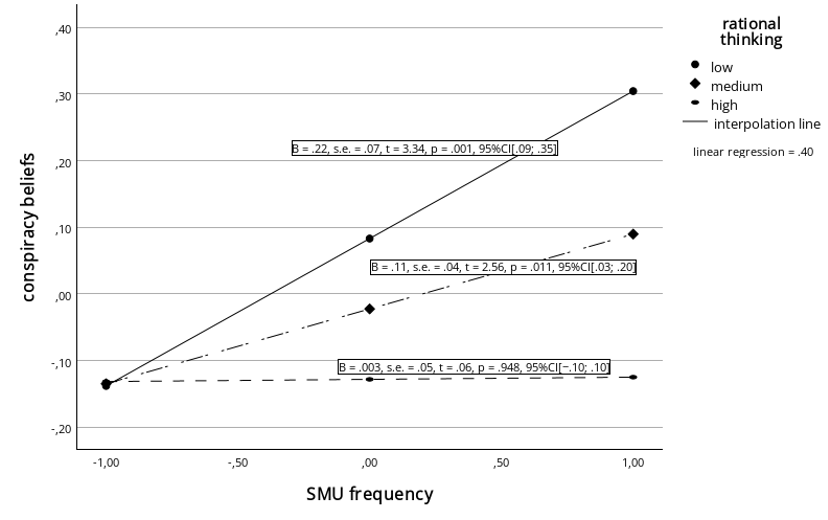
Note. SMU = Social Media Use. Moderator values are the mean and +/− SD from the mean.
Next, we tested the hypothesized moderation effect of tendency toward rational thinking (M) on conspiracy beliefs (Y) for social media use for information-seeking (X; H2b). Additionally, we examined potential moderating effects for other social media use purposes (i.e., self-presentation, entertainment, and social interaction). Of the four moderation effects tested with tendency toward rational thinking as the moderator, three were significant. The analyses revealed that a tendency toward rational thinking moderated the hypothesised relationship between social media use for information-seeking and conspiracy beliefs (ΔR² = .01, ΔF(1, 557) = 5.49, b = −.09, p = .020, 95% CI = [−.17, −.02]). It also turned out that the relationship between social media use for self-presentation (ΔR2 = .02, ΔF(1, 557) = 9.11, b = −.11, p = .003, 95% CI [−.19, −.04]) and entertainment
(ΔR2 = .01, ΔF(1, 557) = 4.04, b = −.08, p = .045, 95% CI [−.16, −.002]), and conspiracy beliefs were also moderated by tendency toward rational thinking.
As shown in Figure 2, the positive relationship between social media use for information seeking and conspiracy beliefs was significant among individuals with low to medium levels of tendency toward rational thinking, but not among those with high levels. This finding supported Hypothesis H2b.
Similar results were observed for two other social media purposes: self-presentation, which showed a significant positive relationship for adolescents with low to medium levels of tendency toward rational thinking (see Figure 3), and entertainment, which showed a significant positive relationship for adolescents with low levels of tendency toward rational thinking (see Figure 4). The moderation effect for social interaction use was not significant (ΔR² = .002, ΔF(1, 557) = .97, b = −.04, p = .325, 95% CI [−.12, .04]).
The moderation analyses testing tendency to experiential thinking (M) as a moderator of the relationship between social media use purposes (X) and conspiracy beliefs (Y) revealed significant effects for both information-seeking (ΔR² = .01, ΔF(1, 557) = 4.30, b = –.08, p = .039, 95% CI [–.15, –.004]) and self-presentation (ΔR² = .01,
ΔF(1, 557) = 5.89, b = –.09, p = .016, 95% CI [–.16, –.02]) purposes. The moderation effects for entertainment (ΔR² = .002, ΔF(1, 557) = 1.23, b = –.05, p = .227, 95% CI [–.13, .04]) and social interaction use (ΔR² = .0001, ΔF(1, 557) = .01, b = .004, p = .918, 95% CI [–.08, .09]) were not significant.
As shown in Figures 5 and 6, the relationship between social media use for both information-seeking and self-presentation was significantly positive at low and medium levels of tendency toward experiential thinking, but non-significant at high levels.
Figure 2. The Moderation Effect of Tendency to Rational Thinking on the Relationship Between
Social Media Use for Information Seeking and Adolescents’ Conspiracy Beliefs.
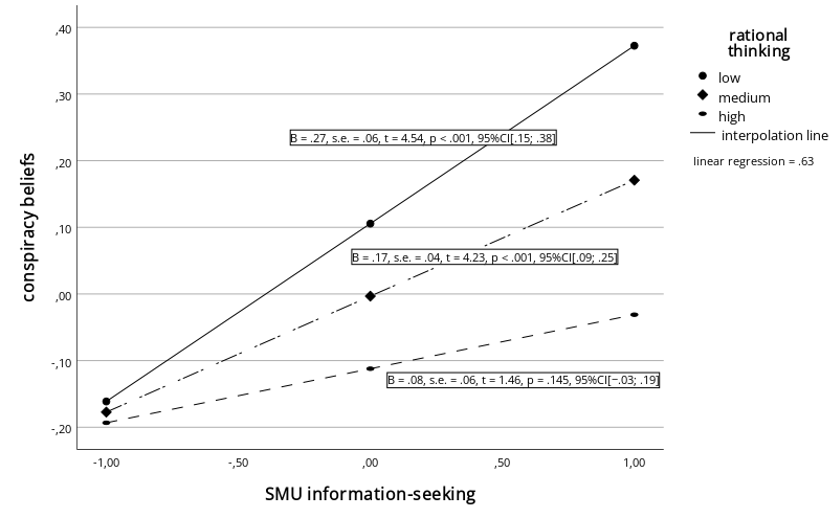
Note. SMU = Social Media Use. Moderator values are the mean and +/− SD from the mean.
Figure 3. The Moderation Effect of Tendency to Rational Thinking on the Relationship Between
Social Media Use for Self-Presentation and Adolescents’ Conspiracy Beliefs.
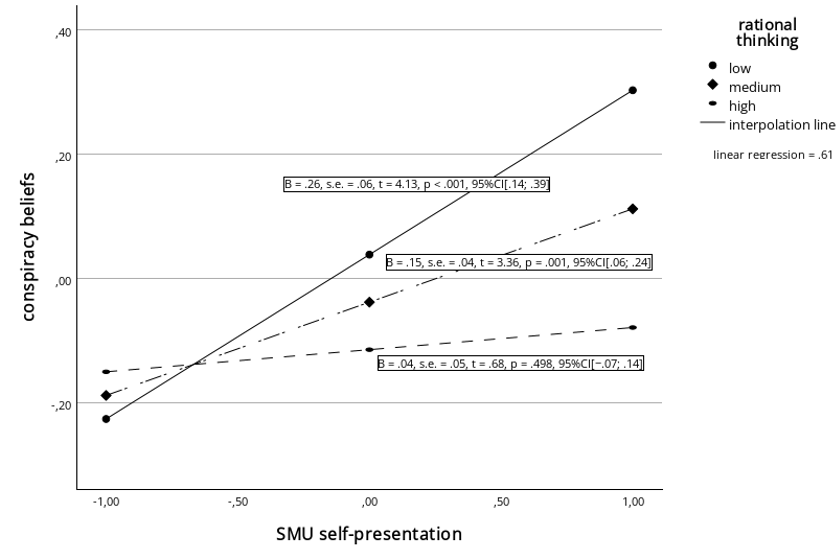
Note. SMU = Social Media Use. Moderator values are the mean and +/− SD from the mean.
Figure 4. The Moderation Effect of Tendency to Rational Thinking on the Relationship Between
Social Media Use for Entertainment and Adolescents’ Conspiracy Beliefs.
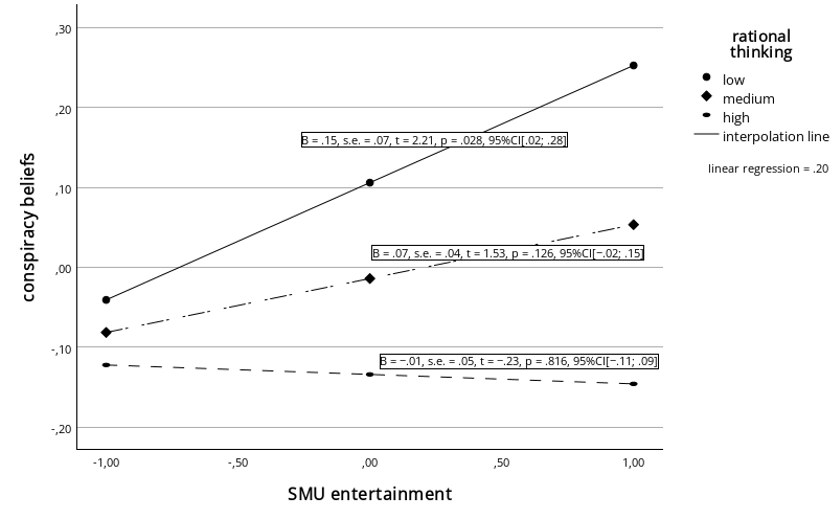
Note. SMU = Social Media Use. Moderator values are the mean and +/− SD from the mean.
Figure 5. The Moderation Effect of Tendency to Experiential Thinking on the Relationship Between
Social Media Use for Information-Seeking and Adolescents’ Conspiracy Beliefs.
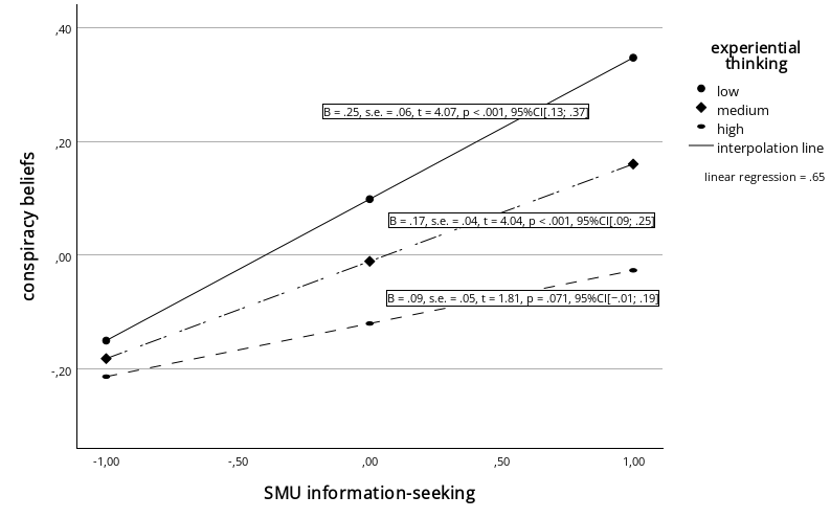
Note. SMU = Social Media Use. Moderator values are the mean and +/− SD from the mean.
Figure 6. The Moderation Effect of Tendency to Experiential Thinking on the Relationship Between
Social Media Use for Self-Presentation and Adolescents’ Conspiracy Beliefs.
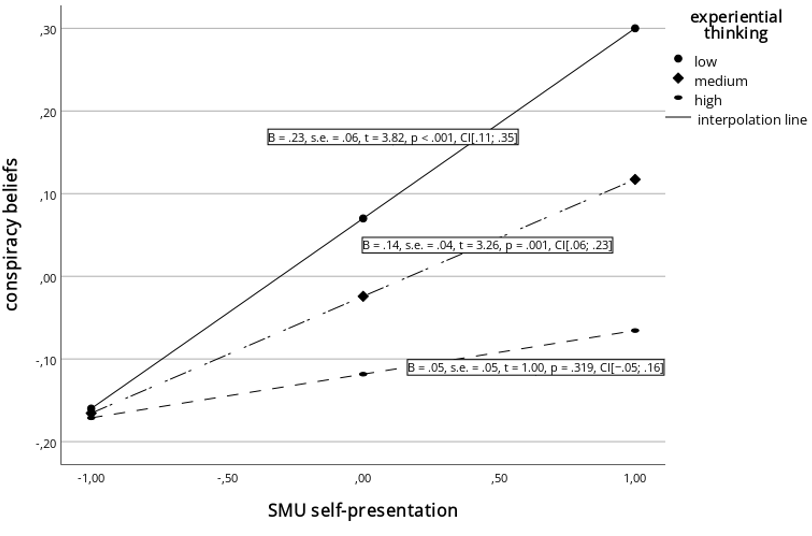
Note. SMU = Social Media Use. Moderator values are the mean and +/− SD from the mean.
Tables 4 and 5 summarize all the results of the moderation analyses.
Table 4. Moderation Analyses of The Relationship Between Social Media Use (Frequency
and Purposes) and Conspiracy Beliefs by Tendency to Rational Thinking.
|
|
|
B |
SE |
t |
p |
LLCI |
ULCI |
|
Model 1 |
SMU FREQ |
.11 |
.04 |
2.56 |
.011 |
.02 |
.20 |
|
|
RATIONAL THINKING |
−.11 |
.04 |
−2.43 |
.015 |
−.19 |
−.02 |
|
|
SMU FREQ x RATIONAL THINKING |
−.11 |
.04 |
−2.74 |
.006 |
−.18 |
−.03 |
|
|
|
R = .20, R2 = .04, F(3, 557) = 8.02, p < .001 ΔR2 = .01, F(1, 557) = 7.49, p = .006 |
|||||
|
Model 2 |
SMU ENTER |
.07 |
.04 |
1.53 |
.126 |
−.02 |
.15 |
|
|
RATIONAL THINKING |
−.12 |
.04 |
−2.75 |
.006 |
−.21 |
−.04 |
|
|
SMU ENT x RATIONAL THINKING |
−.08 |
.04 |
−2.01 |
.045 |
−.16 |
−.002 |
|
|
|
R = .18, R2 = .03, F(3, 557) = 5.93, p < .001 ΔR2 = .01, F(1, 557) = 4.04, p = .045 |
|||||
|
Model 3 |
SMU INF-SEEK |
.17 |
.04 |
4.23 |
< .001 |
.09 |
.25 |
|
|
RATIONAL THINKING |
−.11 |
.04 |
−2.50 |
.013 |
−.19 |
−.02 |
|
|
SMU INF-SEEK x RATIONAL THINKING |
−.09 |
.04 |
−2.34 |
.020 |
−.17 |
−.02 |
|
|
|
R = .24, R2 = .06, F(3, 557) = 11.79, p < .001 ΔR2 = .01, F(1, 557) = 5.49, p = .020 |
|||||
|
Model 4 |
SMU SELF-PRES |
.15 |
.04 |
3.46 |
< .001 |
.06 |
.23 |
|
|
RATIONAL THINKING |
−.08 |
.05 |
−1.70 |
.090 |
−.17 |
.01 |
|
|
SMU SELF-PRES x RATIONAL THINKING |
−.11 |
.04 |
−3.02 |
.003 |
−.19 |
−.04 |
|
|
|
R = .23, R2 = .05, F(3, 557) = 9.99, p < .001 ΔR2 = .02, F(1, 557) = 9.11, p = .003 |
|||||
|
Model 5 |
SMU SOC INT |
.05 |
.04 |
1.16 |
.247 |
−.04 |
.13 |
|
|
RATIONAL THINKING |
−.14 |
.04 |
−3.21 |
.001 |
−.22 |
−.05 |
|
|
SMU SOC INT x RATIONAL THINKING |
−.04 |
.04 |
−.99 |
.325 |
−.12 |
.04 |
|
|
|
R = .16, R2 = .03, F(3, 557) = 4.90, p = .002 ΔR2 = .002, F(1, 557) = .97, p = .325 |
|||||
|
Note. LLCI = lower limit of 95% confidence interval, ULCI = upper limit of 95% confidence interval, SMU = social media use; FREQ = frequency, ENTER = entertainment use; INF-SEEK = information seeking use, SELF-PRES = self-presentation use, SOC INT = social interaction use. |
|||||||
Table 5. Moderation Analyses of The Relationship Between Social Media Use (Frequency
and Purposes) and Conspiracy Beliefs by Tendency to Experiential Thinking.
|
|
|
B |
SE |
t |
p |
LLCI |
ULCI |
|
Model 1 |
SMU FREQ |
.10 |
.04 |
2.30 |
.021 |
.01 |
.18 |
|
|
EXPERIENTIAL THINKING |
−.12 |
.04 |
−2.79 |
.005 |
−.21 |
−.04 |
|
|
SMU FREQ x EXPERIENTIAL THINKING |
−.05 |
.04 |
−1.21 |
.225 |
−.13 |
.03 |
|
|
|
R = .18, R2 = .03, F(3; 557) = 6.30, p = .0003 ΔR2 = .003, F(1; 557) = 1.47, p = .225 |
|||||
|
Model 2 |
SMU ENTER |
.07 |
.04 |
1.52 |
.129 |
−.02 |
.15 |
|
|
EXPERIENTIAL THINKING |
−.13 |
.04 |
−2.98 |
.003 |
−.22 |
−.04 |
|
|
SMU ENT x EXPERIENTIAL THINKING |
−.05 |
.04 |
−1.11 |
.267 |
−.13 |
.04 |
|
|
|
R = .17, R2 = .03, F(3; 557) = 5.30, p = .001 ΔR2 = .002, F(1; 557) = 1.23, p = .227 |
|||||
|
Model 3 |
SMU INF-SEEK |
.17 |
.04 |
4.04 |
.001 |
.09 |
.25 |
|
|
EXPERIENTIAL THINKING |
−.11 |
.04 |
−2.56 |
.011 |
−.19 |
−.03 |
|
|
SMU INF-SEEK x EXPERIENTIAL THINKING |
−.08 |
.04 |
−2.07 |
.039 |
−.15 |
−.004 |
|
|
|
R = .23, R2 = .05, F(3; 557) = 10.52, p < .001 ΔR2 = .01, F(1; 557) = 4.30, p = .039 |
|||||
|
Model 4 |
SMU SELF-PRES |
.14 |
.04 |
3.26 |
.001 |
.06 |
.22 |
|
|
EXPERIENTIAL THINKING |
−.09 |
.04 |
−2.15 |
.032 |
−.18 |
−.008 |
|
|
SMU SELF-PRES x EXPERIENTIAL THINKING |
−.09 |
.04 |
−2.43 |
.016 |
−.16 |
−.02 |
|
|
|
R = .22, R2 = .05, F(3; 557) = 9.24, p < .001 ΔR2 = .01, F(1; 557) = 5.89, p = .016 |
|||||
|
Model 5 |
SMU SOC INT |
.05 |
.04 |
1.13 |
.261 |
−.04 |
.13 |
|
|
EXPERIENTIAL THINKING |
−.15 |
.04 |
−3.48 |
.001 |
−.24 |
−.07 |
|
|
SMU SOC INT x EXPERIENTIAL THINKING |
.004 |
.04 |
.10 |
.918 |
−.08 |
.09 |
|
|
|
R = .16, R2 = .03, F(3; 557) = 4.72, p = .003 ΔR2 = .0001, F(1; 557) = 0.01, p = .918 |
|||||
|
Note. LLCI = lower limit of 95% confidence interval, ULCI = upper limit of 95% confidence interval, SMU = social media use; FREQ = frequency, ENTER = entertainment use; INF-SEEK = information seeking use, SELF-PRES = self-presentation use, SOC INT = social interaction use. |
|||||||
Robustness Checks
To assess the robustness of the reported moderation effects, we re-estimated all models including covariates (opposite thinking style, the remaining SMU variables, and SES, sex, and age). Full results are reported in Appendix C. Below, we summarise whether each interaction effect remained significant and how it changed from the uncontrolled models reported in Tables 4 and 5.
For Rational Thinking as a Moderator
The interaction between SMU frequency and rational thinking remained significant after the inclusion of covariates (b = −.10, p = .013; uncontrolled model: b = −.11, p = .006). Similarly, the interactions involving information-seeking (b = −.10, p = .014; uncontrolled model: b = −.09, p = .020) and self-presentation (b = −.10, p = .012; uncontrolled model: b = −.11, p = .003) remained significant after covariate adjustment. The interaction involving entertainment use, which was significant in the uncontrolled model (b = −.08,
p = .045), became non-significant after adjustment for covariates (b = −.07, p = .104). The interaction involving social interaction use remained non-significant in both the uncontrolled (b = −.04, p = .325) and covariate-adjusted models (b = −.03, p = .394).
For Experiential Thinking as a Moderator
The interactions involving information-seeking (b = −.08, p = .042) and self-presentation (b = −.08, p = .035) remained significant after the inclusion of covariates (uncontrolled models: b = −.08, p = .039; b = −.09, p = .016, respectively). The interaction involving SMU frequency, which was non-significant in the uncontrolled model (b = −.05, p = .225), remained non-significant after covariate adjustment (b = -.05, p = .238), as did the interactions involving entertainment use (uncontrolled: b = −.05, p = .267; adjusted: b = −.04, p = .376) and social interaction use (uncontrolled: b = .004, p = .918; adjusted: b = .01, p = .862).
The overall pattern of results was consistent: interaction effects that were significant in the uncontrolled models generally remained significant after adjustment for covariates and for the opposite thinking style, with modest coefficient changes (2–13%) and stable confidence intervals, while non-significant effects remained non-significant across specifications. The one exception was the interaction between entertainment use and rational thinking, which was attenuated to non-significance after adjustment and should be treated as a more tentative finding.
Discussion
In our paper, we argued that social media use may contribute to the development of conspiracy beliefs among adolescents. Regarding seeking the protective resources, we aimed to replicate findings from adult samples (e.g., Mosleh et al., 2021; Pennycook & Rand, 2019; Stecula & Pickup, 2021) showing that individuals who tend to think rationally (i.e., analytically, consciously, with more effort) are less inclined to believe in conspiracy theories compared to those who think experientially (i.e., intuitively, pre-consciously, with less effort), suggesting that a more rational approach can act as a buffer against conspiracy beliefs. However, we found some interesting nuances to consider when examining both rational and experiential thinking styles in an adolescent sample.
Regarding the frequency of social media use, our study found that overall frequency of social media use does not predict conspiracy beliefs; thus, the obtained result does not support Hypothesis 1a. However, in line with the specific-person approach in media studies (Valkenburg, 2022; Valkenburg & Peter, 2013), our findings suggest that individual factors (i.e., tendency to rational and experiential thinking) play a significant role in the relationship between social media use and conspiracy beliefs. Specifically, social media use frequency was positively related to conspiracy beliefs among adolescents, but only among those with low and medium levels of tendency toward rational thinking, supporting Hypothesis 2a. We also found that the tendency toward experiential thinking, unlike rational thinking, did not significantly moderate the relationship between the frequency of social media use and conspiracy beliefs. A similar pattern emerged for entertainment-focused social media use. A significant positive association with conspiracy beliefs was found among adolescents with low levels of rational thinking, but not among those characterised by experiential thinking. These results suggest that, for adolescents, rational thinking may act as a protective resource against the internalisation of conspiratorial content encountered while spending much time on social media and engaging in self-entertainment. Our results align with prior research indicating that frequent, entertainment-oriented use is a main driver of habitual social media engagement among adolescents (Bucknell Bossen & Kottasz, 2020). In terms of information processing, habitual social media use may encourage a more heuristic or affective processing route (Campbell & Hawkins, 2025), as positive emotions activated by positive experiences may enhance information processing in line with System 1 (i.e., automatic, emotional), thereby limiting System 2 (i.e., deliberative, analytical; Kahneman, 2011). This interpretation is consistent with research showing that conspiracy theories perceived as entertaining are associated with stronger belief in those theories (van Prooijen et al., 2020). Our findings, therefore, suggest that adolescents with a lower tendency to rational thinking may be less able to evaluate such content critically, rendering them more vulnerable to conspiracy beliefs during frequent or entertainment-driven media use. However, because the interaction involving entertainment use was not significant after adjustment for covariates (i.e., opposite thinking style, the remaining social media use variables, SES, sex and age), the effect for this purpose should be interpreted with caution, as it does not consistently hold once covariates are accounted for.
Regarding other purposes of social media use, we obtained consistent results – both without controlling for covariates and after controlling for them. Our study confirmed that social media use for information-seeking predicts conspiracy beliefs (supporting Hypothesis 1b). Moreover, our results show that the positive relationship between this purpose of use and conspiracy beliefs is significant only among adolescents with low and medium levels of tendency to rational thinking, supporting Hypothesis 2b. These findings are consistent with existing research on adults, which has shown that social media use for news consumption is positively correlated with the belief in conspiracy theories and misinformation (Allington et al., 2021; Enders et al., 2021; Stecula & Pickup, 2021). When adolescents use social media to access news and updates about the world, they are more exposed to unverified or misleading content, especially from algorithmically promoted sources (Cinelli et al., 2022). Moreover, false information tends to spread faster than accurate information, as it is often more surprising, emotionally charged, or novel – qualities that are especially appealing to young people (Vosoughi et al., 2018). Adolescents who engage in less analytical thinking may be particularly susceptible, as they are less likely to assess media content critically or verify its accuracy.
Unexpectedly, the results showed that social media use for self-presentation also positively predicts adolescents’ conspiracy beliefs. Consistent with the pattern in social media use for information seeking, the positive association between self-presentation and conspiracy beliefs also emerged among adolescents with a low-to-medium tendency toward rational thinking. Self-presentation refers to using social media to share content about oneself, allowing adolescents to manage how others perceive them and gain social approval (Nadkarni & Hofmann, 2012). Thus, self-presentation on social media may be a way to perform uniqueness publicly, and conspiracy beliefs may foster this sense of uniqueness or belonging to specific communities, further reinforcing conspiratorial thinking (Imhoff & Lamberty, 2017; Lee & Koo, 2022). These results might also suggest that self-presentation consumes cognitive resources, especially when individuals are trying to manage or shape how they appear on idealized-oriented social media (see Pontari & Schlenker, 2000). The results regarding rational thinking as a moderator in the relationship between self-presentation–related social media use and conspiracy beliefs suggest that a greater tendency to engage in analytical, systematic thinking may help adolescents critically evaluate information, also when their social media activity involves shaping and displaying their online persona.
Surprisingly, similar patterns emerged for experiential thinking as a moderator in the relationships between both social media use for information-seeking and self-presentation and conspiracy beliefs. This finding differs from previous results among adults, in which experiential thinking was typically positively associated with conspiracy beliefs (Pytlik et al., 2020). It may be explained by reference to knowledge of cognitive abilities in adolescence, which suggests that during this stage, the two information-processing styles (rational and experiential thinking) may not yet be fully differentiated or in conflict (Crockett et al., 2023). The obtained results also aligns with Epstein’s CEST (1994, 2003), which posits that the two systems are independent, meaning that individuals may score high on both, low on both, or high on one and low on the other, and with evidence from a meta-analysis showing that the two styles can operate simultaneously rather than exclusively (Wang et al., 2017). That is why, when adolescents use social media specifically to seek information, both thinking styles may contribute to resistance against conspiracy beliefs, but probably through different mechanisms. It aligns with van Prooijen et al. (2020)’s suggestions that both systems—System 1 (experiential) and System 2 (rational)—can play a role in either detecting or contributing to conspiracy beliefs. For instance, through System 1, an adolescent may immediately perceive a viral post about a new vaccine or governmental decision as suspicious or misleading. Through System 2, the same adolescent may take the time to check sources, evaluate expert opinions, and verify claims before forming a judgment. In both cases, the conclusion may be the same (the information is unreliable), but the cognitive processes underlying this judgment are different. However, the effectiveness of this process depends on the interaction between the two systems (van Prooijen et al., 2020). Also, the results regarding the unexpected role of experiential thinking are in line with suggestions showing that certain technological contexts (such as fast-paced social media and AI systems) can push adolescents toward heuristic processing (Klein & Klein, 2025; Shen et al., 2026), particularly when decisions are emotionally charged or cognitively demanding—as is often the case when interpreting conspiracy theories.
Lastly, social media use for social interaction did not predict conspiracy beliefs, and there were no significant interactions with information-processing style. Previous studies show that higher social isolation and a lack of social support are related to conspiracy mentality (Jetten et al., 2023). As social media use for social interaction primarily involves communication with friends, family, or peers, this suggests that maintaining positive connections with close others, even via social media, may serve as a protective factor against conspiracy beliefs, or at least does not relate to exposure to such theories.
Limitations and Directions for Future Studies
While the strength of this study lies in its novel exploration of the relationship between adolescents’ social media use—both the frequency and purposes—and conspiracy beliefs, our findings are not without limitations. While our research adds to a growing literature on predictors of adolescents’ conspiracy beliefs, it is important to note that most studies, including ours, are correlational. Such a design cannot definitively establish causality (i.e., whether social media use leads to greater conspiracy belief, whether more conspiratorial individuals seek out social media, or whether some third factor (i.e., rational thinking) drives both). For instance, it remains unclear whether increased social media use for information leads to conspiracy beliefs or if individuals who already hold such beliefs are more likely to seek out information on social media. Future experiments could manipulate different patterns of social media use (e.g., information-seeking vs. self-presentation) to assess their direct impact on conspiracy belief formation.
Moreover, while our study examined general social media use frequency, the platform type appears to play a role in the spread of conspiracy theories. Facebook use, compared to platforms like Twitter, YouTube, and Reddit, shows the weakest correlation with conspiracy beliefs (Enders et al., 2021). Future research should investigate these platform-specific effects in greater detail, particularly concerning algorithm-driven content exposure. Moreover, as we discussed, our study suggests that using social media unintentionally, with a low tendency toward rational thinking, is associated with conspiracy beliefs; therefore, future research should further examine the different dimensions of social media use (e.g., active vs. passive use) and their roles in the formation of conspiracy beliefs.
An important question arising from the present findings concerns the interpretation of the relatively high positive correlation between rational and experiential thinking styles. This result may reflect both theoretical and methodological considerations. First, CEST explicitly allows for “high-high” profiles, in which individuals prefer both rational and experiential processing (Epstein & Epstein, 2016), although the typical pattern reported in adult samples is low or near-zero correlations between both styles (Sadler-Smith, 2011; Witteman et al., 2009). Consistent with this “high-high” profiles perspective, adolescents have been shown to differ substantially from adults, with higher proportions in the “dual preference” (both rational and experiential) and “undifferentiated” (i.e., no clear preference for either style) groups, whereas adults more often fall into more differentiated profiles (Fletcher et al., 2012).
Second, from a measurement perspective, the evidence base for the REI-A scale remains limited and geographically narrow, with only two key studies (Marks et al., 2008, Australia; Shirzadifard et al., 2018, Iran), which constrains conclusions about its developmental and cross-cultural equivalence. Also, interpretative differences may emerge in adolescent samples, particularly in cross-cultural contexts. Although experiential processing is theoretically defined as intuitive and affect-based, it is also characterized by cognitive efficiency (Epstein, 1994). As a result, respondents—especially adolescents—may interpret “experientiality” not strictly as intuitive processing, but also as efficient or adaptive thinking. This may lead to a partial conceptual overlap with rationality at the level of self-report. These considerations highlight the need for further validation and cross-cultural research on the REI-A scale, particularly in adolescent populations.
Moreover, reliance on self-report introduces potential biases, including a halo-like self-evaluation tendency (participants who perceive themselves as “competent thinkers” may rate themselves highly on both dimensions), which may inflate associations between dimensions. That is why, because the REI-A relies on individuals’ ability to assess their own thinking preferences, future research would benefit from incorporating methods that more directly (i.e., by complementing self-reports with behavioural and performance-based measures) assess how young people actually process information in decision-making (especially in the context of evaluating conspiracy theories).
Also, the study was conducted in only two national contexts, so the results may not apply to other countries, even within the same region (Central and Eastern Europe). Extensions to other Central and Eastern European countries require additional data.
Lastly, it is worth noting that one limitation of our study is the low adjusted R² for explaining conspiracy beliefs by social media use purposes, especially after controlling for age, gender, and socioeconomic status, indicating that the results should be interpreted with caution. Future studies should therefore investigate additional predictors of conspiracy beliefs that may co-explain them alongside social media use. However, such effect sizes are standard in media research, with suggestions for a more person-specific approach (Valkenburg, 2022; Valkenburg & Peter, 2013). Our results confirm that both social media use and conspiracy beliefs are complex phenomena and highlight the need to explore additional person– and media–related factors that may contribute to conspiracy beliefs among adolescents.
Practical Implications
Our findings suggest that parents, educators, and policymakers should actively support adolescents in developing more reflective and intentional patterns of social media use, particularly regarding conspiracy-related content. This includes emphasising, in media literacy education and everyday conversations, the potential risks associated with frequent, information-driven social media use, especially among those with a lower tendency toward rational thinking.
Footnotes
1 The Ariadna Research Panel recruits voluntary members whose socioeconomic profiles are representative of Polish internet users. The platform also collects data in other countries in collaboration with international research companies, such as the CINT Research Panel. Registered members earn points for completing surveys, which can be exchanged for rewards. Individuals aged 14 and older are eligible to participate, while minors under 18 require consent from a parent or legal guardian. In accordance with the ethical standards of the European Society for Opinion and Market Research (ICC/ESOMAR) and Polish law, minors must submit a scanned, handwritten consent form from their guardian to Ariadna before participation.
2 For a Confirmatory Factor Analysis, CFI cutoff for satisfactory model fit is > .90. A model can be assumed to perform well when RMSEA < .05, and to be satisfactory when RMSEA < .08. SRMR cutoff for satisfactory model fit is < 0.08 (Byrne, 1994; Hu & Bentler, 1999).
3 The CFI, RMSEA, and SRMR are cutoff criteria most frequently recommended in the literature (Byrne & Stewart, 2006; Cheung & Rensvold, 2002). Accordingly, to indicate metric invariance, the following criteria must be satisfied: ΔCFI ≤ .01, ΔRMSEA ≤ .015, and ΔSRMR ≤ .03.
Conflict of Interest
The authors have no conflicts of interest to declare.
Use of AI Services
The authors declare they have not used any AI services to generate any part of the manuscript or data.
Data Availability Statement
Complete data for this study can be found online at the Open Science Framework: https://osf.io/twmyp. The study was not pre-registered.
Appendices
Appendix A
1. Adolescent Conspiracy Beliefs Questionnaire (ACBQ; Jolley et al., 2021)
Please indicate the extent to which you agree with the following statements. Use a scale from 1 (strongly disagree) to 7 (strongly agree).
Wskaż, w jakim stopniu zgadzasz się z poniższymi twierdzeniami. Użyj skali od 1 (zdecydowanie nie zgadzam się) do 7 (zdecydowanie zgadzam się).
Indică în ce măsură esti de acord cu afirmațiile de mai jos folosindu-te de următoarea scală: de 1 (puternic dezacord) la 7 (puternic de acord).
- The government deliberately hides important information from the public.
- Rząd celowo ukrywa ważne informacje przed opinią publiczną.
- Guvernul ascunde de public informații importante în mod deliberat.
- Some political groups have secret plans which are not good for society.
- Niektóre ugrupowania polityczne mają tajne plany, które nie są dobre dla społeczeństwa.
- Unele grupuri politice au planuri secrete care nu sunt bune pentru societate.
- Secret societies control politicians and other leaders.
- Tajne stowarzyszenia kontrolują polityków i innych przywódców.
- Societățile secrete controlează politicienii și alți lideri.
- Some diseases have been created by the government to be used as weapons.
- Niektóre choroby zostały stworzone przez rząd, aby ich użyć jako broni.
- Unele boli au fost create de guvern pentru a fi folosite ca arme.
- The government often knows about terrorist actions and lets them happen.
- Rząd często wie o akcjach terrorystycznych i na nie zezwala.
- Guvernul știe adesea despre acțiunile teroriste și le lasă să se întâmple.
- Governments have deliberately spread diseases in certain groups of people.
- Rządy celowo rozsiewają choroby w pewnych grupach społecznych.
- Guvernele au răspândit în mod deliberat boli în anumite grupuri de oameni.
- The government monitors people in secret.
- Rząd potajemnie śledzi ludzi.
- Guvernul monitorizează oamenii în secret.
- Secret groups control people’s minds without them knowing.
- Tajne grupy kontrolują umysły ludzi bez ich wiedzy.
- Grupurile secrete controlează mințile oamenilor fără ca aceștia să știe.
- Secret societies influence many political decisions.
- Tajne stowarzyszenia wpływają na wiele decyzji politycznych.
- Societățile secrete influențează multe decizii politice.
2. Social Media Use – Frequency (based on Schor, 2004)
We would like to ask you how frequently you use social media at different times of day, both on weekdays (i.e., Monday through Friday) and on weekends (Saturday and Sunday). For each of the following times of day, please rate how frequently you do the activity. For example, if you never used social media before school on weekdays, place a “1” on that line, then rate how much you use social media after school but before supper, etc. Think about the last month or so as you do these ratings.
Poprosimy Cię teraz o informację, jak często korzystasz z mediów społecznościowych w różnych porach dnia, w dni powszednie (tj. od poniedziałku do piątku) oraz w weekendy (sobota i niedziela). Dla każdej z poniższych pór dnia oceń, jak często wykonujesz tę czynność. Na przykład, jeśli nigdy nie korzystasz z mediów społecznościowych przed szkołą w dni powszednie, zaznacz „1”, a następnie przejdź dalej i oceń, jak często korzystasz z mediów społecznościowych po szkole, ale przed kolacją itp. Przy ocenie pomyśl, jak to wyglądało w minionym miesiącu.
Te rog să precizezi cât de des utilizezi rețelele sociale la diferite ore ale zilei, în zilele lucrătoare (de exemplu, de luni până vineri) și în weekend (sâmbătă și duminică). Pentru fiecare dintre următoarele momente ale zilei, te rog să evaluezi cât de des faci activitatea. De exemplu, dacă nu utilizezi niciodată rețelele sociale înainte de școală în timpul săptămânii, alege „1”, apoi contină să evaluezi cât de mult folosești rețelele sociale după școală, dar înainte de cină. Gândește-te la aproximativ ultima lună pe măsură ce faci aceste evaluări.
- During the weekdays, I:
- Use social media before school. ____
- Use social media after school but before dinner. ____
- Use social media during dinner. ____
- Use social media after dinner. ____
- Use social media before bedtime. ____
- W dni powszednie, ja:
- Używam mediów społecznościowych przed szkołą. ____
- Używam mediów społecznościowych po szkole, ale przed kolacją. ____
- Używam mediów społecznościowych podczas kolacji. ____
- Używam mediów społecznościowych po kolacji ____
- Używam mediów społecznościowych przed pójściem spać. ____
- În timpul săptămânii eu:
- Utilizez rețelele sociale înainte de școală. ____
- Utilizez rețelele sociale după școală, dar înainte de cină. ____
- Utilizez rețelele sociale în timpul cinei. ____
- Utilizez rețelele sociale după cină. ____
- Utilizez rețelele sociale înainte de a merge la culcare în pat.
- During the weekends, I:
- Use social media in the morning. ____
- Use social media before lunch (RO) /dinner (PL). ____
- Use social media between lunch (RO)/dinner (PL) and dinner (RO)/supper (PL). ____
- Use social media after dinner/supper. ____
- Używam mediów społecznościowych przed pójściem spać. ____
- W weekendy, ja:
- Używam mediów społecznościowych rano. ____
- Używam mediów społecznościowych przed obiadem. ____
- Używam mediów społecznościowych między obiadem a kolacją.
- Używam mediów społecznościowych po kolacji ____
- Używam mediów społecznościowych przed pójściem spać. ____
- În weekend, eu:
- Utilizez rețelele sociale dimineața. ____
- Utilizez rețelele sociale înainte de prânz. ____
- Utilizez rețelele sociale între prânz și cină. ____
- Utilizez rețelele sociale după cină. ____
- Utilizez rețelele sociale înainte de a merge la culcare în pat. ____
3. Social Media Uses Scale (Iwanowska, 2024) – adapted for the study sample
We use social media for a variety of purposes. On a scale of 1-5 (where 1 means I strongly disagree and 5 means I strongly agree), assess what your reasons for using social media are.
Media społecznościowe służą nam do różnych celów. Określ na skali 1-5 (gdzie 1 – zdecydowanie nie zgadzam się, a 5 – zdecydowanie zgadzam się), z jakich powodów Ty korzystasz z mediów społecznościowych.
Folosim rețelele sociale pentru o varietate de scopuri. Pe o scară de la 1 la 5 (unde 1 înseamnă complet dezacord și 5 înseamnă că sunt total de acord), care sunt motivele tale pentru a folosi rețelele sociale.
- to search for information
- aby szukać informacji
- să caut informații
- to talk to and write with friends
- aby rozmawiać i pisać ze znajomymi
- să vorbesc și să scriu cu prietenii
- to take a break
- aby zrobić sobie od czegoś przerwę
- să iau o pauză
- to contact others
- aby kontaktować się z innymi
- să-i contactez pe alții
- to cheer myself up
- aby poprawić sobie humor
- să mă înveselesc/binedispun
- to know how my friends are
- aby wiedzieć się, co słychać u znajomych
- să știu cum sunt prietenii mei
- to share the content e.g. posts, and videos
- aby dzielić się treściami, np. postami, wideo
- să dau share/să partajez conținuturi (postări, videoclipuri, etc.)
- to learn something
- aby nauczyć się czegoś
- să învăț ceva
- to present my photos and videos
- aby wstawiać swoje zdjęcia i filmiki
- să-mi prezint pozele și videoclipurile
- to relax
- aby odpocząć
- să mă relaxez
- to improve my knowledge about something
- aby pogłębiać wiedzę na jakiś temat
- să-mi îmbunătățesc cunoștințele despre ceva
- to share my thoughts with others
- aby dzielić się swoimi przemyśleniami z innymi
- să-mi împărtășesc gândurile/ideile cu ceilalți
- to learn how to do something
- aby dowiadywać się, jak coś zrobić
- să învăț cum să fac ceva anume
- to entertain myself
- dla zabawy
- să mă distrez
4. Rational-Experiential Inventory for Adolescents (Marks et al., 2008) – adapted for the study sample
Please circle the number that best represents your feelings about each statement: 1 = disagree strongly, 2 = disagree a little, 3 = neither agree nor disagree, 4 = agree a little, 5 = agree strongly.
Proszę zakreślić cyfrę, która najlepiej oddaje Twoje odczucia na temat każdego stwierdzenia: 1 = zdecydowanie się nie zgadzam, 2 = trochę się nie zgadzam, 3 = ani się nie zgadzam, ani się zgadzam, 4 = trochę się zgadzam, 5 = zdecydowanie się zgadzam.
Folosind următoarea scală, încercuiește numărul care reprezintă cel mai bine sentimentele tale despre fiecare dintre următoarele afirmații: 1 = total dezacord, 2 = puțin de acord, 3 = nici de acord, nici de dezacord, 4 = puțin de acord, 5 = puternic de acord.
- I generally don't depend on my instincts to help me make decisions.
- Zasadniczo nie polegam na mojej intuicji, gdy podejmuje decyzje.
- În general nu depind de instinctele mele pentru a mă ajuta să iau o decizie.
- I don’t enjoy having to think.
- Nie odczuwam przyjemności, kiedy muszę myśleć.
- Nu-mi face plăcere să gândesc.
- I don’t have very strong gut instincts.
- Nie posiadam silnej intuicji.
- Nu am o intuiție foarte puternică.
- I don't like to have to do a lot of thinking.
- Nie lubię, kiedy muszę dużo myśleć.
- Nu-mi place să fiu nevoit să gândesc/să raționez mult.
- I'm not that good at figuring out complicated problems.
- Nie jestem zbyt dobry(a) w rozwiązywaniu skomplikowanych problemów.
- Nu mă pricep atât de bine la rezolvarea problemelor complicate.
- Reasoning things out carefully is not one of my strong points.
- Dokładne analizowanie spraw nie jest moją mocną stroną.
- Să analizez lucrurile cu atenție nu este unul dintre punctele mele forte.
- I try to avoid situations that require thinking in depth about something.
- Staram się unikać sytuacji, które wymagają głębokiego przemyślenia czegoś.
- Încerc să evit situațiile care necesită să gândesc în profunzime.
- I don’t trust my initial feelings about people.
- Nie ufam moim początkowym przeczuciom na temat ludzi.
- Nu am încredere în primele mele sentimentele în legătură cu oamenii.
- I don't like situations in which I have to rely on my gut instincts.
- Nie lubię sytuacji, w których muszę polegać na intuicji.
- Nu-mi plac situațiile în care trebuie să mă bazez pe intuiție.
- I am not very good at solving problems that require careful thinking.
- Nie jestem zbyt dobr(a) w rozwiązywaniu problemów, które wymagają starannego przemyślenia.
- Nu mă pricep foarte bine la rezolvarea problemelor care necesită o gândire atentă.
5. General Subject Characteristics
What is your gender?
- Male
- Female
- Other
- Prefer not to answer
Jaka jest Twoja płeć?
- Mężczyzna
- Kobieta
- Inne
- Wolę nie odpowiadać
Care este sexul tău?
- Masculin
- Feminin
- Altele
- Prefer să nu răspund
What is your age in years? _________
Ile masz lat? _________
Care este vârsta ta în ani? _________
Would you describe the place where you live as:
- village
- city up to 10,000 inhabitants
- city with more than 10,000 inhabitants to 50,000 inhabitants
- city with more than 50,000 to 100,000 inhabitants
- city with more than 100,000 to 500,000 inhabitants
- city with over 500,000 inhabitants
Gdzie mieszkasz?
- wieś
- miasto do 10,000 mieszkańców
- miasto od 10,000 do 50,000 mieszkańców
- miasto od 50,000 do 100,000 mieszkańców
- miasto od 100,000 do 500,000 mieszkańców
- miasto powyżej 500,000 mieszkańców
Te rog indică unde locuiești:
- la sat
- oraş cu până la 10.000 de locuitori
- oraș cu peste 10.000 de locuitori până la 50.000 de locuitori
- oraș cu peste 50.000 până la 100.000 de locuitori
- oraș cu peste 100.000 până la 500.000 de locuitori
- oraş cu peste 500.000 de locuitori
Appendix B
1. Adolescents' Conspiracy Beliefs Questionnaire, 9 items
Table B1. Confirmatory Factor Analysis and Multi-Group Confirmatory Factor Analysis
in Polish and Romanian Samples: Single-Factor Model.
|
Separate Confirmatory Factor Analyses2 |
|||||||
|
Country |
χ2 |
CFI |
RMSEA |
SRMR |
Factor loadings |
||
|
Poland |
34.86(df = 16) |
.986 |
.066 [.036; .096] |
.031 |
.55-.79 |
||
|
Romania |
19.89(df = 16) |
.998 |
.029 [.000; .065) |
.014 |
.59-.85 |
||
|
Multigroup Confirmatory Factor Analysis3 |
|||||||
|
Level of invariance |
χ2 |
CFI |
RMSEA |
SRMR |
ΔCFI |
ΔRMSEA |
ΔSRMR |
|
Configural |
54.75(df = 32) |
.993 |
.036 [.018; .051) |
.031 |
— |
— |
— |
|
Metric |
63.21(df = 40) |
.993 |
.032 [.016; .047) |
.035 |
.000 |
.004 |
.004 |
|
Note. χ2 = chi-square test; df = degrees of freedom; CFI = comparative fit index; SRMR = standardized root mean square residual; RMSEA = root mean square error of approximation. |
|||||||
2. Social Media Uses Scale, 14 items
Table B2. Confirmatory Factor Analysis and Multi-Group Confirmatory Factor Analysis
in Polish and Romanian Samples: Four-Factor Model With Modifications.
|
Separate Confirmatory Factor Analyses |
|||||||
|
Country |
χ2 |
CFI |
RMSEA |
SRMR |
Factor loadings |
||
|
Poland |
139.16(df = 68) |
.959 |
.062 [.047, .077] |
.048 |
.61–.80 |
||
|
Romania |
137.86(df = 68) |
.952 |
.060 [.045, .074) |
.045 |
.53–.78 |
||
|
Multigroup Confirmatory Factor Analysis |
|||||||
|
Level of invariance |
χ2 |
CFI |
RMSEA |
SRMR |
ΔCFI |
ΔRMSEA |
ΔSRMR |
|
Configural |
277.02(df = 136) |
.956 |
.043 [.036, .050) |
.048 |
— |
— |
— |
|
Metric |
294.08(df = 146) |
.954 |
.043 [.036, .050) |
.050 |
.002 |
.000 |
.002 |
|
Note. χ2 = chi-square test; df = degrees of freedom; CFI = comparative fit index; SRMR = standardized root mean square residual; RMSEA = root mean square error of approximation. |
|||||||
3. Rational-Experiential Inventory for Adolescents, 10 items
Table B3. Confirmatory Factor Analysis and Multi-Group Confirmatory Factor Analysis
in Polish and Romanian Samples: Two-Factor Model With Modifications.
|
Separate Confirmatory Factor Analyses |
|||||||
|
Country |
χ2 |
CFI |
RMSEA |
SRMR |
Factor loadings |
||
|
Poland |
65.79 (df = 31) |
.964 |
.064 [.043, .086] |
.040 |
.56–.74 |
||
|
Romania |
19.27 (df = 14) |
.989 |
.036 [.000, .072) |
.029 |
.52–.80 |
||
|
Multigroup Confirmatory Factor Analysis |
|||||||
|
Level of Invariance |
χ2 |
CFI |
RMSEA |
SRMR |
ΔCFI |
ΔRMSEA |
Δ SRMR |
|
Configural |
134.15 (df = 62) |
.971 |
.046 [.035, .056) |
.040 |
— |
— |
— |
|
Metric |
141.64 (df = 70) |
.971 |
.043 [.033, .053) |
.043 |
.000 |
.003 |
.003 |
|
Note. χ2 = chi-square test; df = degrees of freedom; CFI = comparative fit index; SRMR = standardized root mean square residual; RMSEA = root mean square error of approximation. |
|||||||
Appendix C
Table C1. Moderation Analyses of the Relationship Between Social Media Use (Frequency and Purposes)
and Conspiracy Beliefs by Tendency to Rational Thinking, Controlling for Covariates.
|
B |
SE |
t |
p |
LLCI |
ULCI |
||
|
Model 1 |
SMU FREQ |
.10 |
.05 |
1.98 |
.048 |
.00 |
.19 |
|
RATIONAL THINKING |
−.08 |
.07 |
−1.15 |
.252 |
−.20 |
.05 |
|
|
SMU FREQ x RATIONAL THINKING |
−.10 |
.04 |
−2.49 |
.013 |
−.18 |
−.02 |
|
|
|
EXPERIENTIAL THINKING |
−.02 |
.06 |
−.37 |
.713 |
−.15 |
.10 |
|
|
SMU ENT |
−.06 |
.06 |
−1.00 |
.317 |
−.16 |
.05 |
|
|
SMU INF-SEEK |
.16 |
.05 |
3.07 |
.002 |
.06 |
.26 |
|
|
SMU SELF-PRES |
.07 |
.05 |
1.27 |
.206 |
−.04 |
.17 |
|
|
SMU SOC INT |
−.03 |
.05 |
−.67 |
.504 |
−.14 |
.07 |
|
|
SES |
.03 |
.04 |
.64 |
.522 |
−.06 |
.11 |
|
|
SEX |
.04 |
.08 |
.44 |
.659 |
−.12 |
.19 |
|
|
AGE |
−.02 |
.05 |
−.32 |
.752 |
−.12 |
.09 |
|
|
|
R = .27, R² = .07, F(11, 549) = 3.86, p < .001 ΔR² = .01, F(1, 549) = 6.20, p = .013 |
|||||
|
Model 2 |
SMU ENTER |
−.04 |
.06 |
−.62 |
.537 |
−.15 |
.08 |
|
RATIONAL THINKING |
−.08 |
.07 |
−1.14 |
.256 |
−.20 |
.05 |
|
|
SMU ENT x RATIONAL THINKING |
−.07 |
.04 |
−1.63 |
.104 |
−.14 |
.01 |
|
|
|
EXPERIENTIAL THINKING |
−.03 |
.06 |
−.49 |
.624 |
−.15 |
.09 |
|
|
SMU FREQ |
.08 |
.05 |
1.63 |
.103 |
−.02 |
.17 |
|
|
SMU INF-SEEK |
.16 |
.05 |
3.00 |
.003 |
.05 |
.26 |
|
|
SMU SELF-PRES |
.06 |
.05 |
1.24 |
.214 |
−.04 |
.17 |
|
|
SMU SOC INT |
−.05 |
.05 |
−.98 |
.330 |
−.15 |
.05 |
|
|
SES |
.03 |
.04 |
.68 |
.496 |
−.05 |
.11 |
|
|
SEX |
.04 |
.08 |
.53 |
.595 |
−.11 |
.20 |
|
|
AGE |
−.02 |
.05 |
−.38 |
.706 |
−.12 |
.08 |
|
|
|
R = .26, R² = .07, F(11, 549) = 3.52, p < .001 ΔR² = .005, F(1, 549) = 2.66, p = .104 |
|||||
|
Model 3 |
SMU INF-SEEK |
.17 |
.05 |
3.30 |
.001 |
.07 |
.27 |
|
RATIONAL THINKING |
−.06 |
.07 |
−.94 |
.349 |
−.19 |
.07 |
|
|
SMU INF-SEEK x RATIONAL THINKING |
−.10 |
.04 |
−2.46 |
.014 |
−.18 |
−.02 |
|
|
|
EXPERIENTIAL THINKING |
−.02 |
.06 |
−.35 |
.728 |
−.15 |
.10 |
|
|
SMU FREQ |
.08 |
.05 |
1.73 |
.084 |
−.01 |
.17 |
|
|
SMU ENT |
−.06 |
.06 |
−1.01 |
.312 |
−.16 |
.05 |
|
|
SMU SELF-PRES |
.07 |
.05 |
1.30 |
.193 |
−.03 |
.17 |
|
|
SMU SOC INT |
−.05 |
.05 |
−1.06 |
.290 |
−.16 |
.05 |
|
|
SES |
.02 |
.04 |
.59 |
.557 |
−.06 |
.11 |
|
|
SEX |
.05 |
.08 |
.67 |
.500 |
−.10 |
.21 |
|
|
AGE |
−.02 |
.05 |
-.44 |
.658 |
−.13 |
.08 |
|
|
|
R = .27, R² = .07, F(11, 549) = 3.85, p < .001 ΔR² = .01, F(1, 549) = 6.06, p = .014 |
|||||
|
Model 4 |
SMU SELF-PRES |
.10 |
.05 |
1.87 |
.063 |
−.01 |
.21 |
|
RATIONAL THINKING |
−.07 |
.07 |
−1.09 |
.278 |
−.20 |
.06 |
|
|
SMU SELF-PRES x RATIONAL THINKING |
−.10 |
.04 |
−2.51 |
.012 |
−.17 |
−.02 |
|
|
|
EXPERIENTIAL THINKING |
−.02 |
.06 |
−.33 |
.742 |
−.14 |
.10 |
|
|
SMU FREQ |
.08 |
.05 |
1.61 |
.108 |
−.02 |
.17 |
|
|
SMU INF |
.14 |
.05 |
2.77 |
.006 |
.04 |
.25 |
|
|
SMU ENT |
−.06 |
.05 |
−1.13 |
.260 |
−.17 |
.05 |
|
|
SMU SOC INT |
−.05 |
.05 |
−.94 |
.347 |
−.15 |
.05 |
|
|
SES |
.03 |
.04 |
.67 |
.503 |
−.05 |
.11 |
|
|
SEX |
.05 |
.08 |
.57 |
.570 |
−.11 |
.20 |
|
|
AGE |
−.02 |
.05 |
−.35 |
.727 |
−.12 |
.09 |
|
|
|
R = .27, R² = .07, F(11, 549) = 3.87, p < .001 ΔR² = .01, F(1, 549) = 6.31, p = .012 |
|||||
|
Model 5 |
SMU SOC INT |
−.04 |
.05 |
−.76 |
.451 |
−.14 |
.06 |
|
RATIONAL THINKING |
−.08 |
.07 |
−1.25 |
.212 |
−.21 |
.05 |
|
|
SMU SOC INT x RATIONAL THINKING |
−.03 |
.04 |
−.85 |
.394 |
−.12 |
.05 |
|
|
|
EXPERIENTIAL THINKING |
−.03 |
.06 |
−.53 |
.597 |
−.16 |
.09 |
|
|
SMU FREQ |
.08 |
.05 |
1.61 |
.108 |
−.02 |
.17 |
|
|
SMU INF |
.16 |
.05 |
3.05 |
.002 |
.06 |
.26 |
|
|
SMU SELF-PRES |
.07 |
.05 |
1.28 |
.200 |
−.04 |
.17 |
|
|
SMU ENT |
−.06 |
.06 |
−1.09 |
.275 |
−.17 |
.05 |
|
|
SES |
.03 |
.04 |
.66 |
.510 |
−.06 |
.11 |
|
|
SEX |
.05 |
.08 |
.59 |
.555 |
−.11 |
.20 |
|
|
AGE |
−.02 |
.05 |
−.43 |
.664 |
−.13 |
.08 |
|
|
|
R = .25, R² = .06, F(11, 549) = 3.33, p < .001 ΔR² = .001, F(1, 549) = .73, p = .394 |
|||||
|
Note. LLCI = lower limit of 95% confidence interval, ULCI = upper limit of 95% confidence interval, SMU = social media use; FREQ = frequency, |
|||||||
Table C2. Conditional Effects of Social Media Use on Conspiracy Beliefs
at Low, Medium, and High Values of Rational Thinking.
|
Focal SMU predictor |
Level |
Estimate |
SE |
t |
p |
LLCI |
ULCI |
|
SMU FREQ |
Low (−1 SD) |
.18 |
.07 |
2.80 |
.005 |
.06 |
.31 |
|
Medium |
.10 |
.05 |
2.00 |
.047 |
.002 |
.19 |
|
|
High (+1 SD) |
−.01 |
.06 |
−.14 |
.888 |
−.12 |
.10 |
|
|
SMU INF-SEEK |
Low (−1 SD) |
.26 |
.06 |
4.02 |
.0001 |
.13 |
.38 |
|
Medium |
.17 |
.05 |
3.32 |
.001 |
.07 |
.27 |
|
|
High (+1 SD) |
.07 |
.07 |
1.04 |
.297 |
−.06 |
.20 |
|
|
SMU SELF-PRES |
Low (−1 SD) |
.19 |
.07 |
2.63 |
.009 |
.05 |
.33 |
|
Medium |
.10 |
.05 |
1.88 |
.061 |
−.01 |
.21 |
|
|
High (+1 SD) |
.00 |
.06 |
−.01 |
.988 |
−.12 |
.11 |
|
|
Note. LLCI = lower limit of 95% confidence interval, ULCI = upper limit of 95% confidence interval; SMU = social media use; |
|||||||
Table C3. Moderation Analyses of the Relationship Between Social Media Use (Frequency and Purposes)
and Conspiracy Beliefs by Tendency to Experiential Thinking, Controlling for Covariates.
|
B |
SE |
t |
p |
LLCI |
ULCI |
||
|
Model 1 |
SMU FREQ |
.08 |
.05 |
1.65 |
.100 |
−.02 |
.17 |
|
EXPERIENTIAL THINKING |
−.02 |
.06 |
−.39 |
.699 |
−.15 |
.10 |
|
|
SMU FREQ x EXPERIENTIAL THINKING |
−.05 |
.04 |
−1.18 |
.238 |
−.13 |
.03 |
|
|
|
RATIONAL THINKING |
−.09 |
.07 |
−1.35 |
.178 |
−.22 |
.04 |
|
|
SMU INF-SEEK |
.16 |
.05 |
3.18 |
.002 |
.06 |
.27 |
|
|
SMU SELF-PRES |
.06 |
.05 |
1.23 |
.221 |
−.04 |
.17 |
|
|
SMU ENT |
−.06 |
.06 |
−1.06 |
.288 |
−.17 |
.05 |
|
|
SMU SOC INT |
−.04 |
.05 |
−.79 |
.431 |
−.14 |
.06 |
|
|
SES |
.02 |
.04 |
.59 |
.558 |
−.06 |
.11 |
|
|
SEX |
.05 |
.08 |
.65 |
.516 |
−.11 |
.21 |
|
|
AGE |
−.03 |
.05 |
−.52 |
.601 |
−.13 |
.08 |
|
|
|
R = .25, R² = .06, F(11, 549) = 3.39, p < .001 ΔR² = .002, F(1, 549) = 1.40, p = .238 |
|||||
|
Model 2 |
SMU ENTER |
−.05 |
.06 |
−.92 |
.357 |
−.16 |
.06 |
|
EXPERIENTIAL THINKING |
−.03 |
.06 |
−.43 |
.667 |
−.15 |
.10 |
|
|
SMU ENT x EXPERIENTIAL THINKING |
−.04 |
.04 |
−.89 |
.376 |
−.12 |
.05 |
|
|
|
RATIONAL THINKING |
−.09 |
.07 |
−1.32 |
.187 |
−.22 |
.04 |
|
|
SMU FREQ |
.07 |
.05 |
1.56 |
.120 |
−.02 |
.17 |
|
|
SMU INF |
.16 |
.05 |
3.09 |
.002 |
.06 |
.26 |
|
|
SMU SELF-PRES |
.07 |
.05 |
1.27 |
.206 |
−.04 |
.17 |
|
|
SMU SOC INT |
−.05 |
.05 |
−.88 |
.380 |
−.15 |
.06 |
|
|
SES |
.03 |
.04 |
.62 |
.535 |
−.06 |
.11 |
|
|
SEX |
.05 |
.08 |
.61 |
.540 |
−.11 |
.21 |
|
|
AGE |
−.03 |
.05 |
−.52 |
.604 |
−.13 |
.08 |
|
|
|
R = .25, R² = .06, F(11, 549) = 3.33, p < .001 ΔR² = .001, F(1, 549) = .79, p = .376 |
|||||
|
Model 3 |
SMU INF-SEEK |
.18 |
.05 |
3.43 |
.001 |
.08 |
.28 |
|
EXPERIENTIAL THINKING |
−.03 |
.06 |
−.55 |
.584 |
−.16 |
.09 |
|
|
SMU INF-SEEK x EXPERIENTIAL THINKING |
−.08 |
.04 |
−2.04 |
.042 |
−.15 |
−.003 |
|
|
|
RATIONAL THINKING |
−.06 |
.07 |
−.96 |
.337 |
−.19 |
.07 |
|
|
SMU FREQ |
.08 |
.05 |
1.68 |
.093 |
−.01 |
.17 |
|
|
SMU SELF-PRES |
.07 |
.05 |
1.32 |
.186 |
−.03 |
.17 |
|
|
SMU ENT |
−.07 |
.06 |
−1.18 |
.237 |
−.17 |
.04 |
|
|
SMU SOC INT |
−.05 |
.05 |
−.99 |
.322 |
−.15 |
.05 |
|
|
SES |
.03 |
.04 |
.65 |
.514 |
−.06 |
.11 |
|
|
SEX |
.05 |
.08 |
.66 |
.508 |
−.10 |
.21 |
|
|
AGE |
−.03 |
.05 |
−.54 |
.590 |
−.13 |
.08 |
|
|
|
R = .26, R² = .07, F(11, 549) = 3.66, p < .001 ΔR² = .01, F(1, 549) = 4.16, p = .042 |
|||||
|
Model 4 |
SMU SELF-PRES |
.09 |
.05 |
1.63 |
.105 |
−.02 |
.19 |
|
EXPERIENTIAL THINKING |
−.03 |
.06 |
−.52 |
.606 |
−.16 |
.09 |
|
|
SMU SELF-PRES x EXPERIENTIAL THINKING |
−.08 |
.04 |
−2.12 |
.035 |
−.15 |
−.01 |
|
|
|
RATIONAL THINKING |
−.07 |
.07 |
−1.05 |
.294 |
−.20 |
.06 |
|
|
SMU FREQ |
.07 |
.05 |
1.52 |
.130 |
−.02 |
.16 |
|
|
SMU INF |
.16 |
.05 |
3.01 |
.003 |
.05 |
.26 |
|
|
SMU ENT |
−.06 |
.06 |
−1.13 |
.260 |
−.17 |
.05 |
|
|
SMU SOC INT |
−.05 |
.05 |
−.89 |
.371 |
−.15 |
.06 |
|
|
SES |
.03 |
.04 |
.63 |
.532 |
−.06 |
.11 |
|
|
SEX |
.05 |
.08 |
.58 |
.562 |
−.11 |
.20 |
|
|
AGE |
−.03 |
.05 |
−.52 |
.601 |
−.13 |
.08 |
|
|
|
R = .26, R² = .07, F(11, 549) = 3.69, p < .001 ΔR² = .01, F(1, 549) = 4.48, p = .035 |
|||||
|
Model 5 |
SMU SOC INT |
−.04 |
.05 |
−.84 |
.399 |
−.15 |
.06 |
|
EXPERIENTIAL THINKING |
−.04 |
.06 |
−.59 |
.555 |
−.16 |
.09 |
|
|
SMU SOC INT x EXPERIENTIAL THINKING |
.01 |
.04 |
.17 |
.862 |
−.07 |
.09 |
|
|
|
RATIONAL THINKING |
−.09 |
.07 |
−1.40 |
.162 |
−.22 |
.04 |
|
|
SMU FREQ |
.07 |
.05 |
1.46 |
.146 |
−.02 |
.16 |
|
|
SMU INF |
.16 |
.05 |
3.17 |
.002 |
.06 |
.27 |
|
|
SMU SELF-PRES |
.06 |
.05 |
1.24 |
.216 |
−.04 |
.17 |
|
|
SMU ENT |
−.06 |
.06 |
−1.08 |
.278 |
−.17 |
.05 |
|
|
SES |
.03 |
.04 |
.62 |
.537 |
−.06 |
.11 |
|
|
SEX |
.05 |
.08 |
.64 |
.520 |
−.11 |
.21 |
|
|
AGE |
−.03 |
.05 |
−.59 |
.556 |
−.14 |
.07 |
|
|
|
R = .25, R² = .06, F(11, 549) = 3.26, p < .001 ΔR² < .001, F(1, 549) = .03, p = .862 |
|||||
|
Note. LLCI = lower limit of 95% confidence interval, ULCI = upper limit of 95% confidence interval, SMU = social media use; FREQ = frequency, |
|||||||
Table C4. Conditional Effects of Social Media Use on Conspiracy Beliefs
at Low, Medium, and High Values of Experiential Thinking.
|
Focal SMU predictor |
Level |
Estimate |
SE |
t |
p |
LLCI |
ULCI |
|
SMU INF-SEEK |
Low (−1 SD) |
.26 |
.07 |
3.72 |
.0002 |
.12 |
.40 |
|
Medium |
.18 |
.05 |
3.39 |
.001 |
.07 |
.28 |
|
|
High (+1 SD) |
.09 |
.06 |
1.47 |
.141 |
−.03 |
.22 |
|
|
SMU SELF-PRES |
Low (−1 SD) |
.17 |
.07 |
2.36 |
.019 |
.03 |
.31 |
|
Medium |
.08 |
.05 |
1.57 |
.117 |
−.02 |
.19 |
|
|
High (+1 SD) |
.00 |
.06 |
−.02 |
.987 |
−.12 |
.12 |
|
|
Note. LLCI = lower limit of 95% confidence interval, ULCI = upper limit of 95% confidence interval; SMU = social media use; |
|||||||


This work is licensed under a Creative Commons Attribution-ShareAlike 4.0 International License.
Copyright © 2026 Magdalena Iwanowska, Rosana Stan, Anna Maria Zawadzka