
Intrinsic and extrinsic social comparisons in online and offline contexts: An ecological momentary assessment study of associations with wellbeing
Vol.20,No.3(2026)
Marc S. Tibber
 Chan Zhang
Minglei Wang
Chan Zhang
Minglei Wang
Whilst online social comparisons have been linked to wellbeing, little is known about the impact of comparison dimensions. Drawing on Goal Contents Theory (within self-determination theory), we used Ecological Momentary Assessment to explore dynamic associations between online and offline (upward) social comparisons across intrinsic and extrinsic dimensions in 114 Chinese undergraduates, with data sampled five times per day for 21 days. Using network analysis, contemporaneous and temporal networks were estimated. Counter to our predictions, extrinsic comparisons (e.g., comparisons of wealth) were not associated with poorer wellbeing; in fact, there was evidence for a protective effect of online extrinsic comparisons, specifically, increases in positive affect and decreases in loneliness. The results were also potentially consistent with a two-step model of social comparisons, in which benefits or reduced harm dominate with a temporal lag. Future studies should explore the individual, technological and cultural factors that determine the balance of harms and benefits arising from online comparisons.
social media; social network sites; social comparison; well-being; self-esteem; loneliness; affect
Marc S. Tibber
Research Department of Clinical, Educational and Health Psychology, UCL, London
Marc S. Tibber is a Clinical Psychologist and Lecturer in Clinical Psychology at UCL specialising in young people’s mental health. His recent work has focused on the role of interpersonal/social processes in mental health (including social media communication), and how issues of connection and disconnection affect individuals and communities.
Chan Zhang
College of Media and International Culture, Zhejiang University, Hangzhou
Chan Zhang is an associate professor at the College of Media and International Culture at Zhejiang University, China. Her expertise is in the measurement errors of online data collection. She received a Ph.D. in Survey Methodology from the University of Michigan.
Minglei Wang
School of Culture and Tourism, Hefei University, Hefei
Minglei Wang is a lecturer at the School of Culture and Tourism, Hefei University. Her current research interests include social comparison, data quality in ecological momentary assessment, and digital games. She received her Ph.D. in Journalism and Communication from Zhejiang University.
Bennett, B. L., Whisenhunt, B. L., Hudson, D. L., Wagner, A. F., Latner, J. D., Stefano, E. C., & Beauchamp, M. T. (2020). Examining the impact of social media on mood and body dissatisfaction using ecological momentary assessment. Journal of American College Health, 68(5), 502–508. https://doi.org/10.1080/07448481.2019.1583236
Beyens, I., Pouwels, J. L., Van Driel, I. I., Keijsers, L., & Valkenburg, P. M. (2020). The effect of social media on well-being differs from adolescent to adolescent. Scientific Reports, 10(1), Article 10763. https://doi.org/10.1038/s41598-020-67727-7
Bocage-Barthélémy, Y., Chatard, A., Jaafari, N., Tello, N., Billieux, J., Daveau, E., & Selimbegović, L. (2018). Automatic social comparison: Cognitive load facilitates an increase in negative thought accessibility after thin ideal exposure among women. PLOS ONE, 13(3), Article e0193200. https://doi.org/10.1371/journal.pone.0193200
Bradshaw, E. L. (2023). Causes, costs, and caveats: Reflections and future directions for goal contents theory. In R. M. Ryan (Ed.), The Oxford handbook of self-determination theory (pp. 139–159). Oxford University Press. https://doi.org/10.1093/oxfordhb/9780197600047.013.7
Bradshaw, E. L., Conigrave, J. H., Steward, B. A., Ferber, K. A., Parker, P. D., & Ryan, R. M. (2023). A meta-analysis of the dark side of the American dream: Evidence for the universal wellness costs of prioritizing extrinsic over intrinsic goals. Journal of Personality and Social Psychology, 124(4), 873–899. https://doi.org/10.1037/pspp0000431
Burnell, K., Trekels, J., Prinstein, M. J., & Telzer, E. H. (2024). Adolescents’ social comparison on social media: Links with momentary self-evaluations. Affective Science, 5(4), 295–299. https://doi.org/10.1007/s42761-024-00240-6
Butler, S. (2021). The development of market-driven identities in young people: A socio-ecological evolutionary approach. Frontiers in Psychology, 12, Article 623675. https://doi.org/10.3389/fpsyg.2021.623675
Butler, S. (2024). Young people on social media in a globalized world: Self-optimization in highly competitive and achievement-oriented forms of life. Frontiers in Psychology, 15, Article 1340605. https://doi.org/10.3389/fpsyg.2024.1340605
Buunk, A. P., & Dijkstra, P. (2017). Social comparisons and well-being. In M. D. Robinson & M. Eid (Eds.), The happy mind: Cognitive contributions to well-being (pp. 311–330). Springer Nature. https://hdl.handle.net/11370/3a20887b-9b7f-47b6-8070-12f4ea654aa2
Buunk, A. P., & Gibbons, F. X. (2007). Social comparison: The end of a theory and the emergence of a field. Organizational Behavior and Human Decision Processes, 102(1), 3–21. https://doi.org/10.1016/j.obhdp.2006.09.007
Cao, Y. (2024). The cultural consequences of market transition: An empirical examination of rising materialism in twenty-first-century China. American Sociological Review, 89(3), 449–487. https://doi.org/10.1177/00031224241240497
Chen, C., Lee, S., & Stevenson, H. W. (1995). Response style and cross-cultural comparisons of rating scales among East Asian and north American students. Psychological Science, 6(3), 170–175. https://doi.org/10.1111/j.1467-9280.1995.tb00327.x
Chen, X., Cen, G., Li, D., & He, Y. (2005). Social functioning and adjustment in Chinese children: The imprint of historical time. Child Development, 76(1), 182–195. https://doi.org/10.1111/j.1467-8624.2005.00838.x
Chung, T., & Mallery, P. (1999). Social comparison, individualism-collectivism, and self-esteem in China and the United States. Current Psychology, 18(4), 340–352. https://doi.org/10.1007/s12144-999-1008-0
Church, A. T., Katigbak, M. S., Locke, K. D., Zhang, H., Shen, J., De Jesús Vargas-Flores, J., Ibáñez-Reyes, J., Tanaka-Matsumi, J., Curtis, G. J., Cabrera, H. F., Mastor, K. A., Alvarez, J. M., Ortiz, F. A., Simon, J.-Y. R., & Ching, C. M. (2013). Need satisfaction and well-being: Testing self-determination theory in eight cultures. Journal of Cross-Cultural Psychology, 44(4), 507–534. https://doi.org/10.1177/0022022112466590
Clark, J. L., Algoe, S. B., & Green, M. C. (2018). Social network sites and well-being: The role of social connection. Current Directions in Psychological Science, 27(1), 32–37. https://doi.org/10.1177/0963721417730833
Compernolle, E. L., Finch, L. E., Hawkley, L. C., & Cagney, K. A. (2021). Momentary loneliness among older adults: Contextual differences and their moderation by gender and race/ethnicity. Social Science & Medicine, 285, Article 114307. https://doi.org/10.1016/j.socscimed.2021.114307
Deci, E. L., & Ryan, R. M. (2000). The “what” and “why” of goal pursuits: Human needs and the self-determination of behavior. Psychological Inquiry, 11(4), 227–268. https://doi.org/10.1207/S15327965PLI1104_01
Desjarlais, M. (2024). Subtle momentary effects of social media experiences: An experience sampling study of posting and social comparisons on connectedness and self-esteem. Journal of Computer-Mediated Communication, 29(3), Article zmae004. https://doi.org/10.1093/jcmc/zmae004
Dibb, B., & Foster, M. (2021). Loneliness and Facebook use: The role of social comparison and rumination. Heliyon, 7(1), Article e05999. https://doi.org/10.1016/j.heliyon.2021.e05999
Epskamp, S., Waldorp, L. J., Mõttus, R., & Borsboom, D. (2018). The Gaussian graphical model in cross-sectional and time-series data. Multivariate Behavioral Research, 53(4), 453–480. https://doi.org/10.1080/00273171.2018.1454823
Faelens, L., Hoorelbeke, K., Soenens, B., Van Gaeveren, K., De Marez, L., De Raedt, R., & Koster, E. H. W. (2021). Social media use and well-being: A prospective experience-sampling study. Computers in Human Behavior, 114, Article 106510. https://doi.org/10.1016/j.chb.2020.106510
Festinger, L. (1954). A theory of social comparison processes. Human Relations, 7(2), 117–140. https://doi.org/10.1177/001872675400700202
French, D. P., & Sutton, S. (2010). Reactivity of measurement in health psychology: How much of a problem is it? What can be done about it? British Journal of Health Psychology, 15(3), 453–468. https://doi.org/10.1348/135910710X492341
Fukubayashi, N., & Fuji, K. (2021). Social comparison on social media increases career frustration: A focus on the mitigating effect of companionship. Frontiers in Psychology, 12, Article 720960. https://doi.org/10.3389/fpsyg.2021.720960
Gibbons, F. X., & Buunk, B. P. (1999). Individual differences in social comparison: Development of a scale of social comparison orientation. Journal of Personality and Social Psychology, 76(1), 129–142. https://doi.org/10.1037//0022-3514.76.1.129
Grouzet, F. M. E., Kasser, T., Ahuvia, A., Dols, J. M. F., Kim, Y., Lau, S., Ryan, R. M., Saunders, S., Schmuck, P., & Sheldon, K. M. (2005). The structure of goal contents across 15 cultures. Journal of Personality and Social Psychology, 89(5), 800–816. https://doi.org/10.1037/0022-3514.89.5.800
Guo, J., Niu, L., Xie, X., Wang, P., & Lei, L. (2020). Xianshang "xiu en'ai" yu pangguanzhe zhuguan xingfugan de guanxi: Zizun de zhongjie zuoyong he yilian de tiaojie zuoyong. [The association between “show off love” and subjective well-being of spectators: The mediating role of self-esteem and the moderating role of attachment]. Psychological Development and Education, 36(3), 359-366. https://doi.org/10.16187/j.cnki.issn1001-4918.2020.03.13
Guo, J. (2022). The postfeminist entrepreneurial self and the platformisation of labour: A case study of yesheng female lifestyle bloggers on Xiaohongshu. Global Media and China, 7(3), 303–318. https://doi.org/10.1177/20594364221095896
Harter, S. (1990). Developmental differences in the nature of self-representations: Implications for the understanding, assessment, and treatment of maladaptive behavior. Cognitive Therapy and Research, 14(2), 113–142. https://doi.org/10.1007/BF01176205
Harter, S. (1999). Discrepancies between real and ideal self-concepts. In K. W. Fischer & E. T. Higgins (Eds.), The construction of the Self (pp. 142–165). Guilford Press.
Hoffner, C. A., & Bond, B. J. (2022). Parasocial relationships, social media, & well-being. Current Opinion in Psychology, 45, Article 101306. https://doi.org/10.1016/j.copsyc.2022.101306
Hoorelbeke, K., Van Den Bergh, N., Wichers, M., & Koster, E. H. W. (2019). Between vulnerability and resilience: A network analysis of fluctuations in cognitive risk and protective factors following remission from depression. Behaviour Research and Therapy, 116, 1–9. https://doi.org/10.1016/j.brat.2019.01.007
Johannes, N., Nguyen, T., Weinstein, N., & Przybylski, A. K. (2021). Objective, subjective, and accurate reporting of social media use: No evidence that daily social media use correlates with personality traits, motivational states, or well-being. Technology, Mind, and Behavior, 2(2), 152–165. https://doi.org/10.1037/tmb0000035
Karsay, K., Matthes, J., Schmuck, D., & Ecklebe, S. (2023). Messaging, posting, and browsing: A mobile experience sampling study investigating youth’s social media use, affective well-being, and loneliness. Social Science Computer Review, 41(4), 1493–1513. https://doi.org/10.1177/08944393211058308
Kasser, T., & Ryan, R. M. (1996). Further examining the American dream: Differential correlates of intrinsic and extrinsic goals. Personality and Social Psychology Bulletin, 22(3), 280–287. https://doi.org/10.1177/0146167296223006
König, L. M., Allmeta, A., Christlein, N., Van Emmenis, M., & Sutton, S. (2022). A systematic review and meta-analysis of studies of reactivity to digital in-the-moment measurement of health behaviour. Health Psychology Review, 16(4), 551–575. https://doi.org/10.1080/17437199.2022.2047096
Lee, M.-A., & Kawachi, I. (2019). The keys to happiness: Associations between personal values regarding core life domains and happiness in South Korea. PLOS ONE, 14(1), Article e0209821. https://doi.org/10.1371/journal.pone.0209821
Lee, R. M., Draper, M., & Lee, S. (2001). Social connectedness, dysfunctional interpersonal behaviors, and psychological distress: Testing a mediator model. Journal of Counseling Psychology, 48(3), 310–318. https://doi.org/10.1037/0022-0167.48.3.310
Lei, X.-Y., Xiao, L.-M., Liu, Y.-N., & Li, Y.-M. (2016). Prevalence of depression among Chinese university students: A meta-analysis. PLOS ONE, 11(4), Article e0153454. https://doi.org/10.1371/journal.pone.0153454
McCarthy, P. A., & Morina, N. (2020). Exploring the association of social comparison with depression and anxiety: A systematic review and meta-analysis. Clinical Psychology & Psychotherapy, 27(5), 640–671. https://doi.org/10.1002/cpp.2452
Meier, A., Gilbert, A., Börner, S., & Possler, D. (2020). Instagram inspiration: How upward comparison on social network sites can contribute to well-being. Journal of Communication, 70(5), 721–743. https://doi.org/10.1093/joc/jqaa025
Milanovic, B. (2019). Capitalism, alone: The future of the system that rules the world. Harvard University Press. https://doi.org/10.4159/9780674242852
Nalipay, M. J. N., King, R. B., & Cai, Y. (2020). Autonomy is equally important across East and West: Testing the cross-cultural universality of self-determination theory. Journal of Adolescence, 78(1), 67–72. https://doi.org/10.1016/j.adolescence.2019.12.009
Nesi, J., Choukas-Bradley, S., & Prinstein, M. J. (2018a). Transformation of adolescent peer relations in the social media context: Part 1—A theoretical framework and application to dyadic peer relationships. Clinical Child and Family Psychology Review, 21(3), 267–294. https://doi.org/10.1007/s10567-018-0261-x
Nesi, J., Choukas-Bradley, S., & Prinstein, M. J. (2018b). Transformation of adolescent peer relations in the social media context: Part 2—Application to peer group processes and future directions for research. Clinical Child and Family Psychology Review, 21(3), 295–319. https://doi.org/10.1007/s10567-018-0262-9
O’Day, E. B., & Heimberg, R. G. (2021). Social media use, social anxiety, and loneliness: A systematic review. Computers in Human Behavior Reports, 3, Article 100070. https://doi.org/10.1016/j.chbr.2021.100070
Orben, A., & Blakemore, S.-J. (2023). How social media affects teen mental health: A missing link. Nature, 614(7948), 410–412. https://doi.org/10.1038/d41586-023-00402-9
Parry, D. A., Davidson, B. I., Sewall, C. J. R., Fisher, J. T., Mieczkowski, H., & Quintana, D. S. (2021). A systematic review and meta-analysis of discrepancies between logged and self-reported digital media use. Nature Human Behaviour, 5(11), 1535–1547. https://doi.org/10.1038/s41562-021-01117-5
Pomery, E. A., Gibbons, F. X., & Stock, M. L. (2012). Social comparison. In V. S. Ramachandran (Ed.), Encyclopedia of human behavior (2nd ed., pp. 463–469). Academic Press. https://doi.org/10.1016/B978-0-12-375000-6.00332-3
Primack, B. A., Shensa, A., Sidani, J. E., Whaite, E. O., Lin, L. Y., Rosen, D., Colditz, J. B., Radovic, A., & Miller, E. (2017). Social media use and perceived social isolation among young adults in the U.S. American Journal of Preventive Medicine, 53(1), 1–8. https://doi.org/10.1016/j.amepre.2017.01.010
Rosenberg, M. (1965). Society and the adolescent self-image. Princeton University Press.
Ruggieri, S., Ingoglia, S., Bonfanti, R. C., & Lo Coco, G. (2021). The role of online social comparison as a protective factor for psychological wellbeing: A longitudinal study during the COVID-19 quarantine. Personality and Individual Differences, 171, Article 110486. https://doi.org/10.1016/j.paid.2020.110486
Ryan, R. M., & Deci, E. L. (2019). Brick by brick: The origins, development, and future of self-determination theory. In A. J. Elliot (Ed.), Advances in motivation science (Vol. 6, pp. 111–156). Elsevier. https://doi.org/10.1016/bs.adms.2019.01.001
Sheldon, K. M., Ryan, R. M., Deci, E. L., & Kasser, T. (2004). The independent effects of goal contents and motives on well-being: It’s both what you pursue and why you pursue it. Personality and Social Psychology Bulletin, 30(4), 475–486. https://doi.org/10.1177/0146167203261883
Shiffman, S., Stone, A. A., & Hufford, M. R. (2008). Ecological momentary assessment. Annual Review of Clinical Psychology, 4, 1–32. https://doi.org/10.1146/annurev.clinpsy.3.022806.091415
Siebers, T., Beyens, I., Pouwels, J. L., & Valkenburg, P. M. (2022). Social media and distraction: An experience sampling study among adolescents. Media Psychology, 25(3), 343–366. https://doi.org/10.1080/15213269.2021.1959350
Sivertsen, B., Hysing, M., Knapstad, M., Harvey, A. G., Reneflot, A., Lønning, K. J., & O’Connor, R. C. (2019). Suicide attempts and non-suicidal self-harm among university students: Prevalence study. BJPsych Open, 5(2), Article e26. https://doi.org/10.1192/bjo.2019.4
Storrie, K., Ahern, K., & Tuckett, A. (2010). A systematic review: Students with mental health problems—A growing problem. International Journal of Nursing Practice, 16(1), 1–6. https://doi.org/10.1111/j.1440-172X.2009.01813.x
Tao, V. Y. K., & Hong, Y. (2014). When academic achievement is an obligation: Perspectives from social-oriented achievement motivation. Journal of Cross-Cultural Psychology, 45(1), 110–136. https://doi.org/10.1177/0022022113490072
Tibber, M. S., Milne, G., Fonagy, P., & Dekker, T. M. (2024). The online world as a means of connection and disconnection during the COVID-19 pandemic: A test of the interpersonal-connections-behaviour framework. Journal of Affective Disorders, 347, 533–540. https://doi.org/10.1016/j.jad.2023.12.006
Tibber, M. S., & Silver, E. (2022). A trans-diagnostic cognitive behavioural conceptualisation of the positive and negative roles of social media use in adolescents’ mental health and wellbeing. The Cognitive Behaviour Therapist, 15, Article e7. https://doi.org/10.1017/S1754470X22000034
Tibber, M. S., Wang, M., & Zhang, C. (2025). Network analysis of ecological momentary assessment exploring the role of online and offline social comparisons in the mood and wellbeing of undergraduate students. International Journal of Human–Computer Interaction, 41(8), 4934–4947. https://doi.org/10.1080/10447318.2024.2356358
Tibber, M. S., Zhao, J., & Butler, S. (2020). The association between self-esteem and dimensions and classes of cross-platform social media use in a sample of emerging adults – Evidence from regression and latent class analyses. Computers in Human Behavior, 109, Article 106371. https://doi.org/10.1016/j.chb.2020.106371
Turel, O., & Qahri-Saremi, H. (2016). Problematic use of social networking sites: Antecedents and consequence from a dual-system theory perspective. Journal of Management Information Systems, 33(4), 1087–1116. https://doi.org/10.1080/07421222.2016.1267529
Valkenburg, P. M., Meier, A., & Beyens, I. (2022). Social media use and its impact on adolescent mental health: An umbrella review of the evidence. Current Opinion in Psychology, 44, 58–68. https://doi.org/10.1016/j.copsyc.2021.08.017
van de Ven, N., & Zeelenberg, M. (2020). Envy and social comparison. In J. Suls, R. L. Collins, & L. Wheeler (Eds.), Social comparison, judgment, and behavior (pp. 226–250). Oxford University Press. https://doi.org/10.1093/oso/9780190629113.003.0009
Verduyn, P., Gugushvili, N., Massar, K., Täht, K., & Kross, E. (2020). Social comparison on social networking sites. Current Opinion in Psychology, 36, 32–37. https://doi.org/10.1016/j.copsyc.2020.04.002
Vogel, E. A., Rose, J. P., Okdie, B. M., Eckles, K., & Franz, B. (2015). Who compares and despairs? The effect of social comparison orientation on social media use and its outcomes. Personality and Individual Differences, 86, 249–256. https://doi.org/10.1016/j.paid.2015.06.026
Vogel, E. A., Rose, J. P., Roberts, L. R., & Eckles, K. (2014). Social comparison, social media, and self-esteem. Psychology of Popular Media Culture, 3(4), 206–222. https://doi.org/10.1037/ppm0000047
Wang, M., Cao, S., Zhang, C., & Tibber, M. S. (in press). Changes in response quality over repeated measurement in ecological momentary assessment: A three-week observational study. Journal of Survey Statistics and Methodology. https://doi.org/10.1093/jssam/smaf060
Weber, I. (2020). Origins of China’s contested relation with neoliberalism: Economics, the world bank, and Milton Friedman at the dawn of reform. Global Perspectives, 1(1), Article 12271. https://doi.org/10.1525/gp.2020.12271
White, K., & Lehman, D. R. (2005). Culture and social comparison seeking: The role of self-motives. Personality and Social Psychology Bulletin, 31(2), 232–242. https://doi.org/10.1177/0146167204271326
Ybema, J. F., & Buunk, B. P. (1995). Affective responses to social comparison: A study among disabled individuals. British Journal of Social Psychology, 34(3), 279–292. https://doi.org/10.1111/j.2044-8309.1995.tb01064.x
York, R. (2018). Control variables and causal inference: A question of balance. International Journal of Social Research Methodology, 21(6), 675–684. https://doi.org/10.1080/13645579.2018.1468730
Zhang, Z., Van Lieshout, L. L. F., Colizoli, O., Li, H., Yang, T., Liu, C., Qin, S., & Bekkering, H. (2025). A cross-cultural comparison of intrinsic and extrinsic motivational drives for learning. Cognitive, Affective, & Behavioral Neuroscience, 25(1), 25–44. https://doi.org/10.3758/s13415-024-01228-2
Zhou, K., Lu, L., Hu, L., & Wang, Y. (2022). Associations between two conceptualizations of materialism and subjective wellbeing in China: A meta-analysis of studies from 1998 to 2022. Frontiers in Psychology, 13, Article 982172. https://doi.org/10.3389/fpsyg.2022.982172
Zuboff, S. (2015). Big other: Surveillance capitalism and the prospects of an information civilization. Journal of Information Technology, 30(1), 75–89. https://doi.org/10.1057/jit.2015.5
Authors’ Contribution
Marc S. Tibber: conceptualization, methodology, supervision, writing—original draft, writing—review & editing. Chan Zhang:conceptualization, methodology, project administration, supervision, writing—review & editing. Minglei Wang: conceptualization, methodology, data curation, formal analysis, funding acquisition, writing—review & editing.
Editorial Record
First submission received:
April 24, 2025
Revision received:
March 24, 2026
Accepted for publication:
May 26, 2026
Editor in charge:
David Smahel
Introduction
There is growing interest in the potential helpful and harmful role/s of social media (SM) use in mental health (MH). This is particularly the case with respect to adolescents and emerging adults, who are amongst the heaviest users of the technology (Valkenburg et al., 2022), and may stand to both gain and lose the most from SM engagement because of the developmental challenges of this age. Thus, adolescence and emerging adulthood is a time of great biological, psychological, and social change, when individuals will often face challenges of leaving the family home, establishing and consolidating peer, romantic and sexual relationships, and relatedly, developing individual and social identities (Orben & Blakemore, 2023).
There is also increasing recognition of the potential importance of SM habits in the MH of university students (Storrie et al., 2010; Tibber & Silver, 2022); thus, it has been suggested that this population may be particularly sensitive to developing unhelpful patterns of use because of sudden changes in their context, including shifts towards a more flexible schedule, increased free time, and loss of external, e.g., parental and organizational, controls (Turel & Qahri-Saremi, 2016). In addition, there is evidence that MH difficulties are increasing in university students (Sivertsen et al., 2019), including in China (Lei et al., 2016), where this study was undertaken.
Social Comparison as a Key Mechanism
An area of intense research interest in this field is the role of online social comparisons in mediating the benefits and costs of SM use. Social comparisons are a fundamental human process by which we try and gauge our self-worth (ability comparison), as well as how we should think, feel and act (opinion comparison; Festinger, 1954). The literature also commonly distinguishes between: upward and downward social comparisons, in which the comparison target is deemed superior or inferior to oneself, respectively (Pomery et al., 2012); whether the consequences of the comparisons involve a process of identification or contrast, in which a shift (intended and/or actual) is experienced toward or away from the comparator in some domain, respectively (Buunk & Dijkstra, 2017); and more recently, between online and offline social comparisons, distinguishing between the contexts of the comparisons (Verduyn et al., 2020). Thus, a SM-mediated social comparison in which the individual compares him- or herself to someone who is perceived as higher status, and experiences an increase in self-esteem as a result, would involve an online upward social comparison, resulting in upward identification.
Studies of online and offline social comparisons have highlighted how upward social comparisons are typically (though not exclusively) associated with poorer MH and wellbeing (i.e., upward contrast; Verduyn et al., 2020), a canonical example being when someone compares him- or herself online to someone perceived as more successful, and feels ‘malicious’ envy as a result (van de Ven & Zeelenberg, 2020), with knock-on consequences for MH and wellbeing. However, much of the associated research in this area is cross-sectional in nature, precluding conclusions about underlying causality (McCarthy & Morina, 2020; Tibber et al., 2020, 2024), and highlighting the need for research that explores underlying directionality and causality of effects.
In addition, though (arguably) less common in the literature, advantages of upward comparisons (i.e., upward identification) have also been documented, in both the offline and online contexts (e.g., Ruggieri et al., 2021). Thus, upward comparisons can serve an inspirational function, sometimes referred to as ‘benign’ envy, and distinguished from ‘malicious’ envy by its impacts, whereby the individual experiences (for example) a sense that—just like the comparator—they may be able to succeed if they too work hard (Meier et al., 2020). In addition to affect and self-evaluations, loneliness is—we would argue—another important wellbeing outcome in SM-related contexts as well as social-comparison processes more specifically. Thus, prior work links SM use to perceived social isolation/loneliness among young adults (e.g., Primack et al., 2017), and suggests that social connection/disconnection is crucial in determining the relative likelihood of benefits and harms of SM use being experienced (Clark et al., 2018; Tibber & Silver, 2022). Further, research highlights social comparisons as an important factor that can affect the relationship between SM use and loneliness (Dibb & Foster, 2021; O’Day & Heimberg, 2021).
Ecological Momentary Assessment and Network Analysis for Social Media–Wellbeing Dynamics
With the growing availability of advanced statistical methodologies and digitally-mediated data capture techniques, Ecological Momentary Assessment (EMA) and network analysis are increasingly used (in conjunction with one another) in SM/MH research. EMA is a data collection method that allows the researcher to gather data on multiple variables across multiple time-points from participants as they interact in their natural environment, with participants typically responding to brief surveys sent at defined time-points during the day and over the course of several weeks. Closely related intensive longitudinal approaches include the Experience Sampling Method (ESM) and diary methods, with these labels sometimes used interchangeably in the literature. Whilst they might differ in typical sampling schemes and design choices, they share the core feature of dense, repeated assessment in everyday life (Shiffman et al., 2008).
Although loneliness and self-esteem are often conceptualized as relatively stable, evidence from intensive longitudinal EMA/ESM studies in the SM/MH literature indicates that these constructs also show meaningful state-like within-person variation—often small in magnitude yet informative. For instance, mobile experience-sampling research has linked different patterns of SM use (messaging, posting and browsing) to daily fluctuations in affective wellbeing and loneliness (Karsay et al., 2023). Turning more directly to social comparison processes, Desjarlais (2024) used experience sampling to demonstrate how posting and social comparison experiences on SM may produce immediate effects on self-reported connectedness and self-esteem. Similarly, Burnell et al. (2024) reported how adolescents’ directional social comparisons on SM exhibited in-the-moment associations with self-esteem, with upward comparisons linked to poorer self-esteem. In addition, related EMA/ESM studies demonstrate that these momentary fluctuations extend to domain-specific evaluations. For instance, Bennett et al. (2020) observed immediate increases in body dissatisfaction and negative affect following SM use, whilst Fukubayashi and Fuji (2021) linked SM-based upward comparisons to acute spikes in career frustration. Taken together, these studies suggest that social comparison and SM experiences can be reliably linked to short-term shifts in affect, perceived connection, and self-evaluations.
When used in conjunction with network analysis, EMA data can be visualized as a series of networks that allow complex dynamic processes, operating at multiple scales, to be tracked between key variables of interest. Critically, because of the multiple time-point nature of the data, temporal precedence/directions of underlying associations can be explored (more on this below). Thus, whilst contemporaneous networks capture (non-directional) correlations between variables within a timeframe, thought to reflect fast-acting processes (Epskamp et al., 2018), temporal networks denote temporal (and directional) correlations across time (typically modelled as associations between time-points t and t−1). Finally, between-subjects networks can also be plotted, reflecting correlations between variable means.
In this vein, two recent studies provide methodological precedents, particularly relevant to our study, to explore associations betweenonline social comparisons and mental health in longitudinal data. Faelens et al. (2021) explored moment-by-moment fluctuations in key constructs including online social comparisons and various indices of wellbeing, including low self-esteem, over a two-week period. In line with their predictions, they found associations between higher online comparisons and indices of insecurity in the contemporaneous network; however, in the temporal network, they found that insecurity drove subsequent social comparisons (rather than the other way round), suggesting that at this time-scale at least (a lag of two hours), wellbeing likely drives online social comparisons rather than online comparisons driving changes in wellbeing.
Building on the work of Faelens et al. (2021), and addressing some of the limitations therein, Tibber et al. (2025) employed a very similar methodology (EMA and network analyses) as well as overlapping constructs to explore the associations between online social comparisons and various indices of wellbeing in a sample of 100 Chinese undergraduate students. The authors also incorporated a measure of offline social comparisons (in order to control for potential associations between online and offline comparisons and explore similarities and differences in underlying processes) and included a measure of positive as well as negative affect (in order to allow for identification of potential benefits as well as harms).
The authors found that whilst online comparisons were associated with lower self-esteem in the contemporaneous network, they predicted subsequent increases in positive, and decreases in negative, affect in the temporal network (i.e., they were associated with improved mood). In contrast, associations between offline social comparisons and poorer wellbeing were evident across all networks, and for multiple indices of wellbeing. The authors interpreted these findings as consistent with a two-step model of social comparisons that has been proposed previously (Buunk & Gibbons, 2007), in which there is an initial automatic, potentially unconscious, step that is linked to negative effects on mood and self-esteem etc. (Bocage-Barthélémy et al., 2018), as well as a second, less automatic step, in which such negative impacts may be ameliorated, or even reversed.
Comparison Dimensions and the Present Study
In the present study, we built on previous EMA work of relevance, as well as the broader existing literature (e.g., Faelens et al., 2021; Tibber et al., 2025), to explore dynamic associations between online and offline social comparisons and various indices of mood and wellbeing. Specifically, we sought to examine whether associations might vary as a function of the dimensions on which comparisons were made. Thus, a major limitation of much previous research in the field is that social comparisons are typically conceptualised and operationalised monolithically, with questions posed in terms of ‘compar[ing] myself with others’ (when unsigned; Faelens et al., 2021), or comparing oneself to others who are ‘better off than me’ (when signed; Tibber et al., 2025), without further qualification of what this might mean. Instead, it seems reasonable to assume that comparisons may elicit different effects depending on the dimensions on which comparisons are made, and relatedly, which dimensions are valued by the individual. Indeed, research suggests that self-esteem is multi-faceted (Harter, 1990), and contingent on attributes that differ from person to person, as well as at different developmental stages (Harter, 1999). Where research has taken a more focused approach, i.e., exploring particular dimensions of comparisons, this has typically focused on highly specific comparison dimensions and population groups, e.g., comparisons of problem severity and coping success in individuals with disabilities (Ybema & Buunk, 1995).
To explore associations between different types of social comparisons and wellbeing, we drew on a robust theoretical framework to select our comparison dimensions of interest. Specifically, we drew on Self-determination theory (SDT; Deci & Ryan, 2000), and more specifically, one of its composite ‘mini-theories’ called Goal Contents Theory (GCT; Bradshaw, 2023), which identifies two core categories of aspirations or goals: intrinsic and extrinsic. Intrinsic aspirations or goals, such as personal growth, emotional intimacy and community involvement, are goals that are intrinsically rewarding, i.e., enjoyable in and of themselves, not, for example, because they are socially sanctioned or a route to some other benefit. Extrinsic aspirations or goals, such as wealth, beauty and fame, in contrast, tend to be less rewarding in and of themselves, but may be linked to extrinsic rewards because of the status they confer. Critically, intrinsic and extrinsic motivations are differentially related to positive and negative mental health outcomes (respectively), by virtue of their differential likelihood of leading to satisfaction of core needs, particularly those relating to autonomy, relatedness and competence (Sheldon et al., 2004). For example, if a person behaves in a way that is closely connected to and motivated by their underlying desire for connection and intimacy, such needs are more likely to be met, with consequent benefits for wellbeing and mental health, than if (for example) they strive for acceptance and belonging indirectly by trying to accumulate wealth or striving for ideals of beauty.
Our selection of GCT as an orienting framework to select comparison dimensions was guided not only by the long and rich history of empirical and theoretical work within SDT, spanning nearly five decades (Ryan & Deci, 2019), but perhaps more importantly, by our belief that the ‘mini-theory’ of GCT lends itself to clear predictions as to what sort of comparison dimensions should be more strongly related to negative wellbeing outcomes. Specifically, for a number of reasons (discussed below), we proposed that social comparisons of extrinsic dimensions (as opposed to intrinsic dimensions) would be linked to poorer wellbeing.
First, it has been proposed that it may be easier to make comparisons with respect to extrinsic aspirations than with respect to intrinsic ones (e.g., wealth compared to self-fulfilment), since the former can be more easily operationalised and converted into reductive metrics, e.g., income (M.-A. Lee & Kawachi, 2019). From Festinger (1954): “In cases where the criterion is unambiguous and can be clearly ordered, this furnishes an objective reality for the evaluation of one’s ability so that it depends less on the opinions of other persons and depends more on actual comparison of one’s performance with the performance of others.” Further, this effect may be exacerbated in the online environment because of the near-ubiquity of reductive social metrics such as ‘likes’ and ‘shares’, i.e., the ‘quantifiability’ of online communication (Nesi et al., 2018a).
Second, there is evidence to suggest that individuals’ global self-worth/self-esteem may be more closely linked to extrinsic aspirations and goals such as beauty and wealth, potentially because they are socially sanctioned, and relatedly, more visible (Harter, 1999). Once again, such effects may be exacerbated by the features and the affordances of the online environment. For example, asynchronies in online communication coupled with its highly visual nature allow SM users to carefully curate their projected status and image (Nesi et al., 2018a), and provide the user with access to a wide range of social referents against which to compare themselves, including hitherto unavailable access to the lives of the rich and the famous in the form of parasocial relationships (Hoffner & Bond, 2022). Such effects, it has been argued, tap into evolutionary ancestral drives and behaviours such as status seeking, impression management, and social comparisons, particularly amongst the young, creating an extrinsically oriented social media econiche that implicates highly competitive and achievement-oriented forms of life (Butler, 2024).
Third, as mentioned above, intrinsic and extrinsic motivations have been differentially linked to a range of positive and negative mental health and wellbeing outcomes, respectively, through their differential association with satisfaction/dissatisfaction of core needs relating to autonomy, relatedness and competence (Sheldon et al., 2004). Thus, we suggest that intrinsic and extrinsic comparisons may be differentially linked to wellbeing, because the behaviours they subsequently motivate may be more and less likely (respectively) to link to satisfaction of these core needs.
Taken together, the findings described above led us to propose that online (and offline) social comparisons of extrinsic domains, in particular, would be linked to poor mental wellbeing by virtue of them being more pervasive, more visible, and easier to operationalise with respect to one’s own (perceived) status, and more closely tied to one’s self-esteem. Specifically, we tested the following predictions:
H1: Online and offline social comparisons of extrinsic aspirational dimensions (specifically, wealth, image and fame) will be associated with poorer wellbeing (i.e., lower self-esteem and positive affect, and higher negative affect and loneliness).
H2: Online and offline social comparisons of intrinsic aspirational dimensions (relationships, community and personal growth) will not be associated with poorer wellbeing, and may even be associated with positive wellbeing (i.e., higher self-esteem and positive affect, and lower negative affect and loneliness).
Whilst our primary hypotheses regarding intrinsic vs. extrinsic comparison dimensions were specified a priori and preregistered, given the relative paucity of relevant studies using this methodology, we did not make any predictions about the sequence of expected effects in wellbeing indices included, e.g., whether shifts in self-esteem would drive affect, or vice versa. For similar reasons we did not limit our predictions to particular networks (i.e., contemporaneous or temporal). Nonetheless, we focused our analyses on contemporaneous and temporal networks rather than between-participant networks, since we were more interested in within-participant fluctuations in social comparisons and indices of wellbeing rather than inter-individual variable average effects.
Finally, as an exploratory component of the study, we were interested to determine if, following the findings of Tibber et al. (2025), any harmful effects/negative associations found between social comparisons and (poorer) wellbeing detected in the contemporaneous network might be ameliorated, or even reversed, in the temporal network, consistent with a two-step model of social comparisons (Buunk & Gibbons, 2007).
Methods
The study used a prospective mobile-phone-based EMA design, following a methodology similar to that previously described (Tibber et al., 2025). The study was preregistered on Open Science Framework at https://osf.io/j3cvu.
Ethical approval was granted by the College of Media and International Culture, Zhejiang University (Project ID: cmic20221102). The research was undertaken in line with The Code of Ethics of the World Medical Association (Declaration of Helsinki) for experiments involving humans. Informed consent was gathered through a digital consent form. Participation carried minimal risk, and the survey was anonymous to protect participants' identities.
Data Collection and Participants
Data collection occurred between March and April 2024. Recruitment advertisements were posted on Duoduo Campus Circle and CC98 forum, which are used heavily by students of the participating university. Participants were excluded if they were under 18 years of age and selective sampling was used to achieve a balanced gender distribution.
Participants who consented were asked to register and log into a WeChat mini program to access the EMA questionnaires. Surveys were administered five times per day, at
10 am, 12:30 pm, 4 pm, 6 pm, and 10 pm (chosen to avoid university class times) over a 21-day period. To encourage participation, participants were paid ¥2 per completed survey (approximately 20p). In addition, 50% of the participants were randomly allocated to receive an additional ¥5 bonus for completing all five surveys in a day as part of a separate study on the effects of incentivization on survey response rates (data not presented here).
A minimum target sample size of 100 participants was selected on the basis of previous studies by Faelens et al. (2021) and Tibber et al. (2025), which found robust results with an initial sample size of this magnitude.
Measures
Baseline Survey
Participants completed a baseline questionnaire that gathered demographic and socioeconomic information, including age, gender, and parents’ highest educational attainment, as well as participants’ aspirations, using the Aspirations Index (Kasser & Ryan, 1996), and social comparison orientation, using the Iowa-Netherlands Comparison Orientation Measure (Gibbons & Buunk, 1999). Six aspiration categories were used; exploratory factor analysis of these categories using varimax rotation extracted two factors (extrinsic aspirations, including wealth, fame, and image; and intrinsic aspirations, including personal growth, relationships, and community contribution) as expected. This pattern provides preliminary support for the construct validity of the intrinsic–extrinsic distinction in the present sample, suggesting that these domains tap into coherent and meaningful motivational orientations. Importantly, this structural coherence does not necessarily imply functional equivalence across contexts or cultures—a point we return to in the Discussion.
Ecological Momentary Assessment Survey
The EMA survey comprised 25 items focusing on SM use, social comparisons (online and offline; intrinsic and extrinsic domains), well-being (low self-esteem and loneliness), and mood/affect (positive and negative), as detailed in Table 1, with Chinese translations included in Appendix A.
SM time and face-to-face interaction time were assessed using single-item questions, consistent with previous EMA studies such as Beyens et al. (2020).
A custom-written measure of online and offline social comparisons was developed based on the intrinsic and extrinsic domains taken from the Aspirations Index (Kasser & Ryan, 1996). Items were selected to reflect highly visible and common SM content, making them plausible comparison domains in digital contexts. Specifically, three extrinsic aspiration items (wealth, image, fame) were used to generate extrinsic social comparison questions, e.g., In the past hour, how much have you compared yourself to the following people online? People who are richer / more physically attractive / more famous. Three intrinsic aspiration items (relationships, community, and personal growth) were used to assess social comparisons triggered by three kinds of SM content: (a) relationship-focused posts (e.g., couple- or close-friend narratives), (b) community-oriented posts (e.g., public-welfare participation or everyday prosocial contributions), and (c) posts emphasizing autonomy and self-chosen life paths (e.g., leaving a conventional job to pursue personal interests). The personal-growth dimension was informed by one of the Aspirations Index items: To choose what I do, instead of being pushed along by life (Kasser & Ryan, 1996). These content domains are highly salient in Chinese SM and often elicit strong audience feedback, including comments expressing both envy and inspiration
(e.g., Guo, 2022; Guo et al., 2020).
To measure low self-esteem, in order to ensure a balanced mix of positively and negatively worded items we utilized two items: one from Faelens et al. (2021), and one from the Rosenberg Self-Esteem Scale (Rosenberg, 1965).
Similarly, loneliness was assessed using two items: one directly asking about feelings of loneliness, used previously in studies such as Compernolle et al. (2021), and another from the Social Connectedness Scale (R. M. Lee et al., 2001), measuring feelings of closeness to others.
Finally, affect was measured using seven items: three capturing positive affect (Faelens et al., 2021) and four capturing negative effect (Hoorelbeke et al., 2019).
Prior to the main study, cognitive interviews of 12 participants were conducted to refine item wording for clarity and relevance to the target population, and a small pilot study was conducted to ensure the feasibility of the procedure.
Network Analysis
All analyses were conducted using R (version 4.0.3). Participants with fewer than 50 completed responses were excluded. Non-consecutive surveys or time-points (beeps) were considered missing, and the last beep of day X and the first beep of day X+1 were not treated as consecutive. To meet the stationarity assumption all variables were de-trended according to the day of the study. All EMA variables described above were included in the analyses.
Temporal and contemporaneous networks were generated using the mlVAR package (version 0.5.2) through a two-stage multilevel vector autoregressive (VAR) approach (Epskamp et al., 2018). In the first stage, each variable at time-point t was regressed onto all other variables at time t−1, including itself, to incorporate an autocorrelation term. This produced a temporal network model with directed edges, indicating the strength and direction of associations over time (e.g., “do higher extrinsic online comparisons predict subsequent higher loneliness?”).
Table 1. EMA Survey Items and Sources.
|
Variable |
Items |
Source/Adapted from |
Response option |
|
Social media time |
(i) In the past hour, how many minutes have you spent on social media platforms? |
Beyens et al. (2020) |
Numeric entry |
|
Face-to-face time |
(i) In the past hour, how many minutes have you spent in the physical presence of others, i.e., at least one other person regardless of whether you interacted with them? |
Beyens et al. (2020) |
Numeric entry |
|
Online upward SCs (Extrinsic domains) |
In the past hour, how much have you compared yourself to the following people online? |
Faelens et al. (2021) |
|
|
|
(i) People who are richer than you are, (ii) People who are more physically attractive than you are, (iii) People who are more famous than you are. |
|
0 (Not at all) − 10 (Very much) |
|
Online upward SCs (Intrinsic domains) |
In the past hour, how much have you compared yourself to the following people online? |
Kasser & Ryan (1996) |
|
|
|
(i) People with deeper and more intimate relationships than you have (such as friends, family, and romantic partners), (ii) People who help others in need more than you do, (iii) People who choose what they do, instead of being pushed along by life (more than |
|
0 (Not at all) − 10 (Very much) |
|
Offline upward SCs (Extrinsic domains) |
In the past hour, how much have you compared yourself to the following people offline? |
Kasser & Ryan (1996) |
|
|
|
(i) People who are richer than you are, (ii) People who are more physically attractive than you are, (iii) People who are more famous than you are. |
|
0 (Not at all) − 10 (Very much) |
|
Offline upward SCs (Intrinsic domains) |
In the past hour, how much have you compared yourself to the following people offline? |
Kasser & Ryan (1996) |
|
|
|
(i) People with deeper and more intimate relationships than you have (such as friends, family, and romantic partners), (ii) People who help others in need more than you do, (iii) People who choose what they do, instead of being pushed along by life (more than you do). |
|
0 (Not at all) − 10 (Very much) |
|
Low self-esteem |
(i) In the past hour, I have felt insecure. |
Faelens et al. (2021) |
0 (Not at all) − 10 (Very much) |
|
(ii) In the past hour, I have felt positive toward myself (R). |
Rosenberg (1965) |
0 (Not at all) − 10 (Very much) |
|
|
Loneliness |
(i) In the past hour, I have felt close to people (R). |
R. M. Lee et al. (2001) |
0 (Not at all) − 10 (Very much) |
|
(ii) In the past hour, I have felt lonely. |
Compernolle et al. (2021) |
0 (Not at all) − 10 (Very much) |
|
|
Affect |
Please try and rate the separate emotions separately, so that for example a score of zero on happiness means that you are not feeling happy, but does not necessarily mean that you are feeling sad. In the past hour, I have felt… |
|
0 (Not at all) − 10 (Very much) |
|
Positive affect |
(i) Happy, (ii) Satisfied, (iii) Energetic. |
Hoorelbeke (2019) |
0 (Not at all) − 10 (Very much) |
|
Negative affect |
(i) Angry, (ii) Tense, (iii) Sad, (iv) Anxious. |
Faelens et al. (2021) |
0 (Not at all) − 10 (Very much) |
|
Note. Items in the analyses are included along with corresponding response options, and the source reference/s from which survey items were translated and adapted for use with our target sample. R = items that were reverse-coded upon scoring. |
|||
In the second stage, residuals from stage 1 were used to estimate the partial correlations among variables the same time-point, generating a contemporaneous network model with undirected edges, capturing patterns of co-occurrence whilst accounting for variance at t−1 (Epskamp et al., 2018). These networks were visualized using the qgraph package (version 1.9.8) and the ggpubr package (version 0.6.0).
Results
Data were collected on a total of 120 participants. Analyses were undertaken on 114 of these who completed a minimum of 50 responses. In total, data were collected from 10,277 surveys across the 114 participants. On average, participants completed 90.15 surveys (IQR = 82–100), with a maximum of 105 (5 beeps per day; 21 days). Participants therefore completed an average of 4.29 surveys per day. See Table 2 for participant details and baseline data and Table 3 for EMA variable means, etc.
No significant differences were found with respect to age (t(231.52) = −.10, p = .924), male-to-female ratio (χ2(1) = .00, p = .997), mother’s highest level of education (χ2(4) = .04,
p = 1.000), father’s highest level of education (χ2(4) = .05, p = 1.000), or any of the other baseline measures, including social comparison orientation (t(231.19) = .13, p = .899), extrinsic motivations (t(231.87) = −.08, p = .934), intrinsic motivations (t(231.36) = –.15, p = .878), self-esteem (t(231.12) = .03, p = .978), SM time (t(231.85) = .46, p = .647) or face-to-face time (t(231.25) = 0, p = .999) between included and excluded participants. Nor were there any differences between EMA variable mean scores (averaged for each individual across time-points and days) between included and excluded participants: SM time (t(231.21) = .11, p = .914), face-to-face time (t(231.23) = .09, p = .931), online social comparison for extrinsic dimensions (t(231.41)= .01, p = .993), online social comparison for intrinsic dimensions (t(231.58) = .05, p = .962), offline social comparison for extrinsic dimensions (t(231.7) = .05, p = .958), offline social comparison for intrinsic dimensions (t(231.65) = .05, p = .963), loneliness (t(231.76) = .03, p = .980), low self-esteem (t(231.53) = −.10, p = .917), positive affect (t(231.1) = .12, p = .907), or negative affect (t(232) = .02, p = .982).
Wellbeing Variables
Across all networks studied, wellbeing variables (affect, self-esteem and loneliness) showed associations between them that made implicit sense, e.g., positive associations between negative affect, loneliness and low self-esteem. Hence, whilst these findings are reassuring, they will not be discussed further, except in relation to other key variables where relevant.
Contemporaneous Network
Considering the contemporaneous network first (Figure 1A and Appendix B), with respect to general time spent online/offline, time spent face-to-face with others was associated with reduced SM time (PCC = −.14, SD = .23, p < .001), reduced loneliness (PCC = −.19, SD = .08, p < .001), and reduced online social comparisons of both intrinsic
(PCC = −.03, SD = .02, p = .012) and extrinsic domains (PCC = −.05, SD = 0.02, p < .001). However, face-to-face time was also associated with more offline social comparisons, again, with respect to both intrinsic (PCC = .09, SD = .06, p < .001) and extrinsic domains (PCC = .06, SD = .04, p < .001). With respect to SM time, as noted, this was linked to reduced face-to-face time, but also, reduced offline social comparisons on intrinsic (PCC = −.04, SD = .01, p = .006) and extrinsic domains (PCC = −.03, SD = .05, p = .027), but greater online social comparisons, again on intrinsic (PCC = .16, SD = .07, p < .001) and extrinsic domains (PCC = .18, SD = .10, p < .001).
In terms of social comparisons, the strongest associations seen were within a context, i.e., there were strong positive associations between online comparisons of extrinsic and intrinsic domains (PCC = .38, SD = .23, p < .001), as well as for offline comparisons of extrinsic and intrinsic domains (PCC = .36, SD = .21, p < .001). However, intrinsic comparisons (PCC = .14, SD = .13, p < .001) and extrinsic comparisons (PCC = .16, SD = .18, p < .001) were also relatively strongly associated across the online and offline contexts.
Digging deeper into the role of comparisons, considering offline comparisons first, aside from associations seen with SM time, face-to-face time and online comparisons (described previously), offline comparisons on intrinsic domains were associated with reduced loneliness (PCC = −.03, SD = .05, p = .008), but interestingly, higher levels of affect, both positive (PCC = .03, SD = .02, p = .019) and negative (PCC = .07, SD = .05, p < .001). Offline comparisons on extrinsic domains showed a similar pattern, with positive associations seen with positive (PCC = .07, SD = .05, p < .001) and negative (PCC = .03, SD = .05, p = .015) affect, though there was no association with loneliness. With respect to online social comparisons, a similar effect was seen for intrinsic comparisons, which also showed positive associations with positive (PCC = .04, SD = .01,
p = .005) and negative (PCC = .05, SD = .02, p < .001) affect. In contrast, online extrinsic comparisons did not show any associations with wellbeing variables.
Table 2. Participant Details and Baseline Data.
|
Variable |
Level / Range of value |
Percentage / Mean (Min–Max) N = 120 |
Percentage / Mean (Min–Max) n = 114 |
|
Age |
— |
21.86 (19–27) |
21.84 (19–27) |
|
Gender |
Male |
50.00% |
50.88% |
|
Female |
50.00% |
49.12% |
|
|
GPA |
4.50–5.00 |
9.17% |
9.65% |
|
4.00–4.49 |
65.00% |
64.91% |
|
|
3.50–3.99 |
23.33% |
22.81% |
|
|
3.00–3.49 |
2.50% |
2.63% |
|
|
<=2.99 |
0.00% |
0.00% |
|
|
Mother's education |
Middle school or lower |
40.00% |
39.47% |
|
High school or equivalent |
30.00% |
30.70% |
|
|
Associate degrees |
7.50% |
7.02% |
|
|
Bachelor’s degree |
19.17% |
19.30% |
|
|
Graduate degree |
3.33% |
3.51% |
|
|
Father's education |
Middle school or lower |
34.17% |
35.09% |
|
High school or equivalent |
35.83% |
35.09% |
|
|
Associate degrees |
7.50% |
7.02% |
|
|
Bachelor’s degree |
16.67% |
16.67% |
|
|
Graduate degree |
5.83% |
6.14% |
|
|
Social comparison |
11–77 |
50.18 (20–69) |
50.01 (20–69) |
|
Extrinsic Motivation |
5–35 |
21.50 (10–30) |
21.55 (10–30) |
|
Intrinsic Motivation |
5–35 |
28.97 (21.33–35) |
29.03 (21.33–35) |
|
Self-esteem |
0–100 |
70.52 (21–100) |
70.46 (21–100) |
|
Social Media time (hour) |
|
3.48 (0.50–10) |
3.37 (0.50–10) |
|
Face-to-face time (hour) |
|
6.50 (0.50–24) |
6.50 (0.50–24) |
|
Note. Demographic, socioeconomic and baseline variables are presented for the total sample (N = 120) and analytic sample (n = 114). |
|||
Temporal Network
In terms of the temporal network (Figure 1B and Appendix C), all variables included were auto-correlated.
With respect to general time spent in online/offline contexts, loneliness predicted higher levels of subsequent SM use (Edge Weight [EW] = .05, SE = .01, p = .001), which in turn predicted higher levels of face-to-face time (EW = .04, SE = .01, p = .011). Online extrinsic comparisons also predicted subsequent SM use (EW = .03, SE = .01, p = .043), although there seemed to be a negative feedback loop, whereby more SM use predicted subsequent decreases in extrinsic online comparisons (EW = −.03, SE = .01, p = .010).
In terms of face-to-face time, as noted, this was linked to prior SM use, but also predicted subsequent offline extrinsic comparisons (EW = .04, SE = .01, p = .006). In addition, however, online intrinsic comparisons predicted reduced subsequent face-to-face time (EW = −.03, SE = .01, p = .028).
Table 3. Mean Values for Key Ecological Momentary Assessment Variables.
|
Variable |
Min–Max (N = 120) |
M (SD) (N = 120) |
Min–Max (n = 114) |
M (SD) (n = 114) |
|
Social Media time (minutes) |
3.04–47.30 |
21.24 (9.48) |
3.04–47.30 |
21.11 (9.55) |
|
Face-to-face time (minutes) |
4.14–58.87 |
38.46 (12.96) |
4.14–58.87 |
38.31 (13.04) |
|
Online social comparison for extrinsic dimensions |
0.00–21.77 |
6.19 (5.17) |
0.00–21.77 |
6.18 (5.17) |
|
Online social comparison for intrinsic dimensions |
0.00–21.62 |
7.00 (5.94) |
0.00–21.62 |
6.96 (5.89) |
|
Offline social comparison for extrinsic dimensions |
0.00–19.52 |
5.83 (5.06) |
0.01–19.52 |
5.79 (4.98) |
|
Offline social comparison for intrinsic dimensions |
0.00–23.03 |
7.65 (6.30) |
0.00–23.03 |
7.62 (6.22) |
|
Loneliness |
1.85–14.77 |
7.10 (2.54) |
1.85–14.77 |
7.02 (2.49) |
|
Low self-esteem |
0.02–14.79 |
6.24 (2.71) |
0.02–14.79 |
6.28 (2.69) |
|
Positive affect |
0.70–26.78 |
13.81 (5.52) |
0.70–26.78 |
13.72 (5.58) |
|
Negative affect |
0.34–26.39 |
6.86 (5.38) |
0.34–26.39 |
6.85 (5.13) |
|
Note. Minima (Min) and maxima (Max), mean (M) and standard deviation (SD) are shown for key variables included in the analyses. These represent summary statistics of values derived for each individual, averaged across time-points and days. For time spent on social media (online) and face-to-face (offline), units are expressed in minutes; e.g., on average, individuals reported using social media 21.24 mins (SD = 9.48) in the hour preceding each survey. Other items are expressed in arbitrary units reflecting Likert scale item ratings (see Table 1). |
||||
Figure 1. Plotted Networks.
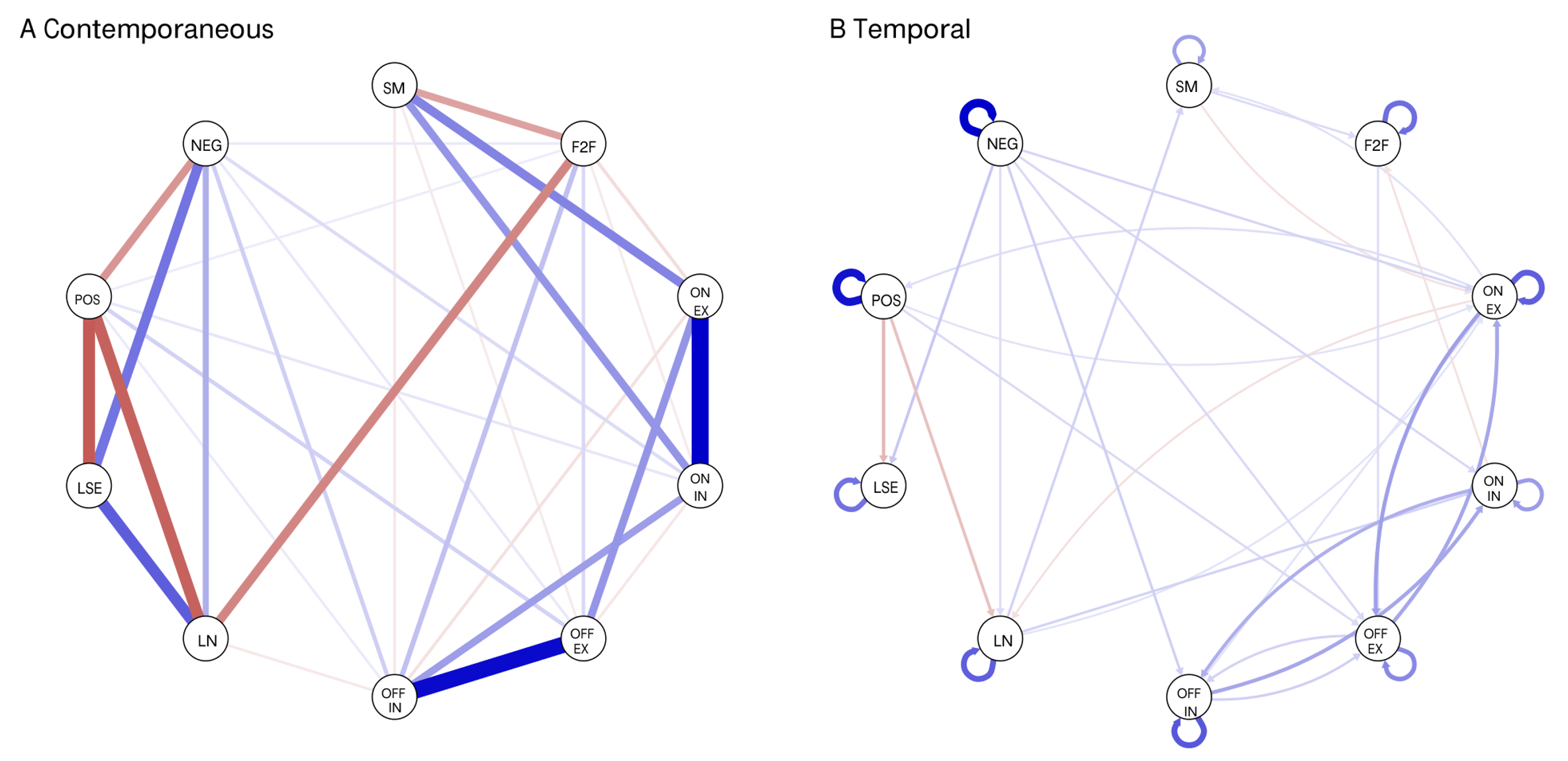
Note. Contemporaneous and temporal networks are shown. Blue lines/edges represent positive associations between variables (nodes), and red edges represent negative associations, where the thickness of the line indicates strength of association. Only significant edges are shown. LN = loneliness; LSE = low self-esteem; POS = positive affect; NEG = negative affect; SM = time spent on social media (online); F2F = time spent face-to-face (offline); ON EX = (upward) online comparisons in the extrinsic domain;
ON IN = (upward) online comparisons in the intrinsic domain; OFF EX = (upward) offline comparisons in the extrinsic domain; OFF IN = (upward) offline comparisons in the intrinsic domain.
Next, considering social comparisons, there were positive reciprocal interactions between most of the online and offline, intrinsic and extrinsic comparisons, indicating that if a participant made one type of social comparison, they were more likely to make subsequent comparisons, irrespective of context or domain. Focusing on offline social comparisons first, the only associations with psychological constructs seen were with respect to affect, with negative affect driving offline intrinsic (EW = .05, SE = .01, p = .001) and extrinsic comparisons (EW = .04, SE = .01, p = .004), and positive affect driving offline extrinsic comparisons (EW = .04, SE = .01, p = .010).
With respect to online social comparisons, online extrinsic comparisons were driven by affect, both positive (EW = .03, SE = .01, p = .031) and negative affect (EW = .04,
SE = .01, p = .004), as well as feelings of loneliness (EW = .03, SE = .01, p = .034). Interestingly, potential feedback loops were evident, with online extrinsic comparisons predicting subsequent increases in positive affect (EW = .03, SE = .01, p = .016) and decreases in loneliness (EW = −.03, SE = .02, p = .028). With respect to online intrinsic comparisons, the only link was to negative affect, with negative affect driving subsequent online intrinsic comparisons (EW = .04, SE= .01, p = .008).
Discussion
With respect to our stated hypotheses, H1 (online and offline social comparisons of extrinsic aspirational dimensions will be associated with poorer wellbeing) was not supported as stated, with mixed evidence across outcomes and contexts. In the contemporaneous network extrinsic offline comparisons were linked to affect irrespective of sign (i.e., positive and negative affect), and extrinsic online comparisons were not associated with any wellbeing variable. Further, in the temporal network, there was a relatively clear association between extrinsic comparisons (in the online context) and positive wellbeing, specifically, reduced loneliness and increased positive affect (more on this below).
With respect to H2 (online and offline social comparisons of intrinsic aspirational dimensions will not be associated with poorer wellbeing, and may even be associated with positive wellbeing), the findings were also more nuanced than anticipated, and did not converge on a single directional pattern. Thus, whilst there was an association between offline intrinsic comparisons and reduced loneliness and increased positive affect (in the contemporaneous network), suggesting potential benefits to wellbeing in terms of short-acting effects, an association was also seen with increased negative affect, suggesting once again, a potential link between comparisons and affect that is irrespective of sign. Further, in the temporal network intrinsic social comparisons did not predict any wellbeing variables at the following time point; rather, all social comparisons were predicted by negative affect.
Finally, in terms of the exploratory analysis (negative associations between social comparisons and wellbeing may be ameliorated, or even reversed, in the temporal network), there was partial support for this. Thus, whilst online extrinsic comparisons were not linked to any wellbeing variable in the contemporaneous network (arguably reflecting no short-acting effects, or no net short-acting effects), there was—as noted above—evidence for an association between online extrinsic comparisons and positive wellbeing, i.e., increased positive affect and decreased loneliness, in the temporal network. This is potentially consistent with a two-step model of social comparisons, in which the second step is less harmful or more beneficial (Buunk & Gibbons, 2007).
Locating the Findings Within the Existing Literature
As per Tibber et al. (2025), we find evidence consistent with the notion that social comparisons are relatively automatic. Thus, time spent online and offline was robustly linked to increased online and offline social comparisons, respectively, such that social comparisons may be an inevitable consequence of spending time with others (irrespective of context). Second, there were strong and robust positive reciprocal interactions between all social comparisons irrespective of type (intrinsic or extrinsic), context (online or offline) or network (contemporaneous or temporal). This would seem to suggest that social comparisons may be a more unitary phenomenon than we proposed in the introduction, or at least, that different types of social comparisons are closely related. This provides support for the theoretical assumptions underpinning measures such as the Social Comparison Orientation (SCO) index, which posit a general pre-disposition towards making social comparisons. However, it is important to note that some differences in patterns of findings were found with respect to comparison dimensions.
Third, irrespective of the sign of the affect (i.e., positive or negative), affect was closely (positively) linked to social comparisons, again across online/offline and intrinsic/extrinsic contexts and domains. Further, the temporal network suggests that this likely reflects elevated affect driving greater social comparisons rather than the reversed direction of causality. One post hoc explanation for this is that in times of elevated affect, we turn to others to make sense of our experiences, irrespective of whether they are linked to positive or negative affect. This is, in essence, close to Festinger’s original formulation of social comparison theory, which did not focus on upward or downward social comparisons, identification or contrast, etc., but more broadly on our tendency to turn towards comparators as a source of gauging one’s own worth and ability, likely universally because “the holding of incorrect opinions and/or inaccurate appraisals of one’s abilities can be punishing or even fatal in many situations” (Festinger, 1954).
Fourth, quite unexpectedly, there seemed to be a protective effect of online extrinsic comparisons, with participants subsequently comparing themselves to others when they were high in affect (positive or negative) or lonely, with feedback loops potentially driving increased positive affect and reduced loneliness as a result. On the basis of our reasoning, we had assumed that any negative effects of social comparisons would be more pronounced and/or evident in extrinsic domains, since (as noted in the introduction), extrinsic comparisons may be easier to operationalize in terms of reductive metrics (e.g., wealth; Nesi et al., 2018a), more closely linked to global self-worth due to social sanctioning (Harter, 1999), and less connected to mental health and wellbeing because of their reduced likelihood in driving behaviors linked to satisfaction of core needs (Sheldon et al., 2004).
Making Sense of Patterns Across Intrinsic and Extrinsic Comparisons
One post hoc explanation of our unexpected findings with respect to intrinsic and extrinsic comparisons is that the same mechanisms that we posited would amplify the harms of comparisons might in fact amplify their benefits. Thus, if we focus on the potential benefits of upward comparisons, i.e., ‘benign envy’, which have been described in the literature (Meier et al., 2020), extrinsic comparisons may be more motivating (in a positive way), because they are more visible, operationalizable, and quantifiable.
A complementary interpretation situates this pattern in a broader marketized platform ecology. Thus, Butler (2021) argues that, in modern market cultures young people may feel ‘obliged’ to develop market-driven identities, i.e., identities underpinned by extrinsically oriented criteria such as beauty, wealth, status, and achievement. In this context, SM may operate as an extrinsically oriented ecological niche in which these criteria are made more salient, whilst also affording peer approval and a sense of belonging contingent on signaling (and hence monitoring) of these criteria (Butler, 2024). From this perspective, online extrinsic comparisons may lead to a sense of being ‘on track’, i.e., being aligned with predominant cultural norms and values, driving an increase in positive affect and a decrease in loneliness as a result, at least in the short-term. If this is the case, however, it is unclear whether such putative benefits are long-lasting, particularly in the context of a wealth of evidence linking extrinsic motivations to negative health outcomes (Bradshaw et al., 2023).
It is also critical to note that in their meta-analysis, Bradshaw et al. (2023) showed that the negative relationship between extrinsic goals and well-being is most evident when extrinsic pursuits are prioritized relative to intrinsic goals (i.e., relative centrality), rather than when considering absolute levels of extrinsic striving alone. This highlights a potential distinction between: (i) the domain on which comparisons occur, and (ii) individuals’ broader goal prioritization profiles, something that our data cannot speak to.
Another possibility, which does not preclude the above, is that whilst we predicted that intrinsic comparisons would be more closely linked to benefits and/or fewer harms by virtue of intrinsic motivations themselves being more closely linked to satisfaction of core needs, this need not necessarily be the case for intrinsic comparisons. In fact, whilst satisfaction of core needs such as autonomy, relatedness and competence may drive life satisfaction, comparing oneself to others (and falling short) on these dimensions may be deeply troubling, because they are deeply valued.
In parallel, trends towards increasing materialism, including within China (Cao, 2024), and arguably exacerbated in the online environment (Butler, 2024), may have successfully commodified such intrinsic aspirations. Thus, social connections become equated to one’s network size or number of friends, physical health and self-care become reduced to shared statistics of one’s latest park run, self-growth is captured by a posted list of books you read this year, and one’s community engagement is gauged by the number of political causes retweeted. Whilst this may be an exaggeratedly pessimistic take on the online social world, there is no doubt that SM companies, and digital technologies more generally, seek to commodify deep and meaningful experiences and yearnings (Zuboff, 2015).
Making Sense of the Relative Lack of Associations Between Social Comparison and Poor Wellbeing
In trying to understand the lack of associations between social comparisons and poor wellbeing in our data, which have been documented elsewhere, in cross-sectional, longitudinal and experimental studies (e.g., Vogel et al., 2014, 2015), it is important to note that negative effects are far from ubiquitous in the literature; as noted, positive effects have been documented and are in no way contradictory to social comparison theory (e.g., Ruggieri et al., 2021). In addition, we cannot entirely rule out the possibility of negative effects in our data, since associations between offline comparisons (intrinsic and extrinsic) and negative affect were seen in the contemporaneous network, potentially indicating fast-acting (harmful) impacts, consistent with the first automatic step of a two-step model of social comparisons (Buunk & Gibbons, 2007). As noted, however, we cannot draw conclusions about underlying directionality from the contemporaneous network.
It is also possible that there is something particular about our population sample. One essential concern is the cultural applicability of GCT, since it is grounded in literature dominated by Western samples. The intrinsic–extrinsic goal distinction shows a broadly similar structural organization across diverse cultures (Grouzet et al., 2005), and cross-cultural studies of SDT indicate that basic need satisfaction is consistently linked to wellbeing across multiple cultural contexts, albeit with meaningful variation in levels and pathways due to cultural differences (Church et al., 2013; Nalipay et al., 2020). At the same time, evidence from Chinese samples suggests that the wellbeing correlates of extrinsic pursuits are not uniformly negative and may depend on how extrinsic goals are conceptualized and measured (Zhou et al., 2022). Zhou et al. (2022) further note that, in Confucian cultural contexts (i.e., cultures in which Confucianism is common or even dominates), financial striving may partly reflect relational responsibilities (e.g., supporting family), potentially lending ‘extrinsic’ goals a more intrinsic or other-oriented meaning and attenuating their negative associations with wellbeing. Relatedly, cross-cultural work on achievement motivation in student samples indicates that extrinsic motivational drives can be more normative—and sometimes more beneficial—in Chinese than in Western European contexts, consistent with social-oriented achievement obligations (Tao & Hong, 2014; Zhang et al., 2025). Together, these findings caution against assuming that extrinsic comparison domains carry identical meanings or wellbeing implications across cultures.
More broadly, these considerations also point to the possibility that our findings with respect to extrinsic comparison–wellbeing links may be historically and institutionally contingent in contemporary China. Longitudinal evidence suggests that the adaptiveness of particular psychological tendencies can shift as socio-economic ecologies change. For example, X. Chen et al. (2005) reported that shyness was associated with social and academic achievement in a cohort of Chinese children assessed in 1990, yet by 2002 was linked to peer rejection, school problems, and depressive symptoms—consistent with reduced fit in a more market-oriented environment. By analogy, the affective consequences of extrinsic comparisons (and their balance of short-term versus longer-term effects) may depend on the broader socio-ecology in which such criteria are rendered salient and rewarded, which cautions against over-generalizing the present pattern beyond contemporary China.
Relatedly, in an attempt to explain their findings of a temporal association between (online) upward social comparisons and increased positive affect and decreased negative affect (Tibber et al., 2025), the authors drew on previous literature to suggest that the effects of social comparisons may be weighted more towards benefits, including ‘benign envy’, in horizontal (i.e., less hierarchical) collectivist cultures such as China, where both these studies were undertaken. Why this is the case is not entirely clear, though several authors have speculated.
In a study of European Canadians and Asian Canadians, which found that Asian Canadians made more upward social comparisons, particularly after being primed to the possibility of self-improvement, the authors proposed that individuals from collectivist cultures may ‘seek social comparisons in ways that facilitate self-improvement’ (White & Lehman, 2005). In another study of US and Chinese students, the authors found that individuals who scored more highly on an index of collectivism reported an increased tendency/desire to make upward social comparisons (Chung & Mallery, 1999). Interestingly, however, the Chinese students actually scored lower than the US students on the collectivism index (based on a self-report questionnaire), though the authors speculated that this may have reflected demand characteristics driven by the Chinese participants knowing that the study was US-sponsored. Nonetheless, the authors proposed that ‘individuals high in collectivism may make upward […] comparisons in order to contribute to the betterment of the group’ (Chung & Mallery, 1999); see also (C. Chen et al., 1995) on potential cross-cultural differences in response styles. Taken together, these suggest that social comparisons may serve a different function, and be differently motivated, in individualistically- and collectivistically- oriented individuals (and/or communities), with the latter potentially motivated more by self-betterment, possibly even for the collective good. However, further research is needed to test this explicitly. We also note that the individualism–collectivism rubric may be too coarse to capture the political–economic specificity and rapid institutional change of contemporary China and should therefore be treated as only one partial lens (Milanovic, 2019; Weber, 2020).
Finally, with respect to methodology, one difference between this study and much previous research is that we used a more granular approach to conceptualising and operationalising social comparisons, exploring comparisons on specific dimensions. Thus, it is possible that more general questions such as ‘In the past hour, I have compared myself to others I encountered online who are better off than me’ (Tibber et al., 2025) or ‘Since the previous signal, I have compared myself with others on Facebook/Instagram’ (Faelens et al., 2021) prime the participants to make more global assessments of their self-worth, with consequently more marked effects on well-being and self-esteem.
Limitations and Conclusion
With respect to the limitations of the study, there are several, including our exclusive use of self-report measures, particularly for data on SM use. Meta-analytic evidence indicates that self-reported digital media use often corresponds only moderately with logged indicators and may be inaccurate (Parry et al., 2021), which could attenuate or bias associations involving these nodes in the network. Whilst passive tracking approaches are generally considered more accurate for quantifying use, they can still involve practical, ethical, and measurement challenges (e.g., incomplete capture across devices). Accordingly, future studies should combine device-based logs with EMA to triangulate exposure and better link objective use patterns to subjective experiences. Nonetheless, EMA-based self-reports may remain valuable for capturing perceived and context-dependent engagement (Johannes et al., 2021).
Second, our measures indexed momentary engagement in upward comparisons on each domain, but not the subjective appraisal/outcome of the comparison (e.g., contrast vs. identification). Future EMA work should incorporate measures of putative mediating processes (e.g., perceived relative status) to better explain the mechanism/s linking comparisons to wellbeing. In the meantime, the items regarding intrinsic domain can be less directly observable and more target-dependent than extrinsic domain, which may introduce ambiguity and attenuate associations.
Third, loneliness and self-esteem were assessed with two-item measures, which may limit construct breadth and sensitivity to change and this could attenuate estimated associations. However, using brief item sets can reduce participant burden and maximise compliance in such an intensive EMA design, which is consistent with common EMA practice (Burnell et al., 2024; Siebers et al., 2022). Our data also show meaningful within-person variability in these measures (see within-person standard deviations reported in Results), indicating that these variables were not static over the study window.
Fourth, a known challenge in intensive longitudinal designs is measurement reactivity, whereby repeated prompts can alter participants’ awareness, behavior, or reporting over time (French & Sutton, 2010). This is more likely when repeated assessment increases self-monitoring and self-regulation, and when the measured experiences are perceived as changeable and controllable (Shiffman et al., 2008). A systematic review of EMA reactivity in health-behavior research suggests that such effects are often small, but can be meaningful, and may vary by domain and study design (König et al., 2020). In addition to potential changes in experiences themselves, intensive self-report designs may also induce shifts in response strategies (e.g., satisficing), potentially degrading data quality over time (Wang et al., in press). In our analyses, we de-trended variables by study day to better meet stationarity assumptions, which may mitigate broad linear drift over the study period; however, such adjustment cannot fully rule out reactivity or other time-varying response biases.
Finally, as has been noted previously, drawing causal inferences in network analysis makes a number of assumptions that may not always be met, including that there are no time-varying confounders; further, network analysis may be prone to spurious effects, particularly where many variables are modelled, because of collider bias (York, 2018), which cannot be ruled out here.
Despite these limitations, we feel that the data reported here offer an important contribution to our understanding of social comparative processes in online (and offline) contexts. Whilst they must be replicated and cross-checked using other methodologies that provide complementary strengths and weaknesses (e.g., qualitative research, longitudinal studies and experimental designs), we believe that it is only through a process of triangulation and integration of approaches that lasting insights will be reached.
In conclusion, whilst there are considerable differences between this study and previous literature on which it closely follows and builds (Faelens et al., 2021; Tibber et al., 2025), the findings broadly support their conclusions in showing that social comparisons are: (i) a common if not ubiquitous, and potentially automatic, process, which is (ii) closely linked to various indices of wellbeing, notably here affect, and (iii) potentially transformed by the online environment (Nesi et al., 2018a, 2018b), with the tantalising and somewhat surprising possibility that, under certain conditions, (iv) online social comparisons may be linked to beneficial effects on mood and wellbeing. Future studies must begin to identify the contextual factors (individual, technological and cultural) that determine when and where such benefits and harms are experienced. One potentially fruitful line of investigation that we would propose on the basis of our own work is a cross-cultural study of social comparisons and their association with wellbeing in collectivist and individualist cultures.
Conflict of Interest
The authors have no conflicts of interest to declare.
Use of AI Services
The authors declare they have not used any AI services to generate any part of the manuscript or data. However, the authors used ChatGPT, Gemini, and Grammarly to improve the readability of the manuscript.
Data Availability Statement
The data and replication codes for this study are available at https://osf.io/6eh98/files/osfstorage.
Acknowledgement
This project was supported by the Hefei University Talent Research Fund awarded to Minglei Wang (25RC42). The authors would like to thank Timothy Toft for comments on the manuscript.
Appendices
Appendix A
Table A1. EMA Survey Items and Chinese Translations.
|
Variable |
Items (English) |
Items (Chinese) |
|
Social media time |
(i) In the past hour, how many minutes have you spent on social media platforms? |
(i) 在过去的一小时内,你花了多少分钟在社交媒体平台上? |
|
Face-to-face time |
(i) In the past hour, how many minutes have you spent in the physical presence of others, i.e., at least one other person regardless of whether you interacted with them? |
(i) 在过去的一小时内,你花了多少分钟在现实生活中与他人在一起(无论你是否与他人有交流)? |
|
Online upward SCs (Extrinsic domains) |
In the past hour, how much have you compared yourself to the following people online? |
在过去的一小时内,你在多大程度上将自己和在网络上遇到的下列这些人进行比较? |
|
(i)People who are richer than you are (ii) People who are more physically attractive than you are (iii) People who are more famous than you are. |
(i) 比你更富有的人 (ii) 比你外表更有吸引力的人 (iii) 比你更有名气的人 |
|
|
Online upward SCs (Intrinsic domains) |
In the past hour, how much have you compared yourself to the following people online? |
在过去的一小时内,你在多大程度上将自己和在网络上遇到的下列这些人进行比较? |
|
(i) People with deeper and more intimate relationships than you have (such as friends, family, and romantic partners), (ii) People who help others in need more than you do, (iii) People who choose what they do, instead of being pushed along by life (more than you do). |
(i) 比你拥有更深厚更亲密的关系的人 (ii) 比你更多帮助他人的人 (iii) 比你更能自主选择自己要做的事而不是被生活推着走的人 |
|
|
Offline upward SCs (Extrinsic domains) |
In the past hour, how much have you compared yourself to the following people offline? |
在过去的一小时内,你在多大程度上将自己和在现实生活中遇到的下列这些人进行比较? |
|
(i) People who are richer than you are, (ii) People who are more physically attractive than you are, (iii) People who are more famous than you are. |
(i) 比你更富有的人 (ii) 比你外表更有吸引力的人 (iii) 比你更有名气的人 |
|
|
Offline upward SCs (Intrinsic domains) |
In the past hour, how much have you compared yourself to the following people offline? |
在过去的一小时内,你在多大程度上将自己和在现实生活中遇到的下列这些人进行比较? |
|
(i) People with deeper and more intimate relationships than you have (such as friends, family, and romantic partners), (ii) People who help others in need more than you do, (iii) People who choose what they do, instead of being pushed along by life (more than you do). |
(i) 比你拥有更深厚更亲密的关系的人 (ii) 比你更多帮助他人的人 (iii) 比你更能自主选择自己要做的事而不是被生活推着走的人 |
|
|
Low self-esteem |
(i) In the past hour, I have felt insecure. (ii) In the past hour, I have felt positive toward myself (R). |
(i) 在过去的一小时内,我缺乏安全感。 (ii) 在过去的一小时内,我对于自己是抱着肯定的态度(R)。 |
|
Loneliness |
(i) In the past hour, I have felt close to people (R). |
(i) 在过去的一小时内,我感到与他人亲近(R)。 (ii) 在过去的一小时内,我感到孤独。 |
|
Affect |
Please try and rate the separate emotions separately, so that for example a score of zero on happiness means that you are not feeling happy, but does not necessarily mean that you are feeling sad. In the past hour, I have felt… |
请对下列情绪进行独立地评分,比如,给“高兴的”选择0分意味着你没有感受到高兴,但并不一定意味着你感受到悲伤。在过去的一小时内,我感到: |
|
Positive affect |
(i) Happy, (ii) Satisfied, (iii) Energetic. |
(i) 高兴的;(ii) 满意的;(iii) 精神充沛的。 |
|
Negative affect |
(i) Angry, (ii) Tense, (iii) Sad, (iv) Anxious. |
(i) 生气的;(ii) 紧张的; (iii)悲伤的;(iv) 焦虑的。 |
|
Note. Chinese translation of items included. |
||
Appendix B
Table B1. Contemporaneous Network Associations Among EMA Variables.
|
Variable 1 |
Variable 2 |
Partial correlation (SD) |
Correlation (SD) |
p value (1→2) |
p value (1←2) |
|
Face-to-face time |
Social media time |
−.141 (.234) |
−.184 (.263) |
< .001 |
< .001 |
|
Online extrinsic SC |
Social media time |
.184 (.096) |
.275 (.160) |
< .001 |
< .001 |
|
Online extrinsic SC |
Face-to-face time |
−.051 (.022) |
−.092 (.132) |
< .001 |
< .001 |
|
Online intrinsic SC |
Social media time |
.156 (.070) |
.255 (.153) |
< .001 |
< .001 |
|
Online intrinsic SC |
Face-to-face time |
−.031 (.024) |
−.075 (.127) |
.012 |
.021 |
|
Online intrinsic SC |
Online extrinsic SC |
.378 (.227) |
.430 (.244) |
< .001 |
< .001 |
|
Offline extrinsic SC |
Social media time |
−.032 (.048) |
−.019 (.136) |
.027 |
.027 |
|
Offline extrinsic SC |
Face-to-face time |
.057 (.038) |
.109 (.111) |
< .001 |
< .001 |
|
Offline extrinsic SC |
Online extrinsic SC |
.157 (.176) |
.159 (.262) |
< .001 |
< .001 |
|
Offline extrinsic SC |
Online intrinsic SC |
−.038 (.030) |
.077 (.199) |
.007 |
.004 |
|
Offline intrinsic SC |
Social media time |
−.035 (.010) |
−.030 (.119) |
.006 |
.003 |
|
Offline intrinsic SC |
Face-to-face time |
.094 (.058) |
.137 (.111) |
< .001 |
< .001 |
|
Offline intrinsic SC |
Online extrinsic SC |
−.044 (.057) |
.063 (.197) |
.005 |
.003 |
|
Offline intrinsic SC |
Online intrinsic SC |
.145 (.131) |
.148 (.215) |
< .001 |
< .001 |
|
Offline intrinsic SC |
Offline extrinsic SC |
.362 (.209) |
.385 (.228) |
< .001 |
< .001 |
|
Loneliness |
Face-to-face time |
−.186 (.080) |
−.233 (.117) |
< .001 |
< .001 |
|
Loneliness |
Offline intrinsic SC |
−.034 (.054) |
−.075 (.111) |
.008 |
.047 |
|
Low self-esteem |
Loneliness |
.240 (.146) |
.394 (.197) |
< .001 |
< .001 |
|
Positive affect |
Face-to-face time |
.027 (.017) |
.124 (.083) |
.038 |
.020 |
|
Positive affect |
Online intrinsic SC |
.036 (.007) |
.018 (.093) |
.005 |
.001 |
|
Positive affect |
Offline extrinsic SC |
.067 (.050) |
.098 (.100) |
< .001 |
< .001 |
|
Positive affect |
Offline intrinsic SC |
.030 (.025) |
.070 (.092) |
.019 |
.018 |
|
Positive affect |
Loneliness |
−.245 (.108) |
−.401 (.146) |
< .001 |
< .001 |
|
Positive affect |
Low self-esteem |
−.256 (.116) |
−.408 (.177) |
< .001 |
< .001 |
|
Negative affect |
Face-to-face time |
.033 (.045) |
−.036 (.087) |
.017 |
.026 |
|
Negative affect |
Online intrinsic SC |
.052 (.025) |
.078 (.077) |
< .001 |
< .001 |
|
Negative affect |
Offline extrinsic SC |
.034 (.055) |
.041 (.114) |
.015 |
.031 |
|
Negative affect |
Offline intrinsic SC |
.071 (.054) |
.075 (.115) |
< .001 |
< .001 |
|
Negative affect |
Loneliness |
.117 (.091) |
.266 (.170) |
< .001 |
< .001 |
|
Negative affect |
Low self-esteem |
.208 (.098) |
.340 (.153) |
< .001 |
< .001 |
|
Negative affect |
Positive affect |
−.161 (.172) |
−.298 (.229) |
< .001 |
< .001 |
|
Note. Effects are shown for the contemporaneous network. Partial and first-order correlation coefficients and associated standard deviations (SD) are shown for all significant effects. Non-significant effects are not shown. |
|||||
Appendix C
Table C1. Temporal Network Edges Among EMA Variables.
|
From |
To |
Edge weight (SE) |
p value |
|
Social media time |
Social media time |
.101 (.017) |
< .001 |
|
Social media time |
Face-to-face time |
.038 (.015) |
.011 |
|
Social media time |
Online extrinsic SC |
-.032 (.013) |
.010 |
|
Face-to-face time |
Face-to-face time |
.155 (.019) |
< .001 |
|
Face-to-face time |
Offline extrinsic SC |
.037 (.013) |
.006 |
|
Online extrinsic SC |
Social media time |
.031 (.015) |
.043 |
|
Online extrinsic SC |
Online social extrinsic SC |
.172 (.023) |
< .001 |
|
Online extrinsic SC |
Offline social extrinsic SC |
.101 (.020) |
< .001 |
|
Online extrinsic SC |
Loneliness |
-.034 (.016) |
.028 |
|
Online extrinsic SC |
Positive affect |
.035 (.015) |
.016 |
|
Online intrinsic SC |
Face-to-face time |
-.032 (.015) |
.028 |
|
Online intrinsic SC |
Online intrinsic SC |
.106 (.019) |
< .001 |
|
Online intrinsic SC |
Offline intrinsic SC |
.084 (.020) |
< .001 |
|
Offline extrinsic SC |
Online extrinsic SC |
.095 (.019) |
< .001 |
|
Offline extrinsic SC |
Offline extrinsic SC |
.125 (.018) |
< .001 |
|
Offline extrinsic SC |
Offline intrinsic SC |
.047 (.017) |
.006 |
|
Offline intrinsic SC |
Online extrinsic SC |
.030 (.015) |
.049 |
|
Offline intrinsic SC |
Online intrinsic SC |
.095 (.016) |
< .001 |
|
Offline intrinsic SC |
Offline extrinsic SC |
.050 (.016) |
.002 |
|
Offline intrinsic SC |
Offline intrinsic SC |
.177 (.021) |
< .001 |
|
Loneliness |
Social media time |
.048 (.015) |
.001 |
|
Loneliness |
Online extrinsic SC |
.029 (.014) |
.034 |
|
Loneliness |
Online intrinsic SC |
.047 (.014) |
.001 |
|
Loneliness |
Loneliness |
.171 (.018) |
< .001 |
|
Low self-esteem |
Low self-esteem |
.150 (.020) |
< .001 |
|
Positive affect |
Online extrinsic SC |
.029 (.014) |
.031 |
|
Positive affect |
Offline extrinsic SC |
.039 (.015) |
.010 |
|
Positive affect |
Loneliness |
-.067 (.016) |
< .001 |
|
Positive affect |
Low self-esteem |
-.078 (.017) |
< .001 |
|
Positive affect |
Positive affect |
.253 (.018) |
< .001 |
|
Negative affect |
Online extrinsic SC |
.044 (.015) |
.004 |
|
Negative affect |
Online intrinsic SC |
.041 (.015) |
.008 |
|
Negative affect |
Offline extrinsic SC |
.041 (.014) |
.004 |
|
Negative affect |
Offline intrinsic SC |
.052 (.015) |
.001 |
|
Negative affect |
Loneliness |
.037 (.014) |
.011 |
|
Negative affect |
Low self-esteem |
.058 (.016) |
< .001 |
|
Negative affect |
Negative affect |
.271 (.020) |
< .001 |
|
Note. Significant edges are shown for the temporal network (with a lag of one). Edge weight = fixed effects coefficients; SE = standard error of fixed effects. |
|||


This work is licensed under a Creative Commons Attribution-ShareAlike 4.0 International License.
Copyright © 2026 Marc S. Tibber, Chan Zhang, Minglei Wang