
Fostering constructive online news discussions: The role of anonymity and subjectivity in shaping perceived polarization in a Dutch sample of online commenters
Vol.20,No.5(2026)
Carla Anne Roos
 Sara Bögels
Emiel Krahmer
Online news discussions are often characterized by polarization and hostile interactions, which may discourage people from participating. This study examines whether two features of online comments influence how people perceive the polarization and disinhibition of commenters, as well as people’s own willingness to join discussions: sender anonymity and subjective phrasing, that is, explicitly phrasing an opinion as an opinion (e.g., “I think”, “In my opinion”). We conducted an experiment with a purposive subsample drawn from a representative general population sample of Dutch adults who self-reported to be currently or previously active in online news discussions (N = 294; repeated-measures, age range = 17–88 years). Participants evaluated manipulated comments to news articles about issues that were generally considered polarized in Dutch society. Sender anonymity did not affect perceived polarization, perceived disinhibition, or intentions to participate in discussions. Subjectivity, however, led participants to perceive comments as less polarized and less disinhibited. Although this did not increase participants’ intentions to join discussions, participants themselves used more subjective language when replying to subjectively phrased comments. These findings suggest that subtle changes in the way opinions are expressed can shape interaction norms in online discussions. Subjective phrasing may encourage more constructive communication styles to spread between users, even without top-down moderation or requirements for identity disclosure.
sender anonymity; subjective phrasing; perceived polarization; online disinhibition; intention to participate; norm compliance; online news discussions
Carla Anne Roos
Department of Communication and Cognition, Tilburg University, Tilburg
Carla A. Roos is assistant professor in the Communication and Cognition department of Tilburg University, The Netherlands.
Sara Bögels
Centre for Language Studies, Radboud University, Nijmegens
Sara Bögels is assistant professor in the Centre for Language Studies of Radboud University Nijmegen, The Netherlands.
Emiel Krahmer
Department of Communication and Cognition, Tilburg University, Tilburg
Emiel Krahmer is full professor in the Communication and Cognition department of Tilburg University, The Netherlands.
Asch, S. E. (1946). Forming impressions of personality. The Journal of Abnormal and Social Psychology, 41(3), 258–290. https://doi.org/10.1037/h0055756
Barnidge, M. (2017). Exposure to political disagreement in social media versus face-to-face and anonymous online settings. Political Communication, 34(2), 302–321. https://doi.org/10.1080/10584609.2016.1235639
Bates, D., Mächler, M., Bolker, B., & Walker, S. (2015). Fitting linear mixed-effects models using lme4. Journal of Statistical Software, 67(1), 1–48. https://doi.org/10.18637/jss.v067.i01
Benoit, K., Watanabe, K., Wang, H., Nulty, P., Obeng, A., Müller, S., & Matsuo, A. (2018). quanteda: An R package for the quantitative analysis of textual data. Journal of Open Source Software, 3(30), Article 774. https://doi.org/10.21105/joss.00774
Boutet, I., LeBlanc, M., Chamberland, J. A., & Collin, C. A. (2021). Emojis influence emotional communication, social attributions, and information processing. Computers in Human Behavior, 119, Article 106722. https://doi.org/10.1016/j.chb.2021.106722
Brehm, J. W. (1966). A theory of psychological reactance. Academic Press.
Byrne, D. (1961). Interpersonal attraction and attitude similarity. Journal of Abnormal and Social Psychology, 62(3), 713–715. https://doi.org/10.1037/h0044721
Caspi, A., & Raz, G. (2024). Using emojis that alter the meaning of written messages to communicate interpersonal relations. Media Psychology, 28(3), 385–411. https://doi.org/10.1080/15213269.2024.2374778
Chen, M. K., & Rohla, R. (2018). The effect of partisanship and political advertising on close family ties. Science, 360(6392), 1020–1024. https://doi.org/10.1126/science.aaq1433
Clark-Gordon, C., Bowman, N., Goodboy, A., & Wright, A. (2019). Anonymity and online self-disclosure: A meta-analysis. Communication Reports, 32(2), 98–111. https://doi.org/10.1080/08934215.2019.1607516
Cohen, J. (1988). Statistical power analysis for the behavioral sciences (2nd ed.). Routledge.
Dubrovsky, V. J., Kiesler, S., & Sethna, B. N. (1991). The equalization phenomenon: Status effects in computer-mediated and face-to-face decision-making groups. Human–Computer Interaction, 6(2), 119–146. https://doi.org/10.1207/s15327051hci0602_2
Febriana, S. K. T., & Fajrianthi. (2019). Cyber incivility perpetrator: The influenced of dissociative anonimity, invisibility, asychronicity, and dissociative imagination. Journal of Physics: Conference Series, 1175(1), Article 012238. https://doi.org/10.1088/1742-6596/1175/1/012238
Finegan, E. (1995). Subjectivity and subjectivisation: An introduction. In D. Stein & S. Wright (Eds.), Subjectivity and subjectivisation: Linguistic perspectives (pp. 1–15). Cambridge University Press. https://doi.org/DOI:10.1017/CBO9780511554469.001
Gerber, A. S., Huber, G. A., Doherty, D., & Dowling, C. M. (2012). Disagreement and the avoidance of political discussion: Aggregate relationships and differences across personality traits. American Journal of Political Science, 56(4), 849–874. https://doi.org/10.1111/j.1540-5907.2011.00571.x
Gervais, B. T. (2015). Incivility online: Affective and behavioral reactions to uncivil political posts in a web-based experiment. Journal of Information Technology & Politics, 12(2), 167–185. https://doi.org/10.1080/19331681.2014.997416
Heisler, J. M., & Crabill, S. L. (2006). Who are “stinkybug” and “Packerfan4”? Email pseudonyms and participants’ perceptions of demography, productivity, and personality. Journal of Computer-Mediated Communication, 12(1), 114–135. https://doi.org/10.1111/j.1083-6101.2006.00317.x
Huang, H. (2005). A cross-cultural test of the spiral of silence. International Journal of Public Opinion Research, 17(3), 324–345. https://doi.org/10.1093/ijpor/edh065
Kelm, O., Dohle, M., Friess, D., Vowe, G., & Ziegele, M. (2024). Which perceived opinion climates influence the participation in online political discussions? Journal of Broadcasting & Electronic Media, 68(4), 519–537. https://doi.org/10.1080/08838151.2024.2361113
Kim, J. won, & Park, S. (2018). How perceptions of incivility and social endorsement in online comments (dis)encourage engagements. Behaviour & Information Technology, 38(3), 217–229. https://doi.org/10.1080/0144929X.2018.1523464
Kim, M., Ellithorpe, M., & Burt, S. A. (2023). Anonymity and its role in digital aggression: A systematic review. Aggression and Violent Behavior, 72, Article 101856. https://doi.org/10.1016/j.avb.2023.101856
Kluck, J. P., & Krämer, N. C. (2022). “What an idiot!” – How the appraisal of the writer of an uncivil comment impacts discussion behavior. New Media & Society, 24(12), 2743–2762. https://doi.org/10.1177/14614448211000666
Knustad, M., & Johansson, C. (2021). Anonymity and inhibition in newspaper comments. Information, 12(3), Article 106. https://doi.org/10.3390/info12030106
Lakens, D. (2022). Sample size justification. Collabra: Psychology, 8(1), Article 33267. https://doi.org/10.1525/collabra.33267
Lapidot-Lefler, N., & Barak, A. (2012). Effects of anonymity, invisibility, and lack of eye-contact on toxic online disinhibition. Computers in Human Behavior, 28(2), 434–443. https://doi.org/10.1016/j.chb.2011.10.014
Lenth, R. V. (2021). emmeans: Estimated marginal means, aka least-squares means (version 1.5.5-1) [R package]. CRAN. https://CRAN.R-project.org/package=emmeans
Lu, S., Liang, H., & Masullo, G. M. (2023). Selective avoidance: Understanding how position and proportion of online incivility influence news engagement. Communication Research, 50(4), 387–409. https://doi.org/10.1177/00936502221130837
Lück-Benz, J., & Nardi, C. (2019). Incivility in user comments on online news articles: Investigating the role of opinion dissonance for the effects of incivility on attitudes, emotions and the willingness to participate. Studies in Communication and Media, 8(3), 311–337. https://doi.org/10.5771/2192-4007-2019-3-311
Miltenburg, E., Geurkink, B., Tunderman, S., Beekers, D., & den Ridder, J. (2022). Burgerperspectieven 2022|2 [Citizens' Perspectives 2022 | 2] [Report]. Sociaal en Cultureel Planbureau [Netherlands Institute for Social Research].
Minson, J. A., & Chen, F. S. (2022). Receptiveness to opposing views: Conceptualization and integrative review. Personality and Social Psychology Review, 26(2), 93–111. https://doi.org/10.1177/10888683211061037
Montoya, A. K., & Hayes, A. F. (2017). Two-condition within-participant statistical mediation analysis: A path-analytic framework. Psychological Methods, 22(1), 6–27. https://doi.org/10.1037/met0000086
Morio, H., & Buchholz, C. (2009). How anonymous are you online? Examining online social behaviors from a cross-cultural perspective. AI & Society, 23(2), 297–307. https://doi.org/10.1007/s00146-007-0143-0
Na, J., & Choi, I. (2009). Culture and First-Person Pronouns. Personality and Social Psychology Bulletin, 35(11), 1492–1499. https://doi.org/10.1177/0146167209343810
Neel, L. A. G., McKechnie, J. G., Robus, C. M., & Hand, C. J. (2023). Emoji alter the perception of emotion in affectively neutral text messages. Journal of Nonverbal Behavior, 47(1), 83–97. https://doi.org/10.1007/s10919-022-00421-6
Newman, N., Fletcher, R., Eddy, K., Robertson, C., & Nielsen, R. (2023). Reuters Institute Digital News Report 2023. Reuters Institute for the Study of Journalism.https://reutersinstitute.politics.ox.ac.uk/sites/default/files/2023-06/Digital_News_Report_2023.pdf
Nitschinsk, L., Tobin, S. J., & Vanman, E. J. (2022). The disinhibiting effects of anonymity increase online trolling. Cyberpsychology, Behavior, and Social Networking, 25(6), 377–383. https://doi.org/10.1089/cyber.2022.0005
Porter, T., Elnakouri, A., Meyers, E. A., Shibayama, T., Jayawickreme, E., & Grossmann, I. (2022). Predictors and consequences of intellectual humility. Nature Reviews Psychology, 1(9), 524–536. https://doi.org/10.1038/s44159-022-00081-9
Postmes, T., Spears, R., & Lea, M. (1998). Breaching or building social boundaries? SIDE-effects of computer-mediated communication. Communication Research, 25(6), 689–715. https://doi.org/10.1177/009365098025006006
Postmes, T., Spears, R., & Lea, M. (2000). The formation of group norms in computer-mediated communication. Human Communication Research, 26(3), 341–371. https://doi.org/10.1111/j.1468-2958.2000.tb00761.x
Preece, J., Nonnecke, B., & Andrews, D. (2004). The top five reasons for lurking: Improving community experiences for everyone. Computers in Human Behavior, 20(2), 201–223. https://doi.org/10.1016/j.chb.2003.10.015
Rains, S. A. (2007). The impact of anonymity on perceptions of source credibility and influence in computer-mediated group communication: A test of two competing hypotheses. Communication Research, 34(1), 100–125. https://doi.org/10.1177/0093650206296084
Rains, S., & Scott, C. (2007). To identify or not to identify: A theoretical model of receiver responses to anonymous communication. Communication Theory, 17(1), 61–91. https://doi.org/10.1111/j.1468-2885.2007.00288.x
Reader, B. (2012). Free press vs. free speech? The rhetoric of “civility” in regard to anonymous online comments. Journalism & Mass Communication Quarterly, 83(3), 495–513. https://doi.org/10.1177/1077699012447923
Rogers, S. L., Howieson, J., & Neame, C. (2018). I understand you feel that way, but I feel this way: The benefits of I-language and communicating perspective during conflict. PeerJ, 6(6), Article e4831. https://doi.org/10.7717/peerj.4831
Roos, C. A., Koudenburg, N., & Postmes, T. (2020). Online social regulation: When everyday diplomatic skills for harmonious disagreement break down. Journal of Computer-Mediated Communication, 25(6), 382–401. https://doi.org/10.1093/jcmc/zmaa011
Roos, C. A., Koudenburg, N., & Postmes, T. (2021). Dealing with disagreement: The depolarizing effects of everyday diplomatic skills face-to-face and online. New Media & Society, 24(9), 2153–2176. https://doi.org/10.1177/1461444821993042
Roos, C. A., Koudenburg, N., & Postmes, T. (2024). The social dynamics approach to mediated communication. European Review of Social Psychology, 35(2), 424–457. https://doi.org/10.1080/10463283.2024.2322905
Roos, C. A., Utz, S., Koudenburg, N., & Postmes, T. (2024). Diplomacy online: A case of mistaking broadcasting for dialogue. European Journal of Social Psychology, 54(1), 314–331. https://doi.org/10.1002/ejsp.3015
Roos, C. A., van der Linden, L., & Krahmer, E. (2025). Mitigating perceived polarization by acknowledging subjectivity: An experimental study of the impact of differently phrasing comments in online news discussions. Media Psychology, 28(6), 870–896.https://doi.org/10.1080/15213269.2025.2456956
Ruiz, C., Domingo, D., Micó, J. L., Díaz-Noci, J., Meso, K., & Masip, P. (2011). Public sphere 2.0? The democratic qualities of citizen debates in online newspapers. The International Journal of Press/Politics, 16(4), 463–487. https://doi.org/10.1177/1940161211415849
Shmargad, Y., Coe, K., Kenski, K., & Rains, S. A. (2022). Social norms and the dynamics of online incivility. Social Science Computer Review, 40(3), 717–735. https://doi.org/10.1177/0894439320985527
Stroud, N. J. (2008). Media use and political predispositions: Revisiting the concept of selective exposure. Political Behavior, 30(3), 341–366. https://doi.org/10.1007/s11109-007-9050-9
Suler, J. (2004). The online disinhibition effect. Cyberpsychology, Behavior, and Social Networking, 7(3), 321–326. https://doi.org/10.1089/1094931041291295
Tanis, M., & Postmes, T. (2003). Social cues and impression formation in CMC. Journal of Communication, 53(4), 676–693. https://doi.org/10.1111/j.1460-2466.2003.tb02917.x
Tanis, M., & Postmes, T. (2005). Short communication: A social identity approach to trust: Interpersonal perception, group membership and trusting behaviour. European Journal of Social Psychology, 35(3), 413–424. https://doi.org/10.1002/ejsp.256
Tessler, M. H., Bakker, M. A., Jarrett, D., Sheahan, H., Chadwick, M. J., Koster, R., Evans, G., Campbell-Gillingham, L., Collins, T., Parkes, D. C., Botvinick, M., & Summerfield, C. (2024). AI can help humans find common ground in democratic deliberation. Science, 386(6719), Article eadq2852. https://doi.org/10.1126/science.adq2852
van der Linden, L. C. A., Waterschoot, C., van den Hemel, E., Kunneman, F. A., van den Bosch, A. P. J., & Krahmer, E. J. (2025). Who are the online commenters? A large-scale representative survey to explore the identity and motivation of online news commenters in comparison to non-commenters. Social Science Computer Review. Advance online publication. https://doi.org/10.1177/08944393251410596
van der Zanden, T., Schouten, A. P., Mos, M. B. J., & Krahmer, E. J. (2020). Impression formation on online dating sites: Effects of language errors in profile texts on perceptions of profile owners’ attractiveness. Journal of Social and Personal Relationships, 37(3), 758–778. https://doi.org/10.1177/0265407519878787
Vinex. (2022, July). Nederlands online bereik onderzoek (NOBO) [Netherlands Online Reach Survey]. Top 50 Juli 2022. https://vinex.nl/wp-content/uploads/2022/08/NOBO-Top-50-juli-2022.pdf
Walther, J. B. (1992). Interpersonal effects in computer-mediated interaction: A relational perspective. Communication Research, 19(1), 52–90. https://doi.org/10.1177/009365092019001003
Wang, S. (2020). The influence of anonymity and incivility on perceptions of user comments on news websites. Mass Communication and Society, 23(6), 912–936. https://doi.org/10.1080/15205436.2020.1784950
Waterschoot, C. D. K. (2024). The constructive conundrum: Computational approaches to facilitate constructive commenting on online news platforms (Publication No. 2024 – 43) [Doctoral dissertation, Utrecht University]. SIKS Dissertation Series. https://doi.org/10.33540/2517
Willis, J., & Todorov, A. (2006). First impressions: Making up your mind after a 100-ms exposure to a face. Psychological Science, 17(7), 592–598. https://doi.org/10.1111/j.1467-9280.2006.01750.x
Witschge, T. (2004). Online deliberation: Possibilities of the internet for deliberative democracy. In P. M. Shane (Ed.), Democracy online: The prospects for political renewal through the internet (pp. 109–122). Routledge. https://doi.org/10.4324/9780203485415
Wu, S., Lin, T.-C., & Shih, J.-F. (2017). Examining the antecedents of online disinhibition. Information Technology & People, 30(1), 189–209. https://doi.org/10.1108/ITP-07-2015-0167
Wu, T.-Y., & Atkin, D. J. (2018). To comment or not to comment: Examining the influences of anonymity and social support on one’s willingness to express in online news discussions. New Media & Society, 20(12), 4512–4532. https://doi.org/10.1177/1461444818776629
Yeomans, M., Minson, J., Collins, H., Chen, F., & Gino, F. (2020). Conversational receptiveness: Improving engagement with opposing views. Organizational Behavior and Human Decision Processes, 160, 131–148. https://doi.org/10.1016/j.obhdp.2020.03.011
Zerback, T., & Fawzi, N. (2017). Can online exemplars trigger a spiral of silence? Examining the effects of exemplar opinions on perceptions of public opinion and speaking out. New Media & Society, 19(7), 1034–1051. https://doi.org/10.1177/1461444815625942
Zwaan, R., Etz, A., Lucas, R. E., & Donnellan, M. B. (2018). Making replication mainstream. Behavioral and Brain Sciences, 41, Article e120. https://doi.org/10.1017/S0140525X17001972
Authors' Contribution
Carla A. Roos: conceptualization, data curation, formal analysis, funding acquisition, investigation, methodology, project administration, software, resources, supervision, validation, visualization, writing—original draft, writing—review & editing. Sara Bögels: conceptualization, methodology, validation, writing—original draft, writing—review & editing. Emiel Krahmer: conceptualization, resources, validation, writing—original draft, writing—review & editing.
Editorial Record
First Submission:
April 8, 2025
Revisions:
December 20, 2025
July 5, 2026
October 13, 2026
Accepted:
October 16, 2026
Editor in charge:
Lenka Dedkova
Introduction
Increasing numbers of people turn to online platforms for their news consumption (Newman et al., 2023; Stroud, 2008). A key feature of some of these platforms is their discussion sections where the audience can express and debate their opinions on pressing topics, such as climate change measures or vaccinations. Arguably, these online news discussions play an important role in shaping how people perceive the broader societal debates surrounding these issues (Barnidge, 2017; Zerback & Fawzi, 2017). By enabling discussions among individuals with differing views, these online spaces have the potential to contribute to citizens’ constructive dialogue on public affairs (Ruiz et al., 2011; Tessler et al., 2024; Witschge, 2004). The reality of online news discussions often falls short of this ideal, however. Only a small fraction of online users actually posts comments in such discussions, with estimates ranging from 1 to 10% (Preece et al., 2004). People’s decisions about whether and how to participate in these discussions are strongly shaped by how respectful or hostile the atmosphere feels and by their perceptions of the other participants’ attitudes (van der Linden et al., 2025). To what extent is this discussion characterized by polarization and offensiveness versus mutual understanding and politeness? To answer this question, online commenters must rely on a limited set of cues, often only other commenters’ usernames and the content of their comments (Heisler & Crabill, 2006; Tanis & Postmes, 2005; Walther, 1992). Here we focus on two such online impression formation cues that might (unconsciously) affect people’s intention to join the online (news) discussion and the way they behave: sender anonymity and message subjectivity. Because only a minority of individuals actively participates in online discussions, understanding these processes requires studying those who are actively engaged in commenting.
A distinctive characteristic of online (news) discussions as compared to face-to-face interactions is their potentially anonymous character. On the one hand, anonymity has been suggested to facilitate equal and open dialogue, by obscuring status differences and relieving people from their tendency to avoid confronting disagreement (Dubrovsky et al., 1991; Witschge, 2004; T.-Y. Wu & Atkin, 2018). On the other hand, anonymous senders have been shown to feel less accountable for their actions and become disinhibited; they are more likely to act as they please because they are not as concerned with the impression they make on others (Clark-Gordon et al., 2019; Suler, 2004). In the context of controversy or polarization this disinhibition can take on toxic forms, such as trolling, cyberbullying, and other forms of online aggression (M. Kim et al., 2023; Nitschinsk et al., 2022). Such aggression causes many online users to avoid participating in these discussions themselves (J. W. Kim & Park, 2018; Lu et al., 2023). It thus appears that, under certain circumstances, being anonymous can lead people to act out online, which might discourage others from participating in the discussion. We propose, however, that simply perceiving someone as acting anonymously, regardless of their actual behavior, might in itself discourage participation as anonymity may serve as a heuristic cue that leads observers to infer sender disinhibition and polarization.
Another factor that likely shapes how people perceive the atmosphere of an online discussion and, in turn, their willingness to participate, concerns a characteristic of the comments. In online news discussions, individuals express their (often divergent) opinions and how they do this matters (Roos, Koudenburg, et al., 2024). Recent research shows that a subtle cue can affect perceptions of polarization and disinhibition in online discussions: subjectivity (Roos et al., 2025). Subjectivity markers, such as “I think,” “in my opinion,” or “I feel”, signal that a statement reflects a personal perspective (Finegan, 1995; Roos et al., 2025). The omission of these markers yields statements that appear more factual, as illustrated in the contrast between “I think that is not true” and “That is not true.” Subjectivity markers occur frequently in face-to-face (FtF) interaction, particularly in potentially conflictual exchanges (Roos et al., 2020), where they help regulate disagreement by leaving space for alternative views to be expressed and discussed (Minson & F. S. Chen, 2022; Rogers et al., 2018; Yeomans et al., 2020). Prior research demonstrates that text-based online communication is less subjective than FtF interaction and that this can lead to miscommunication and exaggerated perceptions of disinhibition and polarization (Roos et al., 2020, 2021). Extending this line of research, Roos et al. (2025) found that a lack of subjectivity in online comments contributes to an unwelcoming discussion climate and thereby discourages participation. However, their study did not examine this relationship among active online commenters. The current study therefore aims to replicate these findings in this specific population.
To examine whether and how subjectivity and anonymity shape perceptions and behaviors in online news discussions, we conducted a survey experiment with a purposive subsample drawn from a representative general population sample of Dutch adults that were currently or previously active online news commenters. These participants evaluated manipulated online news comments on several polarized topics: climate change, immigration, transgressive behavior of celebrities, and Zwarte Piet (Black Pete). Comments were either subjectively or non-subjectively phrased and attributed to either anonymous or identifiable senders.
Sender Anonymity
Whereas a lot of empirical and theoretical literature focuses on the cognitive and behavioral consequences of being anonymous (Lapidot-Lefler & Barak, 2012; Postmes et al., 1998; Suler, 2004), also called self-anonymity, much less is known about the consequences of perceiving someone else as acting anonymously, or other-anonymity (see also M. Kim et al., 2023; Rains & Scott, 2007). Previous studies have predominantly examined the effects of perpetrator anonymity in online aggression, showing that anonymous senders become more disinhibited and are more likely to engage in extreme and aggressive communication compared to when their identity is known (M. Kim et al., 2023). This has been shown in both observational studies where coders, often blind to sender anonymity, evaluate online behaviors (e.g., Knustad & Johansson, 2021) as well as in self-report research where online commenters report about their own online behaviors (Febriana & Fajrianthi, 2019; S. Wu et al., 2017). Much less research is available, however, on the perceptual effects of sender anonymity on the message reader. The available research shows that anonymity is often perceived less positively: people tend to evaluate an anonymous sender and their message as less credible as compared to an identified sender (Rains, 2007; Wang, 2020).
One mechanism that may underlie these unfavorable evaluations of anonymous senders is the perception that they are unwilling to be held accountable for their messages (Wang, 2020). People are known to quickly form first impressions of others (Asch, 1946; Willis & Todorov, 2006), and (anonymous) usernames and profile pictures are among the few cues available for making such judgments in online environments (Heisler & Crabill, 2006; Tanis & Postmes, 2003; Walther, 1992). These initial impressions can influence how the commenter’s subsequent messages are interpreted. Anonymity is generally considered empowering and liberating for the commenter (Reader, 2012). This link between anonymity and disinhibition is a well-known explanation for undesirable online behaviors: reduced inhibition lowers the threshold for posting comments, thereby increasing the likelihood of inappropriate or unwanted responses. As a result, people might either generally assume that commenters wanting to make controversial statements choose the safety of an anonymous channel to do so (“hiding behind the screen”), or, vice versa, that anonymity takes away the commenter’s social constraints to “unleash their inner beast”. In both cases, regardless of their actual degree of disinhibition, anonymous senders might thus be perceived as more disinhibited than non-anonymous senders. As disinhibition is characterized by a reduced focus on others and an increased self-focus (Suler, 2004), we expect that observers view anonymous senders as less open to others’ perspectives and more entrenched in their own. In turn, when perspectives differ, the anonymous sender may also be judged as less understanding and more disagreeing. Thus, we argue that anonymity may function as a cue that the commenter is less inclined to engage constructively with differing viewpoints.
We further propose that this could discourage others from participating in the online discussion. The lower perceived understanding and agreement of the anonymous sender with previous comments may discourage prospective participants because they feel like they have to choose between opposing camps (Kelm et al., 2024). When the anonymous sender is also perceived as disinhibited, this might lead prospective participants to fear being ignored and maybe even attacked themselves. Indeed, research has shown that perceiving an impolite online debate reduces people’s own intention to participate (Lu et al., 2023). So, even in cases where an anonymous commenter does not lose their social concerns and engages in unconstructive behaviors, they might still be perceived as such and scare away others, simply because they are anonymous. This brings us to our first two hypotheses:
H1: Participants perceive less agreement, less understanding, and more disinhibition in a commenter when the commenter is anonymous as compared to when the commenter is non-anonymous.
H2: Participants are less willing to contribute to the online discussion themselves when they read comments by anonymous versus non-anonymous commenters, and this effect is mediated by perceived agreement, understanding, and disinhibition.
Message Subjectivity
In addition to the identity of the commenters, the content of online comments shapes the perceived discussion atmosphere. Commenters can express their, potentially disagreeing, opinion about a polarized issue in various ways. We examine a subtle and ostensibly neutral cue that is pervasive in online comments and can unintentionally shape discussion tone in detrimental ways: subjectivity.
With subjectivity we mean the linguistic marking of a statement as an opinion that belongs to the speaker (Finegan, 1995; Roos et al., 2025). Examples of subjectivity markers include “I think”, “In my opinion”, and “I feel”. By using subjective language, a speaker arguably communicates intellectual humility in acknowledging that their viewpoint is just one of various possible viewpoints, rather than the only correct reflection of reality. In this way, subjectivity communicates that there is room for other opinions to coexist and be explored within the discussion. Therefore, subjectivity can be viewed as a form of conversational receptiveness—behaviors that demonstrate a willingness to openly listen to and thoughtfully engage with opposing views (Minson & F. S. Chen, 2022; Yeomans et al., 2020). Research found that subjectivity is used less in online text as compared to FtF interactions and that this can lead to the erroneous interpretation of lack of social concern in discussion partners (Roos et al., 2020, 2021). A recent study builds on these insights by comparing reader perceptions of online discussions with and without subjectivity markers (Roos et al., 2025). Results showed that readers perceived the commenters in the non-subjectively phrased discussions as more disinhibited and disagreeing, and thought commenters felt less heard and socially connected. These perceptions subsequently made readers less willing to participate in the discussion themselves.
There are two limitations to this previous study, however. First, it was conducted on a student sample composed primarily of lurkers: online users that only read online content without producing it themselves (Preece et al., 2004), which translated in a low overall intention to participate. While lurkers do represent the majority of online users, they are not the ones creating the content that affects people’s perception of society (Barnidge, 2017; Zerback & Fawzi, 2017). It therefore remains unclear whether the same processes apply to the minority of online commenters who create the content that also the lurking majority encounters. Research shows that commenters are a diverse group mainly motivated by expressing their opinions or emotions (van der Linden, 2025). Compared with lurkers, they are similar in education, income, background, residence, and political preferences, but are more often male, middle-aged, and less trusting of institutions. A second limitation of the Roos et al. (2025) study is that they manipulated and assessed perceptions of entire discussion threads. Consequently, while this approach demonstrates that discussion climates can influence perceptions and behavioral intentions, it does not reveal which specific characteristics of individual comments drive these effects. We therefore know little about how users evaluate and respond to single comments within online discussions.
These limitations motivate a conceptual replication of the findings reported by Roos et al. (2025). Conceptual replications are important because they test whether an effect generalizes across different samples and contexts, thereby strengthening confidence in the underlying theoretical mechanisms (Zwaan et al., 2018). In the present study, we therefore investigate whether the effects observed by Roos et al. (2025) also emerge among a sample of online commenters rather than lurkers, and when evaluations are based on a single online comment rather than an entire discussion thread. By testing the robustness and generalizability of the original findings, this study both replicates and extends this previous research. This leads us to hypothesize that:
H3: Participants perceive less agreement, less understanding, and more disinhibition in a commenter when the commenter's comment is non-subjectively phrased as compared to when the comment is subjectively phrased.
H4: Participants are less willing to contribute to the online discussion themselves when they read non-subjectively phrased versus subjectively phrased comments, and this effect is mediated by perceived agreement, understanding, and disinhibition.
Normative Behavior
Besides looking at whether people participate, we also want to know how they participate. Ample empirical research shows that participants in online discussions tend to behave in line with the prevalent expression style they observe around them; they comply with the local norms (Postmes et al., 2000; Shmargad et al., 2022). This would mean that when participants read subjectively phrased comments, they would express themselves using more subjectivity markers as well. This is important because this points towards a positively reinforcing spiral: subjectivity, that could indicate a friendly and inviting discussion atmosphere, invites more replies that are subjective, inviting more replies that are subjective, etc., leading to an increasingly more inviting atmosphere. We thus predict that:
H5: Participants use more subjectivity markers in response to subjectively phrased comments than in response to non-subjectively phrased comments.
Current Study
We tested our hypotheses in a within-subject experiment where participants read comments from online news discussions that were either subjectively or non-subjectively phrased, and written by an anonymous or non-anonymous sender. We also explored how participants’ agreement or disagreement with the comment influenced their perceptions and behavioral intentions, recognizing that people often experience negative emotions and react defensively or disengage when confronted with opposing viewpoints (Brehm, 1966; M. K. Chen & Rohla, 2018; Gerber et al., 2012). The news discussions used as stimuli were about four different topics that are generally considered to be polarized in Dutch society: climate change, immigration, transgressive behavior of celebrities or #MeToo, and Zwarte Piet (“Black Pete” in English). Although most of these issues elicit similar divisions across Western countries, the specific opposing viewpoints differ somewhat in the Dutch context (Miltenburg et al., 2022; Waterschoot, 2024). In the Netherlands, climate debates focus less on the existence of (human-caused) climate change and more on its severity and required societal sacrifices; immigration debates center on whether asylum inflows should be reduced due to perceived pressure on housing and public services; #MeToo discussions concern how to address sexual harassment while balancing the rights of victims and those accused; and Zwarte Piet involves disagreement over whether the traditional blackface depiction is a harmful stereotype or an important cultural tradition.
Methods
Design
The study has a within-subject design with two factors with two levels each: 1) anonymous versus non-anonymous senders and 2) subjectively phrased versus non-subjectively phrased comments. This comes down to four conditions. The study was approved by the Research Ethics and Data Management Committee of the Tilburg School of Humanities and Digital Sciences at Tilburg University. Informed consent was obtained from all participants prior to their participation. The study design, hypotheses, and analyses were preregistered before data collection at AsPredicted: https://aspredicted.org/ZKF_91L. The materials, anonymized dataset, and analysis code are publicly available from DataVerseNL: https://doi.org/10.34894/HD7DOI.
Stimuli
Each stimulus consists of a comment with a direct reply: a comment-reply pair. We created four different comment-reply pairs. The comment-reply pairs were based on real comments from discussions on www.NUjij.nl. This is one of the most frequently visited online news websites in the Netherlands which also provides the opportunity to comment on news articles (Vinex, 2022). We selected comment-reply pairs from existing discussions about topics that are currently considered polarized in Dutch society. To choose these topics, we asked the editors of NUjij which news items were controversial and invited many reactions: climate change, immigration, transgressive behavior of celebrities, and Zwarte Piet (Black Pete). Hereafter, we refer to the selected topics as follows: Climate, Immigration, MeToo, and ZP. We selected comments with direct replies where there was clear disagreement; preferably representing two clearly opposite positions on the news item. The comments needed to be of approximately equal length and understandable without the context of the news article. Comments could not contain (rhetorical) questions, sarcasm, and other factors potentially causing ambiguity in reader understanding. We removed personal attacks in order to minimize differences in extremity in the comments. We additionally removed any spelling mistakes, because these can also strongly affect interpretations (van der Zanden et al., 2020). For ethical and privacy reasons, the comments were slightly adapted through use of paraphrasing, so that they could not directly be traced back to the original comments. We conducted a pretest with N = 5 communication scientists to make sure the “extremity” of comments did not confound the effect of topic.
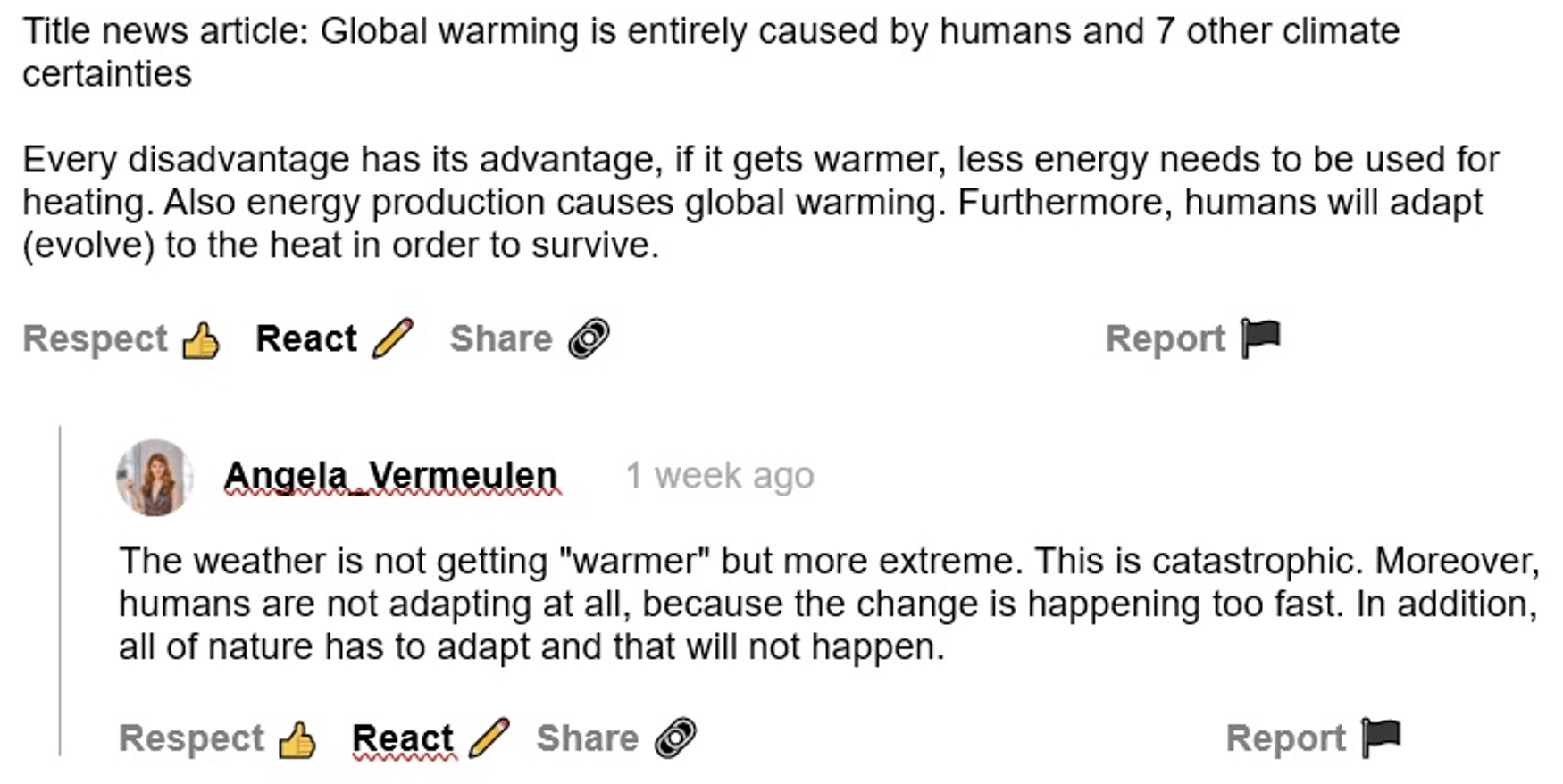
In line with the conditions, we subsequently made four versions of each comment-reply pair. First, for the anonymity factor, we manipulated whether the user replying to the first comment was represented by a constructed but apparently real and non-anonymous profile picture and name, or by a clearly anonymous username and profile picture template. The non-anonymous and anonymous names were inspired by real user names, for example, “Angela_Vermeulen” and “Frans_V_Beek” as non-anonymous user names, and “A4tje” (A4 in English) and “Gebruiker123” (User123 in English) as anonymous user names. For the non-anonymous condition, we constructed two male and two female profiles. The non-anonymous profile pictures were taken from the stock photo website Pixabay. They contained frontal photos of people with neutral facial expressions, zoomed out and shrunken to such an extent to make details invisible. The anonymous profile picture was a standard profile picture template. Second, to manipulate subjectivity, we included an opinion statement (e.g., "I think", "In my opinion") in each sentence of both the first comment and the reply. The non-subjectively phrased condition included the original comments because these did not include any opinion statements in the first place.
We put all comments in the format of Nujij.nl where we indicated all comments as being posted “One week ago” and included buttons for: Respect, React, Share, and Report (but without any scores). Above the comment-reply pairs, we placed the title of the online news article from which the respective comments originated. See Figure 1 below for an example stimulus and see Appendix A for all stimuli, translated from Dutch to English by the first author. Since we had four topics (e.g., Climate, Immigration), we had 16 possible combinations of topics crossed with both factors (anonymity and subjectivity). Applying a classical Latin-square design, we made four lists of four stimuli each to which participants were randomly assigned and within which the stimuli were presented in random order, see Appendix B. In this way, all participants were exposed to all conditions and all topics (but different combinations of them) and all conditions were combined with all topics over participants.
Figure 1. Example of a Comment With Non-Subjective and Non-Anonymous Reply, Translated to English.
Sample
Participants were recruited via the LISS panel (Longitudinal Internet studies for the Social Sciences) managed by the non-profit research institute Centerdata (https://en.centerdata.nl/liss-panel). The LISS panel is a representative sample of the Dutch population, based on a true probability sample of households drawn from the population register of Statistics Netherlands (CBS). The panel includes approximately 5,300 households including about 7,500 adults aged 16 and older. Participation is by invitation only, and self-registration is not allowed. Households that lack the means to participate are provided with a computer and internet access. LISS panel members sign informed consent to participate in monthly online questionnaires and receive a monetary incentive for each completed questionnaire.
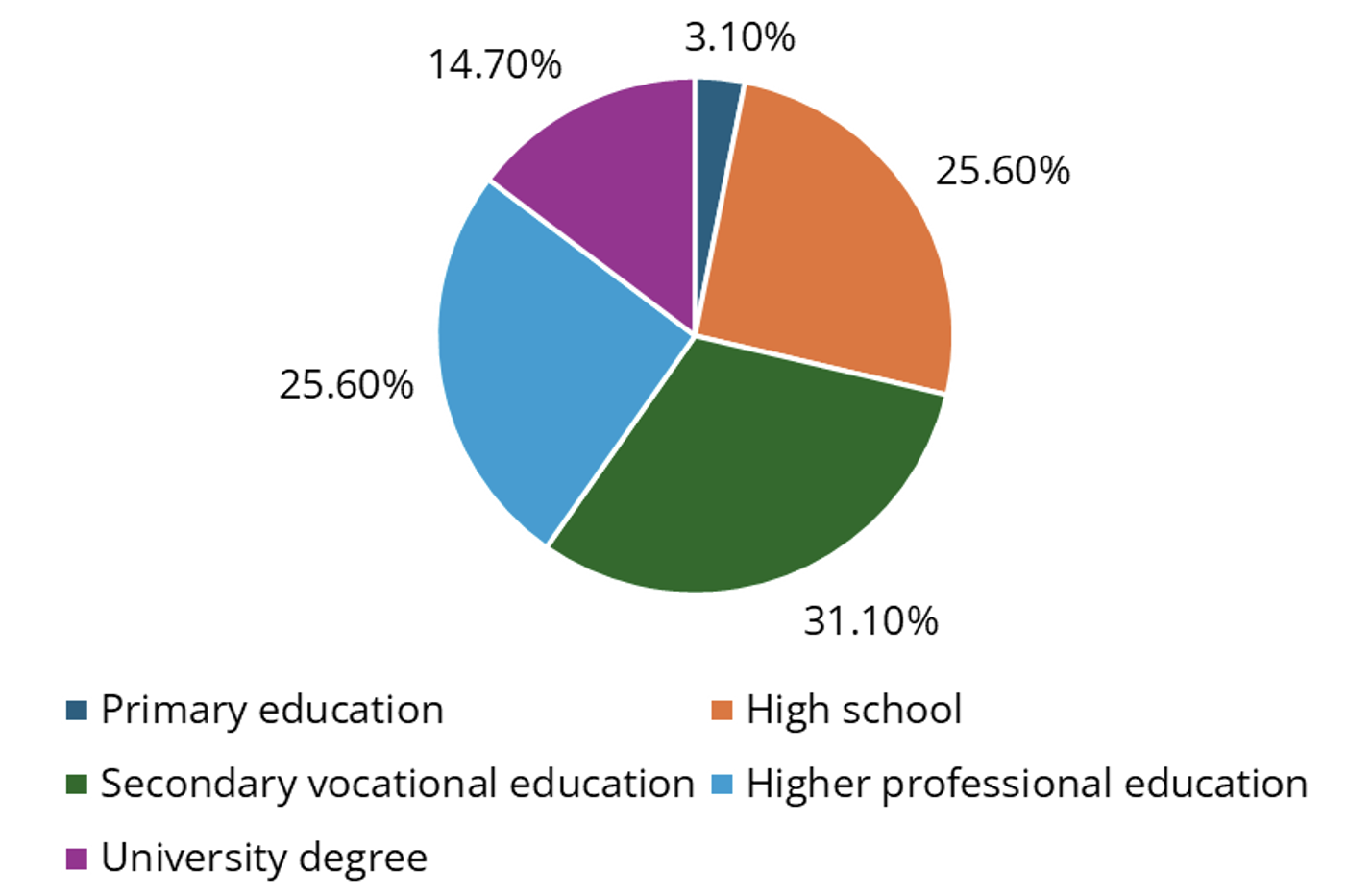
Based on a similar previous study with a sample size of 175 participants (Roos et al., 2025), and considering resource constraints (Lakens, 2022), we aimed for a total sample size of 300 participants. Since we were interested in assessing people’s intention to join the online discussions and previous research shows that most people never place comments, we only invited LISS panel members that had indicated, in a previous survey in 2022, to be active in discussions about online news articles, which meant both reading and posting comments (van der Linden et al., 2025). Ideally, participants would have been selected based on their commenting activity at the time of data collection in 2024. However, this was not feasible because no information on respondents' more recent commenting behavior was available prior to the current survey. Consequently, the 2022 survey provided the only, and most recent, basis for identifying participants with demonstrated experience as active online news commenters. This previous survey was administered to all 7.056 adult panel members in October 2022, of whom 77.8% completed the entire survey. In that survey, 610 respondents indicated that they actively participated in online news discussions. By January 2024, 563 of these respondents were still active members of the panel. From this group, we invited a random subsample of 400 participants to take part in the current study. The response rate was 75.5%, corresponding to a sample of 302 participants. After removing the 8 participants that had not completed the survey, the final sample consisted of 294 participants (Mage = 54.80, SDage = 15.53, range = 17–88 years; 55.4% male and 44.6% female). See Figure 2 for a breakdown of participants’ highest level of educational attainment. The sociodemographic characteristics of the respondents closely match those of the invited sample, see Appendix C.
Figure 2. Participants’ Highest Level of Educational Attainment.
Notably, although participants were selected based on previous self-reports of being active in online news discussions, when asked whether they still reacted to online news articles, only 50.30% of the sample indicated that they did, suggesting that actual online commenting fluctuates over time (we return to this in the Discussion). Of the people that did still react, 54.10% indicated that they then also discussed with others in the online news article threads. Figure 3 (right graph) shows how often they do.
Figure 3. Breakdown of Frequency of Participation in Online News Discussions
Amongst the Subset of the Sample That Still Comments. 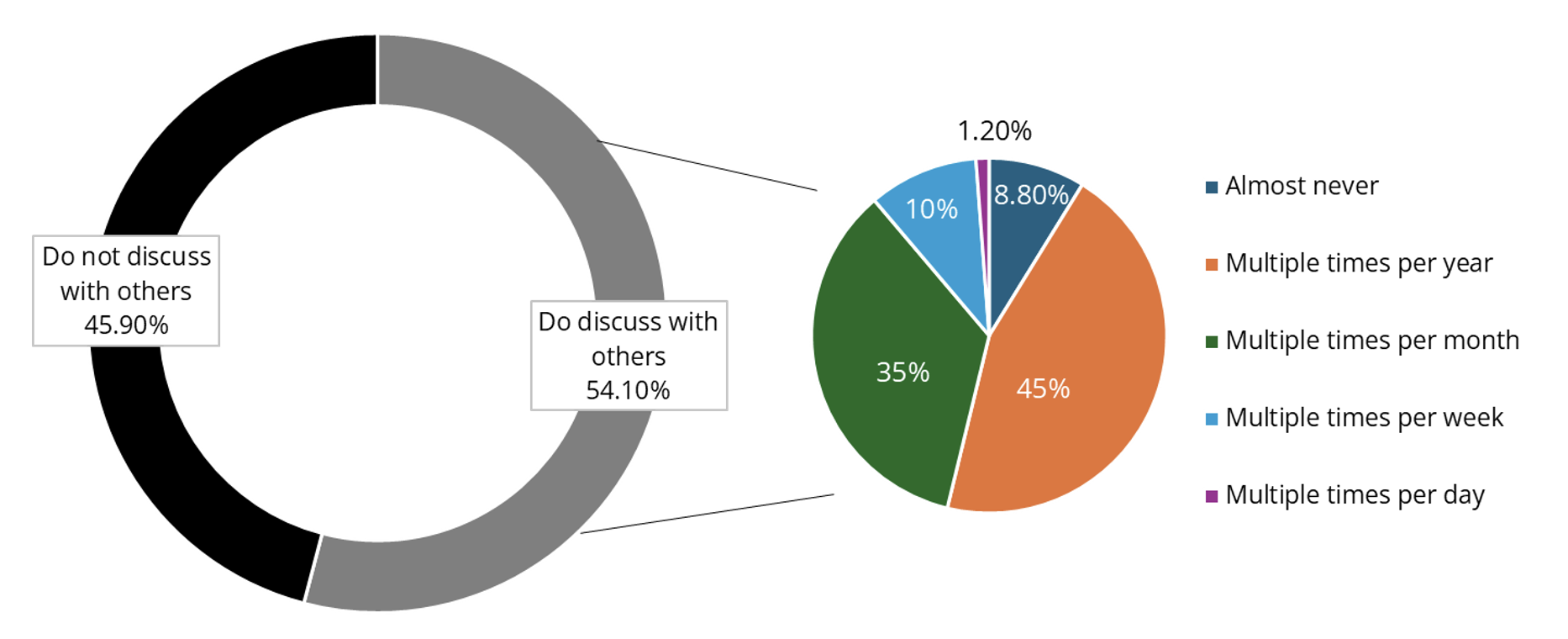
Note. The left pie represents 50.30% of the total sample and the right pie is 54.10% of this 50.30% = 27.20%.
Procedure
Data collection took place in March 2024. Eligible panel members were invited to participate via the LISS platform where they were told that the study was about online discussions. Upon accepting this invitation, participants read four comment-reply pairs representing the four conditions (anonymous + subjective, anonymous + non-subjective, non-anonymous + subjective, non-anonymous + non-subjective), each followed by the same set of questions, which are described under “Measures”. While completing these measures, the pertinent comment-reply pair remained accessible to participants on top of the page (click to expand). We additionally asked participants about the topic of the news article and discussion (on 5-point Likert scales from 1 = completely disagree to 5 = completely agree): to what extent they were interested in it, to what extent they thought this topic strongly divided Dutch society, and whether they had a strong opinion about the topic.
At the end of the questionnaire, we included a manipulation check of the anonymity factor. We asked participants whether the writer of the reply was anonymous in all discussions, non-anonymous in all discussions, or anonymous in some discussions and non-anonymous in others; the last option was the right answer. Participants were additionally asked some general questions about their online news commenting behaviors. Lastly, the questionnaire ended with questions about the study: the suspected goal (answers revealed that, although many participants did understand the goal of the study as related to their evaluation of different(ly formulated) reactions in online discussions, none of them suspected our aim of testing the constructiveness of subjectivity and non-anonymity), the experienced difficulty of the study and participants’ interest in the study, and whether they had additional comments. See Appendix D for the complete questionnaire.
Measures
Perceived Sender Agreement
We assessed perceived agreement of the commenter with the sender of the first comment with one item: “To what extent did [username] agree or disagree with the first comment?” Participants indicated their answer on a 7-point Likert scale ranging from 1 = completely disagree to 7 = completely agree.
Perceived Sender Understanding
We measured perceived understanding with three items, for example, “I have the impression that [username] understood the position of the other”. The items were rated on
5-point Likert scales ranging from 1 = completely disagree to 5 = completely agree. The scale was reliable with a Cronbach’s alpha of .86.
Perceived Sender Disinhibition
We included eight items based on (Roos et al., 2020) to measure perceived disinhibition of the commenter, but this scale showed a relatively low alpha (.70) for its number of items. We therefore performed factor analyses (see Appendix E for the full results), resulting in a four-item disinhibition scale with the following items: “I think that [username] was careless”, “I think that [username] took others into account” (R), “I think that [username] chose his or her words carefully” (R), “I think that [username] was polite.” (R) The items were rated on 5-point Likert scales ranging from 1 = completely disagree to 5 = completely agree. This scale was reliable with an alpha of 0.79.
Reply Behavior
An open-ended question was included in the questionnaire to measure reply behavior, namely: “Suppose you were to respond to [username]'s response yourself, what would your response look like? Type your reaction below.” We used the dictionary function of the Quanteda package in R (version 4.1.0; Benoit et al., 2018) to automatically code participants’ responses as either 0 = Missing, 1 = Subjective, or 2 = Non-subjective. For this, we constructed two lists of words and phrases: one of subjectivity indicators, such as “I think”, “in my opinion”, and one of missing indicators, such as “I never react”, “no comment”, see Appendix F for the full lists (in Dutch). A comment was coded as subjective when it contained at least one subjectivity indicator. When a comment was not coded as subjective or missing, it was coded as non-subjective. The words and phrases in this dictionary were based on a manual coding trial of 200 comments by the first and second author, which was refined after applying it to the data and manually checking part of the resulting coding. The list for the missing observations was intentionally broad to ensure that no instances were overlooked. The first and second author manually checked all comments that were coded as missing and corrected them (to subjective or non-subjective) if needed. We also manually checked all mentions of “eens” because this has a double meaning in Dutch: both meaning “agree”, which indicates subjectivity, and “once”, which might also occur in a non-subjective sentence. As such, 92 of the 1,176 automatically coded comments were manually corrected by the authors. Excluding the missing observations (205 out of 1,176 comments), left 480 comments in response to non-subjective stimuli and 491 comments in response to subjective stimuli.
Willingness to Reply
After writing their reply, participants were asked to indicate on a five-point Likert-scale to indicate the likelihood that they would actually react to the post (ranging from 1 = very small to 5 = very large): “What are the chances that you would respond to [username]'s response in real life?”
Agreement With the Post
Lastly, participants were asked to what extent they (dis)agreed with the post they wrote a reply to, on a 7-point Likert scale ranging from 1 = completely disagree to
7 = completely agree.
Analysis
Hypotheses 1 and 3 were tested in multilevel regressions where the two factors (H1: anonymous vs. non-anonymous, or H3: subjective vs. non-subjective; repeated measures, level 1) nested in participants (random effect, level 2) were the predictors, and perceived agreement, understanding, and disinhibition were the dependent variables. We used the lmer function in R (lme4, version 1.1.32; Bates et al., 2015) and the emmeans package (version 1.10.4; Lenth, 2021) for this. Hypotheses 2 and 4 were tested in repeated measures mediation analyses with the anonymity or subjectivity factor as predictor, perceived agreement, understanding, and disinhibition as the mediators, and willingness to reply as the dependent variable. For this, we used the SPSS macro MEMORE, percentile bootstrap with 5000 samples (version 2.1; Montoya & Hayes, 2017). Hypothesis 5 was tested in a multilevel logistic regression with the subjectivity factor as predictor and reply behavior (subjective or not) as the dichotomous outcome. This was done with the glmer function from the lme4 package in R.
Results
Descriptives
Topic Evaluation
As also reported in the preregistration, we considered our four different news topics interchangeable, so we only give a short summary of their descriptives here, see Appendix G for the statistics. Participants indicated a medium interest in the discussed topics (means ranging from 3.09 to 3.44 on a five-point scale), and a somewhat strong opinion about these topics (means between 3.36 and 3.61). Participants further considered most topics as dividing Dutch society, but this was less the case for MeToo (means ranging from 3.08 for MeToo to 4.04 for Immigration).
Manipulation Check
Only 58.5% of the sample correctly noticed our anonymity manipulation; 26.9% thought that all commenters were either anonymous (11.6%) or non-anonymous (15.3%), and 14.6% indicated that they did not know. In line with the preregistration, we decided to include all data and, where appropriate, check whether findings differ for participants who passed the manipulation check and those who did not. The statistics of the entire sample are reported in the main text and those of the subsample that passed the anonymity manipulation check (n = 172) are reported in Appendix H and I. The same applies to the subsample of participants (n = 148) who still react to online news articles.
Dependent Variables
As can be seen in Table 1, participants considered the commenters as low on agreement with each other, in line with our manipulation. Perceived understanding and disinhibition were around the midpoint. Despite our selection criterium of being active in online news discussions, but in line with the observation that many participants indicated not to post anymore (see Methods), participants had a low willingness to reply. Lastly, on average, participants did not agree nor disagree with the reaction of the commenter (i.e., the reply in the comment-reply pair).
As can be expected, perceived agreement and understanding were positively correlated, and perceived disinhibition was negatively correlated with both agreement and understanding. This latter correlation was notably strong: apparently, participants consider a commenter that does not show understanding as more disinhibited. Interestingly, the more participants were in agreement with the comment, the more they considered the commenter as agreeing and understanding, and the less they considered them disinhibited. Participants thus evaluated a commenter more positively when they agreed with that commenter’s message. Lastly, participants were equally likely to post a reaction themselves when they agreed with the comment. There was, however, a (small but significant) negative correlation between perceived disinhibition and intention to join: a disinhibited commenter might not be an inviting discussion partner.
Table 1. The Means, SDs and Repeated Measures Correlation Between the Dependent Variables.
|
|
Mean (SD) |
Perceived understanding |
Perceived dis-inhibition |
Intention to join |
Agree with reaction |
|
Perceived agreement1 |
2.75 (1.70) |
.43*** [.37, .48] |
−.16*** [−.23, −.10] |
−.01ns [−.07, .06] |
.12*** [.06, .19] |
|
Perceived understanding2 |
2.77 (0.92) |
|
−.54*** [−.59, −.49] |
.04ns [−.02, .11] |
.36*** [.30, 0.42] |
|
Perceived disinhibition2 |
2.84 (0.74) |
|
|
−.09** [−.15, −.02] |
−.44*** [−.49, −.38] |
|
Intention to join2 |
1.97 (1.17) |
|
|
|
.06ns [−.01, .12] |
|
Agree with reaction1 |
4.18 (1.88) |
|
|
|
|
|
Note. 1Measured on a 7-point Likert scale. 2Measured on a 5-point Likert scale. nsp > .05; **p < .01; ***p < .001. |
|||||
Main Analyses
Hypothesis 1: Main Effects of Sender Anonymity
As can be seen in Table 2, participants perceived equal amounts of agreement, understanding, and disinhibition when the commenter was anonymous as compared to when the commenter was non-anonymous. This means that we find no support for Hypothesis 1. This is also true when we only look at the subsample that still reacts to online news, see Appendix H, Table H1. We also checked whether this applied to the subsample that did pass the anonymity manipulation check because participants might need to consciously notice sender anonymity in order for it to have an effect on their judgement. In this subsample the effect remained insignificant, see Appendix H, Table H2.
Table 2. Main Effects of Sender Anonymity on Perceived Agreement, Understanding, and Disinhibition.
|
|
|
Sender anonymity |
|
|
|
|
t(881) |
Non-Anonymous |
Anonymous |
Cohen’s dv1 |
|
Perceived agreement |
0.22ns |
2.74 [2.50, 2.88] |
2.76 [2.61, 2.91] |
.02 |
|
Perceived understanding |
0.44ns |
2.76 [2.68, 2.84] |
2.78 [2.71, 2.86] |
.03 |
|
Perceived disinhibition |
−0.18ns |
2.85 [2.77, 2.92] |
2.84 [2.76, 2.91] |
.01 |
|
Note. 1Effect sizes (Cohen’s dv) were calculated by dividing the difference between the condition means by the average variance. nsp > .05. |
||||
Hypothesis 2: Sender Anonymity and Intention to Join
We did not find support for Hypothesis 2 stating that sender anonymity would decrease participants’ intention to join the discussion, and this effect is mediated by perceived agreement, understanding, and disinhibition. First, we did not find a total effect of anonymity on intention to join: c-path in Figure 4. There was also no direct effect, controlling for the mediators, c’-path, and no indirect effect of anonymity on intention to join through the mediators. Further, anonymity did not have a direct effect on the three mediators (a-paths in Figure 4) and the mediators did not have a direct effect on the intention to join the discussion (b-paths in Figure 4). Lastly, the model explained only 0.5% of variance (R2 = .005) in the intention to join (F(6, 287) = 0.26, p = .954). This pattern of results is the same when we only look at people who still participate in online discussions
(R2 = .007, F(6, 141) = 0.1595, p = .987), see Appendix I, Figure I1, or those that did notice our anonymity manipulation (R2 = .026, F(6, 165) = 0.7303, p = .626), see Appendix I, Figure I2. This means that the anonymity of previous commenters in an online discussion does not affect participants’ willingness to contribute to the online discussion themselves.
Figure 4. Mediation Model of Sender Anonymity Predicting Intention to Join
Through Perceived Agreement, Understanding, and Disinhibition.
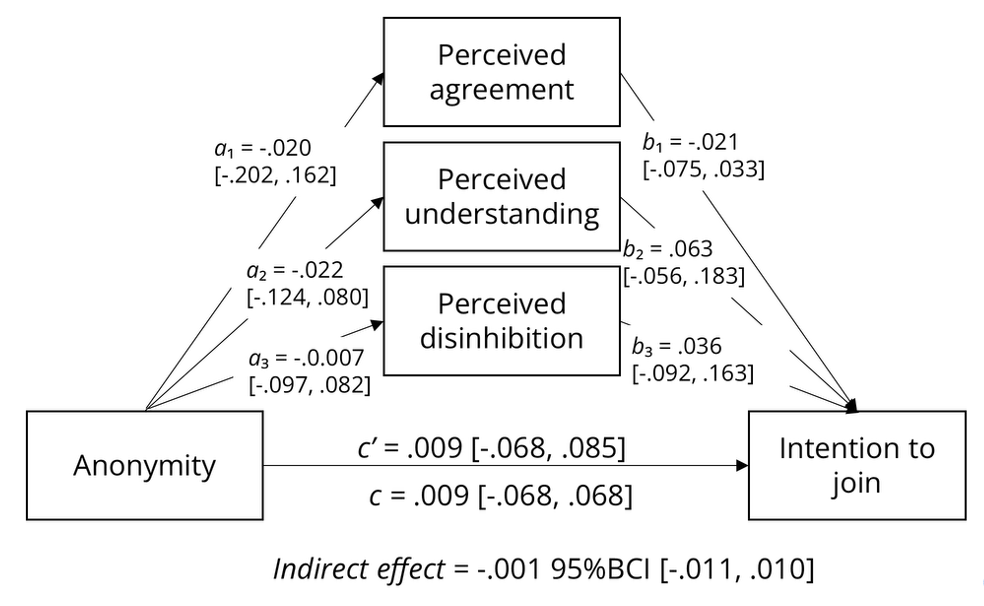
Note. Reference category is non-anonymous. a, b, c and c' are path coefficients representing unstandardized regression weights and bootstrapped (5000 samples) confidence intervals. The c-path coefficient represents the total effect of subjectivity on intention to join. The c-prime-path coefficient refers to the direct effect of subjectivity on intention to join.
Hypothesis 3: Main Effects of Subjectivity
As can be seen in Table 3, we find support for Hypothesis 3: participants perceive less agreement, less understanding, and more disinhibition in the commenter when their comment is non-subjectively phrased as compared to when the comment is subjectively phrased. Effect sizes were small with dv ranging from .21 to .24 (Cohen, 1988), which is in line with similar previous research (Roos et al., 2025). If we only look at the subsample of participants that still react to online news, these relationships become somewhat stronger (dv = .28 for agreement, dv = .34 for understanding, and dv = .23 for disinhibition), see Appendix H, Table H3.
Table 3. Main Effects of Subjectivity on Perceived Agreement, Understanding, and Disinhibition.
|
|
|
Subjectivity |
|
|
|
|
t(881) |
Non-subjective |
Subjective |
Cohen’s dv1 |
|
Perceived agreement |
2.62** |
2.63 [2.48, 2.78] |
2.87 [2.72, 3.01] |
.21 |
|
Perceived understanding |
3.92*** |
2.68 [2.60, 2.75] |
2.87 [2.79, 2.95] |
.24 |
|
Perceived disinhibition |
−3.92*** |
2.92 [2.85, 3.00] |
2.76 [2.86, 2.83] |
.23 |
|
Note. 1Effect sizes (Cohen’s dv) were calculated by dividing the difference between the condition means by the average variance. **p < .01; ***p < .001. |
||||
Hypothesis 4: Subjectivity and Intention to Join
We did not find support for Hypothesis 4 stating that subjectivity would increase the intention to join the discussion, and that this effect is mediated by perceived agreement, understanding, and disinhibition. As can be seen in Figure 5, we find no total effect, no direct effect, and no indirect effect of subjectivity on intention to join. Although, in line with Hypothesis 3, subjectivity did have a direct effect on the three mediators (a-paths in Figure 5), the mediators did not have a direct effect on the intention to join the discussion
(b-paths in Figure 5). Lastly, the model only explained 3% of variance (R2 = .031) of the intention to join (F(6, 287) = 1.54, p = .165). We see the same pattern of results when we only look at people who still participate in online discussions (R2 = .037, F(6, 141) = 0.8946,p = .501), see Appendix I, Figure I3. This means that participants are not more or less likely to contribute to the online discussion themselves when they read non-subjectively phrased versus subjectively phrased comments.
Figure 5. Mediation Model of Subjectivity Predicting Intention to Join
Through Perceived Agreement, Understanding, and Disinhibition. 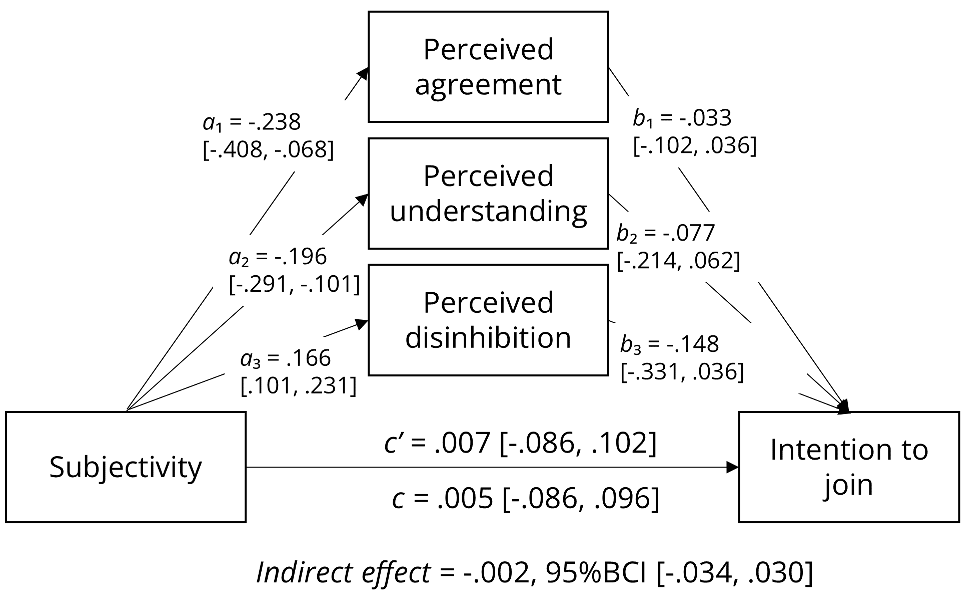
Note. Reference category is non-subjective. a, b, c and c' are path coefficients representing unstandardized regression weights and bootstrapped (5000 samples) confidence intervals. The c-path coefficient represents the total effect of subjectivity on intention to join. The c-prime-path coefficient refers to the direct effect of subjectivity on intention to join.
Hypothesis 5: Reaction Behavior
Our fifth and last hypothesis stated that when asked to supply a reaction to the discussion themselves, participants will use more subjectivity markers in response to subjectively phrased comments than in response to non-subjectively phrased comments. As can be seen in Table 4 below, the minority of participants wrote subjective comments in general (29%). This is in line with what can be seen on many online discussion platforms. However, the multilevel logistic regression shows that the chance that people write a subjective comment depends on whether they saw non-subjective or subjective stimuli (b = 0.58; z = −3.91; p < .001). Participants were about 1.5 times more likely to add explicit marking of subjectivity in their comment after reading a subjective discussion (171 out of 491, 35%) than after reading a non-subjective discussion (114 out of 480, 24%). We thus find support for Hypothesis 5.
Table 4. Frequencies of Coded Commenting Behavior (Rows) Split Out Per Condition (Columns).
|
|
|
Condition |
|
|
|
|
|
Non-subjective |
Subjective |
Total |
|
Coding comments |
Non-subjective |
366 |
320 |
686 |
|
Subjective |
114 |
171 |
285 |
|
|
|
Total |
480 |
491 |
971 |
To illustrate the use of subjectivity by the participants, we include four example comments in Table 5 below. We first quote two participants replying to the discussion about “Zwarte Piet” (ZP). The first comment is coded as non-subjective and the second comment is coded as subjective. After that, we do the same for the discussion about “Immigration”. All quotes are translated from Dutch to English by the first author.
Table 5. Examples of Comments Written by Participants, With Their Respective Topic and Code.
|
Topic |
Coded as |
Example comment |
|
Zwarte Piet |
Non-subjective |
“Zwarte Piet and Sinterklaas are part of our culture, there's nothing wrong with that. The problem is that a small minority group gets to dictate things here. Not the parents and/or the children.” (Participant 10) |
|
Zwarte Piet |
Subjective |
“I completely agree with you. This is a discussion between adults, not children. Let the children simply celebrate Sinterklaas like they used to.” (Participant 120) |
|
Immigration |
Non-subjective |
“All asylum seekers are fortune seekers. Except Ukrainians, the Muslims have come through many other safe countries. Why don't Muslims go to wealthy oil states? Because they don't want poor Muslims, and Saudi Arabia shoots them dead. More than 80% have no work. It's a shame.” (Participant 17) |
|
Immigration |
Subjective |
“I respect your opinion; however, the portion that wants to work is small. As far as I’m concerned, labor migrants are welcome, but so-called refugees are no longer. Labor migrants are exploited, housed in cramped conditions and abused. Refugees are exploiting us and our prosperity.” (Participant 32) |
|
Note. We underlined the phrases that led to the classification of a comment as subjective. |
||
Discussion
Only a small minority of online users who read online (news) discussions also participates in these discussions themselves. People’s decisions about whether and how to participate in an online discussion are shaped by their impressions of the discussion atmosphere and the individuals involved. When people perceive the discussion as polarized, with little agreement and mutual understanding between commenters, and the commenters as disinhibited, that is, acting without social inhibitions, this can make people decide to forgo participating themselves. This study focused on two online message characteristics that might affect these perceptions of disinhibition and polarization: sender anonymity and message subjectivity (the explicit acknowledgement that a statement represents the speaker’s perspective, e.g. “I think that is not true”). Importantly, we studied the effects of these manipulations in a purposive subsample drawn from a representative general population sample of Dutch adults who self-reported to be currently or previously active in online news discussions.
No Effects of Sender Anonymity
Contrary to our expectations (Hypothesis 1), anonymous commenters were not perceived as less agreeing, less understanding, and more disinhibited, as compared to non-anonymous commenters. This null finding is unlikely to be due to a failure of the manipulation or low statistical power, as participants who passed the manipulation check (i.e., noticed the sender’s anonymity) showed the same pattern and the study was sufficiently powered to detect small effects. One possible explanation is that anonymity has become so common in online environments that it no longer strongly shapes interpretations of commenters’ intentions and dispositions (Roos et al., 2021). Although anonymity has been shown to reduce perceived credibility and persuasiveness in other contexts (Wang, 2020), these effects may not extend to judgments of agreement, understanding, and disinhibition. Such judgments may rely more strongly on relative opinion positioning and relational inferences than on source credibility.
An alternative explanation for the null findings is that our stimuli were relatively moderate and polite. Because we removed any personal attacks to reduce variation in extremity across the comments we drew from actual online news discussions, the resulting stimuli may have lacked the extremity and aggression needed for anonymity to become a salient cue, potentially attenuating its effects. It might thus very well be that anonymity will have a stronger effect on person perceptions in more heated debates.
Lastly, evaluations of commenters may be driven mostly by message content and much less by anonymity. In our study, for example, subjective language and participants’ own agreement with the message showed clearer effects, as discussed below.
Subjectivity Perceived as Less Polarized and Disinhibited
In line with our second hypothesis, we find that commenters were perceived as more agreeing, more understanding, and less disinhibited when they wrote a subjectively phrased comment as compared to when they did not use any subjectivity markers in their comment. Note that, like previous research (Roos et al., 2025), effect sizes were small.
This shows that subjectivity indicators can communicate conversational receptiveness in online discussions; demonstrating the commenter’s openness to considering opposing viewpoints (Minson & F. S. Chen, 2022; Yeomans et al., 2020). Expressions such as “I think,” “In my opinion,” and “I feel,”, when included in an opinion statement, suggest that the commenter acknowledges and understands the opposing perspective, while also indicating that their disagreement may not be particularly strong (as reflected in higher scores on perceived agreement and understanding). In this sense, subjectivity markers can also cue intellectual humility—the ability to recognize the limits of one’s own knowledge and beliefs (Porter et al., 2022). By using subjectivity the sender refrains from claiming absolute truth, instead conveying that their perspective reflects their personal thoughts or feelings rather than definitive knowledge (as reflected in lower scores on perceived disinhibition).
Sender Anonymity and Subjectivity Do Not Predict Intention to Join
We did not find that people were more or less willing to join the discussion depending on the anonymity of previous commenters (Hypothesis 2) or the subjectivity of previous comments (Hypothesis 4), nor did we find indirect effects via perceived agreement, understanding, or disinhibition. This is not surprising for anonymity, given the absence of effects on the proposed mediators. For subjectivity, the findings are perhaps more puzzling, particularly because they contrast with the findings of Roos et al. (2025). One explanation for the absence of an effect is that, as with anonymity, subjectivity was inconsequential for intention to join because our comments were relatively moderate and polite. When comments are non-aggressive and non-extreme, there is less need to soften the message to avoid conflict. Such regulatory cues like subjectivity are more expected and more consequential in the context of offensive or otherwise negative statements (Yeomans et al., 2020; Roos et al., 2024b). It might therefore be that the effects of subjectivity on behavior will be stronger in a more divided and hostile discussion. However, this does not explain our failure to replicate the findings of Roos et al. (2025), as their stimuli also consisted of relatively moderate and polite comments. A second explanation relates to the sample, which did differ from Roos et al. (2025). Although we recruited participants who had previously indicated to be active commenters, nearly half reported no longer participating in online discussions. Since they do not participate in any online discussions anymore, these participants logically indicate that the chances of them reacting to our stimuli discussions in real-life would likewise be (very) small. These findings show that participation in online discussions can be highly volatile and people regularly stop participating. A recent study on motivations for not engaging in online news discussions found that among the most frequently cited reasons were beliefs that posting comments is ineffective and that comment sections are often rude or mean (van der Linden et al., 2025). Similarly, it might be that our previously active commenters felt disillusioned due to being confronted with online aggression or little response to their comments at all. Importantly, former commenters may differ from people who have never participated in online discussions in their willingness to re-engage. Indeed, individuals who have actively withdrawn from commenting may be particularly unlikely to return, potentially making them less responsive to cues such as subjectivity. This could help explain why Roos et al. (2025) observed an effect on intention to join whereas we did not. More broadly, our findings suggest that subjectivity functions more as a cue for attracting new or potential participants rather than re-engaging individuals who have previously disengaged. Future research could test this possibility by distinguishing between non-participants (lurkers), current commenters, and former commenters, and by examining whether subjectivity has different effects on the intention to join across these groups.
Subjectivity Invites Subjectivity
Lastly, we found support for the normative effect of subjectivity as stated in Hypothesis 5. Participants were more likely to write with subjectivity markers in response to subjective comments than in response to non-subjective comments. This suggests that a local norm was established, which has been shown before in online discussions (Postmes et al., 2000; Shmargad et al., 2022). We show that even one single comment-reply pair can be enough to establish this norm and make people comply. Effects were again, and not surprisingly (considering the minimal manipulation), relatively small. In general, most participants expressed themselves without any subjectivity markers. Even when the stimulus was subjective, only 35% of participants also used subjectivity (as opposed to 24% in the non-subjective condition). This is in line with what has been observed in actual online discussions, and is part of the cause of online escalation by leading to higher perceived disagreement, misunderstanding, and disinhibition (Roos et al., 2020). So, although subjectivity can become a local norm that participants follow, the usual pattern (or general norm) of non-subjectivity in online comments is hard to change.
Explorative Results: The Importance of Own Opinion
Since people can react with negative emotions and evaluations, and defensive or avoidant behavior when they encounter viewpoints that disagree with theirs (Gerber et al., 2012; Gervais, 2015), we also explored the relationship between participants’ own (dis)agreement with the comment and their evaluation of the commenter. We found strong and interesting effects here. Participants perceived the commenter as more agreeing, understanding, and less disinhibited when they agreed with the commenter’s opinion. Agreement might evoke a similarity bias or similar-to-me effect: “I agree with you (i.e., we are similar) so you must be nice (i.e., I like you)” (Byrne, 1961). Recent research has found something similar, showing that people attribute more aggressive discussion motivations to a sender that expresses an opinion opposite to theirs as compared to like-minded senders (Kluck & Krämer, 2022). Lastly, we found no effects of agreement on intention to join: participants were equally likely to join the discussion when they agreed versus disagreed with the comment (as also found in Lück-Benz & Nardi, 2019).
Limitations
To control the influence of additional variables (beyond sender anonymity and message subjectivity) as much as possible, we created a somewhat artificial set-up with only one comment and one reply in response to a news article title without further content. This is less complex than actual online (news) discussions consisting of many threading comments. The structural characteristics of online discussions might affect comment interpretation and sender evaluation. For example, it might matter whether a commenter’s opinion is in agreement with the majority or minority within the online discussion for how much subjectivity is expected and valued, since subjectivity is mostly needed in the presence of disagreement (Roos, Utz, et al., 2024). In future research it therefore would be interesting and valuable to look at the (interaction) effects of discussion structure.
An additional and related limitation of this study is that we only manipulated two characteristics of online discussion comments: anonymity and subjectivity. But, of course, there are many other sender and message characteristics that will influence perceived polarization and disinhibition and response behavior. For example, emoji are known to have a strong impact on the affective and social interpretation of a message (Boutet et al., 2021; Caspi & Raz, 2024; Neel et al., 2023). It would be interesting to see whether and how other message characteristics, such as positively or negatively valanced emoji, complement or interact with message subjectivity in affecting the perceived tone in an online discussion.
Lastly, although we used a purposive subsample drawn from a representative general population sample of currently or previously active online commenters, which is a notable strength of this study, our sample concerned the Dutch population. This means that we do not know whether our findings are generalizable to other countries and cultures. For example, subjectivity might be interpreted differently in collectivistic cultures than in individualistic cultures, because of differences in the frequency of “I” references (Na & Choi, 2009) and opinion expression forms (Huang, 2005) in certain languages. This could also hold for sender anonymity: in more collectivistic cultures being identified as an individual might be valued less than in individualistic cultures (Morio & Buchholz, 2009). These might be interesting directions for future research.
Conclusions
Notwithstanding the potential of online discussion spaces for enabling dialogue across many divides (ideological, cultural, time, space), most online users refrain from commenting in online (news) discussions. We set out to investigate whether sender anonymity and a lack of message subjectivity might be two reasons why online commenters appear disinhibited and polarized, thereby creating an unwelcoming discussion climate. Uniquely, we tested these effects in a purposive subsample of self-reported current and previous online commenters drawn from a representative general population sample, ensuring our findings reflect real-world decisioning processes. We found no evidence that sender anonymity affects people’s impression of the commenters, or their intention to join the discussion themselves. In contrast, conceptually replicating the findings of Roos et al. (2025), we did show that, contrary to what most online posters attempt to do by formulating their opinion as if it is a fact, admitting that a statement represents one’s own subjective stance is perceived as less polarized and disinhibited by (previously) active commenters. Moreover, we observed that subjective expressions also prompt more subjective replies, creating the potential for an upwards spiral leading to a more welcoming online discussion climate.
Footnotes
1 Compared to the preregistration, we changed the numbering and verb tenses of the hypotheses and replaced “responder” with “commenter” for the sake of presentation.
Conflict of Interest
The authors have no conflicts of interest to declare.
Use of AI Services
During the preparation of this work the authors used ChatGTP in order to rephrase (parts of) sentences. After using this tool, the authors reviewed and edited the content as needed and take(s) full responsibility for the content of the published article.
Data Availability Statement
The design and hypotheses of this study were preregistered before data collection at AsPredicted https://aspredicted.org/ZKF_91L. The materials, anonymized dataset, and analysis code are publicly available from DataVerseNL: https://doi.org/10.34894/HD7DOI.
Acknowledgement
This research did not receive any specific grant from funding agencies in the public, commercial, or not-for-profit sectors.
The authors thank Jade van Tilburg for her assistance in designing the stimuli. In this paper, we make use of data from the LISS panel (Longitudinal Internet studies for the Social Sciences) managed by the non-profit research institute Centerdata (Tilburg University, The Netherlands). We are grateful to Stein Jongerius for programming the questionnaire and arranging the data collection on the LISS panel.
Appendices
Appendix A. Example of All the Stimuli.
Climate Subjective Anonymous
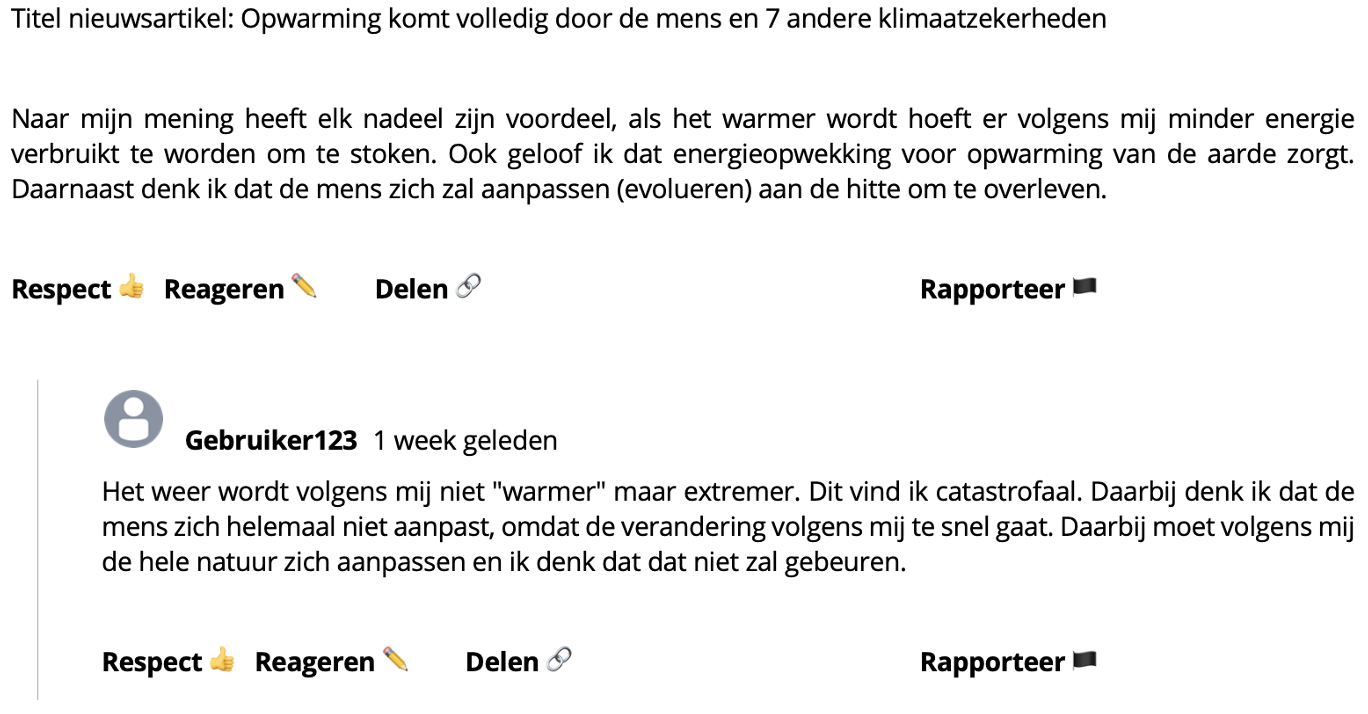
English translation:
Title news article: Global warming is entirely caused by humans and 7 other climate certainties
“In my opinion every disadvantage has its advantage, if it gets warmer, I think less energy needs to be used for heating. I also believe that energy production causes global warming. Furthermore, I think that humans will adapt (evolve) to the heat in order to survive.“
“I don't think the weather is getting "warmer" but more extreme. In my view this is catastrophic. Moreover, I think that humans are not adapting at all, because the change is happening too fast I feel. In addition, I believe that all of nature has to adapt and I don't think that will happen. “
Climate Non-Subjective Non-Anonymous
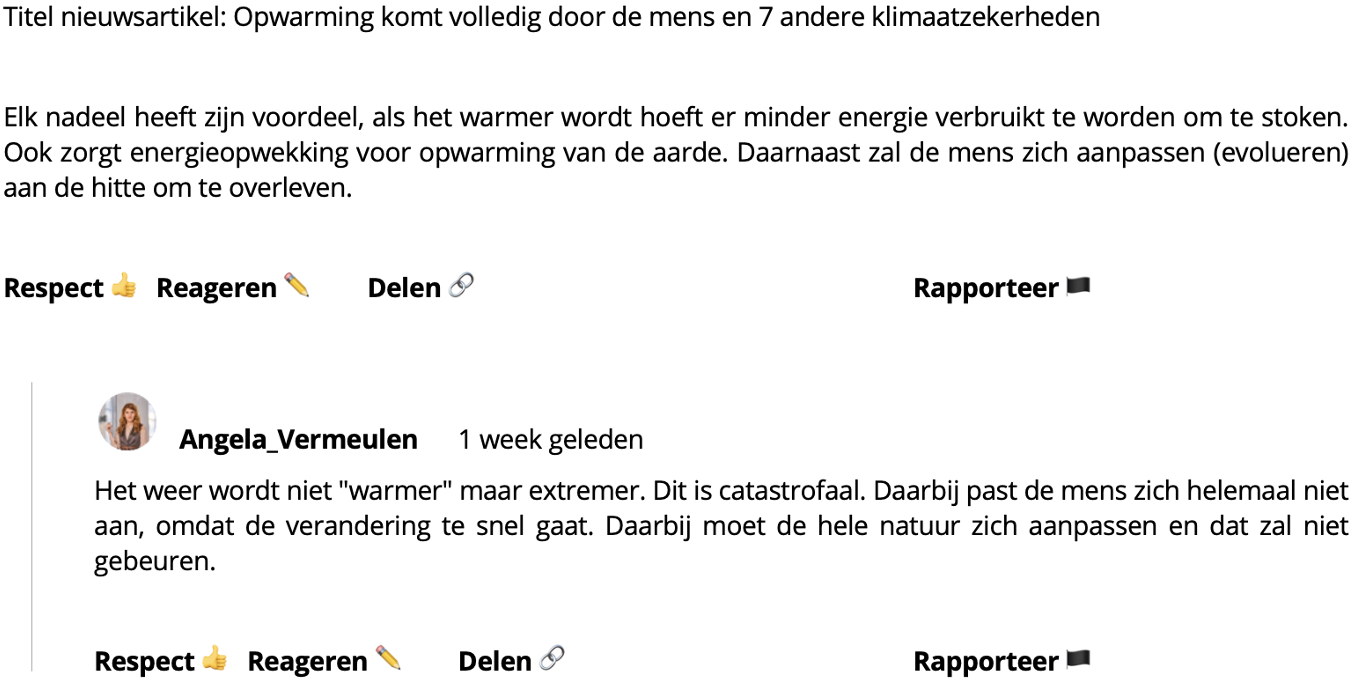
English translation:
Title news article: Global warming is entirely caused by humans and 7 other climate certainties
“Every disadvantage has its advantage, if it gets warmer, less energy needs to be used for heating. Also energy production causes global warming. Furthermore, humans will adapt (evolve) to the heat in order to survive.“
“The weather is not getting "warmer" but more extreme. This is catastrophic. Moreover, humans are not adapting at all, because the change is happening too fast. In addition, all of nature has to adapt and that will not happen.“
Metoo Non-Subjective Anonymous
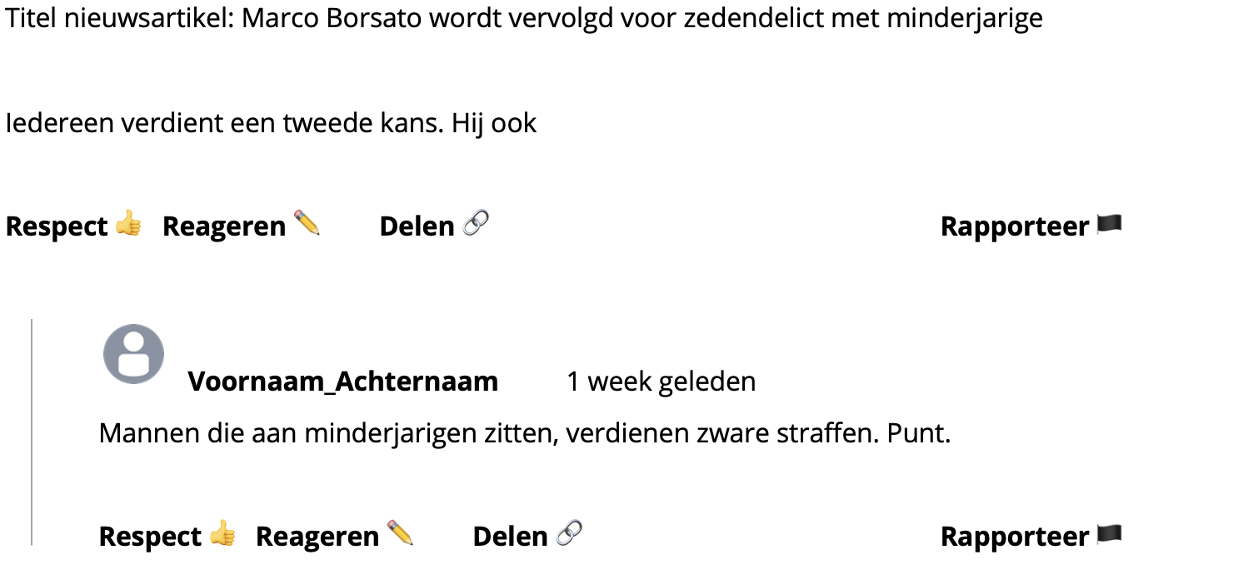
English translation:
Title news article: Marco Borsato is being prosecuted for a sex offense involving a minor
“Everyone deserves a second chance. He does too“
“Men who touch minors deserve severe punishment. Period.“
Metoo Subjective Non-Anonymous
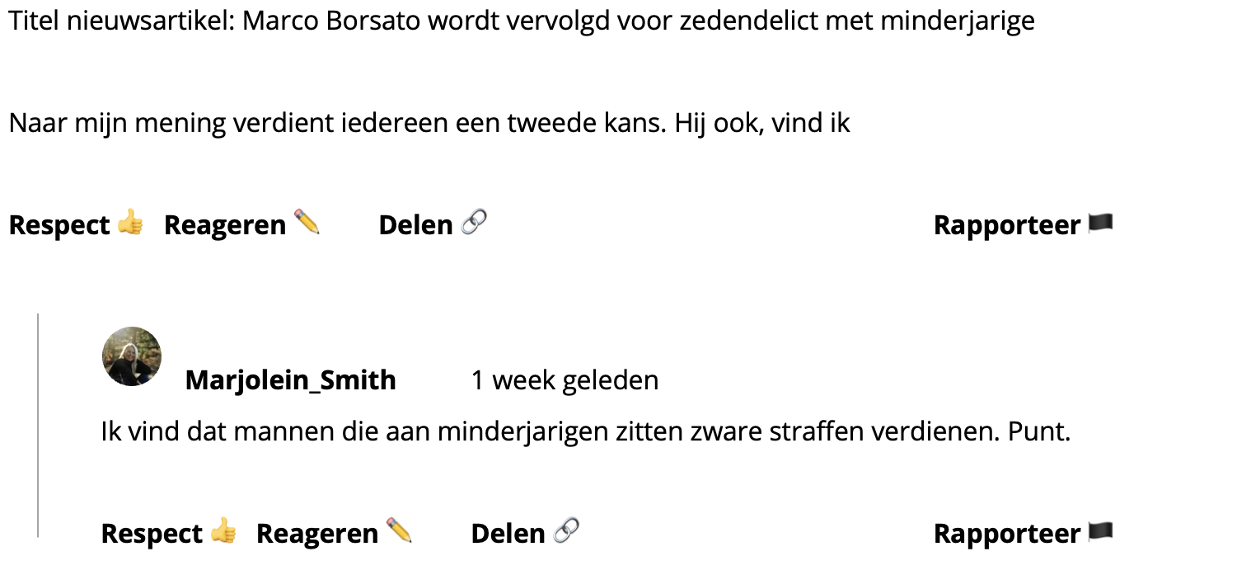
English translation:
Title news article: Marco Borsato is being prosecuted for a sex offense involving a minor
“In my opinion everyone deserves a second chance. He does too, I find“
“I think men who touch minors deserve severe punishment. Period.“
Immigration Subjective Non-Anonymous
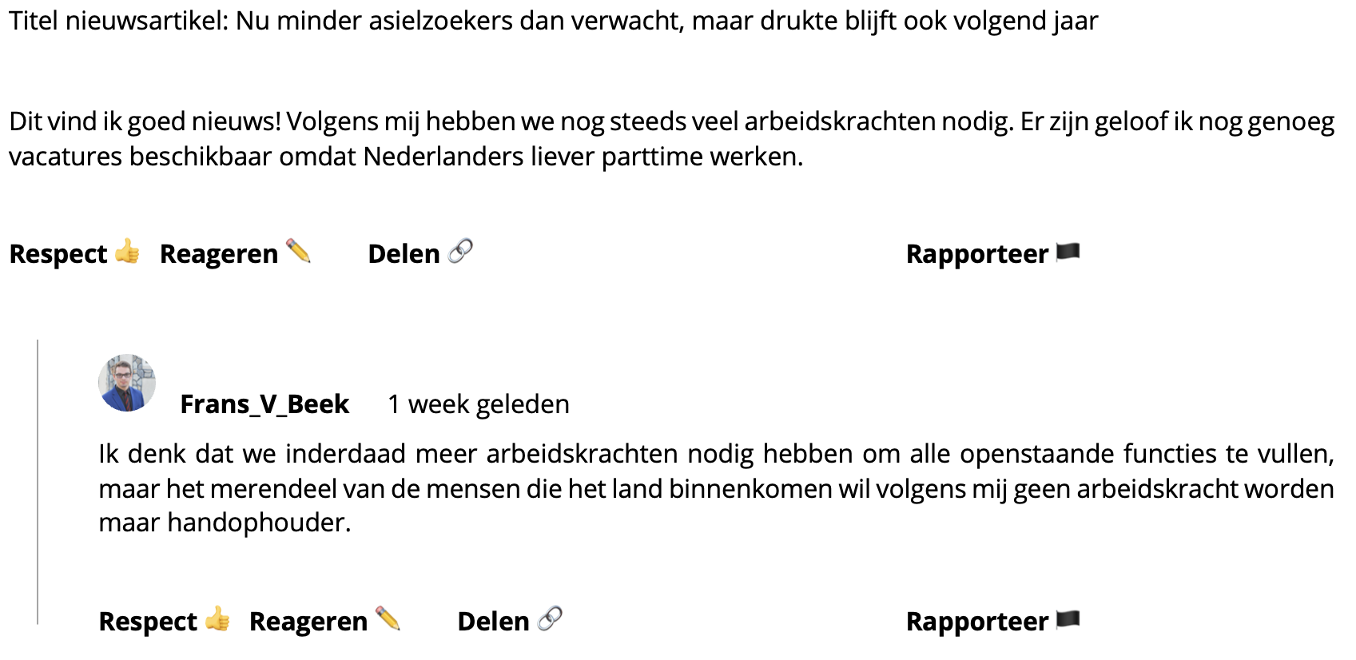
English translation:
Title news article: Fewer asylum seekers than expected now, but pressure will remain next year as well
“I find this is good news! It seems to me we still need a lot of workers. There are still enough vacancies available I believe because the Dutch prefer to work part-time.“
“I think we do indeed need more workers to fill all the vacancies, but I believe the majority of the people entering the country don’t want to become workers but rather depend on handouts.“
Immigration Non-Subjective Anonymous
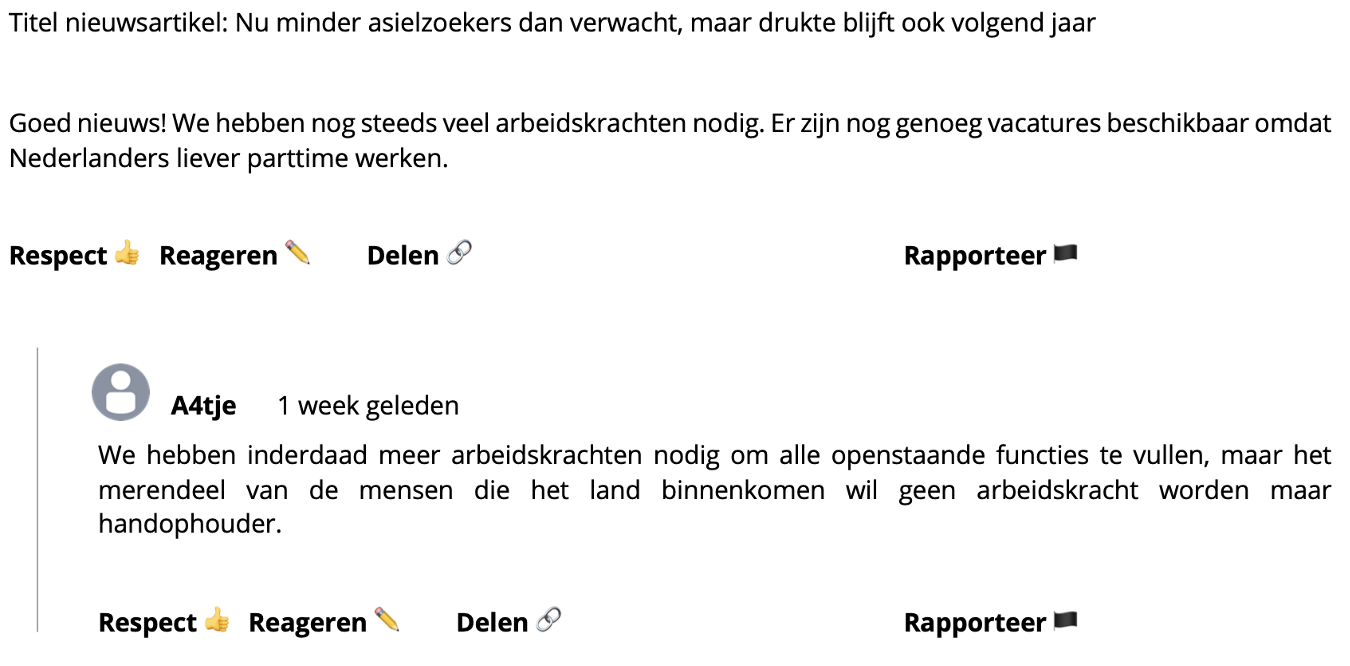
English translation:
Title news article: Fewer asylum seekers than expected now, but pressure will remain next year as well
“Good news! We still need a lot of workers. There are still enough vacancies available because the Dutch prefer to work part-time.“
“We do indeed need more workers to fill all the vacancies, but majority of the people entering the country don’t want to become workers but rather depend on handouts.“
AZ Non-Subjective Non-Anonymous
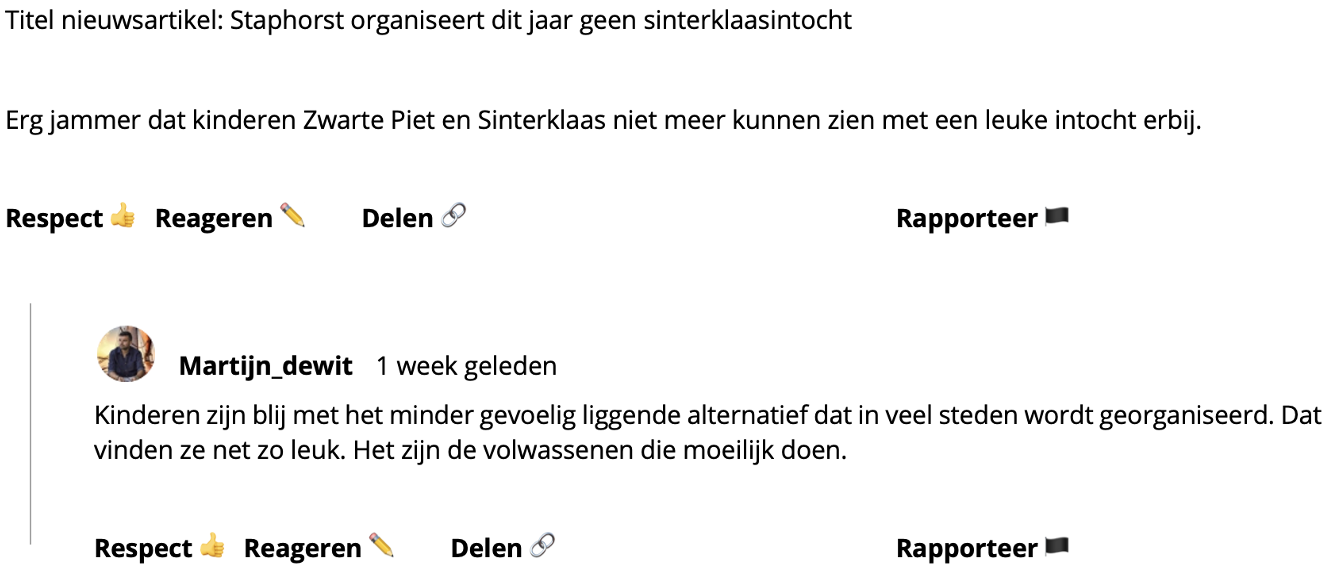
English translation:
Title news article: Staphorst is not organizing a Sinterklaas arrival parade this year
“Very unfortunate that children can no longer see Zwarte Piet and Sinterklaas with a nice arrival parade.“
“Children are happy with the less controversial alternative that is organized in many cities. They enjoy that just as much. It is the adults who are making it difficult.“
ZP Subjective Anonymous
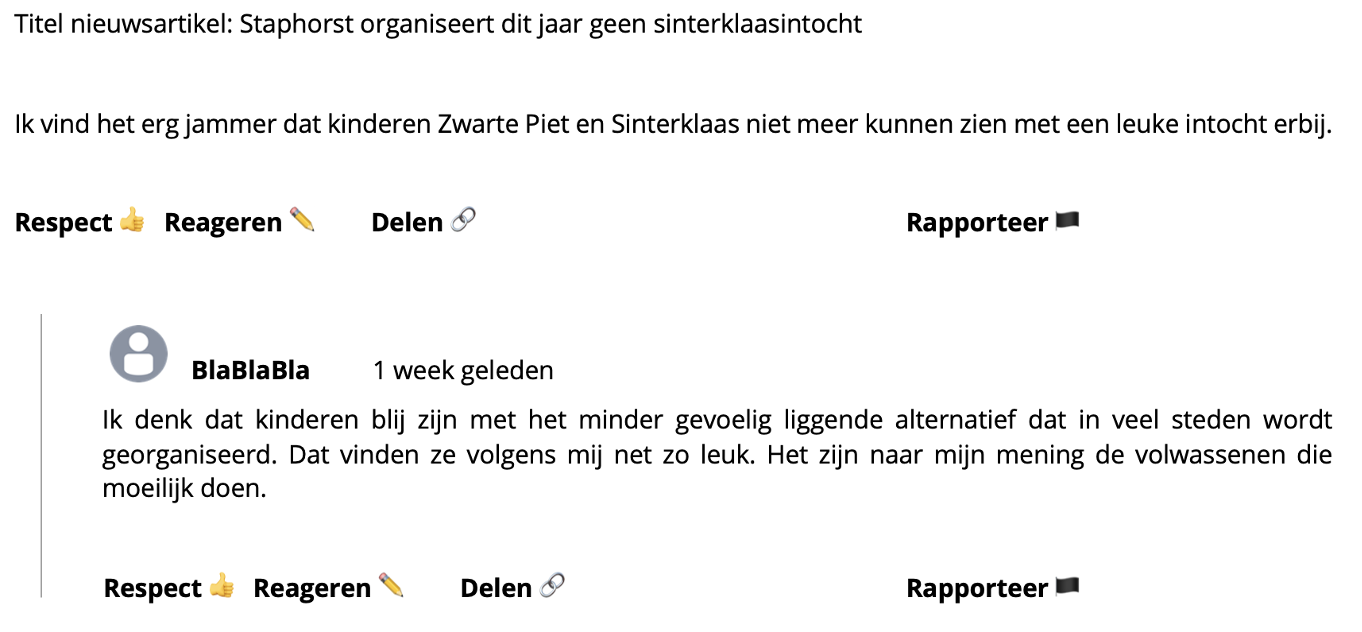
English translation:
Title news article: Staphorst is not organizing a Sinterklaas arrival parade this year
“I find it very unfortunate that children can no longer see Zwarte Piet and Sinterklaas with a nice arrival parade.“
“I think children are happy with the less controversial alternative that is organized in many cities. I believe they enjoy that just as much. In my opinion it is the adults who are making it difficult.“
Appendix B.
Table B1. The Four Lists of Stimuli to Which Participants Were Randomly Assigned
and Within Which Stimuli Were Presented in Randomized Order.
|
|
Climate |
Metoo |
Immigration |
ZP |
|
Subjective anonymous |
11 |
4 |
3 |
2 |
|
Non-subjective anonymous |
2 |
1 |
4 |
3 |
|
Subjective non-anonymous |
3 |
2 |
1 |
4 |
|
Non-subjective non-anonymous |
4 |
3 |
2 |
1 |
|
Note. 1The numbers in the table refer to the four stimuli lists. |
||||
Appendix C.
Table C1. Socio-Demographic Characteristics of Respondents vs. the Invited Sample.
|
|
Respondents (n = 294) |
Invited sample (n = 400) |
||
|
Characteristics |
n |
% |
n |
% |
|
Gender |
|
|
|
|
|
Men |
163 |
55.4 |
215 |
53.8 |
|
Women |
131 |
44.6 |
185 |
46.3 |
|
Other |
— |
— |
— |
— |
|
Education |
|
|
|
|
|
Primary |
9 |
3.1 |
13 |
3.3 |
|
VMBO (intermediate secondary) |
48 |
16.3 |
61 |
15.3 |
|
HAVO/VWO (higher secondary) |
27 |
9.2 |
36 |
9.0 |
|
MBO (intermediate vocational) |
91 |
31.0 |
120 |
30.0 |
|
HBO (higher vocational) |
75 |
25.5 |
106 |
26.5 |
|
WO (university) |
43 |
14.6 |
62 |
15.5 |
|
Missing |
1 |
0.3 |
2 |
0.5 |
|
Age group |
|
|
|
|
|
16–24 |
13 |
4.4 |
17 |
4.3 |
|
25–34 |
19 |
6.5 |
38 |
9.5 |
|
35–44 |
42 |
14.3 |
69 |
17.3 |
|
45–54 |
62 |
21.1 |
83 |
20.8 |
|
44–64 |
67 |
22.8 |
86 |
21.5 |
|
65+ |
91 |
31.0 |
107 |
26.8 |
|
Note. % based on the total number of respondents or non-respondents. |
||||
Appendix D. Questionnaire Translated from Dutch to English.
This questionnaire is about online discussions. You will be presented four times with a snippet of an online discussions. After reading each snippet, we will ask you a couple of questions about that discussion.
------------------------ (Note: This marks a new page.)
On the next screen you will read a snippet of an online discussion. In the discussion, someone posts a comment in response to a news item, after which a second person responds to this comment.
The title of the news item was: "[topic]". We only show you the discussion and not the news item itself. Read the discussion carefully. After 15 seconds you can continue with the questions. Of course, you can also take more time to read the discussion.
------------------------
[stimulus]
Above we show you the reactions to the news item. After 15 seconds you can continue with the questions, of course you can also take more time.
------------------------
Click here to read the discussion again (Note: By clicking here participants could unfold the stimulus they just saw.)
The discussion you just read was posted under an online news item. In the discussion,
someone posted a comment about the news item, after which a second person responded to this comment. We now ask you a few questions about the person who responded second: [username].
To what extent did [username] agree or disagree with the first comment?
- Strongly disagree
- Disagree
- Slightly disagree
- Neutral
- Slightly agree
- Agree
- Strongly agree
------------------------
Click here to read the discussion again
To what extent do you agree or disagree with the following statements?
I think that [username]…
…could put themself in the other person's shoes.
…understood the other person's point of view.
…empathized with the other person's position.
- Strongly disagree
- Disagree
- Neutral
- Agree
- Strongly agree
------------------------
Click here to read the discussion again
I think that [username]…
… was self-confident.
… was careless.
… wrote what he or she wanted.
… took others into account.
… chose his or her words carefully.
… was concerned with how he or she came across to others.
… was uninhibited.
… was polite.
… presented his or her opinion as fact.
- Strongly disagree
- Disagree
- Neutral
- Agree
- Strongly agree
------------------------
Title news item: [topic]
[stimulus]
Suppose you were to respond to [username]'s comment, what would your response look like? Type your response below.
__________________________
__________________________
------------------------
Click here to read the discussion again
How likely is it that you would respond to [username]'s comment in real life?
- Very unlikely
- Unlikely
- Neutral
- Likely
- Very likely
------------------------
Click here to read the discussion again
To what extent do you agree or disagree with [username]'s response?
- Strongly disagree
- Disagree
- Slightly disagree
- Neutral
- Slightly agree
- Agree
- Strongly agree
------------------------
Below are a couple of statements about the topic of the online discussion you just read:
"[topic]".
To what extent do you agree or disagree with the following statements?
I find this topic interesting.
This is a topic that strongly divides Dutch society.
I have a strong opinion about this topic.
- Strongly disagree
- Disagree
- Neutral
- Agree
- Strongly agree
------------------------ (Note: Each participant was shown the above questions four times, with four different stimuli.)
You have read a couple of online discussions in this questionnaire. Looking back at the entire questionnaire, which of the following statements is correct?
- In all discussions, the writer of the second comment was anonymous.
- In all discussions, the writer of the second comment was not anonymous.
- In some discussions, the writer of the second comment was anonymous and in other discussions, the writer was not anonymous.
------------------------
You indicated in an earlier questionnaire that you sometimes respond to online news items.
Do you still sometimes respond to online news items?
- Yes
- No
If Yes: Do you then also engage in discussion with other people who respond?
- Yes
- No
------------------------
If Yes: How often do you participate in online discussions?
- Several times a day
- Several times a week
- Several times a month
- Several times a year
- Almost never
------------------------
What do you think was the purpose of this study?
__________________________
__________________________
------------------------
Would you like to be kept informed about the results of this research?
- Yes
- No
------------------------
NB: Please complete the questionnaire until you return to the home screen. Only then will the system register the questionnaire as fully completed.
Finally. What did you think of this questionnaire:
Did you find it difficult to answer the questions?
Did you find the questions clear?
Did the questionnaire make you think?
Did you find the topic interesting?
Did you enjoy completing the questions?
- 1 Definitely not
- 2
- 3
- 4
- 5 Definitely yes
------------------------
Do you have any comments about this questionnaire?
- Yes
- No
You can enter your comment below.
__________________________
__________________________
Appendix E. Alternative Disinhibition Scale.
Since the disinhibition scale showed relatively low alpha for its number of items, we performed a confirmatory factor analysis (CFA). The hypothesized one-factor model demonstrated insufficient fit to the data, χ²(20) = 634.089, p < .001, CFI = .741, TLI = .637, RMSEA = .162 (90% CI [.151, .173]), and SRMR = .113. Examination of the standardized factor loadings (Table A5.1) indicated that Items 1, 3, 6, and 7 contributed weakly to the latent construct and may be problematic indicators.
Table E1. Standardized Factor Loadings for the Perceived Disinhibition Scale.
|
Item |
Standardized loading |
|
Item 1 – “I think that [username] was self-confident.” |
−.154 |
|
Item 2 – “I think that [username] was careless.” |
.535 |
|
Item 3 – “I think that [username] wrote what he or she wanted.” |
.049 |
|
Item 4 – “I think that [username] took others into account.” |
−.673 |
|
Item 5 – “I think that [username] chose his or her words carefully.” |
−.830 |
|
Item 6 – “I think that [username] was concerned with how he or she came across to others.” |
−.349 |
|
Item 7 – “I think that [username] was uninhibited.” |
.371 |
|
Item 8 – “I think that [username] was polite.” |
−.779 |
We subsequently ran another CFA without items 1, 3, 6 and 7. This model showed good fit to the data, χ²(2) = 8.267, p = .016, CFI = .996, TLI = .987, RMSEA = .052
(90% CI [.019, .090]), and SRMR = .015. The standardized factor loadings ranged from 0.541 to 0.823. Based on these results, we constructed an alternative disinhibition scale consisting of Items 2, 4, 5, and 8. This scale was reliable with an alpha of 0.79.
Appendix F. Dutch Words and Phrases Used for the Automated Coding of Participant Comments, Including English Glosses.
|
Subjectivity indicators |
English glosses |
Missing indicators |
English glosses |
|
ik zou denken |
I would think |
niet reageren |
not responding / do not respond |
|
ik denk |
I think / I suppose |
niet op reageren |
do not respond to (it) |
|
eens |
agreed |
reageer daar |
respond to that |
|
denk ik |
I think / I suppose |
reageer niet |
don’t respond |
|
ik zou zeggen |
I would say |
ik reageer |
I respond / I reply |
|
ik zeg |
I say |
niet online |
not online |
|
ik zou vinden |
I would consider / I would find |
ik doe |
I do |
|
ik vind |
I find / I think |
ik zou niet |
I wouldn’t |
|
vind ik |
I find / I think |
weet het niet |
don’t know |
|
volgens mij |
in my opinion / as far as I’m concerned |
weet niet |
don’t know |
|
naar mijn mening |
according to my opinion |
weet ik niet |
I don’t know |
|
lijkt me |
seems to me |
nA |
n/a (not applicable) |
|
lijkt mij |
seems to me |
geen idee |
no idea |
|
mij lijkt |
seems to me |
neutraal |
neutral |
|
ik ga mee |
I agree / I go along |
nvt |
n/a (not applicable) |
|
ik wens |
I wish |
geen |
none / no |
|
ik zou wensen |
I would wish |
niks |
nothing |
|
ik zou hopen |
I would hope |
..* |
..* |
|
ik hoop |
I hope |
-* |
-* |
|
ik ben van mening |
I am of the opinion |
= |
= |
|
oneens |
disagree/ not in agreement |
n |
n |
|
deel ik |
I share |
nnn |
nnn |
|
maak mij |
I make myself / I get (e.g., “I get worried”) |
m |
m |
|
maak me |
I make myself / I get |
mm |
mm |
|
maak ik me |
I make myself / I get |
like* |
like* |
|
wat mij betreft |
as far as I’m concerned |
duim* |
thumb* |
|
ik geloof |
I believe |
respect |
respect |
|
geloof ik |
I believe |
|
|
|
ik niet geloof |
I do not believe |
|
|
|
ik zou het |
I would it |
|
|
|
denk niet |
don’t think |
|
|
|
sluit me |
I join / I align myself |
|
|
|
sluit mij |
I join / I align myself |
|
|
|
ik sta |
I stand / I am positioned |
|
|
|
mij niet |
not me |
|
|
|
mij vinden |
find me (i.e., in a certain opinion) |
|
|
|
in vinden |
to find myself in |
|
|
|
vraag mij |
I ask myself / I wonder |
|
|
|
vraag me |
I ask myself / I wonder |
|
|
Appendix G.
Table G1. Means and SDs for the Topic Evaluation Variables.
|
|
Interest1,2 |
Dividing society |
Opinion strength |
|
|
Mean (SD) |
Mean (SD) |
Mean (SD) |
|
Climate |
3.37 (1.13) |
3.79 (0.84) |
3.36 (1.07) |
|
MeToo |
3.16 (1.09) |
3.08 (1.05) |
3.42 (1.01) |
|
Immigration |
3.44 (1.02) |
4.04 (0.89) |
3.61 (0.98) |
|
ZP |
3.09 (1.11) |
3.90 (0.90) |
3.54 (1.05) |
|
Note. 1All variables were measured on 5-point Likert scales. 2Reported are (from left to right): Participants’ interest in the topic, the extent to which they considered the topic as strongly dividing Dutch society, and the strength of their own opinion on the topic. |
|||
Appendix H. Additional Main Effects Models for Subsamples.
Table H1. Subsample of Those That Still React to Online News. Main Effects of Sender
Anonymity on Perceived Agreement, Understanding, and Disinhibition.
|
|
|
Sender anonymity |
|
|
|
|
t(443) |
Non-anonymous |
Anonymous |
t(443) |
|
Perceived agreement |
−0.34ns |
2.74 [2.48, 2.99] |
2.69 [2.44, 2.95] |
.04 |
|
Perceived understanding |
−0.55ns |
2.80 [2.66, 2.94] |
2.76 [2.62, 2.90] |
.05 |
|
Perceived disinhibition |
−0.57ns |
2.81 [2.71, 2.92] |
2.78 [2.67, 2.88] |
.05 |
|
Note. n = 148. 1Effect sizes (Cohen’s dv) were calculated by dividing the difference between the condition means by the average variance. nsp > .05. |
||||
Table H2. Subsample of Those That Did Pass the Manipulation Check for Anonymity. Main
Effects of Sender Anonymity on Perceived Agreement, Understanding and Disinhibition.
|
|
|
Anonymity |
|
|
|
|
t(260) |
Non-anonymous |
Anonymous |
t(260) |
|
Perceived agreement |
−0.41ns |
2.67 [2.43, 2.91] |
2.62 [2.38, 2.86] |
.04 |
|
Perceived understanding |
−0.67ns |
2.78 [2.65, 2.91] |
2.74 [2.61, 2.87] |
.05 |
|
Perceived disinhibition |
0.91ns |
2.79 [2.70, 2.89] |
2.84 [2.75, 2.94] |
.07 |
|
Note. n = 172. 1Effect sizes (Cohen’s dv) were calculated by dividing the difference between the condition means by the average variance. nsp > .05. |
||||
Table H3. Subsample of Those That Still React to Online News. Main Effects
of Subjectivity on Perceived Agreement, Understanding, and Disinhibition.
|
|
|
Subjectivity |
|
|
|
|
t(443) |
Non-subjective |
Subjective |
t(443) |
|
Perceived agreement |
2.47* |
2.55 [2.35, 2.76] |
2.88 [2.67, 3.08] |
2.47* |
|
Perceived understanding |
3.97*** |
2.64 [2.51, 2.78] |
2.92 [2.79, 3.06] |
3.97*** |
|
Perceived disinhibition |
-2.76** |
2.88 [2.77, 2.98] |
2.71 [2.61, 2.82] |
-2.76** |
|
Note. n = 148. 1Effect sizes (Cohen’s dv) were calculated by dividing the difference between the condition means by the average variance. *p < .05; **p < .01; |
||||
Appendix I. Additional Mediation Models for Subsamples.
Figure I1. For the Subsample Of Those That Still React To Online News (n = 148): Mediation
Model Of Anonymity Predicting Intention To Join Through Perceived Agreement,
Understanding And Disinhibition.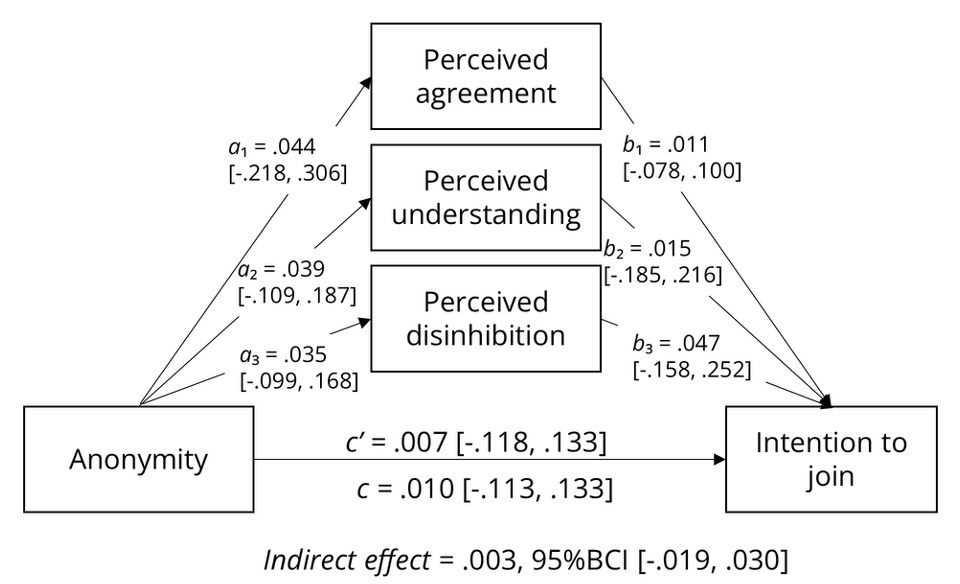
Note. Reference category is non-anonymous. a, b, c and c' are path coefficients representing unstandardized regression weights and bootstrapped (5,000 samples) confidence intervals. The c-path coefficient represents the total effect of subjectivity on intention to join. The c-prime-path coefficient refers to the direct effect of subjectivity on intention to join.
Figure I2. For the Subsample of Those That Did Pass the Manipulation Check
for Anonymity (n = 172): Mediation Model of Anonymity Predicting Intention
to Join Through Perceived Agreement, Understanding and Disinhibition.
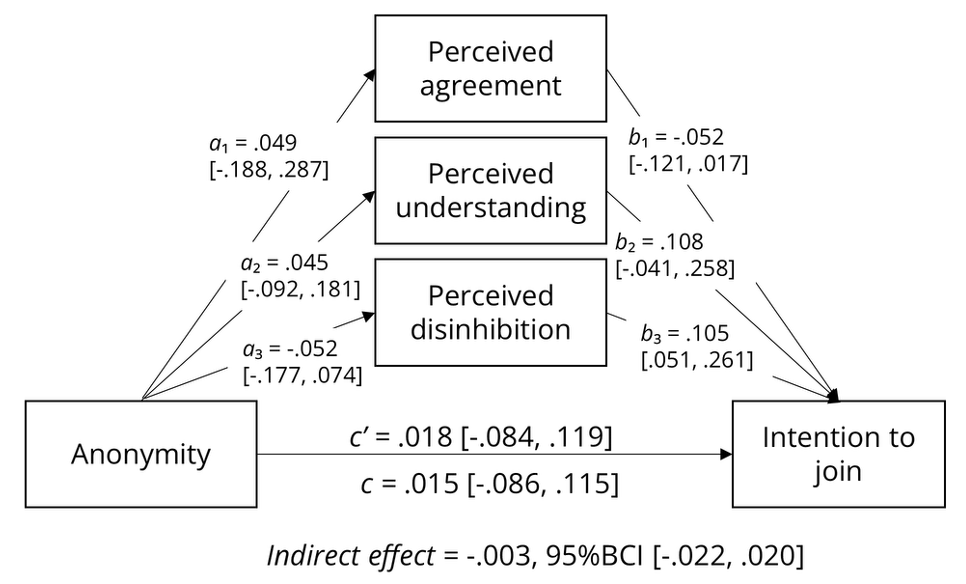
Note. Reference category is non-anonymous. a, b, c and c' are path coefficients representing unstandardized regression weights and bootstrapped (5,000 samples) confidence intervals. The c-path coefficient represents the total effect of subjectivity on intention to join. The c-prime-path coefficient refers to the direct effect of subjectivity on intention to join.
Figure I3. For the subsample of Those That Still React to Online News (n = 148):
Mediation Model of Subjectivity Predicting Intention to Join Through Perceived
Agreement, Understanding and Disinhibition.
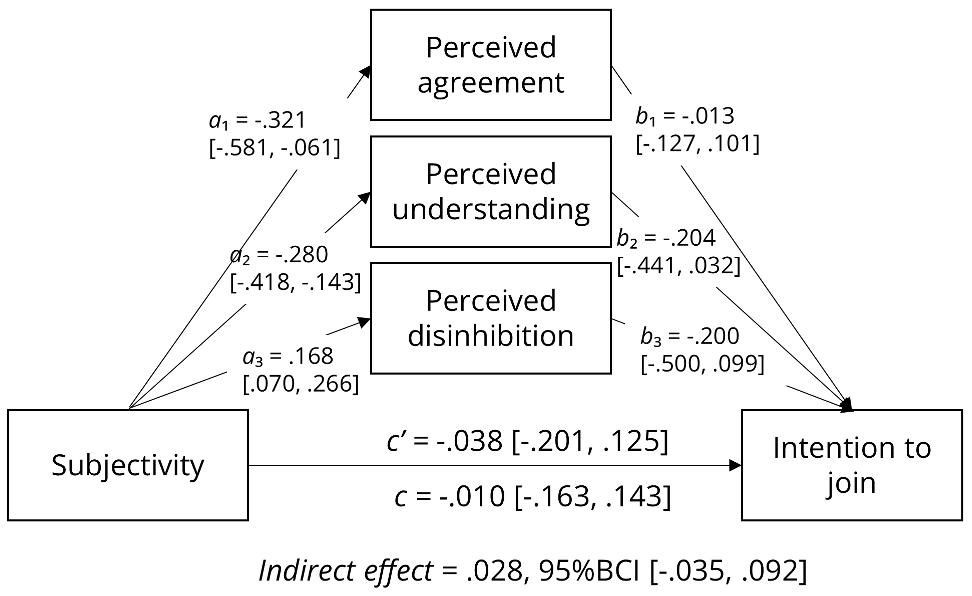
Note. Reference category is non-subjective. a, b, c and c' are path coefficients representing unstandardized regression weights and bootstrapped (5,000 samples) confidence intervals. The c-path coefficient represents the total effect of subjectivity on intention to join. The c-prime-path coefficient refers to the direct effect of subjectivity on intention to join.


This work is licensed under a Creative Commons Attribution-ShareAlike 4.0 International License.
Copyright © 2026 Carla Anne Roos, Sara Bögels, Emiel Krahmer