
The associations of relatedness need frustration and socioeconomic status with youth perfectionistic self-presentation on social media: The mediating role of social comparison
Vol.20,No.3(2026)
Shujian Wang
 Xinze Liu
Xiangping Liu
Xinze Liu
Xiangping Liu
The phenomenon of online perfectionistic self-presentation (PSP) poses significant risks for young people, contributing to heightened anxiety, depression, and social isolation as individuals strive to project idealized versions of themselves on social media. This pressure to conform to unrealistic standards often leads to detrimental psychological outcomes, necessitating an understanding of the factors that drive such behaviors. This study examines the relationship between relatedness need frustration (RNF)—a psychological state arising from feelings of social exclusion or disconnection—and online PSP among college students, alongside the moderating effect of family socioeconomic status (SES) and the mediating role of social comparison on social media. Utilizing a sample of 1,924 college students aged 17 to 26 years (M = 18.59, SD = 0.75, 65% females), we assessed RNF, PSP, social comparison on social media, SES, and demographic information through questionnaires. The results revealed that (a) RNF was positively associated with online PSP; (b) SES moderates the relationship between RNF and PSP, with individuals from low and average SES families exhibiting a significant positive correlation between RNF and PSP, while those from high SES families do not; (c) the moderating effect of SES occurs through the mediating process of social comparison. These findings highlight the psychological mechanisms underlying unhealthy self-presentation behaviors on social media and emphasize the need to address socioeconomic disparities in mental health interventions, promoting healthier social media engagement among youth.
online perfectionistic self-presentation; relatedness need frustration; social comparison; socioeconomic status; mediated moderation model
Shujian Wang
Faculty of Psychology, Beijing Normal University, Beijing, China & Beijing Key Laboratory of Applied Experimental Psychology, National Demonstration Center for Experimental Psychology Education, Beijing, China
Shujian Wang is a PhD candidate in Clinical and Counseling Psychology at Beijing Normal University. His research interests include comparative psychopathology, cross-cultural studies of emotional disorders, and the impact of online information on mental health.
Xinze Liu
Faculty of Psychology, Beijing Normal University, Beijing, China & Beijing Key Laboratory of Applied Experimental Psychology, National Demonstration Center for Experimental Psychology Education, Beijing, China
Xinze Liu received a master’s degree in Clinical and Counseling Psychology from Beijing Normal University. Her research interests focus on attachment and intimate relationship issues among emerging adults.
Xiangping Liu
Faculty of Psychology, Beijing Normal University, Beijing, China & Beijing Key Laboratory of Applied Experimental Psychology, National Demonstration Center for Experimental Psychology Education, Beijing, China
Xiangping Liu is a professor in the Faculty of Psychology at Beijing Normal University. His research interests include positive psychology, self-determination theory, and attachment theory.
Alfasi, Y. (2019). The grass is always greener on my Friends’ profiles: The effect of Facebook social comparison on state self-esteem and depression. Personality and Individual Differences, 147, 111–117. https://doi.org/10.1016/j.paid.2019.04.032
Bai, X., Jiang, L., Zhang, Q., Wu, T., Wang, S., Zeng, X., Li, Y., Zhang, L., Li, J., Zhao, Y., & Dai, J. (2021). Subjective family socioeconomic status and peer relationships: Mediating roles of self-esteem and perceived stress. Frontiers in Psychiatry, 12, Article 634976. https://doi.org/10.3389/fpsyt.2021.634976
Ballara, N. B. (2023). The power of social validation: A literature review on how likes, comments, and shares shape user behavior on social media. International Journal of Research Publication and Reviews, 4(7), 3355–3367. https://doi.org/10.55248/gengpi.4.723.51227
Baumeister, R. F., & Leary, M. R. (1995). The need to belong: Desire for interpersonal attachments as a fundamental human motivation. Psychological Bulletin, 117(3), 497–529. https://doi.org/10.1037/0033-2909.117.3.497
Besser, A., Flett, G. L., & Hewitt, P. L. (2010). Perfectionistic self-presentation and trait perfectionism in social problem-solving ability and depressive symptoms. Journal of Applied Social Psychology, 40(8), 2121–2154. https://doi.org/10.1111/j.1559-1816.2010.00653.x
Blackburn, M., Puffer, H., Molnar, D. S., & Zinga, D. (2025). Perfect fronts, fragile bonds: Prospective associations between perfectionistic self-presentation and peer experiences. Journal of Applied Developmental Psychology, 97, Article 101769. https://doi.org/10.1016/j.appdev.2025.101769
Buffardi, L. E., & Campbell, W. K. (2008). Narcissism and social networking web sites. Personality and Social Psychology Bulletin, 34(10), 1303–1314. https://doi.org/10.1177/0146167208320061
Buunk, A. P., & Gibbons, F. X. (2006). Social comparison orientation: A new perspective on those who do and those who don’t compare with others. In S. Guimond (Ed.), Social comparison and social psychology: Understanding cognition, intergroup relations, and culture (pp. 15–32). Cambridge University Press.
Byrne, B. M. (2016). Structural equation modeling with AMOS (3rd ed.). Routledge. https://doi.org/10.4324/9781315757421
Casale, S., Svicher, A., Fioravanti, G., Hewitt, P. L., Flett, G. L., & Pozza, A. (2024). Perfectionistic self-presentation and psychopathology: A systematic review and meta-analysis. Clinical Psychology & Psychotherapy, 31(2), Article e2966. https://doi.org/10.1002/cpp.2966
Chen, B., Vansteenkiste, M., Beyers, W., Boone, L., Deci, E. L., Van der Kaap-Deeder, J., Duriez, B., Lens, W., Matos, L., Mouratidis, A., Ryan, R. M., Sheldon, K. M., Soenens, B., Van Petegem, S., & Verstuyf, J. (2015). Basic psychological need satisfaction, need frustration, and need strength across four cultures. Motivation and Emotion, 39(2), 216–236. https://doi.org/10.1007/s11031-014-9450-1
Chen, C., Hewitt, P. L., & Flett, G. L. (2015). Preoccupied attachment, need to belong, shame, and interpersonal perfectionism: An investigation of the perfectionism social disconnection model. Personality and Individual Differences, 76, 177–182. https://doi.org/10.1016/j.paid.2014.12.001
Chen, C., Hewitt, P. L., Flett, G. L., Cassels, T. G., Birch, S., & Blasberg, J. S. (2012). Insecure attachment, perfectionistic self-presentation, and social disconnection in adolescents. Personality and Individual Differences, 52(8), 936–941. https://doi.org/10.1016/j.paid.2012.02.009
Cho, E.-C., & Kyoung, J. M. (2024). The mediating effects of perfectionistic self-presentation on the relationship between insecure attachment and attitudes toward seeking professional help of university students. Journal of Creativity and Convergence, 4(1), 1–18. https://doi.org/10.23021/JCC.2024.4.1.1
Chua, T. H. H., & Chang, L. (2016). Follow me and like my beautiful selfies: Singapore teenage girls’ engagement in self-presentation and peer comparison on social media. Computers in Human Behavior, 55(Part A), 190–197. https://doi.org/10.1016/j.chb.2015.09.011
Crăciun, B., & Holdevici, I. (2013). Cognitive-behavioural intervention in diminishing perfectionistic self-presentation and depression. Procedia - Social and Behavioral Sciences, 78, 476–480. https://doi.org/10.1016/j.sbspro.2013.04.334
Cramer, E. M., Song, H., & Drent, A. M. (2016). Social comparison on Facebook: Motivation, affective consequences, self-esteem, and Facebook fatigue. Computers in Human Behavior, 64, 739–746. https://doi.org/10.1016/j.chb.2016.07.049
Danielsen, H. E., Finserås, T. R., Andersen, A., Hjetland, G., Woodfin, V. I., & Skogen, J. C. (2023). Focus on self-presentation on social media is associated with perfectionism and eating disturbance. European Journal of Public Health, 33(Supplement_2), Article ckad160.297. https://doi.org/10.1093/eurpub/ckad160.297
Deci, E. L., & Ryan, R. M. (1991). A motivational approach to self: Integration in personality. In R. A. Dienstbier (Ed.), Nebraska Symposium on Motivation, 1990: Perspectives on motivation (pp. 237–288). University of Nebraska Press.
Deci, E. L., & Ryan, R. M. (2000). The “what” and “why” of goal pursuits: Human needs and the self-determination of behavior. Psychological Inquiry, 11(4), 227–268. https://doi.org/10.1207/S15327965PLI1104_01
Dibb, B., & Foster, M. (2021). Loneliness and Facebook use: The role of social comparison and rumination. Heliyon, 7(1), Article e05999. https://doi.org/10.1016/j.heliyon.2021.e05999
Dobson, A. S. (2015). Postfeminism, girls and young women, and digital media. In A. S. Dobson (Ed.), Postfeminist digital cultures: Femininity, social media, and self-representation (pp. 23–51). Palgrave Macmillan. https://doi.org/10.1057/9781137404206_2
Ellison, N., & Boyd, D. M. (2013). Sociality through social network sites. In W. H. Dutton (Ed.), The Oxford handbook of internet studies (pp. 151–172). Oxford University Press. https://doi.org/10.1093/oxfordhb/9780199589074.013.0008
Fardouly, J., & Vartanian, L. R. (2016). Social media and body image concerns: Current research and future directions. Current Opinion in Psychology, 9, 1–5. https://doi.org/10.1016/j.copsyc.2015.09.005
Festinger, L. (1954). A theory of social comparison processes. Human Relations, 7(2), 117–140. https://doi.org/10.1177/001872675400700202
Fioravanti, G., Bocci Benucci, S., Vinciarelli, V., & Casale, S. (2024). Body shame and problematic social networking sites use: The mediating effect of perfectionistic self-presentation style and body image control in photos. Current Psychology, 43(5), 4073–4084. https://doi.org/10.1007/s12144-023-04644-8
Flett, G. L., Nepon, T., Hewitt, P. L., Molnar, D. S., & Zhao, W. (2016). Projecting perfection by hiding effort: Supplementing the Perfectionistic Self-Presentation Scale with a brief self-presentation measure. Self and Identity, 15(3), 245–261. https://doi.org/10.1080/15298868.2015.1119188
Fox, J., & Vendemia, M. A. (2016). Selective self-presentation and social comparison through photographs on social networking sites. Cyberpsychology, Behavior, and Social Networking, 19(10), 593–600. https://doi.org/10.1089/cyber.2016.0248
Gerber, J. P., Wheeler, L., & Suls, J. (2018). A social comparison theory meta-analysis 60+ years on. Psychological Bulletin, 144(2), 177–197. https://doi.org/10.1037/bul0000127
Gibbons, F. X., & Buunk, B. P. (1999). Individual differences in social comparison: Development of a scale of social comparison orientation. Journal of Personality and Social Psychology, 76(1), 129–142. https://doi.org/10.1037/0022-3514.76.1.129
Gil-Or, O., Levi-Belz, Y., & Turel, O. (2015). The “Facebook-self”: Characteristics and psychological predictors of false self-presentation on Facebook. Frontiers in Psychology, 6, Article 99. https://doi.org/10.3389/fpsyg.2015.00099
Gottfried, A. W. (1985). Measures of socioeconomic status in child development research: Data and recommendations. Merrill-Palmer Quarterly, 31(1), 85–92.
Grieve, R., March, E., & Watkinson, J. (2020). Inauthentic self-presentation on Facebook as a function of vulnerable narcissism and lower self-esteem. Computers in Human Behavior, 102, 144–150. https://doi.org/10.1016/j.chb.2019.08.020
Guo, S. (2024). The psychology of social class: How socioeconomic status impacts self-acceptance and self-esteem. Lecture Notes in Education Psychology and Public Media, 37(1), 204–209. https://doi.org/10.54254/2753-7048/37/20240545
Hair, J., Black, W. C., Babin, B. J., & Anderson, R. E. (2009). Multivariate data analysis (7th ed.). Pearson Educational International.
Harman, D. (1967). A single factor test of common method variance. Journal of Psychology, 35, 359–378.
Hellmann, E. (2016). Keeping up appearances: Perfectionism and perfectionistic self-presentation on social media [Honor Scholar Theses, DePauw University]. https://scholarship.depauw.edu/studentresearch/50
Hewitt, P. L., & Flett, G. L. (1991). Perfectionism in the self and social contexts: Conceptualization, assessment, and association with psychopathology. Journal of Personality and Social Psychology, 60(3), 456–470. https://doi.org/10.1037/0022-3514.60.3.456
Hewitt, P. L., Flett, G. L., & Mikail, S. F. (2017). Perfectionism: A relational approach to conceptualization, assessment, and treatment. The Guilford Press.
Hewitt, P. L., Flett, G. L., Besser, A., Sherry, S. B., & McGee, B. (2003). Perfectionism Is multidimensional: A reply to Shafran, Cooper and Fairburn (2002). Behaviour Research and Therapy, 41(10), 1221–1236. https://doi.org/10.1016/S0005-7967(03)00021-4
Hewitt, P. L., Flett, G. L., Sherry, S. B., Habke, M., Parkin, M., Lam, R. W., McMurtry, B., Ediger, E., Fairlie, P., & Stein, M. B. (2003). The interpersonal expression of perfection: Perfectionistic self-presentation and psychological distress. Journal of Personality and Social Psychology, 84(6), 1303–1325. https://doi.org/10.1037/0022-3514.84.6.1303
Hollender, M. H. (1965). Perfectionism. Comprehensive Psychiatry, 6(2), 94–103. https://doi.org/10.1016/S0010-440X(65)80016-5
Hollingshead, A. B. (1971). Commentary on “the indiscriminate state of social class measurement”. Social Forces, 49(4), 563–567. https://doi.org/10.2307/2576737
Jin, L. S., & Hee, L. S. (2024). The effect of perfectionistic self-presentation on emotional eating among college students: The sequential effect of social comparison orientation and body dissatisfaction. Journal of cognitive Enhancement and Intervention, 15(2), 169–184. https://doi.org/10.21197/JCEI.15.2.9
Kenny, D. A., Kaniskan, B., & McCoach, D. B. (2015). The performance of RMSEA in models with small degrees of freedom. Sociological Methods & Research, 44(3), 486–507. https://doi.org/10.1177/0049124114543236
Keutler, M., & McHugh, L. (2022). Self-compassion buffers the effects of perfectionistic self-presentation on social media on wellbeing. Journal of Contextual Behavioral Science, 23, 53–58. https://doi.org/10.1016/j.jcbs.2021.11.006
Kim, S. H.-S. (2012). The moderating effects of self-acceptance in terms of the interpersonal-relationships, depression, anxiety of high school students. Korean Journal of Child Studies, 33(3), 119–130. https://doi.org/10.5723/KJCS.2012.33.3.119
Kothari, R., Egan, S., Wade, T., Andersson, G., & Shafran, R. (2016). Overcoming perfectionism: Protocol of a randomized controlled trial of an internet-based guided self-help cognitive behavioral therapy intervention. JMIR Research Protocols, 5(4), Article e215. https://doi.org/10.2196/resprot.6378
Kraus, M. W. (2018). Beggars do not envy millionaires: Social comparison, socioeconomic status, and subjective well-being. In E. Diener, S. Oishi, & L. Tay (Eds.), Handbook of well-being. UT: DEF publishers.
Kraus, M. W., Piff, P. K., Mendoza-Denton, R., Rheinschmidt, M. L., & Keltner, D. (2012). Social class, solipsism, and contextualism: How the rich are different from the poor. Psychological Review, 119(3), 546–572. https://doi.org/10.1037/a0028756
Kuncel, N. R., Rose, M., Ejiogu, K., & Yang, Z. (2014). Cognitive ability and socio-economic status relations with job performance. Intelligence, 46, 203–208. https://doi.org/10.1016/j.intell.2014.06.003
Kusserow, A. S. (1999). De-homogenizing American individualism: Socializing hard and soft individualism in Manhattan and Queens. Ethos, 27(2), 210–234. https://doi.org/10.1525/eth.1999.27.2.210
Leary, M. R., & Kowalski, R. M. (1990). Impression management: A literature review and two-component model. Psychological Bulletin, 107(1), 34–47. https://doi.org/10.1037/0033-2909.107.1.34
Lee, K.-T., Noh, M.-J., & Koo, D.-M. (2013). Lonely people are no longer lonely on social networking sites: The mediating role of self-disclosure and social support. Cyberpsychology, Behavior, and Social Networking, 16(6), 413–418. https://doi.org/10.1089/cyber.2012.0553
Lee, S. Y. (2014). How do people compare themselves with others on social network sites?: The case of Facebook. Computers in Human Behavior, 32, 253–260. https://doi.org/10.1016/j.chb.2013.12.009
Liu, J., Peng, P., Zhao, B., & Luo, L. (2022). Socioeconomic status and academic achievement in primary and secondary education: A meta-analytic review. Educational Psychology Review, 34(4), 2867–2896. https://doi.org/10.1007/s10648-022-09689-y
Loas, G., Cormier, J., & Perez-Diaz, F. (2011). Dependent personality disorder and physical abuse. Psychiatry Research, 185(1–2), 167–170. https://doi.org/10.1016/j.psychres.2009.06.011
Malka, A., & Miller, D. T. (2007). Political-economic values and the relationship between socioeconomic status and self-esteem. Journal of Personality, 75(1), 25–41. https://doi.org/10.1111/j.1467-6494.2006.00431.x
Manova, V., & Khoury, B. (2024). Interpersonal perfectionism and social anxiety: The mediational role of mindfulness. Canadian Journal of Behavioural Science / Revue Canadienne des Sciences du Comportement, 56(3), 205–215. https://doi.org/10.1037/cbs0000370
Martin, R., Suls, J., & Wheeler, L. (2002). Ability evaluation by proxy: Role of maximal performance and related attributes in social comparison. Journal of Personality and Social Psychology, 82(5), 781–791. https://doi.org/10.1037/0022-3514.82.5.781
Matthews, K. A., & Gallo, L. C. (2011). Psychological perspectives on pathways linking socioeconomic status and physical health. Annual Review of Psychology, 62(1), 501–530. https://doi.org/10.1146/annurev.psych.031809.130711
McLeod, B. A., & Genereux, R. L. (2008). Predicting the acceptability and likelihood of lying: The interaction of personality with type of lie. Personality and Individual Differences, 45(7), 591–596. https://doi.org/10.1016/j.paid.2008.06.015
Meier, A., & Johnson, B. K. (2022). Social comparison and envy on social media: A critical review. Current Opinion in Psychology, 45, Article 101302. https://doi.org/10.1016/j.copsyc.2022.101302
Merikangas, K. R., Lieb, R., Wittchen, H.-U., & Avenevoli, S. (2003). Family and high-risk studies of social anxiety disorder. Acta Psychiatrica Scandinavica, 108(s417), 28–37. https://doi.org/10.1034/j.1600-0447.108.s417.5.x
Michinov, N., & Bavent, L. (2001). Upward persistence and downward desistence: Some reactions to social-comparison deprivation after a threat. European Psychologist, 6(2), 112–122. https://doi.org/10.1027/1016-9040.6.2.112
Milson, R., & Madigan, D. J. (2025). Picture perfect. Journal of Media Psychology, 37(4), 191–204. https://doi.org/10.1027/1864-1105/a000434
Miyamoto, Y., Yoo, J., Levine, C. S., Park, J., Boylan, J. M., Sims, T., Markus, H. R., Kitayama, S., Kawakami, N., Karasawa, M., Coe, C. L., Love, G. D., & Ryff, C. D. (2018). Culture and social hierarchy: Self- and other-oriented correlates of socioeconomic status across cultures. Journal of Personality and Social Psychology, 115(3), 427–445. https://doi.org/10.1037/pspi0000133
Mueller, C. W., & Parcel, T. L. (1981). Measures of socioeconomic status: Alternatives and recommendations. Child Development, 52(1), 13–30. https://doi.org/10.2307/1129211
Mun, I. B., & Kim, H. (2021). Influence of false self-presentation on mental health and deleting behavior on Instagram: The mediating role of perceived popularity. Frontiers in Psychology, 12, Article 660484. https://doi.org/10.3389/fpsyg.2021.660484
Myers, T. A., & Crowther, J. H. (2009). Social comparison as a predictor of body dissatisfaction: A meta-analytic review. Journal of Abnormal Psychology, 118(4), 683–698. https://doi.org/10.1037/a0016763
Nesi, J., & Prinstein, M. J. (2015). Using social media for social comparison and feedback-seeking: Gender and popularity moderate associations with depressive symptoms. Journal of Abnormal Child Psychology, 43(8), 1427–1438. https://doi.org/10.1007/s10802-015-0020-0
Niu, X., Gou, L., Han, Y., Zhou, X., & Wang, J. (2024). Self‐concept clarity and envy as mediators between upward social comparison on social networking sites and subjective well‐being. British Journal of Developmental Psychology, 43(3), 611–628. https://doi.org/10.1111/bjdp.12538
Olivos, F., Olivos-Jara, P., & Browne, M. (2021). Asymmetric social comparison and life satisfaction in social networks. Journal of Happiness Studies, 22(1), 363–384. https://doi.org/10.1007/s10902-020-00234-8
Renger, D., Lohmann, J. F., Renger, S., & Martiny, S. E. (2024). Socioeconomic status and self-regard. Social Psychology, 55(1), 12–24. https://doi.org/10.1027/1864-9335/a000536
Robillard, C. L., Switzer, A. C., Legg, N. K., Spargo, E. L., & Turner, B. J. (2025). Associations between self-criticism, basic psychological needs frustration, and self-damaging behaviors: An application of self-determination theory. Cognitive Therapy and Research, 49(1), 126–139. https://doi.org/10.1007/s10608-024-10533-6
Rosseel, Y. (2012). lavaan: An R Package for structural equation modeling. Journal of Statistical Software, 48(2), 1–36. https://doi.org/10.18637/jss.v048.i02
Roxborough, H. M., Hewitt, P. L., Kaldas, J., Flett, G. L., Caelian, C. M., Sherry, S., & Sherry, D. L. (2012). Perfectionistic self-presentation, socially prescribed perfectionism, and suicide in youth: A test of the perfectionism social disconnection model. Suicide and Life-Threatening Behavior, 42(2), 217–233. https://doi.org/10.1111/j.1943-278X.2012.00084.x
Rozental, A., Shafran, R., Wade, T., Egan, S., Nordgren, L. B., Carlbring, P., Landström, A., Roos, S., Skoglund, M., Thelander, E., Trosell, L., Örtenholm, A., & Andersson, G. (2017). A randomized controlled trial of internet-based cognitive behavior therapy for perfectionism including an investigation of outcome predictors. Behaviour Research and Therapy, 95, 79–86. https://doi.org/10.1016/j.brat.2017.05.015
Schlechter, P., König, M., McNally, R. J., & Morina, N. (2023). Crying over spilled milk? A network analysis of aversive well-being comparison, brooding rumination and depressive symptoms. Journal of Affective Disorders, 339, 520–530. https://doi.org/10.1016/j.jad.2023.07.088
Schlosser, A. E. (2020). Self-disclosure versus self-presentation on social media. Current Opinion in Psychology, Privacy and Disclosure, Online and in Social Interactions, 31, 1–6. https://doi.org/10.1016/j.copsyc.2019.06.025
Schmidt, A., Neubauer, A. B., Dirk, J., & Schmiedek, F. (2020). The bright and the dark side of peer relationships: Differential effects of relatedness satisfaction and frustration at school on affective well-being in children’s daily lives. Developmental Psychology, 56(8), 1532–1546. https://doi.org/10.1037/dev0000997
Seekis, V., & Kennedy, R. (2023). The impact of beauty and self-compassion tiktok videos on young women’s appearance shame and anxiety, self-compassion, mood, and comparison processes. Body Image, 45, 117–125. https://doi.org/10.1016/j.bodyim.2023.02.006
Shah, A. K., Mullainathan, S., & Shafir, E. (2012). Some consequences of having too little. Science, 338(6107), 682–685. https://doi.org/10.1126/science.1222426
Shao, S., Mao, N., Zhang, Z., Yang, M., He, S., Yue, X., Li, C., & Cui, L. (2024). Adolescents’ loneliness and problematic smartphone use: The mediating role of upward social comparison and the moderating role of self‐identity. Psychology in the Schools, 61(8), 3224–3242. https://doi.org/10.1002/pits.23215
Sherry, S. B., Hewitt, P. L., Flett, G. L., Lee-Baggley, D. L., & Hall, P. A. (2007). Trait perfectionism and perfectionistic self-presentation in personality pathology. Personality and Individual Differences, 42(3), 477–490. https://doi.org/10.1016/j.paid.2006.07.026
Sirin, S. R. (2005). Socioeconomic status and academic achievement: A meta-analytic review of research. Review of Educational Research, 75(3), 417–453. https://doi.org/10.3102/00346543075003417
Skinstad, M. (2008). Facebook: A digital network of friends [Paper presentation]. 24th Conference of the Nordic Sociological Association. Aarhus, Denmark.
Song, H., Zmyslinski-Seelig, A., Kim, J., Drent, A., Victor, A., Omori, K., & Allen, M. (2014). Does Facebook make you lonely?: A meta analysis. Computers in Human Behavior, 36, 446–452. https://doi.org/10.1016/j.chb.2014.04.011
Statista. (2024). Global TikTok user age and gender distribution 2024. Statista. https://www.statista.com/statistics/1299771/tiktok-global-user-age-distribution/
Stephens, N. M., Markus, H. R., & Phillips, L. T. (2014). Social class culture cycles: How three gateway contexts shape selves and fuel inequality. Annual Review of Psychology, 65(1), 611–634. https://doi.org/10.1146/annurev-psych-010213-115143
Stephens, N. M., Markus, H. R., & Townsend, S. S. M. (2007). Choice as an act of meaning: The case of social class. Journal of Personality and Social Psychology, 93(5), 814–830. https://doi.org/10.1037/0022-3514.93.5.814
Stoeber, J., Madigan, D. J., Damian, L. E., Esposito, R. M., & Lombardo, C. (2017). Perfectionism and eating disorder symptoms in female university students: The central role of perfectionistic self-presentation. Eating and Weight Disorders - Studies on Anorexia, Bulimia and Obesity, 22(4), 641–648. https://doi.org/10.1007/s40519-016-0297-1
Suls, J., & Wheeler, L. (2012). Social comparison theory. In P. A. M. Van Lange, A. W. Kruglanski, & E. T. Higgins (Eds.), Handbook of theories of social psychology: Volume 1. (pp. 460–482). SAGE Publications Ltd. https://doi.org/10.4135/9781446249215
Sun, J., & Zheng, Q. (2004). Self-cognition in social comparison and temporal comparison. Advances in Psychological Science, 12(2), 240–245.
Tiggemann, M., & Velissaris, V. G. (2020). The effect of viewing challenging “reality check” Instagram comments on women’s body image. Body Image, 33, 257–263. https://doi.org/10.1016/j.bodyim.2020.04.004
Tong, E. M. W., Reddish, P., Oh, V. Y. S., Ng, W., Sasaki, E., Chin, E. D. A., & Diener, E. (2022). Income robustly predicts self-regard emotions. Emotion, 22(7), 1670–1685. https://doi.org/10.1037/emo0000933
Twenge, J. M., & Campbell, W. K. (2002). Self-esteem and socioeconomic status: A meta-analytic review. Personality and Social Psychology Review, 6(1), 59–71. https://doi.org/10.1207/S15327957PSPR0601_3
Ubaradka, A., Fathima, A., & Batra, S. (2023). Psychological correlates of perfectionistic self-presentation among social media users. International Journal of Cyber Behavior, Psychology and Learning, 13(1), 1–13. https://doi.org/10.4018/ijcbpl.324089
Vansteenkiste, M., Ryan, R. M., & Soenens, B. (2020). Basic psychological need theory: Advancements, critical themes, and future directions. Motivation and Emotion, 44(1), 1–31. https://doi.org/10.1007/s11031-019-09818-1
Vogel, E. A., Rose, J. P., Okdie, B. M., Eckles, K., & Franz, B. (2015). Who compares and despairs? The effect of social comparison orientation on social media use and its outcomes. Personality and Individual Differences, 86, 249–256. https://doi.org/10.1016/j.paid.2015.06.026
Vogel, E. A., Rose, J. P., Roberts, L. R., & Eckles, K. (2014). Social comparison, social media, and self-esteem. Psychology of Popular Media Culture, 3(4), 206–222. https://doi.org/10.1037/ppm0000047
Wang, J.-L., Wang, H.-Z., Gaskin, J., & Hawk, S. (2017). The mediating roles of upward social comparison and self-esteem and the moderating role of social comparison orientation in the association between social networking site usage and subjective well-being. Frontiers in Psychology, 8, Article 771. https://doi.org/10.3389/fpsyg.2017.00771
Wang, P., Xie, X., Wang, X., Wang, X., Zhao, F., Chu, X., Nie, J., & Lei, L. (2018). The need to belong and adolescent authentic self-presentation on SNSs: A moderated mediation model involving FoMO and perceived social support. Personality and Individual Differences, 128, 133–138. https://doi.org/10.1016/j.paid.2018.02.035
Wang, Y., Li, L. M. W., & Xie, F. (2019). Cultural difference in maladaptive functions of perfectionistic self‐presentation. Asian Journal of Social Psychology, 22(3), 290–300. https://doi.org/10.1111/ajsp.12371
Wang, Y., Sun, Y., & Wang, N. (2024). Authentic presentation or false exaggeration? Exploring the effects of social- and personal-based comparisons from cognitive emotion theory. Computers in Human Behavior, 156, Article 108231. https://doi.org/10.1016/j.chb.2024.108231
Waterloo, S. F., Baumgartner, S. E., Peter, J., & Valkenburg, P. M. (2018). Norms of online expressions of emotion: Comparing Facebook, Twitter, Instagram, and WhatsApp. New Media & Society, 20(5), 1813–1831. https://doi.org/10.1177/1461444817707349
Weibo Corporation. (2024). Weibo user agreement. https://weibo.com/signup/v5/protocol
Wilson, C., Talbot, C. V., & Scott, G. G. (2024). Online self-presentation: Psychological predictors and outcomes. Telematics and Informatics Reports, 14, Article 100147. https://doi.org/10.1016/j.teler.2024.100147
Xie, Y. (2015). Review on affecting the mediation mechanism between perfectionism and depression. Advances in Psychology, 5, 284–290. http://dx.doi.org/10.12677/ap.2015.55039
Xing, X., Ma, Y., Shi, R., & Hu, X. (2022). Indirect path from household chaos to preschooler’s executive function: The role of children’s sleep. China Journal of Health Psychology, 30(7), 1076–1081. https://doi.org/10.13342/j.cnki.cjhp.2022.07.024
Yan, W., Yang, K., Wang, Q., You, X., & Kong, F. (2021). Subjective family socioeconomic status and life satisfaction in Chinese adolescents: The mediating role of self-esteem and social support. Youth & Society, 53(7), 1047–1065. https://doi.org/10.1177/0044118X20941344
Yang, C.-c, & Robinson, A. (2018). Not necessarily detrimental: Two social comparison orientations and their associations with social media use and college social adjustment. Computers in Human Behavior, 84, 49–57. https://doi.org/10.1016/j.chb.2018.02.020
Ye, B., & Wen, Z. (2013). A discussion on testing methods for mediated moderation models: Discrimination and integration. Acta Psychologica Sinica, 45(9), 1050–1060. https://doi.org/10.3724/SP.J.1041.2013.01050
Yu, E., & Kim, H.-C. (2020). Is she really happy? A dual-path model of narcissistic self-presentation outcomes for female Facebook users. Computers in Human Behavior, 108, Article 106328. https://doi.org/10.1016/j.chb.2020.106328
Zhang, W., Li, D., & Xie, Z. (2007). Low socioeconomic status and child development. Journal of South China Normal University (Social Science Edition), 6, 104–112, 118. https://doi.org/10.3969/j.issn.1000-5455.2007.06.018
Zhang, Q., Maner, J. K., Xu, Y., & Zheng, Y. (2017). Relational motives reduce attentional adhesion to attractive alternatives in heterosexual university students in China. Archives of Sexual Behavior, 46(2), 503–511. https://doi.org/10.1007/s10508-016-0759-6
Zhang, X., Lin, J., & Zhang, J. (2020). Relationship between passive use of social network site and loneliness and its chain mediation. Chinese Journal of Clinical Psychology, 28(1), 63–66. https://doi.org/10.16128/j.cnki.1005-3611.2020.01.015
Zheng, L. R., Atherton, O. E., Trzesniewski, K., & Robins, R. W. (2020). Are self-esteem and academic achievement reciprocally related? Findings from a longitudinal study of Mexican-origin youth. Journal of Personality, 88(6), 1058–1074. https://doi.org/10.1111/jopy.12550
Zhou, J. (2017). Modern psychology research on human basic psychological needs—Validation of the basic psychological needs satisfaction process model in social network sits [Doctoral dissertation, Wuhan University]. https://kns.cnki.net/KCMS/detail/detail.aspx?dbcode=CDFD&dbname=CDFDLAST2017&filename=1014250285.nh
Zhou, Q., Fan, L., & Yin, Z. (2018). Association between family socioeconomic status and depressive symptoms among Chinese adolescents: Evidence from a national household survey. Psychiatry Research, 259, 81–88. https://doi.org/10.1016/j.psychres.2017.09.072
Zhu, X., & Xiong, Z. (2022). Exploring association between social media addiction, fear of missing out, and self-presentation online among university students: A cross-sectional study. Frontiers in Psychiatry, 13, Article 896762. https://doi.org/10.3389/fpsyt.2022.896762
Zuo, A. (2014). Measuring up: Social comparisons on Facebook and contributions to self-esteem and mental health [Master’s thesis, University of Michigan]. http://deepblue.lib.umich.edu/handle/2027.42/107346
Authors' Contribution
Shujian Wang: formal analysis, writing—original draft, writing—review & editing, conceptualization. Xinze Liu: writing—original draft. Xiangping Liu: investigation, writing—original draft.
Editorial Record
First submission received:
February 18, 2025
Revisions received:
July 29, 2025
March 5, 2026
April 7, 2026
Accepted for publication:
April 7, 2026
Editor in charge:
Lenka Dedkova
Introduction
The use of social media has become a central aspect of social life for young people, with platforms like TikTok exemplifying this trend. As of April 2024, TikTok has been downloaded over 4.92 billion times and boasts 1.58 billion monthly active users. Notably, 36.2% of these users are between the ages of 18 and 24, highlighting the platform's role as a primary communication tool among young people (Statista, 2024). Although social media apps vary (e.g., TikTok, Facebook, Twitter), Ellison and Boyd (2013) identified three defining features common to all: (a) the ability to generate a list of online connections; (b) the ability to view and interact with a stream of frequently updated content; and (c) most importantly, the ability to freely create a personal profile. These features enable individuals to curate and project an idealized image of success on social media—a phenomenon in psychology referred to as Perfectionistic Self-Presentation (PSP). Young people, in particular, may experience negative outcomes such as stress, loneliness, and depression when they focus excessively on maintaining a flawless self-image online while concealing their imperfections (Flett et al., 2016; Mun & H. Kim, 2021). Thus, understanding the risk factors contributing to young people’s online PSP and providing guidance on appropriate social media use is critical for safeguarding their mental health.
PSP refers to a form of interpersonal expression in which individuals feel compelled to appear perfect to others, often to avoid judgment, criticism, or rejection (Hewitt, Flett, Sherry, et al., 2003). While most research focuses on the detrimental effects of PSP on physical and mental well-being, fewer studies address the underlying mechanisms that generate PSP on social media. A systematic review suggests that perfectionists often exhibit high levels of neuroticism, which can result in negative emotional responses when they encounter challenges. This predisposition may drive them to engage in self-criticism as a way to restore inner balance and security (Hewitt & Flett, 1991; Xie, 2015). Additionally, a study in college students found that individuals with high levels of insecure attachment may be more motivated to present a perfect self-image (Cho & Kyoung, 2024). However, while these studies link personal traits to PSP, they often overlook environmental factors such as interpersonal alienation and family environment. Just as other pathological social behaviors can be triggered by specific events, it is plausible that PSP on social media may also be influenced by particular environment-related factors (Loas et al., 2011; Merikangas et al., 2003).
One such factor is relatedness need frustration (RNF), a concept within Self-Determination Theory (SDT). It captures the active thwarting of the basic psychological need to feel close, connected, and significant to others. Some evidence suggests that social disconnection is significantly associated with young people’s PSP (C. Chen et al., 2012). College students may use social media to compensate for social anxiety or loneliness in real life, seeking recognition from others (Hewitt, Flett, Sherry, et al., 2003; McLeod & Genereux, 2008). Unfortunately, this inauthentic behavior can have long-term negative effects on mental health (Hewitt, Flett, Sherry, et al., 2003). However, research findings remain mixed. For instance, Skinstad (2008) found that some individuals engage in selective honesty to satisfy their need for recognition, while other studies indicate that RNF does not significantly predict PSP (P. Wang et al., 2018). A potential reason for these contradictions is that prior studies have not fully explored the internal processes through which RNF elicits PSP, nor have they considered moderating mechanisms that might make certain groups more susceptible to PSP. To address this gap, the current study investigates the association between RNF and PSP on social media among college students, examining the mediating role of online social comparison and the moderating effect of family socioeconomic status in this process.
Relatedness Need Frustration (RNF) and Perfectionistic Self-Presentation (PSP)
In SDT, the relatedness need is conceptualized as one of the three basic human psychological needs. According to Deci and Ryan (1991), relatedness need “encompasses a person's strivings to relate to and care for others, to feel that those others are relating authentically to oneself, and to feel a satisfying and coherent involvement with the social world more generally” (p. 243). When individuals experience relational exclusion, rejection, or loneliness, they may suffer from RNF (Vansteenkiste et al., 2020). While conceptually related to the fundamental need to belong (Baumeister & Leary, 1995), which emphasizes the universal motivational drive for social connection, RNF specifically captures the subjective psychological distress and thwarting of that connection. Deci and Ryan (2000) argue that frustration of basic psychological needs often leads to maladaptive outcomes. One prominent manifestation of such maladaptation is the pursuit of need substitutes—external objects or behaviors that offer a temporary illusion of satisfaction, but fail to satisfy basic needs in a sustainable way. For example, when the need for relatedness is thwarted, individuals may engage in compensatory behaviors such as excessive reassurance-seeking, problematic internet use, or superficial socializing to artificially manufacture a sense of relatedness (B. Chen et al., 2015). In the context of modern digital interactions, emerging literature suggests that a potential maladaptive outcome is Perfectionistic Self-Presentation (PSP).
Leary and Kowalski (1990) described self-presentation as a goal-driven behavior aimed at controlling and managing others’ perceptions of the self. Accordingly, the core of PSP is to “appear perfect in the eyes of others” (Sherry et al., 2007, p. 478). Hewitt, Flett, Besser, et al. (2003) conceptualized PSP as a maladaptive self-presentational style comprising three dimensions: perfectionistic self-promotion (i.e., displaying one’s perfection), non-display of imperfection (i.e., avoiding the exposure of flaws), and non-disclosure of imperfection (i.e., refraining from verbally admitting imperfections). Compared to traditional social interactions, social media enables individuals to freely construct and curate their personal profiles for others to view (Tiggemann & Velissaris, 2020). This affordance facilitates greater control—and even fabrication—of self-relevant information, thereby making PSP more easily enacted online (Buffardi & Campbell, 2008). Consequently, social media has become a prominent platform for PSP among contemporary youth (Keutler & McHugh, 2022; Seekis & Kennedy, 2023; Wilson et al., 2024).
The most widely accepted explanation for the development of PSP is Perfectionism Social Disconnection Model (PSDM, Hewitt et al., 2017). Early research suggested that individuals with perfectionistic tendencies often experienced weak emotional bonds with their parents during childhood, which contributed to heightened sensitivity and insecurity regarding social connectedness. This insecurity may evolve into a strong desire for acceptance in later interpersonal relationships (Hollender, 1965). The PSDM builds on this perspective and extends it to broader social contexts, emphasizing that PSP frequently emerges following experiences of social rejection or exclusion. As Hewitt et al. (2017) noted, PSP is “an attempt in the interpersonal domain to procure the sense of mattering, belonging, being accepted, and being good enough” (p. 126). However, the model also posits that the nature of PSP may paradoxically lead others to perceive perfectionistic individuals as cold, distant, and hostile, or even provoke jealousy—ultimately intensifying the individual’s interpersonal difficulties (Chua & Chang, 2016; Hewitt et al., 2017). This dynamic closely mirrors the mechanism described in SDT, wherein individuals experiencing RNF seek out need substitutes to compensate for unmet psychological needs. Thus, theoretically, we can assume that PSP is a maladaptive outcome of RNF.
Several studies provide empirical support for this view. For instance, in a clinical sample of children and adolescents, Roxborough et al. (2012) assessed social disconnection using measures of peer bullying and social hopelessness and found a significant positive association between social disconnection and PSP. Similarly, C. Chen et al. (2012) reported that social connectedness was negatively related to PSP among adolescents. Extending this to young adults, a study by C. Chen et al. (2015) involving 513 undergraduate students further supported the idea that promoting one’s perceived perfection or concealing imperfections serves as a response to frustrated relatedness needs. Recent longitudinal research further clarifies this temporal relationship. Blackburn et al. (2025) demonstrated that negative peer experiences prospectively predict increased PSP in youth over time. Collectively, this evidence suggests that individuals may deploy “perfect” facades to compensate for fragile social bonds.
Based on the theoretical framework and empirical foundation, we hypothesize that RNF is positively related to PSP (Hypothesis 1).
Social Comparison on Social Media as a Mediator
In classical psychological theory, social comparison refers to the process by which individuals evaluate their own abilities, opinions, and characteristics by comparing themselves with others during social interactions (Festinger, 1954). With the rise of the internet, interpersonal interactions have increasingly shifted from face-to-face settings to online platforms, making social comparison more frequent and accessible in cyber space (Vogel et al., 2014). Some investigates show that college students not only compare their abilities and achievements but also their posts, social media followers, likes, and seemingly “flawless” lives on platforms like TikTok and Instagram (Chua & Chang, 2016; S. Y. Lee, 2014).
Social comparison theory (Festinger, 1954) posits that individuals often compare themselves with others to obtain self-evaluations, especially in the absence of objective standards. Individuals who feel socially isolated may develop negative emotions such as depression, anxiety, and confusion (Schmidt et al., 2020). To alleviate these negative feelings and gain recognition, they may use social comparison as a means of adjusting their self-perceptions and achieving comfort or compensation (Martin et al., 2002; Sun & Q. Zheng, 2004). In digital contexts, this tendency often manifests as comparing oneself to peers who appear more successful or socially rewarded, reflecting a general leaning toward upward comparison. For instance, a study of 466 high school students revealed that RNF leads to upward social comparisons on social network sites, enabling teenagers to validate their values and find emotional relief (Shao et al., 2024). Similar findings suggest that individuals who experience loneliness are more likely to compare themselves with others perceived as superior on platforms such as Facebook (Vogel et al., 2015). A study among Chinese college students showed that a lack of realistic interpersonal relationships is significantly associated with greater social comparison on social network sites (X. Zhang et al., 2020), a phenomenon also observed among Facebook users in the UK (Dibb & Foster, 2021).
On social media, where curated images of success and beauty are pervasive, social comparisons frequently lead to self-dissatisfaction and self-criticism (Niu et al., 2024; J.-L. Wang et al., 2017). To cope with these negative self-perceptions and project a desirable image, individuals may engage in PSP, seeking external validation and positive feedback. Empirical studies consistently show that online social comparisons—particularly with idealized content such as filtered selfies or aspirational lifestyles—lead to body dissatisfaction, reduced self-esteem, and emotions like envy and shame among college students (Myers & Crowther, 2009; Zuo, 2014). These negative responses, in turn, heighten the motivation for both undergraduates (Ubaradka et al., 2023) and the general population (Ballara, 2023; Y. Wang et al., 2019, 2024) to curate an enhanced online persona through strategic PSP behaviors, such as photo editing or deleting less popular posts. Furthermore, Jin and Hee (2024) confirmed that social comparison serves as a significant predictor of PSP in college students. Similarly, Danielsen et al. (2023) found that exposure to others’ seemingly perfect lives intensifies self-dissatisfaction in adolescents, prompting individuals to conceal their authentic selves and present a more idealized version online (Fox & Vendemia, 2016).
Based on this body of evidence, it is reasonable to propose that RNF may increase individuals’ susceptibility to engage in social comparison behaviors on social media, which in turn could lead to higher levels of PSP. Therefore, we hypothesize that social comparison might mediate the relationship between RNF and PSP among young people (Hypothesis 2).
Family Socioeconomic Status (SES) as a Moderator
Despite the theoretically established relationship between RNF and PSP via social comparison, not all individuals with RNF engage in social comparison behaviors (Meier & Johnson, 2022), suggesting the presence of additional risk factors that may predispose certain individuals with RNF to social comparison. One such factor is family socioeconomic status (SES). SES refers to an individual’s or family’s relative position in the social hierarchy, based on wealth, prestige, and power (Mueller & Parcel, 1981). As a composite indicator, SES provides an overview of a family’s economic background, cultural environment, and interpersonal relationships (Matthews & Gallo, 2011; W. Zhang et al., 2007).
SDT posits that RNF motivates individuals to seek recognition, establish social connections, and take related actions to fulfill their unmet needs (B. Chen et al., 2015). However, such actions do not always yield positive outcomes. For instance, J. Zhou (2017) argued that students experiencing RNF may spread rumors about classmates in an attempt to gain popularity and feel valued. Similarly, Robillard et al. (2025) found that RNF can lead individuals to feel worthless. These feelings of worthlessness, along with the desire to be acknowledged, are key triggers of social comparison (Alfasi, 2019; Festinger, 1954; Schlechter et al., 2023).
Individuals from high SES families typically demonstrate higher academic and job achievement (Kuncel et al., 2014; Liu et al., 2022; Sirin, 2005). These social achievements may help them attain recognition and a sense of self-worth independently of social comparison (Tong et al., 2022; L. R. Zheng et al., 2020). Numerous studies have shown that individuals from high SES backgrounds also exhibit higher levels of self-esteem (Renger et al., 2024; Twenge & Campbell, 2002). Moreover, high SES individuals tend to endorse more self-oriented values, suggesting that their self-esteem is derived more from internal standards than from external validation (Kraus et al., 2012; Stephens et al., 2014). Consequently, they may not rely on social comparison to satisfy psychological needs when experiencing RNF. Furthermore, individuals from high SES families exhibit greater self-acceptance (Guo, 2024), which has been shown to moderate the relationship between interpersonal relationships and negative emotional reactions. Specifically, when faced with interpersonal frustration, those with high self-acceptance are more likely to tolerate exclusion and are less prone to depression and anxiety (S. H.-S. Kim, 2012). Therefore, we hypothesize that RNF may not predict social comparison behavior in individuals from high SES backgrounds.
In contrast, individuals from lower SES backgrounds face limited access to social resources, which often imposes greater constraints and life challenges (Shah et al., 2012), making it more difficult for them to pursue self-oriented goals (Kraus et al., 2012).Compared to their high SES counterparts, who tend to emphasize unique self, individuals from low SES backgrounds are more likely to seek approval and derive self-worth from external sources, such as social relationships and environment (Kusserow, 1999; Miyamoto et al., 2018; Stephens et al., 2007). As a result, they may be more inclined to engage in social comparison following experiences of RNF. Q. Zhang (2017) found that SES is significantly correlated with social comparison tendencies among college students. Additionally, a substantial body of research has shown that low SES is strongly associated with lower self-esteem (Bai et al., 2021; Malka & Miller, 2007; Yan et al., 2021). Individuals with low self-esteem are, in turn, more likely to engage in social comparison (Buunk & Gibbons, 2006). In an effort to enhance self-esteem and perceived self-worth, such individuals may resort to false self-presentation (Grieve et al., 2020).
Taken together, we hypothesize that SES moderates the relationship between RNF and PSP. Specifically, individuals from lower SES backgrounds may be more prone to engage in social comparison on social media when experiencing RNF, ultimately exhibiting online PSP (Hypothesis 3).
The Current Study
Most previous studies on PSP have emphasized its negative consequences (Casale et al., 2024), such as affective disorders (Besser et al., 2010; Manova & Khoury, 2024), eating disorders (Stoeber et al., 2017), and problematic social network use (Fioravanti et al., 2024). However, there is limited research examining the upstream psychological and social factors that drive this behavior. Existing studies often treat PSP as a static trait linked to perfectionism or personality, but less is known about how situational psychological experiences—such as RNF—may be associated with online self-presentation. Moreover, the role of social comparison as a mechanism, and family SES as a contextual vulnerability factor, remains underexplored. From a motivational perspective, individuals may adopt PSP as a compensatory strategy—seeking validation and managing social insecurity (Flett et al., 2016; Hewitt et al., 2017; Mun & H. Kim, 2021). To address these gaps, our study proposes a novel integrative model linking RNF, social comparison, and PSP within a mediated moderation framework grounded in Self-Determination Theory and the Perfectionism Social Disconnection Model. This approach not only advances theoretical understanding of maladaptive online behavior, but also offers practical insights into the mental health disparities that emerge in digital spaces, especially among youth from lower socioeconomic backgrounds.
Several factors that may influence online PSP were measured and included as control variables in the analysis—specifically, online self-disclosure, frequency of social media use, gender, and age.
Online self-disclosure was controlled because, although it sometimes entails revealing vulnerable aspects of the self, social media users frequently engage in the strategic disclosure of selectively positive information to construct a desirable online persona (Schlosser, 2020). Given this context-dependent relationship, we treated self-disclosure as a control variable in order to isolate the unique effects of RNF and SES. Frequency of social media use was also included, as engaging in PSP requires a baseline level of social media activity. Therefore, low PSP may simply reflect infrequent social media use, while higher levels of use are positively associated with online PSP (Milson & Madigan, 2025; Zhu & Xiong, 2022). Finally, gender and age were included as covariates based on evidence suggesting they affect patterns of social comparison and self-presentation. Females are generally more likely to engage in appearance-related social comparisons and experience pressure to present an idealized self online (Dobson, 2015; Fardouly & Vartanian, 2016). Similarly, younger users are more developmentally sensitive to peer evaluation and use social comparison more frequently to gain approval (Nesi & Prinstein, 2015; Yang & Robinson, 2018). Statistically controlling for these variables ensures a more accurate interpretation of our primary findings.
Moreover, in this study, we assessed PSP as a general behavioral tendency across social media platforms, rather than restricting measurement to a single site. This approach was informed by both theoretical and practical considerations. Theoretically, our primary interest lies in the psychological mechanism of social comparison as a general process through which RNF may give rise to PSP. Because social comparison occurs across a wide range of platforms, employing a generalized measure allows us to more accurately capture this underlying mechanism in diverse online contexts. Practically, among Chinese college students—the target population of this study—multi-platform usage is the norm. Platforms such as WeChat, Weibo, Xiaohongshu, and TikTok are frequently used in parallel, each serving distinct social functions. Restricting the assessment to a single platform would therefore compromise ecological validity and limit the generalizability of our findings to the broader landscape of social media use.
In summary, the current study seeks to investigate the mediating role of social comparison on social media and the moderating role of SES in the relationship between RNF and PSP. Based on the literature review, this study proposes the following hypotheses: (1) RNF is positively related to young people's PSP on social media. (2) social comparison on social media mediates the relationship between RNF and PSP, with RNF positively affecting social comparison, which in turn is positively related to PSP. (3) Family SES moderates the relationship between RNF and social comparison.
Methods
Participants and Procedure
Data were obtained from Beijing Normal University in Beijing and Northeast Agricultural University in Heilongjiang Province in September 2023. Course instructors at both universities distributed a link to an online questionnaire via their respective course chat groups and invited students to participate during class. Due to varying class schedules, the exact timing of participant responses differed by up to two weeks. Students who complete the entire questionnaire can receive extra course credit. Data collection utilized the online questionnaire platform Wenjuanxing. 357 students in Beijing Normal University and 1,569 students in Northeast Agricultural University voluntarily participated in the research. After excluding the incomplete questionnaires, 1,924 complete questionnaires were included in the final analysis. The sample comprised 678 (35%) males and 1,246 (65%) females, aged between 17 and 26 years (M = 18.59, SD = 0.75). Demographic information for the sample is shown in Table 1. All participants provided electronic informed consent. The Ethics Committee of Beijing Normal University approved the current study.
Table 1. Demographic Information (N = 1,924).
|
Variables |
N |
% |
|
Gender |
|
|
|
Female |
678 |
35.24% |
|
Male |
1,246 |
64.76% |
|
Father occupation |
|
|
|
Unskilled employees or small-scale farmer |
928 |
48.23% |
|
Machine operators or semiskilled employees |
200 |
10.4% |
|
Skilled manual employees |
326 |
16.94% |
|
Clerical, sales workers, technicians, or owners of little businesses |
196 |
10.19% |
|
Administrative personnel, small independent businesses, or lesser professionals |
147 |
7.64% |
|
Business managers, proprietors of medium-sized businesses, or lesser professionals |
51 |
2.65% |
|
Higher executives, proprietors of large concerns, or major professionals |
76 |
3.95% |
|
Mother occupation |
|
|
|
Unskilled employees or small-scale farmer |
894 |
46.47% |
|
Machine operators or semiskilled employees |
155 |
8.06% |
|
Skilled manual employees |
368 |
19.13% |
|
Clerical, sales workers, technicians, or owners of little businesses |
205 |
10.65% |
|
Administrative personnel, small independent businesses, or lesser professionals |
149 |
7.74% |
|
Business managers, proprietors of medium-sized businesses, or lesser professionals |
59 |
3.07% |
|
Higher executives, proprietors of large concerns, or major professionals |
94 |
4.89% |
|
Father education level |
|
|
|
Less than three years of education |
394 |
20.48% |
|
Elementary school |
386 |
20.06% |
|
Middle school |
996 |
51.77% |
|
High school |
81 |
4.21% |
|
Bachelor's degree |
40 |
2.08% |
|
Master's degree or above |
27 |
1.40% |
|
Mother education level |
|
|
|
Less than three years of education |
508 |
26.4% |
|
Elementary school |
522 |
27.13% |
|
Middle school |
777 |
40.38% |
|
High school |
83 |
4.31% |
|
Bachelor's degree |
18 |
0.94% |
|
Master's degree or above |
16 |
0.83% |
Measures
Relatedness Need Frustration
RNF was assessed using the RNF subscale of the Basic Psychological Need Satisfaction and Frustration Scale (BPNSFS) developed by B. Chen et al. (2015). The RNF subscale includes four items (e.g., I feel excluded from the group I want to be a part of) rated on a 5-point Likert scale (1 = strongly disagree, 5 = strongly agree). with higher scores indicating higher levels of RNF. In the current study, the Cronbach’s α value for the RNF subscale was .79. Confirmatory factor analysis (CFA) was conducted using maximum likelihood estimation with the lavaan package (version 0.6-19) in R (version 4.4.0). For the RNF subscale, the model showed acceptable fit: χ2 = 39.12, df = 2,
CFI = .98, TLI = .94, RMSEA = .09 (90% CI = [.07, .13]), SRMR = .02. While the RMSEA slightly exceeded the conventional threshold of .08, this index is known to be inflated in models with few items and low degrees of freedom (Kenny et al., 2015). Considering that other fit indices were within acceptable ranges and internal consistency was high, the model was judged to have adequate construct validity.
Perfectionistic Self-Presentation on Social Media
A common measure for PSP is the Perfectionistic Self-Presentation Scale (PSPS; Hewitt, Flett, Besser, et al., 2003). Keutler and McHugh (2022) adapted the PSPS to measure PSP specifically on social media, modifying items to reflect social media-related behavior (e.g., I try to present a picture of perfection on social media). The PSPS on social media consists of 27 items rated on a 7-point Likert scale (1 = strongly disagree, 7 = strongly agree), with higher scores indicating higher levels of PSP. Previous studies have shown that the PSPS on social media has favorable measurement properties and retains the same factorial structure as the original version (Hellmann, 2016; Keutler & McHugh, 2022). In the current study, the Cronbach’s α value for the PSPS on social media was .92. CFA results showed a good model fit (χ2 = 1756.80, df = 222, CFI = .95,
TLI = .92, RMSEA = .06, 90% CI of RMSEA = [.06, .06], SRMR = .05).
Social Comparison on Social Media
Social comparison on social media was measured using an adaptation of the 11-item Iowa-Netherlands Comparison Orientation Measure (Gibbons & Buunk, 1999), which was originally developed to measure social comparison activities on Facebook (Cramer et al., 2016). Since this study focuses on various types of social media, the word “Facebook” was replaced with “social media” in the original prompt, such as: Please think about your experiences while using social media (Facebook). Do you compare yourself to others on social media (Facebook)? Please indicate your level of agreement with the statements below. Participants should rate on a 5-point Likert scale (1 = strongly disagree,
5 = strongly agree). Higher scores indicate a greater inclination to engage in social comparison on social media. In the current study, the Cronbach’s α value for the social comparison scale was .92. CFA results indicated a good model fit (χ2 = 236.88, df = 32, CFI = .98, TLI = .96, RMSEA = .06, 90% CI of RMSEA = [.05, .06], SRMR = .03), demonstrating the scale's reliability and validity.
Family Socioeconomic Status
Hollingshead's Two-Factor Index of Social Position (ISP) was utilized to measure participants' family SES (Hollingshead, 1971). Hollingshead's ISP is based on two weighted components: parents' education and occupation. Occupation is categorized into seven ranks, from 1 (Unskilled employees or small-scale farmer) to 7 (Higher executives, proprietors of large concerns, or major professionals). Education level is scaled from 1 (Less than three years) to 6 (Master's degree or above). The ISP was obtained by averaging the standardized scores of parents' education levels and occupations. Numerous studies have confirmed Hollingshead’s ISP as a valid indicator of family SES (Gottfried, 1985; Xing et al., 2022).
Control Variables
Participants' social media usage frequency and self-disclosure were included as control variables. Social media usage frequency was assessed with a single item: On average, how often do you use social media? Participants responded on a scale from 1 (less than once per day) to 6 (more than 3 times per hour). Self-disclosure on social media was measured using three 5-point Likert items adapted from K.-T. Lee (2013), such as I often discuss my feelings about myself on social media and I fully reveal myself in my self-disclosures on social media. The average score of the three items was used as an index of self-disclosure, with higher scores indicating a greater inclination to self-disclose on social media.
Statistical Analysis
All data were analyzed using SPSS v22 and lavaan package in R v4.4.0 (Rosseel, 2012). First, Harman’s single-factor test was used to test for common method bias (Harman, 1967). The factor analysis extracted 4 factors
(eigenvalue > 1), with the most important factor accounting for 19.62% (less than 40%) of the variance, suggesting no significant common method variance. Second, a multicollinearity analysis was conducted to check whether the predictor variables were related to each other. The variance inflation factor (VIF) of all predictors were 1.01~1.09 (less than 5), reflecting no severe multicollinearity. Next, the kurtosis and skewness values were used to test whether variables had a normal distribution. Hair et al. (2009) and Byrne (2016) argued that data is considered to be normal if skewness is between −2 to +2 and kurtosis is between −7 to +7. According to this criterion, all main variables were in line with normal distribution.
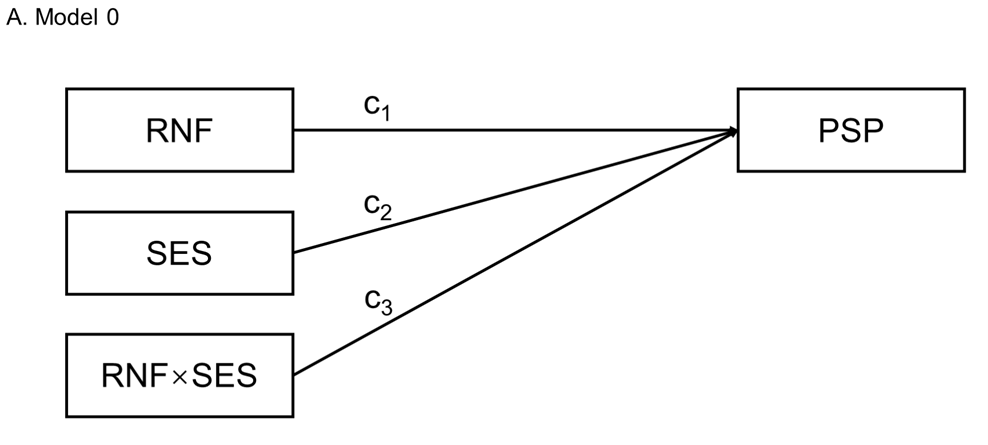
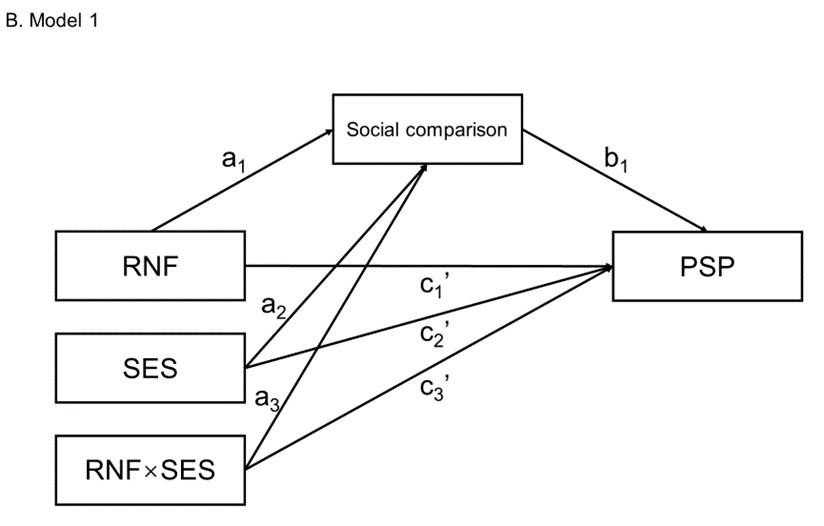
The moderating effect of SES and the mediating effect of social comparison were tested using hierarchical regression models while controlling social media usage frequency, online self-disclosure and demographic characteristics (gender and age). All predictors were centered before included in the model. To test the mediated moderation effect, we followed the procedure suggested by Ye and Wen (2013). First, a moderation model was constructed (see Model 0 in Figure 1). The effect of the interaction between RNF and SES (c3) must be significant in the Model 0. Second, a mediated moderation model was constructed (see Model 1 in Figure 1). Based on our hypothesis, the moderating effect of SES was mediated by social comparison, which means, the mediated moderating effect (a3*b1) should be significant. If the regression coefficient of the interaction term between RNF and SES on PSP (c3') is significant, SES can directly moderate the impact of RNF on PSP. We further tested the significance of c3-c3'. The interactive effect between the independent variable and moderator on the dependent variable should be reduced significance in magnitude compared with the overall effect of moderation.
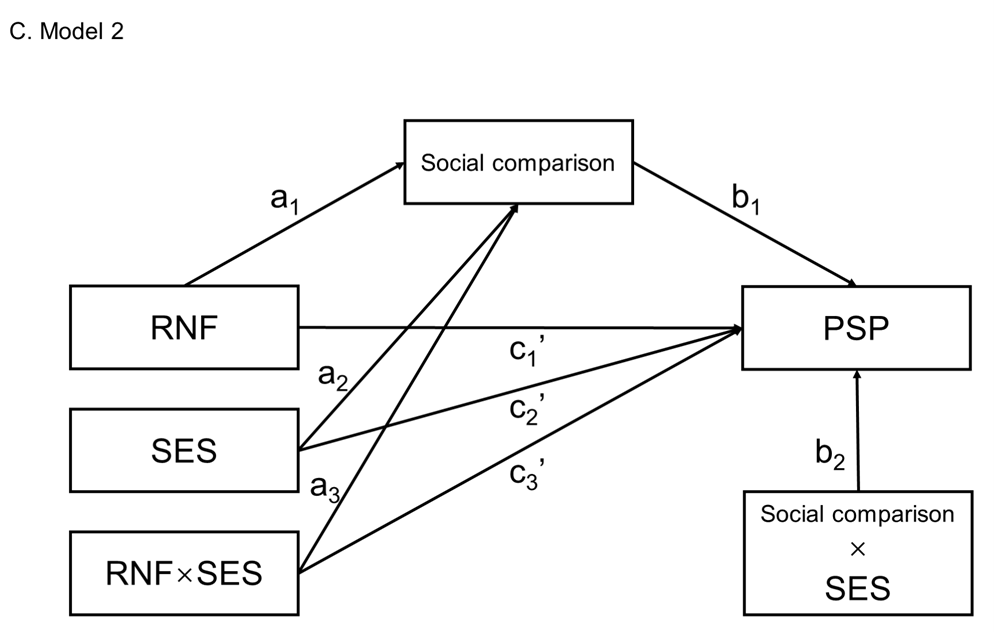
To explore the possibility of processes beyond our hypothesis, we constructed the third competitive model (see Model 2 in Figure 1). If a1*b2 is significant, SES moderates the latter half of the mediating process. A bootstrap test with 5,000 iterations was conducted to calculate the 95% confidence intervals (CIs) of these effects.
Figure 1. The Proposed Models.
Results
Preliminary Analyses
The descriptive statistics and Pearson correlations for all variables are presented in Table 2. RNF and social comparison were significantly positively correlated with PSP
(p < .001), while SES was significantly positively related to RNF (p < .01) and negatively correlated with PSP (p < .05).
Table 2. Descriptive Statistics and Correlation Analysis.
|
Variable |
M |
SD |
Skew |
Kurtosis |
1 |
2 |
3 |
4 |
5 |
|
1. RNF |
2.34 |
0.75 |
0.51 |
0.07 |
— |
|
|
|
|
|
2. Social comparison |
2.88 |
1.08 |
0.60 |
−0.63 |
.06** |
— |
|
|
|
|
3. PSP |
3.96 |
1.35 |
0.10 |
−0.26 |
.11*** |
.37*** |
— |
|
|
|
4. SES |
−0.01 |
0.45 |
1.12 |
2.25 |
.06** |
.00 |
−.05* |
— |
|
|
5. Frequency |
4.90 |
1.11 |
1.11 |
−0.52 |
−.02 |
.12*** |
.09*** |
.07** |
— |
|
6. Self-disclosure |
2.82 |
0.91 |
0.81 |
0.35 |
−.02 |
.17*** |
.10*** |
.04 |
.16*** |
|
Note. * p < .05. ** p < .01. *** p < .001. RNF = Relatedness Need Frustration; Social comparison = Social Comparison on Social media; PSP = Perfectionistic Self-Presentation on social media; SES = Family Socioeconomic Status; Frequency = Social media usage frequency; Self-disclosure = Self-disclosure on social media. |
|||||||||
Test of Hypotheses
First, the moderating effect of SES was tested. The regression analysis results of Model 0 are presented in Table 3. The full regression results are presented in the appendix. The results showed that RNF was significantly positively associated with PSP (c1 = 0.23, t = 5.62, p < .001), and the moderating effect of SES was significant (c3 = −0.31, t = −3.86, p < .001). Specifically, when family SES is one SD below the mean or equal to the mean, RNF was significantly positively associated with PSP (β = 0.37, t = 6.42,
p < .001; β = 0.23, t = 5.62, p < .001). When family SES is one SD above the mean, the association between RNF and PSP is not significant (β = 0.09, t = 1.77, p = .076). To further examine the overall association between RNF and PSP, we constructed an additional model that included RNF, SES, and other control variables, but excluded the interaction term. Results indicated that the association between RNF and PSP remained significant: β (unstandardized) = 0.21, SE = 0.04, t = 5.20, p < .001.
Table 3. Regression and Model Comparison Results (N = 1,924).
|
Dependent variable |
Predictors |
Model 0 |
Model 1 |
Model 2 |
||||
|
β |
SE |
β |
SE |
β |
SE |
|||
|
1. Social comparison |
Constant |
|
|
1.92** |
0.60 |
1.92** |
0.60 |
|
|
|
Age |
|
|
−0.06* |
0.03 |
−0.06* |
0.03 |
|
|
|
Sex |
|
|
−0.44*** |
0.05 |
−0.44*** |
0.05 |
|
|
|
Frequency |
|
|
0.11*** |
0.02 |
0.11*** |
0.02 |
|
|
|
Self-disclosure |
|
|
0.20*** |
0.03 |
0.20*** |
0.03 |
|
|
|
RNF (a1) |
|
|
0.13*** |
0.03 |
0.13*** |
0.03 |
|
|
|
SES (a2) |
|
|
0.01 |
0.05 |
0.01 |
0.05 |
|
|
|
RNF*SES (a3) |
|
|
−0.38*** |
0.06 |
−0.38*** |
0.06 |
|
|
2. PSP |
Constant |
1.09 |
0.77 |
0.24 |
1.66 |
0.14 |
0.73 |
|
|
|
Age |
−0.05 |
0.04 |
−0.03 |
−0.02 |
−0.01 |
0.04 |
|
|
|
Sex |
−0.12 |
0.06 |
0.03 |
0.07 |
0.07 |
0.06 |
|
|
|
Frequency |
0.10*** |
0..03 |
0.05* |
0.03 |
0.06* |
0.03 |
|
|
|
Self-disclosure |
0.14*** |
0.04 |
0.06 |
0.04 |
0.05 |
0.04 |
|
|
|
RNF (c1/c1') |
0.23*** |
0.04 |
0.17*** |
0.04 |
0.16*** |
0.04 |
|
|
|
Social comparison (b1) |
|
|
0.44*** |
0.03 |
0.44*** |
0.03 |
|
|
|
SES (c2/c2') |
−0.15* |
0.07 |
−0.15* |
0.06 |
−0.17** |
0.06 |
|
|
|
RNF*SES (c3/c3') |
−0.31*** |
0.08 |
−0.14 |
0.08 |
−0.16* |
0.07 |
|
|
|
Social comparison*SES (b2) |
|
|
|
|
−0.11 |
0.06 |
|
|
|
|
R2 = .04 |
R2 = .15 |
R2 = .15 |
||||
|
Conditional estimates of the RNF–PSP association across different SES levels in the model including social comparison |
Effect |
Bootstrapped SE |
Bootstrapped 95% CI |
|||||
|
−1 from SD |
0.13*** |
0.02 |
[0.09, 0.17] |
|||||
|
Equal to the mean |
0.06*** |
0.02 |
[0.02, 0.09] |
|||||
|
+1 from SD |
−0.02 |
0.02 |
[−0.05, 0.02] |
|||||
|
Index of mediated moderation (c3 - c3') |
−0.17* |
0.03 |
[−0.23, −0.10] |
|||||
|
Note. *p < .05. **p < .01. ***p < .001. RNF = Relatedness Need Frustration; Social comparison = Social Comparison on Social media; PSP = Perfectionistic Self-Presentation on social media; SES = Family Socioeconomic Status; Frequency = Social media usage frequency; Self-disclosure = Self-disclosure on social media. All βs are unstandardized coefficients. |
||||||||
Second, the mediating role of social comparison was included in the model (see Table 3). Social comparison was regressed on the control variables (sex, age, social media usage frequency, and self-disclosure on social media), RNF, SES, and the interaction term. The results showed that the regression coefficient of the interaction term on social comparison was significant (a3 = −0.38, t = −6.16, p < .001), the regression coefficient of social comparison on PSP was also significant (b1 = 0.44, t = 15.86, p < .001). The 95% bootstrapped CI of a3*b1 was [−0.23, −0.10], which did not include 0. The test of the indirect effect of moderation (c3-c3') showed that the direct moderating effect was significantly reduced after including the mediating term (c3-c3' = −0.17, t = −4.92, p < .001, 95% CI = [−0.23, −0.10]). Meanwhile, in Model 1, the direct moderating effect of SES was not significant (c3' = −0.14, t = −1.85, p = .064). These results indicated that the moderating effect of SES on the relationship between RNF and PSP was completely mediated by social comparison. Specifically, the estimated RNF–PSP association in the model including social comparison was larger among individuals from low-SES families (β = 0.13, t = 6.20, p < .001, 95% CI = [0.09, 0.17]) than those from high SES families (β = −0.02, t = −1.10, p = .273, 95% CI = [−0.05, 0.02]).
A simple slope analysis was conducted better to understand the interaction effects of RNF and family SES. As shown in Figure 2, the association between RNF and social comparison among individuals from low SES families (simple slope = 0.30, SE = 0.04, t = 6.74, p < .001, 95% CI = [0.21, 0.39]) was stronger than those from high SES families (simple slope = −0.04, SE = 0.04, t = −1.09, p = .275, 95% CI = [−0.12, 0.03]). These findings support Hypothesis 3, indicating that family SES moderates the relationship between RNF and PSP through social comparison.
Figure 2. The Relationship Between RNF and Social Comparison
With Family SES as a Moderator.
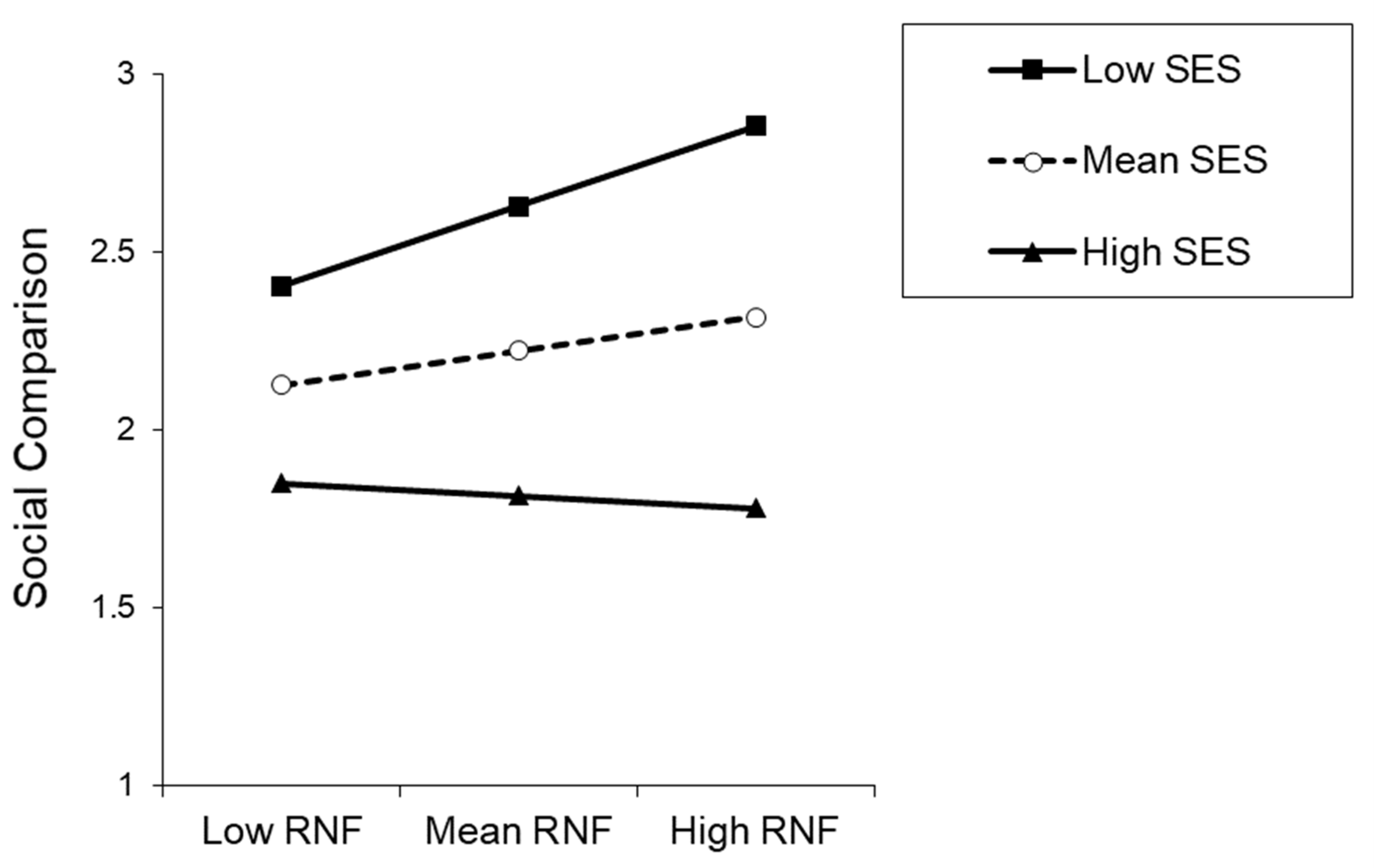
Note. RNF = Relatedness Need Frustration; SES = Family Socioeconomic Status.
We further tested whether SES moderates the relationship between social comparison and PSP (Model 2 in Figure 1). The regression analysis results (Table 3) indicated that the effect of the interaction term between social comparison and SES on PSP reached borderline significance (b2 = −0.11, t = −1.93, p = .054). The 95% bootstrapped CI of a1*b2 was [−0.22, 0.00], which included 0. Thus, based on the current evidence, we can conclude that SES moderates only the first half of the mediating process.
Discussion
This study investigated the relationship between RNF and PSP on social media, revealing that RNF was more strongly associated with PSP among individuals from low SES families, while this association was not significant for those from high SES families. We further found that SES exhibits the moderating effect that works by mitigating the association between RNF and social comparison.
Relatedness Need Frustration and Perfectionistic Self-Presentation
This study demonstrated that RNF positively relates to PSP on social media (H1). Consistent with SDT and PSDM, the results indicate that PSP on social media can be a behavioral strategy for individuals attempting to gain the attention and acceptance of others after experiencing RNF. Several studies have provided empirical support for this finding (Gil-Or et al., 2015; Mun & H. Kim, 2021), suggesting that individuals compensate in other ways when their psychological needs are frustrated. For example, a study involving 338 women found that loneliness is a significant factor leading individuals to embellish their images on internet platforms (Yu & H.-C. Kim, 2020). Additionally, individuals lacking approval from others are more likely to misrepresent their self-presentation on Instagram (Mun & H. Kim, 2021). In the context of online socializing, individuals may create “false selves” to cope with external pressures and satisfy their psychological needs (Gil-Or et al., 2015). This pursuit of perfection becomes a coping strategy: to minimize the risk of rejection, people often change their thoughts and attitudes, or learn to act or present themselves in a way that they can gain recognition and acceptance.
The Mediating Role of Social Comparison on Social Media
Hypothesis 2 was supported, with results indicating that social comparison on social media mediates the relationship between RNF and online PSP. This finding is consistent with prior research showing that online social comparison can trigger self-exaggeration and strategic self-presentation, particularly when individuals experience emotional insecurity or social disconnection (Chua & Chang, 2016; Y. Wang et al., 2024). In the Chinese cultural context, similar patterns emerge: envy elicited through online comparisons frequently motivates users to enhance or idealize their public image (Y. Wang et al., 2024). Indirect evidence further suggests that loneliness predicts increased Facebook use, which amplifies opportunities for social comparison (Song et al., 2014).
Beyond these empirical parallels, this mediation effect can be further explained through several theoretical frameworks. According to SDT, frustration of the relatedness need motivates individuals to engage in compensatory behaviors aimed at restoring belongingness (Deci & Ryan, 2000). In online settings, one such behavior is social comparison, which provides indirect cues about one’s social standing and self-worth through others’ curated content (Cramer et al., 2016). Social Comparison Theory also suggests that those who feel interpersonally disconnected are especially prone to engaging in comparisons to evaluate their own value in the absence of affirming offline relationships (Buunk & Gibbons, 2006). Social media exacerbates this tendency, given the abundance of idealized portrayals and the prominence of impression management. Although psychological distress was not directly measured in the current study, it is theoretically plausible that these comparisons elicit negative emotional states, which individuals may then attempt to regulate by engaging in PSP. In this sense, PSP serves as a behavioral response to the psychological threat posed by RNF and intensified by unfavorable online comparisons. While previous research has emphasized external attributes—such as appearance or achievement—as the basis of social comparison, our findings underscore the importance of internal psychological factors, including self-worth and need frustration, as precursors to PSP (Suls & Wheeler, 2012).
Taken together, these perspectives suggest that social comparison is not merely an outcome of the lack of interpersonal relationships, but also a key mechanism through which individuals seek emotional compensation and external validation. This sheds light on why social comparison functions as a bridge between RNF and PSP, offering a deeper understanding of the motivational and cognitive dynamics underlying perfectionistic behaviors in digital contexts.
The Moderating Role of Family Socioeconomic Status
The findings indicate that family SES moderates the relationship between RNF and social comparison, exhibiting a significant mediated moderating effect. Specifically, in the low-SES group, RNF significantly predicts PSP via social comparison, whereas in the high-SES group, this association is not significant. Higher family SES provides individuals with more resources to compensate for a lack of relatedness. The combination of abundant resources and opportunities (e.g., quality education, sufficient material goods) enables them to achieve success more easily and perceive their significance and value during development (Q. Zhou et al., 2018). Consequently, they may not rely excessively on online comparisons to recognize their self-worth. These findings align with previous research, which indicates that individuals from high SES backgrounds are more likely to base their self-worth on self-appraisal rather than on others’ evaluations, and are therefore less likely to engage in social comparison (Gerber et al., 2018; Kraus, 2018; Miyamoto et al., 2018). The current study reveals the role of family SES in moderating the relationship between RNF and social comparison and highlights the differing social network behaviors of individuals across various SES levels. Therefore, this finding has significant implications for understanding the psychosocial roots of undesirable social networking behaviors across the socioeconomic spectrum.
Gender Differences in Social Comparison
While gender was included as a control variable in all models, the regression results revealed that it was among the strongest predictors of social comparison on social media. Specifically, female participants reported significantly higher levels of social comparison than males. This result is consistent with a large body of research indicating that women are more likely to engage in appearance-based and upward social comparisons online, which are often associated with increased self-consciousness, negative self-evaluations, and greater pressure to present an idealized version of the self (Dobson, 2015; Fardouly & Vartanian, 2016). These gendered patterns of online comparison may help explain why females also tend to exhibit stronger PSP behaviors. Therefore, our findings contribute to a growing literature that emphasizes the importance of gender in understanding both the antecedents and expressions of online perfectionism.
Limitations and Future Direction
This study demonstrates that RNF is positively related to online PSP through social comparison, revealing differences in this process among individuals from families with varying SES. However, certain limitations warrant emphasis.
First, this study explored PSP behaviors on social networks and their psychological roots. However, different social platforms possess unique characteristics (e.g., anonymity, interaction styles, and social environments). For instance, on Facebook, “excessively emotional” expressions are often viewed as norm violations, may place certain restrictions on a user's social media presentations (Waterloo et al., 2018). Weibo, the largest social media platform in China, requires users to sign in with real names (Weibo Corporation, 2024). Real-name social comparisons may induce greater fluctuations in an individual's mental state and limit their online PSP. Therefore, these differing characteristics may influence users' online performance, including positive and negative social comparisons, as well as upward and downward comparisons (Michinov & Bavent, 2001; Olivos et al., 2021). Given these possibilities, individuals' PSP may vary across platforms. The present study demonstrates that individuals from low SES backgrounds who experience RNF are more likely to engage in social comparison on social media, which in turn contributes to online PSP behaviors. However, the measure of PSP employed in this study reflected a general tendency across platforms and did not account for potential differences in PSP expression on specific social media sites. Given that platform-specific characteristics may moderate the relationship between SES, RNF, and PSP, future research should examine how these dynamics vary across different online environments. Such investigations would provide a more nuanced understanding of how structural features of social media platforms influence perfectionistic self-presentation.
Second, the cross-sectional design employed in this study limits the ability to identify causal relationships between variables. The mediated moderating model presented here is grounded in theoretical frameworks of self-determination theory and perfectionism social disconnection model, suggesting that RNF may be linked to greater PSP. However, we must also acknowledge the possibility of bidirectional or reverse relationships. For instance, individuals who actively engage in PSP may become highly attuned to peer feedback and more prone to continuous social comparison; this exhausting cycle could, in turn, exacerbate feelings of social isolation and elevate their RNF. To definitively establish directionality and confirm these theoretical links, future studies should adopt longitudinal designs or experimental paradigms.
Third, the current study did not include a measure of self-esteem, which represents an important limitation. As highlighted in our literature review, self-esteem is closely intertwined with family SES, social comparison tendencies, and perfectionistic behaviors. It is highly probable that individuals with lower self-esteem are more vulnerable to the adverse impacts of RNF, rendering them more likely to engage in social comparisons and subsequent PSP as compensatory mechanisms. Future studies should incorporate self-esteem into the research design to provide a more comprehensive understanding of the complex psychological mechanisms driving online perfectionistic self-presentation.
Implications
Despite certain limitations, this study offers several novel and meaningful contributions from both theoretical and clinical perspectives. From a theoretical standpoint, this research reconceptualizes PSP not merely as a stable trait or antecedent to mental health problems, but as a situational coping strategy shaped by unmet psychological needs and social-cognitive processes. By integrating Self-Determination Theory with the Perfectionism Social Disconnection Model, this study demonstrates that RNF predicts PSP through social comparison. These finding sheds new light on the motivational roots of PSP, which have often been overlooked in favor of trait-based explanations. Our results align with previous evidence that individuals high in PSP are motivated by unmet interpersonal needs and a desire for acceptance (C. Chen et al., 2012; Roxborough et al., 2012). In doing so, this study expands the literature by situating PSP within a broader framework of need frustration and mediated self-regulation, contributing to a more dynamic understanding of how perfectionistic behavior is cultivated and sustained in digital environments.
In addition, this study introduces family SES as a contextual moderator, offering a critical extension to previous research that has largely focused on individual-level predictors. While existing work has explored how personality traits and cognitive styles relate to PSP, few studies have examined how structural variables such as SES influence vulnerability to maladaptive social comparison and compensatory self-presentation. Our findings show that individuals from lower SES backgrounds are more likely to engage in social comparison when experiencing RNF, which in turn is linked to heightened PSP. This pattern echoes broader research showing that individuals from lower SES backgrounds are more sensitive to status-based comparisons and more reliant on external validation (Bai et al., 2021). Conversely, individuals from higher SES families tend to derive self-worth from internal standards and exhibit less dependence on environmental affirmation (Kraus et al., 2012; Stephens et al., 2014). These findings deepen our understanding of how social class conditions the psychological impact of unmet relational needs in the context of digital self-presentation.
From a clinical perspective, the current findings inform the design of therapeutic and digital mental health interventions. Given that PSP can be understood as a maladaptive strategy to cope with psychological distress, interventions should target the motivational deficits and cognitive distortions that maintain such behavior. Cognitive Behavioral Therapy (CBT)—especially versions tailored for perfectionism—has demonstrated efficacy in reducing PSP (Crăciun & Holdevici, 2013). More recently, digital therapies, including guided internet-based CBT (ICBT) and brief online programs focused on perfectionism and social comparison, have shown moderate effects in decreasing maladaptive self-presentation and associated distress (Kothari et al., 2016; Rozental et al., 2017). Based on our findings, we speculate that these interventions may be particularly valuable for individuals from disadvantaged backgrounds, who are more prone to PSP as a compensatory response to social exclusion and perceived inferiority. As socioeconomic disparities become increasingly salient in online spaces, digital mental health interventions must not only foster healthier self-presentation practices but also address the underlying structural inequities that exacerbate the effects of RNF and social comparison. Our findings thus highlight the importance of recognizing and responding to the disproportionate psychological burdens faced by youth from low SES backgrounds in navigating social media environments.
In sum, this study broadens the conceptualization of PSP by framing it as an outcome of frustrated psychological needs and socially contingent self-worth, rather than as a fixed personality trait. By accounting for contextual vulnerability and emphasizing the need for targeted intervention, the findings offer a new theoretical lens and a foundation for the development of evidence-based strategies aimed at fostering resilience and reducing perfectionistic pressures in digital youth culture.
Conclusion
This study explored the relationship between RNF and online PSP. The findings indicate that RNF is significantly associated with online PSP via the mediating role of social comparison on social media. Furthermore, individuals from low SES families are more likely to be affected negatively in this process, while favorable family conditions appear to mitigate the adverse effects of RNF. These results suggest that an individual's actual SES and the self-image presented on social media may sometimes be incongruous, providing both theoretical and empirical support for psychological interventions aimed at addressing undesirable social networking behaviors. Current findings remind us that in today’s information age, socioeconomic disadvantage can harm individuals’ mental health by fostering negative online behaviors, with real-life interpersonal frustrations acting as potential triggers. Despite the widespread adoption of online social interactions, we should remain vigilant regarding individuals' real-world relationships and their sense of social acceptance, while also acknowledging the new threats posed by lower socioeconomic status in the digital era, thereby further promoting social and economic equality.
Conflict of Interest
The authors have no conflicts of interest to declare.
Use of AI Services
The authors declare they have not used any AI services to generate or edit any part of the manuscript or data.
Acknowledgement
This research did not receive any specific grant from funding agencies in the public, commercial, or not-for-profit sectors.
Ethics Statement
All procedures performed in studies involving human participants were in accordance with the ethical standards of the institutional and/or national research committee and with the 1964 Helsinki Declaration and its later amendments or comparable ethical standards. The study was approved by the Ethics Committee of Beijing Normal University (IRB number: 202309080128).
Data Availability Statement
Data are available from: https://osf.io/yp5jr.
Appendix
Table A1. Full Regression Results for Model 0. Outcome: Perfectionistic Self-Presentation (PSP).
|
Predictor |
B |
SE |
t |
p |
95% CI (LLCI, ULCI) |
|
Intercept |
1.09 |
0.77 |
1.41 |
.159 |
[−0.43, 2.60] |
|
RNF |
0.23 |
0.04 |
5.62 |
< .001 |
[0.15, 0.31] |
|
SES |
−0.15 |
0.07 |
−2.20 |
.028 |
[−0.28, −0.02] |
|
RNF x SES |
−0.31 |
0.08 |
−3.86 |
< .001 |
[−0.46, −0.15] |
|
Sex |
−0.12 |
0.06 |
−1.93 |
.054 |
[−0.25, 0.00] |
|
Age |
−0.05 |
0.04 |
−1.16 |
.246 |
[−0.13, 0.03] |
|
Social Media Frequency |
0.10 |
0.03 |
3.72 |
< .001 |
[0.05, 0.16] |
|
Self-Disclosure |
0.14 |
0.04 |
3.77 |
< .001 |
[0.07, 0.22] |
Table A2. Full Regression Results for Model 1. Outcome: Social Comparison on Social Media.
|
Predictor |
B |
SE |
t |
p |
95% CI (LLCI, ULCI) |
|
Intercept |
1.92 |
0.60 |
3.21 |
.001 |
[0.75, 3.10] |
|
RNF |
0.13 |
0.03 |
4.04 |
< .001 |
[0.07, 0.19] |
|
SES |
0.01 |
0.05 |
0.19 |
.851 |
[−0.09, 0.11] |
|
RNF × SES |
−0.38 |
0.06 |
−6.16 |
< .001 |
[−0.50, −0.26] |
|
Sex |
−0.44 |
0.05 |
−8.95 |
< .001 |
[−0.54, −0.35] |
|
Age |
−0.06 |
0.03 |
−2.02 |
.043 |
[−0.13, −0.00] |
|
Social Media Frequency |
0.11 |
0.02 |
5.26 |
< .001 |
[0.07, 0.15] |
|
Self-Disclosure |
0.20 |
0.03 |
6.78 |
< .001 |
[0.14, 0.26] |
Table A3. Full Regression Results for Model 1. Outcome: Perfectionistic Self-Presentation (PSP).
|
Predictor |
B |
SE |
t |
p |
95% CI (LLCI, ULCI) |
|
Intercept |
0.24 |
0.73 |
0.33 |
.739 |
[−1.18, 1.67] |
|
RNF |
0.17 |
0.04 |
4.49 |
< .001 |
[0.10, 0.25] |
|
Social Comparison |
0.44 |
0.03 |
15.86 |
< .001 |
[0.38, 0.49] |
|
SES |
−0.15 |
0.06 |
−2.41 |
.016 |
[−0.28, −0.03] |
|
RNF × SES |
−0.14 |
0.08 |
−1.85 |
.064 |
[−0.29, 0.01] |
|
Sex |
0.07 |
0.06 |
1.17 |
.242 |
[−0.05, 0.19] |
|
Age |
−0.02 |
0.04 |
−0.50 |
.616 |
[−0.09, 0.06] |
|
Social Media Frequency |
0.05 |
0.03 |
2.03 |
.042 |
[0.00, 0.10] |
|
Self-Disclosure |
0.06 |
0.04 |
1.53 |
.125 |
[−0.02, 0.13] |
Table A4. Full Regression Results for Model 2. Outcome: Social Comparison on Social Media.
|
Predictor |
B |
SE |
t |
p |
95% CI (LLCI, ULCI) |
|
Intercept |
1.92 |
0.60 |
3.21 |
.001 |
[0.75, 3.10] |
|
RNF |
0.13 |
0.03 |
4.04 |
< .001 |
[0.07, 0.19] |
|
SES |
0.01 |
0.05 |
0.19 |
.851 |
[−0.09, 0.11] |
|
RNF × SES |
−0.38 |
0.06 |
−6.16 |
< .001 |
[−0.50, −0.26] |
|
Sex |
−0.44 |
0.05 |
−8.95 |
< .001 |
[−0.54, −0.35] |
|
Age |
−0.06 |
0.03 |
−2.02 |
.043 |
[-0.13, -0.00] |
|
Social Media Frequency |
0.11 |
0.02 |
5.26 |
< .001 |
[0.07, 0.15] |
|
Self-Disclosure |
0.20 |
0.03 |
6.78 |
< .001 |
[0.14, 0.26] |
Table A5. Full Regression Results for Model 2. Outcome: Perfectionistic Self-Presentation (PSP).
|
Predictor |
B |
SE |
t |
p |
95% CI (LLCI, ULCI) |
|
Intercept |
0.14 |
0.73 |
0.19 |
.852 |
[−1.29, 1.56] |
|
RNF |
0.16 |
0.04 |
4.24 |
< .001 |
[0.09, 0.24] |
|
Social Comparison |
0.44 |
0.03 |
15.97 |
< .001 |
[0.39, 0.50] |
|
SES |
−0.17 |
0.06 |
−2.68 |
.008 |
[−0.30, −0.05] |
|
RNF × SES |
−0.16 |
0.08 |
−2.16 |
.031 |
[−0.31, −0.01] |
|
Social Comparison× SES |
−0.11 |
0.06 |
−1.93 |
.054 |
[−0.22, −0.00] |
|
Sex |
0.07 |
0.06 |
1.22 |
.223 |
[-0.05, 0.19] |
|
Age |
−0.01 |
0.04 |
−0.36 |
.721 |
[−0.09, 0.06] |
|
Social Media Frequency |
0.06 |
0.03 |
2.16 |
.031 |
[0.01, 0.11] |
|
Self-Disclosure |
0.05 |
0.04 |
1.28 |
.201 |
[−0.02, 0.12] |


This work is licensed under a Creative Commons Attribution-ShareAlike 4.0 International License.
Copyright © 2026 Shujian Wang, Xinze Liu, Xiangping Liu