
Social media as sources of sexual health knowledge: A compensatory or complementary form of education?
Vol.20,No.2(2026)

Recent research has shown that information about sexuality is increasingly prevalent on social media. At the same time, it is well-documented that sexual health content shared or created by laypeople can be misleading or inaccurate. This study investigates who consumes sexual health knowledge on these platforms and tests whether social media technologies have a compensatory (i.e., making up for a lack of sexual education elsewhere) or complementary (i.e., enhancing sexual information individuals obtain elsewhere) function for sexual education. Results from a survey conducted in early 2023 among N = 1,245 adult social media users living in Germany (age: M = 41.94 years, SD = 14.47; gender identity: 50.3% identified as female, 49.3% as male, 0.4% as other) indicated that young, male, and highly educated individuals are more likely to be exposed to sexual education on social media. Among participants, 54.1% indicated that they encounter sexual misinformation at least sometimes. Findings further provide evidence for both mechanisms—educational compensation and educational enhancement: Individuals with stronger sexual communication apprehension, as well as those who tend to engage in sexuality-related talk in everyday life, expose themselves more frequently to sexual education. These findings have implications for theory building in the field of informal education processes through contemporary technologies and for the design of sexuality-related educational interventions.
sexual education; social media; compensation; enhancement; sexual knowledge
German Neubaum
Department of Human-Centered Computing and Cognitive Science & Psychological Processes of Education in Social Media, University of Duisburg-Essen, Duisburg
German Neubaum (PhD, University of Duisburg-Essen) is an Assistant Professor at the Department of Human-Centered Computing and Cognitive Science at the University of Duisburg-Essen, Germany. His research interests focus on the educational benefits users can gain from contemporary technologies and the skills they need to navigate these technologies responsibly. Moreover, he studies psychological mechanisms underlying communication processes in the context of politics, morality, intergroup conflicts, and interpersonal relationships. Since 2023, he has served as an Associate Editor of the Journal of Media Psychology.
Jan-Sebastian Grund
Department of Human-Centered Computing and Cognitive Science & Psychological Processes of Education in Social Media, University of Duisburg-Essen, Duisburg
Jan-Sebastian Grund is a Master’s student at the University of Duisburg-Essen. His research has explored the design and evaluation of interventions to improve algorithm and AI literacy, as well as the interplay between moral outrage, social polarization, and algorithmic visibility. He is currently conducting his Master’s thesis investigating the role of intellectual humility in the context of AI chatbots and (mis)information seeking behavior.
Babin, E. A. (2013). An examination of predictors of nonverbal and verbal communication of pleasure during sex and sexual satisfaction. Journal of Social and Personal Relationships, 30(3), 270–292. https://doi.org/10.1177/0265407512454523
Behre, J. (2022). Young adults’ online sexual health information seeking and evaluating skills: Implications for everyday life information literacy instruction. Proceedings of the Association for Information Science and Technology, 59(1), 1–10. https://doi.org/10.1002/pra2.599
Berger, M. N., Taba, M., Marino, J. L., Lim, M. S. C., & Skinner, S. R. (2022). Social media use and health and well-being of lesbian, gay, bisexual, transgender, and queer youth: Systematic review. Journal of Medical Internet Research, 24(9), Article e38449. https://doi.org/10.2196/38449
Cookingham, L. M., & Ryan, G. L. (2015). The impact of social media on the sexual and social wellness of adolescents. Journal of Pediatric and Adolescent Gynecology, 28(1), 2–5. https://doi.org/10.1016/j.jpag.2014.03.001
Cover, R., Aggleton, P., & Clarke, K. (2020). Education and affinity? Pedagogies of sexual citizenship in LGBTIQ youth support videos. Journal of Youth Studies, 23(2), 221–236. https://doi.org/10.1080/13676261.2019.1593334
Culha, Y., Ak, E. S., Merder, E., Ariman, A., & Culha, M. G. (2021). Analysis of the YouTube videos on pelvic floor muscle exercise training in terms of their reliability and quality. International Urology and Nephrology, 53(1), 1–6. https://doi.org/10.1007/s11255-020-02620-w
Delmonaco, D., Marcu, G., & Haimson, O. L. (2020). Search engines and the sex education information practices of LGBTQ+ youth. Proceedings of the Association for Information Science and Technology, 57(1), Article e364. https://doi.org/10.1002/pra2.364
Dickel, V., & Evolvi, G. (2023). “Victims of feminism”: Exploring networked misogyny and #MeToo in the manosphere. Feminist Media Studies, 23(4), 1392–1408. https://doi.org/10.1080/14680777.2022.2029925
Döring, N. (2021). Sex education on social media. In A. D. Lykins (Ed.), Encyclopedia of sexuality and gender (pp. 1–12). Springer. https://doi.org/10.1007/978-3-319-59531-3_64-1
Döring, N. (2023). Online-Videos zum schwangerschaftsabbruch: Anbieter, botschaften und publikumsreaktionen [Online videos about abortion: Providers, messages and audience reactions]. FORUM Sexualaufklärung und Familienplanung: Informationsdienst der Bundeszentrale für Gesundheitliche Aufklärung (BZgA), 1, 41–47. https://doi.org/10.17623/BZgA_SRH:forum_2023-1_beitrag_onlinevideo_schwangerschaftsabbruch
Döring, N. (2024). Social media and sex education. In M. L. Rasmussen (Ed.), The Palgrave encyclopedia of sexuality education (pp. 1–9). Springer. https://doi.org/10.1007/978-3-030-95352-2_131-1
Döring, N., & Conde, M. (2021). Sexuelle gesundheitsinformationen in sozialen medien: Ein systematisches scoping review [Sexual health information on social media: A systematic scoping review]. Bundesgesundheitsblatt - Gesundheitsforschung - Gesundheitsschutz, 64(11), 1416–1429. https://doi.org/10.1007/s00103-021-03431-9
Döring, N., Lehmann, S., & Schumann-Doermer, C. (2022). Verhütung in der deutschsprachigen Wikipedia: Eine inhalts- und qualitätsanalyse [Contraception in the German-language Wikipedia: A content and quality analysis]. Bundesgesundheitsblatt – Gesundheitsforschung – Gesundheitsschutz, 65(6), 706–717. https://doi.org/10.1007/s00103-022-03537-8
Döring, N., Lehmann, S., & Schumann-Doermer, C. (2023). Verhütung auf YouTube, Instagram und TikTok: Eine inhalts- und qualitätsanalyse [Contraception on YouTube, Instagram, and TikTok: A content and quality analysis]. Bundesgesundheitsblatt - Gesundheitsforschung - Gesundheitsschutz, 66(9), 990–999. https://doi.org/10.1007/s00103-023-03698-0
Dreston, J. H., & Neubaum, G. (2025). Navigating social media news use: Exploring the impact of intentional and incidental news consumption on objective and subjective political knowledge. Communication Research. https://doi.org/10.1177/00936502251317818
Duggan, J. (2023). Using TikTok to teach about abortion: Combatting stigma and miseducation in the United States and beyond. Sex Education, 23(1), 81–95. https://doi.org/10.1080/14681811.2022.2028614
Ekram, S., Debiec, K. E., Pumper, M. A., & Moreno, M. A. (2019). Content and commentary: HPV vaccine and YouTube. Journal of Pediatric and Adolescent Gynecology, 32(2), 153–157. https://doi.org/10.1016/j.jpag.2018.11.001
European Expert Group on Sexuality Education. (2016). Sexuality education – what is it? Sex Education, 16(4), 427–431. https://doi.org/10.1080/14681811.2015.1100599
Fleming, P. J., & Agnew-Brune, C. (2015). Current trends in the study of gender norms and health behaviors. Current Opinion in Psychology, 5, 72–77. https://doi.org/10.1016/j.copsyc.2015.05.001
Fletcher, R., & Nielsen, R. K. (2018). Are people incidentally exposed to news on social media? A comparative analysis. New Media & Society, 20(7), 2450–2468. https://doi.org/10.1177/1461444817724170
Fowler, L. R., Schoen, L., Smith, H. S., & Morain, S. R. (2022). Sex education on TikTok: A content analysis of themes. Health Promotion Practice, 23(5), 739–742. https://doi.org/10.1177/15248399211031536
Fox, J., & Ralston, R. (2016). Queer identity online: Informal learning and teaching experiences of LGBTQ individuals on social media. Computers in Human Behavior, 65, 635–642. https://doi.org/10.1016/j.chb.2016.06.009
Goldfarb, E. S., & Lieberman, L. D. (2021). Three decades of research: The case for comprehensive sex education. Journal of Adolescent Health, 68(1), 13–27. https://doi.org/10.1016/j.jadohealth.2020.07.036
Graf, A. S., & Patrick, J. H. (2015). Foundations of life-long sexual health literacy. Health Education, 115(1), 56–70. https://doi.org/10.1108/HE-12-2013-0073
Gul, M., & Diri, M. A. (2019). YouTube as a source of information about premature ejaculation treatment. The Journal of Sexual Medicine, 16(11), 1734–1740. https://doi.org/10.1016/j.jsxm.2019.08.008
John, J. N., Gorman, S., Scales, D., & Gorman, J. (2025). Online misleading information about women’s reproductive health: A narrative review. Journal of General Internal Medicine, 40(5), 1123–1131. https://doi.org/10.1007/s11606-024-09118-6
Kaynak, Y., Kaya, C., & Aykaç, A. (2020). YouTube as a source of premature ejaculation. Revista Internacional de Andrología, 18(2), 63–67. https://doi.org/10.1016/j.androl.2018.12.002
Koch, W. (2022). Reichweiten von social-media-plattformen und messengern. Ergebnisse der ARD/ZDF-onlinestudie 2022 [Reach of social media platforms and messaging services. Results of the ARD/ZDF online study 2022]. Media Perspektiven, 10, 471–478. https://www.media-perspektiven.de/fileadmin/user_upload/media-perspektiven/ARD-ZDF-Onlinestudie/2022__Reichweiten_von_Social_Media_und_Messengern.pdf
Kraut, R., Kiesler, S., Boneva, B., Cummings, J., Helgeson, V., & Crawford, A. (2002). Internet paradox revisited. Journal of Social Issues, 58(1), 49–74. https://doi.org/10.1111/1540-4560.00248
Kriofske Mainella, A. M., Callender, K. A., & Laubacher, S. (2024). Sex education through the lifespan: A pilot intervention for older adults in changing attitudes and comfort with sexuality. Gerontology & Geriatrics Education, 45(4), 647–658. https://doi.org/10.1080/02701960.2023.2280061
LeBeau, K., Carr, C., & Hart, M. (2020). Examination of gender stereotypes and norms in health-related content posted to Snapchat discover channels: Qualitative content analysis. Journal of Medical Internet Research, 22(3), Article e15330. https://doi.org/10.2196/15330
Lim, G., Waling, A., James, A., & Power, J. (2025). Sex education on the newsfeed: Exploring young people’s incidental exposure to information about sex and relationships. Sex Education, 25(4), 513–528. https://doi.org/10.1080/14681811.2024.2359989
Mack, A. N. (2016). The self-made mom: Neoliberalism and masochistic motherhood in home-birth videos on YouTube. Women’s Studies in Communication, 39(1), 47–68. https://doi.org/10.1080/07491409.2015.1129519
Marwick, A. E., & Caplan, R. (2018). Drinking male tears: Language, the manosphere, and networked harassment. Feminist Media Studies, 18(4), 543–559. https://doi.org/10.1080/14680777.2018.1450568
Mitchell, K. J., Ybarra, M. L., Korchmaros, J. D., & Kosciw, J. G. (2014). Accessing sexual health information online: Use, motivations and consequences for youth with different sexual orientations. Health Education Research, 29(1), 147–157. https://doi.org/10.1093/her/cyt071
Morris, N. (2021, September 9). The rise of sex education on Instagram. The New Statesman. https://www.newstatesman.com/science-tech/2019/11/the-rise-of-sex-education-on-instagram
Neubaum, G., & Krämer, N. C. (2015). Let’s blog about health! Exploring the persuasiveness of a personal HIV blog compared to an institutional HIV website. Health Communication, 30(9), 872–883. https://doi.org/10.1080/10410236.2013.856742
Nikkelen, S. W. C., Van Oosten, J. M. F., & van den Borne, M. M. J. J. (2020). Sexuality education in the digital era: Intrinsic and extrinsic predictors of online sexual information seeking among youth. The Journal of Sex Research, 57(2), 189–199. https://doi.org/10.1080/00224499.2019.1612830
Olamijuwon, E., & Odimegwu, C. (2022). Sexuality education in the digital age: Modelling the predictors of acceptance and behavioural intention to access and interact with sexuality information on social media. Sexuality Research and Social Policy, 19(3), 1241–1254. https://doi.org/10.1007/s13178-021-00619-1
Ortiz-Martinez, Y., Ali-Salloum, W., González-Ferreira, F., & Molinas-Argüello, J. (2017). HIV videos on YouTube: Helpful or harmful? Sexually Transmitted Infections, 93(7), 481–481. https://doi.org/10.1136/sextrans-2017-053197
Pampati, S., Johns, M. M., Szucs, L. E., Bishop, M. D., Mallory, A. B., Barrios, L. C., & Russell, S. T. (2021). Sexual and gender minority youth and sexual health education: A systematic mapping review of the literature. Journal of Adolescent Health, 68(6), 1040–1052. https://doi.org/10.1016/j.jadohealth.2020.09.032
Pask, E. B., & Wu, Q. L. (2024). Let’s (not) talk about sexual health: How sexual communication apprehension with healthcare providers and peer communication influence intentions to protect sexual health. Patient Education and Counseling, 126, Article 108318. https://doi.org/10.1016/j.pec.2024.108318
Porter, A., Cooper, S., Falcon, A., Piller, M., Modi, R., & Hawver, E. (2025). The “memeification” of sexual health communication on Instagram. Sex Education, 25(2), 221–237. https://doi.org/10.1080/14681811.2023.2300069
Ruppel, E. K., Burke, T. J., Cherney, M. R., & Dinsmore, D. R. (2018). Social compensation and enhancement via mediated communication in the transition to college. Human Communication Research, 44(1), 58–79. https://doi.org/10.1093/hcr/hqx003
Scharmanski, S., & Hessling, A. (2022). Sexuality education for young people in Germany. Results of the ‘Youth Sexuality’ representative repeat survey. Journal of Health Monitoring, 7(2), 21–38. https://doi.org/10.25646/9875
Scheerder, A., van Deursen, A., & van Dijk, J. (2017). Determinants of internet skills, uses and outcomes. A systematic review of the second- and third-level digital divide. Telematics and Informatics, 34(8), 1607–1624. https://doi.org/10.1016/j.tele.2017.07.007
Sciberras, R., & Tanner, C. (2024). ‘Sex is so much more than penis in vagina’: Sex education, pleasure and ethical erotics on Instagram. Sex Education, 24(3), 344–357. https://doi.org/10.1080/14681811.2023.2199976
Setty, E. (2023). Digital media and relationships, sex, and health education in the classroom. Pastoral Care in Education, 41(3), 289–305. https://doi.org/10.1080/02643944.2022.2095418
Shigeto, A., & Scheier, L. M. (2024). Learning about sex from different sources: Implications for sexual attitudes, sexual knowledge, and risky sexual behavior among U.S. college students. Archives of Sexual Behavior, 53(7), 2653–2670. https://doi.org/10.1007/s10508-024-02901-w
Todaro, E., Silvaggi, M., Aversa, F., Rossi, V., Nimbi, F. M., Rossi, R., & Simonelli, C. (2018). Are social media a problem or a tool? New strategies for sexual education. Sexologies, 27(3), e67–e70. https://doi.org/10.1016/j.sexol.2018.05.006
Tufekci, Z. (2010). Who acquires friends through social media and why? “Rich get richer” versus “seek and ye shall find.” Proceedings of the International AAAI Conference on Web and Social Media, 4(1), 170–177. https://doi.org/10.1609/icwsm.v4i1.14025
Valkenburg, P. M., & Peter, J. (2013). The differential susceptibility to media effects model. Journal of Communication, 63(2), 221–243. https://doi.org/10.1111/jcom.12024
Van Wichelen, T., Verhoeven, E., & Hau, P. (2024). The genderbread person: Mapping the social media debate about inclusive sexuality education. Sex Education, 24(5), 585–601. https://doi.org/10.1080/14681811.2023.2238189
White, A., Boehm, M., Glackin, E., & Bleakley, A. (2023). How sexual information sources are related to emerging adults’ sex-positive scripts and sexual communication. Sexuality & Culture, 27(4), 1224–1245. https://doi.org/10.1007/s12119-022-10061-z
Yamamoto, M., & Yang, F. (2022). Does news help us become knowledgeable or think we are knowledgeable? Examining a linkage of traditional and social media use with political knowledge. Journal of Information Technology & Politics, 19(3), 269–283. https://doi.org/10.1080/19331681.2021.1969611
Zamponi, V., Mazzilli, R., Nimbi, F. M., Ciocca, G., French, D., Limoncin, E., Lombardo, F., Sesti, F., Todaro, E., Tenuta, M., Caserta, D., Tubaro, A., Gianfrilli, D., & Faggiano, A. (2024). Sexual and reproductive health: Level of knowledge and source of information in adolescence. The Journal of Sexual Medicine, 21(10), 872–877. https://doi.org/10.1093/jsxmed%2Fqdae094
Zywica, J., & Danowski, J. (2008). The faces of Facebookers: Investigating social enhancement and social compensation hypotheses; Predicting FacebookTM and offline popularity from sociability and self-esteem, and mapping the meanings of popularity with semantic networks. Journal of Computer-Mediated Communication, 14(1), 1–34. https://doi.org/10.1111/j.1083-6101.2008.01429.x
Authors' Contribution
German Neubaum: conceptualization, data curation, formal analysis, investigation, methodology, project administration, supervision, writing—original draft, writing—review & editing. Jan-Sebastian Grund: conceptualization, formal analysis, investigation, methodology, visualization, writing—draft.
Editorial Record
First submission received:
January 27, 2025
Revisions received:
July 25, 2025
January 29, 2026
Accepted for publication:
January 29, 2026
Editor in charge:
Lenka Dedkova
Introduction
Sexual education is essential not only for young adults but also for individuals in general, as it fosters their sexual health and well-being. While research has documented that school-based educational interventions sometimes succeed in covering a variety of sexual health topics, the educational effectiveness of classroom-based formats does not apply globally and cannot meet individual needs (Goldfarb & Lieberman, 2021; Setty, 2023). Contemporary technologies such as social media have emerged as venues in which sexual health becomes an increasingly present topic, opening up many opportunities to spread this particular domain of knowledge to a large-scale audience (Döring, 2024; White et al., 2023; Zamponi et al., 2024). The combination of peer-delivered or non-intrusive influencer education covering factual knowledge with personal accounts, curated by algorithms, may turn these technologies into unprecedented tools to effectively distribute knowledge along the lines of individual needs (Döring, 2021). However, it is unclear who consumes sexual education on these platforms and who benefits from it.
Comprehensive analyses of sexual health information and its use on social media have provided initial findings: First, sexual education via social media covers an extensive breadth of topics, often addressing issues that are not part of traditional education formats (Döring, 2024). Second, for most topics across most channels, content is generated largely by health laypeople (e.g., Döring, 2023; Döring & Conde, 2021; Döring et al., 2023). Third, content and quality analyses indicate that sexual health information on social media across various topics can be misleading—if not false—while, at the same time, young adults frequently do not apply their skills to assess the accuracy of this information (Behre, 2022; Culha et al., 2021; Döring et al., 2022, 2023; Ekram et al., 2019; Kaynak et al., 2020). Although benchmark data and comparisons with error rates in other contexts—such as kitchen-table conversations or medical consultations—are lacking (Döring, 2024), the spread of misleading sexual information on social media appears problematic due to its ability to reach large audiences simultaneously, potentially influencing personal health decisions on a broad scale. Given the current state of knowledge, it seems plausible to adopt a complementary perspective and ask who consumes sexual health information on social media, and for what purposes. Informed by the recurring debate over whether technology use fulfills compensatory or enhancement functions in our lives (Kraut et al., 2002; Zywica & Danowski, 2008), we ask: Do individuals expose themselves to sexual education through social technologies to complement their sexual knowledge, or do they compensate for a lack of information and communication in their social environment?
This research aims to a) identify user groups that are more likely to engage in sexual education through social media, b) assess how users evaluate the sexual information they encounter and whether they experience knowledge gains, and c) examine whether social media provides educational compensation or enhancement in the domain of sexual health knowledge. The results promise to expand our understanding of the motivational underpinnings of using social media as sources of sexual education.
Manifestations of Sexual Education on Social Media
Sexual education is an umbrella term for any type of learning process that conveys knowledge, skills, and positive attitudes toward sexuality (European Expert Group on Sexuality Education, 2016). By encountering sexual education, individuals are expected to learn about the social, cognitive, emotional, behavioral, medical, and interactive facets of sexuality, enabling them to make responsible decisions and engage in relationships and interactions while maintaining their personal and others’ sexual health and well-being. At least two different forms of sexual education are observable: While formal sexual education is provided by professionals, that is, trained educators or teachers offering workshops, courses, or counseling in predefined circumstances (e.g., schools or organizational websites), informal sexual education occurs when laypeople such as parents, influencers, or peers share their sexual knowledge with their audience in informal settings (e.g., social gatherings; Döring, 2021).
Both forms of sexual education are prevalent not only in people’s offline life but also to an increasing extent in their online world (Cookingham & Ryan, 2015; Todaro et al., 2018). As documented by previous research, social media platforms, in particular Instagram, YouTube, and TikTok, have become comparatively important informal sources of sexual education, particularly for adolescents and sexual minorities (e.g., White et al., 2023; Zamponi et al., 2024). These platforms offer a diversity of sexuality-related content, emphasizing in particular the female perspective ranging from female anatomy, sexual pleasure (e.g., female orgasm), sexually transmitted infections (STIs), risk behaviors, contraception, and sexual health (Döring, 2021; Fowler et al., 2022; Todaro et al., 2018). There are several examples of social media channels that reflect the popularity of and impressive demand for sexual education on these platforms: On TikTok, the ob/gyn Dr. Jennifer Lincoln (@drjenniferlincoln) hosts a channel with 2.8 million followers and a total of 56.6 million video likes, providing content on topics such as hormones, menstruation, and hygiene for a female audience. Further key channels dealing with sexuality, such as those of Madeline Gregg (@the.attitude.tok with 1.1 million followers and 11.6 million video likes) and Dr. Allison Rodgers (@dr.allison.rodgers with 1.2 million followers and 37.6 million video likes), cover issues such as fertility, pregnancy, and LGBTQ+ topics. Similarly, on Instagram, channels such as @leezamangaldas (1 million followers) and @sexwithemily (639K followers) also reach a wide audience with topics bridging “a gap between the unrealistic expectations of sex peddled by pornography and the limited remit of sex education within schools” (Morris, 2021).
The Prevalence and Audiences of Sexual Education on Social Media
With the rising presence of sexual education on social media, high expectations were set by envisioning these technologies as tools that reach large audiences, ensure anonymity and privacy, and foster the representation of diversity while increasing the effectiveness of and engagement with sexual health education due to their convenient accessibility (Döring, 2021; Duggan, 2023; Porter et al., 2025). However, the actual effectiveness of these platforms has not yet been evaluated. It is still unclear how frequently social media users encounter sexual education content on these platforms and to what extent these encounters occur intentionally. Research has differentiated between incidental and intentional exposure to social media content (Fletcher & Nielsen, 2018), referring to incidental exposure as encountering information without the intention to do so (e.g., when browsing a news feed), while intentional exposure represents actively seeking information. When addressing the prevalence of exposure to sexual education among social media users, it also seems key to ask how sociodemographic factors such as gender, age, and educational level are associated with different forms of exposure. Normatively, the need for sexual education is essential across all sociodemographic groups; however, perceived needs and engagement in education may vary by gender, age group, and educational level.
As for gender, studies have shown that females are more likely to engage with the topic of sexuality compared to males (Zamponi et al., 2024). Sexual health literacy among gender minority groups is understudied (Pampati et al., 2021); nevertheless, LGBTQ+ individuals may find online spaces particularly suitable for exploring identities and accessing educational information (Delmonaco et al., 2020; Fox & Ralston, 2016; Mitchell et al., 2014).
According to previous research, younger individuals are more likely to be exposed to sexual education than older individuals (Behre, 2022). This increased exposure may be due to a greater emphasis on promoting sexual health literacy among younger generations (Graf & Patrick, 2015), given their critical stage of sexual development, particularly during adolescence. With social media readily accessible, it is essential to investigate the extent to which exposure to sexual education occurs intentionally or incidentally (cf. White et al., 2023).
Although the level of formal education has been shown to predict a greater level of sexual education at home (Scharmanski & Hessling, 2022), it is unclear whether it is predictive of other forms of sexual education, particularly those that are easily accessible through one’s own actions (such as using the Internet/social media).
In the context of sexual education on social media, we therefore ask:
RQ1: How frequently do users encounter sexual education content on social media?
RQ2: How do sociodemographic factors determine incidental and intentional use of sexual education content on social media?
The Quality of Sexual Education on Social Media
What characterizes sexual education on social media and differentiates it from other informal sources is the representation of sexual health knowledge in a combined form of personal experience and factual information (Döring & Conde, 2021). Although this unique characteristic may increase the effectiveness of sexual education, it may also reduce the accuracy of sexual health information (Döring, 2021; Döring & Conde, 2021; Fowler et al., 2022). In a scoping review, Döring and Conde (2021) found that 86.1% of sexual health-related content was created by laypeople. This fact may increase the likelihood that some of the information provided does not meet the standards and quality of information offered by professionals such as physicians or health care providers. A series of studies aimed to evaluate the accuracy of sexual health information presented on social media: An analysis of 150 widely viewed YouTube videos dealing with HIV revealed that while 47.3% contained useful content, 45.3% contained misleading information (Ortiz-Martinez et al., 2017). For a series of further topics such as pelvic floor training, premature ejaculation, and male infertility, quality assessments revealed that the percentage of social media content that was either misleading or incorrect ranged between 12 and 90% (Culha et al., 2021; Döring et al., 2023; Ekram et al., 2019; Gul & Diri, 2019; John et al., 2025; Kaynak et al., 2020).
What is also notable about the assessment of the quality of sexual health information on social media is that the published material is somewhat normative, at times even reinforcing stigma by presenting, for instance, anti-abortion or anti-gender rhetoric (Döring & Conde, 2021; Duggan, 2023; Mack, 2016; Van Wichelen et al., 2024). Moreover, a survey found that young adults struggle to accurately evaluate online sexual health information, indicating the need to foster their literacy in this regard (Behre, 2022).
In light of this, it seems pivotal to ask how users evaluate sexual education on these platforms and how frequently they encounter information that they perceive to be factually incorrect:
RQ3: How do users evaluate the quality of sexual education content on social media?
Sexual Education on Social Media: Potential Effects
The most obvious impact that sexual education on social media can have on its users is actual learning. These learning outcomes can manifest in increased sexual knowledge, identifying gaps in one’s own pre-existing knowledge, updating knowledge, reflecting upon sexual health topics from someone else’s perspective (e.g., other genders), or rectifying heteronormative conceptions of sexuality (Lim et al., 2025; Sciberras & Tanner, 2024; Shigeto & Scheier, 2024). In addition to knowledge acquisition, research has documented other positive effects of socially mediated sexual education. Consumers have been observed to increase their sex positivity, improve their agency, provide mutual support, express more positive attitudes and self-efficacy toward condom use, and feel encouraged to undergo testing for STIs (Cover et al., 2020; Döring, 2021; Neubaum & Krämer, 2015; Olamijuwon & Odimegwu, 2022).
This optimistic view of the benefits is met with research revealing that learning outcomes may be limited by the algorithmically curated microcosm to which users are exposed. User-generated content that is not controlled or endorsed by health professionals may even lead to the reinforcement of stigma, prejudices, and discrimination against sexual minorities and health-related decisions such as abortion (Berger et al., 2022; Duggan, 2023). Given the presence of misleading sexual health information on social media (Döring & Conde, 2021), it seems plausible to assume that individuals also make personal health decisions based on inaccurate information or share misleading content, contributing to its spread. Further negative effects have been indicated by observations of the so-called manosphere (i.e., social media groups formed by men who perceive themselves as oppressed victims of feminism), in which misogynist views and the trivialization of rape and sexual violence can foster the promotion of sexual abuse of women (Dickel & Evolvi, 2023; Döring, 2021; Marwick & Caplan, 2018).
This list of potential effects of sexual education via social media may not apply equally to each individual user. While for some individuals, encountering sexual health knowledge on these platforms may be beneficial, for others it may not. In the following, we outline two different mechanisms through which sexual knowledge on social media can have educational effects on individuals.
A Compensatory or Complementary Form of Sexual Education?
Given that individuals have a differential susceptibility to process and respond to content they encounter on media (Valkenburg & Peter, 2013), it seems critical to ask for whom sexual education via social media is an indispensable tool in their personal dealing with sexual health and for whom it may merely represent an enriching complementary resource.
Since the emergence of online communication, varying observations of the social functions of these technologies have been made: Research under the umbrella of the social compensation hypothesis has argued that individuals with social anxieties use the Internet as an effective tool to compensate for their lack of social interactions in their offline life, enabling them to express themselves and interact with others in more controlled settings (Kraut et al., 2002; Zywica & Danowski, 2008). Consequently, those who have a limited social life elsewhere are able to fulfill their social needs online. For this group, communication technologies serve as compensatory tools of communication. This compensatory function may lead to a poor-get-richer effect. The social enhancement hypothesis, in contrast, predicts a rich-get-richer process in which those who can easily connect and interact with others can do so online, reaching higher levels of sociability through the Internet (Ruppel et al., 2018; Tufekci, 2010). In other words, those who are extraverted and already embedded in a social fabric outside the online world complement their social life by using these technologies.
Applying these hypotheses to the context of sexual education on social media would mean that those who have sexual communication barriers in non-mediated settings (e.g., in the form of sexual communication apprehension; Pask & Wu, 2024) would benefit from the mediated nature of social media by being able to consume and even demand information that is beneficial for their sexual health under anonymous and asynchronous circumstances (educational compensation hypothesis). On the other hand, it seems plausible to assume that those who regularly engage in sexuality-related talk in other settings (e.g., at social gatherings) would do so in their online environment, using social media as a complement to their sexual education (educational enhancement hypothesis).
Empirical research provides initial evidence for both hypotheses: A survey among adolescent Internet users showed that members of sexual minorities (bisexual, gay, lesbian, queer youth) were more likely to seek sexual health information online, stating that privacy is a key reason to expose themselves to online communication in the context of this topic (Mitchell et al., 2014). Similarly, results from Fox and Ralston (2016) showed that social media affordances such as visibility, persistence, anonymity, and interactivity enable LGBTQ+ individuals unique informal learning experiences that they might not encounter elsewhere. Given the marginalization of these sexual minorities, members of these groups might experience apprehension about engaging in sexual education communication in identifiable, face-to-face interactions, making social media a compensatory source for sexuality-related knowledge. At the same time, research also shows that individuals with greater sexual knowledge are more likely to seek sexual information online (Nikkelen et al., 2020), which would indicate a rich-get-richer process in the form of educational enhancement. Taking into account the evidence for both hypotheses, we ask:
RQ4: Which individuals benefit subjectively the most from sexual education content on social media?
RQ5: To what extent do social media serve as compensatory or complementary sources of sexual education?
Methods
We addressed these research questions with a survey among social media users living in Germany. The procedure received ethics approval from the Institutional Review Board of the University of Duisburg-Essen, Department of Computer Science and Applied Cognitive Science (ID: 2212PBHA4640). Data from this study and supplementary material are shared at https://osf.io/yh52g/.
Procedure and Sample
We used a commercial online panel to collect data in January and February 2023 for a period of 7 days. The online access panel comprises approximately 4 million panelists worldwide, including around 250,000 in Germany. Based on a predefined quota, we targeted a sample representative of regular social media users living in Germany with respect to age and biological sex. Panelists are registered on an online platform and are contacted via email to participate in individual studies. Participants were invited to take part in a survey on the topic of sexual education on social media, with the prerequisite that they use some form of social media at least occasionally. After completing the questionnaire (see measures below), respondents were reimbursed with €1.50 for their participation in the survey, which took them on average M = 9.8 minutes to complete. While 1,936 social media users living in Germany started the questionnaire, n = 187 failed the attention test, n = 504 terminated the questionnaire prematurely, and ultimately, N = 1,245 completed the questionnaire. Regarding gender identity, 626 participants (50.3%) identified as female, 614 (49.3%) as male. Three individuals (0.2%) identified as transgender women (assigned male at birth), one (0.1%) as a transgender man (assigned female at birth), and one (0.1%) as intersex. Age varied between 18 and 89 years, with a mean of M = 41.94 years (SD = 14.47). For further analyses, we assigned participants to three different groups according to their level of education: Low comprised low/middle school qualification (39%), moderate covered high school qualification (28.1%), and high represented a college degree or doctoral qualification (32.9%).
Measures
After giving their informed consent, participants were asked to answer a series of questions about their sexual education in general and in the context of social media use.
Perceived Quality of Traditional Sex Education
Participants were asked to state how they evaluated their original sexual education based on eight adjectives on a five-point scale (1 = totally disagree to 5 = fully agree) such as comprehensive, pleasant, open, satisfactory, informative, accompanied by shame, associated with negative experiences, and not very instructive. Negatively framed items were recoded, so that higher means represented a higher quality of traditional sexual education (M = 3.02, SD = 0.87; Cronbach’s α = .85).
Frequency of Sexuality-Related Talk in Everyday Life
Using a five-point scale ranging from 1 = never to 5 = always, participants answered the question: How often do you talk about sexuality in everyday life? (M = 2.75, SD = 0.83).
Sexual Communication Apprehension
Based on the comprehensive measure provided by Babin (2013), we used four items that referred to respondents’ perceived difficulties in talking about sexuality in their social environment. On a five-point scale, participants indicated their agreement with statements such as Talking about sexuality with my social circle makes me feel uncomfortable or While participating in a conversation about sexuality with my social environment, I get nervous. Higher means represented greater sexual communication apprehension (M = 2.48, SD = 1.07; Cronbach’s α = .94).
Incidental and Intentional Exposure to Sexual Education on Social Media
To measure the frequency with which participants are accidentally exposed to sexual education on social media, we asked: How often do you come across sexual education content (e.g., about reproduction, contraception, and sexual techniques or practices) on the following platforms without you specifically looking for it? Analogously, intentional exposure was measured with the question: How often do you actively search for sexual education content on the following platforms (e.g., about reproduction, contraception, and sexual techniques or practices)? Both questions needed to be answered with reference to 10 social media platforms on a six-point scale ranging from 0 = do not use this platform for this topic to 5 = at least once daily. We created the list of 10 platforms based on their popularity at the time the study was conducted (Koch, 2022) and on whether they were found to feature sexual health information (Döring et al., 2023). Higher means of incidental (M = 1.22, SD = 1.39; Cronbach’s α = .98) and intentional (M = 0.71, SD = 1.25; Cronbach’s α = .99) exposure represented a higher frequency of encountering sexual education content on social media. Additionally, participants indicated whether or not they intentionally subscribed to social media channels devoted to the topic of sexual education.
Perceived Quality of Sexual Education on Social Media
Respondents were asked to rate the quality of sexual education on social media (How do you evaluate information about sexuality on social media?) on a five-point scale (1 = totally disagree to 5 = fully agree) using the adjectives credible, useful, interesting, and important. Higher means indicated higher quality (M = 3.01, SD = 0.93; Cronbach’s α = .93). Moreover, we asked participants to indicate the frequency with which they are exposed to sexuality-related misinformation, that is, information on social media that is clearly false (1 = never to 5 = always; M = 2.47, SD = 0.93).
Perceived Suitability of Social Media as Spaces for Sexual Education
We used the three original items Social media are suitable spaces to talk about sexuality, Social media should be used to improve people’s sexual education, and I think social media could establish themselves as very appropriate forums for sexual education on a five-point scale (1 = totally disagree to 5 = fully agree) to measure people’s perception of social media as suitable tools to promote sexual education (M = 2.88, SD = 1.10; Cronbach’s α = .93). We further asked participants to rate the suitability of 10 social media platforms as spaces of sexual education.
Perceived Gains of Sexual Knowledge Using Social Media
Participants were then asked to Estimate to what extent you were able to expand your knowledge on the topic of sexuality using social media. On a five-point scale ranging from 1 = not expanded at all to 5 = significantly expanded, they estimated their knowledge gains on the topics anatomy of the human body, fertility and/or reproduction, sexual techniques and/or practices, contraceptive methods, and sexually transmitted diseases. Higher means reflected higher knowledge gains (M = 2.59, SD = 1.17; Cronbach’s α = .94).
Results
Frequency of Exposure to Sexual Education on Social Media
To examine RQ1 exploring the general frequency of exposure to sexual education content on social media, we provide a descriptive overview in Figure 1. The figure shows that incidental exposure is generally more prevalent than intentional.
Figure 1. Prevalence of Incidental and Intentional Exposure to Sexual Education
(in Descending Order Based on the Mean Values of Incidental Exposure).
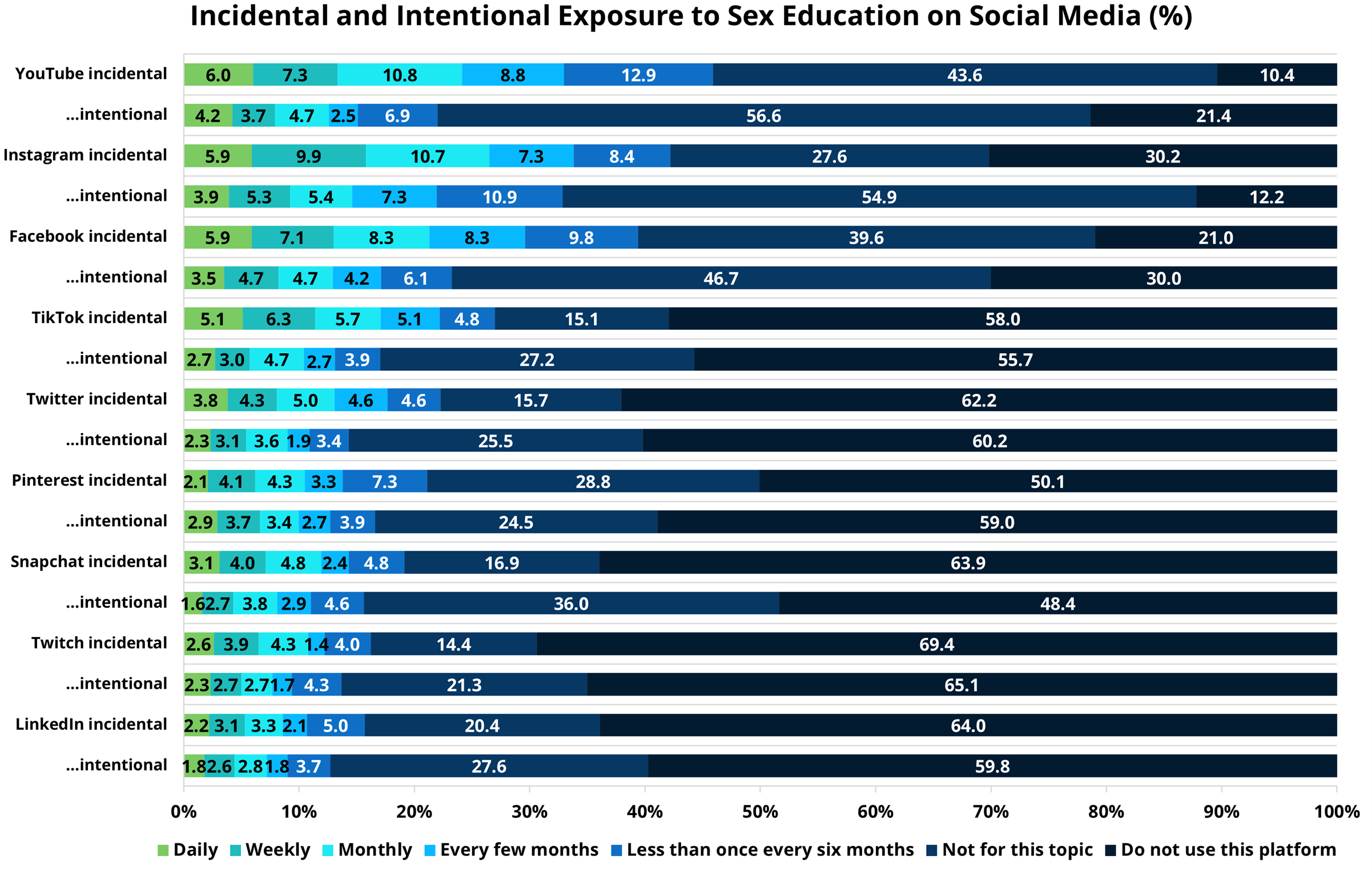
On a daily basis, only a small share of participants is incidentally exposed to sexual education content (e.g., 6% on YouTube, 5.9% on Facebook, 5.9% on Instagram, and 5.1% on TikTok), and an even smaller percentage is exposed intentionally (e.g., 4.2% on Facebook, 3.9% on YouTube, 3.5% on Instagram, and 2.7% on TikTok). This limited intentional use was also reflected by the fact that 9.8% of participants indicated that they subscribed to at least one social media channel that promotes sexual education (while 90.2% did not). When looking at incidental exposure at least every few months on the most frequently used platforms, 33.8% were exposed to sexual education content on Instagram, 32.9% on YouTube, and 29.6% on Facebook. For intentional exposure to sexual education, 21.9% used YouTube, 17.1% Instagram, and 15.1% Facebook at least every few months. Thus, the general prevalence of sexual education on social media is as follows: While approximately 10% actively subscribe to sexual education channels, one-third of users are exposed to sexual education incidentally, and 15‒20% actively seek that content at least every few months.
Sociodemographic Predictors of Exposure to Sexual Education on Social Media
RQ2 asked how sociodemographic factors predict incidental and intentional exposure to sexual education content on social media. Two regression analyses (see Table 1) with incidental, F(6,1178) = 48.44, p < .001, and intentional, F(6,1169) = 46.30, p < .001, exposure as dependent variables indicated that younger, male, and highly educated participants more frequently exposed themselves incidentally and intentionally to sexual education than older, female, and less educated participants. Male participants were more likely to seek sexual education intentionally (β = .20) than to encounter it incidentally (β = .16).
Table 1. Regression Analyses Predicting Incidental and Intentional Exposure to Sexual Education in Social Media.
|
|
Incidental exposure to sexual education |
Intentional exposure to sexual education |
||||||
|
|
B (SE) |
β |
t |
p |
B (SE) |
β |
t |
p |
|
(Constant) |
−1.51 (.31) |
|
−4.85 |
< .001 |
−2.30 (.28) |
|
−8.07 |
< .001 |
|
Age |
−0.02 (.00) |
−.17 |
−6.22 |
< .001 |
−0.01 (.00) |
−.11 |
−4.15 |
< .001 |
|
Sex (1 = female/2 = male) |
0.44 (.07) |
.16 |
6.17 |
< .001 |
0.49 (.06) |
.20 |
7.54 |
< .001 |
|
Level of education |
0.14 (.04) |
.08 |
3.16 |
.002 |
0.13 (.04) |
.09 |
3.32 |
< .001 |
|
Quality of traditional sexual education |
0.16 (.04) |
.10 |
3.72 |
< .001 |
0.20 (.04) |
.14 |
5.04 |
< .001 |
|
Sexual communication apprehension |
0.22 (.04) |
.17 |
5.75 |
< .001 |
0.24 (.03) |
.20 |
7.08 |
< .001 |
|
Frequency of sexuality-related talk |
0.54 (.05) |
.32 |
11.14 |
< .001 |
0.45 (.04) |
.29 |
10.21 |
< .001 |
|
R2 |
.20 |
.19 |
||||||
Users’ Evaluation of Sexual Education on Social Media
From a descriptive point of view, an examination of how users evaluated sexuality-related information on social media (RQ3) showed a balanced distribution: Collapsing the two highest and the two lowest scale points, we see that 30.3% perceived sexual information as credible, 37.3% as interesting, 29.7% as useful, and 21.6% as important. Similarly, 29% found sexual information to be less credible, 22.2% less interesting, 26.3% less useful, and 27.2% less important. Overall, 54.1% indicated that they encounter sexual misinformation at least sometimes. When predicting the perceived quality of sexual information on social media using regression analysis, F(8,1166) = 41.94, p < .001, we found that younger and female participants tend to evaluate sexual information more highly than older and male participants (see Table 2). Moreover, those who exposed themselves to sexual education incidentally and, in particular, intentionally were also more likely to evaluate sexual information on social media positively than those who exposed themselves to sexual education less often (see Table 2).
Table 2. Regression Analyses Predicting Perceived Quality of Sexual Education, Perceived Knowledge Gains,
and Perceived Suitability of Social Media for Sexual Education.
|
|
Perceived quality of sexual education |
Perceived knowledge gains |
Perceived suitability of social media for sexual education |
|||||||||
|
|
B |
β |
t |
p |
B |
β |
t |
p |
B |
β |
t |
p |
|
(Constant) |
2.84 |
— |
13.41 |
< .001 |
2.32 |
— |
9.13 |
< .001 |
1.83 |
— |
7.45 |
< .001 |
|
Age |
−0.01 |
−.14 |
−5.22 |
< .001 |
−0.01 |
−.15 |
−5.59 |
< .001 |
−0.01 |
−.11 |
−4.28 |
< .001 |
|
Sex (1 = female; 2 = male) |
−0.17 |
−.09 |
−3.54 |
< .001 |
−0.09 |
−.04 |
−1.57 |
.116 |
−.09 |
−.04 |
−1.66 |
.096 |
|
Level of education |
0.04 |
.04 |
1.51 |
.133 |
−0.02 |
−.02 |
−0.70 |
.485 |
.16 |
.12 |
4.80 |
< .001 |
|
Quality of traditional sexual education |
0.05 |
.05 |
1.74 |
.083 |
0.01 |
.01 |
0.39 |
.698 |
.02 |
.02 |
0.74 |
.461 |
|
Sexual communication apprehension |
0.02 |
.02 |
0.79 |
.433 |
−0.00 |
−.00 |
−0.06 |
.950 |
−.01 |
−.01 |
−0.44 |
.660 |
|
Frequency of |
0.10 |
.09 |
3.03 |
.002 |
0.20 |
.14 |
4.92 |
< .001 |
.10 |
.07 |
2.56 |
.011 |
|
Incidental exposure |
0.12 |
.17 |
4.19 |
< .001 |
0.25 |
.30 |
7.51 |
< .001 |
.10 |
.13 |
3.20 |
.001 |
|
Intentional exposure |
0.16 |
.22 |
5.24 |
< .001 |
0.12 |
.13 |
3.27 |
.001 |
.04 |
.04 |
1.10 |
.271 |
|
Perceived knowledge gains |
— |
— |
— |
— |
— |
— |
— |
— |
.30 |
.32 |
11.06 |
< .001 |
|
R2 |
.22 |
.28 |
.29 |
|||||||||
Perceived Benefits of Exposure to Sexual Education on Social Media
To investigate which social media users reported subjectively benefiting from exposing themselves to sexual education on social media (RQ4), we conducted a regression analysis with perceived knowledge gains, F(8,1166) = 55.69, p < .001, as the dependent variable. Based on their own accounts, younger participants and those who exposed themselves intentionally and, in particular, incidentally perceived greater knowledge gains on the topic of sexuality using social media than older participants and those who were exposed to that content less often (see Table 2). The knowledge growth was evenly distributed across all four topics (collapsing the three highest scale points), as 54% perceived at least a slight expansion of their knowledge on human anatomy, 53.9% on sexually transmitted diseases, 53.2% on sexual techniques/practices, 51.9% on contraceptive methods, and 49.7% on fertility/reproduction.
Compensatory and Complementary Forms of Sexual Education
To address RQ5, which asked whether social media serves as a compensatory or complementary source of sexual education, we included the predictors perceived quality of traditional sexual education, sexual communication apprehension, and frequency of sexuality-related talk in daily life in the above-mentioned regression analyses (see Table 1). These analyses indicate support for both forms of use: Those who exhibited stronger sexual communication apprehension more frequently exposed themselves to sexual education incidentally and, in particular, intentionally than those with lower apprehension. However, social media users with stronger sexual communication apprehension do not necessarily gain knowledge when using social media for sexual education (based on their subjective assessment). At the same time, results indicated that users who perceive a higher quality of their traditional sexual education and those who engage more in sexuality-related talk tend to expose themselves to sexual education more often incidentally and intentionally through social media than those who perceive a lower quality of their traditional sexual education and those who engage less in sexuality-related talk. Additionally, those who more frequently talk about sexuality in their daily life are more likely to evaluate the quality of sexual education on social media more positively and report gaining more sexual knowledge than those who talk less frequently about this topic (see Table 2). Thus, this complementary use seems to be beneficial for these users.
The Suitability of Social Media as Venues for Sexual Education
An exploratory regression analysis of who perceives social media as suitable spaces for sexual education, F(9, 1165) = 51.93, p < .001, indicates that younger and more educated users, as well as those who talk more frequently about sexuality and subjectively gain more knowledge, perceive social media as more suitable spaces than do older, less educated users and those who talk less about sexuality in their daily life and gain less knowledge. Participants rated YouTube (35.3%), Instagram (21.6%), Facebook (18%), and TikTok (16.5%) as the most suitable platforms for sexual education (collapsing the highest scale points of suitability).
Discussion
The present survey examined the presence of sexual education on social media from different points of view by asking who consumes this type of education, with which (subjectively perceived) effects, and what the relative importance of social media as sources of sexual education is. We summarize our findings within a sample of users in Germany and interpret them in light of the state-of-the-art in the following.
Who Is Exposed to Sexual Education on Social Media?
Less than 10% of users living in Germany encounter sexual education on a daily basis. One-third of participants are exposed to sexual education at least every few months on YouTube, Instagram, and Facebook as the most prominent platforms. Our results suggest that prevalence is higher for younger than for older social media users: Indeed, younger social media users more often exposed themselves to sexual education on these platforms and consider these to be suitable spaces. This corroborates previous findings documenting that socially mediated sexual education is more prominent for younger groups (White et al., 2023; Zamponi et al., 2024). The association between age and exposure seems plausible, given that the need for information regarding sexuality and associated issues may be greatest among young adults (Behre, 2022). As shown in the Supplementary Material (see Table A1; https://osf.io/yh52g/files/cb248), a breakdown of the variable age into categorical groups reveals a linear decline in mean values for exposure, perceived knowledge, perceived quality, and perceived suitability of social media for sexual education from the 18–29 to the 60–69 age groups. However, it is noteworthy that both incidental and intentional exposure to sexual education is higher in the 70–89 age group compared to the 50–59 and 60–69 groups. While the standard deviation is also larger in this oldest group, this may reflect greater variability in life circumstances (e.g., more free time), which could facilitate engagement with sexual education. Nonetheless, the educational needs of this group warrant further investigation, as there is (a) a potential neglect of educational interventions concerning sexual health among older populations (Graf & Patrick, 2015), and (b) persistent stigma and negative attitudes toward older adult sexuality (Kriofske Mainella et al., 2024). The level of education also had a comparatively weak effect on frequency of exposure, indicating that more educated social media users may have formed information networks that cover slightly more educational content, including sexuality-related topics. What is notable is that males exposed themselves incidentally, and in particular intentionally, more often to sexual education on these platforms than females. This is surprising, as previous research documented that females are more inclined to engage with sexuality-related topics than males (Zamponi et al., 2024), since—in the form of a gender stereotype—engaging with health-related issues is seen as less masculine (Fleming & Agnew-Brune, 2015; LeBeau et al., 2020). Thus, social media platforms may be suitable tools for male users to engage with the topic of sexuality in a protected, private, and discreet manner. At the same time, one could question whether individuals of all genders interpret the concept of sexual education in the same way, or whether they hold different definitions of what constitutes sexual education content on social media. While we attempted to reduce ambiguity by providing examples of relevant topics in our questions (e.g., explicitly mentioning reproduction, contraception, and sexual techniques or practices), we cannot rule out the possibility that the observed differences in exposure frequency between men and women are due to differing interpretations of what qualifies as sexual education content.
Since exposure to sexual education on social media is not evenly distributed if one considers sociodemographic factors, it is reasonable to ask whether there could be a divide in exposure or even in access to sexual education among social media users. While age may be an organic determinant, given that one’s sexuality is more likely to evolve in younger adulthood, we may ask whether a gap in sexual knowledge could emerge between male/more educated and female/less educated social media users (compared to divides documented in other domains; Scheerder et al., 2017)—at least in this sample of users living in Germany. Moreover, systematic content analyses need to assess whether this pattern only matches what social media channels offer (that is to say, content is targeted more at a male and more educated audience).
Who Benefits from Sexual Education on Social Media?
In their own perception, social media users seem to gain more than they lose by exposing themselves to sexual education using these technologies. While half of users are exposed to sexual misinformation at least sometimes (supporting content analyses on the prevalence of misleading or false information; Döring & Conde, 2021), one–third rates the information as credible, important, useful, and interesting. Across four key sexual health issues, half of participants perceive knowledge gains through exposure to socially mediated sexual education. This finding is consistent with research documenting educational benefits of sexual information online (Lim et al., 2025; Sciberras & Tanner, 2024; Shigeto & Scheier, 2024). However, these benefits are not evenly distributed: Female and younger users seem to find higher-quality sexual education on social media. This is an interesting observation, considering that male participants are exposed more frequently to sexual education than females. Thus, female social media users may expose themselves less to sexual education, but when exposed, they encounter subjectively better quality. Subjective knowledge gains were observable among younger users and those who engage in sexuality-related talk in everyday life. It seems conceivable that sexual education content on social media is tailored to younger individuals with a stronger interest in sexual health, making it is easier for them to process and internalize the distributed knowledge. It is also notable that intentional exposure was associated more strongly with perceived knowledge gains than incidental exposure, suggesting that purposefully seeking information might lead to a deeper processing of information and, therefore, to an expansion of knowledge (Dreston & Neubaum, 2025). However, there may be a miscalibration of subjective and objective knowledge, particularly when using social media (Yamamoto & Yang, 2022), suggesting that (long-term) studies measuring objective knowledge gains through the use of social media could clarify who the actual beneficiaries of sexual education on those platforms are.
Do Social Media Serve as Compensatory or Complementary Sources of Sexual Education?
Our findings support both the educational compensation and the enhancement hypotheses: On the one hand, individuals who have sexual communication apprehension, and therefore have difficulties engaging in direct conversations about sexuality in their offline life (Babin, 2013; Pask & Wu, 2024), seem to expose themselves in particular intentionally to sexual education through social media. This clearly indicates a compensatory function of social media, as these individuals might make up for their lack of engagement with the topic of sexuality by using these technologies. This could certainly apply to members of sexual minorities who face marginalization and discrimination (Fox & Ralston, 2016; Mitchell et al., 2014) and who use social media as protected spaces to explore their sexual identity. At the same time, the compensatory function of social media in the area of sexual education can be problematic given the prevalence of inaccurate and misleading content (Döring & Conde, 2021). This could lead to individuals being misinformed without encountering any correction.
On the other hand, we see evidence of an enhancement process in the form of a rich-get-richer dynamic, since those who perceive their traditional sexual education to be of higher quality and those who engage in sexuality-related talk in everyday life expose themselves more often to sexual education online, with the latter group in particular apparently encountering high quality information and perceiving greater knowledge gains (corroborating results presented by Nikkelen et al., 2020).
It seems reasonable to infer that both the compensation and the enhancement hypotheses can apply and be valid at the same time. Nevertheless, effect sizes indicate that the enhancement process is more likely to occur than the compensation process. The design of educational interventions could take these findings into account by providing instructions and information not only targeting those who feel comfortable discussing sexuality but also directly addressing those who feel inhibited and may not be able to verbalize their need for information related to sexuality.
The fact that, in the view of social media users, YouTube appears to be the most suitable platform for sexual education suggests that users want complex topics related to sexual health to be addressed and explained through formats that allow for the comprehensive presentation of well-researched educational material that enhances processing fluency and, hopefully, leads to significant gains in knowledge and skills. Compared to TikTok or Instagram, which provide shorter peer-to-peer or influencer-to-peer interactions, YouTube may represent a platform on which longer videos produced by official sources are more common and better suited to the topic of sexual health.
Limitations
This correlational survey has several limitations: First, the nature of the study was not able to cover the actual content to which individuals were exposed. Self-reports of social media use can clearly be distorted and provide limited insight into actual communication processes. Nevertheless, we believe that subjective assessment of the presence of sexuality on social media—and subjective knowledge gains in particular—can serve as leverage points empowering people to make personal decisions (irrespective of whether there is an objective knowledge gain or not). Second, we were not able to assess the objective quality of sexual education, making it difficult to assess the accuracy of the educational content that users had in mind. This is a key limitation, since young adults in particular were found to have limited abilities to estimate the accuracy of online sexual health information (Behre, 2022). However, we believe that users’ subjective assessment of the quality of information could determine their trust in educational content on social media, indicating barriers to be overcome when disseminating knowledge of this kind.
Conclusion and Future Directions
This study advances the state of the art on sexual education disseminated through contemporary communication technologies in at least three respects: First, this study shows which groups of social media users in Germany are currently exposed to sexual education content—mainly younger, male, and highly educated individuals. As a result, these users form the core audience for this type of content. Based on these findings, educators and content creators should reflect on whether their sexual education content is inclusive and engaging enough to reach other groups that are currently less represented.
Second, our findings suggest that while incidental and intentional exposure to sexual education on social media was modestly associated with perceived sexual knowledge gains, not all user groups who more frequently encounter sexual education ultimately expand their knowledge in the area of sexual health. Therefore, research is needed to identify the barriers to knowledge acquisition through these technologies and how they can be resolved.
Third, this study extends the technology-mediated compensatory and enhancement mechanisms—originally focused on social gratification—to an educational level, suggesting that social media can serve as suitable tools for both a) compensating for a lack of sexual education and b) complementing users’ everyday engagement with the topic of sexual health. In particular, the educational compensation function of social technologies such as Instagram and YouTube warrants further investigation, as target groups (especially sexual minorities) need to be identified and specific content for these groups needs to be designed.
Conflict of Interest
The authors have no conflicts of interest to declare.
Use of AI Services
The authors declare they have not used any AI services to generate or edit any part of the manuscript or data.
Acknowledgement
The authors would like to thank Janosh Beucker, Alisa Draber, Anna Hoffmann, Lars Hufen, and Natalie Scholtyschik for their help when preparing the survey.


This work is licensed under a Creative Commons Attribution-ShareAlike 4.0 International License.
Copyright © 2026 German Neubaum, Jan-Sebastian Grund