
Knowledge benefits through work-related social media use: A preregistered measurement burst study
Vol.20,No.2(2026)
Christine Anderl
 Franziska Gaiser
Sonja Utz
Franziska Gaiser
Sonja Utz
The claim that work-related social media use can help people to get better access to information has received cross-sectional empirical support, but it remains unclear to what extent these benefits are really media effects or rather selection effects. We conducted a year-long five-wave panel study with two intensive measurement periods (bi-daily assessment for one workweek after Waves 3 and 4) to disentangle within- and between-person effects. Within-person effects would support the claim that there are media effects on work-related outcomes. By looking at two different timeframes (half-day vs. three months), we also aim to explore on which timescales these effects evolve. Our analyses focused on reading and posting on social media and controlled for networking (waves) and workload (bursts) as potential confounders. In line with preregistered predictions, we found that within-person increases in reading and posting differentially predicted increases in informational benefits, ambient awareness, serendipity, creativity, and productivity measured at the same time period. Reading was positively related to the outcomes in both bursts and waves. Posting, in contrast, showed positive associations with most outcomes only within the same half‑day (bursts), and with creativity alone in the waves. In contrast, we found no consistent lagged effects at half-day or three-month intervals. In addition, between-person differences also emerged, especially for posting. Individuals who posted more often reported higher creativity and serendipity. Overall, the stronger within-person effects observed in the bursts suggest that WRSMU may provide positive, but predominantly short-term, benefits.
creativity; informational benefits; serendipity; ambient awareness; work-related social media use; experience sampling; longitudinal
Christine Anderl
Endo Health GmbH, Leibniz-Institut für Wissensmedien, Tübingen, Germany; Leibniz-Institut für Wissensmedien, Tübingen, Germany
Christine Anderl is Head of Science at Endo Health GmbH, a company developing digital women's health solutions. She received her PhD in Psychology at Goethe University Frankfurt. She is interested in examining the effects of digital technology use in health, professional, and social contexts.
Franziska Gaiser
Bayrische Landeszentrale für neue Medien, München, Germany; Leibniz-Institut für Wissensmedien, Tübingen, Germany
Franziska Gaiser works in Media Research and Media Economics at the Bavarian Regulatory Authority for New Media (BLM). She is responsible for research on media use, with a focus on audio and media market indicators. She received her PhD in communication science in 2026 from University of Hohenheim.
Sonja Utz
Leibniz-Institut für Wissensmedien, Tübingen, Germany; University of Tübingen, Tübingen, Germany
Sonja Utz is professor for Communication via Social Media at University of Tübingen and head of the Everyday Media Lab at Leibniz-Institut für Wissensmedien. She received her PhD in psychology at the Catholic University of Eichstätt. She examines the effects of knowledge-related social media and AI use in professional and informal settings.
Acar, S., Neumayer, M., & Burnett, C. (2021). Social media use and creativity: Exploring the influences on ideational behavior and creative activity. The Journal of Creative Behavior, 55(1), 39–52. https://doi.org/10.1002/jocb.432
Adler, P. S., & Kwon, S.-W. (2002). Social capital: Prospects for a new concept. Academy of Management Review, 27(1), 17–40. https://www.jstor.org/stable/4134367
Albulescu, P., Macsinga, I., Rusu, A., Sulea, C., Bodnaru, A., & Tulbure, B. T. (2022). „Give me a break!“ A systematic review and meta-analysis on the efficacy of micro-breaks for increasing well-being and performance. PLoS ONE, 17(8), Article e0272460. https://doi.org/10.1371/journal.pone.0272460
Anderl, C., & Utz, S. (2025). Examining the automaticity of ambient awareness via its persistence under cognitive load. Media Psychology, 1–23. https://doi.org/10.1080/15213269.2025.2549488
Anderl, C., Baumann, L., & Utz, S. (2023). Social networking site use in professional contexts. In J. Skopek (Ed.), Research handbook on digital sociology (pp. 179–194). Edward Elgar Publishing. https://doi.org/10.4337/9781789906769.00018
Anderl, C., Levordashka, A., & Utz, S. (2024). Ambient awareness of who knows what: Spontaneous inferences of domain expertise. Media Psychology, 27(3), 329–351. https://doi.org/10.1080/15213269.2023.2239144
Burt, R. S. (1992). Structural holes: The social structure of competition. Harvard University Press.
Carpenter, J. P., Morrison, S. A., Craft, M., & Lee, M. (2020). How and why are educators using Instagram? Teaching and Teacher Education, 96, Article 103149. https://doi.org/10.1016/j.tate.2020.103149
Chen, Y.-C., Wu, J.-Y., & Chu, H.-C. (2025). Correlations of workload with personality traits, perceived negative and positive behaviors, and organizational factors: A meta-analysis. WORK: A Journal of Prevention, Assessment & Rehabilitation. https://doi.org/10.1177/10519815251365103
Dantonio, L., Makri, S., & Blandford, A. (2012). Coming across academic social media content serendipitously. Proceedings of the American Society for Information Science and Technology, 49(1), 1–10. https://doi.org/10.1002/meet.14504901002
Davis, J., Wolff, H.-G., Forret, M. L., & Sullivan, S. E. (2020). Networking via LinkedIn: An examination of usage and career benefits. Journal of Vocational Behavior, 118, Article 103396. https://doi.org/10.1016/j.jvb.2020.103396
Ellison, N. B., Steinfield, C., & Lampe, C. (2007). The benefits of Facebook „friends:“ Social capital and college students’ use of online social network sites. Journal of Computer-Mediated Communication, 12(4), 1143–1168. https://doi.org/10.1111/j.1083-6101.2007.00367.x
Ellison, N. B., Steinfield, C., & Lampe, C. (2011). Connection strategies: Social capital implications of Facebook-enabled communication practices. New Media & Society, 13(6), 873–892. https://doi.org/10.1177/1461444810385389
Finkel, S. E. (1995). Causal analysis with panel data. Sage Publications, Inc. https://doi.org/10.4135/9781412983594
Fischer, G., Scharff, E., & Ye, Y. (2004). Fostering social creativity by increasing social capital. In M. Huysman & V. Wulf (Eds.), Social capital and information technology (pp. 355–399), The MIT Press. https://doi.org/10.7551/mitpress/6289.003.0018
Fulk, J., & Yuan, Y. C. (2013). Location, motivation, and social capitalization via enterprise social networking. Journal of Computer-Mediated Communication, 19(1), 20–37. https://doi.org/10.1111/jcc4.12033
Gabriel, A. S., Podsakoff, N. P., Beal, D. J., Scott, B. A., Sonnentag, S., Trougakos, J. P., & Butts, M. M. (2019). Experience sampling methods: A discussion of critical trends and considerations for scholarly advancement. Organizational Research Methods, 22(4), 969–1006. https://doi.org/10.1177/1094428118802626
Granovetter, M. S. (1973). The strength of weak ties. American Journal of Sociology, 78(6), 1360–1380. https://www.jstor.org/stable/2776392
Koroleva, K., Krasnova, H., Veltri, N. F., & Günther, O. (2011). It’s all about networking! Empirical investigation of social capital formation on social network sites. In Proceedings of the 32nd International Conference on Information Systems (ICIS 2011). https://www.researchgate.net/publication/221598201_It's_All_About_Networking_Empirical_Investigation_of_Social_Capital_Formation_on_Social_Network_Sites
Kühnel, J., Vahle-Hinz, T., de Bloom, J., & Syrek, C. J. (2020). Staying in touch while at work: Relationships between personal social media use at work and work-nonwork balance and creativity. The International Journal of Human Resource Management, 31(10), 1235–1261. https://doi.org/10.1080/09585192.2017.1396551
Kümpel, A. S. (2022). Social media information environments and their implications for the uses and effects of news: The PINGS Framework. Communication Theory, 32(2), 223–242. https://doi.org/10.1093/ct/qtab012
Lantz-Andersson, A., Peterson, L., Hillman, T., Lundin, M., & Bergviken Rensfeldt, A. (2017). Sharing repertoires in a teacher professional Facebook group. Learning, Culture and Social Interaction, 15, 44–55. https://doi.org/10.1016/j.lcsi.2017.07.001
Leeuw, J. de, & Meijer, E. (2008). Introduction to multilevel analysis. In J. de Leeuw & E. Meijer (Eds.), Handbook of Multilevel Analysis (pp.1–75). Springer. https://doi.org/10.1007/978-0-387-73186-5_1
Leonardi, P. M. (2015). Ambient awareness and knowledge acquisition: Using social media to learn “who knows what” and “who knows whom”. MIS Quarterly, 39(4), 747–762. https://www.jstor.org/stable/26628649
Leonardi, P. M., & Meyer, S. R. (2015). Social media as social lubricant: How ambient awareness eases knowledge transfer. American Behavioral Scientist, 59(1), 10–34. https://doi.org/10.1177/0002764214540509
Levordashka, A., & Utz, S. (2016). Ambient awareness: From random noise to digital closeness in online social networks. Computers in Human Behavior, 60, 147–154. https://doi.org/10.1016/j.chb.2016.02.037
LinkedIn. (2023). About LinkedIn. Retrieved (October 27, 2023), from https://about.linkedin.com/
McCay-Peet, L., & Toms, E. G. (2015). Investigating serendipity: How it unfolds and what may influence it. Journal of the Association for Information Science and Technology, 66(7), 1463–1476. https://doi.org/10.1002/asi.23273
McCay-Peet, L., Toms, E. G., & Kelloway, E. K. (2015). Examination of relationships among serendipity, the environment, and individual differences. Information Processing & Management, 51(4), 391–412. https://doi.org/10.1016/j.ipm.2015.02.004
Ohly, S., Kase, R., & Škerlavaj, M. (2010). Networks for generating and for validating ideas: The social side of creativity. Innovation, 12(1), 41–52. https://doi.org/10.5172/impp.12.1.41
Olshannikova, E., Pirkkalainen, H., Olsson, T., & Huhtamäki, J. (2022). What supports serendipity on Twitter? Online survey on the role of technology characteristics and their use. In Proceedings of the 25th International Academic Mindtrek Conference (pp. 89–101). https://doi.org/10.1145/3569219.3569346
Parise, S., Whelan, E., & Todd, S. (2015). How Twitter users can generate better ideas. MIT Sloan Management Review, 56(4), 21–25. http://mitsmr.com/1KIZnUk
Parry, D. A., Davidson, B. I., Sewall, C. J. R., Fisher, J. T., Mieczkowski, H., & Quintana, D. S. (2021). A systematic review and meta-analysis of discrepancies between logged and self-reported digital media use. Nature Human Behaviour, 5(11), 1535–1547. https://doi.org/10.1038/s41562-021-01117-5
Pew Research Center (2016, June 22). Social media and the workplace. https://www.pewresearch.org/internet/2016/06/22/social-media-and-the-workplace
Pirkkalainen, H., Olshannikova, E., Olsson, T., & Huhtamäki, J. (2021). Examining serendipitous encounters and self-determination in twitter-enabled innovation. Advances in Human-Computer Interaction, 2021(1), Article 6665449. https://doi.org/10.1155/2021/6665449
Podsakoff, P. M., Podsakoff, N. P., Williams, L. J., Huang, C., & Yang, J. (2024). Common method bias: It’s bad, it’s complex, it’s widespread, and it’s not easy to fix. Annual Review of Organizational Psychology and Organizational Behavior, 11(1), 17–61. https://doi.org/10.1146/annurev-orgpsych-110721-040030
R Core Team (2025). R: A Language and Environment for Statistical Computing. R Foundation for Statistical Computing, Vienna, Austria. https://www.R-project.org
Rajkumar, K., Saint-Jacques, G., Bojinov, I., Brynjolfsson, E., & Aral, S. (2022). A causal test of the strength of weak ties. Science, 377(6612), 1304–1310. https://doi.org/10.1126/science.abl4476
Rohrer, J. M., & Murayama, K. (2023). These are not the effects you are looking for: Causality and the within-/between-persons distinction in longitudinal data analysis. Advances in Methods and Practices in Psychological Science, 6(1). https://doi.org/10.1177/25152459221140842
Saxton, G. D., & Guo, C. (2020). Social media capital: Conceptualizing the nature, acquisition, and expenditure of social media-based organizational resources. International Journal of Accounting Information Systems, 36, Article 100443. https://doi.org/10.1016/j.accinf.2019.100443
Sun, T., Zhang, M., & Mei, Q. (2013). Unexpected relevance: An empirical study of serendipity in retweets. Proceedings of the International AAAI Conference on Web and Social Media, 7(1), Article 1. https://doi.org/10.1609/icwsm.v7i1.14435
Tierney, P., Farmer, S. M., & Graen, G. B. (1999). An examination of leadership and employee creativity: The relevance of traits and relationships. Personnel Psychology, 52(3), 591–620. https://doi.org/10.1111/j.1744-6570.1999.tb00173.x
Utz, S. (2016). Is LinkedIn making you more successful? The informational benefits derived from public social media. New Media & Society, 18(11), 2685–2702. https://doi.org/10.1177/1461444815604143
Utz, S., & Breuer, J. (2016). Informational benefits from social media use for professional purposes: Results from a longitudinal study. Cyberpsychology: Journal of Psychosocial Research on Cyberspace, 10(4), Article 3. https://doi.org/10.5817/CP2016-4-3
Utz, S., & Breuer, J. (2019). The relationship between networking, Linkedin use, and retrieving informational benefits. Cyberpsychology, Behavior, and Social Networking, 22(3), 180–185. https://doi.org/10.1089/cyber.2018.0294
Valkenburg, P. M., van Driel, I. I., & Beyens, I. (2022). The associations of active and passive social media use with well-being: A critical scoping review. New Media & Society, 24(2), 530–549. https://doi.org/10.1177/14614448211065425
Verduyn, P., Lee, D. S., Park, J., Shablack, H., Orvell, A., Bayer, J., Ybarra, O., Jonides, J., & Kross, E. (2015). Passive Facebook usage undermines affective well-being: Experimental and longitudinal evidence. Journal of Experimental Psychology: General, 144(2), 480–488. https://doi.org/10.1037/xge0000057
Vitak, J., & Ellison, N. B. (2012). „There’s a network out there you might as well tap“: Exploring the benefits of and barriers to exchanging informational and support-based resources on Facebook. New Media & Society, 15(2), 243–259. https://doi.org/10.1177/1461444812451566
Vranken, I., & Vandenbosch, L. (2024). Social and vocational identity in workers’ online posts: A large-scale Instagram content analysis of job-related hashtags. Behaviour & Information Technology, 43(12), 2966–2986. https://doi.org/10.1080/0144929X.2023.2264928
Wang, B., Liao, Y., Chen, M., Zhang, L., & Qian, J. (2023). Work and affective outcomes of social media use at work: A daily-survey study. The International Journal of Human Resource Management, 34(5), 941–965. https://doi.org/10.1080/09585192.2021.2012711
Weiler, M., Stolz, S., Lanz, A., Schlereth, C., & Hinz, O. (2022). Social capital accumulation through social media networks: Evidence from a randomized field experiment and individual-level panel data. Management Information Systems Quarterly, 46(2), 771–812. https://doi.org/10.25300/MISQ/2022/16451
Wickramasinghe, V., & Weliwitigoda, P. (2011). Benefits gained from dimensions of social capital: A study of software developers in Sri Lanka. Information Technology & People, 24(4), 393–413. https://doi.org/10.1108/09593841111182287
Wolfers, L. N., Neumann, D., Klein, S. H., Gaiser, F., Anderl, C., & Utz, S. (2025). What do you mean by “social media”? Introducing the reporting items for social media research (RISoMeR). Annals of the International Communication Association, 49(3) 192–204. https://doi.org/10.1093/anncom/wlaf009
Wolff, H.-G., & Spurk, D. (2020). Developing and validating a Short Networking Behavior Scale (SNBS) from Wolff and Moser’s (2006) measure. Journal of Career Assessment, 28(2), 277–302. https://doi.org/10.1177/1069072719844924
Zelenski, J. M., Murphy, S. A., & Jenkins, D. A. (2008). The happy-productive worker thesis revisited. Journal of Happiness Studies, 9(4), 521–537. https://doi.org/10.1007/s10902-008-9087-4
Authors’ Contribution
Christine Anderl: conceptualization, data curation, investigation, formal analysis, project administration, writing—original draft, writing—review and editing. Franziska Gaiser: data curation, investigation, project administration, writing—original draft, writing—review and editing. Sonja Utz: conceptualization, formal analysis, funding acquisition, writing—original draft, writing—review and editing
Editorial Record
First submission received:
January 16, 2025
Revisions received:
September 22, 2025
January 8, 2026
March 11, 2026
Accepted for publication:
March 11, 2026
Editor in charge:
Alexander P. Schouten
| Please note: Article updated on August 27, 2026. Table 3 was updated. The name of the last variable measured in the waves was incorrect. Productivity was only measured in the bursts; this has been updated to ambient awareness. The means for the posting scale were based on the 11-item measures used at first submission; the table now contains the updated means for the 6-item measure used in the final paper. Finally, the reported means were recalculated using the listwise-deletion approach consistent with the analysis script available on OSF. This resulted in minor changes to some values. |
Introduction
The rise of social media platforms has fundamentally altered how professionals acquire and leverage informational resources (Saxton & Guo, 2020). LinkedIn, the largest professional social network site, reports having over a billion users (LinkedIn, 2023). In addition to professional social network sites, which specifically target professionals, several general-purpose social network sites like Facebook and Instagram, micro-blogging platforms like X (formerly Twitter), Bluesky, and Mastodon, and video sharing platforms like YouTube are also used to exchange work-related information (Carpenter et al., 2020; Lantz-Andersson et al., 2017; Vranken & Vandenbosch, 2024). These platforms enable unprecedented access to diverse professional networks and knowledge flows, raising important questions about their potential effects on workplace outcomes.
Despite the popularity of work-related social media use (WRSMU), research addressing its potential benefits is somewhat scarce and there are several gaps in the current scientific literature. Previous research has found evidence that people who use social media for professional purposes experience benefits of increased access to information, learning, and creativity and that these benefits increase with frequency or duration of WRSMU (Koroleva et al., 2011; Kühnel et al., 2020; Leonardi, 2015; Utz, 2016; Utz & Breuer, 2016).
It is less clear what the underlying processes are. Two processes for leveraging social capital built via social media use have been proposed (Weiler et al., 2022). One research line built on an information processing perspective and examined how regularly browsing through social media feeds can create so-called ambient awareness, knowledge about “who knows what” in the network (Leonardi, 2015; Leonardi & Meyer, 2015). Another research line explored whether active use, e.g., asking for advice or participating in work-related group discussions, predicts informational benefits (Utz, 2016; Utz & Breuer, 2016; Weiler et al., 2022). These studies focused on outcomes related to information, but did not look at other potential outcomes of WRSMU such as creativity or serendipity.
Moreover, because many studies have either been cross-sectional (Koroleva et al., 2011; Leonardi & Meyer, 2015; Utz, 2016) or did not distinguish between- and within-person effects (Leonardi, 2015; Utz & Breuer, 2016), it remains unclear whether these benefits are mainly media effects or rather selection effects. Within-person effects show whether people, when they use social media more than usual, also report more benefits than usual, hinting towards media effects. Between-person effects would show that people who in general use social media more report more benefits, a pattern that points to selection effects.
It is also unclear on which timescales such effects would unfold. In a longitudinal study on the relationship between LinkedIn use and informational benefits, Utz and Breuer (2016) found longitudinal relationships between network size and informational benefits half a year later, but only small and inconsistent effects of reading and posting. This could either mean that there are no long-term effects of WRSMU use or that the time-lag of six months was too long.
Taken together, the scarcity of longitudinal research on WRSMU, the open questions whether effects of WRSMU are within- and/or between-person effects and on which timescales they occur motivate our focus on disentangling media versus selection effects and on specifying when (time scale) and how (reading vs. posting) WRSMU relates to multiple outcomes.
In the present study, we aim to advance the understanding of WRSMU benefits in three ways. First, we tease apart explained variance within and between persons. Effects found within individuals are not sufficient for causal inference, but they are typically more helpful in pinpointing the underlying causal structure than effects found between individuals because they control for all time-invariant between-person confounders, including unobservable ones (Rohrer & Murayama, 2023, p. 3). Second, we employ a longitudinal design combining comprehensive assessments every 3 months over five waves with two week-long periods of twice-daily assessment. By looking at two different timespans we learn more about the time the processes need to unfold. Third, we extend prior work by looking at several potential outcomes that we derived from work on social capital (informational benefits (Burt, 1992) and creativity (Fischer et al., 2004)) and work on effects triggered by features of social media (ambient awareness (Levordashka & Utz, 2016) and serendipity (Sun et al., 2013). We also look at a potential downside of social media use: lower productivity.
Theoretical Background
Social media platforms, especially those that are used for work-related activities, have been theorized as a potential source of social capital (Anderl et al., 2023; Fulk & Yuan, 2013; Utz, 2016). Social capital, which has been described as “the goodwill available to individuals or groups”, provides access to information, influence, and emotional support (Adler & Kwon, 2002, p. 23).
The rise of social media has qualitatively and quantitatively changed the ways in which social capital can be generated and leveraged (Ellison et al., 2007, 2011): Social media platforms enable users to connect and stay connected with a large number of diverse people across the globe, benefit from their publicly disseminated content and to interact with them at low effort. This is particularly relevant because many social media connections are so-called weak ties (Utz, 2016), that is, less close connections like acquaintances or former colleagues. Weak ties have been both theorized (Granovetter, 1973) and empirically shown (Rajkumar et al., 2022) to be particularly relevant for providing non-redundant information. Indeed, empirical studies showed that professionals who engage in WRSMU and especially those who have more weak ties in their network report higher informational benefits (Rajkumar et al., 2022; Utz & Breuer, 2016, 2019).
To receive benefits from one’s social network one needs to leverage it (Weiler et al., 2022). There are two primary ways to do so. First, individuals can reach out to (members of) their network, for instance by posting questions, commenting on others’ posts, or engaging in discussions. This way of leveraging one’s network’s resources can happen at a much larger scale than was previously possible due to the broadcasting affordance of social media. This form of socially interactive social media use is also referred to as active social media use (e.g., Verduyn et al., 2015). For brevity, we will refer to this type of use as posting. Second, individuals can leverage the resources available in their network simply by browsing or reading posts. We will refer to this type of use as reading. This form of social media use is also called passive social media use (Verduyn et al., 2015) and represents a qualitatively drastically different way of (potentially) leveraging one’s social capital than was previously possible: Because much of the content on social media is publicly visible and because many people, including influential and knowledgeable individuals in their respective fields, regularly share content they consider relevant for others, reading or even browsing one’s social media feed has the potential to provide relevant information in a timely manner.
Although there is evidence that posting and reading content are related to benefits of social media use (Davis et al., 2020; Utz, 2016; Utz & Breuer, 2016), it is less clear whether these effects are media (vs. selection) effects and on which timescale they unfold. Cross-sectional correlations have been reported repeatedly (Davis et al., 2020; Utz, 2016), but cross-sectional studies do not allow to draw conclusions about whether observed effects represent media or selection effects and on which timescale they operate. In a longitudinal study with six months between the waves, Utz and Breuer (2016) found that only a small proportion of variance was explained by longitudinal effects, indicating that in addition to potential media effects, there are also selection effects at work. Subsequent work showed, for example, that people who are better in-person networkers receive more informational benefits and use professional social media to a larger extent (Utz & Breuer, 2019). Utz and Breuer (2016) found consistent longitudinal effects of the network composition on informational benefits but none for posting and reading. Since social media usually display the newest message on top of the feed, it is not surprising that posting or reading during the same data collection timepoint has a stronger relationship with positive outcomes than content that one has posted or read half a year ago. Effects might, however, still be there if shorter timespans than six months are chosen. It is, thus, important to study on which timescale media effects unfold. This aspect has been insufficiently addressed by conceptual or empirical work so far. To answer this question, we combine two different timeframes in our study: burst periods with two measures per work-day and longitudinal intervals of three months. We examine effects within the same timepoint (half-day for the bursts and three-month period for the waves) and on the next timepoint (next half-day or next three-month period, respectively).
We extend prior work by extending the scope of potential outcomes. Next to the information-related outcomes informational benefits and ambient awareness, we also include creativity and serendipity. Creativity has been discussed as outcome of social capital (Fischer et al., 2004) and there is work on the relationship with network size and composition (Parise et al., 2015) but not on the relationship with WRSMU. Serendipity overlaps with creativity but might matter especially on social media and their diverse news feeds because it is defined as “an experience marked by an interruption or discontinuity triggered by ideas, information, or phenomena that stops us in our tracks and prompts us to make connections that may have personal, organizational, community, or global outcomes” (McCay-Peet et al., 2015, p. 391). To also address potential downsides of WRSMU we also assessed productivity. We applied a user-centered (vs. technology-centered) perspective and left it to the users which platforms they considered work-related social media use (Wolfers et al., 2025). In the following section, we will deduce hypotheses per outcome and specify whether they are tested in the bursts or waves. Analyses were guided by preregistration; deviations are listed on OSF (see https://osf.io/4bwk3) and the appendix.
The Present Research
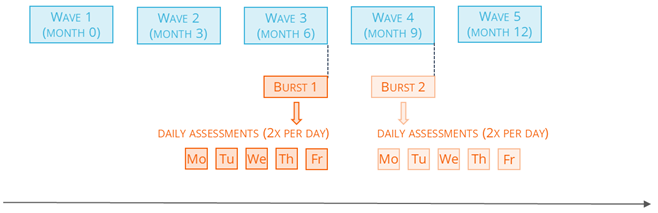
We combined a longitudinal survey with two burst periods of experience sampling. In the longitudinal part of the study, participants answered five surveys with a time interval of three months. Additionally, there were two burst periods (after waves 3 and 4) in which participants received two surveys each weekday (one around lunch and one at the end of the workday).
Informational Benefits
A fundamental premise of social capital theory is that weaker connections, especially the ones that bridge between different groups, provide (timely) access to non-redundant information (Adler & Kwon, 2002; Burt, 1992). Social media platforms may amplify this effect by enabling users to maintain larger networks while reducing the costs of information exchange. Reading should increase informational benefits because people encounter useful information on social media. People could also directly ask for information and thereby tap their network (Vitak & Ellison, 2012). Prior work showed positive correlations between reading and posting professional content with informational benefits cross-sectionally (Davis et al. 2020; Utz, 2016; Utz & Breuer, 2016). Combined with the theoretical assumption that these relationships reflect at least partially media effects, which should show on a within-person level, we predict for the bursts and waves:
H1: Within individuals, posting (H1a) and reading (H1b) social media content positively predict informational benefits at the same timepoint (t + 0).
It is less clear whether these benefits are immediate but fleeting, or whether they persist over time as professionals build knowledge through repeated platform engagement. Therefore, we formulate an open research question:
RQ1: Within individuals, do posting (RQ1a) and reading (RQ1b) social media content predict informational benefits at the next timepoint (t + 1)?
Ambient Awareness
Ambient awareness is closely related to information but focuses more on a process enabled by features of social media. It entails that skimming social media updates might be enough to develop knowledge about where expertise is located in one’s network (Leonardi, 2015; Levordashka & Utz, 2016). On social media, the (semi-)public posts by one’s network members are displayed in one’s newsfeed; the selection is curated by algorithms (Kümpel, 2022). Several studies showed that people can develop an idea of other people’s expertise just by skimming social media feeds (Anderl et al., 2024; Anderl & Utz, 2025; Leonardi, 2015; Leonardi & Meyer, 2015; Levordashka & Utz, 2016). Ambient awareness is built by repeated exposure to posts. In experiments with one-shot exposure to constructed status updates, it only occurred for targets who posted several expertise-inferring updates. Therefore, we deemed it unlikely that ambient awareness occurs after one half-day and assessed it only in the waves. Although ambient awareness is supposed to stem from reading updates, prior work has also shown positive correlations with posting content (Levordashka & Utz, 2016). We, therefore, examine the following hypothesis and RQ:
H2: Within individuals, posting (H2a) and reading (H2b) social media content positively predict ambient awareness at the same timepoint (t + 0) for the wave data.
RQ2: Within individuals, do posting (RQ2a) and reading (RQ2b) social media content predict ambient awareness at the next timepoint (t + 1)?
Creativity
Communication plays a role in the various stages of the creativity process (Ohly et al., 2010). In the idea generation stage, people mainly receive input from others; in the idea validation phase, they discuss their ideas with others (Ohly et al., 2020). Several studies found evidence for a positive relationship between creativity and WRSMU. Parise et al. (2015) reported that working professionals who used Twitter submitted more creative ideas than non-users. This effect was stronger among people with more diverse networks. Parise et al. (2015) did, however, only look at the networks and not on reading vs. posting. Acar et al. (2021) addressed this gap and found positive cross-sectional relationships between active and passive social media use, especially for Twitter. Kühnel et al. (2020) found in an experience sampling study that personal social media use was a negative predictor of creativity both between and within individuals. It is, thus, unclear whether there are positive short-term effects of work-related (vs. personal) social media use on creativity within a half-day, so we pose an open research question for the bursts. We expect, however, positive effects for reading and posting on creativity in the waves data because getting input (= reading) and discussing ideas (= posting) are both relevant for creativity, only in different stages (Ohly et al., 2010). Again, we explore whether there are also effects over a longer time period when controlling for prior levels of creativity.
RQ3: Within individuals, do posting (RQ3a) and reading (RQ3b) social media content predict creativity at the same timepoint (t + 0) for the burst data?
H3: Within individuals, posting (H3a) and reading (H3b) social media content positively predict creativity at the same timepoint (t + 0) for the wave data.
RQ4: Within individuals, do posting (RQ4a) and reading (RQ4b) social media content predict creativity at the next timepoint (t + 1)?
Serendipity
Serendipity shows overlap with creativity (getting new ideas) but might matter especially on social media. Because of the continuous and diverse information flow on social media, the fragmented way of how this information is presented on users’ timelines, and the additional possibility to directly engage in conversations with other users, social media may be a particularly promising and “trigger-rich” environment for potential serendipitous experiences (Dantonio et al., 2012; McCay-Peet & Toms, 2015). Indeed, prior research provided converging evidence from cross-sectional research (Olshannikova et al., 2022; Pirkkalainen et al., 2021) and a large-scale behavioural analysis using microblogging data (Sun et al., 2013) that WRSMU and serendipitous experiences are positively associated. Assuming that these positive associations at least partially reflect media effects, we test the following directional hypothesis for bursts and waves:
H4: Within individuals, posting (H4a) and reading (H4b) social media content positively predict serendipity at the same timepoint (t + 0).
Long-time effects are somewhat unlikely because serendipity is defined as interruptive (McCay-Peet et al., 2015), but because the effects might at least last to the next half-day, we formulated the following non-directional research question:
RQ5: Within individuals, do posting (RQ5a) and reading (RQ5b) social media content predict serendipity at the next timepoint (t + 1)?
Productivity
We included productivity to investigate whether the expected professional benefits of WRSMU come at the cost of lower productivity. This could be because work time spent on social media might then lack for other tasks or people might use social media for procrastination (Wang et al., 2023). However, people might also benefit from short breaks spent on social media. Indeed, a recent meta-analysis revealed that micro-breaks reduce fatigue (Albulescu et al., 2022). Because we focus on the rather immediate procrastination vs. micro-break aspect, we only assessed productivity in the bursts. Due to the opposing lines of argumentation, we ask the following non-directional research questions:
RQ6: Within individuals, do posting (RQ6a) and reading (RQ6b) social media content predict productivity at the same timepoint (t + 0) for the burst data?
RQ7: Within individuals, do posting (RQ7a) and reading (RQ7b) social media content predict productivity at the next timepoint (t + 1) for the burst data?
Potential Confounders: External Networking and Workload
We also looked at potential confounders. Networking refers to the building, maintaining, and leveraging one’s social network and is related to several career outcomes (Wolff & Spurk, 2020). Utz and Breuer (2019) found that LinkedIn users did not only report higher informational benefits than non-users, but also that they score higher on external networking, i.e., networking with people outside of one’s organization. We also focus on external networking because social media platforms are ideal for connecting with people from all over the world and some people, e.g., self-employed, might not even have internal contacts. Better networkers have larger and more diverse networks with more bridging ties that give them access to non-redundant information (Wolff & Spurk, 2020). External networking has been found to be positively associated with various indicators of LinkedIn activity and larger LinkedIn networks (Utz & Breuer, 2019). It might, thus, be a construct that explains both WRSMU and our outcomes. We assessed it in the first wave and predicted for the waves part:
H5: Interpersonal differences in external networking are positively related to informational benefits (H5a), ambient awareness (H5b), creativity (H5c) and serendipity (H5d).
In the burst part of the study, we included workload as a potential time-variant confounder. Workload is higher if more tasks have to be completed within a limited time; it is perceived as stressor and can lead to lower performance (Chen et al., 2025). In times of higher workload, individuals might have less time to browse or post on social media. They might thus also be less exposed to serendipitous or useful information. We, thus, explore:
RQ8: Within individuals, are the effects predicted for informational benefits (RQ8a), creativity (RQ8b), serendipity (RQ8c), and productivity (RG8d) robust to controlling for workload?
Methods
Participants
A total of N = 463 German speaking knowledge workers (demographics see Table 1) who self-reported that they used social media like LinkedIn or Xing for work-related purposes at least once per week were recruited online through a commercial panel provider and provided informed consent to participate and to store their data. We took a user-centered approach and left it to the users to define WRMSU (Wolfers et al., 2025). As a consequence, a diverse range of social media were used for professional purposes at least once per week: Facebook: n = 268, Instagram: n = 242, Youtube: n = 234, LinkedIn: n = 176, XING: n = 134, Tiktok: n = 125, Twitter (now X): n = 117, Snapchat: n = 99, Slack: n = 58, Mastodon: n = 40, Yammer: n = 37, other: n = 48. Retention rates from each wave to the next varied between 77−90%. As can be seen in Table 1, younger people were somewhat more likely to drop out in the last wave. Participants who completed all waves also showed higher values for posting in wave 1 than participants who dropped out. They did, however, not differ in reading and informational benefits at wave 1.
Power calculations for multilevel models are complicated, so we based our planned sample size on comparable studies when applying for funding. We originally aimed for 200-300 participants to end with at least 80 participants in the last wave. Recruiting people via social media posts or going to co-working spaces turned out to be very difficult, so we switched to a panel provider. The panel provider recommended to invite 450 people for the first wave; to have at least 100/80 participants who completed at least 7 of the 10 bursts in the first/second burst period. The provider overrecruited slightly. The research project was approved by the ethics board of Leibniz-Institut für Wissensmedien. Participants were paid by the panel provider. The surveys for waves and bursts were conducted with Qualtrics.
Table 1. Drop-Out Analyses.
|
|
Wave 1 |
Wave 2 |
Wave 3 |
Burst 1 |
Wave 4 |
Burst 2 |
Wave 5 |
|
N |
463 |
354 |
290 |
260 |
265 |
221 |
202 |
|
Attrition rate (%) |
— |
23.54 |
18.08 |
— |
8.62 |
15.00 |
23.77 |
|
Female (%) |
49.03 |
46.61 |
44.83 |
43.85 |
43.77 |
42.47 |
42.57 |
|
M Age (SD) |
40.81 (12.69) |
41.02 (12.79) |
41.08 |
41.29 (12.32) |
40.68 (12.70) |
41.59 (12.46) |
41.81 (12.18) |
|
Age 18-29 (%) |
22.03 |
21.47 |
22.07 |
21.62 |
21.89 |
22.17 |
16.34 |
|
Age 30-39 (%) |
26.78 |
28.81 |
27.59 |
29.34 |
29.06 |
28.96 |
30.69 |
|
Age 40-49 (%) |
23.33 |
20.90 |
20.00 |
20.08 |
20.38 |
20.81 |
22.28 |
|
Age 50-65 (%) |
24.84 |
25.99 |
27.59 |
26.64 |
26.04 |
25.34 |
29.21 |
|
Age 65+ (%) |
3.02 |
2.82 |
2.76 |
2.32 |
2.64 |
2.71 |
1.49 |
|
Note. Burst 1 and 2 includes participants who have participated in at least one slot per burst. |
|||||||
Procedure
The study timeline is depicted in Figure 1. Data collection started in December 2022 and ended in December 2023. Six and nine months into the study (June and September 2023), participants were invited to take part in measurement bursts. During each burst period, participants were asked to complete the measures displayed in Table 2 in the presented order at every timepoint—twice a day for five consecutive workdays. The first survey per day could be completed between 11 am and 2:00 pm, the second survey between 4:30 pm and 23:59 pm.
Figure 1. Study Timeline.
Survey Measures
Most concepts were assessed at every wave and during each burst. For the waves, the items referred to the last three months and we used Likert scales. For the bursts, we used adapted versions of the measures and yes/no questions (see Table 2). Confirmatory factor analyses confirmed configural, metrics, and scalar measurement invariance for the constructs across waves (see https://osf.io/4bwk3).
Table 2. Study Measures That Were Assessed Twice per Day for the Duration of One Workweek.
|
Measures |
Scoring |
M (SD) per Burst |
|
Serendipity (adapted from McCay-Peet et al., 2015) 1. This [morning/afternoon], I have made an unexpected fortunate discovery that was useful for me in my work. 2. This [morning/afternoon], I encountered useful information, ideas, or resources that I was not looking for. 3. This [morning/afternoon], I have gained unexpected insights that were valuable for me. |
yes = 1 no = 0 sum per timepoint |
B1: 1.00 (1.14) |
|
Informational benefits (adapted from Wickramasinghe & Weliwitigoda, 2011) 1. This [morning/afternoon], I got access to knowledge that was helpful in mastering job tasks from my network members. 2. This [morning/afternoon], I received information about job opportunities from my network members. 3. This [morning/afternoon], I received information about innovations in my field from my network members, timely. |
yes = 1 no = 0 sum per timepoint |
B1: 0.90 (1.14) |
|
Creativity (adapted from Tierney et al., 1999) 1. This [morning/afternoon], I generated novel, but operable work-related ideas. 2. This [morning/afternoon], I solved problems that had caused others difficulty. 3. This [morning/afternoon], I demonstrated originality in my work. |
yes = 1 no = 0 sum per timepoint |
B1: 1.26 (1.11) |
|
Productivity (adapted from Zelenski et al., 2008) 1. This [morning/afternoon], I was productive in my work role. |
yes = 1 no = 0 single item per timepoint |
B1: 0.88 (0.33) |
|
Work-related social media use How often have you engaged in the following activities on professional social media sites such as LinkedIn or on Twitter this [morning/afternoon]?
Reading social media content. 1. This [morning/afternoon], I have carefully read others’ social media posts. 2. This [morning/afternoon], I have browsed through others’ social media posts. 3. This [morning/afternoon], I have actively searched for information on social media.
Posting on social media. 1. This [morning/afternoon], I have posted on social media to ask for advice. 2. This [morning/afternoon], I have been engaged in discussions on social media. 3. This [morning/afternoon], I have commented on (a) post(s) on social media. |
0 = not at all 1 = once 2 = several times, 3 = very often
maximum value per timepoint |
B1: 1.34 (1.10)
B1: 0.88 (1.11) |
|
Workload 1. This [morning/afternoon], my job has required me to work very hard. [yes / no] 2. This [morning/afternoon], I have experienced severe time pressures in my work. [yes / no] |
yes = 1 no = 0 sum per timepoint |
B1: 0.95 (0.87) |
Frequency of reading or posting social media content in the past 3 months were assessed with two subscales adapted from a twenty-item pilot test. Posting work-related content was assessed with six items (e.g., posting about work-related information or successes), reading work-related content with 5 items (e.g., skimming posts). Answers were given on a 7-point scale ranging from 1 = never to 7 = several times per day. Both frequency of posting (α ≥ .94) and frequency of reading social media content (α ≥ .91) had excellent reliability in all waves.
In the bursts, participants indicated on three items each whether they engaged in posting or reading content on social media (see Table 2). We asked whether they did so not at all, once, several times or very often and used the maximum score because this seemed more appropriate than the mean for such a short timespan. For example, if somebody posts very often on a half-day but does not engage in discussion groups or commenting others’ posts, the person will receive a score of 1 when taking the mean and 3 when taking the maximum. A score of 1 would then be equivalent to a person posting once, making one contribution in a discussion and commenting on one post.
Informational benefits received over the past three months were assessed as in Utz (2016) at a general level (i.e., without referring to social media) with five items from Wickramasinghe and Weliwitigoda (2011), answered on a 5-point scale from 1 = do not agree at all to 5 = fully agree (example item: I receive information about innovations in my field from my network members, timely.). Reliability of this measure was excellent in all waves (α ≥ .91). Three items were adapted to the shorter time window during the measurement bursts. Because the burst addressed a short timespan, we changed the answering scale for all outcome variables to 0 = no and 1 = yes and used the sum score.
Serendipity was assessed with the slightly adapted general serendipity scale (4 items, 5-point scale from 1 = never to 5 = very often; example item: I made a chance discovery that turned out to be helpful in my work.) from McCay-Peet et al. (2015) in the waves and an adapted shortened version during the bursts. Internal consistency of this measure was good to excellent in all waves (α ≥ .87).
Creativity over the past three months was assessed with nine items (5-point scale from 1 = never to 5 = very often; example item I demonstrated originality in my work.) modified from Tierney et al. (1999) and an adapted version in the bursts. Internal consistency of this measure was excellent in all waves (α ≥ .92).
Productivity was measured only in the bursts by one item adapted from Zelenski et al. (2008, see Table 2).
Ambient awareness was assessed with an eight-item scale developed by our lab on a 7-point scale from 1 = do not agree at all to 7 = fully agree. An example item is: By skimming through status updates/posts on social media, I have a pretty good idea of who in my network knows what. Internal consistency of this measure was excellent in all waves (α ≥ .93).
External networking behaviour was assessed at Wave 1 only with the nine items of the external networking subscale (5-point scale from 1 = never/very rarely to 5 = very often/always; example item: I meet with acquaintances from other organizations outside of regular working hours.) by Wolff and Spurk (2020). Internal consistency of this measure was α = .93.
Transparency and Openness
The study design, hypotheses, and analyses were preregistered prior to data collection Preregistration files, study data, analysis code, study measures, and a description of deviations from the preregistrations are available at https://osf.io/4bwk3. Data were analyzed using R, version 4.51 (R Core Team, 2025).
Results
The descriptives across the waves are displayed in Table 3.
Table 3. Means and Standard Deviations (in Brackets) of the Central Variables for the Waves.
|
|
Wave 1 |
Wave 2 |
Wave 3 |
Wave 4 |
Wave 5 |
|
Posting |
3.04 (1.72) |
2.90 (1.77) |
2.91 (1.78) |
2.93 (1.84) |
2.98 (1.85) |
|
Reading |
3.91 (1.70) |
3.54 (1.80) |
3.59 (1.80) |
3.55 (1.82) |
3.65 (1.81) |
|
Informational Benefits |
3.25 (1.00) |
3.19 (1.01) |
3.17 (1.13) |
3.16 (1.09) |
3.08 (1.07) |
|
Serendipity |
2.88 (0.92) |
2.83 (0.96) |
2.78 (1.03) |
2.75 (1.03) |
2.72 (1.05) |
|
Creativity |
3.14 (0.85) |
3.10 (0.88) |
3.09 (0.94) |
3.16 (0.90) |
3.07 (0.88) |
|
Ambient Awareness |
4.68 (1.23) |
4.64 (1.20) |
4.54 (1.35) |
4.47 (1.45) |
4.40 (1.48) |
Analysis
To account for the hierarchical structure of the data (timepoints nested within individuals), we used multilevel regression modeling, allowing intercepts to vary at random. The high ICCs of the null models also indicated the appropriateness of multilevel models (see Tables 4 and 6 for the bursts and waves, respectively). As preregistered, we ran one model for each outcome variable. Frequency of posting and reading were always entered as predictors. Following recommendations in the literature (Leeuw & Meijer, 2008), level 1 predictors (frequency of posting; frequency of reading) were both person-mean centered at level 1 and grand-mean centered at level 2. Both person- and grand-mean centered variables were then entered into the models, allowing us to distinguish between effects within and between participants. To examine our research questions whether predictors predicted outcomes over time, we repeated the analyses with a lag of 1 (i.e., predictor variables at t + 0, outcome variables at t + 1, controlling for outcome variables at t + 0).
Table 4. Results From Multilevel Models Predicting (a) Informational Benefits, (b) Creativity, (c) Serendipity,
and (d) Productivity From Posting and Reading Social Media Content at Levels 1 (Same Timepoint; Within-Person)
and 2 (Across Timepoints; Between-Person) and Workload for the Bursts.
|
|
Informational Benefits |
Creativity |
||||||
|
Predictors |
coef. |
CI |
std. coef. |
p |
coef. |
CI |
std. coef. |
p |
|
(Intercept) |
0.90 |
[0.83;0.98] |
.00 |
<.001 |
1.23 |
[1.15;1.31] |
.00 |
<.001 |
|
Posting, within |
0.18 |
[0.14;0.23] |
.14 |
<.001 |
0.07 |
[0.02;0.12] |
.05 |
.003 |
|
Posting, between |
0.53 |
[0.41;0.65] |
.59 |
<.001 |
0.31 |
[0.18;0.44] |
.38 |
<.001 |
|
Reading, within |
0.07 |
[0.03;0.11] |
.06 |
.001 |
0.09 |
[0.05;0.13] |
.07 |
<.001 |
|
Reading, between |
0.12 |
[0.00;0.25] |
.13 |
.050 |
0.07 |
[−0.07;0.20] |
.08 |
.336 |
|
Workload, within |
0.16 |
[0.12;0.20] |
.12 |
<.001 |
0.27 |
[0.23;0.32] |
.20 |
<.001 |
|
Workload, between |
0.30 |
[0.18;0.41] |
.22 |
<.001 |
0.47 |
[0.34;0.60] |
.38 |
<.001 |
|
Burst [B2] |
0.02 |
[−0.03;0.07] |
.01 |
.440 |
0.06 |
[0.01;0.12] |
.04 |
.023 |
|
Random Effects |
|
|
|
|
|
|
|
|
|
σ² |
0.50 |
|
|
|
0.55 |
|
|
|
|
τ₀₀ (randID) |
0.29 |
|
|
|
0.35 |
|
|
|
|
ICC null/final model |
.56/.37 |
|
|
|
.53/.39 |
|
|
|
|
Observations |
3305 |
|
|
|
3305 |
|
|
|
|
R² (Marginal/Conditional) |
.400/ .619 |
|
|
|
.277/ .558 |
|
|
|
|
|
Serendipity |
Productivity |
||||||
|
Predictors |
coef. |
CI |
std. coef. |
p |
coef. |
CI |
std. coef. |
p |
|
(Intercept) |
0.99 |
[0.91;1.07] |
.00 |
<.001 |
0.87 |
[0.85;0.90] |
.00 |
<.001 |
|
Posting, within |
0.12 |
[0.07;0.17] |
.09 |
<.001 |
-0.01 |
[−0.03;0.01] |
−.03 |
.159 |
|
Posting, between |
0.52 |
[0.40;0.65] |
.59 |
<.001 |
−0.07 |
[−0.11;−0.03] |
−.37 |
<.001 |
|
Reading, within |
0.09 |
[0.04;0.13] |
.07 |
<.001 |
0.02 |
[0.01;0.04] |
.05 |
.004 |
|
Reading, between |
0.04 |
[−0.10;0.17] |
.04 |
.596 |
0.06 |
[0.02;0.10] |
.29 |
.007 |
|
Workload, within |
0.18 |
[0.13;0.22] |
.13 |
<.001 |
0.07 |
[0.06;0.09] |
.15 |
<.001 |
|
Workload, between |
0.33 |
[0.21;0.46] |
.25 |
<.001 |
0.09 |
[0.05;0.14] |
.34 |
<.001 |
|
Burst [B2] |
0.02 |
[−0.04;0.07] |
.01 |
.496 |
−0.02 |
[−0.04;−0.00] |
−.04 |
.016 |
|
Random Effects |
|
|
|
|
|
|
|
|
|
σ² |
0.56 |
|
|
|
0.07 |
|
|
|
|
τ₀₀ (randID) |
0.33 |
|
|
|
0.03 |
|
|
|
|
ICC null/final model |
.43/.37 |
|
|
|
.62/.30 |
|
|
|
|
Observations |
3305 |
|
|
|
3305 |
|
|
|
|
R² (Marginal/Conditional) |
.332/.583 |
|
|
|
.059/.338 |
|
|
|
|
Note. coef. = unstandardized fixed-effect coefficients; CI = 95% confidence intervals, std. coef. = pseudo-standardized (predictors standardized; outcome original scale); p-values < .05 are in bold. |
||||||||
In the following, we report per dependent variable first the within-person effects of posting and reading within the same time slot (bursts and waves) to test our hypotheses. For the burst, we report the results including workload as potential time-variant covariate to answer RQs 8a–d, that the effects hold when including workload. The pattern was basically the same without workload; these results can be found on OSF. We also briefly report the less central between-person effects. Next, we report the results of the models using the lagged variables as predictors. Here, we focus in the text on the within-person effects relevant for the research questions. The between-person effects and the autoregressive paths can be seen in Tables 5 (bursts) and 7 (waves). We report the results for the potential confounders workload and networking at the end.
Informational Benefits
When using informational benefits as outcome variable and posting and reading social media content (both level 1 and level 2) as predictors and using the burst periods as level of analysis (see Table 4 for detailed results), we found that in line with H1a, posting social media content at the within person level was a significant positive predictor of informational benefits at the same timepoint, b = 0.18, p < .001, meaning that at times when a person engages more in posting content than usual, that person receives more informational benefits. This effect was not maintained across the three-month wave intervals, b = 0.02, p = .510.
In line with our prediction (H1b), reading more social media content than usual did significantly predict informational benefits at the same timepoint, both in the burst-, b = 0.07, p = .001, and wave-based data, b = 0.09, p < .001.
Although not explicitly predicted, we also observed that posting (only bursts: b = 0.53, p < .001) and reading at the between-person level (only waves: b = 0.17, p < .001; b = 0.12, p = .050 for bursts) were significant predictors of informational benefits. This means that individuals who engage more in posting social media content than others report higher informational benefits throughout the course of one workweek and that people who read more than others report higher informational benefits across both timespans.
Addressing RQ1 whether posting (RQ1a) and reading (RQ1b) social media content predict informational benefits at the next timepoint within individuals, we did not find a significant effect, neither in the burst nor waves data, all |b| < .04, p > .21 (see Tables 5 and 7, respectively).
Ambient Awareness
Ambient awareness was only assessed in the waves. In contrast to H2a, posting more than usual did not predict higher informational benefits in the same three-month period, b = 0.03, p = .428. Reading was, however, positively related to ambient awareness in the same wave, b = 0.18, p < .001. H2b is, thus, supported. On the between level, also only reading mattered, b = 0.33, p < .001. Surprisingly, there was a negative lagged effect of reading, b = −0.12, p = .014, such that people who reported reading more frequently in the preceding wave reported less ambient awareness for the following three months.
Creativity
When creativity was used as the dependent variable, posting (RQ3a), b = 0.07, p = .003 and reading (RQ3b), b = 0.09, p < .001 were significant predictors of creativity on the same half-day. In line with H3a, posting was also positively related to creativity reported within the same wave, b = 0.05, p = .045. In contrast to H3b, reading was no significant predictor of creativity in the same wave, b = 0.04, p = .096. Between individuals, posting social media content was a significant predictor of creativity on both time levels, b = 0.31, p < .001 for the bursts and b = 0.15, p < .001 for the waves. Again, there were no significant lagged effects (RQ4a and RQ4b), all |b| < .026, p > .453.
Serendipity
When using serendipity as dependent variable, in accordance with H4a, daily within-person fluctuations in posting social media content were a significant positive predictor of serendipity at the same timepoint in the burst part, b = 0.12, p < .001. There was, however, no effect for the waves, b = 0.02, p = .500. There is, thus, only partial support for H4a. We found support for H4b, that at times when a person engages more in reading social media content, that person experiences more serendipity on the burst, b = 0.09, p < .001, and the waves level, b = 0.10, p < .001.
We again observed a between-person effect showing that individuals who overall engage more in posting report higher serendipity throughout the course of one workweek, b = 0.52, p < .001, as well as the three-month period between waves, b = 0.26, p < .001, than individuals who engage less in posting. This was not the case for reading social media content, b = 0.04, p = .596 for the bursts, and b = −0.02, p = .593 for the waves.
Examining whether posting (RQ5a) and reading (RQ5b) social media content predicted serendipity at the next timepoint within individuals, we did not find an indication that this was the case, all |b| < .05, p > .131.
Productivity
For the bursts, we investigated whether posting (RQ6a) and reading (RQ6b) social media content predict productivity at the same daily timepoint. Posting social media content was unrelated to productivity within the same half-day, b = −0.01, p = .159, but reading was positively related to productivity within individuals, b = 0.02, p = .004. Reading was also a significant positive predictor of productivity on the between-person level, b = 0.06, p = .007. However, between-persons, posting was a significant negative predictor of productivity, b = −0.07, p < .001. Regarding RQ7a and RQ7b, we did not find any indication that posting or reading social media content affected productivity at the next timepoint, both |b| < .011, both p > .289.
Table 5. Results From Multilevel Models Predicting (a) Informational Benefits, (b) Creativity, (c) Serendipity,
and (d) Productivity From Lagged Posting and Reading Social Media Content at Levels 1 (Within-Person)
and 2 (Between-Person) for the Bursts.
|
|
Informational Benefits |
Creativity |
||||||
|
Predictors |
coef. |
CI |
std. coef. |
p |
coef. |
CI |
std. coef. |
p |
|
(Intercept) |
0.73 |
[0.65;0.80] |
.00 |
<.001 |
1.04 |
[0.95;1.14] |
.00 |
<.001 |
|
Posting, lagged, within |
−0.00 |
[−0.05;0.05] |
−.00 |
.927 |
0.02 |
[−0.04;0.07] |
.01 |
.502 |
|
Posting, between |
0.49 |
[0.38;0.60] |
.54 |
<.001 |
0.34 |
[0.21;0.47] |
.41 |
<.001 |
|
Reading, lagged, within |
−0.00 |
[−0.05;0.04] |
−.00 |
.858 |
−0.02 |
[−0.07;0.03] |
−.02 |
.453 |
|
Reading, between |
0.11 |
[−0.00;0.22] |
.11 |
.059 |
0.10 |
[−0.03;0.24] |
.12 |
.130 |
|
Burst [B2] |
−0.01 |
[−0.07;0.04] |
−.01 |
.676 |
0.06 |
[−0.00;0.12] |
.04 |
.056 |
|
Informational Benefits, lagged |
0.20 |
[0.17;0.24] |
.32 |
<.001 |
NA |
NA |
NA |
NA |
|
Creativity, lagged |
|
|
|
|
|
0.16 |
[0.12;0.20] |
.23 |
|
Random Effects |
|
|
|
|
|
|
|
|
|
σ² |
0.52 |
|
|
|
0.58 |
|
|
|
|
τ₀₀ (randID) |
0.18 |
|
|
|
0.30 |
|
|
|
|
ICC |
.26 |
|
|
|
.34 |
|
|
|
|
Observations |
2826 |
|
|
|
2826 |
|
|
|
|
R² (Marginal/ Conditional) |
.417/.568 |
|
|
|
.228/.489 |
|
|
|
|
|
Serendipity |
Productivity |
||||||
|
Predictors |
coef. |
CI |
std. coef. |
p |
coef. |
CI |
std. coef. |
p |
|
(Intercept) |
0.86 |
[0.77;0.94] |
.00 |
<.001 |
0.69 |
[0.65;0.73] |
.00 |
<.001 |
|
Posting, lagged, within |
−0.04 |
[−0.10;0.01] |
−.03 |
.114 |
0.00 |
[−0.02;0.02] |
.00 |
.809 |
|
Posting, between |
0.50 |
[0.37;0.63] |
.56 |
<.001 |
−0.00 |
[−0.03;0.02] |
−.01 |
.797 |
|
Reading, lagged, within |
0.01 |
[−0.04;0.06] |
.01 |
.578 |
0.01 |
[−0.01;0.03] |
.02 |
.289 |
|
Reading, between |
0.06 |
[−0.07;0.19] |
.07 |
.332 |
NA |
NA |
NA |
NA |
|
Burst [B2] |
−0.00 |
[−0.06;0.06] |
−.00 |
.975 |
−0.02 |
[−0.04;0.00] |
−.03 |
.097 |
|
Serendipity, lagged |
0.15 |
[0.11;0.18] |
.23 |
<.001 |
NA |
NA |
NA |
NA |
|
Productivity, lagged |
|
|
|
|
0.21 |
[0.17;0.24] |
.24 |
<.001 |
|
Random Effects |
|
|
|
|
|
|
|
|
|
σ² |
0.57 |
|
|
|
0.08 |
|
|
|
|
τ₀₀ (randID) |
0.27 |
|
|
|
0.02 |
|
|
|
|
ICC |
.33 |
|
|
|
.22 |
|
|
|
|
Observations |
2826 |
|
|
|
2826 |
|
|
|
|
R² (Marginal/ Conditional) |
.316/.539 |
|
|
|
.045/.257 |
|
|
|
|
Note: coef. = unstandardized fixed-effect coefficients; CI = 95% confidence intervals, std. coef. = pseudo-standardized (predictors standardized; outcome original scale); p-values < .05 are in bold. |
||||||||
Effects of Networking and Workload
In line with H5a-d, external networking was positively related to all dependent measures in the same wave, all |b| > .38, p < .001 (see Table 6). Interestingly, workload was positively associated with all outcomes, both at the within- and between-person level, all |b| > .07, p < .001 for the within-person level and all |b| > .09, p < .001 for the between-person level (see Table 4). The answer to RQ8a-d is that we find within-effects of WRSMU even when controlling for workload (see OSF for the models without workload that show exactly the same pattern).
Table 6. Results From Multilevel Models Predicting (a) Informational Benefits, (b) Ambient Awareness, (c) Creativity,
and (d) Serendipity From Posting and Reading Social Media Contentat Levels 1 (Same Timepoint; Within-Person)
and 2 (Across Timepoints; Between-Person) and Networking for the Waves.
|
|
Informational Benefits |
Ambient Awareness |
||||||||
|
Predictors |
coef. |
CI |
std. coef. |
p |
coef. |
CI |
std. coef. |
p |
||
|
(Intercept) |
3.23 |
[3.16;3.31] |
.00 |
<.001 |
4.64 |
[4.54;4.74] |
.00 |
<.001 |
||
|
Posting, within |
0.02 |
[−0.04;0.07] |
.02 |
.593 |
0.03 |
[−0.05;0.11] |
.03 |
.428 |
||
|
Posting, between |
0.06 |
[−0.02;0.13] |
.11 |
.125 |
−0.01 |
[−0.10;0.08] |
−.01 |
.878 |
||
|
Reading, within |
0.09 |
[0.04;0.14] |
.13 |
<.001 |
0.18 |
[0.11;0.24] |
.19 |
<.001 |
||
|
Reading, between |
0.17 |
[0.10;0.24] |
.32 |
<.001 |
0.33 |
[0.24;0.42] |
.53 |
<.001 |
||
|
External networking |
0.42 |
[0.34;0.50] |
.46 |
<.001 |
0.38 |
[0.28;0.48] |
.37 |
<.001 |
||
|
Wave W2 |
−0.04 |
[−0.13;0.04] |
−.03 |
.314 |
0.03 |
[−0.09;0.15] |
.01 |
.632 |
||
|
Wave W3 |
−0.10 |
[−0.19;−0.00] |
−.06 |
.041 |
−0.11 |
[−0.24;0.02] |
−.05 |
.089 |
||
|
Wave W4 |
−0.11 |
[−0.21;−0.01] |
−.07 |
.027 |
−0.21 |
[−0.34;−0.07] |
−.09 |
.003 |
||
|
Wave W5 |
−0.17 |
[−0.27;−0.06] |
−.09 |
.002 |
−0.27 |
[−0.42;−0.13] |
−.11 |
<.001 |
||
|
Random Effects |
|
|
|
|
|
|
|
|
||
|
σ² |
0.35 |
|
|
|
0.69 |
|
|
|
||
|
τ₀₀ (randID) |
0.30 |
|
|
|
0.41 |
|
|
|
||
|
ICC null/final model |
.66/.46 |
|
|
|
.57/.37 |
|
|
|
||
|
Observations |
1540 |
|
|
|
1540 |
|
|
|
||
|
R² (Marginal/ Conditional) |
.402/.679 |
|
|
|
.355/.597 |
|
|
|
||
|
|
Creativity |
Serendipity |
||||||||
|
Predictors |
coef. |
CI |
std. coef. |
p |
coef. |
CI |
std. coef. |
p |
||
|
(Intercept) |
3.13 |
[3.07;3.20] |
.00 |
<.001 |
2.86 |
[2.80;2.93] |
.00 |
<.001 |
||
|
Posting, within |
0.05 |
[0.00;0.10] |
.07 |
.045 |
0.02 |
[−0.03;0.07] |
.02 |
.500 |
||
|
Posting, between |
0.15 |
[0.09;0.21] |
.34 |
<.001 |
0.26 |
[0.20;0.32] |
.53 |
<.001 |
||
|
Reading, within |
0.04 |
[−0.01;0.08] |
.06 |
.096 |
0.10 |
[0.06;0.15] |
.17 |
<.001 |
||
|
Reading, between |
−0.00 |
[−0.06;0.06] |
−.00 |
1.000 |
−0.02 |
[−0.08;0.04] |
−.03 |
.593 |
||
|
External networking |
0.39 |
[0.32;0.46] |
.52 |
<.001 |
0.38 |
[0.31;0.44] |
.45 |
<.001 |
||
|
Wave W2 |
−0.02 |
[−0.10;0.05] |
−.02 |
.561 |
−0.02 |
[−0.10;0.06] |
−.02 |
.559 |
||
|
Wave W3 |
−0.03 |
[−0.11;0.05] |
−.02 |
.481 |
−0.07 |
[−0.16;0.02] |
−.05 |
.107 |
||
|
Wave W4 |
0.02 |
[−0.06;0.10] |
.01 |
.652 |
−0.12 |
[−0.20;−0.03] |
−.08 |
.011 |
||
|
Wave W5 |
−0.06 |
[−0.15;0.03] |
−.04 |
.202 |
−0.15 |
[−0.24;−0.05] |
−.09 |
.004 |
||
|
Random Effects |
|
|
|
|
|
|
|
|
||
|
σ² |
0.26 |
|
|
|
0.30 |
|
|
|
||
|
τ₀₀ (randID) |
0.22 |
|
|
|
0.18 |
|
|
|
||
|
ICC |
.66/.46 |
|
|
|
.67/.37 |
|
|
|
||
|
Observations |
1540 |
|
|
|
1540 |
|
|
|
||
|
R² (Marginal/ Conditional) |
.388/.667 |
|
|
|
.491/.681 |
|
|
|
||
|
Note: estimates are unstandardized fixed-effect coefficients; 'Std. Coef.' are pseudo-standardized (predictors standardized; outcome original scale); p-values < .05 are in bold. |
||||||||||
Table 7. Results From Multilevel Models Predicting (a) Informational Benefits, (b) Ambient Awareness, (c) Creativity,
and (d) Serendipity From Lagged Posting and Reading Social Media Content at Levels 1 (Within-Person)
and 2 (Between-Person) and Networking for the Waves.
|
|
Informational Benefits |
Ambient Awareness |
||||||
|
Predictors |
coef. |
CI |
std. coef. |
p |
coef. |
CI |
std. coef. |
p |
|
(Intercept) |
1.90 |
[1.70;2.10] |
.00 |
<.001 |
3.02 |
[2.72;3.32] |
.00 |
<.001 |
|
Posting, lagged, within |
−0.00 |
[−0.08;0.08] |
−.00 |
.991 |
−0.02 |
[−0.13;0.10] |
−.01 |
.783 |
|
Posting, between |
0.08 |
[0.02;0.15] |
.15 |
.014 |
0.02 |
[−0.06;0.11] |
.04 |
.563 |
|
Reading, lagged, within |
−0.04 |
[−0.11;0.02] |
−.06 |
.212 |
−0.12 |
[−0.21;−0.02] |
−.12 |
.014 |
|
Reading, between |
0.13 |
[0.06;0.20] |
.22 |
<.001 |
0.31 |
[0.22;0.39] |
.45 |
<.001 |
|
External networking |
0.15 |
[0.07;0.22] |
.15 |
<.001 |
0.11 |
[0.02;0.20] |
.10 |
.014 |
|
Wave W3 |
−0.02 |
[−0.13;0.08] |
−.02 |
.670 |
−0.18 |
[−0.33;−0.03] |
−.09 |
.019 |
|
Wave W4 |
−0.03 |
[−0.14;0.08] |
−.02 |
.547 |
−0.24 |
[−0.40;−0.09] |
−.12 |
.002 |
|
Wave W5 |
−0.09 |
[−0.21;0.04] |
−.06 |
.166 |
−0.26 |
[−0.43;−0.09] |
−.12 |
.003 |
|
Informational Benefits, lagged |
0.40 |
[0.34;0.46] |
.72 |
<.001 |
NA |
NA |
NA |
NA |
|
Random Effects |
|
|
|
|
|
|
|
|
|
σ² |
0.44 |
|
|
|
0.89 |
|
|
|
|
τ₀₀ (randID) |
0.08 |
|
|
|
0.07 |
|
|
|
|
ICC |
.15 |
|
|
|
.07 |
|
|
|
|
Observations |
1081 |
|
|
|
1081 |
|
|
|
|
R² (Marginal/ Conditional) |
.521/.594 |
|
|
|
.465/.505 |
|
|
|
|
|
Creativity |
Serendipity |
||||||
|
Predictors |
coef. |
CI |
std. coef. |
p |
coef. |
CI |
std. coef. |
p |
|
(Intercept) |
1.42 |
[1.24;1.61] |
.00 |
<.001 |
1.78 |
[1.60;1.96] |
.00 |
<.001 |
|
Posting, lagged, within |
−0.01 |
[−0.08;0.06] |
−.01 |
.823 |
−0.01 |
[−0.08;0.07] |
−.01 |
.880 |
|
Posting, between |
0.09 |
[0.04;0.14] |
.20 |
<.001 |
0.22 |
[0.17;0.28] |
.42 |
<.001 |
|
Reading, lagged, within |
−0.02 |
[−0.07;0.04] |
−.03 |
.620 |
−0.05 |
[−0.11;0.01] |
−.08 |
.130 |
|
Reading, between |
0.03 |
[−0.02;0.08] |
.06 |
.224 |
0.02 |
[−0.04;0.07] |
.03 |
.523 |
|
External networking |
0.10 |
[0.04;0.15] |
.12 |
<.001 |
0.14 |
[0.08;0.20] |
.16 |
<.001 |
|
Wave W3 |
−0.00 |
[−0.10;0.10] |
−.00 |
.976 |
−0.06 |
[−0.15;0.04] |
−.05 |
.257 |
|
Wave W4 |
0.05 |
[−0.05;0.15] |
.04 |
.371 |
−0.10 |
[−0.21;−0.00] |
−.08 |
.043 |
|
Wave W5 |
−0.07 |
[−0.18;0.04] |
−.05 |
.193 |
−0.10 |
[−0.21;0.01] |
−.07 |
.068 |
|
Creativity, lagged |
0.54 |
[0.48;0.59] |
.94 |
<.001 |
|
|
|
|
|
Serendipity, lagged |
|
|
|
|
.37 |
[0.31;0.43] |
.66 |
<.001 |
|
Random Effects |
|
|
|
|
|
|
|
|
|
σ² |
0.37 |
|
|
|
0.37 |
|
|
|
|
τ₀₀ (randID) |
0.00 |
|
|
|
0.03 |
|
|
|
|
ICC |
NA |
|
|
|
.07 |
|
|
|
|
Observations |
1081 |
|
|
|
1081 |
|
|
|
|
R² (Marginal/ Conditional) |
.542/ NA |
|
|
|
.599/.628 |
|
|
|
|
Note: estimates are unstandardized fixed-effect coefficients; 'Std. Coef.' are pseudo-standardized (predictors standardized; outcome original scale); p-values < .05 are in bold. |
||||||||
Table 8. Summary of Results Across Bursts and Waves.
|
|
Informational Benefits |
Ambient Awareness |
Creativity |
Serendipity |
Productivity |
|
|
Posting |
|
|
|
|
|
|
|
within (Burst) |
✓ H1a |
Not meas. |
✓ RQ3a |
✓ H4a |
× RQ6a |
|
|
within (Wave) |
× H1a |
× H2a |
✓ H3a |
× H4a |
Not meas. |
|
|
between (Burst) |
✓ |
Not meas. |
✓ |
✓ |
✓ (neg) |
|
|
between (Wave) |
× |
× |
✓ |
✓ |
Not meas. |
|
|
within, lagged (Burst) |
× RQ1a |
Not meas. |
× RQ4a |
× RQ5a |
× RQ7a |
|
|
within, lagged (Wave) |
× RQ1a |
× |
× RQ4a |
× RQ5a |
Not meas. |
|
|
Reading |
|
|
|
|
|
|
|
within (Burst) |
✓ H1b |
Not meas. |
✓ RQ3b |
✓ H4b |
✓ (pos) RQ6b |
|
|
within (Wave) |
✓ H1b |
✓ H2b |
×H3b |
✓ H4b |
Not meas. |
|
|
between (Burst) |
× |
Not meas. |
× |
× |
✓ (pos) |
|
|
between (Wave) |
✓ |
✓ |
× |
× |
Not meas. |
|
|
within, lagged (Burst) |
× RQ1b |
Not meas. |
× RQ4b |
× RQ5b |
× RQ7b |
|
|
within, lagged (Wave) |
× RQ1b |
× |
× RQ4b |
× RQ5b |
Not meas. |
|
|
Networking |
✓ H5a |
✓ H5b |
✓ H5c |
✓ H5d |
Not meas. |
|
|
Note. Not meas. = not measured, ✓ significant effect, × no significant effect. |
|
|||||
Discussion
The aim of this measurement burst study was to examine the relationships between WRSMU and various work-related outcomes. We were especially interested in within-person effects that could give hints on causality and the time scales on which these effects occur. We investigated these dynamics both for half-days assessed during two burst periods of one workweek and three months assessed in a year-long longitudinal study. We extended prior work by focusing not only on informational benefits and ambient awareness, but also creativity and serendipity. Additionally, we explored whether higher WRSMU might come with reductions in productivity. Our research revealed three key findings. First, we found within-person effects on all outcomes at the same measurement point, both in the bursts and the waves. Second, we did not find positive relationships between lagged indicators of WRSMU and any of our outcome measures. Third, we found meaningful differences between the relative impact of posting and reading on the respective outcomes, also for the between-person effects. We will first briefly discuss what this means for media effects before turning to between-person effects and temporal dynamics.
Within-Person Effects: Hints Towards Media Effects
We found several within-person effects of reading and posting that hint towards media effects. Importantly, within-person effects should not be equated with media effects, nor between-person differences with selection effects. They provide suggestive evidence only; causal identification would require experiments (Rohrer & Murayama, 2023). We, thus, interpret these patterns cautiously.
For reading, we found consistent same-period within-person effects on all dependent variables in the bursts and on all dependent variables except creativity in the waves. Because we controlled for between-person effects and thus all time-invariant confounders and workload as potential time-variant confounder, we consider these within-person effects as likely indicators of media effects; more reading than usual results in more ambient awareness, informational benefits, serendipitous encounters and more creativity. Interestingly, reading was also positively related to productivity. People may use social media more for micro-breaks than for procrastination.
For posting, we mainly found within-person effects in the bursts. This could indicate that people ask their network for support and receive useful answers within a short time, but not three months later.
Between-Person Effects of Posting and Reading
Although we found within-person effects, there were additional between-person effects, especially for posting, indicating that there might also be selection effects. People who posted more reported also higher creativity and serendipity. Third variables like being more talkative might come with higher creativity. People who are more creative might also present themselves more on social media or even brag about their creative ideas. Reading was only related to informational benefits and ambient awareness. Some people might be more eager to gain new information and, therefore, also read more.
Taken together, the differential patterns of posting and reading on the within- and between-person level also contribute to the broader debate about the usefulness of an active versus passive use dichotomy when investigating effects of social media use (Valkenburg et al., 2022). This debate primarily focuses on research examining social media use effects on well-being. Our results suggest that at least for WRSMU, separating effects of so-called active (posting) and passive (reading) use makes sense, especially because there are also theoretical arguments for why reading should be sufficient to develop ambient awareness or encounter useful or serendipitous information.
Temporal Dynamics: No Effects Over Time
We did, however, not find any positive effect of reading and posting on the subsequent timepoint. A methodological reason could be that it is in general difficult to find effects on the next time span in multilevel models that also control for the lagged outcome variable (Finkel, 1995). However, we belief that this is a meaningful result that indicates that social media use might have rather immediate effects because social media display more recent posts on top of the feed.
Effects of Potential Confounders
Networking was positively related to all outcome variables, replicating prior work (Davis et al., 2020; Utz & Breuer, 2019) and the central premise of social capital theory that network ties provide people with information and trigger creativity (Adler & Kwon, 2002; Fischer et al., 2004). Interestingly, workload was also positively related to the outcomes both on the within- and the between-person level. Thus, short-time higher workload seems not to be detrimental for various work outcomes; people might use social media even more efficient under time pressure. It could also be that people who have a higher workload have occupations that depend more on information and creativity.
Limitations
The study was entirely based on self-report. It might have been especially difficult for participants to judge their own creativity or productivity. Future studies could combine participants’ self-assessment with the judgments of third-person observers (e.g., supervisors, colleagues). This could work for creativity and productivity. Active WRSMU could be assessed via digital traces, and screentime apps could give information on the duration of (active + passive) WRSMU. Self-reported media use is known to correlate only moderately with logged measurements (Parry et al., 2021). This is more problematic for the waves because in the bursts, we focused on a short time window so that people should correctly remember how often they used social media. The sample was self-selected and, as common in these types of studies, younger people were more likely to drop out (Utz & Breuer, 2016). More active social media users were also more likely to stay in the study. Since we focus mainly on within-person changes, this affects mostly the between-person effects.
Finally, it needs to be acknowledged that although our differential and robust within-person effects give valuable hints for media effects because we can exclude the role of time-invariant confounders and controlled for workload (Rohrer & Murayama, 2023), we can still not be sure that WRSMU causes various work-related benefits because our results might also be influenced by common-method bias (Podsakoff et al., 2024). We cannot completely rule out this explanation. A confirmatory factor analysis modelling an additional common-method factor fitted the data slightly better than the model without the common-method factor (see OSF for CFAs). We applied, however, several measures to reduce common-method variance: using different scales (agreement, frequencies, yes-no in the bursts), anonymous data collection, and mean-centering the data for the within-person effects (Gabriel et al., 2019; Podsakoff et al., 2024). Since we also found theoretically meaningful differences between posting and reading that mirror effects from (quasi)experimental work (Anderl et al., 2024; Anderl & Utz, 2025; Leonardi, 2015; McCay-Peet et al., 2015), we are confident that the results are not only due to common-method bias. An experimental design in which WRSMU is manipulated would be required to be able to draw causal conclusions about whether WRSMU indeed leads to various benefits.
Implications for Knowledge Workers and Employers
Our findings have important practical implications. For knowledge workers, the present evidence suggests that engaging in WRSMU might result in better and faster access to information, more ambient awareness, experiences of serendipity, and heightened creativity. Assuming that the effects at least partially reflect media effects, this suggests that knowledge workers can strategically read or post more on social media, depending on which outcome they are most interested in.
These results may be particularly informative for employers who often ban or regulate WRSMU because they consider it loafing (Pew Research Center, 2016). This approach might be short-sighted, especially as productivity did not seem to be systematically impacted by WRSMU or even be increased by reading. So at least when it comes to reading, WRSMU appears to allow knowledge workers to gain relevant insights and boost their creativity without harming their productivity.
Conflict of Interest
The authors have no conflicts of interest to declare.
Use of AI Services
We have used AI services, specifically Grammarly, for grammar correction and minor style refinements. We used Copilot and ChatGPT (both based on GPT-5 architecture) for fixing errors in the R-Code, but checked accuracy at the end with our institute’s statistics advisor. We also used Copilot (institutional version of Leibniz-Institut für Wissensmedien) for a first draft of the language refinements and minor structural changes requested as minor revisions in round 2. All conceptual decisions and interpretation were conducted by the authors.
Acknowledgement
We thank the Deutsche Forschungsgemeinschaft for funding this research under Project #437132708. We also thank research assistants Lena Anderl and Jila Petsch for their valuable work and Nora Wickelmaier for help with the analyses.
Data Availability Statement
The data are available on https://osf.io/4bwk3.
Appendix
Table A1. Deviations From Preregistration for Burst and Waves Part.
|
Deviation |
In preregistration |
In manuscript |
Rationale |
|
Changed and harmonized order of hypotheses in manuscript
|
Waves: Informational benefits, creativity, ambient awareness serendipity; networking hypothesis after each construct (H2, H4,…) Bursts: Serendipity, Informational benefits, creativity, productivity |
Informational benefits, ambient awareness, creativity, serendipity, productivity
Networking hypothesis H5a–d |
Informational benefits + ambient awareness both refer to information; creativity + serendipity to new ideas; the first variables come from social capital literature, the second focuses more on a process triggered by the features of social media (newsfeeds) |
|
Renamed variables |
(socially) passive and (socially) active use |
Reading and posting |
Reviewer comment that one items on the passive scale included “I actively searched…” |
Table A2. Deviations From Preregistration for Bursts.
|
Deviation |
In preregistration |
In manuscript |
Rationale |
|
Corrected copy paste mistake in RQ2 |
Informational benefits (same as RQ4) |
Serendipity |
Was a copy paste mistake |
|
Calculation of reading/posting scale |
Mean of 3 items [0 = not at all, 3 = very often] |
Maximum of 3 items [0 = not at all, 3 = very often] |
Reviewer comment that the mean might not be adequate for a half-day; people who for example posted a lot, but did not write a comment or in a group discussion would only receive a score of 1 (instead of 3) although they used social media a lot |
|
Sample size |
200–300 in wave 1 |
463 in wave 1 |
Recruitment on our own was difficult, so we ended up with a panel provider. Sample size based on recommendations of panel provider for sufficient people in the bursts and available funds |
|
Analysis including workload |
Stepwise multilevel regression; first enter only reading and posting, in step 2 add workload |
Report only results including workload |
Word limit of paper; results without workload are on OSF |
|
Analyzed bursts |
Use data from burst one; check whether pattern is stable in burst 2 |
Use both bursts and add burst number as control |
Higher power; was preregistered this way because we were afraid of too high attrition |
Table A3. Deviations From Preregistration for Waves.
|
Deviation |
In preregistration |
In manuscript |
Rationale |
|
Skipped hypotheses and RQs on the adding of weak or absent ties |
Adding ties was additional predictor |
Predictor has been dropped; results are on OSF |
Not all platforms allow to easily see how many ties have been added in the last three months; we have many missing values on these variables and loose power (only 397 observations left); adding ties had no effect |
|
Used less items for posting scale |
11 items |
6 items |
See above change in name from (socially) active use to posting; removed the items that focused on network building/shaping, so that items fit name; slightly better CFA fit [pattern of results is almost identical, only the between-person effect of posting on informational benefits is no longer significant |


This work is licensed under a Creative Commons Attribution-ShareAlike 4.0 International License.
Copyright © 2026 Christine Anderl, Franziska Gaiser, Sonja Utz