
Attachment to social media: Conceptualization, measurement, and examination of its proximity-seeking function
Vol.20,No.5(2026)
Or Zaplavi
 Yair Amichai-Hamburger
Mario Mikulincer
In two studies, social media was conceptualized as an attachment-like figure that users turn to for proximity in times of need. This approach addressed the theoretical gap regarding whether individuals form specific attachment orientations toward social media that shape relational patterns and online behaviors. Hypotheses predicted users seek social media proximity in distress and form domain-specific attachment orientations predicting engagement beyond global attachment. Study 1 predicted that a new scale, the Social Media Attachment Orientations (SMAO) scale, would show anxiety/avoidance factors, correlate moderately with the Experiences in Close Relationships (ECR) scale, and uniquely predict engagement and interpersonal goals (anxiety increasing, avoidance decreasing both). Study 2 predicted mortality salience would increase
closeness/identification, with effects moderated by SMAO anxiety (exacerbating) and avoidance (inhibiting). In Study 1 (N = 495), the Social Media Attachment Orientations (SMAO) scale was developed and validated to assess attachment anxiety and avoidance toward social media. Factor analyses and regressions supported its two-factor structure, reliability, one-month stability, and incremental validity beyond global attachment orientations. In Study 2 (N = 117), exposure to a distressing condition (mortality salience) was manipulated to determine whether it increased users’ closeness and identification with social media and whether these effects were moderated by SMAO scores. Hierarchical regression examined the main and interactive effects of distress and SMAO orientations. Findings showed that the SMAO is a reliable, valid tool explaining engagement with social media beyond global attachment orientations. Users reported higher closeness to social media after distress (vs. control), moderated by SMAO avoidance. Results extend attachment theory to the digital realm, with implications for understanding online engagement and digital well-being.
attachment theory; social media attachment; social media attachment anxiety; social media attachment avoidance
Or Zaplavi
Baruch Ivcher School of Psychology, Reichman University, Herzliya, Israel
Or Zaplavi, MA, is a clinical psychology intern at an outpatient mental health clinic. She earned her BA in Psychology and MA in Clinical Psychology from Reichman University, graduating with highest honors. Her research interests include attachment theory, interpersonal relationships, and the interplay between psychological processes and digital environments.
Yair Amichai-Hamburger
Research Center for Internet Psychology, Reichman University, Herzliya, Israel
Yair Amichai-Hamburger, PhD, is Professor of Psychology and Director of the Research Center for Internet Psychology (CIP) at the Sammy Ofer School of Communications, Reichman University, Herzliya, Israel. He received his PhD in Psychology from the University of Oxford. A pioneer in Internet psychology, his research has focused on human interaction with technology for more than 30 years. His work has received awards from the Academy of Management and the American Library Association.
Mario Mikulincer
Department of Psychology and The Israel Center for Addiction and Mental Health (ICAMH), The Hebrew University of Jerusalem, Jerusalem, Israel
Mario Mikulincer, PhD, is Professor of Psychology, Founding Dean of the Baruch Ivcher School of Psychology at Reichman University in Herzliya, Israel, and Academic Director of the Center on Addiction and Mental Health at the Hebrew University in Jerusalem, Israel. He published is research interests include attachment processes in adulthood, terror management theory, personality processes in interpersonal relationships, evolutionary psychology, human learned helplessness and depression, trauma and posttraumatic processes, and coping with stress. Dr. Mikulincer published more than 400 hundris a Fellow of the Association for Psychological Science and the Society for Personality and Social Psychology. He is a recipient of Israel’s EMET Prize for Art, Science, and Culture and of the Berscheid–Hatfield Award for Distinguished Mid-Career Achievement from the International Association for Relationship Research.
Ainsworth, M. D. S. (1991). Attachment and other affectional bonds across the life cycle. In C. M. Parkes, J. Stevenson-Hinde, & P. Marris (Eds.), Attachment across the life cycle (pp. 33–51). Routledge.
Alfasi, Y. (2022). Attachment style and social media fatigue: The role of usage-related stressors, self-esteem, and self-concept clarity. Cyberpsychology: Journal of Psychosocial Research on Cyberspace, 16(2), Article 3. https://doi.org/10.5817/CP2022-2-3
Amichai-Hamburger, Y. (2002). Internet and personality. Computers in Human Behavior, 18(1), 1–10. https://doi.org/10.1016/S0747-5632(01)00034-6
Amichai-Hamburger, Y., & Vinitzky, G. (2010). Social network use and personality. Computers in Human Behavior, 26(6), 1289–1295. https://doi.org/10.1016/j.chb.2010.03.018
Arndt, J., Greenberg, J., Solomon, S., Pyszczynski, T., & Simon, L. (1997). Suppression, accessibility of death-related thoughts, and cultural worldview defense: exploring the psychodynamics of terror management. Journal of Personality and Social Psychology, 73(1), 5–18. https://doi.org/10.1037/0022-3514.73.1.5
Aron, A., Aron, E. N., & Smollan, D. (1992). Inclusion of Other in the Self Scale and the structure of interpersonal closeness. Journal of Personality and Social Psychology, 63(4), 596–612. https://psycnet.apa.org/doi/10.1037/0022-3514.63.4.596
Bai, X., Zhou, Y., Lv, X., Li, J., Wang, L., & Gao, X. (2024). Clarifying the relationship between insecure attachment and problematic social media use across platforms: A network analysis. Social Psychiatry and Psychiatric Epidemiology, 60(60), 1467–1478. https://doi.org/10.1007/s00127-024-02756-5
Blackwell, D., Leaman, C., Tramposch, R., Osborne, C., & Liss, M. (2017). Extraversion, neuroticism, attachment style and fear of missing out as predictors of social media use and addiction. Personality and Individual Differences, 116, 69–72. https://doi.org/10.1016/j.paid.2017.04.039
Bowlby, J. (1973). Attachment and loss: Vol. 2. Separation: Anxiety and anger. Basic Books.
Bowlby, J. (1980). Attachment and loss: Vol. 3. Sadness and depression. Basic Books.
Bowlby, J. (1982). Attachment and loss: Vol. 1. Attachment (2nd ed.). Basic Books.
Bowlby, J. (1988). A secure base: Clinical applications of attachment theory. Routledge.
Brennan, K. A., Clark, C. L., & Shaver, P. R. (1998). Self-report measurement of adult attachment: An integrative overview. In J. A. Simpson & W. S. Rholes (Eds.), Attachment theory and close relationships (pp. 46–76). Guilford Press.
Bronstein, J., Gazit, T., Perez, O., Bar-Ilan, J., Aharony, N., & Amichai-Hamburger, Y. (2016). An examination of the factors contributing to participation in online social platforms. Aslib Journal of Information Management, 68(6), 793–818. http:// doi.org/10.1108/AJIM-05-2016-0059
Brown, T. A. (2015). Confirmatory factor analysis for applied research (2nd ed.). The Guilford Press.
Cassidy, J., & Kobak, R. R. (1988). Avoidance and its relationship with other defensive processes. In J. Belsky & T. Nezworski (Eds.), Clinical implications of attachment (pp. 300–323). Erlbaum.
Chang, C. (2019). Ambivalent Facebook users: Anxious attachment style and goal cognition. Journal of Social and Personal Relationships, 36(8), 2528–2548. https://doi.org/10.1177/0265407518791310
Degen, J. L., Pistoll, D., Brandmaier, A. M., & Bröning, S. (2025). Where you lead, I will follow: Developing a new measure for studying parasocial involvement with influencers. Cyberpsychology: Journal of Psychosocial Research on Cyberspace, 19(3), Article 2. https://doi.org/10.5817/CP2025-3-2
Egan, K. G., & Moreno, M. A. (2011). Prevalence of stress references on college freshmen Facebook profiles. Computers, Informatics, & Nursing, 29(10), 586–592. https://doi.org/10.1097/NCN.0b013e3182160663
Eichenberg, C., Schneider, C., & Rumpl, E. (2024). Social media addiction: Associations with attachment style, mental distress, and personality. BMC Psychiatry, 24(1), Article 278. https://doi.org/10.1186/s12888-024-05709-z
Enez, Ö., & Yalçınkaya-Alkar, Ö. (2021). Assessing mobile phone attachment: Validation of the mobile attachment questionnaire in Turkish university students and examination of related variables. Psychological Reports, 125(3), 1732–1764. https://doi.org/10.1177/00332941211005117
Faul, F., Erdfelder, E., Buchner, A., & Lang, A.-G. (2009). Statistical power analyses using G*Power 3.1: Tests for correlation and regression analyses. Behavior Research Methods, 41(4), 1149–1160. https://doi.org/10.3758/BRM.41.4.1149
Florian, V., Mikulincer, M., & Hirschberger, G. (2002). The anxiety-buffering function of close relationships: Evidence that relationship commitment acts as a terror management mechanism. Journal of Personality and Social Psychology, 82(4), 527–542. https://doi.org/10.1037/0022-3514.82.4.527
Fraley, R. C., Heffernan, M. E., Vicary, A. M., & Brumbaugh, C. C. (2011). The experiences in close relationships—relationship structures questionnaire: A method for assessing attachment orientations across relationships. Psychological Assessment, 23(3), 615–625. https://psycnet.apa.org/doi/10.1037/a0022898
Furr, R. M. (2011). Scale construction and psychometrics for social and personality psychology. Sage Publications. https://doi.org/10.4135/9781446287866
Gazit, T., Aharony, N., & Amichai-Hamburger, Y. (2019). Tell me who you are and I will tell you which SNS you use: SNSs participation. Online Information Review, 44(1), 139–161. https://doi.org/10.1108/OIR-03-2019-0076
Gillath, O., Karantzas, G. C., & Lee, J. (2019). Attachment and social networks. Current Opinion in Psychology, 25, 21–25. https://doi.org/10.1016/j.copsyc.2018.02.010
Gori, A., Topino, E., & Griffiths, M. D. (2023). The associations between attachment, self-esteem, fear of missing out, daily time expenditure, and problematic social media use: A path analysis model. Addictive Behaviors, 141, Article 107633. https://doi.org/10.1016/j.addbeh.2023.107633
Gorsuch, R. L. (2015). Factor analysis (2nd ed.). Routledge. https://doi.org/10.4324/9781315735740
Hart, J., Nailling, E., Bizer, G. Y., & Collins, C. K. (2015). Attachment theory as a framework for explaining engagement with Facebook. Personality and Individual Differences, 77, 33–40. https://doi.org/10.1016/j.paid.2014.12.016
Hazan, C., & Shaver, P. R. (1987). Romantic love conceptualized as an attachment process. Journal of Personality and Social Psychology, 52(3), 511–524. https://doi.org/10.1037/0022-3514.52.3.511
Hu, L., & Bentler, P. M. (1999). Cutoff criteria for fit indexes in covariance structure analysis: Conventional criteria versus new alternatives. Structural Equation Modeling: A Multidisciplinary Journal, 6(1), 1–55. https://doi.org/10.1080/10705519909540118
Huang, L., Yang, F., & Wu, W. (2025). Adult attachment, social anxiety, and problematic social media use: A meta-analysis and meta-analytic structural equation model. Addictive Behaviors, 160, Article 108163. https://doi.org/10.1016/j.addbeh.2024.108163
Keles, B., McCrae, N., & Grealish, A. (2020). A systematic review: The influence of social media on depression, anxiety and psychological distress in adolescents. International Journal of Adolescence and Youth, 25(1), 79–93. https://doi.org/10.1080/02673843.2019.1590851
Konok, V., Gigler, D., Bereczky, B. M., & Miklósi, Á. (2016). Humans' attachment to their mobile phones and its relationship with interpersonal attachment style. Computers in Human Behavior, 61, 537–547. https://doi.org/10.1016/j.chb.2016.03.062
Konok, V., Pogány, Á., & Miklósi, Á. (2017). Mobile attachment: Separation from the mobile phone induces physiological and behavioural stress and attentional bias to separation-related stimuli. Computers in Human Behavior, 71, 228–239. https://doi.org/10.1016/j.chb.2017.02.002
Lafontaine, M.-F., Brassard, A., Lussier, Y., Valois, P., Shaver, P. R., & Johnson, S. M. (2016). Selecting the best items for a short form of the Experiences in Close Relationships questionnaire. European Journal of Psychological Assessment, 32(2), 140–154. https://doi.org/10.1027/1015-5759/a000243
Leach, C. W., Van Zomeren, M., Zebel, S., Vliek, M. L., Pennekamp, S. F., Doosje, B., Ouwerkerk, J. W., & Spears, R. (2008). Group-level self-definition and self-investment: A hierarchical (multicomponent) model of in-group identification. Journal of Personality and Social Psychology, 95(1), 144–165. https://doi.org/10.1037/0022-3514.95.1.144
Mallinckrodt, B. (2010). The psychotherapy relationship as attachment: Evidence and implications. Journal of Social and Personal Relationships, 27(2), 262–270. https://doi.org/10.1177/0265407509360905
Mayseless, O., & Popper, M. (2019). Attachment and leadership: Review and new insights. Current Opinion in Psychology, 25, 157–161. https://doi.org/10.1016/j.copsyc.2018.08.003
McKenna, K. Y., & Bargh, J. A. (1999). Causes and consequences of social interaction on the Internet: A conceptual framework. Media Psychology, 1(3), 249–269. https://doi.org/10.1207/s1532785xmep0103_4
Mikulincer, M., & Shaver, P. R. (2016). Attachment in adulthood: Structure, dynamics, and change (2nd ed.). Guilford Press.
Mikulincer, M., & Shaver, P. R. (2023). Attachment theory expanded: Security dynamics in individuals, dyads, groups, and societies. Guilford Press.
Musetti, A., Manari, T., Billieux, J., Starcevic, V., & Schimmenti, A. (2022). Problematic social networking sites use and attachment: A systematic review. Computers in Human Behavior, 131, Article 107199. https://doi.org/10.1016/j.chb.2022.107199
Nadkarni, A., & Hofmann, S. G. (2012). Why do people use Facebook? Personality and Individual Differences, 52(3), 243–249. https://doi.org/10.1016/j.paid.2011.11.007
Nitschinsk, L., J. Tobin, S., Gugushvili, N., McComb, C., & Verduyn, P. (2025). The relationship between usage of social networking sites and meaning in life: Anonymous versus identifiable contexts. Cyberpsychology: Journal of Psychosocial Research on Cyberspace, 19(4), Article 3. https://doi.org/10.5817/CP2025-4-3
Oldmeadow, J. A., Quinn, S., & Kowert, R. (2013). Attachment style, social skills, and Facebook use amongst adults. Computers in Human Behavior, 29(3), 1142–1149. https://doi.org/10.1016/j.chb.2012.10.006
Overall, N. C., Fletcher, G. J., & Friesen, M. D. (2003). Mapping the intimate relationship mind: Comparisons between three models of attachment representations. Personality and Social Psychology Bulletin, 29(12), 1479–1493. https://doi.org/10.1177/0146167203251519
Quinn, S. (2018). Positive aspects of social media. In A. Attrill-Smith, C. Fullwood, M. Keep, & D. J. Kuss (Eds.), The Oxford handbook of cyberpsychology (pp. 412–431). Oxford University Press. https://doi.org/10.1093/oxfordhb/9780198812746.013.23
Rom, E., & Mikulincer, M. (2003). Attachment theory and group processes: The association between attachment style and group-related representations, goals, memories, and functioning. Journal of Personality and Social Psychology, 84(6), 1220–1235. https://psycnet.apa.org/doi/10.1037/0022-3514.84.6.1220
Rosenblatt, A., Greenberg, J., Solomon, S., Pyszczynski, T., & Lyon, D. (1989). Evidence for terror management theory: I. The effects of mortality salience on reactions to those who violate or uphold cultural values. Journal of Personality and Social Psychology, 57(4), 681–690. https://doi.org/10.1037//0022-3514.57.4.681
Rubin, A. M. (2009). Uses-and-gratifications perspective on media effects. In J. Bryant & M. B. Oliver (Eds.), Media effects (pp. 181–200). Routledge.
Sabol, T. J., & Pianta, R. C. (2012). Recent trends in research on teacher–child relationships. Attachment & Human Development, 14(3), 213–231. https://doi.org/10.1080/14616734.2012.672262
Sibley, C. G., & Overall, N. C. (2008). Modeling the hierarchical structure of attachment representations: A test of domain differentiation. Personality and Individual Differences, 44(1), 238–249. https://doi.org/10.1016/j.paid.2007.08.003
Smith, E. R., Murphy, J., & Coats, S. (1999). Attachment to groups: Theory and management. Journal of Personality and Social Psychology, 77(1), 94–110. https://doi.org/10.1037/0022-3514.77.1.94
Stöven, L. M., & Herzberg, P. Y. (2021). Relationship 2.0: A systematic review of associations between the use of social network sites and attachment style. Journal of Social and Personal Relationships, 38(3), 1103–1128. https://doi.org/10.1177/0265407520982671
Tabachnick, B. G., & Fidell, L. S. (2001). Using multivariate statistics (4th ed.). Allyn and Bacon.
Turel, O., & Serenko, A. (2012). The benefits and dangers of enjoyment with social networking websites. European Journal of Information Systems, 21(5), 512–528. https://doi.org/10.1057/ejis.2012.1
Vaillancourt-Morel, M. P., Daspe, M. È., Lussier, Y., & Giroux-Benoît, C. (2019). For the love of being liked: A moderated mediation model of attachment, likes-seeking behaviors, and problematic Facebook use. Addiction Research & Theory, 28(5), 397–405. https://doi.org/10.1080/16066359.2019.1672667
VanMeter, R. A., Grisaffe, D. B., & Chonko, L. B. (2015). Of “likes” and “pins”: The effects of consumers' attachment to social media. Journal of Interactive Marketing, 32(1), 70–88. https://doi.org/10.1016/j.intmar.2015.09.001
Zarco-Alpuente, A., Ciudad-Fernández, V., Carrique-Martínez, M., Serrano-Pastor, L., Malonda-Vidal, E., Llorca-Mestre, A., García-Ros, R., & Samper-García, P. (2025). Unravelling social network usage patterns: A study based on unsupervised learning. Cyberpsychology: Journal of Psychosocial Research on Cyberspace, 19(4), Article 7. https://doi.org/10.5817/CP2025-4-7
Authors’ Contribution
Or Zaplavi: conceptualization, methodology, validation, investigation, resources, data curation, writing—original draft, project administration. Yair Amichai-Hamburger: conceptualization, methodology, resources, writing—review & editing, supervision. Mario Mikulincer: conceptualization, methodology, validation, formal analysis, resources, data curation, writing—review & editing, visualization, supervision.
Editorial Record
First submission received:
December 11, 2024
Revisions received:
November 1, 2025
February 21, 2026
June 12, 2026
July 25, 2026
Accepted for publication:
August 1, 2026
Editor in charge:
Maèva Flayelle
Introduction
Social media use has grown exponentially over the past two decades, becoming integral to daily social routines (Stöven & Herzberg, 2021). Despite growing evidence linking social media use with attachment-related tendencies (e.g., Alfasi, 2022; Degen et al., 2025; VanMeter et al., 2015), it remains unclear whether social media itself can function as an attachment figure—fulfilling proximity-seeking, safe haven, and secure base functions -or elicit distinct attachment orientations (anxious or avoidant) toward it. Addressing this question is essential for understanding how relational mechanisms operate in digital contexts and how social media may compensate for or reinforce users’ interpersonal attachment patterns. This research aims to fill this gap by integrating attachment theory with the study of social media as a potential attachment-like figure.
Researchers aim to understand its psychological functions and individual differences of social media habits and usage (Amichai-Hamburger & Vinitzky, 2010). In the current research, social media is examined through the lens of attachment theory (Bowlby, 1982). Specifically, the study investigates whether social media fulfills core attachment functions and how individual attachment orientations shape users’ emotional and behavioral engagement online. First, the study tests whether social media accomplishes one of the basic functions of an attachment figure -serving as a target for proximity-seeking when help is needed. Second, it explores attachment-related differences in the ways users relate to social media (attachment orientations) and examines whether and how these relational tendencies explain users’ engagement with social media, in general, and when dealing with dangers, threats, and challenges, in particular.
Attachment Theory and Research
One core tenet of attachment theory (Bowlby, 1973, 1980, 1982) is that humans are born with an innate psychobiological system (the attachment system) that motivates them to seek proximity to supportive others (attachment figures) in times of need. Ainsworth (1991) identified three functions that others should fulfill to become an attachment figure: (1) proximity seeking -being a target for proximity seeking in times of need; (2) safe haven—providing protection and comfort when facing threats; and (3) secure base - encouraging exploration and autonomous goal pursuit. Having a safe haven and secure base creates a sense of attachment security or felt security (confidence that support will be available if needed), which is crucial for sustaining mental health (Mikulincer & Shaver, 2016).
Seeking proximity to attachment figures continues actively throughout life (Bowlby, 1988). However, the identity and type of targeted figures tend to change as people mature (Gillath et al., 2019). During infancy, parents typically occupy the role of attachment figures (Ainsworth, 1991). During adolescence and adulthood, close friends and romantic partners also become potential attachment figures (Mikulincer & Shaver, 2016). In addition, a wide variety of people can become targets for proximity seeking in specific settings, including teachers in schools, managers in organizations, and therapists in clinical settings (e.g., Mallinckrodt et al., 2009; Mayseless & Pooper, 2019; Sabol & Pianta, 2012). Mikulincer and Shaver (2023) reviewed evidence that God, social groups, and pets can also be recruited as attachment figures.
According to Bowlby (1973), interactions with supportive attachment figures foster and strengthen felt security. In contrast, interactions with attachment figures who behave in a rejecting manner disrupt felt security and promote more insecure attachment orientations. These orientations are conceptualized and measured along two dimensions: attachment anxiety (worries about one’s lovability) and attachment-related avoidance (distrust of other people’s goodwill and inhibition of relational closeness; e.g., Brennan et al., 1998). These dimensions are associated with mental health and relationship quality (Mikulincer & Shaver, 2016).
Mikulincer and Shaver (2016) proposed that people who score low on both attachment anxiety and avoidance enjoy a strong sense of security and tend to be resilient when facing threats. Those who score high on either attachment anxiety or avoidance feel less attachment-secure and tend to hyperactivate or deactivate their proximity seeking to cope with threats (Cassidy & Kobak, 1988). People who score high on attachment anxiety rely on hyperactivating strategies - energetic and intrusive proximity-seeking attempts to get others’ care combined with lack of confidence that care will be provided. In contrast, people who score high on attachment avoidance tend to use deactivating strategies - inhibition of proximity seeking and discomfort with relational closeness and interdependence (Mikulincer & Shaver, 2016).
According to Hazan and Shaver (1987), a person’s habitual attachment orientation generalizes across relational contexts and shapes their expectations, feelings, and behaviors in a new relationship. This kind of generalization has been found with regard to social groups. Smith et al. (1999) constructed the Group Attachment Scale (GAS) to assess anxious and avoidant attachment to groups and found that attachment insecurities exhibited in close relationships were generalized to social groups. Similar effects were reported by Rom and Mikulincer (2003). Specifically, people who were more attachment-anxious in dyadic relationships reported more attachment anxiety to a social group, and those who were more avoidant in dyadic relationships were more likely to develop avoidant attachment to a group.
However, one should take into account that the correlations were only moderate in size, indicating that group attachment insecurities can also be influenced by other factors, such as past and current experiences in groups. Indeed, Rom and Mikulincer (2003) found that a cohesive group weakened the generalization of global attachment anxiety to a social group. Moreover, Smith et al. (1999) also found that higher scores on group attachment anxiety or avoidance predicted lower engagement in group activities and more negative evaluations of social groups beyond the contribution of attachment orientations in close relationships.
In this study, we follow this line of research to study attachment orientations toward social media. Social media platforms share key features with social groups, as they involve a defined community of members, shared norms of interaction, and a sense of belonging. At the same time, they differ from dyadic attachment figures because they represent a collective, diffuse social environment rather than a single individual. This makes the group attachment framework a particularly suitable theoretical perspective for understanding how users relate to social media (Rom & Mikulincer, 2003). Although attachment research has shown that people can develop attachment bonds with diverse entities, including God, pets, and social groups (Mikulincer & Shaver, 2023), social media is conceptually more similar to a social group than to these other attachment figures. Rather than involving a single attachment target, social media represents a collective social environment composed of multiple interaction partners, shared norms, and an ongoing sense of group membership. Therefore, the group attachment framework provides the most appropriate theoretical basis for conceptualizing attachment orientations toward social media.
Attachment and Social Media
Social media plays a crucial role in modern social interactions, facilitating relationship creation and maintenance (Stöven & Herzberg, 2021) and mitigating users' personal concerns (Egan & Moreno, 2011). In addition, social media usage has been positively associated with feelings of connectedness, psychological well-being, and perceived social support (e.g., Quinn, 2018). It offers a distinct social connection that is particularly appealing for users with unmet needs for belonging, allowing interactions without physical proximity and greater control over the time and pace of interactions (Nadkarni & Hofmann, 2012). Recent studies further emphasize the emotional and cognitive dimensions of online engagement, linking social media use to both meaning in life and identity-related processes (Nitschinsk et al., 2025) as well as to distinct emotional profiles underlying users’ engagement patterns (Zarco-Alpuente et al., 2025).
Attachment dynamics have been observed in relation to mobile phones, the main medium through which people access social media. Separation from one’s phone can elicit stress and proximity-seeking behaviors (Konok et al., 2016, 2017), and individuals can form emotional bonds with their devices (Enez & Yalçınkaya-Alkar, 2021). Since most users access social media via smartphones, mobile-phone attachment may underlie users’ emotional connection to digital platforms. These findings suggest that attachment dynamics extend beyond interpersonal relationships to the digital interfaces that mediate them, an idea central to the present research.
There is also evidence that users’ attachment orientations in close relationships shape their social media behavior. More attachment-anxious users use Facebook more frequently, mainly when feeling negative emotions (Oldmeadow et al., 2013). In addition, they show more concerns over how other Facebook members perceive them, feel greater intimacy during Facebook interactions, and exhibit a lower inclination for privacy (Chang, 2019; Hart et al., 2015; Oldmeadow et al., 2013). In contrast, more attachment-avoidant users have less interest in Facebook, use Facebook less frequently, and have fewer online friends (Chang, 2019; Oldmeadow et al., 2013). Furthermore, both avoidance and anxiety predicted increased use of photo filters to enhance self-presentation (Stöven & Herzberg, 2021). Consistent with these findings, recent work has shown that attachment anxiety is linked to higher social media fatigue (Alfasi, 2022) and that insecure attachment styles, predict more compulsive or addictive social media use (Eichenberg et al., 2024).
Attachment insecurities in close relationships have been also found to predict higher levels of problematic Internet use and social media addiction, beyond the contribution of other personality traits (Blackwell et al., 2017). Complementary evidence from network and meta-analytic studies has confirmed that features of attachment anxiety, such as fear of rejection and abandonment, are directly connected to problematic social media use (Bai et al., 2024) and that attachment anxiety shows a robust positive association with problematic engagement across platforms (Huang et al., 2025). A systematic review by Musetti et al. (2022) involving 32 studies and 16,938 participants revealed that attachment anxiety in close relationships is associated with heightened problematic social networking site use (PSNSU). This association seems to be mediated by attachment-anxious users' low self-esteem, fear of missing out, and likes-seeking behavior (e.g., Gori et al., 2023; Vaillancourt-Morel et al., 2019). These findings highlight the complex dynamics between attachment orientations and social media use.
Beyond behavioral patterns, emotional bonds also arise in mediated relationships. Degen et al. (2025) found that parasocial involvement with influencers correlates with attachment anxiety and empathy, indicating that attachment processes extend to parasocial contexts. VanMeter et al. (2015) conceptualized attachment to social media and measured users’ emotional connection to platforms, focusing on behavioral outcomes rather than psychological mechanisms and overlooking individual differences in attachment orientations. The present research builds on this work by testing proximity-seeking functions and introducing the Social Media Attachment Orientations (SMAO) scale.
These findings suggest that global attachment insecurities in close relationships are associated with social media usage. However, we know that attachment orientations within a specific relationship are more predictive of relational patterns within that relationship than are global attachment orientations (Fraley et al., 2011; Sibley & Overall, 2008). Moreover, some people who typically feel insecure in close relationships can feel more secure within a specific relationship. Therefore, studying a specific relational context should also include the extent to which people feel anxious or avoidant in the targeted relationship. Following this reasoning, we want to focus on users' attachment orientations toward a social media group.
The Current Research
The studies reviewed above have shown that global attachment orientations can explain social media usage. On this basis, Oldmeadow et al. (2013) concluded that attachment theory is a suitable lens for investigating how people relate to social media. However, this conclusion needs to be substantiated by more research on both the attachment-related functions of social media and attachment-related individual differences in the way people relate to social media. Previous studies on online attachment and media engagement (e.g., Bai et al., 2024; Huang et al., 2025; VanMeter et al., 2015) have not directly examined whether social media can fulfill core attachment functions such as proximity seeking or whether users develop distinct attachment orientations toward social media. This research seeks to fill this gap.
Specifically, we aim to develop and validate the Social Media Attachment Orientation scale (SMAO), which was designed to assess two domain-specific attachment dimensions toward social media. Social media attachment anxiety reflects hyperactivating attachment strategies expressed in the social media context, including heightened concerns about social approval, fear of rejection or exclusion, and a strong need for reassurance and validation through online interactions. In contrast, social media attachment avoidance reflects deactivating attachment strategies, characterized by discomfort with emotional closeness and dependence within the social media environment, distrust of online relational interactions, and a tendency to maintain emotional distance while using social media. These dimensions were adapted from attachment theory's conceptualization of attachment anxiety and attachment avoidance in close relationships (Mikulincer & Shaver, 2016) and applied to users' relationships with their preferred social media platform.
Study 1: Aims and Hypotheses
Study 1 was designed to construct and validate the Social Media Attachment Orientation (SMAO) scale (including reliability, factorial structure, stability tests, and associations with global attachment orientations within close relationships, and other related constructs). Based on attachment theory's principle that global attachment orientations generalize to specific relational contexts, social media provides a particularly relevant context in which attachment dynamics can be examined. Attachment anxiety is characterized by hyperactivating strategies - a continuous vigilance regarding rejection and a heightened need for social feedback and approval (Mikulincer & Shaver, 2016). Thus, individuals with high SMAO anxiety are expected to utilize social media intensively and endorse strong interpersonal goals as a means of obtaining reassurance. Conversely, attachment avoidance is driven by deactivating strategies aimed at maintaining self-reliance and suppressing emotional closeness (Cassidy & Kobak, 1988; Mikulincer & Shaver, 2016). Consequently, high SMAO avoidance should lead users to minimize relational engagement and prefer instrumental, information-seeking uses of social media. The following hypotheses were tested:
H1a: SMAO items would be organized around two factors - attachment anxiety and avoidance.
H1b: Users' attachment anxiety and avoidance in close relationships (ECR scores) will be positively correlated with their corresponding attachment insecurities toward social media (SMAO scores), with correlations being moderate in size, indicating that attachment orientations regarding social media may also be influenced by users' past and current experiences in social media.
This hypothesis is based on prior research showing that global attachment orientations only partially generalize to specific relational contexts (Rom & Mikulincer, 2003; Smith et al., 1999). Accordingly, attachment orientations toward social media were expected to reflect both individuals' global attachment orientations and their relational experiences within the social media environment, resulting in moderate rather than strong associations between the two constructs.
H1c: Attachment anxiety on the SMAO subscale would be associated with higher engagement with social media (e.g., hours on social media activities, frequency of activities).
H1d: Attachment anxiety on the SMAO subscale would be associated with greater endorsement of interpersonal goals underlying social media usage.
H1e: Attachment avoidance on the SMAO subscale would be associated with lower engagement with social media.
H1f: Attachment avoidance on the SMAO subscale would be associated with fewer interpersonal goals and greater endorsement of information-seeking goals underlying social media usage.
H1g: These associations would account for unique variance beyond global attachment orientations in close relationships (ECR scores).
Study 2: Aims and Hypotheses
Study 2 was designed to experimentally test whether social media serves as a target of proximity seeking in times of threat and whether attachment orientations to social media moderate this effect. Participants were randomly assigned to threat or neutral conditions and identifying and merging with social media were assessed as signs of proximity seeking under threat. Attachment theory posits that threat exposure activates the attachment system, motivating proximity-seeking bids toward available attachment figures (Bowlby, 1982; Mikulincer & Shaver, 2016). We propose that social media can also serve as such a figure under distress. However, individuals high in SMAO avoidance are expected to suppress these proximity-seeking bids through deactivating strategies (Cassidy & Kobak, 1988). In contrast, those high in SMAO anxiety, who are driven by hyperactivation of attachment needs and behaviors, are expected to show heightened closeness and identification with social media. The following hypotheses were tested:
H2a: Exposure to mortality salience (vs. control condition) will increase users' felt closeness to and identification with social media.
H2b: The effect of mortality salience on closeness to and identification with social media will be moderated by SMAO scores. Specifically, these tendencies would be exacerbated by attachment anxiety to social media (proximity-seeking hyperactivation) and inhibited by attachment avoidance to social media (proximity-seeking deactivation) even after controlling for global attachment orientations (ECR scores).
It's important to note that none of the reviewed studies have empirically examined the extent to which exposure to a threat condition, compared to a neutral condition, heightens users’ tendency to seek proximity to and symbolically merge with their social media. This question was therefore addressed in the current research.
Beyond theoretical advancement, this research also carries applied implications for digital well-being initiatives, clinical interventions, and educational practice. Understanding how individuals form and regulate attachment-like bonds with social media can inform programs that foster healthier online engagement, emotional resilience, and adaptive coping in the digital environment.
Study 1
The main goal of Study 1 was to develop a reliable and valid self-report scale tapping a person’s attachment orientations (anxiety, avoidance) regarding their preferred social media (the Social Media Attachment Orientations scale, SMAO). Specifically, the validity of the theoretical two-factor structure of the 18-item SMAO scale (anxiety, avoidance) and the temporal stability of participants’ scores on this scale were empirically examined. In addition, the construct validity of the new scale was assessed by examining its associations with (a) scores on the most frequently used scale for assessing global attachment orientations in close relationships (the Experiences in Close Relationships scale, ECR, Brennan et al., 1998); and (b) patterns of engagement with social media.
As noted in the introduction, an individual’s global attachment orientation in close relationships tends to generalize to specific relational contexts. Therefore, if users perceive social media as an attachment figure, their global attachment orientation might generalize to their relationship with social media platforms. To examine whether this generalization occurs and how domain-specific attachment orientations shape social media engagement, Study 1 tested hypotheses H1a through H1g by examining the factorial structure of the SMAO scale, its temporal stability, and its associations with global attachment orientations and patterns of social media engagement.
Methods
Participants
Study 1’s sample consisted of 495 Israeli young adults (294 women and 201 men, ranging in age from 19 to 31 years, M = 24.41, SD = 3.13, median = 24), recruited from a panel of Hebrew-speaking Israelis (www.midgam.com). Participants received monetary compensation for their participation. The required sample size was determined using G*Power 3.1 (Faul et al., 2009), targeting 0.80 power to detect medium effects (f² = .15, α = .05), indicating a minimum of approximately 90 participants; our sample of 495 exceeded this threshold (Faul et al., 2009). Before beginning the survey, participants were asked to mark the names of the social media platforms (e.g., Facebook, Instagram) they were members of, and to rate their daily use of social media on a 6-point scale, with 1 = 10 minutes or less, 2 = 10–30 minutes, 3 = 31–60 minutes, 4 = 1–2 hours, 5 = 2–3 hours, and 6 = 3 hours or more. Only participants who were members of at least one social media platform and reported using social media for at least 31 minutes per day were eligible to complete the survey (see Bronstein et al., 2016, and Turel & Serenko, 2012, for using daily minutes spent on social networks as a criterion for including participants who are engaged in social networks). All the participants had completed high school and were studying in Israeli academic colleges and universities. Most of the participants were single (86%). Originally, data were collected from 500 participants, but 5 participants were excluded due to missing data. Data were collected during 2021.
Measures and Procedure
Participants were invited to participate in an online study on attitudes toward interpersonal relationships and social media via the midgam.com website. After signing an informed consent form, they completed a randomly ordered battery of scales tapping attachment orientations to social media, attachment orientations in close relationships, and social media usage. Ethical approval for the study was obtained from the Institutional Review Board of Reichman University.
To assess attachment orientations (anxiety, avoidance) with respect to social media, we constructed an 18-item self-report scale (the Social Media Attachment Orientations scale, SMAO). The SMAO scale was originally constructed in Hebrew (see Appendix A for an English version of the scale). It was adapted from Smith et al.’s (1999) Group Attachment Scale, which demonstrated good psychometric properties in the original validation studies, with Cronbach's alphas ranging from .86 to .91 for attachment anxiety and from .75 to .84 for attachment avoidance, and test-retest correlations ranging from .80 to .90 (Smith et al., 1999). The scale was originally developed in English and translated to Hebrew by Rom and Mikulincer (2003). To ensure content validity, independent experts in attachment and psychometrics reviewed the translation and adaptation process, evaluating the clarity, conceptual equivalence, and relevance of the items to the social media context. Of the 25 original items, 18 were selected based on theoretical relevance and applicability to online relationships, as well as their strong conceptual alignment with the two attachment dimensions—anxiety and avoidance.
The item-generation process resulted in a pool of 18 items (9 tapping attachment anxiety and 9 tapping attachment avoidance). On this scale, participants were asked to think about the way they felt toward their preferred social media platform and to rate the extent to which each item was descriptive of these feelings. Ratings were made on a 7-point scale, ranging from 1 (not at all) to 7 (very much). Prior to data collection, a pilot study (n ≈ 30) was conducted to test the clarity of items and procedure.
Participants also completed the 12-item Experiences in Close Relationships scale (ECR-12, Lafontaine et al., 2016), tapping attachment anxiety and avoidance in close relationships (6 items per dimension). Participants rated the extent to which each item described their feelings in close relationships on a 7-point scale, ranging from 1 (strongly disagree) to 7 (strongly agree). The psychometric properties of the ECR-12 have been found to be acceptable in community and clinical samples (Cronbach αs ranging from .74 to .87; Lafontaine et al., 2016) and appear to be as sound as those of the 36-item ECR scale (Brennan et al., 1998). In the current sample, Cronbach αs for the anxiety and avoidance subscales were acceptable (.85, .79, respectively).
To assess participants’ engagement with and use of social media, participants completed several scales. Beyond rating their daily use of social media (see Participants subsection). Second, they completed Bronstein et al.’s (2016) 5-item scale tapping frequency of social media activities (e.g., “I read the content of others”; “I respond to the content of others”; “I share or refer to the content of others”). Participants rated how frequently they perform each activity on a 5-point scale, ranging from 1 (not at all) to 5 (very much). In the current sample, Cronbach α for the five items was acceptable (.74). Then a total score was computed by averaging the five items, with higher scores reflecting more frequent social media activities (M = 3.40, SD = 0.95).
Third, participants answered ten items based on Gazit et al.’s (2019) framework for assessing interpersonal goals and information-seeking goals underlying social media usage (see Appendix B for an English version of the items). Participants rated their agreement with each item on a 5-point scale, ranging from 1 (not at all) to 5 (very much). The psychometric properties of the two goals subscales have been found to be acceptable (Cronbach αs of .86 and .88; Gazit et al., 2019). In the current sample, Cronbach αs for the interpersonal goals and information-seeking goals subscales were acceptable (.77, .74, respectively).
Data Analysis
Prior to conducting the main analyses, the statistical assumptions of normality, linearity, and homoscedasticity were examined and found to be satisfactory. All variables met the criteria for parametric testing. To examine the factorial structure of the SMAO scale, an exploratory factor analysis with Varimax rotation was first conducted. Again, Varimax rotation was selected because factors are expected to be orthogonal (Gorsuch, 2015). Then, a confirmatory factor analysis (CFA) with Mplus version 8.2 was performed to examine the extent to which the data fitted the theoretical two-factor model with an “attachment anxiety” latent variable on which the nine anxiety items loaded, and an “attachment avoidance” latent variable on which the nine avoidance items loaded. The latent variables were correlated, and all unique variances (measurement errors) were uncorrelated. Standard recommendations were followed in the CFA to assess model fit (Brown, 2015; Hu & Bentler, 1999). First, Comparative Fit Index (CFI) and Tucker Lewis Index (TLI) values above .90 reflect good fit of the model to the data. Second, Root-Mean-Square Error of Approximation with 90% confidence intervals (RMSEA 90% CI) values of .10 or less reflect acceptable fit.
Results
Preliminary Factor Analyses of Study Measures
A principal component analysis with Varimax rotation was conducted on the 12 ECR-12 items. Varimax rotation was selected because it maximizes factor interpretability and minimizes item cross-loadings, a recommended approach for scale construction when factors are expected to be orthogonal (Gorsuch, 2015). Accordingly, Varimax rotation was used here because attachment anxiety and avoidance have been conceptualized and consistently found to be two orthogonal dimensions within a two-dimensional space of attachment orientations (Brennan et al.,1998).
This analysis yielded two main factors (eigenvalue > 1) that explained 58.73% of the variance. The first factor explained 35.36% of the variance and included the six items dealing with attachment anxiety (loadings > .50). The second factor explained 23.37% of the variance and included the six items tapping attachment avoidance (loadings > .46). Two scores were then computed for each participant by averaging items on each subscale, with higher scores reflecting greater anxiety (M = 3.72, SD = 1.41) and avoidance
(M = 3.82, SD = 1.22). The association between these scores was not significant, r = .02, consistent with Lafontaine et al.'s (2016) findings.
A principal component analysis with Varimax rotation was also conducted on the ten interpersonal and information-seeking goals items. This analysis revealed two main factors (eigenvalue > 1) that explained 54.69% of the variance. The first factor explained 31.84% of the variance and included the five items dealing with interpersonal goals
(loadings > .61). The second factor explained 22.85% of the variance and included the five items tapping information-seeking goals (loadings > .51). Two scores were computed for each participant by averaging items that loaded high on each factor, with higher scores reflecting greater endorsement of interpersonal goals (M = 2.68, SD = 0.96) and information-seeking goals (M = 3.66, SD = 1.01).
SMAO Factorial Structure
Table 1. Rotated Factor Loadings for the 18 Items of the SMAO Scale.
|
Item |
Factor 1 Anxiety |
Factor 2 Avoidance |
|
|
15 |
I need a lot of approval on social media to feel liked. |
.87 |
.07 |
|
12 |
I need a lot of supporting comments, likes, and tags on social media, to feel accepted. |
.87 |
.02 |
|
9 |
I become frustrated if I feel like I’m not getting as much attention as I would like on social media. |
.86 |
.09 |
|
7 |
I need a lot of likes, comments, and tags on the social media to feel self-worthy. |
.85 |
.01 |
|
13 |
Without affectionate responses on social media, I feel worthless. |
.84 |
.09 |
|
5 |
If I fail to get others to show interest in me on social media, I become angry or frustrated. |
.79 |
.14 |
|
17 |
I worry that I will not have followers/friends on social media. |
.77 |
.08 |
|
1 |
I become frustrated when my friends don’t respond to me on social media when I need them. |
.72 |
.07 |
|
3 |
Sometimes I feel that I require my friends on social media to show more commitment and affection towards me. |
.70 |
.11 |
|
2 |
I prefer not to be overly exposed to my friends on social media. |
−.05 |
.77 |
|
8 |
I prefer not to share too much personal content on social media. |
−.13 |
.73 |
|
4 |
I prefer to keep distance from my friends on social media. |
−.18 |
.65 |
|
14 |
I prefer not to share about my feelings on social media. |
−.04 |
.61 |
|
16 |
I feel uncomfortable when people send me friend requests on social media. |
.20 |
.58 |
|
18 |
I find it hard to send a friend request to other people on social media |
.32 |
.52 |
|
11 |
I become tense when people from social media feel too close to me. |
.25 |
.50 |
|
10 |
If necessary, I can close my account on social media without special difficulties. |
−.32 |
.49 |
|
6 |
Many times, social media is a nuisance to me. |
.31 |
.48 |
|
Percent of explained variance |
37.21 |
16.98 |
|
|
Cronbach’s alpha |
.94 |
.78 |
|
|
Note. SMAO: Social Media Attachment Orientation. |
|||
Consistent with our expectations, the exploratory factor analysis yielded two main factors (eigenvalue > 1) that explained 54.19% of the variance (see Table 1). The first factor explained 37.21% of the variance and included the nine items that were originally designed to tap attachment anxiety to social media (loadings > .70). The second factor explained 16.98% of the variance and included the nine items that were originally designed to tap attachment avoidance to social media (loadings > .48). Each item loaded on a single factor higher than the .32 level recommended by Tabachnick and Fidell (2001) The CFA also revealed that the theoretical two-factor model had a good fit with the data, CFI = .91, TLI = .90, RMSEA = .10, CI 95% ranging from 0.08 to 0.11 (Brown, 2015). In addition, Cronbach alphas for items in each of the two factors were acceptable, .94 for anxiety and .78 for avoidance (Gorsuch, 2015).
On this basis, two total scores for each participant were computed by averaging items that loaded high on each factor. Higher scores reflect greater attachment anxiety
(M = 2.47, SD = 1.31) and avoidance (M = 3.50, SD = 1.10) regarding social media. The two scores were significantly associated, r = .22, p < .001. Importantly, the strength of this association was mild, highlighting the orthogonality of the two dimensions.
Temporal Stability of the SMAO Scale
One hundred and sixty participants from Study 1’s sample completed the SMAO scale twice with a 1-month interval between them. A one-month interval was chosen as it is commonly used in scale validation studies to assess temporal stability while minimizing recall bias and real-life changes during scale construction (Furr, 2011). At both Time 1 and Time 2, Cronbach’s alpha was adequate for both attachment anxiety (.95, .94) and avoidance (.76, .77). More important, Pearson correlations between participants’ SMAO scores at Time 1 and their scores at Time 2 were strong for both attachment anxiety, r = .69, p < .001, and attachment avoidance, r = .65, p < .001. It seems that participants’ attachment orientations toward social media were relatively stable over a one-month period.
Associations Between the SMAO and ECR Scales
As can be seen in Table 2, Pearson correlations indicated that the ECR anxiety score had a strong association with the SMAO anxiety score and a milder but statistically significant association with the SMAO avoidance score. The ECR avoidance score had a mild but statistically significant association with the SMAO avoidance score (see Table 2). No significant association was found between the ECR avoidance and the SMAO anxiety scores (see Table 2).
Associations Between SMAO Scores and Social Media Usage
Attachment anxiety toward social media was significantly associated with spending more hours on social media and engaging in social media activities more frequently. In contrast, avoidant attachment to social media was significantly associated with spending fewer hours on social media and engaging in social media activities less frequently. In addition, whereas SMAO anxiety was associated with higher endorsement of interpersonal goals as underlying social media usage, SMAO avoidance was associated with lower endorsement of these goals. Rather, social-media avoidant participants were more likely to endorse information-seeking goals as underlying their social media usage. Overall, the findings confirmed the study’s predictions.
Table 2. Pearson Correlations Between SMAO Scores, ECR Scores, and Social Media Usage.
|
|
SMAO Anxiety |
SMAO Avoidance |
|
ECR scores |
|
|
|
Attachment anxiety |
.47*** |
.26*** |
|
Attachment avoidance |
.04 |
.25*** |
|
Social media usage |
|
|
|
Hours on social media activities |
.20*** |
−.18*** |
|
Frequency of social media activities |
.51*** |
−.20*** |
|
Interpersonal goals |
.06 |
.14** |
|
Information-seeking goals |
−.002 |
.238*** |
|
Note. ** p < .01; *** p < .001; SMAO: Social Media Attachment Orientation; ECR: Experience in Close Relationship. |
||
Incremental Validity of the SMAO Scale
As noted in the general introduction, previous studies have shown that attachment orientations within close relationships (ECR scores) are associated with engagement and use of social media. Therefore, it is important to examine whether SMAO scores would make a unique contribution to social media usage beyond the already known contribution of ECR scores (incremental validity test). For this purpose, two-step hierarchical regressions were conducted in which ECR scores and SMAO scores were entered as predictors of social media usage. In the first step of these regressions, attachment anxiety and avoidance in close relationships (ECR-12 scores) were introduced as the predictors. In the second step of the regressions, SMAO scores were introduced as additional predictors. In this way, the unique contribution of SMAO scores was examined after statistically controlling for ECR scores.
Table 3. Standardized Regression Coefficients and Amount of Explained Variance
of Social Media Measures as a Function of ECR and SMAO Scores.
|
|
Step 1 |
Step 2 |
|
|||||
|
|
ECR Anxiety |
ECR Avoidance |
R2 |
SMAO Anxiety |
SMAO Avoidance |
ΔR2 |
Total R2 |
|
|
Hours on social media |
.19*** |
.01 |
.04 |
.17*** |
−.28*** |
.08*** |
.12 |
|
|
Frequency of activities |
.13** |
−.29*** |
.10 |
.28*** |
−.22*** |
.10*** |
.20 |
|
|
Interpersonal goals |
.25*** |
−.19*** |
.09 |
.55*** |
−.30*** |
.29*** |
.38 |
|
|
Information-seeking goals |
.07 |
−.06 |
.01 |
.03 |
.16*** |
.02 |
.03 |
|
|
Note. ** p < .01; *** p < .001; SMAO: Social Media Attachment Orientation; ECR: Experience in Close Relationship. |
||||||||
As can be seen in Table 3, ECR scores made significant contributions to hours on social media, frequency of social media activities, and endorsement of interpersonal goals underlying social media usage. The ECR anxiety score was significantly associated with higher engagement and endorsement of interpersonal goals, and the ECR avoidance score was significantly associated with lower engagement and lower endorsement of interpersonal goals. In all these cases, without exception, SMAO scores made a significant contribution beyond that made by ECR scores and significantly increased the amount of explained variance in each of the assessed variables (see Table 3).
Discussion of Study 1
Overall, the findings provided evidence for the construct validity of the SMAO scale. They revealed that attachment insecurities toward social media (as measured with the SMAO score) tend to be associated with corresponding insecurities in close relationships (as measured with the ECR scale). That is, people who are attachment-anxious in close relationships are more likely to experience attachment anxiety with social media, and people who are more avoidant in close relationships are more likely to develop avoidant attachment to social media. However, as expected, the correlations were only moderate in size, indicating that attachment orientations regarding social media may also be influenced by users’ past and current experiences in social media. This suggests that while global attachment orientations provide a starting point, the social media context likely introduces additional relational experiences that shape these orientations independently (Fraley et al., 2011).
The findings provided support for the two-factor structure and construct validity of the SMAO scale. As expected, SMAO scores were organized around two attachment orientations to social media: anxiety and avoidance. Moreover, SMAO scores had significant but moderate associations with attachment orientations in close relationships (ECR scores). SMAO scores also made a significant unique contribution to the engagement and use of social media beyond that made by ECR scores. As predicted, the SMAO anxiety score was associated with higher engagement with social media and greater endorsement of interpersonal goals. This pattern is consistent with the hyperactivating strategies of anxious attachment, whereby individuals seek reassurance and validation through heightened relational engagement (Mikulincer & Shaver, 2016). In contrast, participants who scored relatively high on the SMAO avoidance subscale were less engaged with social media, and their primary goal in using this medium was to consume information rather than to form or solidify interpersonal relationships. This preference for informational over interpersonal goals may reflect avoidant users' reluctance to form strong emotional bonds during online interactions (McKenna & Bargh, 1999), consistent with the deactivating strategies of avoidant attachment (Mikulincer & Shaver, 2016).
These results are consistent with previous findings showing that attachment-related tendencies in close relationships generalize to online behavior (e.g., Hart et al., 2015; Oldmeadow et al., 2013; Stöven & Herzberg, 2021). Furthermore, the incremental validity of SMAO beyond ECR scores underscores the importance of assessing attachment orientations at the domain-specific level, as global orientations alone do not fully capture how individuals relate to social media. Together, the findings provide support for the reliability and validity of the SMAO scale and establish a solid basis for Study 2, which aimed to experimentally test whether social media serves an attachment-related proximity-seeking function in times of need.
Study 2
In Study 2, it was examined whether social media accomplishes the proximity seeking function of an attachment-like figure as well as the moderating role of attachment orientations to social media. Although previous research has established correlations between global attachment orientations and social media use, no experimental studies have directly examined whether exposure to threat heightens users' tendency to seek proximity to and symbolically merge with social media a fundamental prediction of attachment theory. Specifically, it was tested whether social media users would seek to increase psychological connection (e.g., closeness, identification) to social media when facing a threatening situation and whether this effect would be moderated by their attachment orientations to social media (anxiety, avoidance). For this purpose, participants completed the SMAO and ECR-12 scales and were randomly assigned to a threatening (mortality salience) or control (neutral) condition. Afterward, all the participants completed scales assessing closeness to, and identification with, social media. To test hypotheses H2a and H2b (presented in the introduction), hierarchical regression analyses examined the main and interactive effects of the experimental condition and SMAO scores on psychological connection with social media.
Method
Participants
The sample consisted of 117 Israeli adults (97 women and 20 men, ranging in age from 19 to 28 years, M = 22.86, SD = 1.86, median = 23) who were recruited through social media platforms and volunteered to participate in the study without any monetary payment. Inclusion criteria were identical to those described in Study 1. All the participants had completed high school and most of them were single (77%). Originally, data were collected from 120 participants, but three participants were excluded due to lack of open-ended answers to the manipulation probes. Data were collected during 2021.
Participants were randomly assigned to two experimental conditions, with 60 participants in the control condition and 57 in the mortality salience condition. The required sample size was determined using G*Power 3.1 (Faul et al., 2009), targeting 0.80 statistical power to detect medium effects (f² = .15, α = .05). The obtained sample (N = 117) exceeded this threshold, ensuring adequate power for the planned analyses. No significant difference was found between the conditions in any of the assessed sociodemographic variables: gender, χ2(1) = 0.38, p = .541, age, F(1, 115) = 0.33, p = .567, marital status, χ2(1) = 1.56, p = .206, hours on social media, F(1, 115) = 0.34, p = .563, and their preferred social media platform (Instagram or Facebook), χ2(1) = 0.46, p = .493.
Materials and Procedure
After approval was obtained from the university’s research ethics committee and receiving participants’ informed consent, a link was sent to participants via e-mail to a website where an online version of the experimental procedure was completed. First, participants completed the ECR-12 and SMAO scales (See Study 1).
Cronbach’s αs for the ECR subscales were high (.87 for anxiety, .83 for avoidance). Two scores were then computed for each participant by averaging items on each subscale, with higher scores reflecting greater anxiety (M = 3.40, SD = 1.41) and avoidance (M = 3.23, SD = 1.24). The association between the two scores was not significant, r = .07. Cronbach αs for the SMAO subscales were also acceptable (.93 for anxiety, .76 for avoidance). Two scores were then computed for each participant by averaging items on each subscale, with higher scores reflecting greater anxiety (M = 2.38, SD = 1.28) and avoidance (M = 3.21, SD = 1.05) toward social media. The two SMAO scores were not significantly associated, r = .03.
As in Study 1, the ECR anxiety score had a moderate significant association with the SMAO anxiety score, r = .46, p < .001, and a milder but still significant association with the SMAO avoidance score, r = .28, p = .002. The ECR avoidance score had a mild but statistically significant association with the SMAO avoidance score, r = .19, p = .040, and no significant association with the SMAO anxiety score, r = −.08.
Participants were randomly assigned to one of two conditions. In the mortality salience condition, participants were asked to provide open-ended answers to the following probes: “Please briefly describe the emotions that the thought of your own death arouses in you”; and “Jot down, as specifically as you can, what you think will happen to you as you physically die and once you are physically dead.” In the control condition, participants were asked parallel questions about experiencing dental pain. This experimental manipulation was based on Rosenblatt et al.’s (1989) mortality salience manipulation. Previous studies have shown that making mortality salient increases the need for proximity to others (e.g., Florian et al., 2002). No significant difference was found between the two conditions in ECR-12 and SMAO scores, F(1, 115) = 0.22, p = .638, for ECR-12 anxiety; F(1, 115) = 0.01, p = .932, for ECR-12 avoidance; F(1, 115) = 0.01, p = .964, for SMAO anxiety; F(1, 115) = 0.01, p = .932, for SMAO avoidance.
After this manipulation, all the participants completed a 10-item filler/distracting scale on life habits, because previous studies have shown that mortality salience effects occur after participants have been distracted from their death-related thoughts (e.g., Arndt et al., 1997). They then completed two scales tapping their psychological connection (closeness, identification) with their preferred social media. The order of these two scales was randomized across participants.
Feelings of closeness to social media were assessed with the single-item Inclusion-of-other-in-the-self (IOS) scale (Aron et al., 1992). Participants were asked to choose one of seven pairs of circles that ranged from touching to almost completely overlapping. One circle represented the self and the second represented their preferred social media. Participants chose one pair to answer the question, “Which picture best describe your relationship with your preferred social media at this moment?” To score this scale, the number of the pair (1 to 7) was recorded as a participant’s choice, with a higher score reflecting greater inclusion of the social media in the self (M = 3.64, SD = 1.46).
Identification with the social media was assessed with eight items taken from Leach et al.’s (2008) Multidimensional In-Group Identification scale, which demonstrated good psychometric properties, with Cronbach's alphas ranging from .80 to .93 across its five subscales. Items were adapted to tap participants' relationship with their preferred social media by replacing references to a general in-group with references to the platform. Specifically, the original phrase '[In-group]' was replaced with either 'social media' or 'friends on social media,' depending on whether the item referred to the platform as a whole or to interactions within it (e.g., the original item 'I feel a bond with [In-group]' was adapted to 'I feel connected to the rest of my friends on social media'). The wording of each item was preserved as closely as possible to maintain conceptual equivalence with the original scale.
Participants rated the extent to which each item was descriptive of their feelings to preferred social media on a 7-point scale, ranging from 1 (not at all) to 7 (very much). In the current study, Cronbach α was .91 for the eight items. On this basis, a total identification score by averaging these items was computed. Higher scores reflected greater identification with social media (M = 3.51, SD = 1.25). This score was significantly associated with the IOS score, r = .50, p < .001, implying that these two scores tap a common underlying construct (psychological connection).
Finally, participants completed a demographic questionnaire. They were also debriefed about the goals and manipulations of the study and thanked for their participation.
Data Analysis
Prior to conducting the main analyses, the statistical assumptions of normality, linearity, and homoscedasticity were examined and found to be satisfactory. Parametric tests were therefore considered appropriate.
To examine the unique and interactive effects of mortality salience and SMAO scores on psychological connection with social media, two separate two-step hierarchical regressions were conducted, one for each of the psychological connection measures (closeness, identification) as the predicted variable. In the first step of these regressions, SMAO anxiety and avoidance scores (centered around their means) and an effect-coded variable comparing the control condition (−1) to the mortality salience condition (+1) were entered as the predictors. In the second step, the two-way interactions of each SMAO score with the effect-coded variable of mortality salience were entered as additional predictors. In these regressions, variations in hours spent in social media were controlled for as a covariate.
Results
The regression model predicting identification with social media was statistically significant and explained 39% of the variance (see Table 4). In Step 1, the main effect of mortality salience was significant, with participants in the mortality salience condition reporting more identification with social media than those in the control condition (see Table 4). The main effects for the two SMAO scores were also significant. Whereas participants scoring higher on attachment anxiety to social media reported more identification with this virtual entity, those scoring higher on attachment avoidance reported less identification (see Table 4). In Step 2, only the interaction between mortality salience and avoidant attachment to social media was significant (see Table 4).
Simple Slope Effect tests examining the source of the significant interaction revealed that mortality salience, compared to a control condition, led to a significant increase in identification with social media only when the SMAO avoidance score was relatively low (−1 SD), β = .43, p < .001. However, no significant effect of mortality salience was found when the SMAO avoidance score was relatively high, β = −.11, p = .44. Consistent with the study’s prediction, attachment avoidance to social media inhibited the heightened identification with social media produced by mortality salience (see Figure 1).
Table 4. Regression Analysis for Identification With, and Closeness
to Social Media as a Function of Mortality Salience and SMAO Scores.
|
Effects |
b (SE) |
t |
p |
β |
95% CI |
|
Identification with social media |
|||||
|
Step 1 |
|
|
|
|
|
|
Mortality salience (MS) |
.20 (.10) |
2.06 |
.04 |
.16 |
.01, .39 |
|
SMAO Anxiety |
.35 (.10) |
3.48 |
< .001 |
.28 |
.15, .55 |
|
SMAO Avoidance |
−.45 (.10) |
−4.56 |
< .001 |
−.36 |
−.65, −.25 |
|
Hours on social media |
.28 (.10) |
2.79 |
.006 |
.22 |
.08, .48 |
|
R2 |
|
|
.32 |
|
|
|
Step 2 |
|
|
|
|
|
|
MS x SMAO anxiety |
.02 (.09) |
0.26 |
.79 |
.02 |
−.16, .21 |
|
MS x SMAO avoidance |
−.34 (.09) |
−3.59 |
< .001 |
−.27 |
−.52, −.15 |
|
∆R2 Step 2 |
|
|
.07 |
|
|
|
Total R2 |
|
|
.39 |
|
|
|
F(6, 110) |
|
|
11.69*** |
|
|
|
Closeness to social media (IOS score) |
|||||
|
Step 1 |
|
|
|
|
|
|
Mortality salience (MS) |
.08 (.12) |
0.70 |
.49 |
.06 |
−.15, .31 |
|
SMAO Anxiety |
.34 (.12) |
2.90 |
.004 |
.23 |
.11, .58 |
|
SMAO Avoidance |
−.66 (.12) |
−5.64 |
< .001 |
−.45 |
−.89, −.43 |
|
Hours on social media |
.21 (.12) |
1.76 |
.08 |
.14 |
−.03, .44 |
|
R2 |
|
|
.30 |
|
|
|
Step 2 |
|
|
|
|
|
|
MS x SMAO anxiety |
−.10 (.11) |
−0.91 |
.37 |
−.07 |
−.32, .12 |
|
MS x SMAO avoidance |
−.39 (.11) |
−3.47 |
< .001 |
−.26 |
−.61, −.17 |
|
∆R2 Step 2 |
|
|
.08 |
|
|
|
Total R2 |
|
|
.38 |
|
|
|
F(6, 110) |
|
|
11.05*** |
|
|
|
Note. *** p < .001; SMAO: Social Media Attachment Orientation; ECR: Experience in Close Relationship; MS: Mortality salience. |
|||||
Figure 1. Identification With Social Media as a Function of Mortality Salience
and Attachment Avoidance to Social Media.
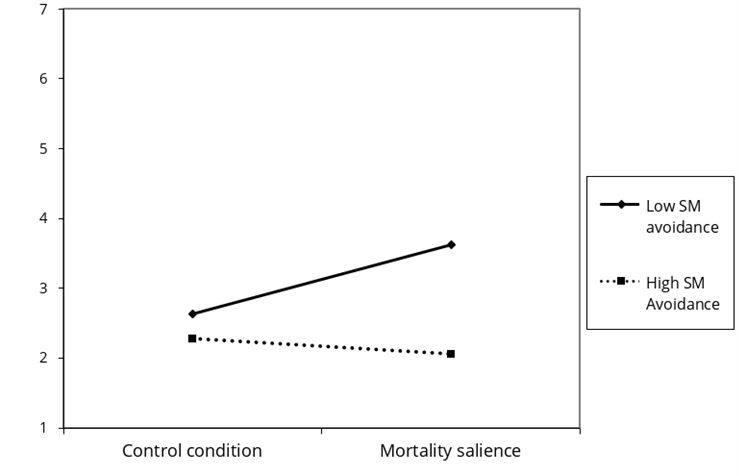
Note. SM: Social Media.
The regression model predicting the sense of closeness with social media (IOS score) was statistically significant and explained 38% of the variance (see Table 4). In Step 1, the main effect of mortality salience was not significant. However, the main effects for the two SMAO scores were significant. Whereas participants scoring higher on the SMAO anxiety scale scored higher on the IOS scale (higher closeness to social media), those scoring higher on attachment avoidance scored lower on the IOS scale (see Table 4). In Step 2, only the interaction between mortality salience and avoidant attachment to social media was significant (see Table 4).
Simple Slope Effect tests examining the source of the significant interaction revealed that mortality salience, compared to a control condition, led to a significant increase in the sense of closeness to social media (higher IOS score) only when the SMAO avoidance score was relatively low (−1 SD), β = .32, p < .001. However, no significant effect of mortality salience was found when the SMAO avoidance score was relatively high (+1 SD), β = −.17, p = .16. As anticipated, attachment avoidance to social media inhibited the heightened sense of closeness to social media (higher IOS score) produced by mortality salience (see Figure 2).
Figure 2. IOS Scores as a Function of Mortality Salience
and SMAO Avoidance.
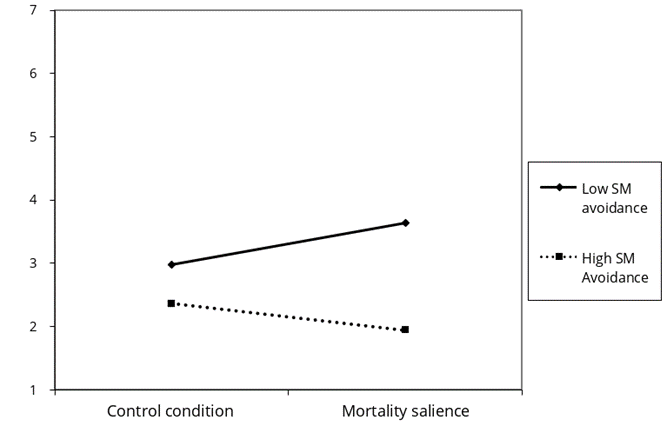
Note. IOS: Closeness to social media; SMAO: Social Media Attachment Orientation; ECR: Experience in Close Relationship; SM: Social Media.
To examine whether the significant main and interactive effects of SMAO scores observed in Table 4 were unique to participants’ attitudes toward social media or a reflection of their attachment orientations in close relationships the above regression analyses were conducted with ECR-12 scores (anxiety, avoidance) as additional predictors. In this way, variations in ECR-12 scores were controlled while examining the effects of SMAO scores on closeness and identification with social media. These regressions revealed that the statistical control for ECR-12 scores did not significantly alter the main and interactive effects of SMAO scores on identification with social media and IOS scores. Even after controlling for ECR-12 scores, SMAO anxiety was significantly associated with more identification with social media (β = .25, p = .006) and higher closeness to it (β = .28,
p = .003). Accordingly, SMAO avoidance was still significantly associated with less identification with social media (β = −.33, p < .001) and lower closeness to it (β = −.42,
p < .001). Finally, the interactions for mortality salience and SMAO avoidance were still significant even after controlling for ECR-12 scores (β = −.26, p < .001, for the identification score; β = −.26, p < .001, for the IOS score).
Discussion of Study 2
Consistent with attachment theory (Bowlby, 1982; Mikulincer & Shaver, 2016), the results suggest that social media can function as a symbolic attachment figure. When attachment needs are activated by distress (e.g., mortality salience), users tend to seek closeness through social media, reflecting the safe-haven and proximity-seeking components of attachment behavior.
Overall, the findings highlighted the targeting of proximity seeking to social media in times of need and the moderating role of attachment avoidance to social media. Specifically, compared to a control condition, exposure to a distress-eliciting situation (mortality salience) heightened feelings of closeness and identification with social media, but this effect was observed only among participants who scored relatively low on attachment avoidance to social media. Although the mortality salience manipulation did not yield significant effects on some measures (e.g., closeness), the interaction patterns indicate that attachment avoidance plays a central role in shaping proximity-seeking responses under threat, consistent with the deactivating strategies that characterize avoidant attachment, whereby proximity-seeking impulses are suppressed even under conditions of heightened threat (Cassidy & Kobak, 1988; Mikulincer & Shaver, 2016).
Attachment anxiety to social media was associated with heightened identification with and closeness to social media but failed to moderate the effects of mortality salience on proximity-seeking tendencies. The non-significant interaction for anxiety may reflect anxious users' already elevated proximity-seeking, which appears to operate as a stable tendency rather than a response to a specific experimental manipulation (Mikulincer & Shaver, 2016). More broadly, the main effects of SMAO scores suggest that attachment orientations toward social media shape not only behavioral engagement, as demonstrated in Study 1, but also the degree of felt closeness and identification with the platform (Mikulincer & Shaver, 2016).
Importantly, these effects were not explained by attachment orientations in close relationships and seemed to reflect the unique attachment-related attitudes and feelings that participants hold toward social media. This finding extends the results of Study 1 by demonstrating that the unique contribution of SMAO scores holds not only for behavioral engagement but also for proximity-seeking responses under threat. The finding that the effects of SMAO scores remained significant even after controlling for ECR scores suggests that users' attachment orientations toward social media cannot be fully explained by their global attachment orientations in close relationships. Rather, attachment-related experiences within the social media environment appear to contribute uniquely to the development of these domain-specific orientations, consistent with conceptualizing social media as a domain-specific attachment-like figure (Mikulincer & Shaver, 2016).
These results extend previous research linking attachment tendencies to online behavior (e.g., Hart et al., 2015; Oldmeadow et al., 2013). They are also consistent with findings showing that avoidant attachment is associated with less reliance on social media for emotional comfort (Stöven & Herzberg, 2021). Taken together with Study 1, the present findings provide experimental evidence that social media can fulfill attachment-related functions, serving as a means of seeking psychological proximity in times of need.
General Discussion
Since Amichai-Hamburger (2002) suggested the relevance of attachment theory for understanding online behavior, many studies have demonstrated this relevance. The current research aimed to deepen the understanding of users' psychological connection and engagement with social media through the lens of attachment theory. It pioneers the exploration of social media as an attachment-like figure, examining whether users form specific attachment orientations toward social media resembling their attachment patterns in close relationships, and how these orientations affect social media use.
In doing so, social media was conceptualized as a group-level rather than a dyadic attachment figure, given that users relate to a collective social environment rather than a single individual (Rom & Mikulincer, 2003). The present findings support this conceptualization by showing that users develop domain-specific attachment orientations toward the collective social environment represented by social media, beyond their global attachment orientations in close relationships. This pattern is consistent with previous findings showing that attachment processes can generalize to social groups while remaining shaped by experiences within that specific relational context (Rom & Mikulincer, 2003; Smith et al., 1999).
To provide an attachment perspective of user-social media relationship, the 18-item SMAO scale was constructed to tap individual differences in attachment orientations (anxiety, avoidance) toward social media, and its factorial structure and temporal stability were tested. In addition, the associations between SMAO scores, attachment orientations in close relationships (ECR scores), and social media engagement and usage were examined. Study 2 was designed to experimentally explore the extent to which social media serves as a target of proximity seeking in times of need, along with the moderating role of users’ SMAO scores.
Study 1’s findings provided considerable support for the hypothesized two-factor structure of the SMAO scale and the temporal stability of participants’ SMAO scores over a one-month period. These findings suggest that users' cognitions, feelings, and behaviors in their relationship with social media are organized around two somewhat orthogonal dimensions: attachment anxiety and avoidance. Those who score relatively high on attachment avoidance tend to distrust the intentions and kindness of members of their social media group, striving to maintain distance and independence from them during online interactions. In contrast, those who score relatively high on attachment anxiety constantly worry that members of their social media group do not value them and anxiously seek their approval and attention.
Findings indicated significant associations between SMAO and ECR scores. More attachment-anxious people in dyadic relationships were more likely to develop attachment anxiety to social media (in the SMAO scale). More attachment-avoidant people in dyadic relationships were more likely to develop avoidant attachment to social media. These findings are consistent with previous findings showing that the dominant attachment orientation in dyadic relationships tends to be generalized to group contexts (e.g., Smith et al., 1999). Prior attachment research supports the generalization of attachment dynamics across relational domains, including group contexts (e.g., Rom & Mikulincer, 2003; Smith et al., 1999). Group-process studies further show that groups can serve as attachment-relevant environments that elicit proximity-seeking tendencies (see Mikulincer & Shaver, 2016, for a review).
However, the associations between SMAO and ECR scores were moderate, indicating that SMAO scores may be shaped by other factors, presumably including experiences in both offline and virtual groups. Reflecting this possibility, Study 1 showed that, although being associated with ECR scores, SMAO scores made a significant contribution to social media engagement and usage beyond the contribution of ECR scores. This finding suggests that attachment orientations toward social media may constitute a distinct relational schema, extending beyond interpersonal attachment (Fraley et al., 2011).
The associations between SMAO scores and social media engagement and usage were consistent with previous attachment studies (e.g., Hart et al., 2015; Oldmeadow et al., 2013). The SMAO anxiety score was associated with higher engagement with social media and higher endorsement of interpersonal goals during social media interactions. In contrast, the SMAO avoidance score was associated with the opposite pattern of social media engagement and usage.
Although Hart et al. (2015) found that attachment avoidance in dyadic relationships did not predict restrained Facebook engagement, our study found that participants scoring high on social media avoidance were less likely to engage social media activities and to endorse interpersonal goals in social interactions. In contrast, attachment-avoidant users were likely to endorse information-seeking goals, what Rubin (2009) called instrumental or entertaining motives (Rubin, 2009). It seems that they prioritize information consumption (Stöven & Herzberg, 2021), reflecting their general reluctance to form strong emotional bonds (McKenna & Bargh, 1999) during online connections.
Study 2’s findings indicated that participants’ tendency to approach social media (feelings of closeness and identification) was higher following an experimentally induced threat (mortality salience) than following a neutral condition. This finding supports the conceptualization of social media as an attachment-like figure that users can search for its proximity in times of need. However, this proximity-seeking effect was observed only among participants scoring low on the SMAO Avoidance scale. Participants scoring high on this scale did not react to mortality salience with heightened feelings of closeness and identification with social media.
These findings align with a core characteristic of avoidant attachment – proximity-seeking inhibition (Mikulincer & Shaver, 2016). Attachment-avoidant individuals tend to cope with threats by deactivating proximity seeking to avoid the pain caused by attachment-figure unavailability. Indeed, Oldmeadow et al. (2013) reported that avoidant attachment in dyadic relationships is associated with less use of Facebook for comfort, and Study 1’s findings indicated that the SMAO avoidance score was associated with lower endorsement of interpersonal goals during social media interactions. Thus, it seems that users scoring high on SMAO avoidance might suppress their quest for proximity to social media during threat to avoid disappointment.
Overall, the findings indicate that attachment theory is a relevant framework for understanding users’ social media relationships and individual differences in how people relate to social media. They also expand the construct of attachment bonds into the social media realm. Moreover, the observed effects of SMAO scores could not be explained by attachment orientations in dyadic relationships (in the ECR) and reflected participants’ unique attachment-related attitudes, feelings, and behaviors toward social media.
Furthermore, specific attachment orientations that users form toward social media are more important than their attachment orientations in dyadic relationships for explaining proximity seeking of social media in times of need. These results support the idea that attachment orientations are hierarchically organized (see Overall et al., 2003, for a review). Hence, the current research demonstrates the unique relevance of the new SMAO scale in exploring user-social media relationship. By clarifying the attachment-based mechanisms that underlie social media engagement, this research extends prior correlational work and offers a coherent theoretical framework for understanding user–platform relationships through the lens of attachment dynamics.
More research is required to understand the attachment functions of social media’s usage. It would be valuable to explore whether social media fulfills the two regulatory functions of attachment figures – provision of comfort and relief and encouragement of exploration and learning. It would be also valuable to explore whether and how SMAO scores moderate users’ ability to benefit from the safe-haven and secure-base functions of social media.
The current research has some limitations. The studies were conducted among young Israeli adults, limiting the findings' generalizability. The relatively small and culturally homogeneous sample and the predominance of female participants further constrain external validity. Further studies should replicate our findings with different age groups, cultures, and countries, including adolescents who are considered “heavy” social media users (Keles et al., 2020). In addition, both the ECR and SMAO scales are self-report questionnaires. However, self-report measures are still commonly used to examine attachment-related dynamics (Mikulincer & Shaver, 2016).
Attachment theory and its measures were originally developed to assess interpersonal rather than digital relationships. Therefore, future research should further validate the SMAO scale across diverse media environments and incorporate qualitative methods (e.g., interviews, focus groups) to complement the current quantitative approach. Furthermore, it would be interesting to examine a different manipulation other than mortality salience (e.g., manipulating of loneliness or FOMO) to explore the connections between users' attachment and social media. Another limitation involves Study 1’s cross-sectional design, which does not allow for testing of causal relationships between SMAO scores and social media engagement and usage. In fact, some of the findings are open to alternative explanations. For example, although there are compelling theoretical reasons to assume that attachment anxiety triggers reassurance seeking during social media interactions, one can alternatively claim that excessive focus on approval and reassurance during these interactions might heighten attachment anxiety to social media. Therefore, future research should apply prospective and experimental designs. Nevertheless, notable methodological strengths of our research is Study 2's experimental design and inclusion of appropriate covariates, which allowed us to disentangle causal relations and address the specificity of the observed effects. In this context, it would be interesting to use other manipulations of threats rather than mortality salience (e.g., academic failure, ostracism) to explore the extent that users seek proximity to social media in times of need.
Given the prominent role of social media on social behavior, this research contributes to the literature by introducing the SMAO scale as a reliable domain-specific tool for assessing attachment orientations toward social media, providing the first experimental evidence that social media serves a proximity-seeking function under threat, and demonstrating that domain-specific orientations predict engagement beyond global attachment. These findings may carry practical implications: anxious users' heightened engagement with social media may reflect a vulnerability to dysregulated use, while avoidant users' tendency to disengage under distress may leave them without a potential source of support precisely when it is most needed. Specifically, digital well-being programs may benefit from incorporating attachment-based screening tools such as the SMAO to identify users at risk for dysregulated engagement. Clinicians working with clients presenting social media-related distress may find it useful to assess platform-specific attachment orientations alongside global ones, given their incremental predictive validity. Interventions targeting avoidant users should account for their tendency to withdraw from social support under distress, potentially encouraging help-seeking through alternative channels. The SMAO may therefore serve as a useful tool for identifying such patterns in research and applied contexts. More broadly, as social media becomes increasingly central to how people seek comfort and connection, understanding the attachment-based mechanisms that shape these tendencies becomes an important direction for both research and practice.
Conflict of Interest
The authors have no conflicts of interest to declare.
Use of AI Services
No generative AI tools were used in the production of this manuscript.
Data Availability Statement
The data supporting the findings of this study are available from the corresponding author upon reasonable request.
Appendices
Appendix A
Social Media Attachment Orientation (SMAO) Scale
Please respond to the following items based on how you feel toward your preferred social media platform (Facebook, Instagram, YouTube, Tik Tok, Snapchat, Twitter, LinkedIn). Please rate the extent to which each item is descriptive of your feelings, using the following scale:
|
Not at all |
|
|
|
|
|
Very Much |
|
1 |
2 |
3 |
4 |
5 |
6 |
7 |
Table A1. Items of the Social Media Attachment Orientation (SMAO) Scale.
|
1 |
I become frustrated when my friends don’t respond to me on social media when I need them. |
1 |
2 |
3 |
4 |
5 |
6 |
7 |
|
|
2 |
I prefer not to be overly exposed to my friends on social media. |
1 |
2 |
3 |
4 |
5 |
6 |
7 |
|
|
3 |
Sometimes I feel that I require my friends on social media to show more commitment and affection towards me. |
1 |
2 |
3 |
4 |
5 |
6 |
7 |
|
|
4 |
I prefer to keep distance from my friends on social media. |
1 |
2 |
3 |
4 |
5 |
6 |
7 |
|
|
5 |
If I fail to get others to show interest in me on social media, I become angry or frustrated. |
1 |
2 |
3 |
4 |
5 |
6 |
7 |
|
|
6 |
Many times, social media is a nuisance to me. |
1 |
2 |
3 |
4 |
5 |
6 |
7 |
|
|
7 |
I need a lot of likes, comments, and tags on the social media to feel self-worthy. |
1 |
2 |
3 |
4 |
5 |
6 |
7 |
|
|
8 |
I prefer not to share too much personal content on social media. |
1 |
2 |
3 |
4 |
5 |
6 |
7 |
|
|
9 |
I become frustrated if I feel like I’m not getting as much attention as I would like on social media. |
1 |
2 |
3 |
4 |
5 |
6 |
7 |
|
|
10 |
If necessary, I can close my account on social media without special difficulties. |
1 |
2 |
3 |
4 |
5 |
6 |
7 |
|
|
11 |
I become tense when people from social media feel too close to me. |
1 |
2 |
3 |
4 |
5 |
6 |
7 |
|
|
12 |
I need a lot of supporting comments, likes, and tags on social media to feel accepted. |
1 |
2 |
3 |
4 |
5 |
6 |
7 |
|
|
13 |
Without affectionate responses on social media, I feel worthless. |
1 |
2 |
3 |
4 |
5 |
6 |
7 |
|
|
14 |
I prefer not to share about my feelings on social media. |
1 |
2 |
3 |
4 |
5 |
6 |
7 |
|
|
15 |
I need a lot of approval on social media to feel liked. |
1 |
2 |
3 |
4 |
5 |
6 |
7 |
|
|
16 |
I feel uncomfortable when people send me friend requests on social media. |
1 |
2 |
3 |
4 |
5 |
6 |
7 |
|
|
17 |
I worry that I will not have followers/friends on social media. |
1 |
2 |
3 |
4 |
5 |
6 |
7 |
|
|
18 |
I find it hard to send a friend request to other people on social media. |
1 |
2 |
3 |
4 |
5 |
6 |
7 |
|
|
Note. (1) The Social Media Avoidant Attachment score is computed by averaging the 9 (2,4,6,8,10,11,14,16,18) items. Higher scores reflect greater avoidance. (2) The Social Media Attachment Anxiety score is computed by averaging the 9 (1,3,5,7,9,12,13,15,17) items. Higher scores reflect greater anxiety. |
|
||||||||
Appendix B
The Social and Informational Usage Questionnaire
The following are statements describing your use and reference to the four social network sites: Facebook, WhatsApp, Instagram and Twitter. Please select your agreement with the following statements for each network, where 1 indicates complete disagreement, and 5 indicates strongest agreement.
Table B1. Items Assessing Social and Informational Social Media Use.
|
1. I use social media to find and spread information. |
1 |
2 |
3 |
4 |
5 |
|
2. Social media is primarily for information. |
1 |
2 |
3 |
4 |
5 |
|
3. I use social media to keep abreast of current events. |
1 |
2 |
3 |
4 |
5 |
|
4. I use the internet to keep in touch with friends. |
1 |
2 |
3 |
4 |
5 |
|
5. I use social media because my friends do. |
1 |
2 |
3 |
4 |
5 |
|
6. Social media is primarily for socializing. |
1 |
2 |
3 |
4 |
5 |
|
7. I seek to follow people and topics of interest on social media. |
1 |
2 |
3 |
4 |
5 |
|
8. I seek to increase my number of followers/friends on social media. |
1 |
2 |
3 |
4 |
5 |
|
9. I try to initiate new friendships on social media. |
1 |
2 |
3 |
4 |
5 |
|
10. I use social media to receive and consume information. |
1 |
2 |
3 |
4 |
5 |
|
Note. Based on Gazit et al.’s (2019). |
|||||


This work is licensed under a Creative Commons Attribution-ShareAlike 4.0 International License.
Copyright © 2026 Or Zaplavi, Yair Amichai-Hamburger, Mario Mikulincer