
Safer sexting: Who cares and how?
Vol.20,No.4(2026)
Marina F. Thomas
 Alice Binder
Jörg Matthes
Alice Binder
Jörg Matthes
Sexting denotes technology-mediated sexual interactions from text messages to video calls. Involving sensitive data, safer sexting necessitates privacy management. Yet, digital privacy protection in intimate relationships remains understudied. We developed a four-factorial model of privacy strategies, the Sexting Privacy Management Inventory (SPMI). The SPMI distinguishes four kinds of privacy strategies along two dimensions: behaviors individuals employ alone or in interaction with their sexting partner (personal vs. interpersonal), and behaviors before or after sexting (preventive vs. reactive). As predictors of sexting privacy protection, we tested privacy concerns, romantic rejection sensitivity, sexting frequency, and sexting frequency in interaction with loneliness. Results of an online survey in a quota-based sample of 557 sexters (49.9% male) between 16 and 40 years (M = 28.97, SD = 6.67) confirmed the four-factor structure of the SPMI and showed differential effects for the four strategies. Privacy concerns against the sexting partner (social privacy concerns) predicted all privacy strategies, while concerns about how apps handle data (institutional privacy concerns) were unrelated to privacy protection. Individuals with higher romantic rejection sensitivity did not report less privacy management. More frequent sexting was related to more employment of privacy protection behaviors if individuals asynchronously sent storable files (e.g., pictures or videos). Effects of sexting frequency on privacy strategies were independent of loneliness. Thus, safer sexting was reported by those who were concerned about their sexting partner(s) and by frequent sexters (asynchronous). Overall, our four-dimensional model could be applied to other domains of privacy management.
data privacy; image-based sexual abuse; information security; safe sexting; sexual privacy; technology-mediated sexual interactions; technology-facilitated violence
Marina F. Thomas
Research Centre Transitional Psychiatry, Karl Landsteiner University of Health Sciences, Krems, Austria
Marina F. Thomas (PhD, University of Vienna) is a postdoctoral researcher at the research centre Transitional Psychiatry at Karl Landsteiner University. Her work combines communication science with clinical and social pychology to understand how digital environments are associated with well-being, mental health, and mental disorders.
Alice Binder
Department of Communication, University of Vienna, Vienna, Austria
Alice Binder (PhD, University of Vienna) is a senior scientist in the Department of Communication at the University of Vienna. Her research focuses on strategic communication and media effects in digital environments. She is particularly interested in influencer communication, AI-driven communication, algorithmic persuasion, and trust in digital communication.
Jörg Matthes
Department of Communication, University of Vienna, Vienna, Austria
Jörg Matthes (PhD, University of Zurich) is a professor of communication science at the University of Vienna, Austria. His research focuses on digital media effects, advertising and consumer research, sustainability communication, children & media, terrorism and populism as well as empirical methods.
Alashoor, T., Al-Maidani, N., & Al-Jabri, I. (2018). The privacy calculus under positive and negative mood states. In Proceedings of the 39th International Conference on Information Systems. Association for Information Systems. https://aisel.aisnet.org/icis2018/security/Presentations/6
Amundsen, R. (2022). Hetero-sexting as mediated intimacy work: ‘Putting something on the line.’ New Media & Society, 24(1), 122–137. https://doi.org/10.1177/1461444820962452
Barrense-Dias, Y., Berchtold, A., Surís, J. C., & Akre, C. (2017). Sexting and the definition issue. Journal of Adolescent Health, 61(5), 544–554. https://doi.org/10.1016/j.jadohealth.2017.05.009
Barroso, R., Marinho, A. R., Figueiredo, P., Ramião, E., & Silva, A. S. (2023). Consensual and non-consensual sexting behaviors in adolescence: A systematic review. Adolescent Research Review, 8(1), 1–20. https://doi.org/10.1007/s40894-022-00199-0
Barth, S., & de Jong, M. D. T. (2017). The privacy paradox – Investigating discrepancies between expressed privacy concerns and actual online behavior – A systematic literature review. Telematics and Informormatics, 34(7), 1038–1058. https://doi.org/10.1016/j.tele.2017.04.013
Baruh, L., Secinti, E., & Cemalcilar, Z. (2017). Online privacy concerns and privacy management: A meta-analytical review. Journal of Communication, 67(1), 26–53. https://doi.org/10.1111/jcom.12276
Berenson, K., Paprocki, C., Thomas Fishman, M., Bhushan, D., El-Bassel, N., & Downey, G. (2015). Rejection sensitivity, perceived power, and HIV risk in the relationships of low-income urban women. Women & Health, 55(8), 900–920. https://doi.org/10.1080/03630242.2015.1061091
Berridge, C., & Wetle, T. F. (2020). Why older adults and their children disagree about in-home surveillance technology, sensors, and tracking. The Gerontologist, 60(5), 926–934. https://doi.org/10.1093/geront/gnz068
Bhogal, M. S., & Howman, J. M. (2018). Mate value discrepancy and attachment anxiety predict the perpetration of digital dating abuse. Evolutionary Psychological Science, 5(1), 113–120. https://doi.org/10.1007/s40806-018-0172-6
boyd, d. (2014). It’s complicated. The social lives of networked teens. Yale University Press. https://doi.org/10.12987/9780300166439
Brenick, A., Flannery, K. M., Karr, E., & Carvalheiro, D. (2020). Send nudes?: Sexting experiences and victimization relating to attachment and rejection sensitivity – incorporating sexual minority perspectives. In M. Wright (Ed.), Recent advances in digital media impacts on identity, sexuality, and relationships (pp. 119-143). IGI Global Scientific Publishing. https://doi.org/10.4018/978-1-7998-1063-6.ch007
Chen, H., Beaudoin, C. E., & Hong, T. (2017). Securing online privacy: An empirical test on Internet scam victimization, online privacy concerns, and privacy protection behaviors. Computers in Human Behavior, 70, 291–302. https://doi.org/10.1016/j.chb.2017.01.003
Chen, H., & Chen, W. (2015). Couldn't or wouldn't? The influence of privacy concerns and self-efficacy in privacy management on privacy protection. Cyberpsychology, Behavior, and Social Networking, 18(1), 13–19. https://doi.org/10.1089/cyber.2014.0456
Chen, H., & Kim, Y. (2013). Problematic use of social network sites: The interactive relationship between gratifications sought and privacy concerns. Cyberpsychology, Behavior, and Social Networking, 16(11), 806–812. https://doi.org/10.1089/cyber.2011.0608
Choi, T. R., & Choi, J. H. (2023). You are not alone: A serial mediation of social attraction, privacy concerns, and satisfaction in voice AI use. Behavioral Sciences, 13(5), Article 431. https://doi.org/10.3390/bs13050431
Delevi, R., & Weisskirch, R. (2013). Personality factors as predictors of sexting. Computers in Human Behaviors, 29(6), 2589–2594. https://doi.org/10.1016/j.chb.2013.06.003
Derlega, V. J., & Berg, J. H. (2013). Self-disclosure: Theory, research, and therapy. Springer. https://doi.org/10.1007/978-1-4899-3523-6
De Wolf, R. (2019). Contextualizing how teens manage personal and interpersonal privacy on social media. New Media & Society, 22(6), 1058–1075. https://doi.org/10.1177/1461444819876570
De Wolf, R., Martens, M., Vanden Abeele, M., & De Marez, L. (2023). Predicting teens’ privacy management and attitude toward data protection on social media. Cyberpsychology, Behavior, and Social Networking, 26(3), 153–160. https://doi.org/10.1089/cyber.2021.0338
Dhir, A., Torsheim, T., Pallesen, S., & Andreassen, C. S. (2017). Do online privacy concerns predict selfie behavior among adolescents, young adults and adults? Frontiers in Psychology, 8, Article 815. https://doi.org/10.3389/fpsyg.2017.00815
Dinev, T., McConnell, A. R., & Smith, H. J. (2015). Research commentary – Informing privacy research through information systems, psychology, and behavioral economics: Thinking outside the "APCO" box. Information Systems Research, 26(4), 639–655. https://doi.org/10.1287/isre.2015.0600
Dir, A. L., Coskunpinar, A., Steiner, J. L., & Cyders, M. A. (2013). Understanding differences in sexting behaviors across gender, relationship status, and sexual identity, and the role of expectancies in sexting. Cyberpsychology, Behavior, and Social Networking, 16(8), 568–574. https://doi.org/10.1089/cyber.2012.0545
Döring, N. (2014). Consensual sexting among adolescents: Risk prevention through abstinence education or safer sexting? Cyberpsychology: Journal of Psychosocial Research on Cyberspace, 8(1), Article 9. https://doi.org/10.5817/CP2014-1-9
Döring. N., & Bortz J. (1993). Psychometrische einsamkeitsforschung: Deutsche neukonstruktion der UCLA loneliness scale. [Psychometric research on loneliness: A new German version of the University of California at Los Angeles (UCLA) Loneliness Scale]. Diagnostica 39(3), 224–239.
Downey, G., & Feldman, S. (1996). Implications of rejection sensitivity for intimate relationships. Journal of Personality and Social Psychology, 70(6), 1327–1343. https://doi.org/10.1037//0022-3514.70.6.1327
Drouin, M., & Tobin, E. (2014). Unwanted but consensual sexting among young adults: Relations with attachment and sexual motivations. Computers in Human Behavior, 31, 412–418. https://doi.org/10.1016/j.chb.2013.11.001
Drouin, M., Vogel, K. N., Surbey, A., & Stills, J. R. (2013). Let’s talk about sexting, baby: Computer-mediated sexual behaviors among young adults. Computers in Human Behavior, 29(5), A25–A30. https://doi.org/10.1016/j.chb.2012.12.030
Edwards, G. L., & Barber, B. L. (2010). The relationship between rejection sensitivity and compliant condom use. Archives of Sexual Behavior, 39(6), 1381–1388. https://doi.org/10.1007/s10508-009-9520-8
Erikson, E. H. (1968). Youth and crisis. W. W. Norton & Company.
Eronen, S. & Nurmi, J.-E. (2001). Sociometric status of young adults: Behavioural correlates, and cognitive-motivational antecedents and consequences. International Journal of Behavioral Development, 25(3), 203–213. https://doi.org/10.1080/01650250042000212
Feldman, S., & Downey, G. (1994). Rejection sensitivity as a mediator of the impact of childhood exposure to family violence on adult attachment behavior. Development and Psychopathology, 6(1), 231–247. https://doi.org/10.1017/S0954579400005976
Finkelhor, D., Sutton, S., Turner, H., & Colburn, D. (2024). How risky is online sexting by minors? Journal of Child Sexual Abuse, 33(2), 169–182. https://doi.org/10.1080/10538712.2024.2324838
Galovan, A. M., Drouin, M., & McDaniel, B. T. (2018). Sexting profiles in the United States and Canada: Implications for individual and relationship well-being. Computers in Human Behavior, 79, 19–29. https://doi.org/10.1016/j.chb.2017.10.017
Gao, S., Assink, M., Liu, T., Chan, K. L., & Ip, P. (2021). Associations between rejection sensitivity, aggression, and victimization: A meta-analytic review. Trauma, Violence, & Abuse, 22(1), 125–135. https://doi.org/10.1177/1524838019833005
Gebhardt, W. A., Kuyper, L., & Greunsven, G. (2003). Need for intimacy in relationships and motives for sex as determinants of adolescent condom use. Journal of Adolescent Health, 33(3), 154–164. https://doi.org/10.1016/S1054-139X(03)00137-X
Geeng, C., Hutson, J., & Roesner, F. (2020). Usable sexurity: Studying people’s concerns and strategies when sexting. In H. R. Lipford (Ed.), Proceedings of the Sixteenth Symposium on Usable Privacy and Security, Virtual Conference (pp. 127–144). https://www.usenix.org/conference/soups2020/presentation/geeng
Gerber, N., Gerber, P., & Volkamer, M. (2018). Explaining the privacy paradox: A systematic review of literature investigating privacy attitude and behavior. Computers & Security, 77, 226–261. https://doi.org/10.1016/j.cose.2018.04.002
Gruzd, A., & Hernández-García, Á. (2018). Privacy concerns and self-disclosure in private and public uses of social media. Cyberpsychology, Behavior, and Social Networking, 21(7), 418–428. https://doi.org/10.1089/cyber.2017.0709
Hafen, C., Spilker, A., Chango, J., Marston, E., & Allen, J. (2014). To accept or reject? The impact of adolescent rejection sensitivity on early adult romantic relationships. Journal of Research on Adolescence, 24(1), 55–64. https://doi.org/10.1111/jora.12081
Hasinoff, A. (2015). Sexting panic: Rethinking criminalization, privacy, and consent. University of Illinois Press. https://doi.org/10.5406/illinois/9780252038983.001.0001
Hasinoff, A., & Shepherd, T. (2014). Sexting in context: Privacy norms and expectations. International Journal of Communication, 8, 2932–2945. https://ijoc.org/index.php/ijoc/article/view/2264
Holmes, E. J., & Babchishin, K. M. (2024). Safe sexting, sexual orientation, and gender: Risky sexting in a community sample. Archives of Sexual Behavior, 54(8), 2921–2931. https://doi.org/10.1007/s10508-024-03050-w
Jiang, Z., Heng, C. S., & Choi, B. C. F. (2013). Privacy concerns and privacy-protective behavior in synchronous online social interactions. Information Systems Research, 24(3), 579–595. https://doi.org/10.1287/isre.1120.0441
Jiménez-Picón, N., Romero-Martín, M., Romero-Castillo, R., Palomo-Lara, J. C., & Alonso-Ruíz, M. (2023). Internalization of the romantic love myths as a risk factor for gender violence: A systematic review and meta-analysis. Sexuality Research and Social Policy, 20(3), 837–854. https://doi.org/10.1007/s13178-022-00747-2
Kahlow, J. (2020). The influence of technology on privacy boundary management in young adults' sexting relationships: A communication privacy management perspective. In R. Kalish (Ed.), Young adult sexuality in the digital age (pp. 73–93). Information Science Reference/IGI Global. https://doi.org/10.4018/978-1-7998-3187-7.ch005
Kehr, F., Kowatsch, T., Wentzel, D., & Fleisch, E. (2015). Blissfully ignorant: The effects of general privacy concerns, general institutional trust, and affect in the privacy calculus. Information Systems Journal, 25(6), 607–635. https://doi.org/10.1111/isj.12062
Kim, H. M., & Miller, L. C. (2020). Are insecure attachment styles related to risky sexual behavior? A meta-analysis. Health Psychology, 39(1), 46–57. https://doi.org/10.1037/hea0000821
Kirana, D. C., & Hendriyani, H. (2023). Privacy management of sexting in young adult's dating relationships. Jurnal Komunikasi Indonesia, 12(2), Article 7. https://doi.org/10.7454/jkmi.v12i2.1209
Klettke, B., Hallford, D. J., Clancy, E., Mellor, D. J., & Toumbourou, J. W. (2019). Sexting and psychological distress: The role of unwanted and coerced sexts. Cyberpsychology, Behavior, and Social Networking, 22(4), 237–242. https://doi.org/10.1089/cyber.2018.0291
Klettke, B., Hallford, D. J., & Mellor, D. J. (2014). Sexting prevalence and correlates: A systematic literature review. Clinical Psychology Review, 34(1), 44–53. https://doi.org/10.1016/j.cpr.2013.10.007
Klettke, B., Mellor, D., Silva-Myles, L., Clancy, E., & Sharma, M. K. (2018). Sexting and mental health: A study of Indian and Australian young adults. Cyberpsychology: Journal of Psychosocial Research on Cyberspace, 12(2), Article 2. https://doi.org/10.5817/CP2018-2-2
Lebedíková, M., Olveira-Araujo, R., Mýlek, V., Smahel, D., & Dedkova, L. (2024). The reciprocal relationship between consensual sexting and peer support among adolescents: A three-wave longitudinal study. Computers in Human Behavior, 152, Article 108048. https://doi.org/10.1016/j.chb.2023.108048
Levy, K., & Schneier, B. (2020). Privacy threats in intimate relationships. Journal of Cybersecurity, 6(1), 1–13. https://doi.org/10.1093/cybsec/tyaa006
Luo, M., & Hancock, J. T. (2020). Self-disclosure and social media: Motivations, mechanisms and psychological well-being. Current Opinion in Psychology, 31, 110–115. https://doi.org/10.1016/j.copsyc.2019.08.019
Lutz, C., & Ranzini, G. (2017). Where dating meets data: Investigating social and institutional privacy concerns on Tinder. Social Media + Society, 3, 1–12. https://doi.org/10.1177/2056305117697735
Mamonov, S., & Benbunan-Fich, R. (2018). The impact of information security threat awareness on privacy-protective behaviors. Computers in Human Behavior, 83, 32–44. https://doi.org/10.1016/j.chb.2018.01.028
McDaniel, B. T., & Drouin, M. (2015). Sexting among married couples: Who is doing it, and are they more satisfied? Cyberpsychology, Behavior, and Social Networking, 18(11), 628–634. https://doi.org/10.1089/cyber.2015.0334
Mikulincer, M., & Florian, V. (2000). Exploring individual differences in reactions to mortality salience: Does attachment style regulate terror management mechanisms? Journal of Personality and Social Psychology, 79(2), 260–273. https://doi.org/10.1037/0022-3514.79.2.260
Mishra, M., & Allen, M. S. (2023). Rejection sensitivity and romantic relationships: A systematic review and meta-analysis. Personality and Individual Differences, 208, Article 112186. https://doi.org/10.1016/j.paid.2023.112186
Mori, C., Cooke, J. E., Temple, J. R., Ly, A., Lu, Y., Anderson, N., Rash, C., & Madigan, S. (2020). The prevalence of sexting behaviors among emerging adults: A meta-analysis. Archives of Sexual Behavior, 49(4), 1103–1119. https://doi.org/10.1007/s10508-020-01656-4
Mori, C., Park, J., Temple, J. R., & Madigan, S. (2022). Are youth sexting rates still on the rise? A meta-analytic update. Journal of Adolescent Health, 70(4), 531–539. https://doi.org/10.1016/j.jadohealth.2021.10.026
Möller, J. E. (2024). Situational privacy: theorizing privacy as communication and media practice. Communication Theory, 34(3), 130–142. https://doi.org/10.1093/ct/qtae011
Murray, L., Moreno, L., Rosario, S., Ellen, J., Sweat, M., & Kerrigan, D. (2007). The role of relationship intimacy in consistent condom use among female sex workers and their regular paying partners in the Dominican Republic. AIDS and Behavior, 11(3), 463–470. https://doi.org/10.1007/s10461-006-9184-5
Nigrini, M. J. (2025). Insider threats: Gaining an appreciation of the risks of endpoint access by departing employees. Journal of Emerging Technologies in Accounting, 22(2), 109–124. https://doi.org/10.2308/JETA-2022-059
Noetzel, S., Stubenvoll, M., Binder, A., & Matthes, J. (2025). Four shades of avoidance: Conceptualising and predicting reactive and preventive dimensions of online political microtargeting avoidance. Behaviour & Information Technology, 45(1), 157–179. https://doi.org/10.1080/0144929X.2025.2512415
Norberg, P., Horne, D. R., & Horne, D. A. (2007). The privacy paradox: Personal information disclosure intentions versus behaviors. Journal of Consumer Affairs, 41(1), 100–126. https://doi.org/10.1111/j.1745-6606.2006.00070.x
Ojeda, M., & Del Rey, R. (2022). Lines of action for sexting prevention and intervention: A systematic review. Archives of Sexual Behavior, 51(3), 1659–1687. https://doi.org/10.1007/s10508-021-02089-3
Paradiso, M. N., Rollè, L., & Trombetta, T. (2024). Image-based sexual abuse associated factors: A systematic review. Journal of Family Violence, 39(5), 931–954. https://doi.org/10.1007/s10896-023-00557-z
Park, H. S., Dailey, R., & Lemus, D. (2002). The use of exploratory factor analysis and principal components analysis in communication research. Human Communication Research, 28(4), 562–577. https://doi.org/10.1111/j.1468-2958.2002.tb00824.x
Petronio, S. (2002). Boundaries of privacy. State University of New York Press.
Petronio, S. (2015). Communication privacy management theory. In C. R. Berger, M. E. Roloff, S. R. Wilson, J. P. Dillard, J. Caughlin, & D. Solomon (Eds.), The international encyclopedia of interpersonal communication (pp. 1–9). John Wiley & Sons. https://doi.org/10.1002/9781118540190.wbeic132
R Core Team (2022). R: A language and environment for statistical computing (Version 2022.07.2) [Computer software]. R Foundation for Statistical Computing. https://www.R-project.org/
Reed, L., Tolman, R., Ward, M., & Safyer, P. (2016). Keeping tabs: Attachment anxiety and electronic intrusion in high school dating relationships. Computers in Human Behavior, 58, 259–268. https://doi.org/10.1016/j.chb.2015.12.019
Renfrow, D., & Rollo, E. A. (2014). Sexting on campus: Minimizing perceived risks and neutralizing behaviors. Deviant Behavior, 35(11), 903–920. https://doi.org/10.1080/01639625.2014.897122
Ringrose, J., Harvey, L., Gill, R., & Livingstone, S. (2013). Teen girls, sexual double standards and ‚sexting‘: Gendered value in digital image exchange. Feminist Theory, 14(3), 305–323. https://doi.org/10.1177/1464700113499853
Romero-Canyas, R., & Downey, G. (2013). What I see when I think it's about me: People low in rejection-sensitivity downplay cues of rejection in self-relevant interpersonal situations. Emotion, 13(1), 104–117. https://doi.org/10.1037/a0029786
Rothmüller, B. (2025). Safer sexting strategies in technology-mediated sexual interactions: Findings from a national study. Sexuality Research and Social Policy, 22(2), 948–963. https://doi.org/10.1007/s13178-024-01015-1
Russell, D., Peplau, L. A., & Cutrona, C. E. (1980). The revised UCLA Loneliness Scale: Concurrent and discriminant validity evidence. Journal of Personality and Social Psychology, 39(3), 472–480. https://doi.org/10.1037/0022-3514.39.3.472
Samper, J., & Ferreira, B. (2025). SoK – Self-generated nudes over private chats: How can technology contribute to a safer sexting? In M. Blanton, W. Enck, & C. Nita-Rotaru (Eds.), 2025 IEEE Symposium on Security and Privacy (SP) (pp. 4495–4514). IEEE. https://doi.org/10.1109/SP61157.2025.00234
Schreurs, L., Sumter, S. R., & Vandenbosch, L. (2020). A prototype willingness approach to the relation between geo-social dating apps and willingness to sext with dating app matches. Archives of Sexual Behavior, 49(4), 1133–1145. https://doi.org/10.1007/s10508-020-01671-5
Setty, E., & Dobson, E. (2024). Young love “locked down”: Adolescent and young adult perspectives on sexting during the COVID-19 pandemic in England. Archives of Sexual Behavior, 53(2), 481–495. https://doi.org/10.1007/s10508-023-02734-z
Skakoon-Sparling, S., & Cramer, K. M. (2020). Are we blinded by desire? Relationship motivation and sexual risk-taking intentions during condom negotiation. The Journal of Sex Research, 57(5), 545–558. https://doi.org/10.1080/00224499.2019.1579888
Stutzman, F., Capra, R., & Thompson, J. (2011). Factors mediating disclosure in social network sites. Computers in Human Behavior, 27(1), 590–598. https://doi.org/10.1016/j.chb.2010.10.017
Thomas, M. F., Binder, A., & Matthes, J. (2022). Love in the time of Corona: Predicting willingness to engage in sexting during the first COVID-19-related lockdown. Archives of Sexual Behavior, 51(1), 157–168. https://doi.org/10.1007/s10508-022-02292-w
Van Ouytsel, J., Van Gool, E., Walrave, M., Ponnet, K., & Peeters, E. (2017). Sexting: Adolescents’ perceptions of the applications used for, motives for, and consequences of sexting. Journal of Youth Studies, 20(4), 446–470. https://doi.org/10.1080/13676261.2016.1241865
Vanhalst, J., Soenens, B., Luyckx, K., Van Petegem, S., Weeks, M. S., & Asher, S. R. (2015). Why do the lonely stay lonely? Chronically lonely adolescents’ attributions and emotions in situations of social inclusion and exclusion. Journal of Personality and Social Psychology, 109(5), 932–948. https://doi.org/10.1037/pspp0000051
Walrave, M., Van Ouytsel, J., Ponnet, K., & Temple, J. R. (2018). Sharing and caring? The role of social media and privacy in sexting behaviour. In M. Walrave, J. Van Ouytsel, K. Ponnet, & J. R. Temple (Eds.), Sexting: Motives and risk in online sexual self-presentation (pp. 1–17). Palgrave Macmillan. https://doi.org/10.1007/978-3-319-71882-8_1
Wang, K., & Pachankis, J. E. (2016). Gay-related rejection sensitivity as a risk factor for condomless sex. AIDS and Behavior, 20(4), 763–767. https://doi.org/10.1007/s10461-015-1224-6
Weisskirch, R., Drouin, M., & Delevi, R. (2017). Relational anxiety and sexting. Journal of Sex Research, 54(6), 685–693. https://doi.org/10.1080/00224499.2016.1181147
Wiederhold, B. K. (2011). Should adult sexting be considered for the DSM? Cyberpsychology, Behavior, and Social Networking, 14(9), 48–481. https://doi.org/10.1089/cyber.2011.1522
Woerner, J., Kopetz, C., Lechner, W., & Lejuez, C. (2016). History of abuse and risky sex among substance users: The role of rejection sensitivity and the need to belong. Addictive Behaviors, 62, 73–78. https://doi.org/10.1016/j.addbeh.2016.06.006
Woodley, G. N., Green, L., & Jacques, C. (2024). ‘Send Nudes?’: Teens’ perspectives of education around sexting, an argument for a balanced approach. Sexualities, 28(5–6), 1891–1909. https://doi.org/10.1177/13634607241237675
Wysocki, D. K., & Childers, C. D. (2011). “Let my fingers do the talking”: Sexting and infidelity in cyberspace. Sexuality & Culture, 15(3), 217–239. https://doi.org/10.1007/s12119-011-9091-4
Youn, S., & Hall, K. (2008). Gender and online privacy among teens: Risk perception, privacy concerns, and protection behaviors. Cyberpsychology, Behavior, and Social Networking, 11(6), 763–765. https://doi.org/10.1089/cpb.2007.0240
Zeileis, A., & Hothorn, T. (2002). Diagnostic checking in regression relationships. R News 2(3), 7–10. https://CRAN.R-project.org/doc/Rnews/
Zeileis, A., Köll, S., & Graham, N. (2020). Various versatile variances: An object-oriented implementation of clustered covariances in R. Journal of Statistical Software, 95(1), 1–36. https://doi.org/10.18637/jss.v095.i01
Zemmels, D. R., & Khey, D. N. (2015). Sharing of digital visual media: Privacy concerns and trust among young people. American Journal of Criminal Justice, 40(2), 285–302. https://doi.org/10.1007/s12103-014-9245-7
Authors’ Contribution
Marina F. Thomas: conceptualization, investigation, methodology, formal analysis, visualization, writing—original draft. Alice Binder: conceptualization, investigation, methodology, writing—review & editing. Jörg Matthes: conceptualization, methodology, supervision.
Editorial Record
First submission received:
August 4, 2023
Revisions received:
December 30, 2024
September 4, 2025
April 22, 2026
Accepted for publication:
July 1, 2026
Editor in charge:
Lenka Dedkova
Introduction
Sexting denotes the digital exchange of personal sexualized text messages, photos, or videos (Mori et al., 2020). Just like in-person sex requires safer sex behaviors (e.g., protection from diseases or unwanted pregnancies), sexting requires safer sexting practices. Notably, exchanging sensitive data necessitates data privacy management. For example, recipients could intentionally or inadvertently disseminate one’s intimate data to unintended audiences (Mori et al., 2020). In addition, “interactions [in online networks] are often public by default, private through effort” (boyd, 2014, p. 14). While people tend to attribute threat to strangers, privacy management is also relevant when it comes to sexting with close others: The dissemination of sexts by resentful ex-partners is particularly concerning (Setty & Dobson, 2024). Thus, managing privacy when sexting is an important topic, and researchers have recommended education about safe and ethical practices (Mori et al., 2022; Ojeda & Del Rey, 2022). Yet, educators still teach abstinence, and researchers investigate prevalence, instead of teaching and researching safer sexting practices (Döring, 2014; Woodley et al., 2024). In line with that, “the systematic study of privacy management strategies for sexual materials remains to be carried out” (De Wolf, 2019, p. 1061). Holmes and Babchishin (2024) asserted that “research has yet to examine the correlates of risky sexting, beyond demographic variables” (p. 2).
We address the gap in safer sexting practices by developing a four-dimensional model of sexting privacy management and the corresponding Sexting Privacy Management Inventory (SPMI). We distinguish between four strategies of sexting-related privacy management: between behaviors individuals employ on their own or in interaction with their sexting partner (personal vs. interpersonal) and between behaviors before or after sexting (preventive vs. reactive). The main aims of the study were: (1) testing the new model and scale for sexting privacy management, and (2) examining what predicts sexting privacy management.
As correlates, we tested privacy concerns (i.e., concerns about how apps handle data and concerns about the sexting partner), romantic rejection sensitivity, and sexting frequency (i.e., asynchronous sending of storable files and synchronous audio or video calls), in interaction with loneliness. Roughly, we hypothesized that greater privacy concerns would be associated with more privacy management and that romantic rejection sensitivity would be associated with less privacy management. Furthermore, since those experienced in sexting may be more aware of privacy risks (Finkelhor et al., 2024; Zemmels & Khey, 2015), we expected higher sexting frequency to be associated with greater privacy management. Moreover, we investigated whether loneliness moderated these associations, as we assumed that in individuals with high loneliness, the need for intimacy may be more salient (Mikulincer & Florian, 2000) than the need for privacy protection. We conducted a preregistered online survey of young adult sexters in Germany to test these predictions.
In the present study, we focused on the volitional sending of self-produced sexualized messages. In contrast to other researchers’ definitions (e.g., Mori et al., 2022), we did not include the reception of another’s sext or the dissemination of third-party sexting material because definitions of sexting should not include nonconsensual practices (Lebedíková et al., 2024). Receiving sexualized messages can be unsolicited, and third-party forwarding is often nonconsensual. Just as sexual abuse should not be considered a way of sex but a form of abuse, nonconsensual online practices are not a form of sexting but a form of online harassment (also termed image-based sexual abuse or sextortion, Paradiso et al., 2024). Moreover, actively sharing self-produced sexts is the definition most used in the literature (Barrense-Dias et al., 2017), and self-disclosure is most relevant for privacy protection.
Sexting Privacy Management
Sexting Privacy Management Approaches
Many safer sexting approaches addressing different threats exist (Samper & Ferreira, 2025). The classic threat is the recipient making unauthorized copies and disseminating them against the sender’s will or knowledge (a form of image-based sexual abuse, Paradiso et al., 2024). Other threats are apps scanning the entire gallery, an attacker using spyware (Samper & Ferreira, 2025), as well as inadvertent third-party exposure, for instance, when sexts are viewed or created in physical spaces monitored by CCTV cameras (e.g., shared residential hallways), or when a child or any bystander accesses an unlocked device. Examples of privacy management approaches are watermarking (visible and digital), simultaneous unlocking, or detecting screen-camming (Samper & Ferreira, 2025).
Despite the availability of such technological solutions, few studies have directly asked sexters about their sexting-related privacy strategies. Taken together, existing research suggests that individuals employ a range of content-related, technical, and interpersonal approaches to manage privacy risks. Content-related strategies include anonymizing sexting content to create plausible deniability, for example, by omitting one’s face or identifiable body and background features (Holmes & Babchishin, 2024; Kirana & Hendriyani, 2023), as well as limiting content explicitness by keeping sexting “fun” (Döring, 2014; Renfrow & Rollo, 2014).
Beyond content-related strategies, studies consistently document technical and social forms of protection. These include the use of ephemeral messaging (Geeng et al., 2020) or protecting sexts with a password (Hasinoff & Shepherd, 2014), as well as non-technical strategies such as trust in their partner (Geeng et al., 2020) or sexting only with partners known personally (Rothmüller, 2025). Although not explicitly focusing on privacy management, Holmes and Babchishin (2024) operationalized sexting risk through behaviors such as showing one’s face, sexting with strangers, sexting while intoxicated, posting one’s sext to a website, and sexting before the age of 16. Although these behaviors are not conceptualized as privacy management strategies, the authors implicitly indicate which practices they consider risky, providing indirect insights into safer sexting.
Prior research also points to the importance of interpersonal privacy management. De Wolf (2019) found that sexting adolescents not only use personal privacy management strategies such as controlling information, but also interpersonal behaviors such as communicating and enforcing privacy boundaries with sexting partners. Similarly, Rothmüller (2025) reported that negotiating boundaries is among the most frequently used strategies.
Measuring Sexting Privacy Management
Existing item pools (Holmes & Babchishin, 2024; Rothmüller, 2025) were developed with different research aims and design choices. First, they used dichotomous response scales: Rothmüller (2025) asked participants if they had used a precaution or not. Likewise, Holmes and Babchishin (2024) used dichotomous variables and compared individuals who have ever engaged in high-risk sexting to individuals who had never sexted or engaged in safer sexting. The use of dichotomous response formats allows comparisons between subsamples, and their findings provide a valuable starting point. However, when the goal is to model gradations and continuous associations between variables, we need continuous response scales that capture fine-grained individual variability. We build on and complement prior dichotomous scales by conceptualizing privacy management as a continuous construct and examining it exclusively among individuals who engage in sexting.
Second, prior research reported results of single items (e.g., Rothmüller, 2025). Holmes and Babchishin (2024) used a composite measure of five practices deemed risky, but these practices were extremely diverse (i.e., showing the face, sexting with strangers, sexting while intoxicated, posting one’s sext to a website, sexting before the age of 16). So, the authors suggested future research should investigate different dimensions of safer sexting individually and their respective correlates.
Additionally, prior item pools included ‘not sexting with strangers’ as safer sexting (Holmes & Babchishin, 2024; Rothmüller, 2025) although precautions are particularly needed against insider threats (Nigrini, 2025). Thus, prior measures provided important insights into sexting privacy management. However, there is so far no continuous, multidimensional scale to reliably assess sexting privacy strategies.
The Sexting Privacy Management Inventory (SPMI)
We present a multi-dimensional scale of sexting privacy management that distinguishes between personal and interpersonal privacy behaviors. This distinction originally stems from Communication Privacy Management theory (Petronio, 2002, 2015). Personal measures include behaviors that individuals perform on their own. The most prominent example is controlling who can access their private information (Petronio, 2015). In contrast, interactive privacy measures involving a communication partner are called interpersonal. After sharing information with a confidant, information owners must engage in interpersonal boundary negotiations, that is, discuss which data should be kept confidential and which can be public (Petronio, 2015). Applying the distinction between personal and interpersonal, technical precautions fall under personal privacy management because sexters take measures on their own. In contrast, interactively discussing and enforcing privacy with a sexting partner would fall under interpersonal privacy management.
In addition to distinguishing between personal and interpersonal privacy management behaviors, we extend the literature by adding a temporal dimension: We distinguish between measures taken before and after the disclosure of information, that is, between preventive and reactive strategies. This additional dimension follows the conceptualization of Noetzel and her colleagues (2025), who differentiated between preventive and reactive behaviors in a context unrelated to sexting.1 For the purpose of this study, we use the terms preventive and reactive to distinguish between measures taken before or after sharing (sexual) information. An overview of the two dimensions that lead to four sexting privacy strategies is presented in Table 1.
Thus, building on prior contributions, the present study aims to develop a multidimensional scale that explicitly captures different sexting privacy management strategies and allows for graded responses, thereby complementing and extending existing approaches. A complete list of items can be found in the Appendix.
Table 1. Examples for the Four Sexting Privacy Strategies.
|
|
Personal |
Interpersonal |
|
Preventive |
“Used another profile or mobile number to disguise my identity” |
“Deleted sexy messages that I have sent again afterward” |
|
Reactive |
“Made agreements with the recipient beforehand” |
“Asked the recipient afterward to remove my sexy messages from the device” |
Predictors of Sexting Privacy Strategies
The psychological predictors of safer sexting strategies in general, and sexting privacy strategies in particular, remain underexplored. Demographic factors such as age, ethnicity, or gender influence perceived sexting-related risk, which may in turn influence privacy protection: For example, girls and women perceive more risk than boys and men due to intersecting power relations (Ringrose et al., 2013) and because boys are more likely than girls to engage in non-consensual sexting practices (Barroso et al., 2023). Yet, we lack (quantitative) research addressing which psychological factors predict privacy protection behaviors (Holmes & Babchishin, 2024).
Holmes and Babchishin (2024) identified predictors of risky sexting such as sexual orientation, peer pressure, positive perceptions of sexting, and impulsivity. Accordingly, we surveyed sexters between 16 and 40, as sexting is more prevalent among individuals under 40 than among those over the age of 40 (Wysocki & Childers, 2011). This age range also captures the developmental stage (18 to 40 years) in which navigating the conflict between intimacy and isolation is the most important task, according to Erikson’s model of psychosocial development (1968).
Privacy Concerns
First and foremost, predictors of privacy protection behaviors often include online privacy concerns (Chen & Chen, 2015; Chen et al., 2017; De Wolf, 2019; De Wolf et al., 2023; Dhir et al., 2017; Gruzd & Hernández-García, 2018; Mamonov & Benbunan-Fich, 2018). These concerns are relevant across different relational contexts in which sexting occurs. Conceptually, online privacy concerns can be differentiated into institutional (i.e., concerns about the trustworthiness of the platform or app) and social (i.e., concerns about the trustworthiness of the communication partner) privacy concerns (Lutz & Ranzini, 2017). Both dimensions are directly relevant for sexting, as one may be concerned that intimate digital content may be misused by platforms (i.e., institutional privacy concerns) or by sexting partners themselves (i.e., social privacy concerns). Research shows that institutional and social privacy concerns are both positively related to the perceived risk of sexting (Kahlow, 2020), which, in turn, has been associated with the use of more privacy management strategies (Kirana & Hendriyani, 2023). Privacy concerns are also associated with a decreased willingness to sext (Thomas et al., 2022). However, despite this evidence, it remains unclear whether privacy concerns are directly associated with the use of safer sexting strategies (rather than only indirectly via perceived risk or reduced sexting willingness).
Importantly, social privacy concerns remain relevant across different relational contexts in which sexting occurs. Although safeguarding a sexting partner’s privacy is indeed less normative in shorter relationships (Hasinoff & Shepherd, 2014), concerns about the trustworthiness of the communication partner remain salient even in steady relationships. Although this risk is often underestimated in favor of a “stranger danger” narrative, the risk of various privacy violations is particularly high in close relationships (insider threat; Nigrini, 2025). For example, an 18-year-old interviewee expressed privacy concerns because his partner might want to disseminate sexts in the future, “when we are no more together” (p. 489, Setty & Dobson, 2024). Apart from the recipient consciously disseminating one’s sext, the recipient could also insufficiently protect one’s intimate digital data from (inadvertent) third-party exposure.
Taken together, these findings suggest that both institutional and social privacy concerns may motivate individuals to adopt privacy management strategies when sexting. Since privacy concerns are predictors of privacy management behaviors in other domains (e.g., Dhir et al., 2017), we expected higher levels of institutional (H1) and social (H2) privacy concerns to be associated with higher employment of privacy strategies.
Romantic Rejection Sensitivity
As a third predictor of safer sexting strategies, we tested the personality trait rejection sensitivity. So far, only impulsivity was established as a predictor of high-risk sexting (Holmes & Babchisin, 2024). Rejection sensitivity is the tendency to expect, readily perceive, and overreact to rejection (Downey & Feldman, 1996). Sensitivity to rejection underlies attachment insecurity and arises from internalized early experiences of rejection (Feldman & Downey, 1994). Rejection-sensitive individuals are sensitive to rejection in their close relationships and may comply with their peers’ or partners’ wishes out of fear of rejection (Hafen et al., 2014). They perceive little power and control in their relationships and thus find it difficult to negotiate and protect their boundaries. A meta-analysis found that individuals reporting higher rejection sensitivity exhibit higher levels of relationship concerns but also engage in more self-silencing behaviors, indicating a failure to voice their concerns and protect their interests (Mishra & Allen, 2023).
Those with insecure attachment more generally, or with rejection sensitivity specifically, fail to protect their boundaries in sexual interactions as well. For example, those with higher attachment anxiety report more condomless sex, according to a meta-analysis (Kim & Miller, 2020). Likewise, anxiously attached individuals, who wanted to avoid an argument, complied with unwanted sexting (Drouin & Tobin, 2014). Relatedly, insecure attachment has been associated with undesired psychological outcomes of sexting (Brenick et al., 2020; Galovan et al., 2018; Weisskirch et al., 2017). Among others, one reason could be that these individuals experience problems following sexting because they fail to protect their boundaries and less likely to engage in safer sexting behaviors.
Albeit less researched than broader constructs surrounding attachment, the literature suggests that rejection sensitivity predicts the failure to safeguard one’s boundaries even better than insecure attachment: Rejection sensitivity predicts unprotected sex (Wang & Pachankis, 2016), (reactive) aggression and victimization (Gao et al., 2021), giving in to unprotected sex against one’s will (Berenson et al., 2015; Edwards & Barber, 2010; Woerner et al., 2016), unwanted sexting (Klettke et al., 2019), and unwanted online privacy intrusion by a partner (Bhogal & Howman, 2018; Reed et al., 2016). Thus, rejection sensitivity is predictive of neglecting to protect one’s sexual (and online) boundaries.
Since rejection sensitivity is related to decreased protection behaviors in several offline (e.g., Woerner et al., 2016) and online (e.g., Drouin & Tobin, 2014) interactions, we presumed that individuals with higher rejection sensitivity—specifically in the domain of romantic relationships—will trade off their boundary protection and employ fewer safer sexting strategies. Thus, we expected romantic rejection sensitivity to be associated with reduced protection behavior regarding sexting privacy (H3).
Sexting Frequency
We conceptualized sexting frequency to be associated with safer sexting strategies. As the present study examines privacy protection, we limited ourselves to include only the active sending of self-produced sexts. Since sending self-produced sexts can happen under pressure (Drouin & Tobin, 2014), we accounted for unwanted sext sending as a control variable. Within self-produced sexts, we used a broad definition including both sexually suggestive and explicit messages and including different media types ranging from text and voice messages over pictures and videos to live phone- or video calls (camming) because privacy management is important to all these forms of sexting. By including audio, our definition of active sext sending thus goes beyond the usual definition by Mori and colleagues (2020), including only text, photos, and videos.
Researchers have asked whether sending more sexts is related to engaging in more privacy behaviors. Findings are inconclusive: While there is evidence that social media users’ frequency of sharing information online is not associated with more privacy-protective measures (Baruh et al., 2017), Baruh and colleagues (2017) did not investigate sexting frequency. We theorize that those who report more frequent sexting also report more online privacy protection behaviors for two reasons: First, more frequent sexters have had more opportunities to become aware of the risks and remedies of sexting and potentially experienced more privacy breaches (Finkelhor et al., 2024; Zemmels & Khey, 2015). Rates of image abuse are somewhat higher in those who have sexted more frequently compared to occasionally (Finkelhor et al., 2024). In line with that, privacy concerns are greater in women experienced in sexting compared to women who have never sexted (Zemmels & Khey, 2015). Second, as privacy management requires digital literacy (Baruh et al., 2017), frequent sexters may report more privacy management because they have a higher digital literacy and are more active online compared to those who sext less (Delevi & Weisskirch, 2013; Galovan et al., 2018; McDaniel & Drouin, 2015).
However, many studies compare individuals with any sexting experience to individuals without sexting experience, and we lack research testing whether, within sexters, higher sexting frequency relates to sexting privacy management. Also, privacy concerns (Zemmels & Khey, 2015) need not translate into consequent behavior. To address this gap, we investigated whether, within sexters, those who report more frequent sexting also report more privacy precautions.
When measuring sexting, we distinguished between asynchronous and synchronous interactions in line with privacy research (Jiang et al., 2013). Asynchronous sexting describes the exchange of (storable) photos, videos, or audio files, while synchronous sexting refers to live interactions via (video-)call (Jiang et al., 2013). Although a relationship between sexting frequency and sexting-related privacy management has not been established, based on the available evidence (Finkelhor et al., 2024; Zemmels & Khey, 2015), we expected both asynchronous and synchronous sexting frequency to predict greater privacy behaviors. Specifically, we expected more frequent asynchronous (H4) and synchronous (H5) sexting to be associated with higher levels of sexting privacy management.
Sexting Frequency and Loneliness
We theorized that the effect of sexting frequency would be further qualified by a psychological state. While we expected more rigorous privacy management among frequent sexters, given their potentially greater awareness of, experience with, and literacy in privacy-related issues, privacy decisions are not merely rational (Alashoor et al., 2018; Dinev et al., 2015). Depending on emotional needs, (privacy) risks and benefits are evaluated differently. Specifically, in a state of loneliness, the need for intimacy becomes more salient compared to the countervailing need to protect one’s boundaries (Mikulincer & Florian, 2000).
Online privacy research showed that lonely individuals report fewer privacy concerns (Choi & Choi, 2023) and that unprotected online self-disclosure has social benefits that can override privacy concerns (Chen & Kim, 2013). Furthermore, there is experimental evidence indicating that mood states moderate privacy decisions (Alashoor et al., 2018; Kehr et al., 2015). That is, perceptions of benefits and their effects on privacy behaviors depend on how individuals feel (Alashoor et al., 2018). Thus, the positive effect of frequent sexting on safer sexting may depend on how lonely people feel.
So far, we lack research on boundary protection during digital sexual interactions, but research on physical sex shows that a stronger relationship motivation is associated with a lower willingness to use barrier protection (Skakoon-Sparling & Cramer, 2020). A salient need for intimacy is related to unprotected sex in different populations (Gebhardt et al., 2003; Murray et al., 2007). Analogue to the evidence from in-person safer sex, the positive association between sexting frequency and safer sexting should be weakened by loneliness.
Intimate self-disclosure—even in virtual contexts (Luo & Hancock, 2020)—builds trust and deepens close relationships (Amundsen, 2022; Derlega & Berg, 2013). Lonely individuals may sext to generate intimacy (Setty & Dobson, 2024). Arguably, sexting with vulnerable self-disclosure is more intimate than sexting with precautions such as a pixelated face. In lonely individuals, frequent sexting may be less closely related to privacy behaviors, as they may willingly trade privacy for closeness (e.g., Chen & Kim, 2013). One study showed that those who felt more socially isolated were more willing to sext, even in the presence of high privacy concerns (Thomas et al., 2022). Thus, we hypothesized that the positive effects of asynchronous (H6) and synchronous (H7) sexting frequency on sexting-related privacy behaviors will be weakened in lonelier individuals.
The Present Study
According to Erikson’s model of psychosocial development (1968), forming romantic relationships and thereby navigating the conflict between intimacy and isolation is the most important task of young adulthood (18 to 40 years). There have been repeated calls for more sexting research in adults (McDaniel & Drouin, 2015; Wiederhold, 2011) because sexting is much more common among adults than adolescents, with a prevalence of around 50% as compared to 10% in teens (Klettke et al., 2014). Empirically, those under 40 had high odds of having engaged in sexting (Wysocki & Childers, 2011). Nevertheless, most sexting research focuses on adolescents only. The few studies on adult sexting focus on emerging adults between 18 and 24 or 29 years old, so research on sexting in adults over the age of 30 is extremely scarce. To address the gap of adult sexting research, we recruited a sample between 16 and 40 years old with quotas not only based on the distribution of gender but also of age in Germany. We started recruiting at 16 because among adolescents, studies consistently find that sexting prevalence increases with age (Klettke et al., 2014; Mori et al., 2022), but studies in adults find no positive effect of age on sexting frequency (Klettke et al., 2014). The peak of sexting frequency lies probably around late adolescence and early adulthood but cannot be confirmed because many studies focus either on adolescents until 18 or on adults over 18. With our sample ranging from 16 to 40, we contribute to sexting studies that encompass wider age ranges, for example, from 13 to 50 years old (Dhir et al., 2017). To capture variation in range, we included age as a control variable.
Methods
The Institutional Review Board of University of Vienna's Department of Communication placed the study in the category of minimal ethical risk (Approval ID: 20230113_002). All participants provided informed consent. Data collection took place in early 2023.
Participants
A polling company recruited a quota-based sample based on the distribution of age and gender in Germany. Individuals could only participate if they had ever sexted. In the screener (see the Appendix), we defined sexting as sending sexy messages to romantic or sexual partners (“sexting” or “cybersex”), gave examples, and wrote “Any interactive sexual activity counts, private or paid, via smartphone or computer. However, receiving or forwarding sexy messages from others or watching porn does not count. The important point is that you have disclosed something about yourself”.
After excluding 102 participants who failed both attention checks and an additional 24 speeders who finished within one-third of the remaining sample’s median, we arrived at 557 young adults between the ages of 16 and 40 (M = 28.97, SD = 6.67). Gender and age were balanced in the sample. Specifically, there were 49.7% self-identified women (n = 278), 49.9% men (n = 277), and 0.4% others (n = 2). Fulfilling the German quotas, 14.7% were between 16 and 20, 40.8% were 21–30, and 44.5% 31–40. Education was diverse: Very few (2%) had no school degree; 11.1% finished elementary or basic secondary school; 39.3% completed secondary school; 28.5% completed A-levels; and 19% held a college degree. The majority (90.8%) identified as (rather) heterosexual, 6.6% identified as (rather) homosexual, and 2.5% preferred not to report their sexual orientation. Almost two-thirds (65.7%) reported being partnered, and 34.3% being single.
Measures
A complete list of items can be found in the Appendix.
Dependent Variables
We developed the Sexting Privacy Management Inventory (SPMI), a self-report questionnaire for sexting-related privacy management. We asked participants on a scale from 1 never to 7 very often: “How many times in your life have you used the following privacy practices for sexy messages? Sexy messages include photos, videos, as well as text and voice messages.” Personal preventive behaviors (four items, M = 2.39, SD = 1.48, ω = .77) were, for example, “used another profile or mobile number to disguise my identity”. Personal reactive behaviors (two items, M = 2.74, SD = 1.87, Spearman’s ρ = .80) were items such as “deleted sexy messages that I have sent again afterward”. For interpersonal preventive behaviors (five items, M = 3.86, SD = 1.84, ω = .86), we asked, for instance, whether participants „made agreements with the recipient beforehand”. An example of interpersonal reactive behaviors (four items, M = 2.24, SD = 1.43, ω = .83) was “only after sending asked the recipient to keep my sexy messages confidential”. The complete list of 16 items can be found in the Appendix. Exploratory factor analysis with the conventional principal axes factoring (PAF) extraction method and the oblique rotation method, which allows the factors to correlate (Park et al., 2002), showed an acceptable to good model fit for the four-factor solution: χ²(51) = 157.24, p < .001, RMSEA = .06, 90% CI [.05, .07]. CFI = .97, TLI = .94. More information can be found in the supplementary material on OSF at https://osf.io/vdztr.
Independent Variables
We used the privacy attitudes questionnaire (Stutzman et al., 2011), adapted by Lutz and Ranzini (2017), to assess social and institutional privacy concerns. For institutional privacy concerns, participants were asked how concerned they were about how platforms or apps handle personal data online (four items, M = 3.11, SD = 1.14, ω = .92). For social privacy concerns, four items asked participants to indicate their concern about identity theft, hacking, stalking, and nonconsensual dissemination of personal information (M = 2.95, SD = 1.09, ω = .85). Participants reported their level of concern on a 5-point Likert-scale.
To gauge romantic rejection sensitivity, we used ten items from the Rejection Sensitivity Questionnaire
(Downey & Feldman, 1996). We used the original introduction and selected five scenarios (ten items) focusing on romantic relationships. An example of a scenario is: “You ask your partner if he/she wants to move in with you.” We rephrased the original questions (“How concerned or anxious would you be…” and “I would expect that he/she would willingly agree to...”) into statements such as “I would be concerned or anxious if I asked my partner to move in with me” and then “I think it is likely that he/she wants to move in with me.” to be rated on a scale from 1 (fully disagree) to 6 (fully agree). We reversed each acceptance likelihood (to indicate rejection expectation) and multiplied it by its respective level of concern. After averaging the five combinations, we arrived at a normally distributed index ranging from 1 to 29 (M = 9.46, SD = 4.01). Reliability in our study was lower (ω = .64) than in the original study (α = .83; Downey & Feldman, 1996), most likely because we used only ten of 36 items. Reliability was not improved by deleting an item.
We asked for the lifetime frequency of asynchronous sexting (M = 2.97, SD = 1.32, ω = .84) with six items, such as “sent a picture of themselves in underwear or swimwear” following prior research (Drouin et al., 2013; Schreurs et al., 2020). The lifetime frequency of synchronous sexting (M = 1.91, SD = 1.24, ω = .76) was measured with three items (e.g., “Had live video sex [for example, masturbating together on camera]”) loosely based on Drouin et al. (2013). Response options ranged from 1 = never to 7 = very often.
Moderator and Control Variables
The moderator loneliness was gauged using items from the revised UCLA Loneliness Scale (Russell et al., 1980) translated by Döring and Bortz (1993). Four items (M = 2.74, SD = 1.40, ω = .82), such as “I feel isolated from others”, were rated on a scale from 1 = Does not apply to me at all and 7 = Fully applies to me.
We controlled for age in years (De Wolf, 2019; Zemmels & Khey, 2015), gender (De Wolf, 2019; Dhir et al., 2017; Hasinoff, 2015; Youn & Hall, 2008) with the two dummies Female (as opposed to male and diverse) and Diverse (as opposed to male and female), and relationship status (Dir et al., 2013; Drouin et al., 2013) with one dummy Partnered (as opposed to single). Moreover, we included one item on unwanted sexting (“How many times in your life have you agreed to send sexual content, for example sexy messages or pictures, although you actually did not want to?”, M = 1.96, SD = 1.36), similar to Drouin and Tobin (2014), to be rated on a scale from 1 (never) to 6 (very often).
Preregistration and Deviations From Preregistration
The preregistration can be accessed here: https://aspredicted.org/blind.php?x=5PT_SG3. We preregistered inclusion (age 16–40, having ever sexted) and exclusion criteria (failing both attention checks), and that we would keep outliers. We preregistered the planned four-factorial structure and seven-point scale of the SPMI. We preregistered all expected main and interaction effects (H1–H7), except for H3: While romantic rejection sensitivity was only mentioned exploratively, we found enough evidence to formulate a hypothesis. In the preregistration, age, gender, and unwanted sexting were conceptualized as predictors, but, for conciseness, we now treated them as covariates. We added relationship status as a covariate. Regarding data analysis, we preregistered the mean-centering of predictors in interactions and conducted separate regressions for each dependent variable. At the time of preregistration, we did not specify procedures for testing regression assumptions.
Data Analysis
After mean-centering continuous predictors to interpret mean effects in the presence of significant interactions, we conducted separate regressions for each dependent variable. We did not aggregate the four privacy strategies into a single index: Conceptually, using more diverse strategies does not necessarily indicate better privacy management; using a single or few strategies can suffice. Consistently using, for example, preventive measures renders reactive measures redundant. Therefore, we treated each factor as a separate dependent variable. We constructed indices for each of the four privacy behavior types and performed separate regression analyses for each outcome.
We conducted ordinary least squares (OLS) regression analyses using the lm function from the stats package (RStudio version 2022.07.2 for macOS; R Core Team, 2022). As control variables, we included age, gender (female), gender (diverse), relationship status (partnered), and unwanted sexting.
We tested the homoscedasticity assumption (i.e., that the distributions of model residuals have equal variances) with the studentized Breusch-Pagan test using the bptest function from lmtest (Zeileis & Hothorn, 2002). Model residuals had significantly unequal variances in the model predicting personal preventive, BP(13) = 40.40, p < .001, personal reactive, BP(13) = 30.54, p = .004, interpersonal preventive, BP(13) = 23.97, p = .031, as well as interpersonal reactive, BP(13) = 46.77, p < .001 privacy behaviors. Therefore, we obtained heteroskedasticity-robust coefficients using coeftest from the lmtest package (Zeileis & Hothorn, 2002) and the vcovHC function from the sandwich package (Zeileis et al., 2020). The data and reproducible R script are available in the supplementary material on OSF at https://osf.io/vdztr.
Results
All coefficients are presented in Tables 2 and 3. A correlation matrix can be found in the appendix. Note that the tables are structured by outcome (i.e., four privacy strategies) because we calculated one regression per outcome. Figures for each outcome are available in the Appendix. In the following section, we adhere to the hypotheses structure and report results sorted by predictor.
Privacy Concerns
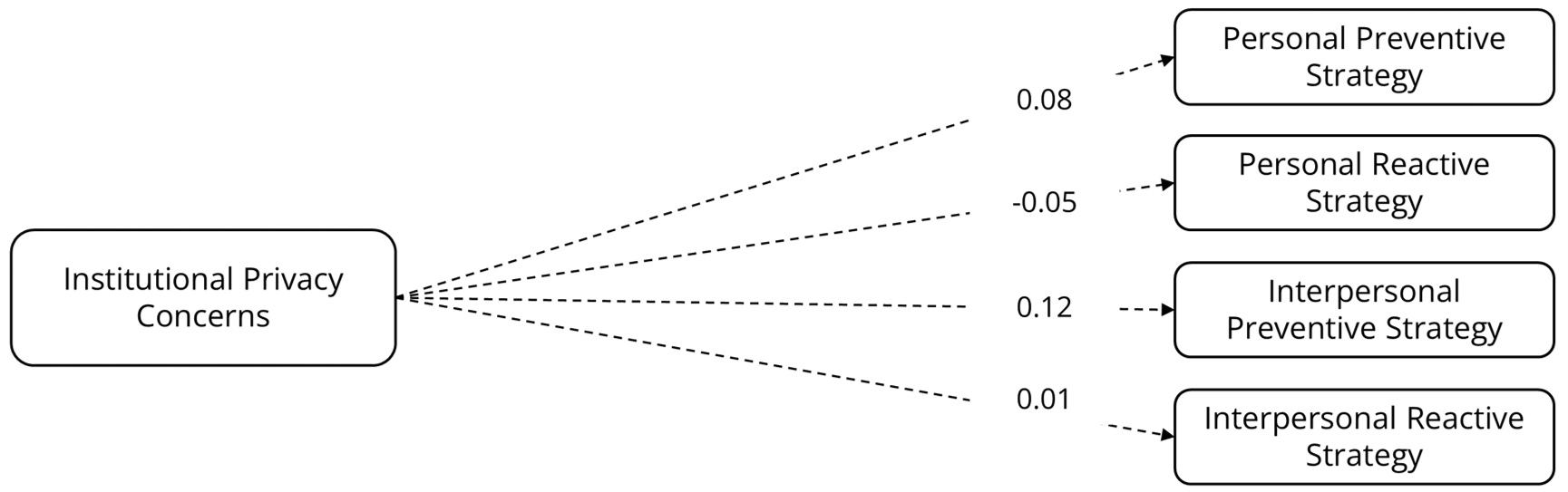
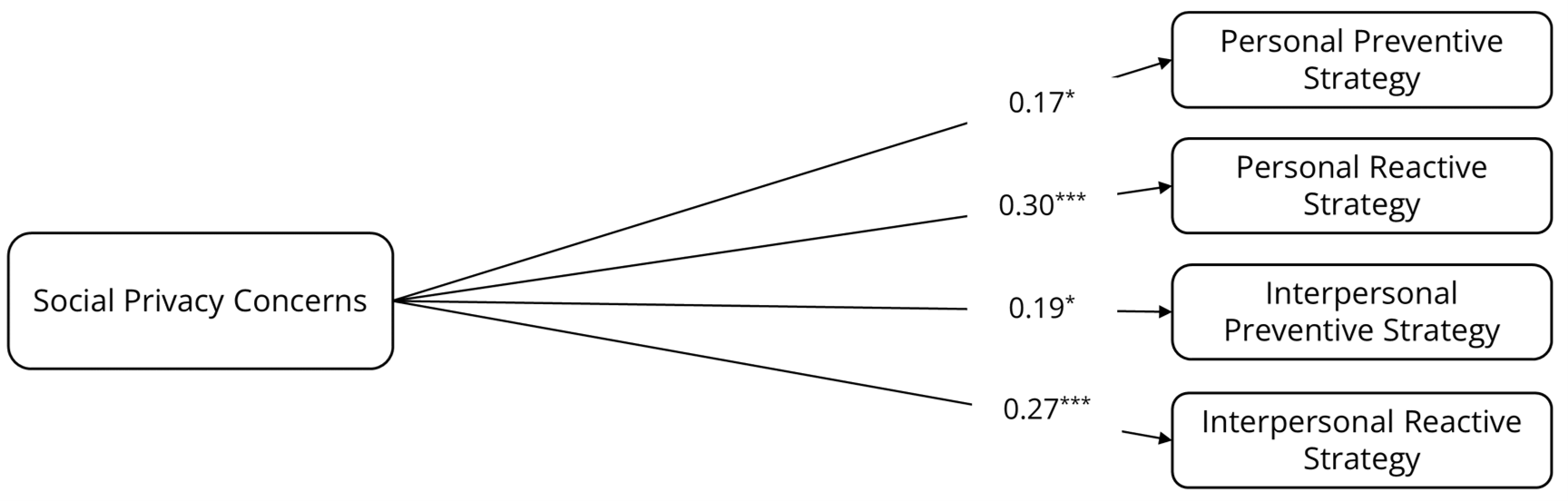
Institutional privacy concerns were unrelated to any of the four privacy management strategies, refuting H1. Social privacy concerns predicted all four types of strategies (H2): They positively predicted personal preventive, personal reactive, interpersonal preventive, and interpersonal reactive privacy strategies. Results are visualized in Figure 1.
Figure 1. Associations of Privacy Concerns (Institutional and Social) With Sexting Privacy Management.
Note. *p < .05, **p < .01, ***p < .001.
Rejection Sensitivity
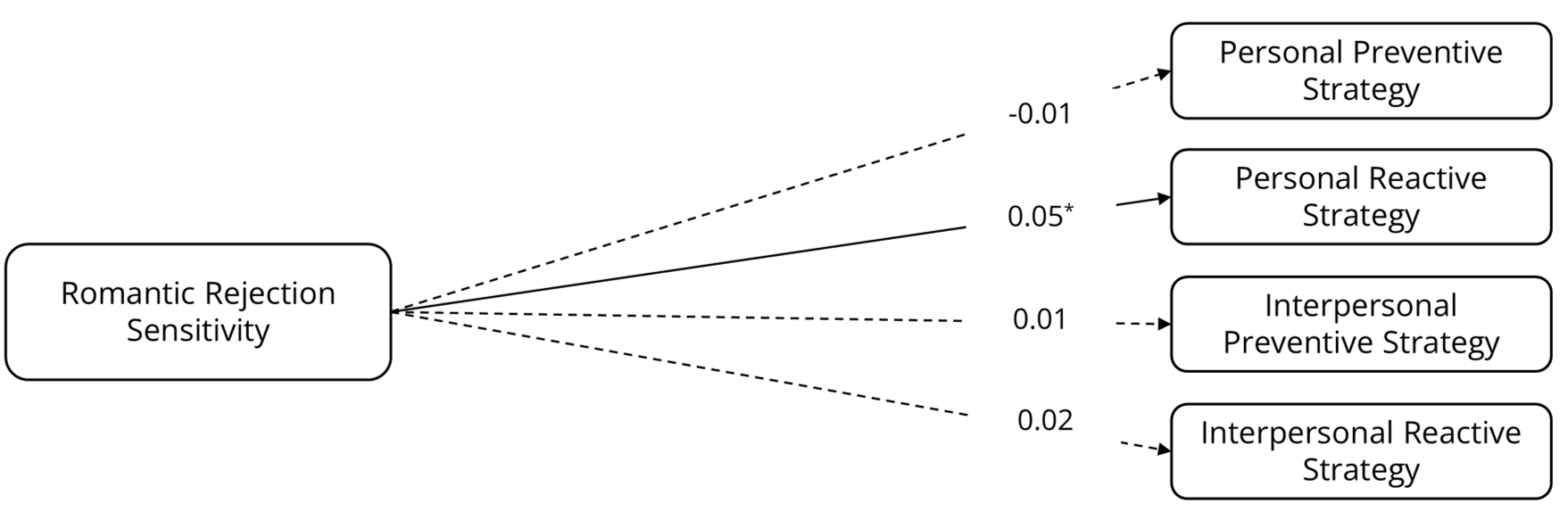
Contrary to our expectations (H3), romantic rejection sensitivity did not predict decreased privacy management. We found no effect of romantic rejection sensitivity on personal preventive, interpersonal preventive, or interpersonal reactive strategies. Regarding personal reactive privacy behaviors, romantic rejection sensitivity was a positive predictor (rather than a negative one). Results are visualized in Figure 2.
Figure 2. Associations of Romantic Rejection Sensitivity With Sexting Privacy Management.
Note. *p < .05.
Sexting Frequency
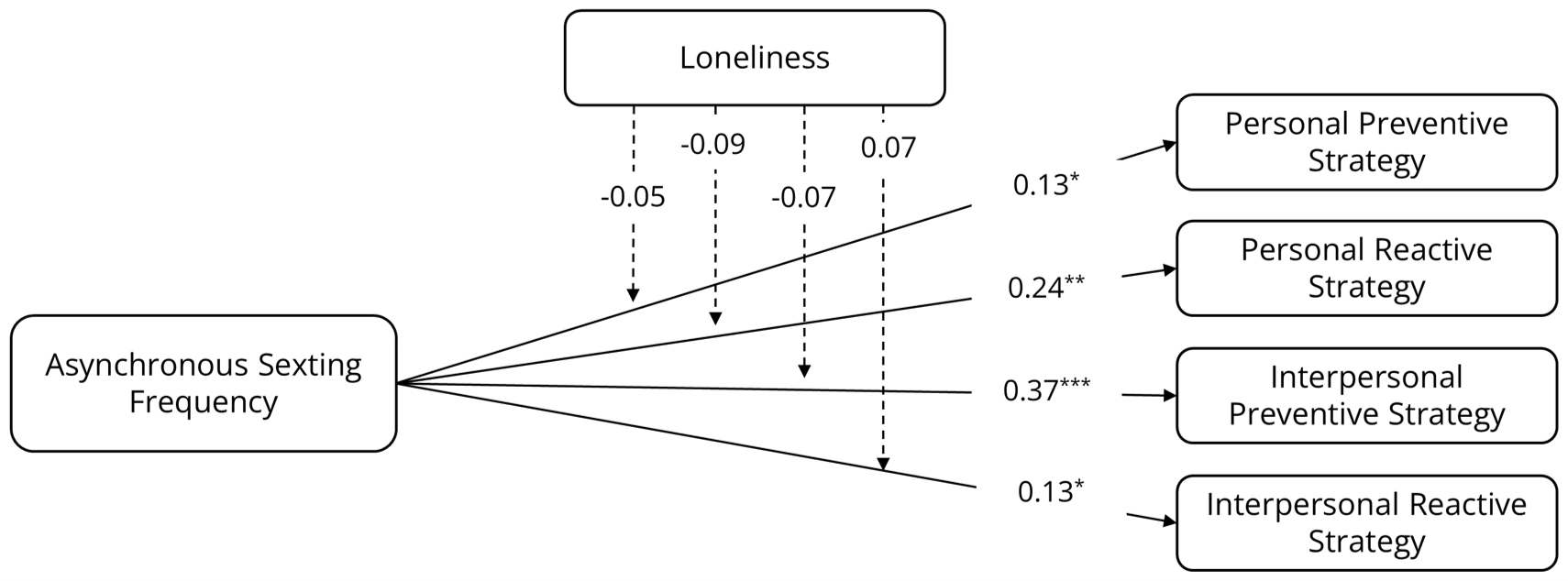
Individuals who reported both more asynchronous sexting also reported more use of all four sexting privacy management strategies (in line with H4). H5 was partially supported: Individuals who reported more frequent synchronous sexting did report more personal preventive but not more personal preventive, interpersonal preventive, or interpersonal reactive strategies. Results are visualized in Figure 3.
Sexting Frequency and Loneliness
There were no joint effects of sexting frequency (asynchronous, H6; synchronous, H7) and loneliness on any of the four types of sexting privacy management. The positive effect on personal reactive privacy behaviors closely failed to reach significance (p = .055). Results are visualized in Figure 3.
Figure 3. Associations of Sexting Frequency (Asynchronous and Synchronous) and Loneliness With Sexting Privacy Management.
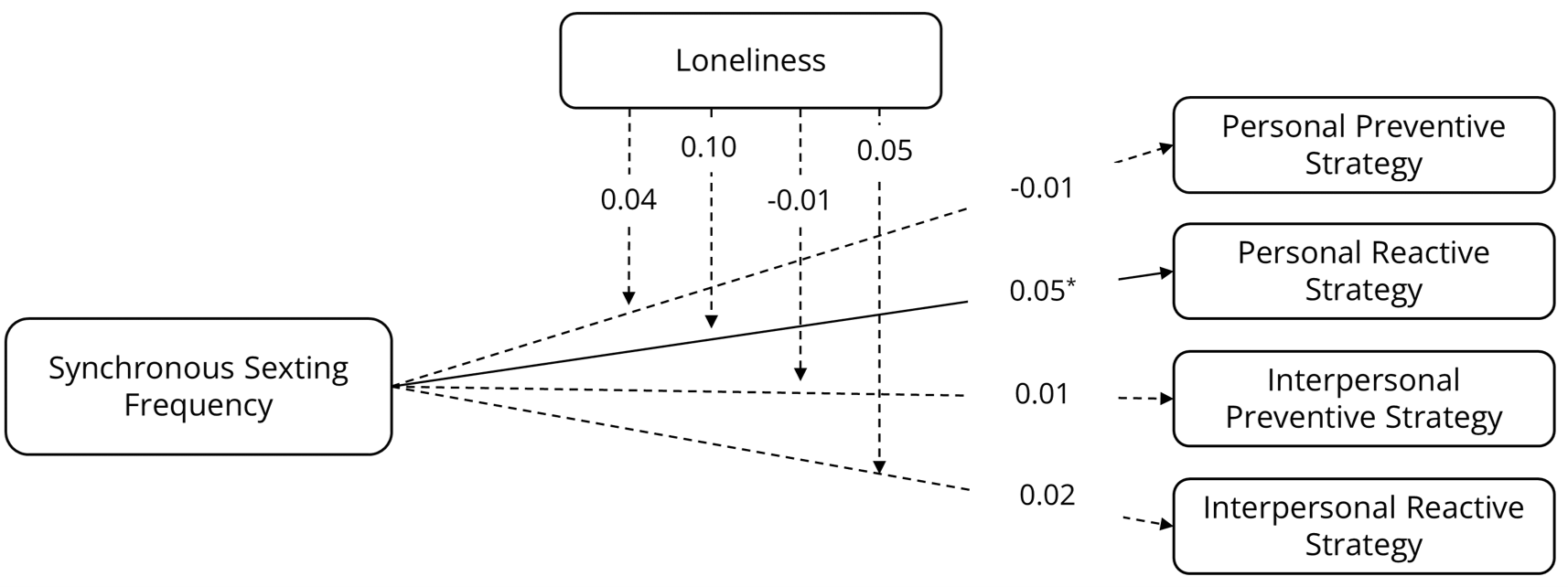
Note. *p < .05, **p < .01, ***p < .001.
Table 2. Regression Analyses Predicting Sexting Privacy Management (Personal Strategies).
|
|
Personal Preventive (robust coefficients) |
Personal Reactive (robust coefficients) |
||||||
|
Predictor |
b |
SE |
t |
p |
b |
SE |
t |
p |
|
Age |
−0.01 |
0.01 |
−1.07 |
.282 |
0.00 |
0.01 |
−0.43 |
.667 |
|
Gender (female) |
−0.20 |
0.12 |
−1.70 |
.090 |
0.06 |
0.14 |
0.44 |
.663 |
|
Gender (diverse) |
0.37 |
0.74 |
0.50 |
.616 |
0.13 |
1.92 |
0.07 |
.946 |
|
Relationship Status (partnered) |
0.04 |
0.13 |
0.28 |
.776 |
0.30+ |
0.16 |
1.89 |
.060 |
|
Unwanted Sexting |
0.24*** |
0.05 |
4.65 |
< .001 |
0.31*** |
0.07 |
4.68 |
< .001 |
|
Institutional Privacy Concerns |
0.08 |
0.06 |
1.22 |
.221 |
−0.05 |
0.09 |
−0.64 |
.519 |
|
Social Privacy Concerns |
0.17* |
0.07 |
2.57 |
.010 |
0.30*** |
0.09 |
3.38 |
< .001 |
|
Romantic Rejection Sensitivity |
−0.01 |
0.02 |
−0.61 |
.541 |
0.05* |
0.02 |
2.57 |
.011 |
|
Loneliness (centered) |
0.04 |
0.04 |
0.94 |
.348 |
0.08 |
0.06 |
1.26 |
.209 |
|
Asynchronous Sexting (centered) |
0.13* |
0.06 |
2.23 |
.026 |
0.24** |
0.07 |
3.15 |
.002 |
|
Synchronous Sexting (centered) |
0.20** |
0.06 |
3.15 |
.002 |
0.06 |
0.07 |
0.88 |
.378 |
|
Loneliness (centered) × Asynchronous Sexting (centered) |
−0.05 |
0.04 |
−1.26 |
.207 |
−0.09 |
0.05 |
−1.69 |
.092 |
|
Loneliness (centered) × Synchronous Sexting (centered) |
0.04 |
0.04 |
0.87 |
.383 |
0.10+ |
0.05 |
1.92 |
.055 |
|
|
adj. R2 = .18, F(13,543) = 10.34, p < .001 |
adj. R2 = .17, F(13,543) = 9.85, p < .001 |
||||||
|
Note. N = 557, +p < .07, *p < .05, **p < .01, ***p < .001. |
|
|
|
|
||||
Table 3. Regression Analyses Predicting Sexting Privacy Management (Interpersonal Strategies).
|
|
Interpersonal Preventive Behaviors |
Interpersonal Reactive Behaviors (robust coefficients) |
||||||
|
Predictor |
b |
SE |
t |
p |
b |
SE |
t |
p |
|
Age |
−0.01 |
0.01 |
−0.80 |
.421 |
0.00 |
0.01 |
−0.54 |
.586 |
|
Gender (female) |
0.47** |
0.15 |
3.04 |
.002 |
−0.20+ |
0.11 |
−1.84 |
.066 |
|
Gender (diverse) |
1.88*** |
0.21 |
8.89 |
< .001 |
−1.88*** |
0.24 |
−7.80 |
< .001 |
|
Relationship Status (partnered) |
0.18 |
0.16 |
1.16 |
.246 |
0.00 |
0.12 |
−0.02 |
.981 |
|
Unwanted Sexting |
0.11* |
0.05 |
2.00 |
.046 |
0.33*** |
0.05 |
6.64 |
< .001 |
|
Institutional Privacy Concerns |
0.12 |
0.09 |
1.32 |
.189 |
0.01 |
0.06 |
0.18 |
.857 |
|
Social Privacy Concerns |
0.19* |
0.10 |
1.99 |
.047 |
0.27*** |
0.07 |
3.98 |
< .001 |
|
Romantic Rejection Sensitivity |
0.01 |
0.02 |
0.25 |
.804 |
0.02 |
0.01 |
1.53 |
.127 |
|
Loneliness (centered) |
−0.13* |
0.06 |
−2.22 |
.027 |
0.04 |
0.04 |
0.96 |
.336 |
|
Asynchronous Sexting (centered) |
0.37*** |
0.07 |
5.26 |
< .001 |
0.13* |
0.05 |
2.41 |
.016 |
|
Synchronous Sexting (centered) |
0.09 |
0.07 |
1.37 |
.172 |
0.09 |
0.05 |
1.63 |
.105 |
|
Loneliness (centered) × Asynchronous Sexting (centered) |
−0.07 |
0.05 |
−1.38 |
.169 |
0.07 |
0.04 |
1.77 |
.078 |
|
Loneliness (centered) × Synchronous Sexting (centered) |
−0.01 |
0.05 |
−0.25 |
.806 |
0.05 |
0.04 |
1.31 |
.192 |
|
|
adj. R2 = .14, F(13,543) = 7.96, p < .001. |
adj. R2 = .27, F(13,543) = 16.59, p < .001. |
||||||
|
Note. N = 557, +p < .07, *p < .05, **p < .01, ***p < .001. |
|
|
|
|
||||
Moderator and Control Variables
We found a negative main effect of the moderator loneliness on interpersonal preventive behaviors, indicating that lonelier individuals were reluctant to discuss privacy in advance. Age and relationship status were unrelated to all four privacy strategies. Female gender was only associated with interpersonal preventive behaviors. Gender was unrelated to the other three privacy behaviors. We refrain from interpreting effects of diverse gender because these effects are based on only two individuals. Unwanted sexting significantly predicted all four sexting privacy behaviors (all p < .001).
Discussion
Our research focused on safer sexting strategies because the highly sensitive data exchanged during sexting can be misused by untrustworthy sexting partners (Mori et al., 2020) or accessed by apps or hackers. We examined who takes privacy precautions and how sexters protect themselves. To understand who, we tested the predictors of social and institutional privacy concerns, rejection sensitivity, asynchronous and synchronous sexting, and their interactions with participants’ level of loneliness. To understand how sexters manage their privacy, we developed the Sexting Privacy Management Inventory (SPMI). Building on prior conceptualizations of sexting-related precautions, the SPMI distinguishes four types of sexting-related privacy behaviors: personal preventive, personal reactive, interpersonal preventive, and interpersonal reactive. Our model of four privacy strategies (personal preventive, personal reactive, interpersonal preventive, and interpersonal reactive) was successful and reliable. Therefore, the factors in the SPMI should not be aggregated. This multidimensional approach complements and extends previous work. Rothmüller (2025) distinguished between concealment, social, and technical precautions and noted that individuals deploy these strategies across different contexts (e.g., the COVID-19 pandemic). In that regard, the SPMI adds value by capturing graded use of strategies and by further differentiating between personal versus interpersonal and preventive versus reactive behaviors. Similarly, Holmes and Babchishin (2024) focused on identifying high-risk sexters rather than measuring privacy strategies directly. Their findings indirectly highlight practices considered safer, thereby providing useful context for interpreting the SPMI's explicit or implicit strategy measures.
Descriptively, we found that the most common privacy strategy was interpersonal preventive. That is, before sexting, individuals selected only sexting partners they trusted to abide by agreements or asked them to keep data confidential. The use of the three other privacy strategies was generally low.
Practically, the Sexting Privacy Management Inventory (SPMI) is proposed as a tool for use in research and practice and requires validation in diverse populations (e.g., in digital sex workers for whom sexting privacy is of utmost importance). The SPMI provides a standardized way to measure how individuals manage privacy when sexting and is intended to facilitate systematic research on sexting privacy management. The SPMI can be used to identify safer and risky privacy strategies in digital sexual communication. It allows researchers to compare sexting privacy management across individuals and investigate associated correlates. The measure may also help evaluate interventions aimed at improving digital sexual literacy. Findings on safer sexting can valuably inform the theoretical debate around desired and undesired sexting consequences.
Distinguishing between four privacy strategies can be a theoretical contribution to other areas of privacy management. Sharing data of our partner, child, or colleague is a crucial and timely topic. For sexualized data, it is obvious that public posting denotes a privacy violation. Yet, for other data, it may just as well be.
Privacy Concerns
Based on previous research (De Wolf, 2019), we expected more privacy management in case of higher privacy concerns. On the one hand, institutional privacy concerns did not predict any privacy strategy. That is, sexters concerned about the trustworthiness of platforms or apps did not resort to more privacy behaviors. Discrepancies between privacy attitudes and behaviors are found in many studies (Barth & de Jong, 2017; Gerber et al., 2018), which has been termed the privacy paradox (Norberg et al., 2007). One of the reasons why concerns do not lead to protection behaviors could be privacy fatigue. De Wolf (2019) found that adolescents feel fatalistic about (sexting) privacy. The finding that institutional privacy concerns are unrelated to safer sexting practices practically implies that sexters lack agency in protecting their privacy. For personal strategies, that would be technical knowledge and skills (e.g., in choosing trustworthy apps). For interpersonal strategies, that would be negotiation skills (with apps and institutions).
Our differential findings across types of privacy concerns refine the debate over the privacy paradox. Future studies could yield even more refined results if they measured not only individuals’ concerns about a potential privacy violation but also their perceived likelihood of this violation (comparable to the rejection sensitivity scale, which multiplies the level of concern by expectation; Downey & Feldman, 1996).
Social privacy concerns, on the other hand, predicted all four privacy behaviors. Thus, sexters concerned about untrustworthy sexting partners did indeed take more privacy precautions of all kinds. Clearly, our results show that concerns about the sexting partner seem more influential in privacy decisions than concerns about apps. While De Wolf (2019) showed that adolescent sexters engage more in interpersonal than personal privacy behaviors, we found that social privacy concerns had its strongest effect on personal reactive behaviors (i.e., deleting the sext again afterward). A possible reason is that De Wolf (2019) surveyed younger participants, aged 11–21 (M = 14.94, SD = 1.85), whereas our sample ranged from 16 to 40 (M = 28.97, SD = 6.67). Perhaps interpersonal measures are more important in adolescents, and personal measures become important in late adolescence and adulthood.
The intuitive finding that social privacy concerns predict privacy management also means that sexters employ fewer protective behaviors with trusted partners. People who self-disclose (online) tend to protect their privacy with strangers but not with close relationships (Berridge & Wetle, 2020; Levy & Schneier, 2020). Trusting one’s sexting partner thus denotes a risk factor for high-risk sexting. On the one hand, this is justified because safeguarding privacy is less normative in shorter, more casual relationships (Hasinoff & Shepherd, 2014). On the other hand, it is a dangerous myth (“stranger danger”) that privacy will only be violated by strangers but will be respected in close relationships.
Privacy management in close relationships is necessary for several reasons. First, even trustworthy individuals may lack the knowledge or control that is necessary to safeguard privacy. That is, sensitive data could get accessed by apps or hackers. Second, close relationships could unintentionally violate another’s privacy because their closeness (and power dynamic) makes them feel entitled to decide what information can and cannot be shared (cf. sharenting, i.e., parents disclosing information about their children online). The risk of different privacy violations, ranging from the dissemination over sensitive data to stalking to gender-based (sexual) violence, is highest in the closest of relationships (Levy & Schneier, 2020). For example, partner idealization is a risk factor for gender-based violence (Jiménez-Picón et al., 2023). Thus, relationship length or relationship intimacy are not necessarily protective; closeness can also be a risk factor. Third, alliances can end. The greatest privacy risk to communities is not strangers but (banished) former members (see insider threats, e.g., Nigrini, 2025). In line with that, people primarily fear the dissemination of sexual information by resentful ex-partners (Setty & Dobson, 2024).
For these reasons, unprotected sexting with trusted partners is far from trivial and warrants future investigation. Unprotected sexting could, for example, influence stay-or-leave decisions only to prevent a resentful ex-partner situation. Practically, this means that privacy protection during sexting should become a habit with everyone, just like using safety belts, no matter how much one trusts the driver.
Romantic Rejection Sensitivity
We hypothesized that individuals reporting high romantic rejection sensitivity would engage in less sexting privacy management because, driven by fear of rejection, rejection-sensitive individuals also employ fewer protection behaviors in other romantic areas (Drouin & Tobin, 2014; Klettke et al., 2019). However, contrary to expectations, individuals with higher romantic rejection sensitivity did not report significantly less privacy behaviors. This predictor was unrelated to most privacy behaviors and, surprisingly, even positively related to personal reactive behaviors (i.e., deleting the sext again). Thus, higher romantic rejection sensitivity was not associated with a general reluctance to engage in sexting privacy management. Rather than functioning as a barrier, rejection sensitivity may relate selectively to certain reactive strategies, a pattern that warrants further investigation.
Several explanations are possible for the nonsignificant associations between rejection sensitivity and the other three privacy management strategies. Methodologically, it could be that an effect of rejection sensitivity was hidden by controlling for unwanted sexting. Theoretically, individuals with high romantic rejection sensitivity may also be highly sensitive to a data leak because they perceive the potential reputational damage as detrimental (Romero-Canyas & Downey, 2013) and thus engage in privacy behavior despite the difficulty. Furthermore, they may fear being negatively evaluated not for setting privacy boundaries but already for their sexts as such and therefore delete them immediately after sending them. For the case of deleting a sext after sending it, setting privacy boundaries is invisible and gives less reason to fear rejection. Future research could test if the use of the visible “view once” - function is similarly related to rejection sensitivity.
Importantly, the items on romantic rejection sensitivity assessed sensitivity to rejection by a romantic partner, while a sexting partner could be anyone from a committed partner to a casual flirt, or a dating app match (Schreurs et al., 2020). So, future research should investigate the relationship with the sexting partner. Perhaps rejection sensitivity affects privacy protection in more casual relationships. Since we found an effect of our moderator loneliness (i.e., lonelier sexters were reluctant to discuss privacy in advance), future research may further examine loneliness as a predictor of sexting privacy management.
Sexting Frequency
Our sample of sexters allowed us to assess sexting behavior (not hypothetical willingness or intention). Based on prior research revealing higher privacy concerns in more frequent sexters (Zemmels & Khey, 2015), we had expected more privacy management in more frequent sexters. Indeed, those who more frequently asynchronously exchanged sexy photos or other files also reported more privacy precautions. Within sexters, more frequently sending storable sexting files seems to increase risk awareness, expert knowledge, and protection behaviors, and thereby have beneficial consequences compared to infrequent sexting. Other researchers have found that infrequent sexters do not report much less abuse than frequent sexters (Finkelhor et al., 2024). These findings imply that sexting interventions should target those who infrequently sext asynchronously. As we consider safer sexting a desired outcome, the present study denotes one of the few cases reporting on beneficial outcomes of sexting more frequently (Klettke et al., 2018).
Yet, for synchronous sexting, we found different associations with privacy behaviors than for asynchronous sexting. Specifically, our results showed that only personal preventive behaviors (e.g., de-identification by hiding individual characteristics or by app choice) were predicted by both asynchronous and synchronous sexting. Synchronous sexting frequency did not affect the three other privacy strategies. An explanation for the differential effects of asynchronous and synchronous sexting could be that, in the case of live (video-)calls, it is much less apparent how files can be stored and disseminated after the interaction, which is why sexters may think of synchronous interactions as being inherently more private compared to asynchronous interactions. When exchanging data in the form of storable files it is obvious that these files could be forwarded to others. Also, in asynchronous interactions, individuals have time to edit messages after sending them and can seek third-party advice, whereas in synchronous interactions, privacy decisions must be made immediately (Jiang et al., 2013). In addition, synchronous interactions are conceptualized as requiring less privacy management because sexting partners see each other’s immediate reactions, thereby reducing online disinhibition (Walrave et al., 2018). To the best of our knowledge, this is the first study to distinguish between asynchronous and synchronous sexting (Jiang et al., 2013), and this distinction was very useful for understanding sexting-related privacy management.
Synchronous sexting frequency had no effect on any reactive behaviors (i.e., deleting data or negotiating privacy afterward), possibly because the real-time nature of synchronous sexting makes reactive actions after sexting difficult, as it is unclear which (if any) data the sexting partner (or the app) has intentionally and unintentionally stored on their device. Although interpersonal preventive behaviors were the most common type of privacy behavior overall, synchronous sexting frequency did not affect them either. An explanation could be that it is easy to hide one’s identifying characteristics, while it is socially confronting to start a discussion, and therefore, frequent live sexters may engage in personal preventive but not interpersonal behaviors.
Sexting Frequency and Loneliness
Effects of asynchronous and synchronous sexting frequency on privacy behaviors were independent of participants’ loneliness. We had expected that effects would be weaker in individuals hungry for social connection (Chen & Kim, 2013; Gebhardt et al., 2003; Skakoon-Sparling & Cramer, 2020). Instead, we found only a direct effect: Lonelier sexters engaged in fewer interpersonal preventive behaviors (e.g., discussing boundaries before sexting). We conclude that affective states can play a role in interpersonal preventive privacy decisions—but not in interaction with sexting frequency. The need for connection has a direct negative effect on the most common type of privacy boundary protection, independent of how frequently individuals sext. Asynchronous sexting had a positive effect on all privacy behaviors, and these effects were not moderated.
An explanation for why loneliness did not attenuate the effect of sexting frequency could be that loneliness is an unpleasant mood state, and experimental research has shown that social media users are more risk-averse in a negative mood (Alashoor et al., 2018). According to this argument, loneliness (as a negative mood) should be associated with a greater perception of risk. Yet, it would still be unclear whether this, in turn, leads to more rigorous privacy management. Future research should keep investigating the direct and interaction effects of loneliness on privacy behavior. Especially the marginally significant (b = 0.10, p = .054)—and unexpectedly positive—interaction between synchronous sexting and loneliness on personal reactive behaviors deserves future scholarly attention. To test the effects of loneliness, we need experimental research manipulating loneliness and measuring sexting privacy decisions. A convenient and ethical way to measure sexting privacy decisions would be a vignette experiment with merely hypothetical choices. Longitudinal research with three or more waves could shed light on the mediating mechanisms of sexting privacy management. Alternative moderators could be sexting motivation or relational context. In casual relationships, one might expect greater precautions because confidentiality is less normative. We would expect less privacy management in close relationships due to lower privacy concerns.
Moderator and Control Variables
While rejection sensitivity was not negatively associated with any of the safer sexting strategies, we found that loneliness was negatively related to interpersonal preventive behaviors. That is, lonelier sexters were reluctant to interpersonally discuss sexting privacy in advance. This is in line with the phenomenon that lonely individuals avoid interactions with others (Eronen & Nurmi, 2001) or interact in more avoidant ways (Vanhalst et al., 2015), which not only maintains their loneliness but, as we show here, puts them at risk when they are reluctant to discuss privacy.
Concerning demographic control variables, age (16–40 in our sample) was unrelated to sexting privacy management. Future research could further examine whether age interacts with predictors of safer sexting. We found women to report more interpersonal preventive privacy behaviors (i.e., carefully choosing the sexting partner and negotiating boundaries before sexting) compared to sexters of male and diverse genders. Women and girls are found to employ more privacy protective measures than men (Baruh et al., 2017; De Wolf, 2019). In cases of sexting privacy violations, popular discourse often made women responsible and blamed the female victim rather than the male perpetrator (Hasinoff, 2015). Due to sexual double standards, women fear more serious reputational damage than men in case of a disseminated sext (Ringrose et al., 2013), which further explains the importance of sexting privacy management for women. Interestingly, women did not employ more personal privacy behaviors that require technical skills.
Whether young adults were single or in a relationship was not related to any of the privacy behaviors. As already mentioned, future research should account for the relational context of sexting. For adolescents’ (Van Ouytsel et al., 2017) as well as for emerging adults’ (Hasinoff & Shepherd, 2014) privacy norms, it mattered whether one sexts with a committed partner or with a casual hook-up. As a result, the relationship with the sexting partner may influence social privacy concerns and sexting privacy management. Hence, we need more research on the effect of relational context on safer sexting strategies.
Moreover, beyond the dyadic relationship between the recipient and the sender, future research may examine the bystander context. Image-based sexual abuse resembles bullying (more than dyadic in-person sexual abuse) because bullying and exposing someone’s intimate files to third parties require an audience of bystanders. Concerns and precautions may be higher if the sender and recipient share the same school, work, or other environment.
We further conclude that the control variable unwanted sexting, that is, how often participants had complied to send sexts despite not really wanting to, should be included when researching safer sexting (Drouin & Tobin, 2014) because unwanted sexting was significant for all privacy behaviors. Future research may additionally control for sexual orientation because identifying as non-heterosexual or transgender have been associated with high-risk sexting (Holmes & Babchishin, 2024).
Limitations
The first limitation of the present study is its cross-sectional design, which prevents conclusions about the causal order of relationships. This design does not allow us to observe dynamics over time, for instance, how privacy concerns are transformed and disrupted (Möller, 2024). Second, the SPMI we developed to measure sexting privacy strategies contains 16 items, but it is not exhaustive. One could think of more dimensions beyond personal vs. interpersonal and preventive vs. reactive, and perhaps more than the currently only two items to assess personal reactive behaviors. The personal preventive factor now consists of items about masking identity. Different personal and preventive behaviors are possible, for example, ephemeral messaging and screenshot-blocking features. So, one could add items such as “used apps with a ‘view once’ function/ self-deleting messages”.
Future qualitative research should inventory the various privacy behaviors individuals employ in the context of sexting to expand the scale. Third, we collected our data online because it allows large sample sizes even for taboo subjects like sexuality. However, online data collection is often accused of poor data quality. To detect insufficient effort responding, we had implemented two attention checks and deleted 102 individuals who failed them, and additionally 24 speeders.
Lastly, individuals across different age groups are likely embedded in distinct social, relational, and technological contexts and may differ in their lived experiences and realities of sexting. Although age was included as a predictor and was not significantly related to sexting privacy strategies, contextual age-related differences may not be captured in the present analyses and should be acknowledged when interpreting the findings. Future research could examine age-specific patterns of privacy management more explicitly.
Future Research on Safer Sexting
We focused on protecting the privacy of the sender’s self-produced sexts from threats posed by the recipient or third parties. Research and education tend to focus on precautions that potential victims of (image-based) sexual abuse can take to prevent being victimized. However, sexting privacy management also includes safely handling sensitive data produced by a sexting partner. Future research and education could focus on precautions against perpetration. Data breaches are not always intentional, so teaching sexual ethics may not suffice. For example, one may send a picture to the wrong recipient by mistake or unwittingly have one’s screen captured by nearby people, their phones, or CCTV cameras. Precautions include storing sexts in a locked (and hidden) album and shielding the phone with a screen protector.
Data privacy is only one domain of safer sexting. Another domain would be consent. Future research should focus on the precautions individuals take to prevent unsolicited sexting (see “cyberflashing” or unsolicited dick pics) or sending the wrong picture by mistake. Other domains of safer sexting would be detection of inauthentic sexting (e.g., deepfakes) and precautions against legal prosecution of minor or LGBTQ sexting (Samper & Ferreira, 2025).
Conclusion
Approaching consensual sexting as a risky but not inherently harmful behavior, we investigated sexting privacy management. To understand how sexters protect their privacy, we developed a four-dimensional model of strategies and the Sexting Privacy Management Inventory (SPMI), the first reliable scale to assess sexting privacy management. To understand who cares about sexting privacy management, we tested associations with attitudinal (social and institutional privacy concerns), personality (rejection sensitivity, loneliness), and behavioral (frequency of asynchronous and synchronous sexting) predictors. Controlling for unwanted sexting, we found differential effects across types of sexting-related privacy behaviors: On the one hand, sexters who were concerned that institutions such as platforms or apps did not protect their privacy did not take additional privacy measures (perhaps due to privacy fatigue or a lack of technical or negotiation skills). On the other hand, sexters who were concerned that their sexting partners would not guard their privacy did indeed report more sexting privacy management. We discussed the reasons why unprotected sexting with trusted partners is not a trivial finding. Privacy protection should become a habit, just like the use of safety belts, no matter how much one trusts the driver.
Unexpectedly, higher rejection sensitivity was not linked to fewer privacy behaviors (surprisingly, even more personal reactive behaviors). Unwanted sexting and asynchronous sexting frequency predicted all privacy behaviors, whereas synchronous sexting frequency predicted only personal preventive behaviors. Loneliness did not moderate any effects of sexting frequency on privacy behaviors. So, unprotected sexting was reported with trusted partners and by infrequent sexters. Differentiating between personal and interpersonal privacy behaviors, as well as between preventive and reactive measures, seems useful for understanding how sexters manage their privacy. The four-dimensional model developed in the context of sexting could be useful for other domains of privacy management.
Footnotes
1 Noetzel et al. (2025) distinguished between preventive and reactive behaviors in the context of avoiding targeted political advertising.
2 The three items read: „changed my appearance after I sent sexy messages so as not to be recognized anymore” (personal reactive), “deleted my profile or changed my phone number after having sent sexy messages” (personal reactive) and “after sending broke off contact with the person that I sent sexy messages to” (interpersonal reactive).
Conflict of Interest
The authors have no conflicts of interest to declare.
Use of AI Services
The authors declare they have used the AI service Grammarly for grammar correction and minor style refinements. They carefully reviewed all suggestions from these services to ensure the original meaning and factual accuracy were preserved.
Data Availability Statement
The preregistration, all items, the data, and the reproducible analysis script are openly accessible: https://doi.org/10.17605/OSF.IO/VDZTR.
Acknowledgement
This research did not receive any specific grant from funding agencies in the public, commercial, or not-for-profit sectors.
Appendix
Find hereunder details on measurements and correlations of all variables (Table A2), and all results reported per privacy management strategy.
Measures
Screener
To screen who was eligible to participate in our sexting survey, we used the following wording: “Digital media are not only suitable for keeping in touch with friends, but also for sending sexy messages to romantic or sexual partners (“sexting” or “cybersex”). Nowadays, half of all young adults report to have used digital media to exchange sexy messages with a partner (source: meta-analysis by Mori et al., 2020).
Have you ever done this? Examples include:
- sending sexy text or voice messages,
- sending photos or videos of yourself in lingerie or naked,
- phone sex or camming.
Any interactive sexual activity counts, private or paid, via smartphone or computer. However, receiving or forwarding sexy messages from others or watching porn does not count. The important point is that you have disclosed something about yourself.” This question could be answered with either “Yes, I have done at least one of these activities.” or “No, I have never done any of these.” Only those who said yes could participate.
Privacy Concerns (Institutional and Social)
For both institutional and social privacy concerns (Stutzman et al., 2011 as adapted by Lutz & Ranzini, 2017), we asked “How concerned are you about the following potential privacy risks that may occur when you share or send your personal information online?” (1 = no concern at all, 2 = low concern, 3 = moderate concern, 4 = high concern,
5 = very high concern). For institutional privacy concerns, we provided the following four situations: “Online platforms/apps do not sufficiently protect personal data.”, “Online platforms/apps track and analyse personal data.”, “Online platforms/apps sell personal data to third parties.”, “Online platforms/apps share personal data with government agencies.”
For social privacy concerns, we asked about the following four situations for concern: “the use of my identity by other persons,” “other people hacking my profile/data,” “stalking by other persons,” “other people disclosing my personal information without my consent”.
Romantic Rejection Sensitivity
We used the original introduction (Downey & Feldman, 1996): “The questions below describe different situations in which you yourself bring a concern to another person or persons. For each question, please imagine what it would be like if you were personally in that situation and then tick how you would feel about it.” We selected the following five scenarios (ten items) focusing on romantic relationships to be rated on a scale from 1 (fully disagree) to 6 (fully agree). Scenario 1: “Your partner is planning to go out with friends tonight. However, you would like him/her to spend the evening with you and you tell him/her this. I would be concerned or anxious in this situation, waiting to see if my partner will stay home or not.” and “It is very likely that my partner will listen to my concerns.” Scenario 2: “After a heated argument the day before, call your partner and tell him/her that you want to meet. I would be concerned or anxious in this situation, thinking about whether my partner wants to see me or not.” and “I think it is likely that he/she wants to see me.” Scenario 3: “You ask your partner, with whom you have not been together very long, if he/she wants to meet your parents. I would be concerned or anxious in this situation, asking whether or not he/she wants to meet your parents.” and “I think it is likely that my partner would like to meet my parents”. Scenario 4: „You ask your partner to move in with you. I would be concerned or anxious in this situation awaiting my partner's reaction.” and “I think it is likely that he/she wants to move in with me.” Scenario 5: “You have done or said something that has hurt your partner quite a bit. Now you turn back to him/her. I would be concerned or anxious in this situation, thinking whether he/she will talk to me or not.” and “I think it is likely that he/she will want to talk to me again to sort the matter out.”
Sexting Frequency (Synchronous and Synchronous)
We introduced with: “The following questions deal with sending sexy messages (“sexting” or “cybersex”). By sexy messages we mean all formats, including photos, videos, text and voice messages. Nowadays, half of all young adults report having ever used digital media to exchange sexy messages with someone (source: meta-analysis by Mori et al., 2020). How often in your life have you done the following activities online?” to be answered on a scale from 1 = never to 7 = very often.
For asynchronous sexting, we followed Thomas et al. (2022), participants rated the following six items: “sent sexy text messages,” “sent sexy audio messages,” “sent a photo of myself in underwear or swimwear,” “sent a naked photo of myself,” “sent a video of myself in underwear or swimwear,” and “sent a video in which I am naked”. For synchronous sexting, we had three items: “had live phone sex”, “had live video sex (e.g., masturbating together on camera)”, and “cammed live for someone else (e.g., on OnlyFans, Chaturbate, etc.)”.
Loneliness
On a scale from 1 = Does not apply to me at all to 7 = Fully applies to me, we asked „Now we want to know if you feel lonely. To what extent do the following statements generally apply to you?” We used the following four items (Russell et al., 1980) from the revised UCLA Loneliness Scale, from the factor feelings of loneliness (Döring & Bortz, 1993): “I feel isolated from others,” “I feel alone”, “There is no one I can turn to,” and “I spend too much time alone”.
Attention Checks
We used two attention check items: “My birthday is on February 30” and “I have never used a computer”. Those who correctly fully disagreed with at least one of those items were considered attentive. Participants who failed to fully disagree (1 = fully disagree to 7 = fully agree) with both statements were screened out.
Sexting Privacy Management Inventory (SPMI)
In the Sexting Privacy Management Inventory (SPMI), we asked participants on a scale from 1 = never to 7 = very often: “How many times in your life have you used the following privacy measures for sexy messages? Sexy messages include photos, videos as well as text and voice messages.”
We first tested if the Sexting Privacy Management Inventory (SPMI) fit the presumed four-factor structure. To do that, we conducted an exploratory factor analysis (EFA) using the function fa from the package psych (Revelle, 2022) with the conventional principal axes factoring (PAF) extraction method and the oblique rotation method which allows the factors to correlate (Park et al., 2002). After omitting three items with low loadings and high cross-loadings2, exploratory factor analysis with the principal axes factoring method showed an acceptable to good model fit for the four-factor solution including 16 items: χ²(51) = 157.24, p < .001, RMSEA = .06, 90% CI [.05, .07]. CFI = .97, TLI = .94. Although chi-square test was significant (which is common in larger samples), the model demonstrated an adequate to strong fit (indicated by an acceptable RMSEA, an excellent CFI and acceptable to good TLI).
The complete list of 16 privacy management strategies can be found in Table A1. The (second) factor interpersonal preventive explained 18%, the (first) factor interpersonal reactive 15%, the (third) factor personal preventive 13% and personal reactive 10% of variance. This shows that interpersonal strategies explain more of the total variance than personal privacy management strategies (see Figure A1).
Figure A1. Factor Model of the Sexting Privacy Management Inventory (SPMI).
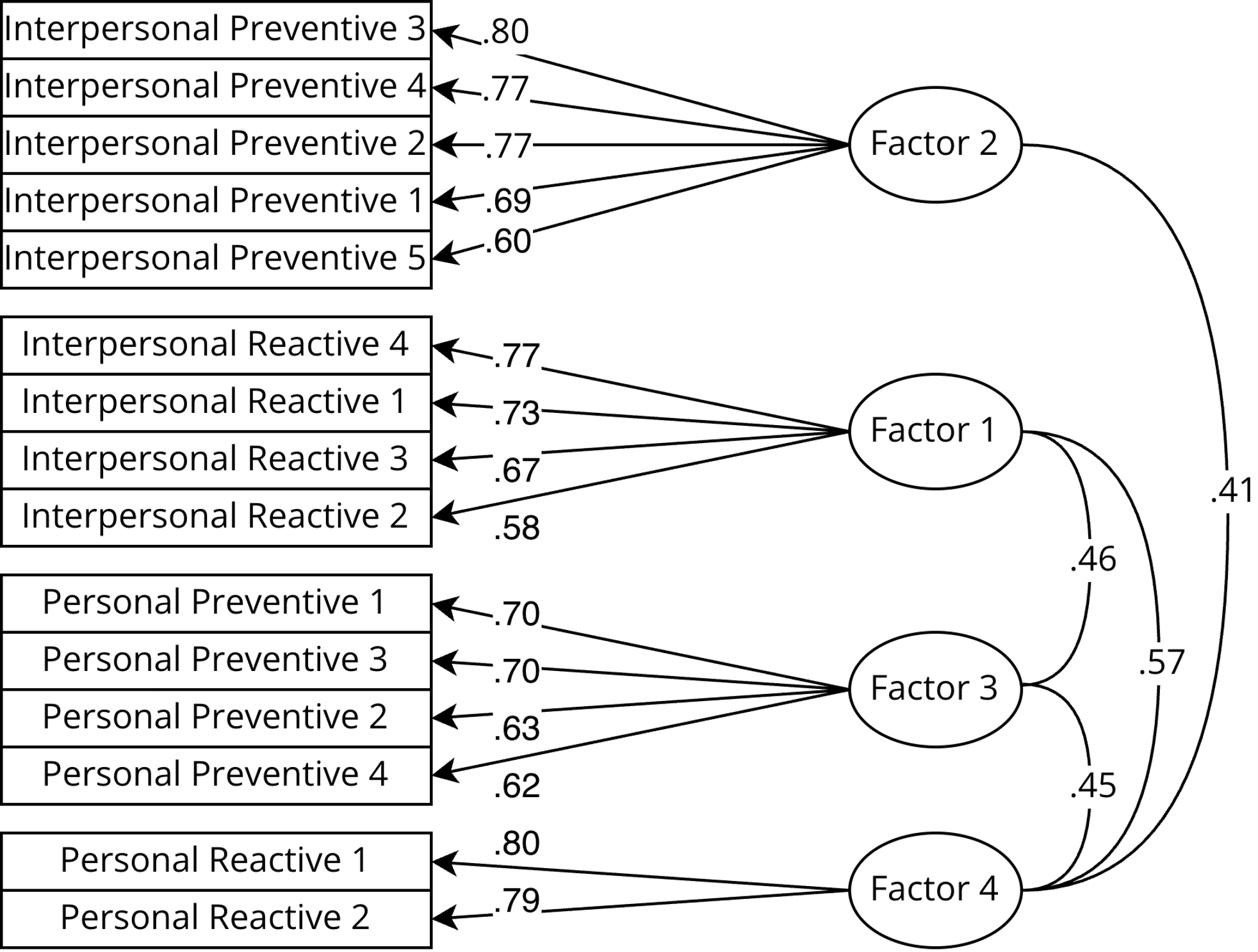
Note. The four-factor model with items sorted by loading shows that interpersonal strategies explain more variance
than personal strategies. Moderate correlations among factors indicate a unique contribution of each factor.
Table A1. Results From Exploratory Factor Analysis.
|
Item |
Factor loading |
|||
|
1 |
2 |
3 |
4 |
|
|
Factor 3: Personal preventive strategy (4 items) |
|
|
|
|
|
Individual features (e.g., tattoos, moles, scars) hidden to avoid recognition. |
|
|
.70 |
|
|
Made sure no one recognizes where I am. |
|
|
.63 |
|
|
Used another profile or mobile number to disguise my identity. |
|
|
.70 |
|
|
Used apps that automatically mask my identity (e.g., pixelate face, delete metadata). |
|
|
.62 |
|
|
Factor 4: Personal reactive strategy (2 items) |
|
|
|
|
|
Deleted sexy messages that I have sent again afterward. |
|
|
|
.80 |
|
Taken sexy messages that I have sent offline again. |
|
|
|
.79 |
|
Factor 2: Interpersonal preventive strategy (5 items) |
|
|
|
|
|
Agreed beforehand that my sexy messages should not be saved. |
|
.69 |
|
|
|
Asked the recipient beforehand to keep my sexy messages between us. |
|
.77 |
|
|
|
Made agreements with the recipient beforehand. |
|
.81 |
|
|
|
Discussed with the recipient beforehand what can and cannot be disseminated. |
|
.77 |
|
|
|
From the outset only selected people with whom I can rely on agreements. |
|
.60 |
|
|
|
Factor 1: Interpersonal reactive strategy (4 items) |
|
|
|
|
|
Asked the recipient afterward to remove my sexy messages from the device. |
.73 |
|
|
|
|
Asked the recipient to keep my sexy messages confidential after sending them. |
.58 |
|
|
|
|
Only after sending threatened them with consequences (e.g., publishing his/her intimate messages or legal consequences) in case they disseminated my sexy messages. |
.67 |
|
|
|
|
Forced the recipient to delete sexy messages from the device after I sent them. |
.77 |
|
|
|
|
Note. N = 547. Exploratory factor analysis testing four factors using the principal axes factoring method and oblique rotation method. |
||||
Table A2. Zero-Order Correlations.
|
1 |
2 |
3 |
4 |
5 |
6 |
7 |
8 |
9 |
10 |
11 |
12 |
13 |
14 |
15 |
|
|
1. Personal Preventive |
1 |
||||||||||||||
|
2. Personal Reactive |
.41*** |
1 |
|||||||||||||
|
3. Interpersonal Preventive |
.28*** |
.36*** |
1 |
||||||||||||
|
4. Interpersonal Reactive |
.42*** |
.52*** |
.27*** |
1 |
|||||||||||
|
5. Institutional Privacy Concerns |
.16*** |
.11** |
.16*** |
.17*** |
1 |
||||||||||
|
6. Social Privacy Concerns |
.19*** |
.20*** |
.17*** |
.26*** |
.65*** |
1 |
|||||||||
|
7. Romantic Rejection Sensitivity |
.06 |
.17*** |
.02 |
.17*** |
.09* |
.17*** |
1 |
||||||||
|
8. Asynchronous Sexting (centered) |
.27*** |
.25*** |
.30*** |
.26*** |
.05 |
−.02 |
.03 |
1 |
|||||||
|
9. Synchronous Sexting (centered) |
.30*** |
.20*** |
.20*** |
.24*** |
.02 |
.02 |
.07 |
.57*** |
1 |
||||||
|
10. Loneliness (centered) |
.14*** |
.18*** |
−.03 |
.18*** |
.09* |
.14*** |
.33*** |
.06 |
.10* |
1 |
|||||
|
11. Age |
−.06 |
−.04 |
.00 |
−.07 |
.02 |
.01 |
−.09* |
.07 |
.03 |
−.17*** |
1 |
||||
|
12. Gender (female) |
−.08 |
.03 |
.11** |
−.04 |
.04 |
.10* |
−.02 |
−.08 |
−.19*** |
−.01 |
−.02 |
1 |
|||
|
13. Gender (diverse) |
.05 |
.02 |
.06 |
−.05 |
−.01 |
−.02 |
.05 |
.04 |
.12** |
.04 |
.06 |
−.06 |
1 |
||
|
14. Relationship Status (partnered) |
−.07 |
−.02 |
.05 |
−.09* |
−.08 |
−.11** |
−.29*** |
.05 |
−.08 |
−.21*** |
.12** |
.13** |
−.08* |
1 |
|
|
15. Unwanted sexting |
.31*** |
.33*** |
.16*** |
.42*** |
.05 |
.15*** |
.16*** |
.25*** |
.22*** |
.24*** |
−.15*** |
.09* |
.02 |
−.14*** |
1 |
|
Note. *p < .05, **p < .01, ***p < .001.
|
|||||||||||||||
Results Per Outcome
We hereunder present results per outcome. Theoretically, using more different strategies does not necessarily indicate better privacy management. Consistently using, for example, preventive measures renders reactive measures redundant. Empirically, the four-factor solution worked and correlations between the strategies were moderate.
Personal Preventive Privacy Strategy
We tested predictors of personal preventive behaviors, adj. R2 = 0.18, F(13,543) = 10.34, p < .001. The model residuals had unequal variances (i.e., were hetereoskedastic), BP(13) = 40.40, p < .001, therefore we report heteroskedasticity-robust coefficients. All coefficients can be found in Table 2. Results are visualized in Figure A2. While institutional privacy concerns (b = 0.08, p = .221; H1a) were unrelated to personal preventive behaviors, social privacy concerns (b = 0.17, p = .010; H2a) positively predicted them. Rejecting H3a, we found no effect of romantic rejection sensitivity on personal preventive behaviors (b = −0.01, p = .541). Individuals who reported both more asynchronous (b = 0.13, p = .026; H4a) as well as more synchronous sexting (b = 0.20, p = .002; H5a) also reported more personal preventive behaviors. Loneliness moderated neither the effect of asynchronous (b = −0.05, p = .207; H6a), nor of synchronous (b = 0.04, p = .383; H7a) sexting on personal preventive behaviors.
Figure A2. Associations With Personal Preventive Privacy Strategy.
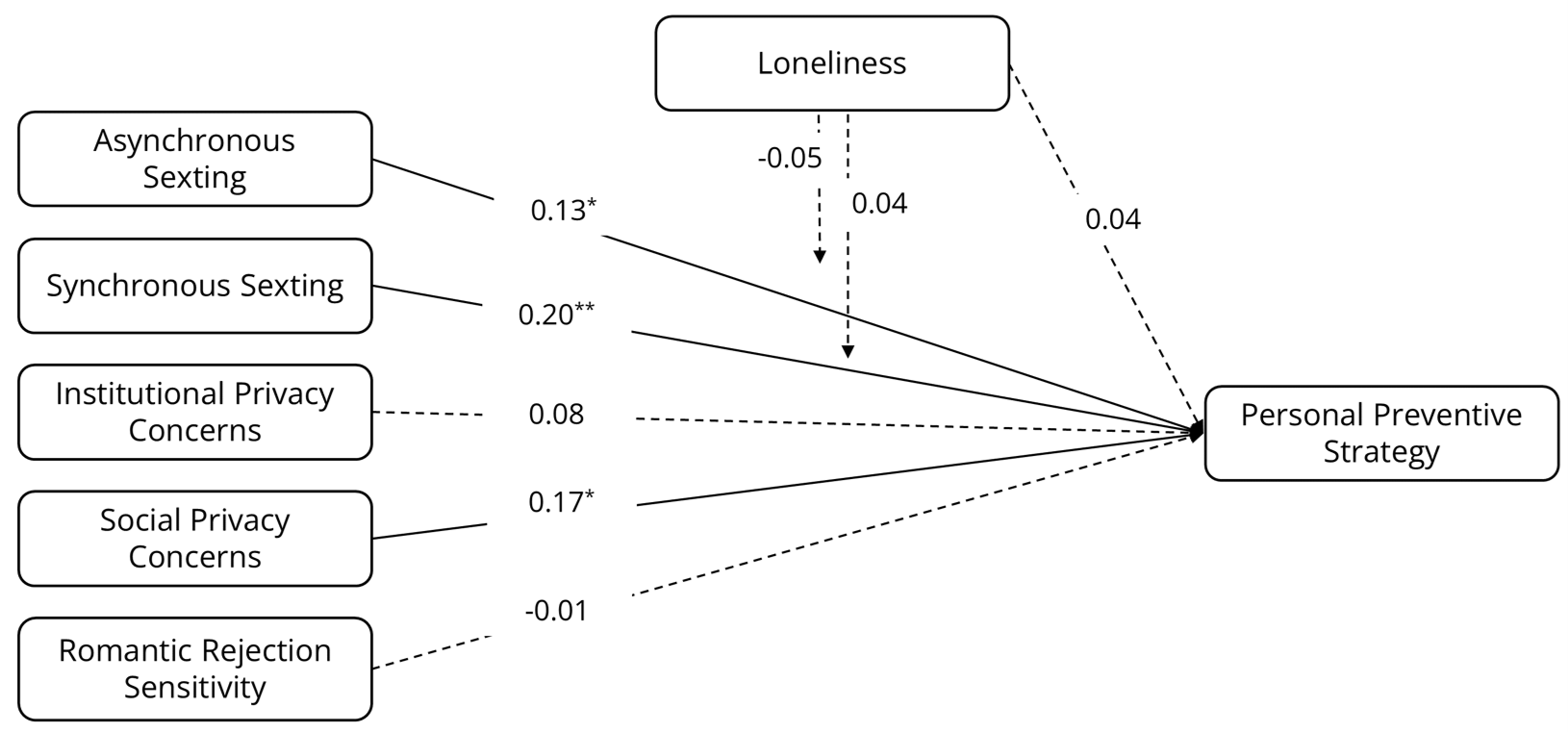
Note. *p < .05, **p < .01.
Personal Reactive Privacy Strategy
Associations with personal reactive privacy behaviors are visualized in Figure A3. The model was significant, adj. R2 = 0.17, F(13,543) = 9.85, p < .001. To account for heteroscedasticity, BP(13) = 30.54, p = .004, we report robust coefficients (cf. Table 2). Personal reactive behaviors were positively predicted by social (b = 0.30, p < .001; H2b) but not by institutional (b = −0.05, p = .519; H1b) privacy concerns. Contrary to our expectation (H3b), romantic rejection sensitivity was positively (instead of negatively) associated with personal reactive behaviors (b = 0.05; p = .010). Asynchronous (b = 0.24, p = .002; H4b) but not synchronous (b = 0.06, p = .378; H5b) sexting frequency predicted personal reactive behaviors. There was no joint effect of loneliness and asynchronous (b = −0.09, p = .092; H6b) or loneliness and synchronous (b = 0.10, p = .055; H7b) sexting frequency on predicted personal reactive behaviors.
Figure A3. Associations With Personal Reactive Privacy Strategy.
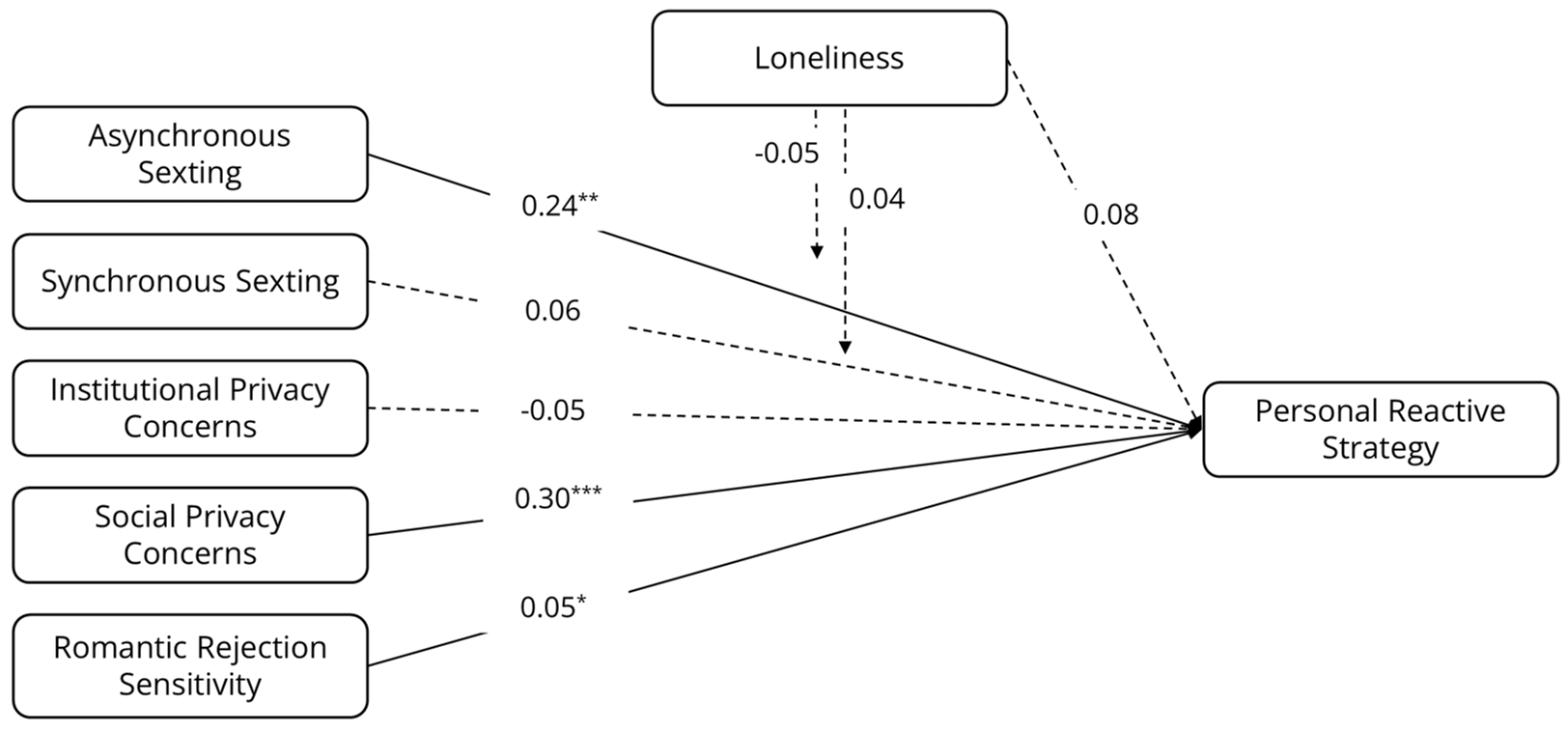
Note. *p < .05, **p < .01, ***p < .001.
Interpersonal Preventive Privacy Strategy
The overall model predicting interpersonal preventive privacy behaviors was significant, adj. R2 = 0.14, F(13,543) = 7.96, p < .001. We report robust coefficients in Table 3 due to heteroskedasticity, BP(13) = 23.97, p = .031). Not institutional (b = 0.12, p = .188; H1c) but social privacy concerns (b = 0.19, p = .047; H2c) predicted interpersonal preventive behaviors. Contrary to hypothesis 3c, romantic rejection sensitivity (b = 0.00, p = .804; H3c) had no effect on interpersonal preventive behaviors. Interpersonal preventive behaviors were related to more frequent asynchronous (b = 0.37, p < .001; H4c) but not synchronous sexting (b = 0.10, p = .172; H5c). There was no interaction of loneliness with asynchronous (b = −0.07, p = .169; H6c) or synchronous sexting (b = −0.01, p = .806; H7c). We found a negative main effect of loneliness (b = −0.13, p = .027) indicating that lonelier individuals engaged in less interpersonal preventive behaviors.
Figure A4. Associations With Interpersonal Preventive Privacy Strategy.
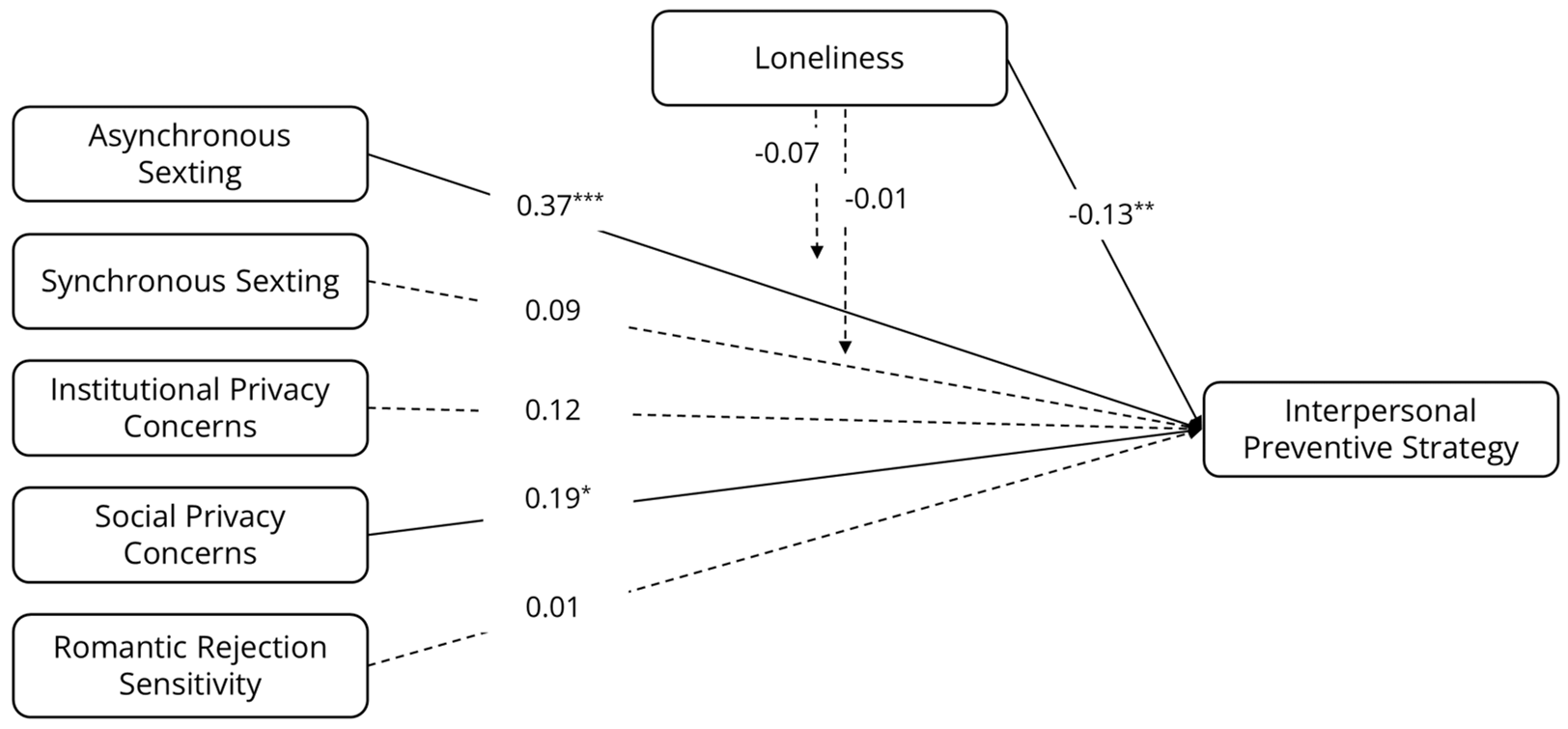
Note. *p < .05, **p < .01, ***p < .001.
Interpersonal Reactive Privacy Strategy
Our predictors explained a high proportion of variance in interpersonal reactive behaviors, adj. R2 = 0.27, F(13,543) = 16.59, p < .001. We report heteroskedasticity-robust coefficients (see Table 3) because the model residuals had unequal variances, BP(13) = 46.77, p < .001. We found no effect of institutional (b = 0.01, p = .857; H1d) but a positive effect of social privacy concerns (b = 0.27, p < .001; H2d) on interpersonal reactive privacy management. Romantic rejection sensitivity was unrelated to interpersonal reactive behaviors (b = 0.02, p = .127; H3d). Regression analysis revealed a significant positive effect of asynchronous (b = 0.13, p = .016; H4d) but not synchronous (b = 0.09, p = .105; H5d) sexting frequency on interpersonal reactive behaviors. The interactions between loneliness and asynchronous (b = 0.07, p = .078; H6d) as well as with synchronous sexting frequency were non-significant (b = 0.05, p = .193; H7d).
Figure A5. Associations With Interpersonal Reactive Privacy Strategy.
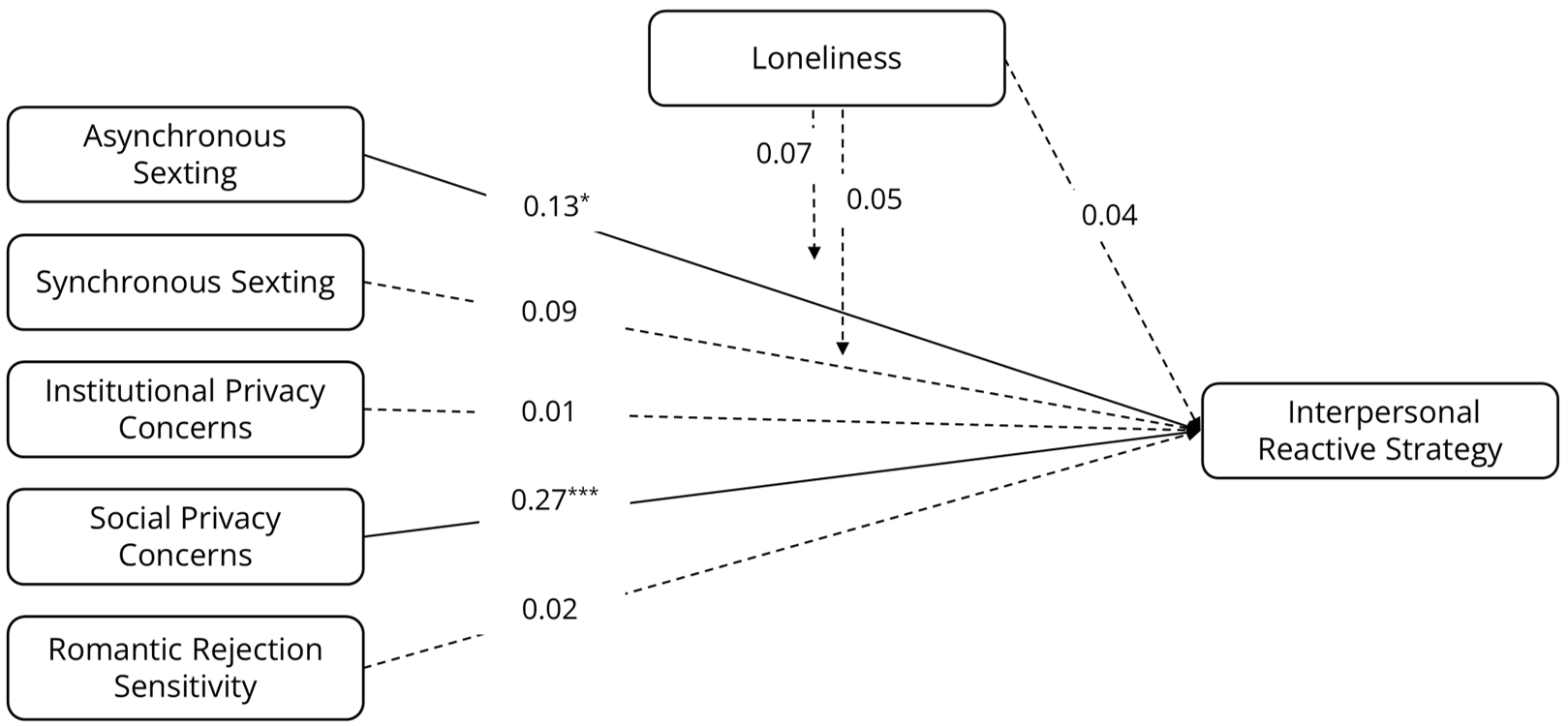
Note. *p < .05, ***p < .001.
References
Downey, G., & Feldman, S. (1996). Implications of rejection sensitivity for intimate relationships. Journal of Personality and Social Psychology, 70(6), 1327–1343. https://doi.org/10.1037//0022-3514.70.6.1327
Döring. N., & Bortz J. (1993). Psychometrische einsamkeitsforschung: Deutsche neukonstruktion der UCLA loneliness scale. [Psychometric research on loneliness: A new German version of the University of California at Los Angeles (UCLA) Loneliness Scale]. Diagnostica 39(3), 224–239.
Lutz, C., & Ranzini, G. (2017). Where dating meets data: Investigating social and institutional privacy concerns on Tinder. Social Media + Society, 3(1), 1–12. https://doi.org/10.1177/2056305117697735
Mori, C., Cooke, J. E., Temple, J. R., Ly, A., Lu, Y., Anderson, N., Rash, C., & Madigan, S. (2020). The prevalence of sexting behaviors among emerging adults: A meta-analysis. Archives of Sexual Behavior, 49(4), 1103–1119. https://doi.org/10.1007/s10508-020-01656-4
Park, H. S., Dailey, R., & Lemus, D. (2002). The use of exploratory factor analysis and principal components analysis in communication research. Human Communication Research, 28(4), 562–577. https://doi.org/10.1111/j.1468-2958.2002.tb00824.x
Revelle, W. (2022). psych: Procedures for personality and psychological research (Version 2.2.9) [Computer software]. https://CRAN.R-project.org/package=psych
Russell, D., Peplau, L. A., & Cutrona, C. E. (1980). The revised UCLA Loneliness Scale: Concurrent and discriminant validity evidence. Journal of Personality and Social Psychology, 39(3), 472–480. https://doi.org/10.1037/0022-3514.39.3.472
Stutzman, F., Capra, R., & Thompson, J. (2011). Factors mediating disclosure in social network sites. Computers in Human Behavior, 27(1), 590–598. https://doi.org/10.1016/j.chb.2010.10.017
Thomas, M. F., Binder, A., & Matthes, J. (2022). Love in the time of Corona: Predicting willingness to engage in sexting during the first COVID-19-related lockdown. Archives of Sexual Behavior, 51(1), 157–168. https://doi.org/10.1007/s10508-022-02292-w


This work is licensed under a Creative Commons Attribution-ShareAlike 4.0 International License.
Copyright © 2026 Marina F. Thomas, Alice Binder, Jörg Matthes