
Decisions and Reviews Statistics for 2025
Before you start reading, please note, that while all submissions from 2025 passed the internal evaluation phase (i.e., the part where an editor decided to desk reject the manuscript or send it to external reviewers), some manuscripts are still in the review process (being revised by the authors, waiting for reviews to come), hence not all statistics for 2025 submissions are final.
Submission and Decision Statistics: 2025
In 2025, we received 780 submissions, i.e., a 55% increase from the previous year. After submission, the assigned editor decides whether the manuscript meets our journal’s basic quality standards and whether it will be sent to external reviewers or directly rejected. The desk reject rate in 2025 increased to 87% (see Figure 1), and we have sent 100 submissions to external reviewers, which represents 8% increase over 2024. In the first half of 2026, before the current summer break, we have received 507 submissions, with desk reject rate even higher – 91%. These figures illustrate the trend the editors see in the submissions: we do receive more submissions in absolute numbers, but relatively less submissions have high enough quality to be sent to external reviewers. For interested readers, we recommend these sources, which show this trend is not unique to our journal:
- Spitzer, M. W. H. (2026). The emerging submission crisis in behavioral science. Trends in Neuroscience and Education, 100276. https://doi.org/10.1016/j.tine.2026.100276
- Gartenberg, C., Hasan, S., Murray, A., & Pierce, L. (2026). More versus better: Artificial intelligence, incentives, and the emerging crisis in peer review. Organization Science, 37(3), 795-812. https://doi.org/10.1287/orsc.2026.ed.v37.n3
In summer 2025, we also started to track the number of submissions that are rejected due to problems with hallucinated references, pointing to generative AI misuse. In 2025, this was 9% of submissions. This trend seems to be similar in 2026, where it was (so far) 7% of submissions.
Figure 1. Submissions and Initial Decisions in 2021-2025.
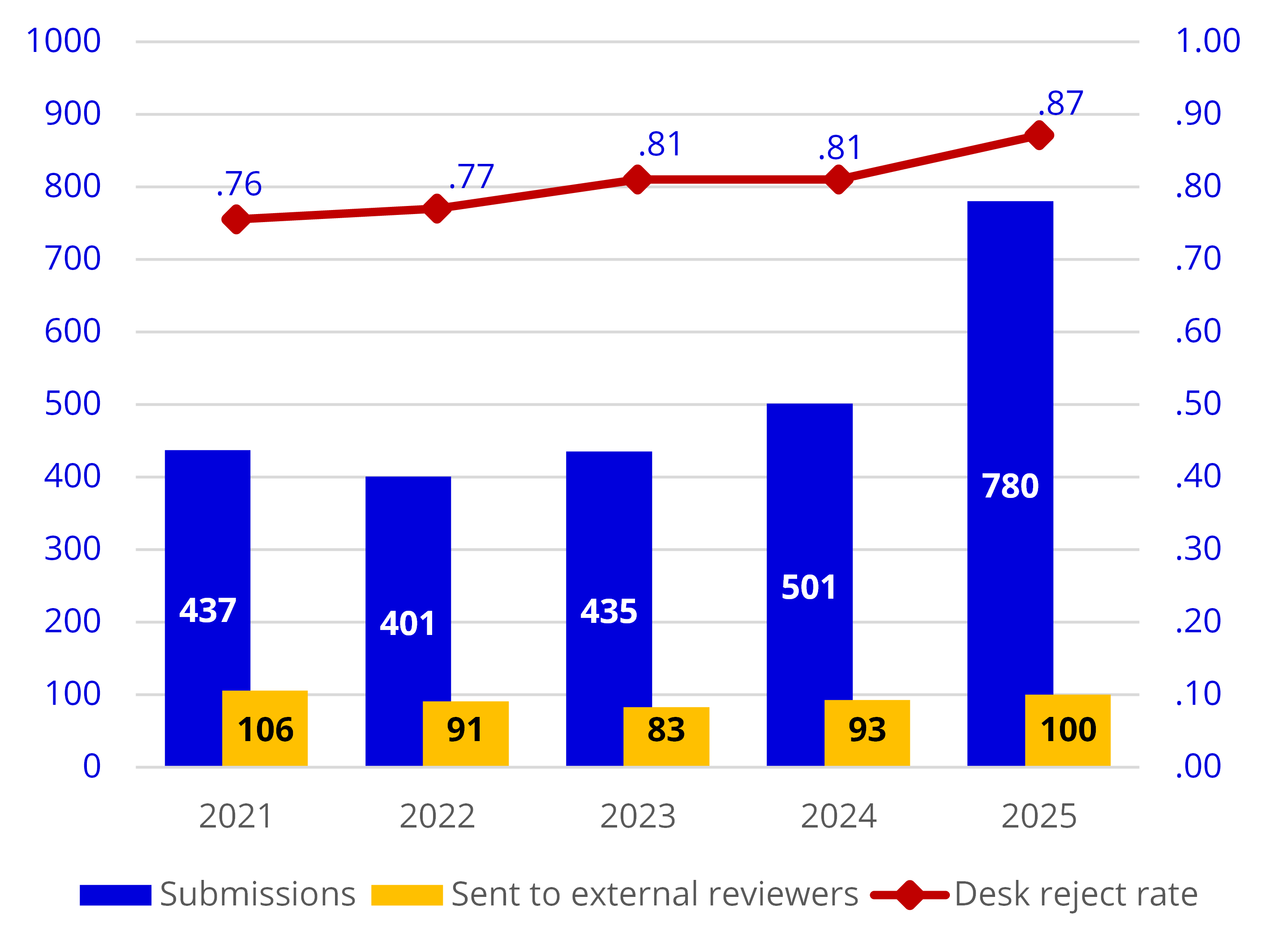
One quarter of the 100 (n = 26) submissions sent to external reviewers in 2025 are still being reviewed or revised, pending a final decision. To gain a more informative overview of how manuscripts typically go through the review process in our journal, we thus look at the last five years (2021-2025) combined.
Figure 2. Decisions for Articles Submitted in 2021-2025 in Each Review Round.
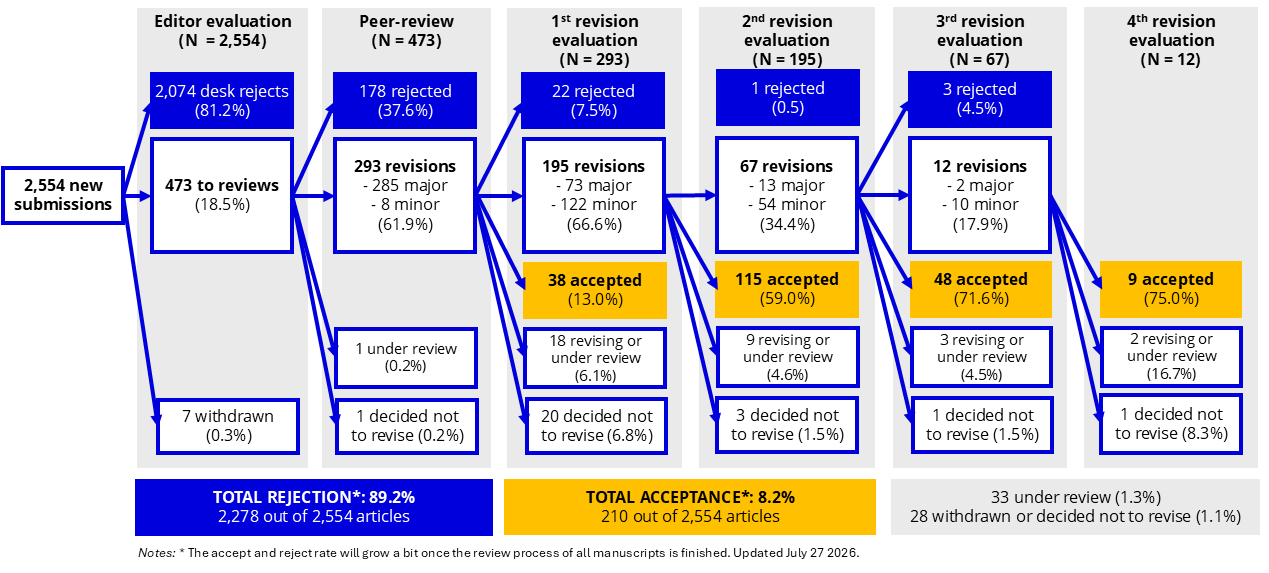
Figure 2 depicts the decision flow for the submitted articles. A few aspects to notice:
- most rejections happen in the initial phase based on the assigned editor’s evaluation
- about 43% of manuscripts that go to external reviewers are rejected, most often when we receive the first reviews. The manuscripts rejected after revisions are mostly those where review process reveals some crucial methodological shortcomings that were not apparent in initial submissions.
- the majority of published articles go through several rounds of revisions
- around 9% of submissions are eventually accepted. You may notice that the figure says 8.2%, but we have 33 manuscripts still in later phases of the review process, most of which will likely be accepted in due time.
Decision Length
We focus on how long it takes to reach two key milestones.
The first one reflects the time from submission to the initial decision, i.e., to receiving a desk reject decision or deciding to send the manuscript to reviewers. On average, the initial evaluation in 2025 took 13 days (Me = 10), with 53% of decisions being made within ten days since submission. These indicators show we were slower than in 2024, where the average was 11 days (Me = 7) and 70% of articles were decided within 10 days since submission. This trend continues in 2026, with almost the same results as in 2025 (for the submissions made in the first half of 2026). This reflects the increased workload due to a higher number of submissions with lower quality that our editors need to handle. To expand our editorial expertise and maintain the sustainable workload, we welcomed two new editors in 2026 – Douglas A. Parry (Vrije Universiteit Amsterdam) started in January, and Kevin Koban (University of Vienna) in April. We also issued a summer break – pause in new submissions during summer to help maintain the number of submissions to a manageable amount. Before opening the submission system again, we also plan to update our aims and scope, and requirements for initial submissions.
The second milestone concerns only the submissions sent to reviewers and captures the time from submission to receiving the decision with reviews. As such, it usually covers the most demanding period in the review process, where we need to contact and secure a sufficient amount of quality reviews. From the 2025 submissions, 100 were sent to reviewers, and 99 of those received the first decision with reviews. For these manuscripts, this process took on average 139 days (Me = 117). In this phase, we were faster than in 2024 (M = 175, Me = 153).
Please note we chose not to present the decision length from submission to the final reject/accept decision because this period is influenced by the number of review rounds, making it less informative.
Reviewer Statistics
To make a decision, we require at least two quality reviews per article. As mentioned above, this process is quite time-consuming. Hopefully, the following statistics will illuminate some of the reasons for the length of the review process.
In 2025, we had to send (so far) 2,113 requests for reviews in the first review round. This translates into 21 review requests per article, which was lower than in 2024, where we ended up with, on average, 27 requests per article. Despite sending more submissions to external reviewers (2024: 93, 2025: 100), we thus needed to contact less reviewers overall (see Figure 3).
Figure 3. The Total and Average Number of Review Requests for Articles.
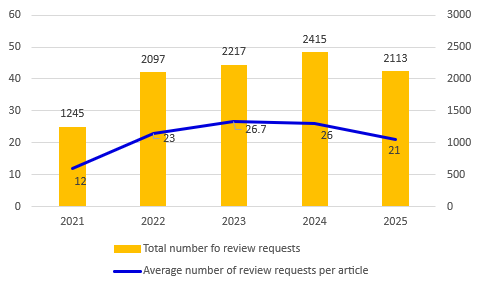
Upon receiving our invitation, the reviewers have the option to accept it or decline it. Out of the 2,113 review requests in 2025, more than half (58%) of reviewers ignored the request and did not respond in any way. Another 29% declined the invitation, totaling 86% of review requests that are without a positive response.
We also encounter reviewers who accept the invitation but never deliver a review. In 2025, this was 14% of those who accepted the invitation. In addition to the reviews that are never delivered, some reviews that we receive are of poor quality and are not sent to the authors. In 2025, the editors rated about 5% of received reviews as having poor quality (1 or 2 points out of 5 points maximum for internal review evaluation). This number is lower than in 2024 (13%), and we also had a higher number of reviews rated with five points (2024: 47%, 2025: 53%), so hopefully, this positive trend will continue.
Concluding Remarks
In 2025 (and continuing in 2026) we saw increases in the number of submissions, but unfortunately, these increases do not translate into receiving more quality submissions. Consequently, our desk reject rates increased, and so did the time needed to make initial decisions due to a higher workload. We responded to this new reality of submissions by issuing a summer break, inviting new editors and by (plans to) adjusting our scope and requirements for new submissions.
Our goal is always to ensure a quality review process and publish robust research that enriches our field. We are grateful to all who help us in achieving this goal. We would thus like to thank the reviewers and editors who contribute their time and expertise to assess manuscripts and offer valuable feedback, as well as the authors for trusting us with their work and working thoroughly on improving it during the review process.
Lenka Dedkova, Marie Jaron Bedrosova, Barbora Lisztwan Honusová
See the report for the previous years: